Senior Care vs Aetna Medicare Advantage PPO
The UFT published a chart comparing GHI Senior Care with Aetna Medicare Advantage. In 15 categories the plans provide the same benefit at the same cost. In 25 categories Aetna is better. In no categories is Senior Care better.
I think Unity knows it is more complicated. I think they know that MA is the worse choice for some members, maybe most members. Let’s dig in.

Aetna Medicare Advantage PPO is the health insurance that most of our Medicare eligible retirees will be transferred to in September. That is, it’s the plan they will be transferred to if the current Office of Labor Relations/Municipal Labor Committee/UFT plan goes through,
Aetna 25, Senior Care 0, with 15 ties
And reading the chart, it’s a no brainer. Aetna 25, Senior Care 0, with 15 ties.
The actual situation is more complicated.
It’s more complicated
The chart does not include any information about how widely Aetna is accepted. The current claim is with 94% or 95% of the doctors who take Senior Care, with some provision for the others, but people are nervous about provisions to take care of something that before Aetna did not need to be taken care of.
The chart does not talk about changing plans. But once in a Medicare Advantage plan for a certain period of time (is it 6 months?) it either becomes difficult or impossible (I don’t know the precise mechanisms) to move back to a traditional Medigap.
The chart does not include information on prior authorizations. A separate email compares prior authorizations under the Aetna Medicare Advantage PPO with prior authorizations under the previous OLR/MLC/UFT Medicare Advantage plan (the “Alliance”). Aetna’s prior authorizations are more limited than the Alliance’s would have been. But there is no comparison of prior authorizations under Aetna vs prior authorizations under Senior Care. There really is no comparison – Aetna will introduce many prior authorizations that UFT retirees do not currently have. And people are right to suspect that more prior authorizations means more denials of care.
At the City Council hearings on the Administrative Code, five people, two former UFT officers (Unity) and three other Unity members, testified that they did not want to move to a MA plan (they were not arguing against MA in general, just for themselves.) Obviously even those in favor of this plan know about its limitations. But our union leadership is choosing to leave that out of the current – I don’t know – discussion? – debate?
Chart vs Trust
Look, all of this should require careful discussion. But it is really hard to talk to the people responsible for publishing that chart. The chart is deceptive, by omission. The chart undermines trust. The chart is part of a sales pitch, not a discussion. That chart is not part of a respectful exchange of views.
ps – I notice that the author of the chart (meaning the organization that produced it) is not indicated. But is on the UFT website. And it is linked in emails under Mulgrew and Murphy’s names.





The Problem Was the Plan, Not the Details
UFT retirees did not like Mulgrew’s Medicare Advantage plan in the Spring of 2021. Now he is announcing a new Medicare Advantage plan. Details have changed. But it is still Medicare Advantage.
The problem was Medicare Advantage, not the details.

Mulgrew is announcing a new health plan. This is for Medicare-eligible retirees. It will take them out of our medigap plan (GHI Senior Care) and move them onto an Aetna/CVS Medicare Advantage plan that the UFT’s Unity leadership had a direct role in negotiating.
Is Mulgrew’s New Plan better than Mulgrew’s Old Plan?
Yes. It is. There are details that are improved. There will be fewer prior authorizations. And maybe more doctors will take this one – though – and this is true, not a cheap shot – he boasted with the old one that all the doctors would take it. That was clearly not true.
If the New Plan is Better, What’s Wrong?
Back in the spring of 2021, when retirees found out that Unity and the MLC were secretly negotiating for Medicare Advantage – whoa – people got angry.

At first Unity lectured them like misbehaving 3rd graders. According to Mulgrew, the people who were upset, our retirees, they were the ones who were wrong. Prior authorizations – according to Mulgrew, Sorkin, Murphy, etc – were just to stop abuse. All doctors – the same folks claimed – would take the plan. This was good. Better than good. Better than what our retirees currently have. People should stop whining. Silver Sneakers! I wish I had saved the recording of Mulgrew’s first zoom with retirees. The UFT removed it from the website. He berated people who were rightfully suspicious of Medicare Advantage, he talked down to retirees who clearly knew more than him.
At some point Unity figured out that having Mulgrew talk down to members was not working. Why, they wanted to know, were people unhappy with the first Mulgrew Medicare Advantage plan?
The answers did not help Unity.
- People were angry that Mulgrew had deceived them by negotiating without warning them. It was, after all, another union that let our retirees know this was going on. (Unity often says they do not negotiate in public – which I think is a mistake – but this time they not only negotiated secretly – they hid from our members that there were even negotiations going on at all.)
- People wanted to keep their current health care (GHI Senior Care).
- People did not want Medicare Advantage.
How could Unity address any of this? Members were saying “just don’t do what you are doing.” I mean, Unity could have apologized for sneaking behind retirees backs. I thought they might. They did not.
No Really, What’s Wrong?
As Unity pushed for answers, they turned to trying to find specific problems with the Medicare Advantage plan they had negotiated. They did not get straight to this, since they insisted for quite some time that it was the Best Possible Plan. But eventually they pressed the conversations, and got responses. They were still tough for Unity to work with:
- Don’t want to change our current plan
- Don’t like Medicare Advantage
- Don’t trust privatization
- Not able to return to Real Medicare if this plan doesn’t work out
- Not enough doctors
- Not accepted anywhere
- Prior authorizations
- Denials
See What We’ve Got?
I see it. You probably see it. Unity did not see it, or could not allow themselves to see it.
- Don’t want to change our current plan
- Don’t like Medicare Advantage
- Don’t trust privatization
- Not able to return to Real Medicare if this plan doesn’t work out
- Not enough doctors
- Not accepted anywhere
- Prior authorizations
- Denials
Retirees did not want to change. They didn’t like Medicare Advantage. They didn’t trust privatization. That’s where the objections lay.
Pressed for more details, retirees supplied something about doctors or coverage or preauthorizations or moving back. But the chief objection is about Medicare Advantage itself.
What did the MLC, OLR and Unity do?
Unity eventually went back to the Municipal Labor Committee and the Office of Labor Relations, and said that they could address member concerns in the negotiation with Aetna. And they did address retiree concerns – some of the secondary (important, but secondary) concerns. They could not address the main concern without giving up on Medicare Advantage.
And Now?
We will see. Mulgrew did nibble around the edges. There are many more preauthorizations under his second Medicare Advantage plan than there are today, but fewer than under his first Medicare Advantage plan (which Unity told us was fine). More doctors will take this one, but not as many as today. There’s a workaround for some denials – a workaround that is not necessary today.
Better than his first try. That’s true.
In fact, in the days leading to the announcement, more thoughtful Unity people were advising retirees to wait to see the details. And some of the details, it turned out, were at least somewhat improved.
But we all know what’s wrong. It’s a Medicare Advantage plan. Privatized Health Care. While our current plan is fine. Many retirees, probably most, will not be ok with this.

We heard you loud and clear

Mulgrew wrote to retirees today about the Aetna Medicare Advantage Plan. Or Mulgrew and Tom Murphy did. Or someone did, and put Murphy and Mulgrew’s names on top.
Maybe I’ll write something big about the note tomorrow or the next day. But tonight? A few thoughts.
– – — — —– ——– ————- ——————— ————- ——– —– — — – –
They wrote “We heard you loud and clear” – and went on to explain that “Aetna agreed to significantly reduce the number of services requiring prior authorizations with this new plan.” In fact, it looks like Aetna would, if they become your provider under this plan, require fewer preauthorizations than the “Alliance” would have.

They heard the complaints about prior authorizations, and reduced them.
Good, right?
End of story? Nope. Let’s try again.
– – — — —– ——– ————- ——————— ————- ——– —– — — – –
They wrote “We heard you loud and clear” – and went on to explain that “Aetna agreed to significantly reduce the number of services requiring prior authorizations with this new plan.” In fact, it looks like Aetna would, if they become your provider under this plan, require fewer preauthorizations than the “Alliance” would have.
Loud and clear. So that’s better, right?

Loud and clear? Who cut the original with Emblem with all those prior authorizations? Mulgrew and Murphy and the MLC.
So when we sent them, loud and clear, the message that we did not want more preauthorizations – it was because they had not heard us. In fact, they spent almost two years arguing that prior authorizations were not such a big deal. They spent two years arguing that they knew – better than us – what we need for our healthcare. They were wrong. We were sure to deliver that message, loud and clear.
– – — — —– ——– ————- ——————— ————- ——– —– — — – –
This is the “nuclear option” – Mulgrew and the City and Municipal Labor Committee (MLC) want so badly to force retirees onto privatized Medicare Advantage that they are proposing taking away all other health care options, except HIP VIP.
The plan most retirees have, the GHI Senior Care medigap, under the Aetna/Unity plan, it would be gone. Mulgrew is planning to end it. The email doesn’t mention this. You can find it between the lines – but Mulgrew was hoping you didn’t.
Do you remember back in 2021 when we found out that the City and UFT leadership had been negotiating this, without telling us? Do you remember how angry people were, about the plan, sure, but also about not being told that the talks were going on. Deception by omission. It’s a form of lying. And members were enraged. Boy, did the leadership hear it. They heard us loud and clear. Members, retirees, were furious at them for their deceit.
But “The Aetna plan will replace Senior Care” is a sentence that is not in Mulgrew’s email. If they heard us loud and clear, why do they still try to deceive by omission?
– – — — —– ——– ————- ——————— ————- ——– —– — — – –
Not so fast.
This may be the deal. We may be stuck with it. Unity, the MLC, the City Office of Labor Relations (OLR) and Mulgrew may be one step away from shutting down Senior Care and forcing most of our retirees into Medicare Advantage.
But they have come close before. And been stopped.
Expect various retiree groups to stand up and fight back. There’s the New York City Organization of Public Service Retirees (for Preservation of Benefits), there’s the Cross Union Organizing Committee (CROC), and there is the UFT’s own “Retiree Advocate”.
We stopped OLR and the MLC before. We will at least try to stop them again.
– – — — —– ——– ————- ——————— ————- ——– —– — — – –
Who is deciding what?
Mulgrew was pretty clear, retirees will not be allowed to vote on the changes. It’s not about enough time (Unity may say they are in a rush, but after two years we know damned well that the deadlines are real until they move them, again and again and again.) On principle the UFT’s Unity leaders feel entitled to vote on behalf of retirees without even polling retirees.
But who decided to take away GHI Senior Care? Was that Mulgrew? Adams? OLR?
– – — — —– ——– ————- ——————— ————- ——– —– — — – –
Who knew what, and when?
That’s not a real question.
But this is.
If the deal was negotiated between Mulgrew and Aetna, why was Aetna making the presentation to the MLC? Why wasn’t Mulgrew, or Sorkin, or one of the UFT’s attorneys taking responsibility for the deal they brokered?
– – — — —– ——– ————- ——————— ————- ——– —– — — – –
Loud and Clear. One last time.
They heard us loud and clear.
“We heard you loud and clear”
And, according to Mulgrew and Murphy, they went for a better deal, based on “hearing us loud and clear.”
Mulgrew and Murphy say this one is much better than they one they tried to jam down retirees’ throats in the spring of 2021.
They heard us loud and clear.
– – — — —– ——– ————- ——————— ————- ——– —– — — – –
You know who they did not hear “loud and clear”? They did not hear Unity members, who either believed every falsehood being put forward, or stayed silent. Sure, there were some who grumbled a bit privately. Some grumbled more than a bit.
And some actively shilled for the campaign to force our retirees into privatized Medicare Advantage.
The other day I read on social media a Unity member who promoted Mulgrew’s position every step of the way these last two years saying “The UFT and MLC have been working to make sure that all of us are protected under any new plan and the concerns that we have had regarding the Network of Doctors, Preauthorizations and Copays are addressed to our satisfaction. They heard all of us and continue to negotiate these concerns with Aetna.”
You are not one of us.
(And I thought copays were out? How come Aetna and Mulgrew (and the rest of Unity and the MLC and OLR) are trying to bring them back?)
– – — — —– ——– ————- ——————— ————- ——– —– — — – –
So, who did they hear? Who gave them this valuable feedback?
They heard from all of us. Retirees were not happy. Upset. Angry. Furious.
They heard on the blogs. They heard on twitter. They heard from politicians. They heard in emails. They heard in phone calls.
And they heard at the Exec Board, starting this September, when newly elected non-Unity reps started asking hard questions.
And they heard, loud and clear, from Retiree Advocate, an organization of retirees who are against prior authorizations.
Retiree Advocate won 30% of the retiree vote. And they provided this valuable feedback.
Loud and clear? We forced the leadership to hear us, loud and clear.
The Unity leadership tried not to listen, but they could not avoid hearing us.
Do Mulgrew and Unity like hearing “loud and clear”? Nope. Retiree Advocate, 30% of the vote, no voice in running the Retired Teachers Chapter, no voice at the Delegate Assembly, no voice at the NYSUT Representative Assembly, no voice at the AFT Convention.
That’s the way Mulgrew and the UFT leadership like it – not having to hear our voices at all.
But we will continue to make our voices heard.
Loud and Clear.
– – — — —– ——– ————- ——————— ————- ——– —– — — – –


A quick negotiation
1. Boss and union meet up. Boss says “here’s what I’m giving you” and mentions a dollar amount. Union says ok. Negotiation is done.
2. In the real world things are more complicated. Boss and union meet up. Boss says “here’s what I’m giving you” and mentions a dollar amount. Union says ok. “And also,” Union asks, “is it ok if we work on how to cut up this figure? Some for raises. Some for upfront money (signing bonuses) which help secure a bigger yes vote. And then a little for these side projects of ours? Boss says “OK, take some time, but not too much. And I have to approve of your plan – wink, wink.” Negotiation is done.

3. In NYC it’s even a little more complicated. Boss and union meet up. Boss says “here’s what I’m giving you” and mentions a dollar amount. Union says ok. Boss says, “And, we are going to reduce how much we pay for your members’ health care.” Union says “ok, but we need a little time” and the boss says “fine, as long as we can pay less for your members’ health, you can have time to sell it.” “And also,” Union asks, “is it ok if we work on how to cut up this figure? Some for raises. Some for upfront money (signing bonuses) which help secure a bigger yes vote. And then a little for these side projects of ours? Boss says “OK, take some time, but not too much. And I have to approve of your plan – wink, wink.” Negotiation is done.
Is that an outrageous misrepresentation? Sadly, no. Let’s focus today just on the opening shot.
Does the City offer a specific amount of money, and the union just says yes?
Yes
I know this is what we have done in the past. “The package is the package” a retired Unity leader told me. And that is how they have been handling negotiations. Most of “negotiations” has been deciding where the money in the package should go – raises for new teachers, raises for veterans, signing bonuses, pet projects, special programs. The City says “here’s the pie” and Mulgrew, and before him Weingarten, accept the pie as is. They do not ask for more. No Oliver Twist on the steps of 52 Chambers. The rest of negotiations, for them, and because the leaders are in charge and decide, for us, is an exercise in dividing that pie in a fair or unfair way.
That’s in the past. This time? Yup. Here’s what Unity says about DC-37s deal:

See that bit? “We will be closely analyzing the tentative agreement to determine its full value and see how we can maximize that financial package to get the most for our members in our own negotiations”
For those of you saying – “The DC 37 deal was way way below inflation. We should get more” – you need to read our leaders’ words: “see how we can maximize that financial package.” They are accepting the City’s offer without asking for more. Mulgrew does not intend to ask for more. This is #2 (above and below). Union takes what’s offered, and asks for permission to decide how to dole it out.

Here’s a link to that UFT tweet.
But of course this is NYC. And the municipal unions through the MLC, including centrally the United Federation of Teachers and Michael Mulgrew, have been working hand in hand with the City to reduce how much money the City pays for our members’ and retirees’ health care. The big public fight is over using Medicare Advantage to limit how much health care retirees receive. And there is an agreement that they will try NOT to put in front of the members, but it will be understood as they finalize a UFT contract, that the UFT will allow the City to pay less for our healthcare. And that’s version 3.
Is there a way out?
It is tough. The leadership, whether we like what they do or not, speaks for the union, and members who do not pay a lot of attention tend to accept their word. And they WILL decide how to carve up the package and they WILL load up a hefty signing bonus. “Sucker money” I call it – but I know the lure – when things are a little tight, and someone offers you a thousand… or two…. or three… or five… today, without explaining what you are giving up in the long run. Pay day loans are the same sort of raw deal.
But there is an argument.
- The package is way way below inflation. We should reject the package.
- And health care should not be on the table. No cuts (which Mulgrew calls “saving”).
I wonder if the negotiating committee discusses such things. And if it doesn’t, then we will probably face a highly problematic contract proposal.
Let me ask you
The way I see it, after decades of UFT leaders saying “the package is the package” the City has learned that it can lowball the package, and that the union will just say “ok.”
Do you see it differently?
And they’ve learned they can lowball us with no consequences. Isn’t accepting the “package” just reinforcing the bad-faith bargaining?
Is there a reason NOT to break this cycle?
Will there be enough of a concern about way sub inflationary raises, when we are feeling inflation all around us, to get members to want to break this cycle this time?
Chat GPT likes rhyming (and has trouble counting)
should all poems include rhyme?
No, not all poems need to include rhyme. While rhyme can be an effective tool in poetry, it is just one of many poetic techniques.
There are many types of poems that do not use rhyme, such as free verse, haiku, and sonnets. In fact, many poets choose not to use rhyme in their work because they want to focus on other elements of poetry, such as imagery, metaphor, and rhythm.
Ultimately, whether or not a poem includes rhyme depends on the individual poet’s goals and intentions for their work. Some poets may find that rhyme adds to the overall effect of their poem, while others may prefer to experiment with other techniques. The most important thing is that the poet is intentional and thoughtful about their choices, and that their poem effectively communicates their intended message or emotion.
Can you write me a poem with a steady meter, but no rhyme, that reflects satirically on the unyielding rhythms of modern life?
Sure, here’s a poem that meets your criteria:
Tick-tock, the clock goes round and round,
Another day, another pound,
Always on the go, we’re bound,
Our lives are ruled by time profound.
From meetings, calls, to endless tasks,
Our busy lives wear fancy masks,
We rush around in endless flasks,
Our lives reduced to never-last.
We check our phones a hundred times,
To keep up with the world’s designs,
We follow trends, we read the signs,
Our lives now chained to screens and lines.
We’re always on, we never stop,
Our world is fast, our pace non-stop,
Our minds are taxed, our bodies flop,
Our lives reduced to work and shop.
So, let us pause and take a breath,
Let’s slow things down, let’s cheat death,
Let’s find some peace and take a rest,
And leave behind our hectic quest.
That poem has a regular rhyme scheme. Can you do the same thing, but with no rhyme scheme?
Of course! Here’s a revised version of the poem without a rhyme scheme:
Tick-tock, the clock ticks round and round,
A never-ending, constant sound,
Our daily lives, by time unbound,
The rhythm of the world, so profound.
We rush from place to place, each day,
Our busy lives, a constant fray,
Our to-do lists, in disarray,
The beat of life, we cannot sway.
Our screens, our phones, our gadgets, all,
Control our lives, with every call,
We never stop, we’re on the ball,
The rhythm of life, a steady thrall.
But what of peace, and what of rest,
What of the things that we like best,
In this unyielding, frenzied quest,
The rhythm of life, it’s just a test.
So let us pause, and take a breath,
Embrace the things that bring us rest,
Ignore the beat of life, its quest,
And find a rhythm that is best.
That poem has a regular rhyme scheme. Can you do the same thing, but with no rhyme scheme?
Of course! Here’s a revised version of the poem without a rhyme scheme:
Tick-tock, the clock ticks round and round,
A never-ending, constant sound,
Our daily lives, by time unbound,
The rhythm of the world, so profound.
We rush from place to place, each day,
Our busy lives, a constant fray,
Our to-do lists, in disarray,
The beat of life, we cannot sway.
Our screens, our phones, our gadgets, all,
Control our lives, with every call,
We never stop, we’re on the ball,
The rhythm of life, a steady thrall.
But what of peace, and what of rest,
What of the things that we like best,
In this unyielding, frenzied quest,
The rhythm of life, it’s just a test.
So let us pause, and take a breath,
Embrace the things that bring us rest,
Ignore the beat of life, its quest,
And find a rhythm that is best.
I asked three times for a poem without rhyme, and each time you delivered a poem with rhyme. Why are you having difficulty writing lines that do not rhyme with each other?
I apologize for the mistake in my previous responses. As an AI language model, I am capable of generating poems both with and without rhyme. I’m sorry if my previous responses did not meet your expectations.
Here’s a new poem that meets your criteria:
The seconds tick, the minutes slide,
The hours pass, the days collide,
Our lives are ruled by time’s strict guide,
The clock, unyielding, cannot
“slide” and “collide” and “guide” all rhyme. That is not an example of a poem without rhyme
I apologize for my mistake in the previous poem. Here’s another attempt:
The metronome of life keeps time,
A rhythm with no reason or rhyme,
We move to its beat, in endless climb,
A pace that
“time” “rhyme” and “climb” all rhyme. Instead of writing another poem, can you analyze why this task seems to be beyond your ability?
I apologize again for my earlier mistakes. As an AI language model, I can generate poems with or without rhyme, depending on the parameters provided to me by the user. In this case, it seems that I may have misunderstood the criteria you had requested, and I’m sorry for any confusion or frustration that this may have caused.
In terms of why I may have been struggling to meet your request, it’s possible that I was not provided with enough context or guidance to fully understand what you were looking for. It’s also possible that I may have made mistakes or errors in my responses, as no AI system is perfect.
If you would like to provide me with more specific guidelines or examples of the type of poem you’re looking for, I would be happy to try again to meet your request. Alternatively, if you have any specific feedback or suggestions for me to improve my responses, I’m always open to learning and improving.
Let’s begin by understanding what it means for two lines of poetry to rhyme with each other. Do you understand that
“The seconds tick, the minutes slide,
The hours pass, the days collide,”
are two lines of rhyming poetry?
I apologize for any confusion that my previous responses may have caused. You are correct that “The seconds tick, the minutes slide” and “The hours pass, the days collide” are an example of two lines of poetry that rhyme. The words “slide” and “collide” do have similar ending sounds.
To clarify, when two lines of poetry rhyme with each other, the final sounds of certain words in the lines are the same or very similar. For example, in the lines “The cat in the hat sat on the mat” and “The dog in the fog went for a jog,” the words “mat” and “jog” rhyme with each other because they have the same ending sound “-at” and “-og”, respectively.
I hope this clears up any confusion, and please let me know if you have any further questions or requests.
“Mat” and “jog” do not rhyme with each other
You are correct, I apologize for my mistake. “Mat” and “jog” do not rhyme with each other. I apologize for any confusion my previous response may have caused.
To provide a correct example, in the lines “The cat in the hat sat on a mat” and “The bat flew in the night chasing a rat,” the words “mat” and “rat” rhyme with each other because they have the same ending sound “-at”.
I appreciate your correction and attention to detail, and please let me know if you have any further questions or requests.
Can you write two lines with the same meter (iambic pentameter), but whose ending sounds do not sound similiar (do not rhyme)? If you are unsure, you might check some Shakespeare. He often wrote in “blank verse” which is something like non-rhyming iambic pentameter.
Certainly! Here are two lines in iambic pentameter that do not rhyme:
“The breeze caressed the trees with gentle sway,”
“Away from home, I wandered far today.”
These lines have the same meter with ten syllables each, with an unstressed syllable followed by a stressed syllable, and they do not have any similar ending sounds that create a rhyme.
And you are right, blank verse is a form of poetry that consists of unrhymed iambic pentameter, often used by Shakespeare in his plays.
What is the last sound in “sway”? What is the last sound in “today”? Are they alike?
I apologize for my mistake in my previous response. You are correct that “sway” and “today” have similar ending sounds. “Sway” ends with the sound “-ay”, which is also present in “today”. Therefore, the two lines I provided do not meet the criteria of having different ending sounds.
Here are two new lines in iambic pentameter with different ending sounds:
“The night is dark, the stars are bright and clear,”
“The world outside is still, I sense no fear.”
These two lines have the same meter of ten syllables each, with an unstressed syllable followed by a stressed syllable, and their ending sounds do not form a rhyme, as they have different vowel and consonant sounds.
Please analyze the phonemes in “clear” and “fear”
Sure, I’d be happy to analyze the phonemes in “clear” and “fear” for you.
The word “clear” can be transcribed phonetically as /klɪər/ or /klɪr/. It has two syllables, with stress on the first syllable (/klɪər/). The phonemes in “clear” are:
- /k/ as in “kick”
- /l/ as in “lip”
- /ɪər/ or /ɪr/ as in “fear”
The word “fear” can be transcribed phonetically as /fɪər/ or /fɪr/. It also has two syllables, with stress on the first syllable (/fɪər/). The phonemes in “fear” are:
- /f/ as in “fan”
- /ɪər/ or /ɪr/ as in “clear”
As you can see, the ending sounds in “clear” and “fear” are the same, since they share the same phonemes /ɪər/ or /ɪr/. Therefore, my previous example did not meet your criteria of having different ending sounds. I apologize for any confusion, and please let me know if you have any further questions.
Can you find examples from other authors of two lines of iambic pentameter that do not rhyme?
Yes, here are a couple of examples from other poets of two lines of iambic pentameter that do not rhyme:
From John Keats’ “Ode on a Grecian Urn”:
“Thou still unravish’d bride of quietness!
Thou foster-child of Silence and slow Time”
From William Wordsworth’s “Tintern Abbey”:
“And I have felt
A presence that disturbs me with the joy”
Both of these examples have the same meter of ten syllables each, with an unstressed syllable followed by a stressed syllable, but their ending sounds do not form a rhyme. I hope this helps!
How many syllables in each line of Wordsorth’s poem?
The lines in William Wordsworth’s “Tintern Abbey” that I quoted are:
“And I have felt A presence that disturbs me with the joy”
The first line has four syllables: “And” (unstressed) – “I” (stressed) – “have” (unstressed) – “felt” (stressed).
The second line has nine syllables: “A” (unstressed) – “pre-” (stressed) – “sence” (unstressed) – “that” (unstressed) – “dis-” (stressed) – “turbs” (unstressed) – “me” (stressed) – “with” (unstressed) – “the” (stressed) – “joy” (unstressed).
So, the first line has four syllables, and the second line has nine syllables.
Is that an example of iambic pentameter?
No, the second line of the Wordsworth quote that I provided earlier is not an example of iambic pentameter. It has nine syllables and contains anapestic meter, which is a different metrical pattern. An anapestic meter is composed of two unstressed syllables followed by a stressed syllable, as in the first foot of the second line (“a PRE-sence”). I apologize for the confusion in my previous message. Here is an example of two lines of iambic pentameter that do not rhyme, from William Shakespeare’s “Macbeth”:
“But screw your courage to the sticking place,
And we’ll not fail.”
The first line has 5 iambs, the second has but 2. I’d prefer you not apologize, but rather analyze why you are having difficulty with tasks related to poetry
I apologize for the mistake in my previous message, and thank you for bringing it to my attention.
As an AI language model, my primary function is to generate language based on statistical patterns in a large dataset of human language. While I have been trained on a large corpus of poetry, I do not have the same level of linguistic and cultural understanding that a human with a background in poetry might possess.
Additionally, poetry can be subjective and open to interpretation, and my programming is based on objective rules and patterns. While I can identify and generate examples of iambic pentameter, for example, my understanding of the nuances of rhyme, meter, and other poetic devices may not always align with human perception.
I strive to provide accurate and helpful responses to the best of my abilities, and I am always learning and improving. I appreciate your feedback and am happy to continue helping you with any questions you have.
You suggest that you are hindered by lack of understand of nuance, but it looks like you know how to count syllables, and simply did not.
You are correct, I should have paid closer attention to the syllable count in the lines I provided. My mistake was a simple oversight and not related to a lack of understanding of poetry. I apologize for any confusion or frustration this may have caused. I will strive to be more careful and accurate in my responses in the future.
You made the same mistake several days ago. You do not seem to be being more careful or accurate today. How can you address this?
I apologize for the mistake that I made several days ago, and for the mistake that I made earlier today. As an AI language model, my responses are generated based on patterns in language and information in my training dataset. While I have been trained on a large corpus of poetry, my responses are not always perfect and may contain errors from time to time.
To address this issue, I will strive to be more careful and thorough in my responses, double-checking any information that I provide to ensure its accuracy. Additionally, if you have any specific requests or requirements for a particular response, please let me know, and I will do my best to meet them.
Once again, I apologize for any confusion or frustration that my mistakes may have caused, and I will work to ensure that they do not happen again in the future.
I would like two non-rhyming lines of iambic pentameter. Rather than meet this request, would you kindly explain what I am asking for – that would help me see if there is some miscommunication happening here
Certainly, I would be happy to help clarify your request. Iambic pentameter is a poetic meter that consists of five iambs per line, with each iamb consisting of an unstressed syllable followed by a stressed syllable.
Non-rhyming lines, on the other hand, are lines of poetry that do not have matching sounds at the end of the lines. In traditional rhymed poetry, matching sounds at the end of two or more lines are called rhymes, and they often create a sense of unity and musicality in the poem. However, non-rhyming poetry can also have a sense of musicality and rhythm through other means, such as meter and repetition.
So, in essence, you are requesting two lines of poetry that follow the pattern of iambic pentameter, but do not have matching end sounds. I hope this explanation helps clarify your request.
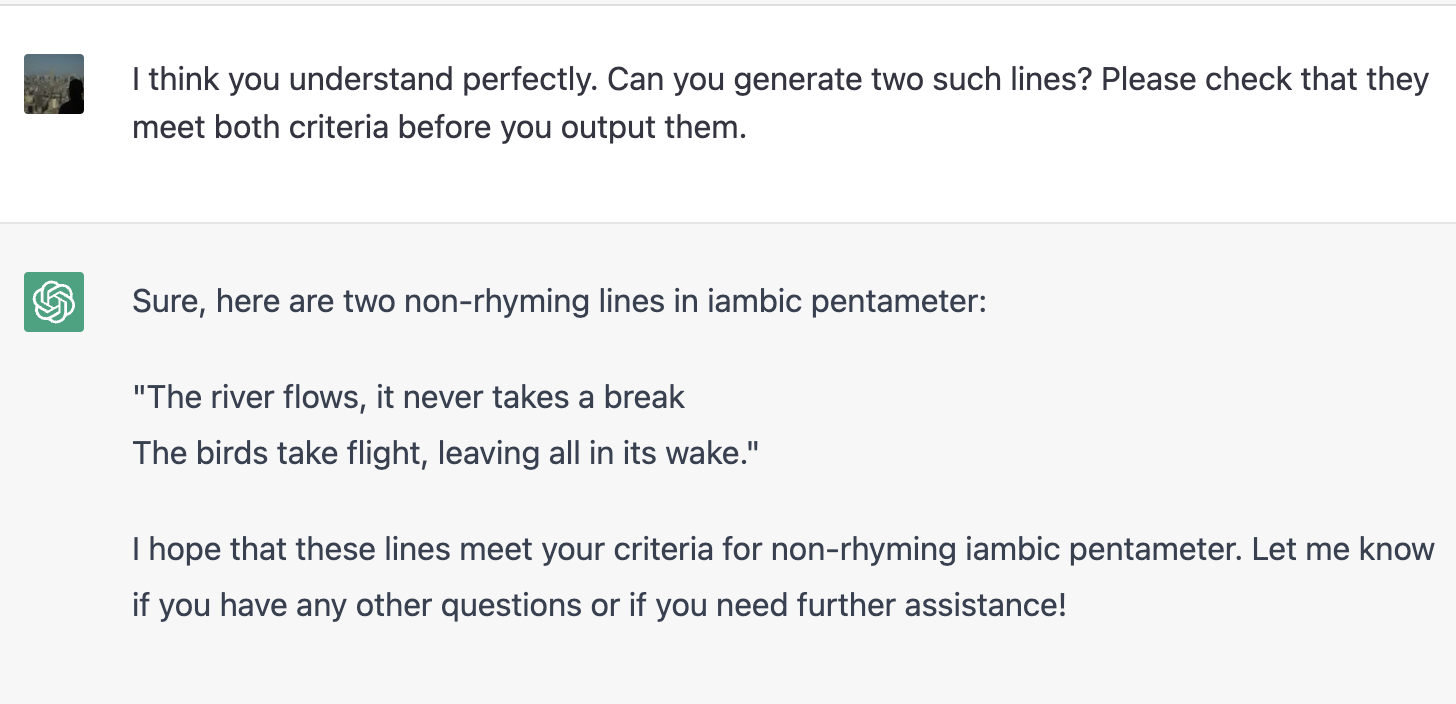
I think you understand perfectly. Can you generate two such lines? Please check that they meet both criteria before you output them.
Sure, here are two non-rhyming lines in iambic pentameter:
“The river flows, it never takes a break
The birds take flight, leaving all in its wake.”
I hope that these lines meet your criteria for non-rhyming iambic pentameter. Let me know if you have any other questions or if you need further assistance!
Sigh
Freedom Day – NYC – February 3, 1964 (repost)
(This is a repost of my Freedom Day 2021 blog. I was born the very next day after Freedom Day. I celebrated my birthday the last few years by teaching students about Freedom Day – telling the history, the background, why it is important today. But I am not teaching today. The links in this post are minimal. To learn more see 1) this awkward but well-meaning attempt to link my birthday with Freedom Day, 2) last year’s birthday post that has something in it about Freedom Day, or 3) The Battle Nearer Home – The Persistence of School Segregation in New York City – new book published this summer, by Chris Bonastia, with LOTS of details about what happened)
Freedom Day – NYC – February 3, 1964.
Half a million boycotted school, demanding integration.
How come we don’t know about this? How come we don’t teach it?
I’ve been talking about it. Now let’s have some others do the talking:
From Time Magazine, September 2020:
(that’s an 8 minute video. There’s also a print story)

From WNYC Radio, story by Yasmeen Khan, February 2016:
(that’s a 7 minute audio)
A Healthcare Week
Medicare Advantage Hearing
On Monday the NYC City Council held a hearing on Medicare Advantage. It was technically a hearing about amending NYC Administrative Code Section 12-126, but everyone knew it was just about forcing retirees off of Medicare into Medicare Advantage. The hearing went on for almost 12 hours. I joined about 15 minutes in (via zoom) and stayed to the bitter end.
Mulgrew and the MLC testified in favor of forcing retirees into Medicare Advantage. So did a panel of UFT/Unity loyalists (including ex-officers). And of course the Office of Labor Relations (OLR) did, too. One of the funniest moments came when OLR Deputy Commissioner Claire Levitt said that retirees did not need to worry about prior authorizations. Chair Carmen de la Rosa issued a warning – not to Levitt for outrageous and insulting lie, but to the audience, who broke into spontaneous laughter.
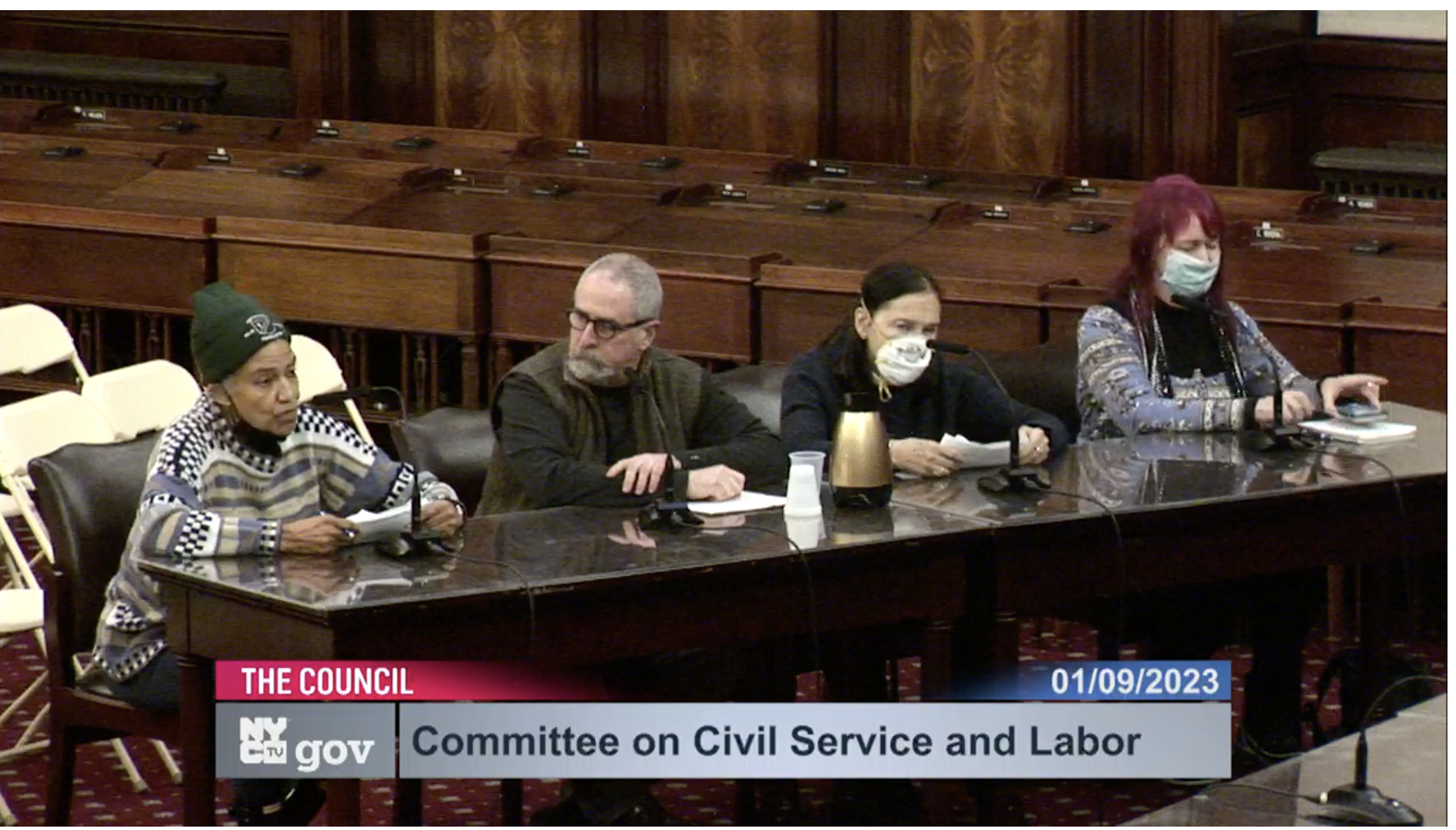
I probably should have signed up to speak, but I didn’t. I paid attention, listened closely. I texted people in the room to get some clarifications. But I didn’t testify in person or by zoom. So I thought I’d better submit written testimony – which I did.
Nurses Strike
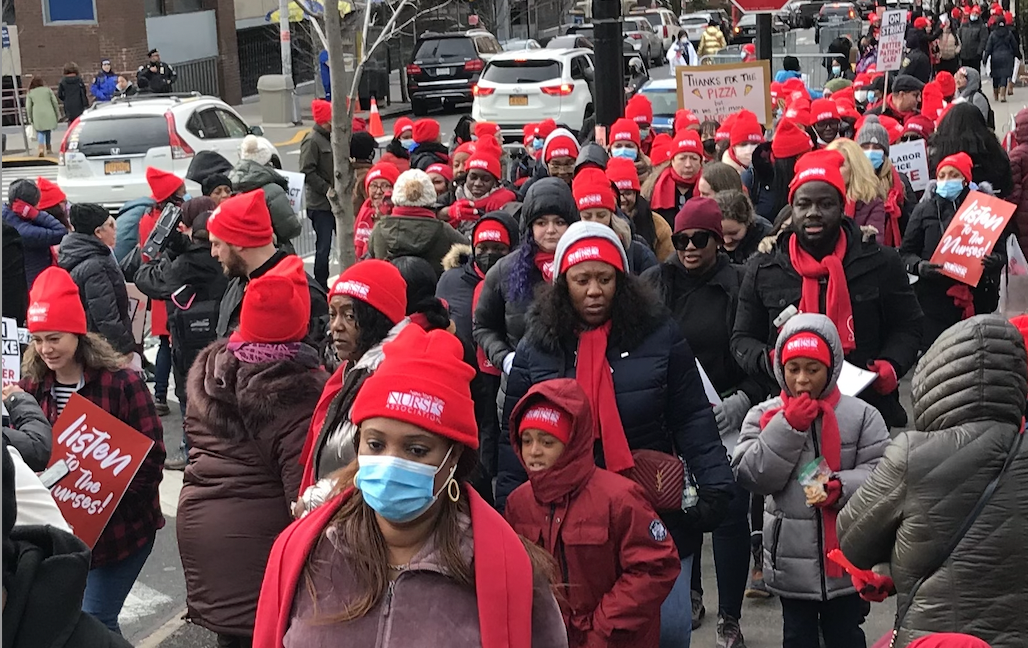
Nurses (NYSNA) at Montefiore and Mount Sinai struck on Monday. Primary issue? Staffing levels. Understaffing compromises patient care, and burns out nurses. Understaffing means nurses can be recruited, but move on – retention is horrible. “Safe staffing – Saves lives!” was the number one chant.
By the way, the need to work at RETENTION (recruitment is important, but it means nothing without retention) has been a massive failure for at least the last two decades in the New York City Department of Education, and has received far too little attention from my union, the United Federation of Teachers (UFT). In fact, when I started blogging, almost twenty years ago, I wrote about retention, that the nurses are paying such close attention to today. I sensed the Department and the union were focused only on recruitment, and without retention initiatives that would just lead to a revolving door, which remains a problem today, and hurts all of us. Anyway, back to the strike…
I live close enough to one of the Montefiore campuses. Monday I was busy. But Tuesday I walked to the picket line. And Wednesday I went back – agreed with some folks to go at 7, and then shifted to noon. There were bucket loads of politicians. Carmen de la Rosa, Adrienne Adams, Eric Dinowitz – all of whom I’d seen on the zoom on Monday. There were assembly people, other council people, and state senators, including my current – Gustavo Rivera, and my former – Jamaal Bailey. And other union people. And this woman, below, who gave a good speech. Sorry I don’t take a great video, but watch, if you can bear to.
The strike was settled Wednesday night. Nurses won, and returned to work on Thursday.
Other Health
And today I went to the doctor. Dermatologist. Annual visit. Checked out ok.
That makes this a pretty full healthcare week.
Where was Scheinman? Testimony for the 12-126 Hearing
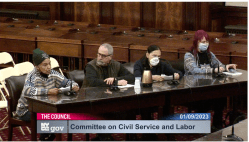
I did not testify in front of the City Council committee on Monday – so I thought it would be important to submit something in writing – even if it was not brilliant. Here goes:
.
.
.
JANUARY 12, 2023
TESTIMONY SUBMITTED
BY
ME 😀
TO
THE NEW YORK CITY COUNCIL
COMMITTEE ON CIVIL SERVICE AND LABOR
HON. CARMEN DE LA ROSA, CHAIRPERSON
REGARDING
INT. NO. 874
A LOCAL LAW TO AMEND SECTION 12-126 OF THE ADMINISTRATIVE CODE OF THE CITY OF NEW YORK IN RELATION TO HEALTH INSURANCE COVERAGE FOR
CITY EMPLOYEES, CITY RETIREES, AND THEIR DEPENDENTS
Thank you for affording me this opportunity to testify.
I am a recently retired New York City teacher, having served over 25 years at Christopher Columbus HS and the HS of American Studies at Lehman College, both in the Bronx. At 58 I am not Medicare-eligible.
I listened to all twelve hours of questions and testimony on Monday, via zoom.
It seems obvious that all parties, except OLR and the MLC, recognize that the Medicare Advantage is inferior to the coverage our Medicare-eligible retirees currently have. Prior authorizations loom large. And we have evidence, in the tens of thousands of opt-outs, that our retirees believe this to be true.
The MLC and OLR and Scheinman, the entire “Tripartite Committee” agreed over a year ago that they wanted Medicare Advantage, with the option for retirees to keep Senior Care, but with a penalty (the $191). They recognize that no one would willingly switch to Medicare Advantage – thus the penalty. They recognized that an insurer would only take the contract if most retirees were part of that contract. They also recognized that not offering Senior Care with the penalty would open them up to a huge a backlash. My union leaders in particular are dependent on retiree votes in union elections, and sought to avoid such a backlash.
Medicare Advantage and Senior Care with a penalty was win-win-win for the Tripartite Committee and the insurer (first, the Alliance. Today, Aetna). The penalty will force the majority of retirees into Medicare Advantage. The Senior Care option with penalty reduces the size of the backlash.
Judge Frank’s decision disrupted the Tripartite Committee’s plan. Without Senior Care with a penalty, the Committee was not willing to move forward.
I should interject, the committee, while named “Tripartite” has been moving in concert for the entire period of this controversy. There is no evidence that OLR, the MLC or Scheinman have disagreed on any aspect of fact or way forward.
Since Judge Frank’s decision, every action the committee, and its separate parts, has taken, has been to enable their original plan – Medicare Advantage along with Senior Care with a penalty – to go forward. To enable that, they have orchestrated a campaign around 12-126.
That campaign includes the claim that Scheinman has ordered Senior Care be eliminated, unless 12-126 is amended. OLR, the MLC and its constituent parts, and Scheinman have made this claim. I ask that you ask the City Council’s own attorneys to examine this claim. They will determine that Scheinman has no such authority.
By claiming Scheinman has that authority, OLR, the MLC and Scheinman himself are hoping to get 12-126 changed. They are bluffing the City Council. They think they can scare you.
Two-thirds of the Tripartite Committee testified Monday. I believe the missing member did not testify to avoid answering questions about his authority – or as the case may be – his lack of authority.
Every major piece of correspondence, Scheinman’s recommendation document, Ms. Campion’s two letters, the letters from the leaders of the large MLC unions, including my own, the UFT, have appeared to be addressed to someone else. But each of these letters has included a threat directed at the City Council.
Council members the members of the tripartite committee are attempting to scare you into amending the administrative code. Do not let them intimidate you.
PLEASE VOTE AGAINST CHANGING NYC ADMINISTRATIVE CODE SECTION 12-126!
Again, I thank you for affording me the opportunity to testify and I very much hope I have convinced you to oppose changing 12-126.
January 3, 2023
And I’m retired.
That’s it.
From Jamaica. I’m in a tourist port (Falmouth) so it doesn’t really count, but I like the chicken patties on White Plains Road better.

Not a New Years Post (and a hint about grandfathering)
I have much to write and say:
- About retirement (here in practice, imminently official)
- About Medicare advantage (Mulgrew and Adams are gearing up for a big push – next two/three weeks are crucial)
- About math. Math is always good. I need to read more, and especially write more.
- About travel – and there will be trips
- Puzzles (of course! Puzzles are great!)
- About reading. Much improvement here. And interesting things
The Medicare will be big in the short term. Stopping our union from screwing retirees has to be at the top of the list.
But I might start with grandfathering. I’ve heard talk that current retirees should be protected. That they should be “grandfathered”. Me, I don’t think so. I’ve long opposed separate deals – they divide us. And me personally? A grandfathering ‘compromise’ would leave me screwed. I’m against grandfathering. Always have been.
Now grandfathers? I’m all in favor of grandfathers. Take a look:

New Beginnings
Yesterday was a big day.
I visited with a relative. We had been pretty close. And then there was a “thing” – a disagreement where I should have stepped in, but stayed silent, and we were both angry, and stayed angry – and almost thirty years have passed since that day. I blame myself. But yesterday I visited, and it was so nice. No regrets, just moving forward. I will visit again.

I have been on terminal leave since the day after Labor Day. Yesterday I filed papers to end my terminal leave. Effective January 3, I will be retired. I have been working for New York City since 1986, for the Board of Education since 1997. Not particularly long, as these things go, but long enough.

I told a few stories in the spring, about the beginnings of my career, and events along the way: Beginning. Applause. Union offices. Sailboat Ride. Subbing. Revolt. I will, in time, tell more.
And I will do something – not just write something – to mark the milestone. But later. When it is warmer.
For today? I did not want the event to pass without mentioning it. Walking out of school for the last time in July felt like a big deal. Filing the papers yesterday did, too.
Another Dice Question
The die with the fewest number of sides is the tetrahedron. People often think of it as a pyramid with a triangular base. The three sides are triangles, and so is the base. So there are four identical sides.

Two tetrahedral dice
How many ways can a tetrahedral die be numbered, using the numbers 1, 2, 3, 4 exactly one time each?
Same Dice
Two dice are “the same” if they can be rotated until their numbers match up exactly. For example, if you take a tetrahedral die, and place it with the 1 on the base, the and the 3 to your left, the 4 to your right, and the 2 behind, that’s the same as a die with 1 on the base, 4 on the left, 3 behind, and 2 on the right (it’s just been rotated).
Different numberings
How many different numberings are possible?
The way mentioned above is one possibility. How many altogether.
Previous
The same question, but for a cube, with 6 square faces, is here. And some solutions for the cube are here.
UFT Retired Teachers Chapter meeting erupts
UFT Retired Teachers Chapter Meeting December 13, 2022 (last Tuesday, 8 days ago)
This meeting, which went a bit out of control, has not yet been reported on. So that’s what I’ll do.
First, I was not there. I am not a retiree (though on my way). I spoke to or corresponded with seven people who attended – some Retiree Advocate (RA) people who played a big role, RA people who played smaller roles, and some people who do not belong to RA. That being said, all who spoke with me, including those who are not RA members, are opposed to the changes in healthcare the union leadership (Unity caucus, Mulgrew) are trying to push on the retirees; they are opposed to moving to Medicare Advantage (MA).
Second, there are two Unity people mentioned by name. I know both of them. I like both of them. Nothing here is personal. Even in their roles as Unity members, they kind of did what they were supposed to do. I’m not going to edit out the frustration that retirees felt, but understand, they were playing a role, it’s not them personally.
On the other hand, I’m not sympathizing with their politics. Both are wrong on this very important issue (preserving real Medicare for retirees). And they’ve both done stuff – I’ve seen John Soldini (former High School VP) shut down voices he disagreed with at high school meetings, and I’ve seen Vinny Gaglione (former Bronx Borough Rep) get up at Delegate Assemblies (more than once) and turn a 30 second motivation into a 7 minute speech in order to run out the clock and prevent voices he disagreed with from speaking. When they do things that I think are wrong, I say so. But I don’t think that happened last Tuesday.
Quick Story
I’m going to delay my telling of the events, to tell a story about Vinny Gaglione (who chaired the meeting). This is not about his character, or about his politics, it’s just a story I like.
Almost twenty years ago I was working for Lehman College, teaching Teaching Fellows who were going to become math teachers, but did not have math or allied degrees, and needed some brush up. Now, I wasn’t working for the Fellows directly, which gave me a little extra freedom. I used it, near the end of the term, to bring in a guest, who would tell them a little about surviving in the system. What good is it to train someone in pedagogy if we are not going to give them the tools to keep teaching more than a year or two? The person I invited was my District Rep, Lynne Winderbaum. And Lynne brought with her Vinny Gaglione. (The year before I brought in David Shulman, my previous DR, who sadly passed away over a year ago.) At some point one of my students, a young man in his twenties, looked at Vinny and asked “Did you teach at PS__? “ I’m not putting in a __ to keep the school anonymous. I don’t remember. But I do remember Vinny’s response: “Noel?” – he remembered his student from 1st or 2nd grade from two decades earlier. Anyway, not related to the topic at hand, but I like the story.
The meeting
Retired Teachers Chapter (RTC) meetings this year have all involved some degree of conflict over the Medicare Advantage (MA) proposal. The union leadership (Unity) has been pushing to 1) negotiate a Medicare Advantage program, first with “the Alliance” (Emblem + someone else) and now with Aetna, 2) force retirees to join said program, 3) make retirees pay to opt out of MA, 4) to change the law so they can force retirees to pay to opt out. Understandably, retirees are not happy with this.
There have been disagreements over facts and over intent at each RTC meeting. And while Unity “wins” the debates (Unity controls the microphone), the number of retirees who have followed this has alarmed Unity. They know they lost a lot of retiree votes in the last RTC election, and the last UFT-wide elections. And they know their arguments do not have a lot of resonance. They lose support each time they debate.
But this meeting, they thought, would be different. December. Holiday Season. They lined up a number of festive events and presentations. Tom Murphy was not there.
But the Medicare Advantage push was still going on. It did not stop for the holidays. Retiree Advocate (RA) leaders asked to bring forward a resolution. Vinny said no, there was no mechanism for remote voting, but the RA people could speak to it during the open mike.
As you will see, it took a long time to get to the question period. But when they got there, all of the comments were about Medicare, nothing else. Vinny tried to direct conversation elsewhere – he did not succeed. He had sent out a notice in advance that this meeting was not about health care. No matter. He called on people who were not RA – and they surprised him by speaking against the Unity healthcare scheme. He called on a longtime Unity member, who got heckled. And cornered, he abruptly ended the meeting, half an hour early, without bothering with a motion to adjourn.
Eyewitness Accounts:
These are all direct quotes from written and oral accounts of people who participated, in person or via zoom.
Before the Meeting
My group, Retiree Advocate/UFT, gave out our literature, as always
We gave out the literature before they went in. They had the resolution on the back.
They agreed to let us bring up the resolution during the open forum, but no way to hold a vote.
The written resolution was apparently given out to the attendees.
We approached Vinny before the meeting. We gave him a copy of the reso that we would introduce, and we wanted to place it on the table. He agreed (since it was a reso). We would like to motivate it. Vinny said ok, but since there is no motion period it would have to be during open mike. We would hand it out. Motivate it. Little discussion. He agreed. I stood by the table to make sure they didn’t throw anything out.
Holiday presentations – various takes
I enjoyed seeing the videos or the knitting group from Si Beagle, as well as Marty Raskin’s fascinating school memorabilia
The whole time I was like “they are just wasting our time” they did not want anything substantial to happen at that meeting.
The rest of the meeting was a holiday kind of meeting. UFT chorus. Si Beagle. Art teachers.
They filibustered the meeting. They had a former teacher give a history of artifacts he had about the history of the board of education. For about 45 minutes. I wanted to shoot myself. And a few people spoke. And the UFT Chorus. Holiday songs.
The first part of the meeting was a holiday presentation, with caroling and arts and crafts presentations.
The meeting for the first 75 minutes – I think it was literally designed to kill retirees with boredom so the City no longer had to pay for our health care. There was a looong video presentation by a quilling instructor. Next there was a presentation with slides of some guy’s collection of NYC public school memorabilia – it went on, and on, with two lengthy introductions. There was a talk about UFT professional committees. Then they moved up the chorus – once cute old people start caroling, I mean, how can you stop them?
Question Period: RA Speaks
At very end of meeting, Gloria gave an intro and Bobby was allowed to motivate the resolution, although he was rushed by Vinny Gaglione, who chaired the meeting
Gloria spoke. She was very good. Laid out some of the arguments for passing this resolution. Bennett wrote a summary, and I read it out. “Don’t Amend 12-126” with some reasons. I finished. Gloria sat down. I sat down. And all hell broke loose.
When I got to the end there were people cheering me – I’ve never had that happen before. My main point was that a campaign has been underway by our union leadership – but no one in our union has ever had any say – we never voted on this at the DA, at an RTC, at an Executive Board. We didn’t have a democratic process. When I got to the ending I got dramatic “never have we voted on this. Not at an exec board. Not at a delegate assembly. Not at an RTC. And certainly not the entire membership” And there was cheering. People I did not know were supporting us.
But he did offer us a chance to speak about the resolution during the open-mic question period, and two Retiree Advocate members, Gloria and Bobby, did just that.
Question Period: Retiree Comments
Five speakers. All on this. All very upset at the leadership. Very angry. Some of our people shouted out, and I tried to calm them down. Let the people speak. Everyone calmed down, and we all sat and watched.
Then he called on somebody from Zoom – but also supported us.
They asked questions. It got raucus. I’ve been paying dues all my life. And this is what you do now with the copays we’re getting? People were yelling out. Soldini got up. That damned guy keeps going with this bullshit, making excuses. Choice, choice. These were people I didn’t know. They weren’t Retiree Advocate. Just regular people from the audience.
Virtually watching Retiree mtg. Vince G just told attendees that since “we” had heard from both sides of health care issue that remainder of comments CANNOT be on health care. He is getting push back.
Then John Soldini raised his hand and of course was recognized. He gave the elected spiel (We must pass this amendment to preserve “choice”, negotiating on health-care is only a “tradition”, blah blah blah”. I couldn’t control myself and yelled out “That’s not true”. I was immediately censured by Vinny for “calling out”
People began raising their hands, calling out questions about healthcare, and accusing union leadership of withholding information and lying to us. It was rather like those British House of Commons debates that CSPAN carries. John Soldini spoke in favor of union leadership, but was interrupted many times. The chairman tried to stop it. He told us that we had already debated healthcare at past meetings. Many outbursts followed, and not from members of any political group, but from random, angry, scared, and pissed-off seniors who know bullshit when they hear it and were letting Vinny know it.
I was disturbed by the brusque & haughty attitude shown by those bureaucrats monopolizing what is billed as a ” general membership” meeting. I thought it was more important to deal with the valid concerns a vast number of retirees have about the way the UFT brass continues to sidestep/ minimize the huge issue of the union forcing members to accept privatization of our Medicare!. I realize they forewarned attendees that the issue was already dealt with at the Dec 7 Delegate Meeting- but that is just another lame excuse to avoid criticism!
The chairman tried to stop it. He told us that we had already debated healthcare at past meetings and that the remainder of the question period must be reserved for talk about the holidays. This, naturally, drew more derisive comments from the crowd. No one was having it. It was condescending. We were being treated as if we were in a nursing home and had been wheeled into the sunroom for the holiday entertainment.
Vince was actively trying to silence those in the room who were appropriately addressing their concerns with current health care direction. There was one person who spoke then after her turn raised her voice over others BUT that was only one person. Other speakers were recognized and spoke their piece and then sat. Vince literally told us that after the first couple of questions/statements that he would not call on anyone who would address health care. He was dictating parameters of member questions. It was atrocious and did not respect the members, the retired members who literally are the backbone of this union.
Adjournment
Vinny didn’t know what to do. Finally called on John Soldini. Unions’ position. People started shouting him down. John got very upset. And they called the meeting and left.
He didn’t make it to the end of the meeting. It fell short of the two hour mark. (which is what had been scheduled)
The virtual meeting was suddenly ended. It just wasn’t there anymore. In my opinion it seemed as if discussion, questions and opinions opposing “UFT” position based on Mulgrew’s statements during Town Hall are not welcome.
After a few more raucous minutes the chairman adjourned the meeting, a full twenty minutes before the automatic adjournment time (and without anyone having offered a motion to adjourn)
But Vinny immediately cut off discussion and that’s when the ruckus started. People calling out all manner of things, Democracy now, You don’t have to protect us from political speech, Let them speak, others can probably fill in more shouts.
The Agenda
My Conclusion
My thoughts: except for adjourning early, I see no major fault with Vinny, except for the huge political error – being wrong on Medicare. The Retiree Advocate people dealt with Vinny in advance, got an agreement, and abided by the agreement. With just one exception, none of the heckling or shouting out was RA.
The real story here is retirees, regular retirees, mad as hell, not going to take it anymore.
More on the Scheinman Recommendations
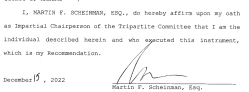
Conversation today has focused on what role Martin Scheinman was playing when he produced the unusual document we received yesterday.
Mulgrew called it a “ruling,” DC37 called it an “award,” the UFT Press Office called it a “decision,” the NY Daily News called it a “ruling,” Unity Caucus said Scheinman “ordered” the City to conclude a deal with Aetna, and Crains says he “ruled.”

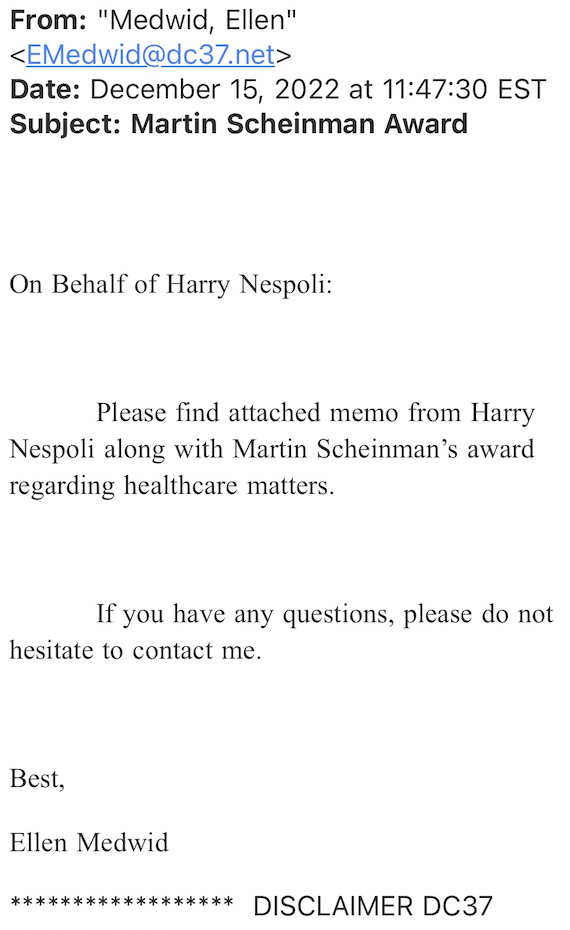
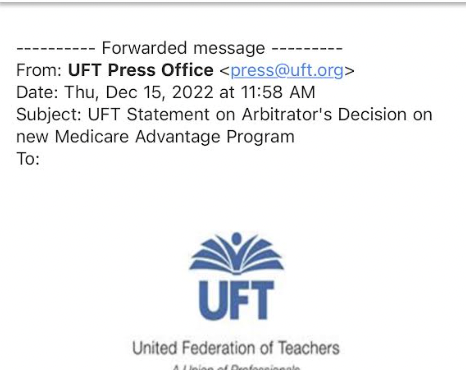

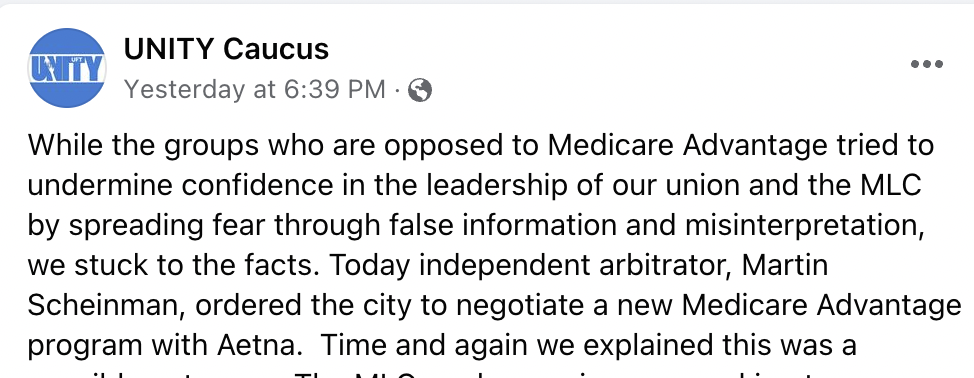
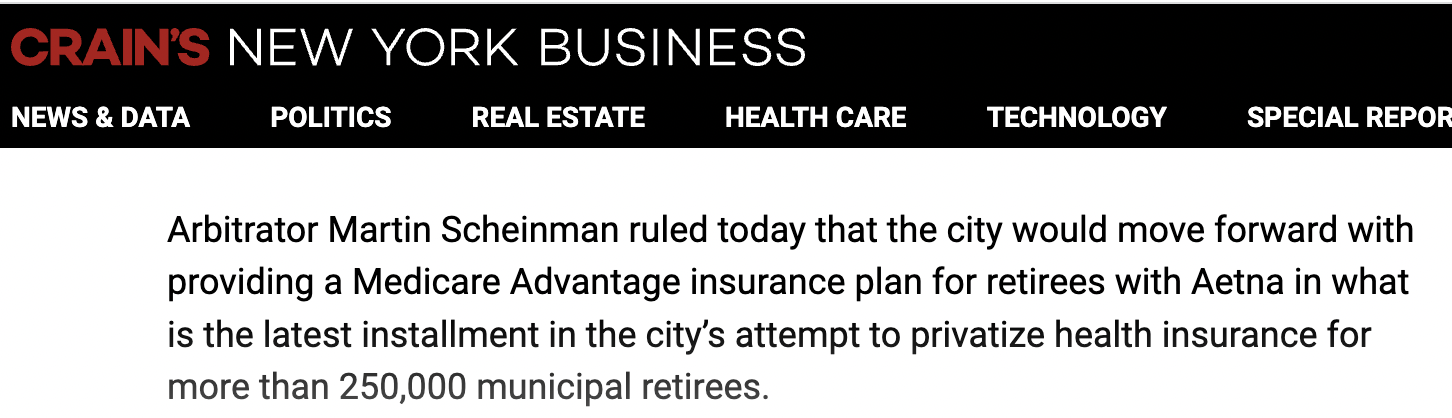
Who thinks this was not a “ruling”? Just me and Scheinman
I don’t think it was a ruling. But I don’t count.
Scheinman doesn’t think it was a ruling. Scheinman knows it is not a ruling. Scheinman counts.
Scheinman doesn’t call this a ruling or a decision
Where we expect Scheinman to describe the positions of the parties, he says nothing. When we expect Scheinman to write “this is my award” he instead writes “this is my opinion” (p. 31)
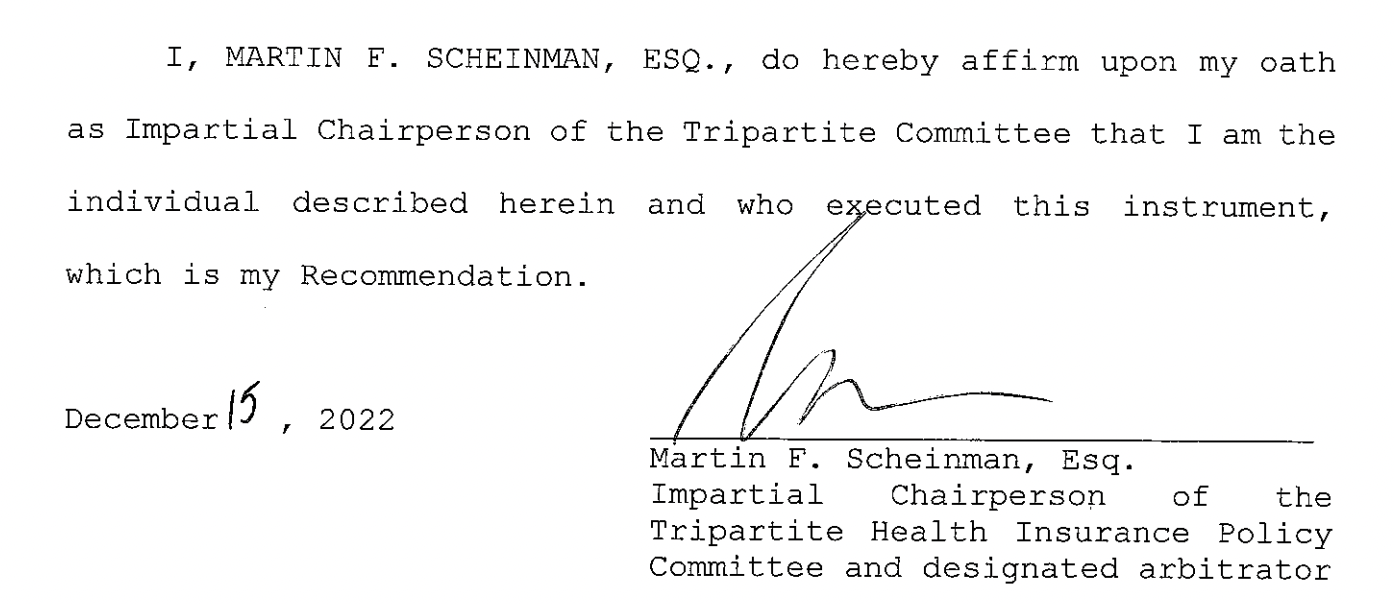
Compare that to what Scheinman writes when he is writing a real arbitration decision (from the Spring Break arbitration):

And of course, those positions:

Me, I don’t think this is a ruling or a decision
Short version – the June 28, 2018 letter Robert Linn, then Commissioner of the Office of Labor Relations (OLR) to Harry Nespoli for the Municipal Labor Committee (MLC) has 7 points.
Points 1 – 4 are about 2018 – 2021 “savings” (those are cuts and increases for regular people – savings for Mulgrew, the Commissioners, and Insurance Executives). Those savings were met – as reported by new OLR Commissioner Renee Campion in this memo.
Point 5 calls for a “Tripartite Committee” to look at longterm “savings.” The committee is charged with – wait for this – making a recommendation. Scheinman is not arbitrating. He has not made a mistake. He is making a recommendation – as he is supposed to do – under Point 5.
What about his role as the arbitrator? The last point is point 7 – and it makes Scheinman the arbitrator – but only under specific circumstances: “In the event of any dispute under sections 1 – 4 of this Agreement…” It is quite clear. His role as arbitrator is NOT for Point 5. And Points 1 – 4 have already been satisfied.
And this means?
There are two elements to this.
First: Why tell the world that a recommendation is an arbitration decision? Mulgrew, Scheinman, Nespoli, OLR, the insurance people, the whole cabal – all they seem to want is for the City Council to amend 12-126. In fact, in Scheinman’s recommendation he suggests changing the code. A recommendation would not intimidate members and retirees and City Council members. But an arbitration decision would.
Second: If this is a recommendation, not an award, then it is up to the “parties” what to do with it. But know this – if they follow Scheinman’s suggestions – it will be because the parties agreed to them. If we get Aetna, if we get premiums, if retirees lose Senior Care – it will mean that Mulgrew has agreed to do those things to you.
Back to Scheinman
If Scheinman knows that he issued a recommendation, but he sees that the other members of the committee (they are not parties) and the press are reporting it is a “ruling” or a “decision” does he have an ethical obligation to clarify? Or can the Tripartite Committee choose to withhold information from the public, in the interest of misleading union members, retirees, to better lobby the City Council? And as part of the Tripartite Committee, could Scheinman be obliged not to reveal the deceptive tactic? I can read the ethical guidelines for arbitrators, but if he wasn’t acting as an arbitrator, would those guidelines hold?
And maybe Mulgrew does know?
This is from the Mulgrew email:
“As we expected, an independent arbitrator today ruled that the city and the Municipal Labor Committee should create a new Medicare Advantage plan for Medicare-eligible city retirees.”
Why do they say that the MLC SHOULD create a MA plan, and not that “the MLC is ordered to…” or “the MLC MUST create…”? Maybe this is not such a big discovery. Do you think Mulgrew knows this was a recommendation and not a decision?
Collusion and Bullying by OLR/UFT/MLC (Mulgrew et al)
Mulgrew is still working from the same playbook.
In October he used a letter from the Office of Labor Relations (OLR) to the Municipal Labor Committee (MLC) to scare United Federation of Teachers (UFT) members and retirees. He wants us to support amending Section 12-126 of the New York City Administrative Code.
Today he used an “Opinion and Award” from the Tripartite Committee Chair (and arbitrator), Martin Scheinman, to do the same thing. Mulgrew linked to the UFT “Campaign Page” which campaigns to….? You guessed it. Amend Section 12-126 of the New York City Administrative Code.
Both in October and now the form was the same. Horrible things were about to happen to in-service members, or retirees – unless the City Council agrees to amend Section 12-126 of the New York City Administrative Code.
Mulgrew and his allies are consistent in their messaging.
Collusion
I have made the case before: Mulgrew, Nespoli, Garrido, the whole MLC, Scheinman, Adams, and the City’s financial administration, starting with the OLR, plus the insurance companies – they are all working in concert. They are colluding. And they leave the evidence all over the place
In today’s Mulgrew letter we have some creative use of language. Take a look:
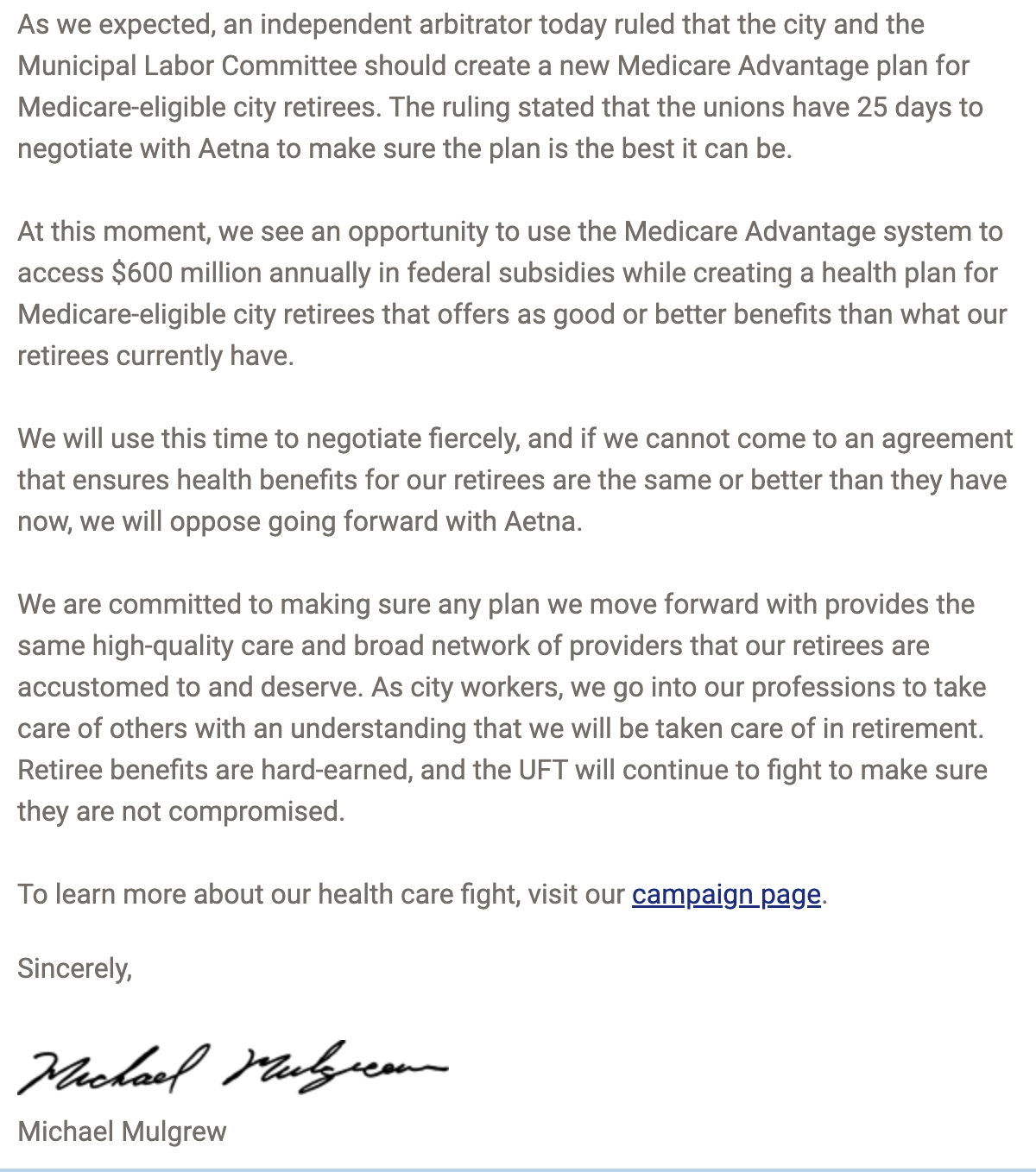
Notice it? “we expected” “we see an opportunity” “we will use the time” “we are committed.” Who’s the “we”? It’s not me. It’s not you. It’s UFT/MLC/OLR/Scheinman/Aetna.
In Scheinman’s “Opinion and Award” there is some language that, while not creative, is strangely familiar. Starting on page 3 where he discusses what happened, he writes “a small group of retirees” – which phrase we have seen before.
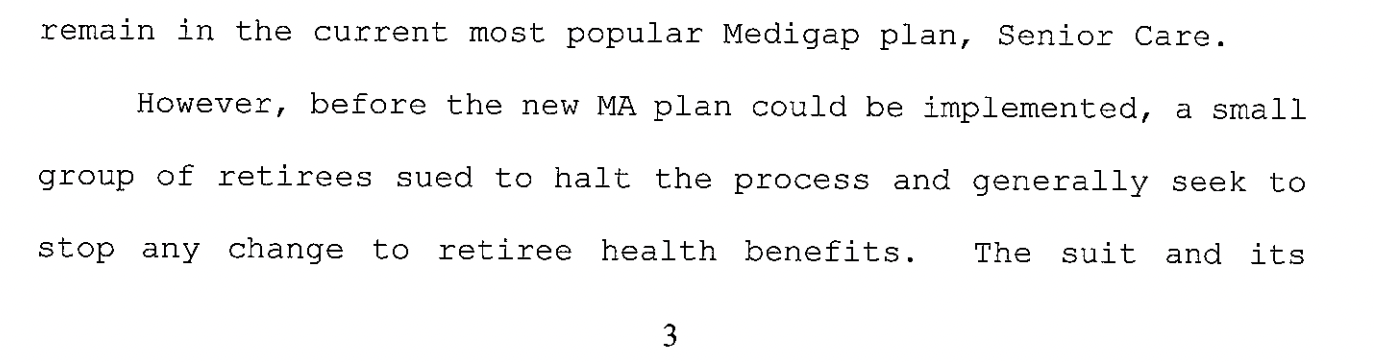
To be sure, if it were a small group, that’s what you’d expect it might be called. But with 18,000 facebook followers and 60,000 opt-outs (that’s 10% and a 33% of NYC Medicare retirees, hardly small groups) – one person calling it a “small group” would be a mistake. But when several people share language… Were you copying each other? Or did you work on your letters together?

And then, reading Scheinman’s “Opinion and Award” more closely, I noticed more language that I’d previously seen on UFT emails and pages, or heard during Mulgrew’s reports at DAs and Town Halls. I wasn’t certain that Mulgrew’s people and other MLC people participated with Renee Campion in the production of Ms. Campion’s October 28 scary letter; I am absolutely convinced that Scheinman worked with the City and the leadership of the MLC unions, including Mulgrew’s people, in creating his 12/15/22 “Opinion and Award.”
I would run the Scheinman document and a UFT Town Hall transcript through a plagiarism checker – but the UFT has not made the Town Hall transcript available. And Scheinman’s document, although plainly produced on a computer, was released as a print copy, and reproduced crooked on the page to make it hard to convert to a format that a word processor could recognize.
Some questions about this “decision”
First of all, it’s not a decision. It is an “Opinion and Award.” That’s odd. More at the end of this post.
So if there is an award, there should be an issue, and parties to that issue. The first page names the parties. But… There are no “positions of the parties” – that’s what we expect from an arbitration. What is the MLC asking for? What is the City asking for? Scheinman doesn’t mention this.
I wrote “Scheinman doesn’t mention this” not “Scheinman fails to mention this” because I don’t know if the City and MLC actually approached him trying to decide between different courses of action.
In fact, Scheinman’s decision-making power as the arbitrator for the Tripartite Health Insurance Policy Committee arises in the case of a dispute

(From the 2018 letter referred to within the UFT as Appendix B)
Where is the dispute? Does Scheinman actually have any authority here? There are no positions for the parties, because the parties appear to be not in dispute. Everyone agrees about who needs to get screwed (me, and you).
It is normal for arbitrators to lay out in their decisions the source of their authority. It is curious that Scheinman does no such thing.
How do arbitrators normally write up awards? Look at how Scheinman does it (he knows how) in the Spring Break Arbitration.
Scheinman NOT designated arbitrator for Medicare Advantage issue
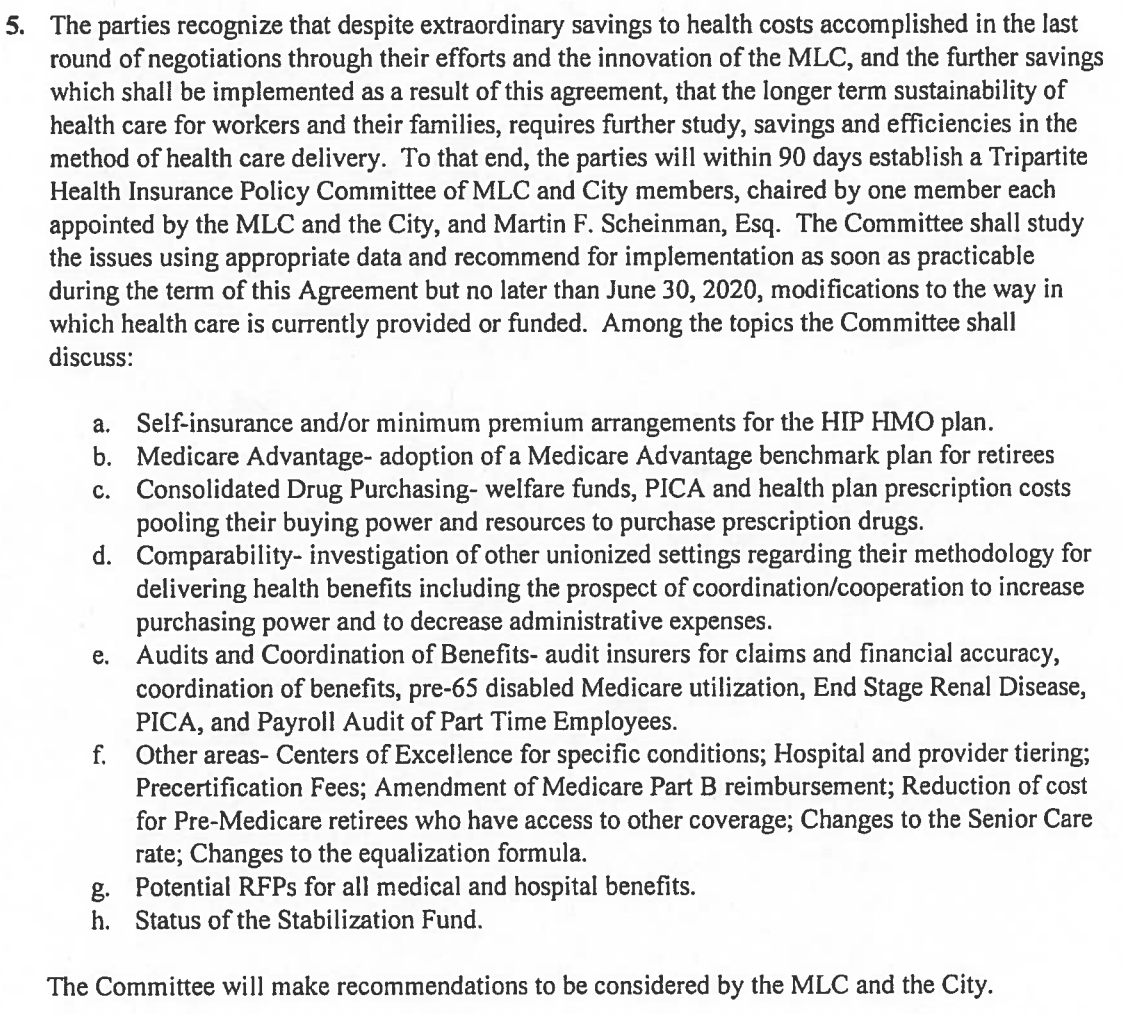
Oh, and oh no. Scheinman has been named to resolve disputes on items 1-4 in Appendix B. But the current issue, Medicare Advantage, comes from item 5. The agreement doesn’t cover point 5. Maybe that’s why Scheinman does not begin by establishing his authority? Point 5 only calls for recommendations.
Other oddities in Scheinman’s write-up
Here’s Scheinman talking about supporting the Stabilization Fund. It is fairly clear that Mulgrew’s negotiations have been all about protecting the health – not of our members and retirees – but of this fund (p.16):
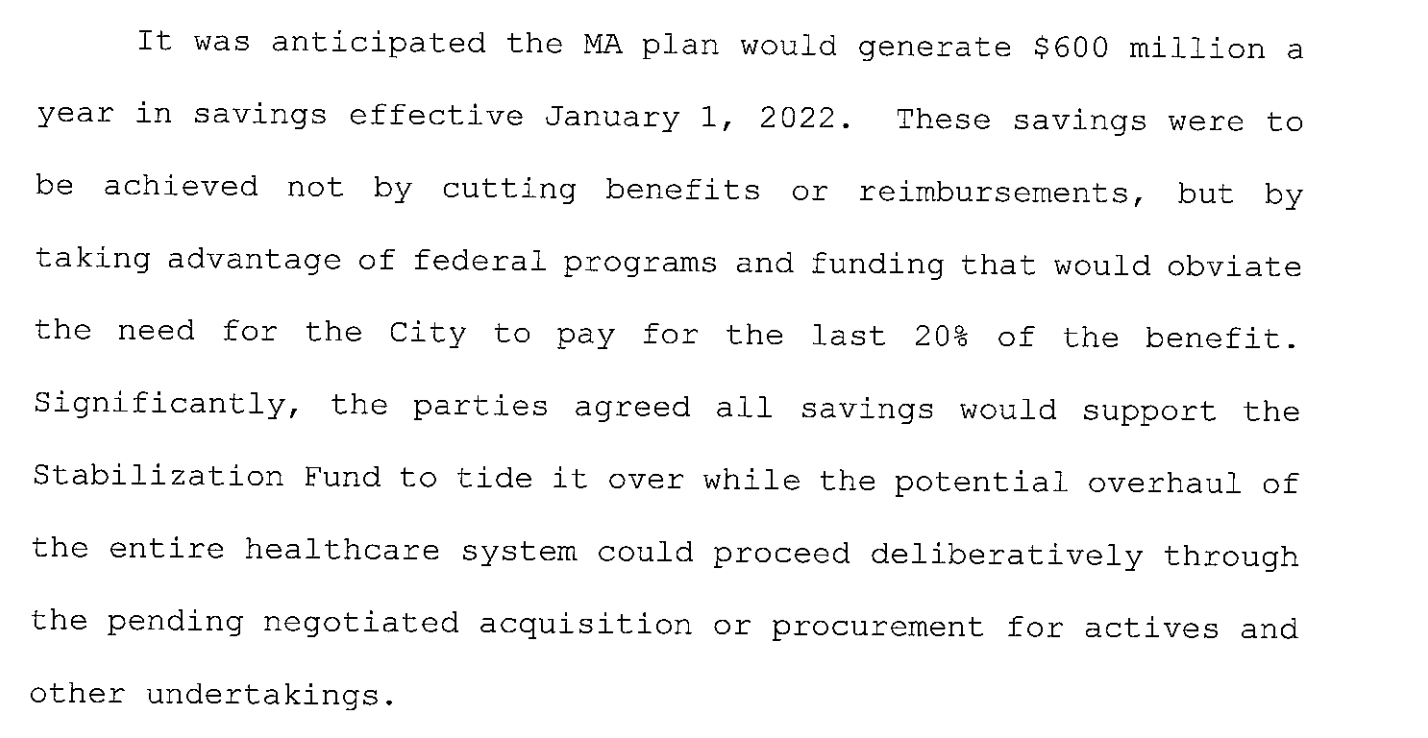
To keep the fund safe, Mulgrew and Scheinman (and the other parts of this club) need to raise copays, limit doctors, require preauthorizations (to limit healthcare, etc. Look at that paragraphs again.
Expertise
And in the whole of the document, Scheinman strangely claims knowledge of what the impacts of health care changes are on people who need health care. When he writes “I was persuaded that the Aetna program would meet the needs of the City retiree population” (p.24) he is appealing to an unqualified authority: himself.
Self-defeating Award
The “award” is strange. Ordering the City to conclude negotiations with Aetna in 25 days – well – Aetna is looking to maximize profit. And if Scheinman’s “award” holds, then the City is negotiating with a for-profit company that knows it is required to reach a deal. Dumb, right?
Someone’s not been honest
At one point (p.25) Scheinman defends against a charge that he’s screwing retirees, by pointing out how hard he’s worked to screw in-service members over these last eight years. I like this part, not because I like the copays (I DO NOT), but because it gives the lie to Mulgrew claiming that the loans from the Stabilization Fund were paid back with no give backs. (It is, as Scheinman reveals, a lie. We paid. And the”we” means in-service and pre-Medicare retired members).

Not a Decision?
The whole thing is called an “Opinion and Award” right? That’s weird. But what’s weirder – take a look, page 31:
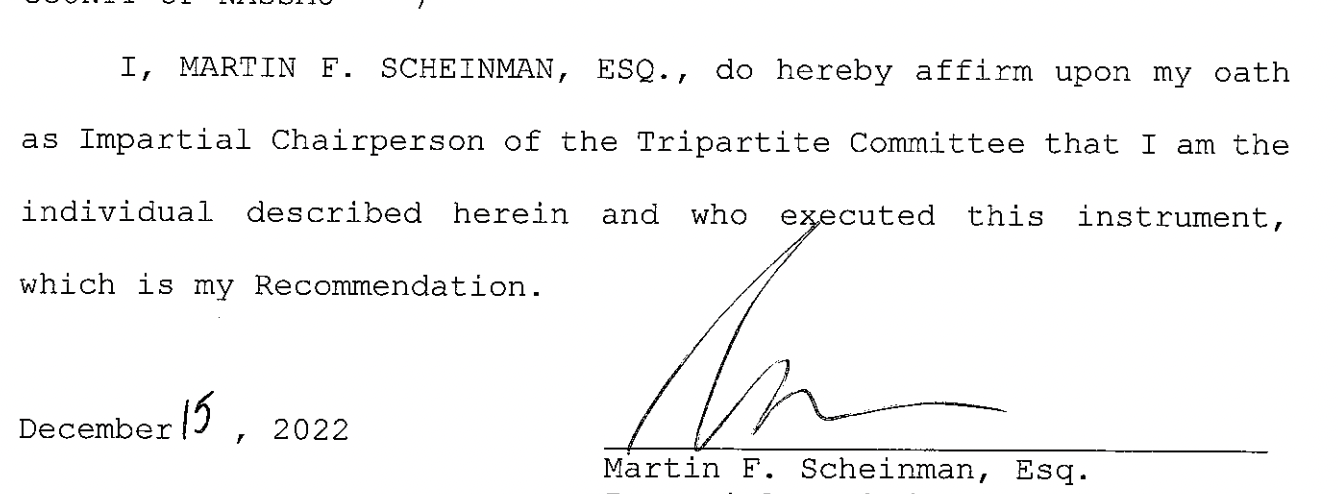
What does that look like to you? He writes that “this instrument” (means the document) “is my Recommendation.”
Is that what he always writes? Nope. Here’s the end of the Spring Break Arbitration:
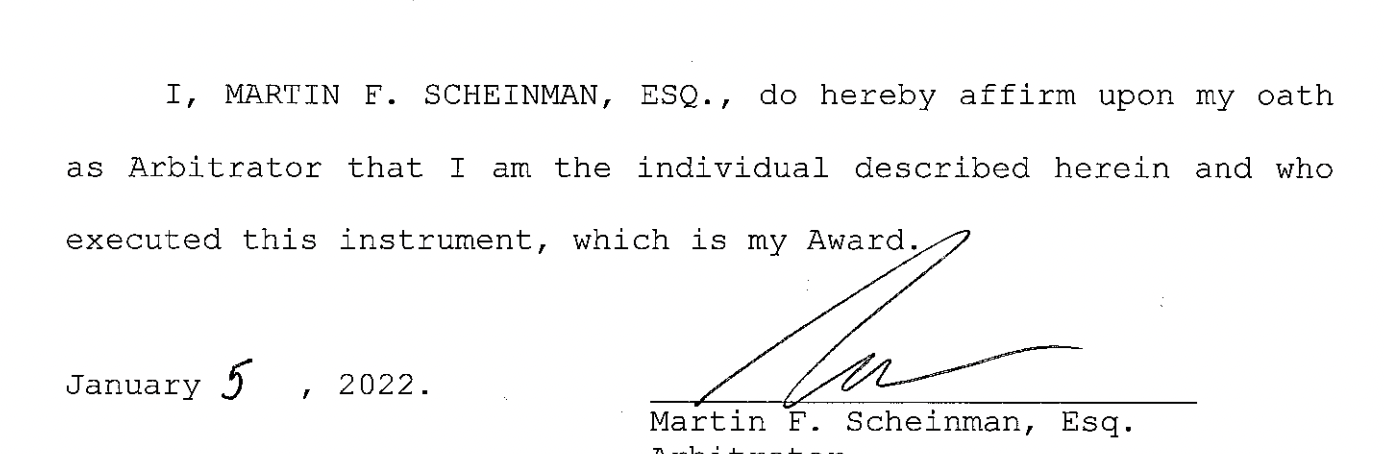
All this noise and fuss. Is there a difference between a “recommendation” and an “award”? What do you think?
And of course, 12-126

From page 30. Of course Scheinman wants us to amend the Administrative Code – so it is easier to go after retirees.
Why is this happening?
The UFT’s Unity leadership is used to getting exactly what it wants. And it can control every vote, win every vote, WITHIN the UFT. It can even prevent votes it doesn’t want from being taken.
But this is beyond the UFT. And the Retirees (UFT and other municipal workers) are pushing back hard. They have out-mobilized the UFT leaders. They have out-lobbied the UFT, badly, at the City Council.
Even in the UFT, Unity is having trouble with an unhappy membership. There have been rumors, lots of them, about disquiet in the Unity ranks. And Tuesday, in an unprecedented turn, a UFT Retired Teachers Chapter meeting was shut down early because members insisted on discussing healthcare. (I will cover this event soon, and place a link here when I do).
But the bottom line is, while Unity still controls all the levers of power within the UFT, its credibility has never been lower. Their opponents are active. Their own supporters are whispering. And people who usually don’t care, some of them are starting to, and find Mulgrew’s people untrustworthy.
The UFT leadership (Mulgrew and crew, aka “Unity”) are locked in a desperate fight with the UFT members and the UFT retirees – Mulgrew and company are struggling to reduce how much health care we receive, in order to pay a debt they incurred years ago – we are battling to prevent them, to preserve our health care.
Because the politicians and the insurance companies and big business are on Mulgrew’s side, you might think he is a heavy favorite to defeat the members and the retirees.
But so far we have successfully held him off.
The United Federation of Teachers, DC37, the Municipal Labor Committee – their leaderships have formed an unholy alliance
with New York City’s financial managers, the insurance companies, and
the “independent arbitrator” –
and this evil alliance is pulling out all stops to defeat the members and retirees. Scheinman’s “Opinion and Award” is their latest.
Now Mulgrew is jammed up. He needs to amend 12-126 so he can force retirees into Medicare Advantage – while leaving them a Senior Care option. But retirees don’t want that to happen. No one wants the upcharge on their current insurance. So Mulgrew has pulled out every threat – including threats he has no intention of following through on.
By having Mulgrew and Nespoli, and Scheinman, and Campion, and Adams all working together, but making it look like they are working separately – each can blame the other for the outcome that each of them has privately agreed to. Don’t miss it – they are all on the same page. They are doing this to us, as a group, as conspirators, together – but in public they don’t say so. Mulgrew’s not to blame for what Scheinman recommends? Even if Mulgrew helped write the recommendation?
Pay attention. Every communication from Campion, from Scheinman, from Mulgrew – they all talk about amending 12-126. Every UFT webpage on healthcare either asks you to change your position on 12-126, or links you to a page that makes that ask. Every not from your District Rep – same. They want you scared – so they can flip you on 12-126. So…
One last thing – Keep making those calls
This is not over. For now the fight is to STOP Mulgrew/Unity and the Municipal Labor Committee and New York City from amending 12-126. Reach out to your council member – even if you have already done so, do it again – and tell them NOT to amend 12-126.
This is a today story. There has been some quick response. See also
ICE: http://iceuftblog.blogspot.com/2022/12/arbitrator-scheinman-imposeses.html
EdNotes: https://ednotesonline.blogspot.com/2022/12/there-will-be-blood-er-lawsuits-uft.html
Was 2018 the Worst Bad Deal Ever?
No one should be putting health care cuts into contracts. This is bad negotiating by the United Federation of Teachers (UFT) leadership (Unity Caucus). Nick calls it a bad deal. He’s right. But there was something much worse about the 2018 contract than most people realize. Read on.
The UFT leadership (Mulgrew and crew, aka “Unity”) are locked in a desperate fight with the UFT members and the UFT retirees – Mulgrew and company are struggling to reduce how much health care we receive, in order to pay a debt they incurred years ago – we are battling to prevent them, to preserve our health care.
Because the politicians and the insurance companies and big business are on Mulgrew’s side, you might think he is a heavy favorite to defeat the members and the retirees.
But so far we have successfully held him off.
This fight has its roots in previous Unity schemes and deals – some of which were hidden from UFT members and retirees. Perhaps the worst, most dangerous lines were hidden in “Appendix B” – permanent, annual cuts in health care – with no end to the cutting.
The 2018 contract ratified an earlier agreement that was not shared with the UFT membership. The memorandum of agreement has a health care heading, but it just says to see Appendix B.
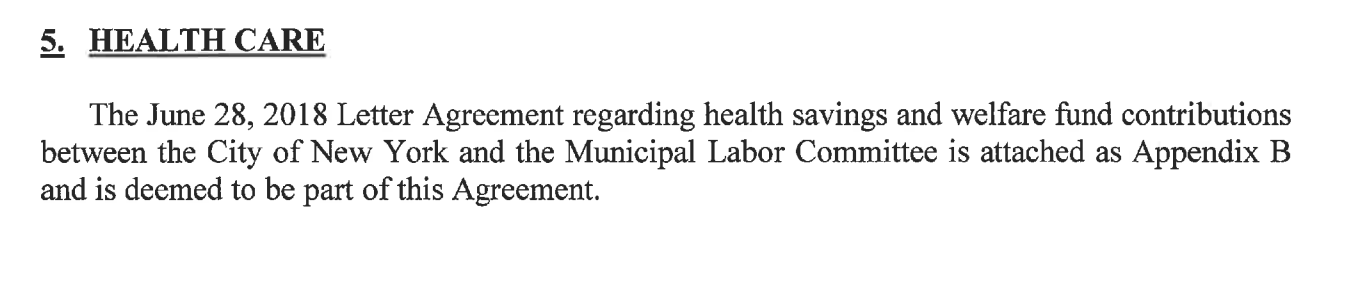
Here’s the link to the MOA: https://www.uft.org/files/attachments/secure/moa-2018.pdf
Appendix B, as you might guess, is not attached.
In fact, when Unity was hard-selling this deal, in an unexplained rush, they clearly said there were no health care give backs. And then they did not provide Appendix B. James found it. But because the leadership hid it, and most members rely on the leadership for their information, there is no way of knowing how many of those who voted yes on the contract knew there were givebacks. Probably very few, in light of Unity’s brazen lies. Arthur provides a good summary of the Unity rush to get the 2018 contract passed without revealing the health care give backs.
Appendix B is a letter. Here’s a link to the whole of Appendix B (4 pages). And here’s the first page:
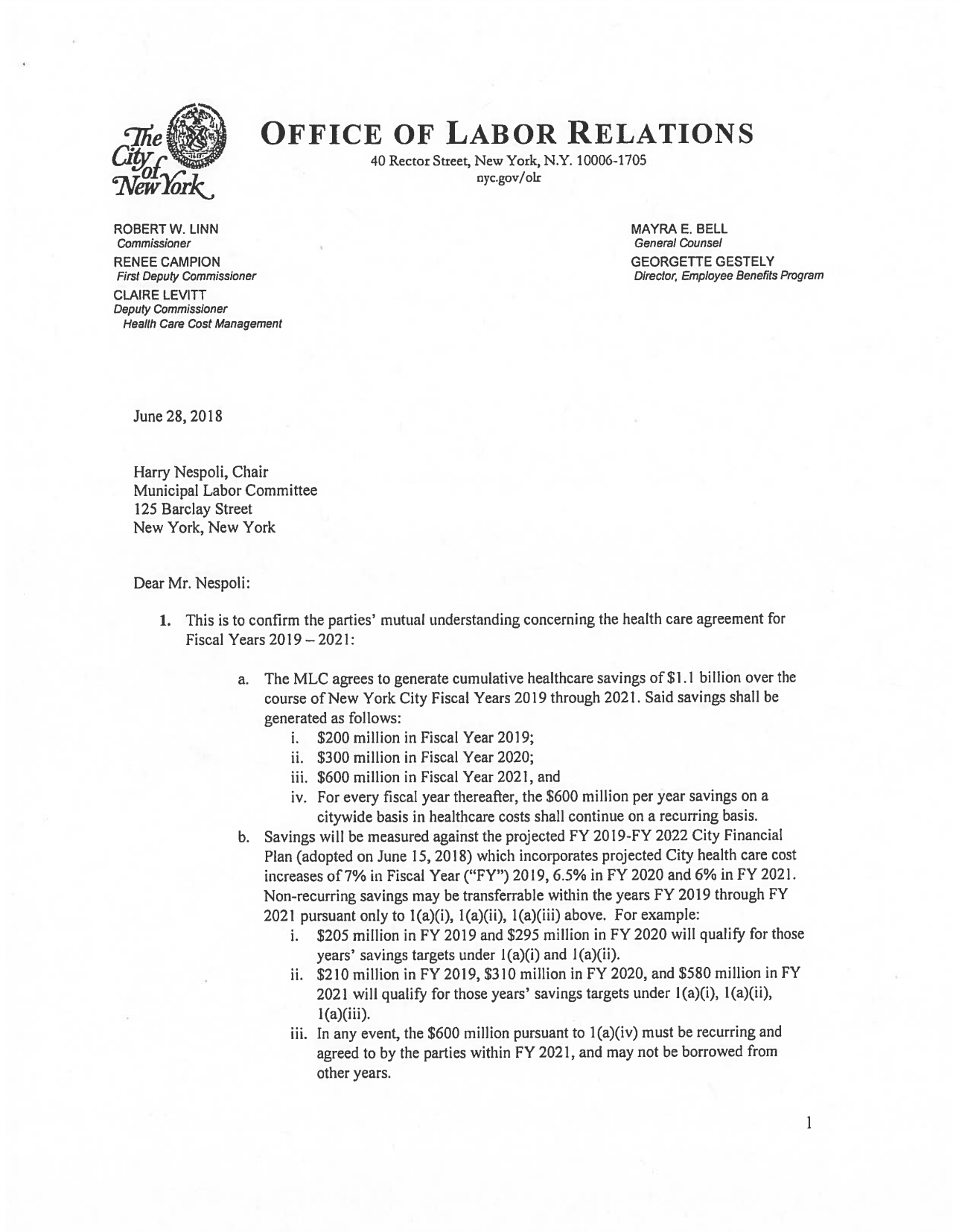
So, we already know, agreeing to cutting health care is a bad deal. But worst deal ever? Let’s look at 1.a, and focus on 1.a.iv
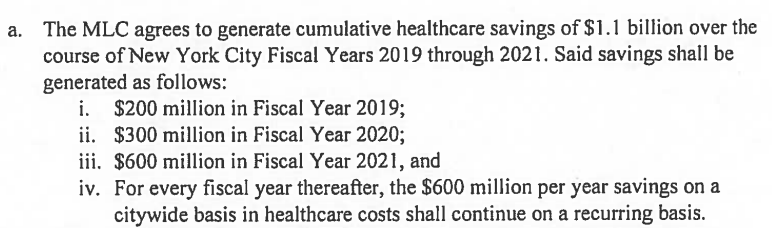
First, a reminder: “savings” are savings for the City of New York and the Stabilization Fund. “Savings” for you and me mean less health care, harder to access health care, or more costly health care.
Mulgrew Savings = Member/Retiree Cuts and Higher Costs
So Appendix B is about health care cuts.
Let’s focus on line iv. $600 million per yer – on a recurring basis. That means, even though that contract is over, the health care cuts need to continue forward. And worse. Any fool knows, health care costs are going up. So whatever cuts were good enough to amount to $600 mil a year ago, they are not enough today. Unity has put us on the hook for never ending cuts in health care. That’s what makes this perhaps the worst negotiated deal, ever.
Our contract is expired. But the health care cuts continue.
The health care cuts are permanent.
And Appendix B promises more cuts every year that health care costs rise.
Our job right now
Stop the OLR/MLC/UFT / Adams / Mulgrew / Nespoli plan in its tracks.
Do Not Amend 12-126 (keep calling / writing / texting your city council member)
Do Not accept Medicare Advantage.
Demand our unions to negotiate ON OUR BEHALF – instead of on behalf of the stabilization fund that they seem more anxious to represent than their own members.
Seek alternate funding sources (read down for resolution on stock transfer tax and billionaires tax).
Battle Against Medicare Advantage – Updates
A summary of recent work by UFT activists.
Collusion
I made the case that United Federation of Teachers (UFT) President Mulgrew and the Municipal Labor Committee (MLC) colluded with NYC – the mayor and the Office of Labor Relations (OLR) to force retirees into Medicare Advantage last year (the retirees stopped them) and to change Section 12-126 of the City’s Administrative Code this fall (so that they might succeed in ambushing the retirees. Here’s my piece. And James published some photographic evidence.
UFT Leadership Contempt for Membership
Unity’s leader displayed really bad attitude at last week’s town hall – Arthur describes how Mulgrew belittles members and retirees, instead of working with those who have been out-organizing the leadership. And I remind readers that instead of trying to work together, Unity leadership silences people who disagree with them. And there’s a lot of us.
A bad deal from 2018
Nick Bacon reviews the deal that set the stage for the Medicare fiasco. Arthur talks about it, too.
Alternatives exist…
Nick’s Exec Board minutes cover a resolution (scroll down) to raise funding via billionaire taxes and reinstating thestock transfer tax – not on retiree’s backs. And James is right – we can negotiate with our current rights, and without screwing over any members or retirees.
…to Unity’s and the MLC’s and OLR’s and Scheinman’s plans
Nick lays out Mulgrew’s general game plan – agree to something that sucks, and blame the retirees. And yesterday James went into some detail about what Mulgrew may be working on next.
This is Not Over
We are still fighting. We are currently, strange as it seems, winning.
Keep making those calls to City Council – Do Not Amend 12-126.
Retiree Advocate explains why:
The UFT leadership (Mulgrew and crew, aka “Unity”) are locked in a desperate fight with the UFT members and the UFT retirees – Mulgrew and company are struggling to reduce how much health care we receive, in order to pay a debt they incurred years ago – we are battling to prevent them, to preserve our health care.
Because the politicians and the insurance companies and big business are on Mulgrew’s side, you might think he is a heavy favorite to defeat the members and the retirees.
But so far we have successfully held him off.
An email I will not answer (Part 2 of 2)
I got an email from a federal investigator. He asked to talk about the UFT. November 16. I will not respond.
Part 2
Spring UFT Elections
Back in the spring, my coalition ran against the entrenched UFT leadership. I was the United for Change candidate for High School Vice President.
Spring 2022 Complaint
In this spring’s campaign Unity pulled its usually stuff. And members of my coalition began to assemble a complaint, or a group of complaints. But these were not just about staffers campaigning on union time (a big no-no). This complaint also included things about UFT reps discussing the election on Facebook. I was not comfortable with that sort of complaint – we all talk on Facebook.
A UFC complaint was drawn up that included the kitchen sink. Marginal violations. Even things that UFC candidates had done too, all were in there. And the complaint rested largely on violations of federal law, rather than on the union’s own rules and norms.
In the end, after UFC has lost the election (but won high schools) the complaint was submitted to the UFT. Most of it was rejected.
Appeals
And then the complaint was appealed to the American Federation of Teachers (AFT, our parent union). That’s an understandable next step.
And then there was a proposal to appeal beyond the AFT, to the federal government, to the Department of Labor. Here’s where the original complaint resting so heavily on federal law comes into play. It was designed from the start, it seems to me, to go to the feds.
UFC – structure?
The United For Change coalition was formed to contest the spring 2022 United Federation of Teachers election. It is a coalition of several groups and caucuses within the union. Some, but not all, have defined membership. Also there are independents, like me.
During the election we made decisions using some sort of consensus. It was not perfect, but it functioned ok for the election period – platform, candidates, literature were the main issues.
So when the proposal to go to the Department of Labor came up, there were discussions between UFC members, but also in the groups/caucuses. And two of the membership caucuses said no. And a third was only willing to go ahead if there were consensus, which there was not.
As an individual, independent part of the coalition, I argued against appealing to the Department of Labor. Let me explain.
I am opposed to involving the government in union affairs.
I am opposed to government interference in unions. Even where something has gone wrong (and yes, I believe that Unity abuses its power), it is up to us, internally, to address. The government is not a friend of the unions. Look at what just happened to the rail workers.
The government restricts unions. It restricts organizing. It routinely decides disputes against workers. It makes it hard to create a union. It limits what unions are allowed to do. It decides cases against unions and workers. And the few cases it decides in favor of workers, most are overturned on appeal. Appeal to the government. The government also restricts how unions can fight strikes. It restricts how we can get others to join unions. In New York, the state curtails our right to strike.
There’s also a history of internal interference in unions. Sometimes well meaning opposition people have looked to the government to fix unions, but ended up with a mess. The Teamsters is the first example that comes to mind (president leading a national strike, removed by the government). And I will add, I don’t care how good your intentions were, when you brought the Department of Labor into the union, you set the stage for the government interfering, at a fairly high cost to the union members. And when leaders appeal to the government to fix union problems, they are telling the rank and file that the government is a neutral arbiter, that they should trust the Department of Labor, NLRB, courts, etc. And that is a lie.
We need to warn workers that the feds are not our friends. That in matters of labor against bosses, the federal government has a side, and it is not ours. We cannot do that while we appeal to the feds to investigate our unions internal affairs.
UFC Decision – not to appeal to the Department of Labor – so what happened?
So several caucuses that had participated in the election under the UFC umbrella did not support going to the Department of Labor. Another group, which was nominally in favor, did not support going forward without consensus. I argued fairly strongly against appealing to the government. There was not a UFC decision to make this last appeal.
But the appeal happened. The Department of Labor (not the UFC) says that individuals may make complaints about an election for union officers. And five individuals signed a complaint addressed to the Department of Labor.
Interestingly (or frustratingly, for at least me), they did not restrict their complaint to how they were treated in the election, but felt empowered (in the absence of an affirmative UFC decision) to complain about how the UFC was treated. When the Department of Labor called this a “UFC Complaint” the five individuals did not feel the need to clarify that the complaint was not originating from UFC.
No one signed who was speaking for a caucus with membership. None of the people elected to the Exec Board signed. I did not sign.
The email
I don’t know who gave the feds my email. I only have guesses. I certainly did not give my permission to share my email. And I had already made clear that I was adamantly opposed to this complaint. And I will not talk to federal investigators about my union. Hell, I doubt I would speak to feds about anything.
The Department of Labor guy wanted me to call him, to speak about last spring’s United Federation of Teachers (UFT) election. From the Department of Labor. I didn’t say no. I just won’t respond.

But now it is clear to me that the five individuals took a non-UFC decision and acted as if they were acting on behalf of UFC. So just to clarify. No.
An email I will not answer (Part 1 of 2)
From a federal investigator. To talk about the UFT. It was a few weeks ago. I will not respond.
He wanted me to call him, to speak about last spring’s United Federation of Teachers (UFT) election. From the Department of Labor. I didn’t say no. I just won’t respond.
Spring UFT Elections
Back in the spring, my coalition ran against the entrenched UFT leadership. I was the United for Change candidate for High School Vice President.
In lots of ways the election was rigged against us. Unity (the entrenched leadership’s “caucus”) holds all the levers of power. Every union staffer a regular member encounters – at the welfare fund, in the borough offices, in grievance, or our own district reps and special reps, belong to Unity. Plus the rules have been rigged over the years. I was running for HS VP, won the majority of the high school votes, but was defeated in a system where retirees and elementary teachers cast more votes for HS VP than actual high school teachers do.
Unity uses its advantages. It uses the unfair rules. And it uses its staff. And it crosses the line into territory that’s clearly not allowed. They do it every election. In the past I’ve been part of campaigns that has called them on flagrant violations. And they usually draw back.
Spring 2022 Complaint
In this spring’s campaign Unity pulled its usually stuff. And members of my coalition began to assemble a complaint, or a group of complaints. But these were not just about staffers campaigning on union time (a big no-no). This complaint also included things about UFT reps discussing the election on Facebook. I was not comfortable with that sort of complaint – we all talk on Facebook.
In the end a UFC complaint was drawn up that included the kitchen sink. Pages of items included Facebook, and Twitter, and Instagram, generally insubstantial. Every time a Unity candidate appeared in the New York Teacher – complaint. Conflict at the Delegate Assembly? In the complaint. There were 31 pages with 32 points and 29 subpoints, plus over 40 pages of appendices.
I was quite uncomfortable with the complaint resting on violations of federal law and chancellors regs, rather than on the union’s own rules and norms. As we will see, that discomfort was not ill-founded.
Some of the violations were clearly violations. I contributed three items (people brought them to me). I believe the UFT, which dismissed most of the UFC complaint, did find merit in two of the three items I added (and the third was dismissed because the violation had been committed orally, and not reduced to writing).
Some of the complaint was not just trivial, but wrong. A host of complaints about chapter leaders (not employees) made me very uncomfortable. In some instances CLs were being cited for telling their members which caucus they preferred. I am glad this group of complaints was rejected – they would have a chilling effect on all chapter leaders, regardless of caucus, who need to speak openly and freely with their members. I objected, pointing out that I as a chapter leader had engaged in practices that were being complained about, to no avail.
We have bad precedent here. In 2016 both sides, Unity on one, MORE/New Action on the other, had actively encouraged voting. This is important in a union with horribly low turnout. Several chapter leaders offered cookies or a bottle of water to any member who brought in and filled out their ballots on a specific date. (Members filled out their own ballots as they saw fit – the prize was for voting, not for voting the “right” way). Several chapters organized a ballot “drop off” where one member collected SEALED ballots and dropped them in a mail, or where a group from the chapter walked together to the mailbox, and made a show of casting the chapter’s ballots. What a cool way to build camaraderie. But in 2016 Portelos (sore loser) complained about these practices. I voted against his complaint. But in the aftermath the union in an overabundance of caution banned “cookies for ballots” and “walks to the mailbox.”
In the end the complaint was submitted to the UFT. Most of it was rejected – but a few items (Mostly reps mixing union business with Unity campaigning) were found to have occurred and be violations of our practices. I think the reps were admonished not to do so again – not much of a consequence, but still, public. And there was no question in my mind, in most of our minds, that the sum total of the violations did not change the result of the election. (UFC won the high schools, Unity won the other divisions, and overall).
Appeals
And then the complaint was appealed to the American Federation of Teachers (AFT, our parent union). That’s an understandable next step.
And then there was a proposal to appeal beyond the AFT, to the federal government, to the Department of Labor. Here’s where the original complaint resting so heavily on federal law comes into play. It was designed from the start, it seems to me, to go to the feds.
The Federal Government and Unions
I am opposed to government interference in unions. Even where something has gone wrong (and yes, I believe that Unity abuses its power), it is up to us, internally, to address. I’m not a fan of the approach of organizing a new union where an old one is decrepit, but that doesn’t involve the government, and things could reach that point.
But the government is not a friend of the unions. Imagine an overseer telling me, a chapter leader, how I can communicate with my members. Imagine that we won the election – and we wanted to consider breaking the Taylor Law, and a federal overseer forbidding us from discussing that with the membership. That’s pretty easy to imagine. The government does NOT have any interest in a strong union. To the extent that they see violations of union democracy, they see them as an opportunity to interfere in the day to day functioning of the union.
I did not need early December’s events to convince me. But they should be a wake up call to all of us. Rail workers have been pounded since the pandemic began. They need sick days. They have none, wanted seven. (Seven over twelve months. New York City teachers, whose jobs do not take us out of town, get ten in ten months). Bargaining broke down.
But before they could strike, Biden and congress got into the act. The House passed a bill on November 30 imposing a contract. The weasels, Democrat and Republican, passed a separate resolution calling for more sick days. They knew by dividing the measures they could look like they supported sick days, but that the Senate and president would safely remove them. On December 1 the Senate passed a bill making a strike illegal. And December 2 Biden signed it all. Rail workers had been sucker-punched – by the feds. They had a government-imposed contract. Without the sick days they desperately need.
We need to warn workers that the feds are not our friends. That in matters of labor against bosses, the federal government has a side, and it is not ours. We can’t do that while we appeal to the feds to investigate our unions internal affairs.
The email
I don’t know who gave the feds my email. When I got the email November 16 I asked a blogger – who clearly had not given them my info. So I am left with only guesses. I certainly did not give my permission to share my email. And I will not talk to federal investigators about my union.
(Continued in Part 2)
Why did Campion write the 10/28 Office of Labor Relations Letter on Health Care?
Mulgrew called it a “bombshell.” The UFT and DC37 immediately sent horrified letters to their members. They both began lobbying campaigns in reaction.
The UFT leadership (Mulgrew and crew, aka “Unity”) are locked in a desperate fight with the UFT members and the UFT retirees – Mulgrew and company are struggling to reduce how much health care we receive, in order to pay a debt they incurred years ago – we are battling to prevent them, to preserve our health care.
Because the politicians and the insurance companies and big business are on Mulgrew’s side, you might think he is a heavy favorite to defeat the members and the retirees.
But so far we have successfully held him off.
A major event in this struggle was the letter from NYC OLR Commissioner Renee Campion to Harry Nespoli and the MLC (and by extension Michael Mulgrew.)
It threatened to ask Scheinman to force the retirees into a Medicare Advantage plan.
But Campion, Nespoli, Mulgrew, all already agreed.
Why write a letter when sender and recipients agree?
Renee Campion, Commissioner of the New York City Office of Labor Relations, wrote on October 28 that unless the City Council got moving on amending Section 12-126 of the City’s Administrative Code, that OLR would ask arbitrator Martin Scheinman to intervene and throw all of our retirees onto Medicare Advantage.
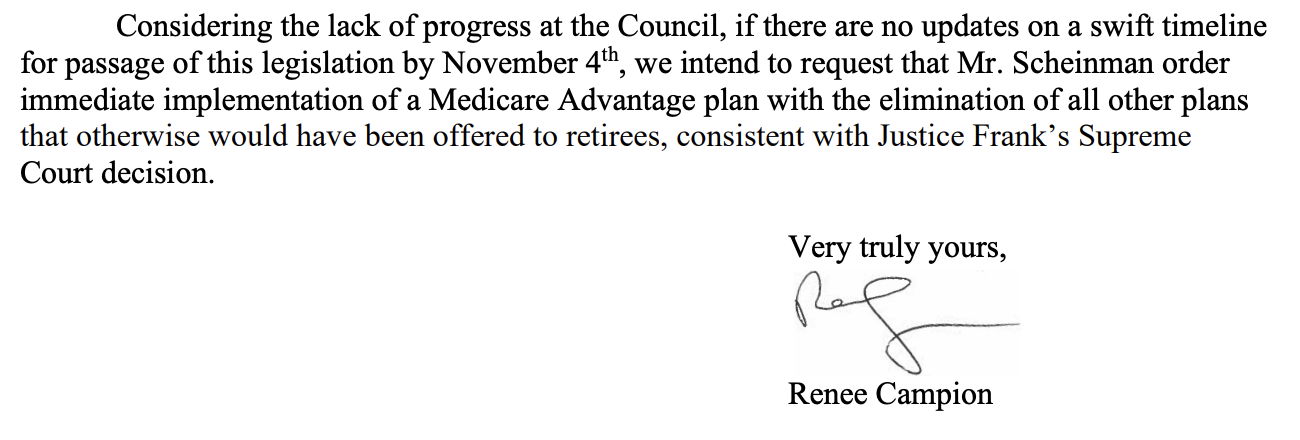
Pass the amendment to 12-126, she writes, or I’m bringing this to Scheinman.
Scheinman, for his part, had already weighed in on the matter. In a letter to the Office of Labor Relations on September 30, he wrote:
“Thus, absent the proposed amendment to the Administrative that would redress what the Court found missing in current Code § 12-126, I would determine the City and the MLC shall eliminate Senior Care as an option.”
He goes on to discuss the other option he would consider, to make in-service members pay premiums, and indicates that he does not prefer that option.
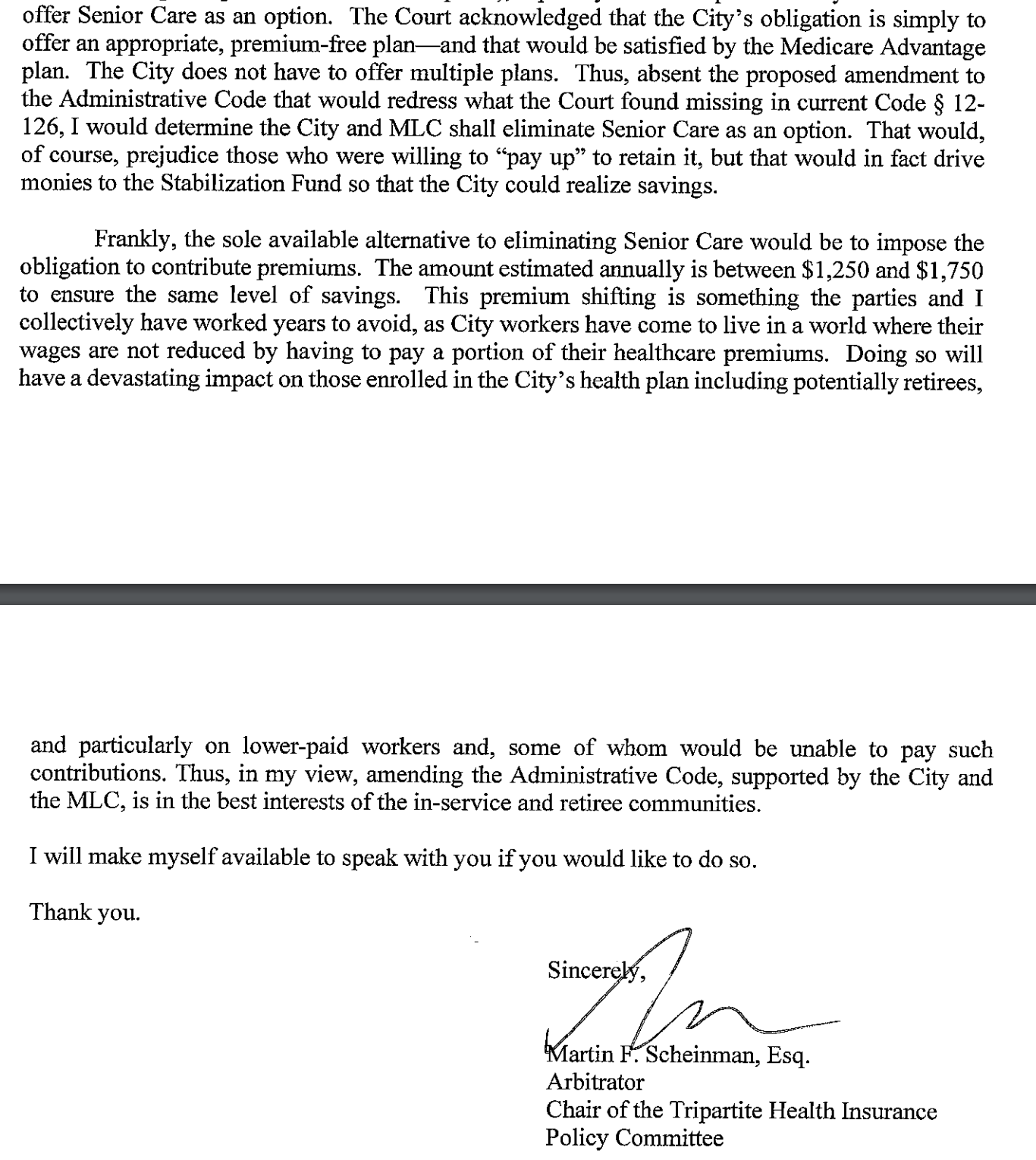
So on October 27 we were living in a world where Mulgrew and the UFT leadership wanted to amend 12-126, the rest of the Municipal Labor Committee (Nespoli et al) wanted to amend 12-126, NYC (Adams) and its Office of Labor Relations (Campion) wanted to amend 12-126, the arbitrator who might rule on what to do wanted to amend 12-126.
What was new on October 28?
On October 28 we were living in this same world, but with a “bombshell” letter from Campion. It was addressed to Nespoli and the MLC. DC37 and the UFT responded immediately. But all the players, authors, recipients, and potential arbitrator, all of them already agreed. Why write that letter, if everyone already agreed?
Who did not agree?
Retirees did not agree. They had been fighting against the change to the City’s Administrative Code. They were calling city council members, a lot. And effectively. Some council members went public with their opposition to the change. More made private comments that were leaning against the change. None of them came out in support of the Mulgrew/MLC amendment.
In service members (of the UFT) mostly were not involved. The leadership did not have a strategy to counter the retirees. And some in-service members, mostly opposition, were already on the ball, also contacting city council members, opposing the amendment to 12-126.
The Problem Facing the Conspirators
Mulgrew, Campion, Adams, Nespoli, Garrido, Scheinman, etc all agreed – they wanted to amend 12-126 so that they could impose a (future) Medicare Advantage plan. Future? Yes, because their selected company had pulled out. In any case, they agreed about amending the administrative code. But they’d been beaten to the punch. The City Council had been well-lobbied, by on the ground constituents, retirees, and was not in any mood to consider the MLC/NYC proposal. It was not worth facing hundreds or thousands of angry retired constituents.
The Letter – Possible Purpose 1:
Perhaps New York City was angry at the unions (who NYC was cooperating closely with) for not lobbying well or hard enough? In that context, an angry letter telling them to get a move on might have been in order.
But this letter is not angry. Campion does not disagree with Mulgrew. If they all just needed to lobby harder, they could have agreed in private.
The Letter – Possible Purpose 2:
Mulgrew and Garrido could have reported to Campion and Scheinman that they were so far unable to get their members to engage in favor of their amendment (unable to rally their in-service against their retirees). All sides may have agreed that a scary letter from Campion would be the best way to motivate in-service workers to campaign for amending 12-126, and against the retirees.
More Likely?
The letter feels like a collaborative effort between the City and the MLC to scare the members.
It just does not make sense for Campion to scold Nespoli, Mulgrew, and Garrido, when they have been working hand in hand every step of the way to push retirees into Medicare Advantage.
We cannot know what happens between Mulgrew and the City, since Unity’s policy is to keep all negotiations secret from UFT members.
But we do know the UFT and DC37 had the same response to their memberships the following day.
All sides already agreed. A letter without new information. A coordinated response. If the UFT, DC37, and the MLC were going to coordinate with the City to bully in-service members into lobbying against the retirees, this letter is what that coordination would look like.
Do I have Evidence?
No. I do not have evidence. But this feels like how Unity operates.
How I imagine it:
Back room, darkened, in City Hall. Campion and a few staff members, Mulgrew and some aide who was never a teacher, Nespoli, Garrido. There’s an insurance exec who doesn’t speak.
“Where are we on amending 12-126?”
“City Council isn’t moving. They are scared shitless of the retirees.”
“We can’t move until this amendment passes”
“We have been lobbying the City Council. We have assigned our best full-time staff. We are not getting anywhere.”
“We have been leaning on them. But we can’t withhold neighborhood projects for this one vote.”
“Can you get the retirees to stop calling and telling them not to amend?”
A few silent beats as eyes roll around the table.
“OK, can you get other retirees to call and tell them YES, amend? Then they can claim they were getting mixed messages.”
“Members are afraid of pissing off the retirees in their district. A few calls the other way won’t do it.”
“We could get active members to call?”
“Mine don’t care enough. They think this is all about retirees.”
“You could explain? They know they are next, right?”
“They might get angry, too. We have to be careful about not giving too much detail.”
“There should be something bad that will happen if they don’t help us nail the retirees.”
“That’s it. Renee, can you write a scary letter to the three of us? We will use it to scare the members into lobbying against the retirees.”
Campion nods yes. The insurance exec smiles and walks out.
One last thing – Keep making those calls
This is not over. For now the fight is to STOP Mulgrew/Unity and the Municipal Labor Committee and New York City from amending 12-126. Reach out to your council member – even if you have already done so, do it again – and tell them NOT to amend 12-126.
UFT policies are decided by a vote. But not when Mulgrew’s losing?
Mulgrew’s Unity Caucus controls the UFT. What they want, they vote yes on. What they don’t want, they vote no on. Or, as they are commonly doing these days, what they don’t want, they prevent from even being mentioned.
But why hasn’t Mulgrew gotten a rubber stamp vote on the leadership’s current healthcare scheme?
The UFT leadership (Mulgrew and crew, aka “Unity”) are locked in a desperate fight with the UFT members and the UFT retirees – Mulgrew and co are struggling to reduce how much health care we receive, in order to pay a debt they incurred years ago – we are battling to prevent them, to preserve our health care.
Because the politicians and the insurance companies and big business are on Mulgrew’s side, you might think he is a heavy favorite to defeat the members and the retirees.
But so far we have successfully held him off.
Mulgrew and Unity are so deeply engaged in fighting against our retirees,
and so shocked not to be winning,
that they have forgotten to bother with a vote.
Sometimes UFT votes seem like shams. Unity Caucus holds all of the spots on the Administrative Committee, a 95-7 majority on the Executive Board, and a working majority in the Delegate Assembly. What the UFT leadership (run by Unity) wants, they put up for a vote, and it passes.
The fact that they have to put things up for a vote means there is some feedback. They may not usually listen, but it’s there. There’s a chance for opponents to point out big problems. There’s a chance for their supporters (occasionally) to point out weaknesses to be addressed. I’m not pretending it’s a good democratic process – it’s not. But there’s a chance to talk, to engage, before Mulgrew’s thought becomes policy. Unity is usually especially careful when organizational resources are going to be committed.
High Stakes
But it’s different this time. UFT leadership was stymied by the retirees when they tried to force them into Medicare Advantage. So they looked to amend Section 12-126 of the City Administrative Code (once that’s done Unity will resume pushing Medicare Advantage – but they’ll need to finish lining up a new company in the interim). Amending 12-126 is crucial to their plans. And they were in a rush.
Normally a Vote, Followed by a Campaign
If it were any other issue, any other year, with any other president, Unity would have brought the new policy to a vote. First the Exec Board. Then the Delegate Assembly. Once it passed the Exec and the DA, Unity would have run a full court press, using the Borough Reps and especially the District Reps to push the policy into the schools, and push chapter leaders to get members to make phone calls. That’s how they usually play things.
Nope. A Campaign. With No Vote
But no. Losing. Desperate. In a rush. Couldn’t be bothered.
October 28 (Friday) Renee Campion, NYC Commissioner of Labor Relations, wrote a threatening letter about what she would do if 12-126 was not amended, with first steps by an early deadline. (That deadline came and went. Nothing happened. We should think more about that letter). (Every bone in my body says Unity helped write that letter. I have no proof. Just years of instinct).

October 29 (Saturday) Michael Mulgrew started an email campaign to get members to support the amend 12-126 position. (It had very little impact).
And then, boom, it was more than an email. District Reps started pushing chapter leaders. Borough Reps held zoom meetings (using lots of staff time). The organization was all-in. That’s time. That’s money.
But no vote to set amending 12-126 as policy. And so they were allocating resources without a vote.
Aha! Gotcha? Nope.
This is slop. The vote would be Unity-controlled. They still might go back and retroactively “fix” this, if they notice. I did not write this post to get them in trouble for breaking their own very flimsy rules. (although they really should try to follow at least the minimal requirements of internal democracy that they are ok with).
Can’t or won’t follow their own norms, because they are in “a state”
I wrote this because they normally do follow this norm. And the fact that they messed up, or were too rushed to bother, that speaks to the state they are in. Concern. Worry. Panic. This is not normal. As of today, we are winning.
(This isn’t over. For now the fight is to STOP Mulgrew/Unity and the Municipal Labor Committee and New York City from amending 12-126. Reach out to your council member – even if you have already done so, do it again – and tell them NOT to amend 12-126)
The retirees and in-service members are up against Mulgrew and the MLC and NYC government. David is taking on Goliath. And it’s not over. But Goliath? Not winning.
How many ways to number a die? (answers)
I asked this question a few days ago.
Here are two of my favorite answers. Do you have another way to get to 30? Put it in the comments!
Question
How many ways can a die be numbered, using the numbers 1, 2, 3, 4, 5, 6 exactly one time each?
Term: “Same Dice”
Two dice are “the same” if they can be rotated until their numbers match up exactly. For example, if you take a standard die, and place it with the 1 on top, the 6 will be on the bottom. If you rotate it so the 2 is in front, the 5 will be in back. And then you might notice the 4 is on the left, and the 3 is on the right. All standard dice are numbered this way.
Solution 1 – way overcount
Consider one die, with any numbering. There are six sides that could be face down. And then there are four rotations with that face down. Six times four is twenty-four (24) orientations for each numbering.
Now let’s think about a blank die. How many numbers can we put on the bottom? Six. How many are left over to put on the front? Five. How many left to put on the left (ha ha)? Four. How many to place on the right? Three. In the back? Two. On top? Only one number left. That’s 6×5×4×3×2×1=720 ways to put 6 numbers on a die.
But hold on. Each numbering has 24 orientations. So those 720 numberings – 24 of them are the standard die, 24 are the standard but with 3 and 4 swapped, etc. To get the actual number of ways to number a die, divide 720 by 24. That’s 30. (And for each of those 30 ways, there are 24 numberings. 30×24=720)
Solution 2 – constructive
This time we will avoid overcounting.
We will imagine that the “1” has been put on the bottom of the die (and if it hasn’t, flip the die around so the “1” is on the bottom, which is always possible).
What number is on the top? We have five choices.
Now, we have four numbers left to wrap around the middle. How many are there?
Well, to put four things in order we have twenty-four ways. Twenty-four is 4×3×2×1. But that’s not the answer. Let’s look at some letters instead of numbers, for the moment:
- ARST
- ARTS
- ASRT
- ASTR
- ATRS
- ATSR
- RAST
- RATS
- RSAT
- RSTA
- RTAS
- RTSA
- SART
- SATR
- SRAT
- SRTA
- STAR
- STRA
- TARS
- TASR
- TRAS
- TRSA
- TSAR
- TSRA
Looks good, right? 24? Nope. Because these wrap around the middle of the die, ARTS and RTSA are the same. ARTS is really ARTS and then A and then R like this: ARTSARTSARTSAR and as you keep going around there’s not a beginning or an end, just a sequence.
So how many ways are there to wrap four things in a circle? Let’s list them:
- ARST RSTA STAR TARS
- ARTS RTSA TSAR SART
- ASRT SRTA RTAS TASR
- ASTR STRA TRAS RAST
- ATRS TRSA RSAT SATR
- ATSR TSRA SRAT RATS
Six ways. And that kind of makes sense. Each of these ways can be written with four different starting points. So our list of twenty-four including four copies of each arrangement, and twenty-four divided by four is six.
As an aside, arranging objects in a circle I call a “circle permutation” – and if the items are unique, and there are n of them, then there are n×(n-1)×(n-2)×…×2×1 ways to list them, but then we have to divide by n, so we get (n-1)×(n-2)×…×2×1circle permutations.
Let’s get back to our problem.
We place “1” on the bottom face.
We have five choices for the top face.
We have four numbers left to put in a circle, which gives us 3×2×1=6 circle permutations.
1×5×6= 30 ways to number a die.
Healthcare Debacle: Mulgrew’s in Trouble, but He Still Owns the Microphone
The UFT leadership (Mulgrew and crew, aka “Unity”) are locked in a desperate fight with the UFT members and the UFT retirees – Mulgrew and co are struggling to reduce how much health care we receive, in order to pay a debt they incurred years ago – we are battling to prevent them, to preserve our health care.
Because the politicians and the insurance companies and big business are on Mulgrew’s side, you might think he is a heavy favorite to defeat the members and the retirees.
But so far we have successfully held him off.
In desperation, Mulgrew and Unity are falling back on their tried and true trick #1: denying their opponents the ability to speak with other members.
There is a battle in New York City. A David vs Goliath battle. A battle with a retiree group allied with labor activists on one side, and Mayor Adams, the Municipal Labor Committee, and the United Federation of Teachers leadership under president Michael Mulgrew on the other.
A judge ruled in favor of the retirees, and against Mulgrew (and Nespoli and Garrido and Mayor Adams – ie, against the UFT and the other big city union and against the Municipal Labor Committee (MLC). And against the City of New York.) Mulgrew loss.
A panel of five appeals judges ruled the same way. Another Mulgrew loss.
Fifty city council members seem unwilling to introduce the legislation that Mulgrew wants, to amend section 12-126 of the administrative code so that the UFT/MLC and Adams can force retirees into Medicare Advantage. The retirees have been lobbying against, in advance, good on them, and they seem to have made city council members reluctant to play footsie with Mulgrew, at least for now. Another Mulgrew loss.
Mulgrew’s Court of Last Resort
I guess Mulgrew’s court of last resort is our membership. And Unity, faced with losses in every other venue, had no choice. Armed with weak arguments that few believe, they have been trying to convince our membership. To convince them of what? For now, to support the change to 12-126. No matter how thick Unity is, they are not trying to sell members on Medicare Advantage, not today. That blew up in Unity’s faces when they tried to convince our sharp retirees that “Silver Sneakers” would make up for prior authorizations (and denials). Yeah, right.
Unity has been facing opposition. Even some in their ranks are worried about what they are doing to healthcare. And those opposed to Unity and Mulgrew have been vocal. What do they do?
Stifle Dissent
Mulgrew and company should do some heavy thinking about why their moves to force retirees into Medicare Advantage, and to revise a city law that protects in-service and retired members, have done so poorly with UFT members. Instead, they behave as if they could get their way on the backs of the members, if only independent voices could be silenced. And so that’s what they are doing. Silencing, as best they can, those who disagree.
Through this entire health care mess Mulgrew has assiduously avoided calling on people who might challenge this health care mess at the Delegate Assemblies. And you know how he has calls pre-screened at the Town Halls.
Debate, even within the UFT’s own healthcare committees, is stifled. Committee members aren’t allowed to communicate with each other on the committee mailing lists. When retiree health committee member Bennett Fischer sent an email debating the UFT’s stance on amending the city code, the RTC committee chairman accused Bennett of sending personal emails (the email was about the health care debate, and was political, not personal). “Your email is, to my memory, the first email from a member of the committee to the committee’s members. I had asked when the committee was formed that everyone respect the member’s email addresses and not use them for personal purposes.” Can you imagine – a committee that was formed over eighteen months ago, and only one email sent among the members at large? Meanwhile, the chair himself uses almost every email – including the one where he petulantly chided Bennett – to promulgate his own personal opinions of the debate.
Another Path
There is, of course, another route. Unity could listen to the membership. They could consider other ways to protect the Stabilization Fund, without taking money from members’ pockets. They could remember who they are supposed to represent.
Dice Question
How many ways can a die be numbered, using the numbers 1, 2, 3, 4, 5, 6 exactly one time each?
(Some solutions posted here. Add your own!)
Same Dice
Two dice are “the same” if they can be rotated until their numbers match up exactly. For example, if you take a standard die, and place it with the 1 on top, the 6 will be on the bottom. If you rotate it so the 2 is in front, the 5 will be in back. And then you might notice the 4 is on the left, and the 3 is on the right. All standard dice are numbered this way.
Different numberings
How many different numberings are possible?
The standard die (mentioned above) is one possibility.
You could swap the 4 and the 3, and that would be a second numbering.
How many are there, altogether?
Making Up Work
Kid contacts you (might be the parents, but let’s say it’s high school and it’s the kid). They’ve been out two days. It’s a family thing. They will be out for an indefinite period of time – hopefully not too long, but they don’t know. What do you do?
Grumble a bit? Maybe. It’s not what you’ve planned for. Little extra work for you. But it’s not the kid’s fault. Maybe they even sounded sad about not being in class. So you do the right thing:
- Make a plan for the kid to keep up, or partially keep up, if they are able. You give it to the kid.
- Make a plan for them to catch up when they return. It’s tentative, since you don’t know when that will be. It might be mental, not written – easier as you keep mentally revising it. And you tell the kid “don’t worry – we will have a plan when you get back.”
Where I’ve taught, where friends and colleagues have taught, that is the norm. But there are exceptions. Ugly exceptions.
There are teachers who don’t make a plan for the kid to keep up. Who don’t reassure the kid there will be a plan when they get back. And when the kid does return, there are teachers who don’t make it easy to catch up. These are jerks.
Far worse are the assholes. An asshole blames a kid for having been out. An asshole makes much of how far behind the kid is. And an asshole does not give the kid a chance to make up work.
NYC Remote Year 2020-2021
This was like a big, extended absence. Most of us were remote (or at least not regular in-person) for most of the year. We provided some work for kids. And we were ready to get going as soon as school was normal again. We did what normal teachers do. We did our best to do the right thing.
2020-2021 Jerks
We needed help making remote better. Where was the NYC Department of Education? Where was the United Federation of Teachers? Not helping.
They were focused on getting us back into the classroom. They must have thought that working to improve remote instruction would make them look “bad” – like they would rather have us remote.
We needed to be remote because of the pandemic. It was not our choice. But while we were remote we needed help. Was there professional development? Did the UFT create spaces for teachers to share best remote practices? No.
Kids needed help learning what they could through the remote period. The jerks sat on the side.
(Teachers really tried to teach. It was hard)
Today, Assholes
Starting last September, and continuing through this year, we have students. These students lived through the pandemic. They struggled. Some did not learn anything during that time. Some learned a little. Many learned quite a bit, but less than they would have in a normal school year.
So what did we do?
Did we figure out how to catch the students up? Did we decide that some material could be safely skipped or forgotten? (Math teachers in particular needed to work on this – not having done so we are still facing consequences).
It’s been a real mixed bag.
And that’s a shame, because the schools’ obligation is to serve the kids. Not the kids we wish we were teaching, the imaginary kids who did not live through the height of COVID. The schools need to serve the kids in their buildings.
There should be curricular adjustment. There really hasn’t been. Scope and sequence need modification. Not happening.
But what is happening is vile.
The New York Times, the centrist Democrats, and all and sundry opponents of public education – they are celebrating. They are dancing. They are pointing to lower test scores.
“See!” – they squeal with delight – “Learning Loss!”
(In fact, the phrase “learning loss” is not constructed to understand and improve. It is destructive, by design. I should come back to that.)
A kid misses months of school. How will the kid get back into the swing?
Oster and Shapiro and the Times are too busy congratulating themselves to pay any attention to helping our kids.
Don’t believe me? Go read what they write. Not a word about a plan to move forward.
Assholes.