Busy Tuesday 11/22/22 – Budget Cuts, 12-126
Budget Cuts Stay. Court Tells City, Don’t Do It Again; Stop Cheating
The New York Court of Appeals released decisions today, including two with impact on United Federation of Teachers members.
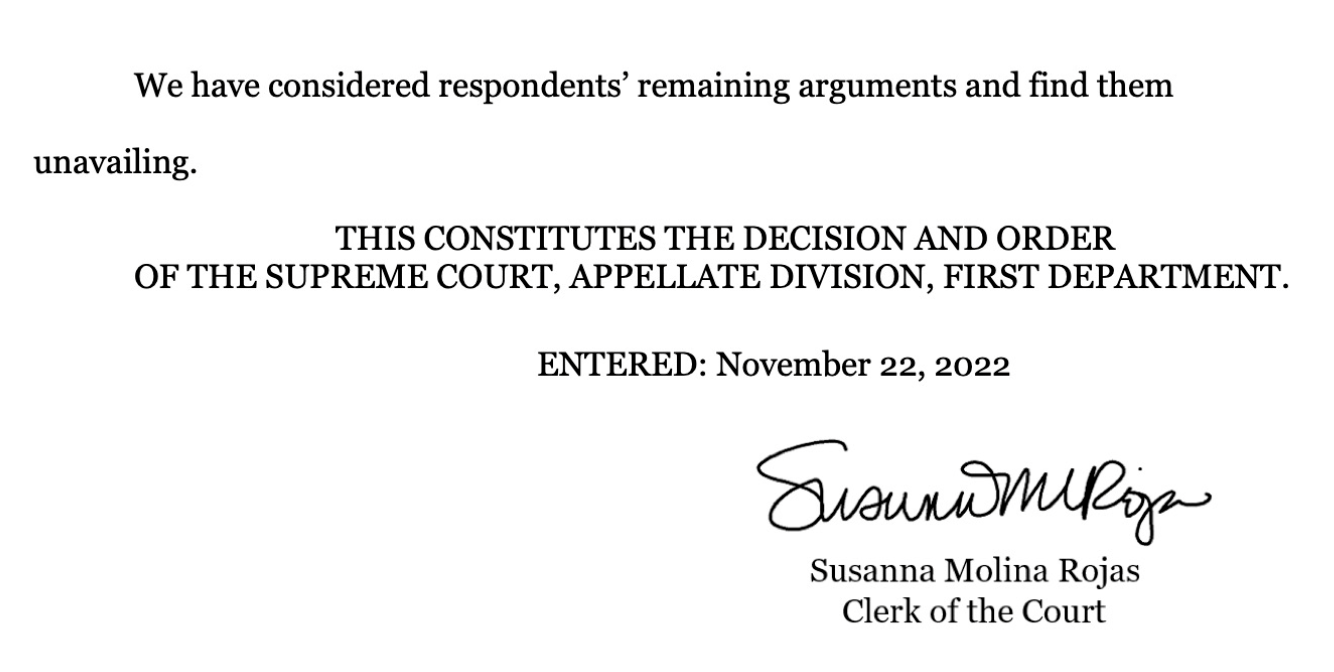
Budget cuts. Last Spring the New York City Department of Education did not allow public input on its budget proposal (that was full of cuts). They got around public comment by declaring an “emergency” – the same slimy tactic they used under Bloomberg and de Blasio. Eventually, though, the City Council passed the budget. In a win that was not a win, the court ruled that New York City violated the law. However, reversing the cuts today, the court affirmed, would be disruptive. They ordered the City to stop declaring emergencies to avoid public scrutiny.
Analysis is at Class Size Matters. The decision is here.
NYC, MLC, UFT cannot impose $192/month fee on retirees
New York City, the Municipal Labor Committee, the United Federation of Teachers leadership, and the leaderships of other municipal unions tried to impose a $192/month fee on municipal retirees who opted out of joining “Medicare Advantage Plus.” Retirees fought back, and in a stunning decision, won. But the City appealed. And today the New York Court of Appeals ruled that the lower court was right.
Coverage of the decision on Norm’s and James’s blogs.

In the meantime, the Mulgrew/Nespoli Medicare Advantage Plan collapsed months ago.
Today Mayor Adams, Harry Nespoli (Sanitation), and the UFT’s own lame duck, Michael Mulgrew, are off trying to change the law, as an end-run around the ruling. Section 12-126 of the administrative code protects workers and retirees against exactly the type of scheme these guys are trying to force on us. Call, email, tweet, write – let your city council member know how you feel “Do Not Amend 12-126. Do Not Amend the Code.”
Today Adams, Nespoli, and Mulgrew are trying to smear their opponents – the members, the retirees, us, the people who have so far blocked their plans to cut our healthcare.
Today Adams, Nespoli, and Mulgrew are off trying to find a new vendor for Medicare Advantage. They will eventually find a vendor – the deal is too good – take federal money – and the more procedures you deny, the more $$$ doesn’t get spent on healthcare – the bigger your profits will be.
So, no choice. Keep making those calls.
Weekend in the Shenandoah Valley
Weekend getaways are not my usual. This one was sweet.
Cozy cottage, set right into the edge of the Blue Ridge. Visited with a former teaching fellow, now a principal. Hadn’t seen each other in over a decade. She credits me, I didn’t realize, with, well, her words: “I’ve always loved math, but this guy was the one that helped me find my passion and love for teaching math as an NYC fellow.” I was touched.
There wasn’t enough time, but we hiked into and up the Blue Ridge. Climbed 750′ to a breathtaking overlook (on the Appalachian Trail), and then detoured another 800′ down to an impressive little waterfall (81′, but the water wasn’t running heavy). We missed the foliage by a few weeks. I can only imagine.
And then a cute local diner, and a winery for tasting.
There wasn’t enough time for Luray Caverns. I guess there should be a return trip. 😀
View from the cabin

Shenandoah Valley from the top of the ridge

Joining the Appalachian Trail

Tying Their Hands
Resolutions to bind their hands
Every few years a United Federation of Teachers (UFT) delegate suggests a resolution that the UFT take up front a position on something that is part of contract negotiations. Resolution to make class size reduction a negotiating priority. Resolution to get raises that at least keep up with inflation. Resolution not to trade more time for money. Resolution not to cut health care.
The leadership typically points out that the item is subject of collective bargaining. They further point out that we have a 50-member or 100-member or 300-member or 500-member negotiating committee. To take a position in advance on what our committee should be negotiating would bind their hands, when we don’t know where negotiations might be going. And then they get the delegate to withdraw the resolution, or they vote it down.
There was an exception. A delegate asked “no more time for money” and Unity approved that one. We voted on it. It is UFT policy. Why was Unity willing to make an exception? Because they had already traded away a huge amount of time for a not-quite commensurate amount of money in the horrible 2005 contract. Unity extended our school day, and then called the extra pay for the extra hours “a raise” – despite it meaning less time with our families – and frustratingly in spite of the fact that the extra time has not been super valuable. Anyway, I’m off track. A delegate stood up with a resolution that we don’t bargain away time for money, and Unity agreed because they’d already traded as much time away for money as they could.
But every other time Unity has said “do not tie the hands of our negotiating committee.”
The negotiating committee
Each contract these committees get larger. And over the years the committee has moved from being just a bunch of observers, to having conversations with the actual UFT negotiators, to actually playing some role in the discussions with the City. Yet most of us get the feeling some of the important dealing is being done out of earshot. Maybe most of it.
The committee members have to sign a confidentiality pledge. I’ve discussed this before. The pledge stops rank and file members from knowing what is going on. But the leadership and the City leak the negotiations to the press. And the Unity leadership lets the City know our demands before we officially give them to them.
Health Care
Arthur Goldstein was on the Negotiating Committee for the last contract. So when he wrote a piece in the Gotham Gazette last week, saying the health care changes were kept secret from us, Unity paid attention.
An officer requested a meeting with Arthur. Five Unity members (or union officials? not sure what capacity they were meeting with him in) met with him and tried to convince him he was wrong about Medicare Advantage. Plus, according to them, they were no longer trying to get retirees onto Medicare Advantage. Also, they pointed out, yes Arthur did know about the health care aspect of the 2018 contract – he wrote about it on his blog.
I checked Arthur’s blog. Yup, he wrote about the health care aspect of the agreement. He had written that Mulgrew said there were no givebacks. The New York Teacher wrote the same thing. Arthur had also written about the Exec Board, where Mulgrew didn’t even mention health care. And Arthur eventually wrote about the appendix where the health care changes were hidden. Arthur (and me) did see the appendix, eventually. But not because Mulgrew/Unity shared it. James Eterno found a source.
It turns out, Unity made a side deal six months before the contract.
- Unity made a deal outside of contract negotiations (Spring 2018) for health care cuts.
- The 2018 Negotiating Committee did not negotiate health care – even though health care cuts appeared in the appendix to the proposed contract. (Unity said “Contract negotiated by membership who sat across from DOE.” This omits health care)
- The cuts were not formally ratified until the October/November 2018 contract vote.
- Mulgrew did not tell the Executive Board the health care cuts were in the proposed contract.
- Mulgrew called it a “no giveback contract” (but there were givebacks)
- Mulgrew told the Delegate Assembly “Healthcare has nothing to do with this agreement”
- The Executive Board heard about the contract and voted to recommend it in the same meeting, without a chance to read the language, and never having seen Appendix B.
- The Delegate Assembly was rushed to recommend the contract to the membership without time to review the agreement. Importantly, the leadership hid Appendix B from the delegates,
- Arthur eventually learned that health care was in the contract, but not from the Unity leadership. It was from another blogger. Unity did not share Appendix B until later, although some sources did leak it before the contract vote.
Because the UFT officials/Unity members correctly pointed out that Arthur knew about health care being in the contract, he wrote a correction in Gotham Gazette (at bottom) and published a correction on his blog.
Here’s Arthur’s Gotham Gazette correction:
Correction: There was a health agreement made by MLC six months before the 2018 Contract, and UFT members were informed if it. Rank and file had not voted on it, and we were not aware of the particulars or implications. It was incorporated into Appendix B of the contract, which was not shared with us before the contract was ratified.
https://www.gothamgazette.com/130-opinion/11684-who-blame-nyc-teacher-health-care-debacle
Tying Their Hands
We need an intrepid delegate to offer a resolution:
- No more healthcare givebacks.
- Get back the health care we gave up.
A negotiating priority should be to undo the healthcare givebacks. It is very hard to get something back once we’ve given it away. It will take an extraordinary effort. It will take great creativity. And it requires rank and file oversight.
But in order for this to happen, we need to control the process.
- All health care negotiations must go through the negotiating committee.
- All health care deals must be completely explained to Exec Board members and Delegates, with time for reflection, research, and conversation with members before any vote.
- And that means no back door health care negotiations.
We do not need to tie the hands of the Negotiating Committee. They did not do this. But Mulgrew’s free rein to wheel and deal behind our backs? No. In that sense we need to place limits.
Big Picture vs Misdirection – Admin Code 12-126
Here’s the series of events:
- Mayor Adams, the Municipal Labor Committee, including the United Federation of Teachers leadership (Mulgrew et al) were trying to force retirees out of real Medicare and into their “Medicare Advantage Plus.”
- Retirees sued to stop them.
- Judge ruled against Mulgrew and Adams. The decision rested on Section 12-126 of the Administrative Code.
Pause here. Mulgrew wanted something. He was denied. There’s a law that stopped him. So how does he react?
- Mulgrew/Nespoli (MLC) et al begin a campaign to amend the law.
- Retirees go into action, and lobby city council NOT to amend.
- Retirees seem to have the upper hand.
- Mulgrew/Garido (DC37) et al try to campaign for the amendment, with talking point memos sent to in-service and retired members.
- Retirees still seem to have the upper hand.
- Adams’ Commissioner of Labor Relations, Renee Campion, sends a letter to the unions October 13 threatening Bad Things if the code is not amended.
- The UFT and DC37 use the Campion letter to revive their City Council Lobbying campaign.
- Using the Campion letter to scare members proves ineffective for Mulgrew. Retirees still have upper hand.
Pause. Mulgrew wants Medicare Advantage Plus. Retirees block him. He tries to change the law to “unblock” the City and the MLC (so they can force retirees onto Medicare Advantage). They block him again. He tries campaigning with members. Nope. He tries using the Campion letter to scare members into supporting amending 12-126 so he can force retirees into Medicare Advantage. Still not working.
- Mulgrew issues a new “fact” sheet.
- He buries the argument over 12-126 in details (it’s SIX pages. I’m not sharing)
- He claims this has nothing to do with Medicare Advantage.
So I put it to you. After fighting for almost two years to force retirees onto Medicare Advantage, is Mulgrew now fighting, with the same people on his side, and the same opponents, but not about Medicare Advantage anymore?
And the City.
- Does the City (Adams/Campion) favor amending the code because it will allow them (with MLC cooperation) to force retirees into a Medicare Advantage Plan?
- Or does the City (Adams/Campion) want to change the code to give the UFT more power and give UFT members more protections?
Adams wants to change the code.
- To protect city workers?
- Or to force retirees into Medicare Advantage?
Focus on the big picture. Mulgrew and Unity think you can be distracted by misdirection.
Do not amend Section 12-126 of the NYC Administrative Code. Take action (sign, call, email) now.

What’s going on with Congressional Results?
All the outlets are saying the Republicans are close, but have not yet clinched.
Except Decision Desk. They say the Republicans already won. And NBC, which is reporting a projection instead of a count.
Quick rundown on what the outlets say. And a quick rundown of the seats that are still, or might be still, in play.
| Outlet | Dem | GOP | Remaining | Note |
| ABC | 209 | 217 | 9 | 10 left on the map |
| Bloomberg | 209 | 217 | 9 | 10 left on the map |
| Decision Desk | 206 | 219 | 10 | |
| Fox News | 209 | 217 | 9 | 10 left open. They put their circles in a grid. It looks like they have 208-217, not 209-217. |
| NBC News | 209 | 216 | 10 | That’s what their map shows. They give a projection 215-220 |
| Politico | 208 | 217 | 10 | |
| Real Clear Politics | 208 | 217 | 10 | |
| Washington Post | 209 | 217 | 9 |
It’s annoying that so many are making some shared counting error – maps show 10 seats left to count, but their counts show 9 left.


But aside from the one seat error, and Decision Desk declaring a few extra seats, the counts are very similar. No one is making crazy claims.
Lets look at the specific seats that have not been called:
Seats Not Yet Called
| Note | Which way | ||
| AK at large | Waiting for Ranked Choice | Very Likely D | 🔵🔵🔵 |
| CO-03 | 1,112 R vote margin, still counting, recount(s) likely | Likely R | 🔴🔴 |
| ME-02 | Waiting for Ranked Choice | Likely D | 🔵🔵 |
| CA-03 | Slow count, but not much drama | Likely R | 🔴🔴 |
| CA-13 | Central Valley – toss up | Lean D | 🔵 |
| CA-22 | Valadao, Trump-impeacher R, holds lead of 3,280 | Lean R | 🔴 |
| CA-27 | Not called, but R Mike Garcia has claimed victory | Very Likely R | 🔴🔴🔴 |
| CA-34 | Gomez (D) leads Kim (D) | Solid D | 🔵🔵🔵 |
| CA-47 | Porter leads by 3,772 with 84% counted. | Lean D | 🔵 |
| CA-49 | D holds 12,000 vote lead | Likely D | 🔵🔵 |
| All others | 208 – 217 |
AK at large. It’s ranked choice – in this case one candidate will need 50%. The democrat, Peltola, has 47% to 26% for Palin and 24% for Begich. The rules will make it take a while to get to the count, but in a very similar race this summer Peltola needed more votes from Begich, and easily got them. Many Begich voters will just not support Palin. This is a Democratic win, just a matter of time.
ME-02. Also a ranked choice situation. Golden, the Democrat, leads Poliquin, the Republican, 151,504 to 141,006, or 48.2% to 44.9%. A third candidate has 21,555 votes, which will be redistributed between the two major candidates. That third candidate, Tiffany Bond, ran on a socially liberal old-fashioned Republican platform, with a tinge of Libertarianism to it. I bet her votes split fairly evenly. And Poliquin, to win, would need 3/4s of her votes. Does not look likely.
CO-03. Lauren Boebert took a very Republican district (+15R partisan lean) and turned it into a nail-biter. Too crazy for Trump voters. She leads 162,040 to 160,918 (50.2% to 49.8%) with only a few votes outstanding. Counting will wrap up Friday, after which there may be a recount (or recounts).
CA-03. District runs a long stretch of the Nevada border. It’s on the right side of the state, and leans to the right side of the political spectrum. It’s got a +8 Republic partisan lean. The Republican leads by 5.6%. Why has this district not been called? Because less than 60% of the vote is in. Is there a reason to think this one might be close? Nah. Kevin Kiley should win.
CA-13. Democratic Adam Gray leads this Central Valley district 56,521 to 55,921, a razor-thin margin (50.3% to 49.7%) with 2/3rds counted. The district has a D Partisan lean of +7, but that my be offset by lower turnout among agricultural workers.
CA-22. David Valadao was one of the few Republicans to vote to impeach Trump. His San Joaquin Valley district, including Bakersfield, is pretty evenly divided. And he maintains a small lead. over Rudy Salas, 35,421 to 32,141. That may be enough to hang on, but only 2/3rds of the vote is in.
CA-27. Likely Republican hold. Decision Desk called it. Incumbent Mike Garcia claimed victory. But race not officially called.
CA-34. California has open primaries (every party) and the top two face off in the general election. Does that mean the top two could both be Democrats? That’s what happened in CD34. Rematch of 2020, Jimmy Gomez (incumbent) beating David Kim in this Los Angeles seat, this time 52%-48%, last time 53%-47%.
CA-47. Katie Porter leads by 3,772 or 1.6% with 84% counted. The district is in Orange County, and has a +6D partisan lean, but elections here have been tight. This may take a while to be finalized.
CA-49. Incumbent Levin (D) leads by over 12,000 votes with 89% of the vote in. Almost a 5% lead. This is approaching a safe margin.
Summary
Today we are at 208 – 217.
Including the most likely remaining: 210 – 218 (Republicans control the house)
Including most of the rest, except CA-13, CA-22 and CA-47: 212-220
Including all: 214 – 221.
212-223, 213-222, 214-221, and 215-220 all seem reasonable picks at this point. Republican margin would be 5, 7, 9, or 11. All small. But all with Republicans in control.
Does Mulgrew have a Plan B?
UFT members, in-service and retired, have been calling our City Council members with a clear message: “Do NOT Amend administrative code 12-126” By the way – there’s still time to write or call.
Why do we have to protect this law?
Because the City and the Municipal Labor Committee have joined forces to lean on members to lobby the city council to change the administrative code 12-126. That’s Mulgrew and the UFT leadership, and DC37, and a bunch of other union leaders.
What are they doing? The unions have promised the City that they would generate $600 million in health care savings, every year. They made the promise in the contract that just ended, but the promise goes on indefinitely.
Health care savings? Means we get less service. Or we pay more. Cuts is what regular people call them.
Anyhow, the route the MLC and the City (Mulgrew, Nespoli, Adams) are trying to take is to amend 12-126 so they can force retirees onto a medicare advantage plan.
Who’s Winning?
Regular folks are saying “don’t amend” – the politicians and the union leaders are saying “amend.” Both sides can’t win.
Right now, believe it or not, the workers and retirees seem to have the upper hand. In this country, the little guy winning? Wow. That’s a movie. (or it would be, if it were sexier than New York City Administrative Code 12-126). And in the UFT? It’s been almost three decades since the rank and file did anything like this, defeating a contract with zeroes in it.
What Happens Next?
If the amendment is defeated? Or if it is never even voted on? (which seems more likely)
There are some scary threats from the City. I might write about them. But I don’t know that they are really coming.
What’s next? Honestly. If they lose their amendment, they will have to come up with something.
If Mulgrew is on the hook for six mil, and he can’t get it from retirees, he’s going to need a back-up plan, a Plan B.
What is Mulgrew’s Plan B?
I think we have to ask him. I think he needs to tell us. Because that is in all likelihood where we are headed.
“Looks like your amendment’s failed. What’s your Plan B?”

Oh, and if you ask him, and he answers, please let the rest of us know.
Any ideas out there?
Yup – there is a resolution out there – apparently not yet introduced – to restore the stock transfer tax, stock buyback tax, and bring the corporate tax back to where it was in 2017, and create several other taxes on super-wealth (luxury Manhattan second homes worth $14M should pay something, right?). We could use that money so that regular people don’t get less healthcare, and don’t have to pay more for what they do get. Anyway: Interim Resolution to Address the Rising Cost of Health Care (scroll down for it).
And if you have other ideas, please share them. Explain them clearly, and simply. Mulgrew really does need a Plan B, and maybe we can help.
Save Our Healthcare –
MORE Town Hall
Sunday evening, November 13
http://tinyurl.com/HealthCareTH

The fight against amending NYC Administrative Code 12-126 continues. The code sets a floor the city must pay for our healthcare, and blocks them from going lower.
The amendment will let them go lower. We need to defeat this amendment, or even stop City Council from considering it.
http://tinyurl.com/HealthCareTH
This event is for current teachers and other school workers, and for retirees.
These changes threaten the healthcare of IN SERVICE and RETIREES. We are in this together. We will beat this together.
See you Sunday!
Votes for Congress in New York State 2022
Most of us know, Democrats lost four districts in New York, including two on Long Island. New York was the worst swing for the Democrats in the country, arguably worse than the loss of four in Florida. In Florida an aggressive gerrymander worked, and the statewide GOP got good turnout – but Democrats held their own exactly where they were expected to.
In New York, it looks like Democratic vote failed to meet expectations hardly anywhere. But “anywhere” introduces the idea of “where” which means we might turn things up looking at some maps. OK.
Before you go on, you might like to take a look at what I wrote about the governor’s race yesterday. There’s a pretty good argument to be made that there were very different dynamics at play – I might use I-84 as the dividing line – from Port Jervis through Poughkeepsie to somewhere on the northwest CT border. Above and to the left, we have some regional variation, but it’s kind of a regular state. Down and to the right, the northern suburbs, NYC, and Long Island are a different sort of animal. In particular this election Hochul did far worse in the lower part (NYC etc) than Cuomo had in 2018, but she ran close to him or even better in the first part. Also, turnout plummeted in the NYC etc part for the Democrats. It rose dramatically, but not nearly as much, for the Republicans downstate.
538
I have followed 538 for a while. They can slice up data pretty well. They are not particularly good at analyzing it. They don’t have much of a sense of history (though I have seen some improvement). They don’t write very well, and as someone who doesn’t write particularly well, I claim some expertise. And their “model” or really “models” remind me of boys making a formula for picking the MVP. Then not liking the results, and adjusting the formula. And doing it again and again until it gives the result they expected. So their prior expectations litter the result, but those expectations are not completely wrong, and in the process of tinkering they might begin to recognize some interesting stuff. That’s pretty much my understanding of Nate Silver, except he has a lot more time, really powerful computers, paid staff, and chronological age over 11.
All of which is to say I am using 538s Deluxe Model, because it is the one Silver has tinkered with the most. Here’s what it predicted for New York State (map looks red because of western NY, the Southern Tier, Central New York, the North Country, and the Capitol Region – which are all less dense than the concentration of districts in the Lower Hudson Valley, New York City (11 districts) and Long Island (4 districts).
538 Deluxe Forecast: Margins in NY Congressional Districts
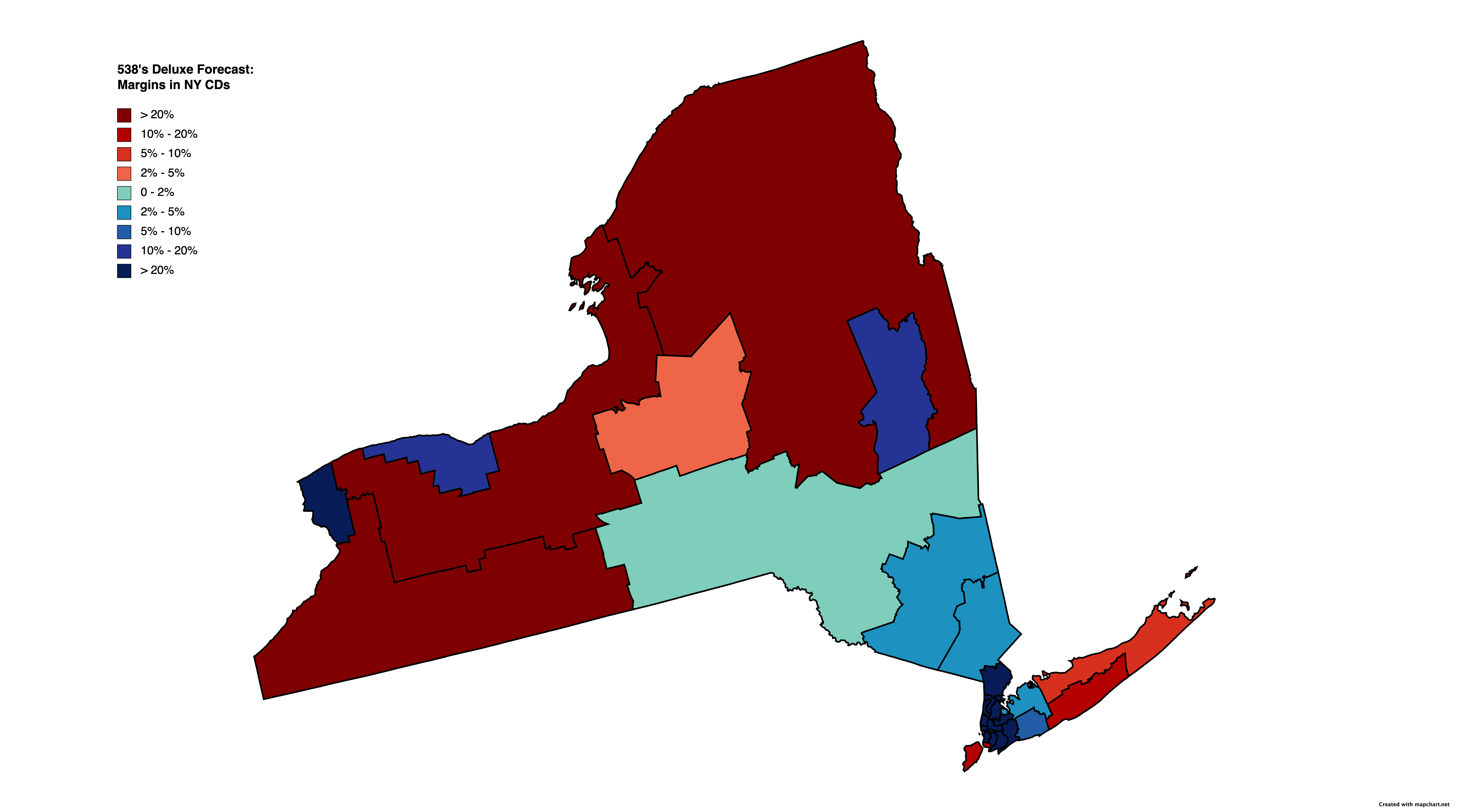
Source 538.com’s model page – not sure you can see the data, but you can try
Democrats had 15 pretty certain and 4 leans, Republicans had 6 pretty certain and 1 lean.
But you know what happened – Democratic turnout, especially in NYC and suburbs, including Rockland and Long Island, was not there. And this is what the map looks like (I am not certain why no one has called 22, that small one that looks like a dog barking right in the center, with Syracuse if you know where that is. But it looks like a GOP hold.)
Unofficial Results: Margins in NY Congressional Districts
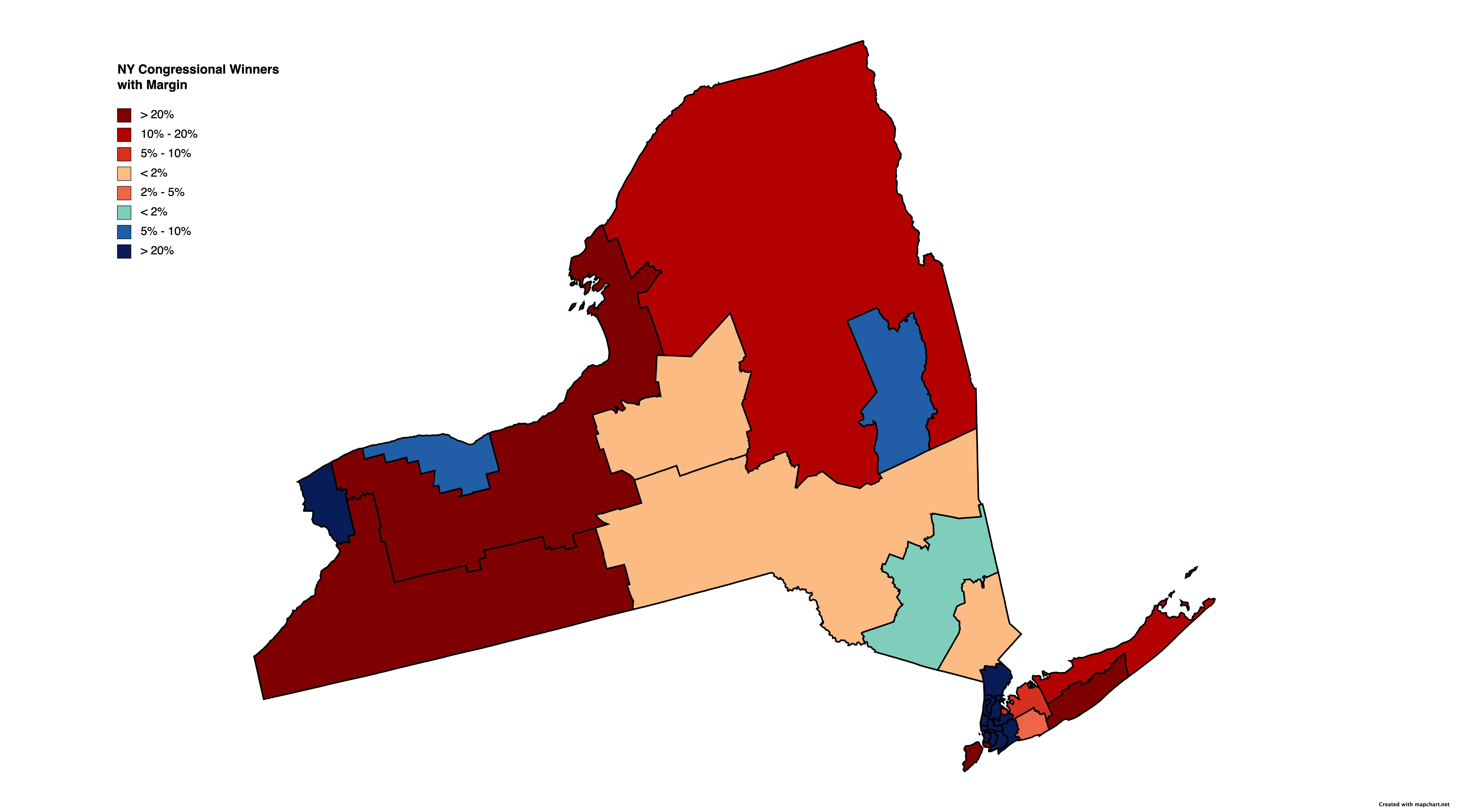
Source: NY State Board of Elections Election Nights Results Page
Immediately I notice that blue belt (20-19-18-17-16-NYC-3-4, above) breaking up. And it is true, those four districts that are not blue, 19, 17, 3, and 4, they are the big New York congressional races news. But I am interested in what’s going on with the votes in New York State.
Let’s look at how much higher or lower margins were than expected. That means not only looking at the flips – but where did each party actually meet expectations. And, I have a feeling you already know what’s going to jump out:
Actual Margin vs Forecast (538 Deluxe) Margin

Where is most of Hochul’s underperformance? NYC. Where is most of Zeldin’s overperformance? Long Island and Staten Island. Look at the rest of the state. Two very close districts flipped, but aside from that, it’s an ordinary map, mostly each party held its own districts by roughly the expected margin.
Specific districts
CD-22, the medium red district in the center that looks like a dog howling – see the snout pointed towards Lake Champlain? And the lower jaw pointing to Lake George? And the stubby tail south of Oswego? It would be clearer if they drew Oneida Lake out, so you could see his left ear. Anyhow, someone needs to draw that dog and make it look beautiful, and someone with more data and skill than I do should look at the demographics and voting patterns of this Erie Canal/New York Central/Central New York district. It is complicated. Rome, Utica, and Syracuse are not like the rest of New York State. I think as the rest of the state swings to and fro, this district may be moving in its own direction.
CD-19, the furthest north of the flipped districts. This is a complicated amalgam of a university town – Ithaca – a fairly Trumpy region, some conservative suburbs, and part of the increasingly hard Democratic leaning Upper Hudson Valley. It too should stay a competitive – perhaps longer than 22, since it’s different parts may tend to drift in different political directions.
CD-17. There is a story. Sean Patrick Maloney losing is a big deal. He was a non-progressive big shot in the Democratic Party. He bullied his way into the seat, running where Mondaire Jones was serving (Jones ran in the primary in CD10 in Manhattan, screwing up that race and handing it to a friend of the family that runs the New York Times). Alessandra Biaggi primaried Maloney (good for her!), but he won, he got what he wanted, and he lost.
It would be easy for outside observers to take some interesting stabs at what happened, without having any specific information. In fact, I see at 538 (remember, data good, analysis? Meh) they are doing just that:
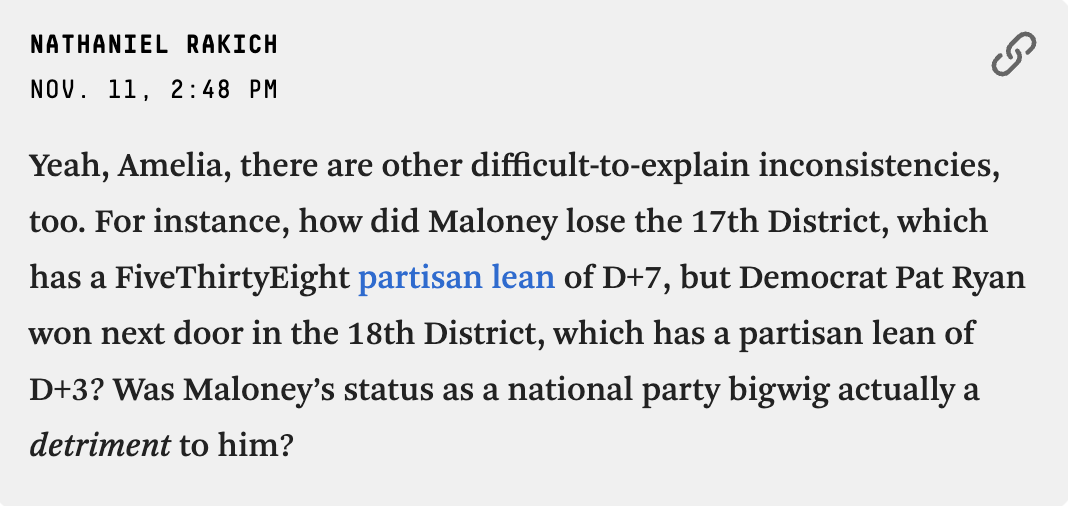
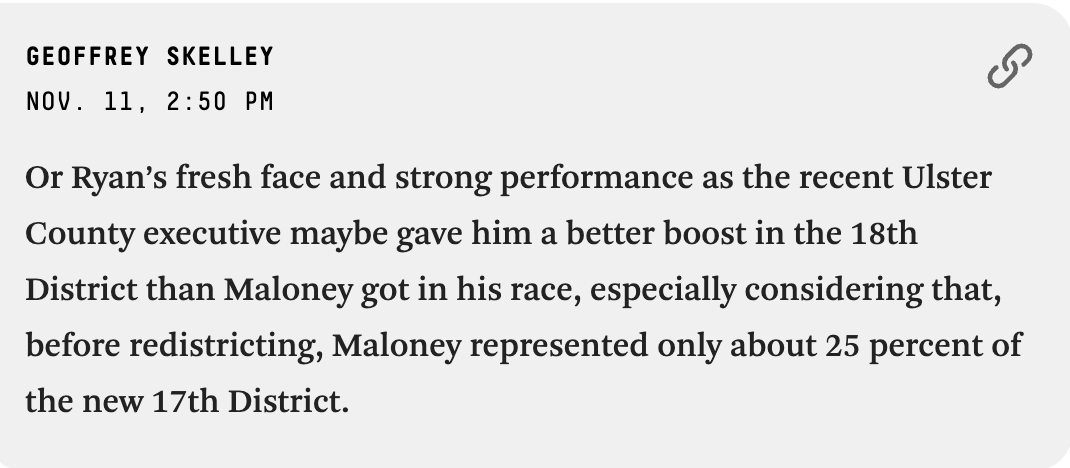
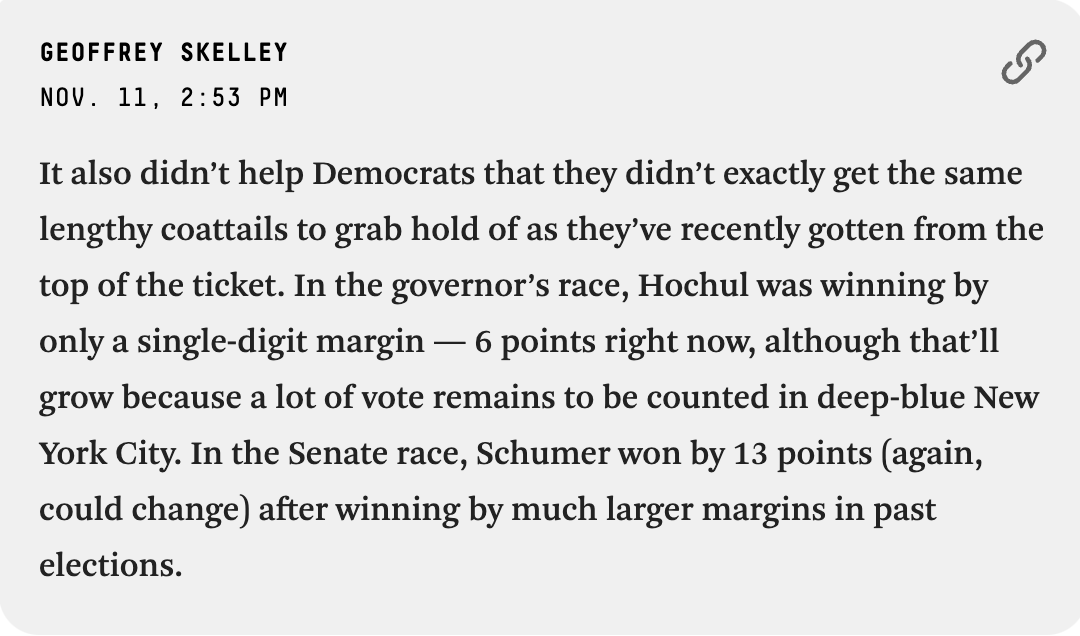

If you are going to discuss a specific district, it might be helpful to know something about that district.
17 was drawn as a balanced, Democratic-leaning district, drawn from part of Westchester, all of Putnam, all of Rockland, and part of Dutchess. By votes: 42% Westchester, 38% Rockland, 14% Putnam, 6% Dutchess. Now, there’s been redistricting, so no direct comparisons are possible district to district. But not every county line was cut. And we have Rockland returns from the last 2 elections.
Rockland County 2020 vs 2022
| Dem | GOP | |
| 2020 | 68,697 | 54,791 |
| 2022 | 47,591 | 58,288 |
How is this different from Zeldin up some, Dem down a bunch anywhere else downstate? First let me note that there were about 1,200 Zeldin (R) / Maloney (D) voters in Rockland. That’s interesting.
But then, let’s just look at this endorsement: https://www.jpost.com/diaspora/article-721699. This week. Hasids. Zeldin. Strong endorsement. Groups vote en bloc. And there are now 50,000 Hasidim in Rockland County. Yes, Zeldin outran Molinaro. Yes Democratic turnout fell in NYC and the near suburbs. But that endorsement hit Sean Patrick Maloney in CD-17, and did not matter one bit in CD-18.
And then the reason is two-fold. One, they like Republicans, but vote for Democrats if they think Democrats are sure winners. Maybe this is a successful version of “seat at the table” politics. We could send in Unity leaders to learn how it is actually done. But maybe not. The second reason might get in the way.
Under Cuomo, the Hasidic groups used that “seat at the table” to secure unwritten agreements that they could get public funding for their schools, with no oversight. In a famous case, a group sued FOR state intervention, because their kids were learning torah, but not math, not to read and write English, not the things that we really expect schools to do. But I don’t think Hochul made the same dirty deal.
And thus Sean Patrick Maloney may have been defeated by people seeking to keep their children from learning to read.
Long Island
I’m not talking about Long Island. I don’t want to get into any more trouble.
What Happened to Hochul’s Vote?
Did Kathy Hochul do much worse than Andrew Cuomo? How did that happen? Can I make maps that will help us understand? Sure I can!
Some historic data first:
| Dem | Rep | Ind | Grn | Other | |
| 1998 | Vallone | Pataki | Golisano | Lewis | Mccaughey (Liberal) |
| 1998 | 1.57M | 2.57M | 0.36M | 0.1M | 0.1M |
| 1998 | 33.2% | 54.3% | 7.7% | 1.1% | 1.7% |
| 2002 | McCall | Pataki | Golisano | ||
| 2002 | 1.53M | 2.26M | 0.65M | ||
| 2002 | 33.5% | 49.4% | 14.3% | ||
| 2006 | Spitzer | Faso | |||
| 2006 | 3.09M | 1.27M | |||
| 2006 | 65.3% | 27.1% | |||
| 2010 | Cuomo | Paladino | Hawkins | ||
| 2010 | 2.91M | 1.55M | 0.1M | ||
| 2010 | 63.0% | 33.5% | 1.3% | ||
| 2014 | Cuomo | Astorino | Hawkins | ||
| 2014 | 2.07M | 1.54M | 0.2M | ||
| 2014 | 54.3% | 40.3% | 4.8% | ||
| 2018 | Cuomo | Molinaro | Hawkins | Sharpe (Libertarian) | |
| 2018 | 3.64M | 2.21M | 0.1M | 0.1M | |
| 2018 | 59.6% | 36.2% | 1.7% | 1.6% | |
| 2022 | Hochul | Zeldin | |||
| 2022 | 3.03M | 2.73M | |||
| 2022 | 52.6% | 47.4% |
I included any parties that both broke 1% and got at least 50k votes. I listed candidates under the main party they campaigned under – sorry WFP. In 1998 the Right to Life (which seems not to have actually had one) got 1.2%.
Now, there’s not enough here to figure out what happened. Hochul scored a lower percent than Cuomo scored in three races, but not much less than 2014. Her vote total exceeded his from 2014 and 2010. And, remember, 2018 everyone was petrified of Trump, which drove urban turnout. Also, no one has a percent as high as Eliot Spitzer, and that was before Trump.
First item. Turnout looks lower in 2022 than 2018.
Turnout 2022 compared to 2018

And this is a VERY specific map. Turnout was mixed in NY from Syracuse, west. Turnout was up slightly in the North Country, flat in the Hudson Valley, up slightly on Long Island, and down, kind of dramatically, in the four major boroughs and Westchester. The biggest fall? The Bronx, where turnout dropped 33.4%
Was this drop in voters felt equally by both parties? Let’s look at Zeldin first:
Zeldin votes as share of Molinaro votes

The legend came out tiny, sorry. But that cherry red is over a 25% increase in raw votes (not percentage) and the dark red is over 50%. Zeldin lost votes or was flat along the CT/MA/VT border and in one county, from Dutchess to Washington, but he gained votes everywhere else in the state. And he topped Molinaro by the biggest numbers on Long Island, in Rockland, and especially in NYC, precisely where the total vote dropped the most sharply. Vote dropped? And Zeldin votes went up? Same places? That’s probably more than enthusiasm – that’s some groups shifting sides.
Let’s see where Hochul’s votes rose and fell.
Hochul votes as Share of Cuomo 2018 votes

Surprised? Hochul generally outran Cuomo upstate, except for a bit of the Trump-y southern tier. And she creamed him in the Capitol District and upper Hudson Valley. But she ran way behind him in Rockland, Westchester, NYC, and Long Island.
Most people would not look at difference in raw votes. They would consider the margin by which the democrat trailed or led the republican. OK, that’s a slightly different lens. If Cuomo lost Dutchess county by 7%, and Hochul lost by 4%, we can call that a plus three (+3%) swing to Hochul. Here’s what that looks like on a map:
Margin swing Cuomo 2018 to Hochul 2022

Nice when a map confirms what we expected! Hochul ran nearly even with Cuomo 2018 in most of the state, outpaced him in the Capitol District (the area around Albany) and the upper Hudson Valley, and did far worse in Rockland, Westchester, NYC, and Long Island.
I was talking to someone from the WFP today, and he said “Jon. but 2018 was amazing turnout in NYC, everyone was wild about Trump.” So, having already downloaded 2014 data, I answered “OK, I’ll compare Hochul to 2014, figure that’s more of a baseline.” And I did.
A quick peek at turnout, before we proceed. Sorry for not sticking to the green scale. I think I got distracted.
Turnout 2022 compared to 2014

It’s going to be hard to look at raw votes between 2014 and 2022, because totals for everyone are up, pretty much everywhere, except 3 fairly lightly populated North Country counties. So we will just look at percentage swing.
Margin swing Cuomo 2014 to Hochul 2022

Color scales are not identical to the 2018 to 2022 map, sorry. But you get the idea.
In the last decade some upstate areas – along the southern tier – in the North Country, have added substantial GOP votes. This needs more work, because these are definitely NOT the counties that swung hardest to the GOP in the age of Trump, though they all did swing at least a little.
But also, all of NYC except Manhattan, Long Island, and Rockland added Republican votes.
In fact, I didn’t repeat the map you can see at Politico, but Hochul and Cuomo carried the same counties upstate.
In the Capitol District and Lower Hudson Valley, Cuomo only carried Ulster and Albany. Hochul took those, and also Schenectady and Columbia.
But the biggest changes were Hochul losing Rockland, Staten Island, Nassau, and Suffolk – all which Cuomo won.
Last Notes
The Capitol District and Lower Hudson are growing more democratic, but also more progressive. It looks like the Greens had been doing better there in the NYC and the suburbs, and the Working Families Party did well in parts of the 5 boroughs, but also Tompkins (Ithaca, the colleges), and the Capitol District and Upper Hudson.
NYC needs a look at the Election District level, or at least the Assembly District level, to get a better handle on which Democratic voters didn’t vote, and which switched to Zeldin. Something like that would be useful for Rockland and Long Island as well.
Since Pataki, New York has looked so Democratic Party run that we might forget that statewide things have swung back and forth. Parts of this state, this city, may be realigning. Or it could just be a fluke election. Me? I am not voting fluke.
That’s one question to dig into. Another, a big one, the Democrats lost Congressional seats on Long Island (Nassau and Suffolk), in the Lower Hudson Valley (that’s Maloney – Westchester, Rockland, and Putnam), and District 19, which stretches from Tioga and Tompkins all the way to Greene and Columbia, so that is more of a mixed district. But for the other three, do those losses represent long-term voter shifts? or just Hochul lagging Cuomo in those areas? Not easy questions.
And yeah, in answer to my original question, Hochul did a lot worse than Cuomo’s best election, and just a little worse than his election before that.
The data comes from the NYS Board of elections, except 2022 comes from Politico, where all returns were unofficial, and mostly incomplete (95%, 98%, like that)
Election Day Today
So go out and vote, if you haven’t yet. Polls are open in New York until 9PM – that’s plenty of time.
A lot of people already voted. I did. We get to relax and watch the results come in. Or don’t relax. But your choice. Some people are volunteering at polling places. I might show up.
Teachers get “PD” instead of a regular work day. I am not teaching this year. But I used to not especially like meetings instead of teaching. The best part of being in school, for me, and for many teachers, is working directly with kids. One year I went to a pd in a nearby school. It was in a large auditorium, and the speaker carefully explained the science behind “attention span” and why 15 minutes was the absolute longest teens and most adults could hold focus, and 10 minutes might be more like it. He spoke to us, without interruption, for 45 minutes on this topic. Was it worth 45 minutes of sliding in and out of focus (consciousness) to earn my favorite pd story? Hmm. I’d rather teach.
Predictions
Might as well make predictions.
In New York, no real surprises. Hochul’s “tight” race will turn out to be about a 10 point win. Bigger wins for Letitia James and Tom Di Napoli. Even bigger for Schumer, who I won’t vote for, ever. The house delegation goes for the Democrats 19 – 7, with no upsets (It’s currently 19 – 8).
Nationally, it’s a likely going to be a bad day for the Democrats.
Current house is 222 Democrats, 212 Republicans, and one vacancy. I keep counting and recounting, best guess is it ends up 199 Democrats and 236 Republicans.
The Senate is at 50 – 50, with VP Harris breaking ties for the Democrats. I think it will take more than a day to get “final” results, and the Democrats seem to have a chance, but I’m torn on my prediction – between 50 Republicans, 49 Democrats, and Georgia going to a run-off to determine control of the senate – or 51 Republicans, 48 Democrats, and Georgia going to a run-off that won’t determine control.
Thought
Can you imagine a country where we are divided roughly 50/50? The “moderate” democrats, the ones really in charge of the party, I’m not making a list, not today, but I have nothing in common with them. But the alternative choice in many races are batshit insane, openly racist Trumpers? And it’s really 50/50. What a sick, sick country we have become.
At least I’ve got a good state senator.
The Proposed Amendment to 12-126 Threatens the Healthcare of In-service NYC Workers as well
Adams and Mulgrew are threatening the healthcare of active workers AND retirees. The Municipal Labor Committee (MLC) and the City Office of Labor Relations have been trying to force retirees out of Real Medicare into Medicare Advantage. Since they have been blocked they are now trying to amend the City Administrative Code (like local law) to make it easy to reduce how much health care is provided.
It’s playing in the media like it’s all about retirees. Why should actives care? Well we should.
First, those retiree benefits that UFT President Mulgrew is trying to diminish? Those are ours, one day.
But more immediately, the changes he and Mayor Adams and the head of the MLC, Sanitation Workers, harry Nespoli are pushing – they would enable to the City to cut health care for active, in-service employees.
Solidarity between retired teachers and in-service teachers, between retired city workers and active city workers – that solidarity is critical to preventing Adams/Mulgrew/Nespoli’s plans to reduce how much health care each of us gets.
A friend, a 71 year old retired NYC employee (not a UFT member) who put in 35 years of service and has kept informed on this matter, wrote up some notes. Here is an excerpt. All the parts that affect in-service members are in bold type:
· The proposed changes to 12-126 have their origin in an ill-conceived scheme hatched by the previous Mayor and the leaders of the MLC that involved the ‘borrowing’ of a billion dollars in health insurance stabilization funds to pay for raises to active employees and ‘repaying’ the borrowed funds with ‘savings’ generated by forcing existing New York City retirees to enroll in a ‘free’ Federally subsidized Medicare Advantage plan or to begin paying for the $200 per month per person for themselves and their dependents for the free Medicare supplemental health insurance plan they had earned as a result of their years of service.
· While the previous Mayor and his MLC cohorts did succeed in ‘borrowing’ the stabilization money to fund raises, their repayment plan failed spectacularly due to the fact it violated 12-126 and the extraordinarily inferior quality of the Medicare Advantage Plan they wanted to impose on existing retirees.
· Although they are now being presented as measures designed to reduce and stabilize healthcare benefit costs, the proposed changes to 12-126 are first and foremost a second attempt to implement the previous administration’s ill-founded and poorly conceived repayment plan.
· The proposed changes to 12-126 will put the quality and cost of active employee and retiree health care benefits at risk by allowing the single health insurance price setting benchmark and the all-inclusive definition of the class it applies to that were explicitly set forth in 12-126 when it was adopted by the City Council to be replaced at any time by the current Mayor and his MLC cohorts as well as by future Mayors and MLC leaders with multiple different price setting benchmarks and class definitions designed to raise the monthly health insurance premiums to be paid by whatever group or groups of people they choose to target.
· The way proposed changes to 12-126 are constructed the City Council, the City’s legislative body, will be unable to review, question, moderate or prevent the imposition of price setting benchmarks and class definitions a Mayor and the MLC decide to set in order to raise premiums.
· The proposed changes to 12-126 will give all power in setting health insurance premiums to the Mayor and MLC members and reduce not only the role of the City Council but of everyone else to that of a powerless bystander.
· The impact of the proposed changes to 12-126 will fall first and most heavily on existing retirees because the changes will allow the Mayor and the MLC to once again offer them the Hobson’s choice of paying $200 per month per person for themselves and each of their dependents to keep the now free supplemental health insurance they were promised and earned or to allow themselves and their dependents to be enrolled in a privately run Medicare Advantage Plan, which is health insurance model proven to foster corruption, offer fewer provider choices and place profit ahead of quality care.
· In the future, active employees can and are likely to be impacted by the proposed changes to 12-126 because the changes will allow this Mayor and his MLC cohorts as well as future Mayors and MLC leaders to change pricing benchmarks and class definitions so as to impose or raise the premiums active employees pay for their health insurance whenever they deem it necessary to cut costs or save money and to do so without any public input or review.
· The proposed changes to 12-126 will result in active employees confronting upon their retirement the same Hobson’s choice to be imposed on existing retirees and needing to choose between paying $200 per month per person for themselves and each of their dependents for the free supplemental health insurance they were originally promised or allowing themselves and their dependents to be enrolled in a privately run Medicare Advantage Plan, which absent substantial reforms at the Federal level will still be a health insurance model that fosters corruption, offers fewer provider choices and places profit ahead of quality care.
· That the proposed changes to 12-126 will do nothing to temper the rising hospital and prescription drug costs which are the true drivers of escalating health insurance premiums and that those rising costs would best be addressed not by changing 12-126 which relates specifically to the premium amounts the City will cover but by the City, the State, the unions and health insurance providers coming together to negotiate better deals with doctors, hospitals and prescription drug providers.

Questions Planned for Tonight’s UFT Exec Board
Tonight’s Exec Board is Closed to UFT Members
It’s called “Executive Session.” It’s a measure normally reserved for financial reports, reports on misconduct, election reports. I don’t know if regular members will ever learn why tonight was closed.
Usually there are minutes of UFT Exec boards. Not formal minutes. When I was a member there was a stenographer. Maybe there still is. But the leadership does not produce detailed minutes, as far as I know. No, for good minutes we look to James Eterno on the ICE blog and Nick Bacon on the New Action blog.
But not tonight. Unity declared tonight’s meeting “executive session” and so the meetings are closed and the proceedings won’t be reported.
However, we know that the seven opposition people had two resolutions ready. One was on finding alternate revenue sources, so that the city doesn’t have to screw over our retirees’ health care. The other was on combatting abusive administrators. Nick published both resolutions BEFORE the MEETING on the New Action site.
Also, no one has to be there to know that LeRoy Barr gave a staff director’s report. He probably talked about Teacher Union Day where I got my certificate (though he won’t mention that). And Mulgrew will give a president’s report. He should talk about health care, and how the retirees are kicking his butt with the City Council (though he won’t be so honest).
But I sat with the seven members of the Exec board who were elected from the high schools. And I know what questions they planned to ask. I’m not sure if they had the chance, closed session, heavy-handed leadership, bureaucratic obstacles to speaking, but they were going to try.
Questions Planned for Tonight’s UFT Exec Board
1. Does each district rep maintain a list of the worst problem principals in their district. What are our plans to act on those?
2. Why did the Mulgrew “bombshell” letter launching a campaign on amending Section 12-126 of the City Administrative code not go to the Exec board first? It’s a big move, involving resources and money. There clearly was time.
3. What is our exit strategy if the amendment to 12-126 does not pass?
A Recent Read: Metabolical
I stopped reading for a long time. And in the last few months I have returned to reading. Instead of picking up one book I have been trying to keep up with three magazines, and keeping 4 – 5 books open at a time, and bounce between them. And even though this does not sound like a great way to read, in June I wasn’t reading, and today I am.
And I have slowly been finishing books. One of them was Metabolical: The Lure and the Lies of Processed Food, Nutrition, and Modern Medicine, by Jack Lustig.
Lustig
Jack Lustig is a doctor. He specialized in pediatric obesity. And he hit the big time outside of medicine when he wrote Fat Chance.
Five parts
The book has 28 chapters, divided into five big parts:
- Debunking Modern Medicine
- Debunking Chronic Disease
- Notes from the Nutritional Battlefield
- (Processed) Food Fight
- Where are the Food Police When You Need Them?
Major points
Medicine treats symptoms, not disease. Big pharma funds and supports doctors. Big food (agribusiness) supports and funds dieticians (and controls the research). Doctors, Dieticians, and Dentists all look at things that are druggable, or that won’t interfere with profits. The respective industries control much of the research, and are interwoven with the government agencies that nominally oversee them.
Lustig spends time teaching (science-y part here) about cell health and metabolism, and about things that go wrong with cell functioning (glycation, oxidative stress, mitochondrial dysfunction, insulin resistance, membrane integrity, inflammation, epigenetics, and autophagy)
He connects these functions (dysfunctions) to chronic noncommunicable diseases: diabetes, hypertension, heart disease, cancer, dementia, autoimmune diseases, fatty liver disease. And he focuses on what is called “metabolic syndrome.” and on insulin resistance.
These illnesses are products, per Lustig, of what we eat. And he pivots to a discussion of food. Calories, he asserts, are the wrong thing to look at. He points at the food industry as he lambastes trans-fats. He talks about the contents of processed foods. And he zeroes in on sugar.
Sugar has calories, and is classified as a food. But Lustig argues that we need nutrients, not calories, to live. And that sugar is addictive. Sugar, he concludes, should be listed as a food additive, not a nutrient.
The book disintegrates as he makes policy recommendations – but the healthy diet recs are interesting:
no to transfats, processed grains, and especially sugars (shout out to big sugary drinks, especially fruit juice)
yes to “Real Food” (although I had trouble figuring out what he specifically meant. He kept promising, but I don’t think he completely delivered). Yes to unprocessed foods. Yes to Omega-3s. No problem with fats (but no trans fats). Whole grains.
When pushed, he analyzes a few diets, but not very deeply. He seems okay with Mediterranean and Keto.
The motto “protect the liver; feed the gut” is repeated throughout the book.
Metabolical matters to me
So I have had to go to a specialist recently. What Lustig is writing about concerns me, directly (although I’m not on the verge of anything terrible – at least I don’t know that I am, and I hope not). But I’ve been to a specialist – which is how I learned about the new copays. My union – the UFT – still won’t tell its members about the new copays.
So I had a feeling my issues were related to weight, probably diet, and having just finished Metabolical, I was ready to lean heavily on diet. And in fact, after some tests (more copays and fees) the doctor brought me back (another copay) to discuss treatment – which involved mostly diet.
- Changes should be small, and sustainable.
- Animal protein from fish, chicken (I assume other poultry would fly), and pork loin (but not other pork)
- Whole grains, with a major vote of confidence for barley and farro and a strong affirmative in response to my question about buckwheat (kasha).
- Bread, pasta, cut out or reduce.
- Portion size, reduce.
- Olive oil, yes.
- Eat in more. Restaurants sneak salt, sugar, and frying into much more than we realize.
- She did not prescribe the Mediterranean Diet, but did suggest that I could get ideas from it.
There’s also this thing about how many pounds – which I am not specifying – I need to lose before I return. Needless to say, my wallet will be lighter from yet another copay – but that’s not enough.
So not exactly the same as Lustig, but they are in the same neighborhood.
So is Lustig special?
I went to check other on-line experts and websites. It turns out that when Lustig started speaking out, his stuff was pretty revolutionary. But now there are a lot of doctors saying similar things. It is no longer shocking to say, as the nurse practitioner did, that a big slice of cake is not as bad as a big sugary drink.
But he’s famous, and needs to keep it up. He’s called as an expert witness. He needs to keep his name out there, prominent. I think that drives some of the more radical-sounding parts of the book. I don’t care if sugar is classified as a food additive, as long as doctors tell us the truth. But I think Lustig needs the sensational claim, for attention. On the other hand, he’s not wrong in any obvious way, just occasionally over the top.

It’s not necessarily the be all and end all – but Metabolical is a pretty good way to begin wrapping your head around thinking about food, nutrition, medicine and health differently.
Everyone should read something about nutrition. What we learned in school – nope, not good enough. Is there a better first read? I don’t know. If there is, I would recommend it. But for now I am recommending Metabolical.
Honored in the AM (UFT) – Speaking in the PM (healthcare)
This evening: Exposing the Mulgrew/Adams Threat to Our Healthcare
Retiree Advocate is organizing a zoom, tonight.
What do we know? What don’t we know? How do we fight back?
Learn what role Mulgrew and other union leaders in the Municipal Labor Committee (MLC) have been playing in partnership with Mayor Adams and the Office of Labor Relations.
Sunday, November 6. 7PM
REGISTER HERE
New information is coming in constantly and we are trying to stay up to date. This meeting will share info & analysis, and try to answer your questions.

Oh, and Marianne Pizzatola is speaking. And Bennett Fisher is speaking. And yours truly, Mr. 2718, Jonathan. will be adding a few pearls of wisdom. If you see this in time, come participate. And if not, I think there will be a recording posted.
This morning: 20 Years Chapter Leader
Today was Teacher Union Day. I served 20 years as a United Federation of Teachers Chapter Leader (like a shop steward) – so I was due a certificate – so I showed up, listened to the speeches, and waited to be called up. Wasn’t. For 10 years of service, 15 years of service, 20 years of service they read our names, we stood at our tables, we were applauded, we sat down. Was I disappointed? Sure. But that’s ok. Went up with Kerry (who kindly came and kept me company) to the thing where they took pictures and took pictures, then went to the buffet and ate and saw people I hadn’t seen in a while and schmoozed.
I did catch Regent Shino Tankikawa, clear voice for fairness, and always a pleasure to learn what she is working on. I saw Kaliris, one of our champions on the Panel for Educational Policy (PEP) and one of the champions from Central Park East (CPE 1) who is wonderful person and a tremendous fighter. A masked woman came up and warmly said hi and I was embarrassed I did not recognize Marilyn, chapter leader from CPE 1. That school – the DoE put in a horrible principal, union members were attacked, Marilyn and the parents and teachers stood together, fought, forced the UFT to help, and won. One of my seniors last year was one of Marilyn’s students years ago. She thanked me profusely for standing along side the CPE1 parents and teachers. This is her, typing in my office:

I saw Katrina who I met in New Orleans (and thus I can never forget her name) and Monique who I met with Katrina. I saw Cook – she retired some time ago, one of the friends I made in San Antonio.


Like I said, Kerry was there with me the whole time. And I saw a bunch of other people, some quick hellos, some longer conversations. I have not gone to a big union face-to-face event in a while. I actually missed it.
Do Not Amend NYC Administrative Code Section 12-126
Sign
Sign the petition. (text below)
Forward
Then forward the petition.
Not enough?
Email your city council member this weekend. Then call them Monday. Emails and phone numbers are at the bottom of this page. Some ideas for messages are here.
The petition:
Dear Mayor Eric Adams, City Council Speaker Adrienne E. Adams, and Commissioner Renee Campion:
https://www.change.org/p/do-not-amend-nyc-administrative-code-section-12-126
I strongly object to the proposed change to the Administrative Code Section 12-126 enabling the City to make Medicare Advantage the only premium-free retiree plan. The current Medicare/Senior Care plan will then cost at least $200 a month per person.
Changing Section 12-126 of the Administrative Code will seriously undermine the healthcare protections for all City workers. It will allow the City to renegotiate the rate for everyone and place employees into different “classes” with reduced benefits eliminating the protections and equal treatment regarding health benefits that current and retired employees have now.
I oppose the Administration’s planned reductions in health coverage through the privatization of Medicare for retirees as the City seeks to weaken the protections for all City workers in the Administrative Code. The City has alternatives for managing rising health care costs. Instead of amending the Administrative Code, the City could use its purchasing power to go after hospitals for exorbitant charges, address the skyrocketing costs of prescription drugs, and audit current insurance providers. The burden should not fall on current workers, retirees, and their dependents.
Campion and Adams tried to pit in-service members against retirees. Mulgrew’s letter tried to pit in-service members against retirees.
In-service and retired workers, together
Except, they are threatening both groups, in-service, and retirees. And the best way to fight them is to stand together. That’s what this petition does. I urge you to sign.
Contact your City Council member
When you are done with the petition forward it to friends and family – then contact City Council
Don’t know who your Council member is? Look it up.
Calls, Language, Questions, and Answers about 12-126
The City and the Municipal Labor Committee have joined forces to lean on members to lobby the city council to change the administrative code 12-126.
Their amendment would divide us, let the City kick in less for our insurance, and allow Adams, Mulgrew and Nespoli to force our retirees out of Real Medicare and into Medicare Advantage (yuch).
So, obviously, we need to stop them.
To do today, or soon
Call your NYC City Council member. Or email them. Or tweet at them. At least one. The call may be most effective.
Numbers are at the bottom of this page.
You can also reach other council members, but you are most effective with your own.
Some short messages
Protect our healthcare. Protect Real Medicare. Do not change Administrative Code 12-126
I like my healthcare and I love my family. Do not amend Administrative Code 12-126
The Administrative Code, which states, “The city will pay the entire cost of health insurance coverage for city employees, city retirees, and their dependents, not to exceed one hundred percent of the full cost of H.I.P.-H.M.O. on a category basis,” (of individual and family) protects us all. Protect it.
Let’s protect health care for retirees AND in-service members. Do NOT modify administrative code 12-126.
Choose one, or edit one, or make your own. There are longer letters as well – but I think the “Don’t Amend 12-126” impact comes from the number of constituents, not the number of words.
Commitment
If you get on the phone with your council member (more likely, a staff member) try to get a commitment to vote no on any amendment to 12-126. They may try to divert with a values statement. But if they say something positive, but vague, such as “I understand. Health care is a very important issue. I want to work in the best interests of our seniors” press them to say that they understand this amendment will hurt city workers and retirees, and that they commit to vote against it.
Language
Say “protect” and say “preserve our healthcare” – those are phrases that tug on the politicians the right way.
Use the word “constituent” if you can. More impact comes from a message from a constituent, and if you fit the bill, remind them of that.
Differentiate between “Real Medicare” and “Medicare Advantage” (or “Privatized Medicare Advantage”). But call the real program “Real Medicare” – pretty much all the time. Underline that they are different. We have heard UFT officials and employees try to confuse the truth by saying “Medicare Advantage is part of Medicare.” Let’s be clear. “Real Medicare”.
A Couple of Points
If you are in the room with Unity people (or MLC, or City), and they are blathering on about their amendment creating choice, like some used car salesman / charter school shill / snake oil huckster, don’t let them!
12-126 sets a specific amount the City has to pay for our healthcare. The amendment would take that away. No! Not okay. We do not want that amendment.
Mulgrew / Nespoli / Adams were trying to force retirees out of Real Medicare, but Judge Frank blocked them. Then they wrote this amendment, to get around Judge Frank’s ruling, so they could force retired city workers (or UFTers, depends who is there) out of Real Medicare. No. That hurts us. We need to oppose that amendment.
City Council Contacts
Don’t know who your Council member is? Look it up.
Administrative Code 12-126 – Line by line
[This post was corrected. Harry Nespoli heads the Sanitation Workers. And the HIP payment level is $938, but comes out to $919, per month, after fees are deducted. Thanks to James Eterno’s sharp eyes.]
What is Mulgrew trying to do? You don’t have to look at the law and the analysis to know. He’s doing now what he’s been trying for the last two years: force retirees out of Real Medicare and into a privatized Medicare Advantage scheme.
It’s not just him, of course. He’s got full agreement with Harry Nespoli of the Sanitation Workers, who is the head of the Municipal Labor Committee (MLC). Because of weighted voting Mulgrew and Nespoli control about 2/3 of the MLC’s votes. But of course, the City is pushing for this big time. We saw the letter from the Office of Labor Relations, Renee Campion, but Mayor Adams, too. And all of NYC’s financial backers.
So they are all trying to get retirees into Medicare Advantage. We don’t really need to look at 12-126 to know what they are doing. But people are curious. Let’s look.
12-126
First, you can just read what James wrote. It’s pretty clear.
But let’s dig through the language.

The yellow and teal are existing language.
The City will pay the entire cost of health insurance for city employees, city retirees, and their dependents,
Translation: “the City pays”
Not to exceed one hundred percent of the full cost of HIP-HMO on a category basis
The amount the City pays is pegged to the cost of HIP. In fact, their’s a way of balancing between HIP and Emblem (old GHI) involved. But that pegging, that sets a maximum the city will pay. They won’t go higher. if you have a plan that costs $300 more than HIP or GHI, the City will pay as much as HIP costs ($919/month), but not the extra, that’s on you. So…
Translation: “an amount equal to the cost of HIP, (not more)”
“The City pays an amount equal to the cost of HIP”
And that’s ok for you and me, since that $919/month ceiling is pretty much what we need today.
The green is the UFT’s language, the proposed amendment:
…or in the alternative…
Wow! Today the City must pay what HIP costs, but for the future Mulgrew, Nespoli, and Adams want an alternative.
So watch what’s coming up. We are looking for the new amount that the City will be obliged to pay. But you know what? There is no minimum mentioned. Let’s read:
In the case of any class of individuals eligible for coverage by a plan jointly agreed upon jointly agreed up on by the City and the Municipal Labor Committee to be a benchmark plan for such class, not to exceed the full cost of such benchmark plan as applied to such class.
Class?
Class? What do they mean by class? It means that they want different rules for different groups of employees. They are proposing that we can be divided up – that benefits may differ group by group.
Think about that. Why are they having a hard time pushing retirees into Medicare Advantage? Because the retirees are standing up, together, united. But they are thinking, if we had different plans, and different benefits, and if they screwed us over at different times, picking off one group, then another – if they can divide us, maybe they can forestall any future righteous revolts.
Divide and conquer? Where are our unions, saying no to divide and conquer? Sadly, our leaders are saying yes. It’s up to us to correct them.
Benchmark?
Benchmark? The current benchmark is HIP. $919/month. The future benchmark? It could really be anything. As we see with the City’s letter (Campion to Nespoli) and as we will examine further, whoever negotiated for the unions in 2018 effectively ceded decision-making power to an arbitrator, Martin Scheinman, who has not been kind to workers (he was the one who said we shouldn’t have had to work through break in April 2020, but that the City didn’t have to pay us. When the City decided not to pay us part of our lump sums, money they had owed us for years, he was the one who said that’s okay, as long as you pay them later).
And how low could this benchmark be? The amendment doesn’t say. Maybe Mulgrew should tell us how low they are planning to lowball our healthcare?
Summary
The code today means:
“The City pays an amount equal to the cost of HIP”
The code if the Mulgrew/Nespoli/Adams amendment goes through will say:
The City pays the cost of HIP, and no more than that, or else some other amount – and that amount could be different for different groups of city workers, and there is no limit on how low those amounts might be.
When you call your city council member, please explain this to them as you urge them to protect workers and retirees, and reject the amendment.
Quiz: Health care cuts? or Health care savings?
New copay
You go to your doctor. There’s a $15 copay. Last year, there was no copay. Cost or Savings?
If you said “that’s a cut” you are like most of us, a real person. You are picking up $15, and the city is no longer paying that part of the cost.
If you said “that’s a savings” you might be Michael Mulgrew, Harry Nespoli, Eric Adams, or some corporate lawyer or manager or executive officer for Emblem or another big insurance company. That’s money you get to keep
Avoid a copay
You are experiencing pain, and think about going to the emergency room, but think about the cost (copay jumped several years ago from $50 to $150) and decide that it’s probably not serious, and take tylenol instead. Cost or Savings?
You are getting less health care than you would have. The cost scared you away. That is a cut, right? Less care?
But you might have said that’s a savings: if you are Mulgrew, Nespoli, Adams, or an Insurance Executive. That’s an emergency room visit that you might have had to pay for, and now you didn’t. High fives for jacking up copays!
(I was in this situation, but I went to the ER. That triple-digit copay was a cost to me, a savings to Mulgrew.)
Approval for a procedure that should not need approval
Because of a family history of cancer, you need a special diagnostic procedure every year. But this year a guy who works for an insurance company calls to say that your procedure has been approved. Cost or Savings?
If you are a regular person, neither. You need the test, you will get it.
But if you are Michael, Harry, Eric or a stockholder in Emblem or Aetna or Alliance of whatever monster insurance company is involved, that’s a savings. Sure, the guy on the phone did not stop you from getting your test. But he’s sitting there, drawing a salary. And he’s earning his keep (or the insurance company would not otherwise employ him). How does he earn his keep? He’s denying procedures. You were lucky. Some other schlubs are getting denied. And when that guy called you, he was normalizing the process where non-doctors decide whether or not you get the healthcare you need.
Denied care, but get approved on appeal
You move from Medicare to Medicare Advantage, and are denied a preauthorization, but appeal, and get the necessary care approved. Cost or Savings?
If that’s you, and there was no rush, that’s pretty neutral, although annoying. But if you had the same pancreatic issue as this guy, that requires almost immediate diagnosis, that is a horrible, potentially deadly, cut.
For Mulgrew, Nespoli, Adams, this is a savings. Delaying health care will discourage many (but not you!) from using the service they need. Less health care for many means savings for the leadership of the UFT and MLC, and for Mayor Adams. But they even save on you – delaying your care means they hold the money longer. How much could that be? Well, how many retirees can they delay?
Denied care, lose your appeal
Denied care, lose your appeal?
You lose.
Mulgrew/UFT leadership/Nespoli/Adams save.
Stay with a convenient radiologist
Get your CT scan in the hospital connected to your GP? And pay $100 copay?
You lose.
MLC and crew save.
No copay. But a surprise bill
Go for a doctor’s visit. Covered. No copay. But then get billed $19.61 or $23.58 or something that feels suspiciously like a copay?
You lose.
Mulgrew saves.
Adjusting our Language
So here’s the deal. If you are a leech (insurance company), inhuman (financial overseers of NYC), or a labor leader more concerned with power and patronage than with protecting your members, go ahead, call all of these savings.
But what are they calling savings?
- Less healthcare for you and me
- Longer waits for you and me
- Bigger copays for you and me
- Procedures denied for you and me
- More bureaucratic hoops to get procedures approved
- Extra bills for you and me
So for the rest of us, and I assume you are more like me than like Mulgrew, let’s stop saying “cost savings” when we are talking about health care. These are cuts. They are trying to give us less health care, and charge us more for it.

Administrative Code 12-126
The City – Renee Campion from the Office of Labor Relations signed the letter, but it’s for Adams and the financial overlords – also Nespoli for the MLC and DC37, and Mulgrew and Unity leadership want to amend 12-126. Why? To make changes so they can institute health care savings.
If you followed closely, you get it. “Health Care Savings” is what they say when they mean “Health Care Cuts.” Mulgrew et al want to charge you more for health care, and give you less of it.
Say no. Do not allow them to amend 12-126. Tell your city council member – “I like my health care. I love my family. Do not amend 12-126.”
UFT still hasn’t told members about October 1 copay increases
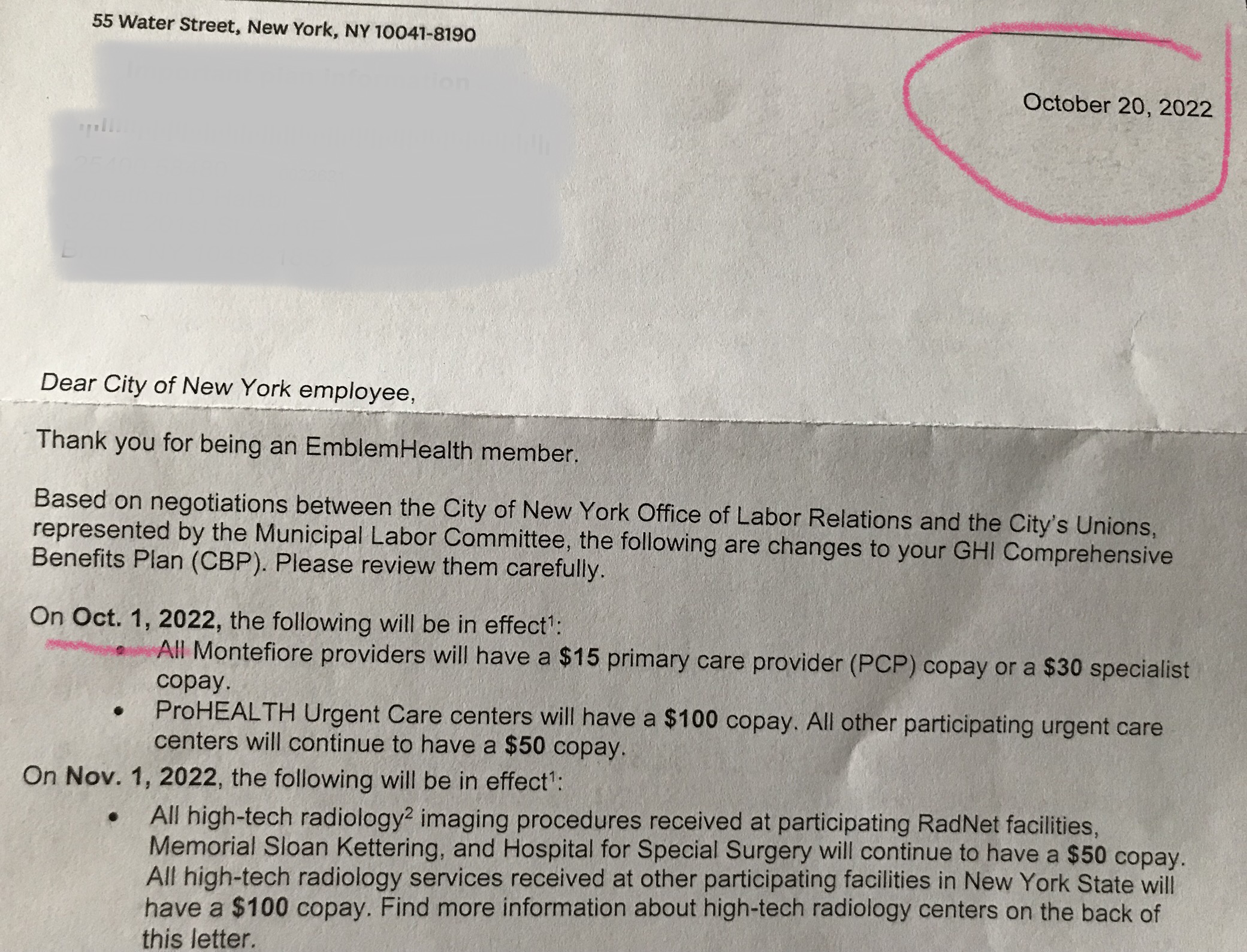
October 1 Emblem added copays for Montefiore, no longer considered a “preferred provider.” And on November 1 Emblem copays for MRIs and CTs will double from $50 to $100, except for three providers.
Emblem (which used to be GHI) wrote to us, and told us. The letter was dated Thursday a week and a half ago. Some of us got it Friday, I got mine Saturday, some people got it on Monday.
But none of us got anything from the UFT, which is unusual. The UFT always (well, clearly not always) sends out some sort of announcement about a change, kind of reminding us that no matter the result, they negotiated it, they are in charge. Imagine the message “We were able to preserve the same copay, as long as you use RadNet instead of the imaging center in your hospital’s network” or something like that.
But nope. No word from the UFT. Not before October 1, the effective date. Not before October 20, when Emblem sent out notice. And not even by the end of October. It’s November, and Mulgrew’s people are staying mum on these new and higher copays.
At a UFT meeting last Tuesday a member asked about these copays. There were two officers there. Neither had heard of the fees. Neither had seen the letter.
You might wonder…
Is it legal for Emblem to raise fees October 1, and not tell people it covers until October 20 (really October 21, 22, or 24, because, you know, mail…)?
How had officers not seen the Emblem letter? Do officers get different health insurance from regular UFT members?
And why is the UFT leadership slow to send out information about copay increases? Did they forget? Or are they trying not to share additional bad health care news the same week they are threatening members with huge premiums?
And if the UFT leadership hasn’t been forthcoming about new copays and copay increases, wouldn’t that make people wonder about what they say about other health care issues?
ABCs of Mulgrew vs. Retirees’ health care
- Forced by Mulgrew (and the Municipal Labor Committee, and Mayor Adams) to choose MAP (for free) or Real Medicare (for $191/month, or roughly $2300/year) – thousands of our retirees chose to pay extra to stay off Medicare Advantage. Smart.
- Preauthorizations are the Achilles Heel of insurance plans. Real Medicare hardly has any. Medicare Advantage has LOTS OF PREAUTHORIZATIONS.
- Medicare Advantage plans engage in systematic fraud. This New York Times Medicare Advantage / Fraud article is tough on them. And if they rob big organizations they work with, what do you think they do the little guy?
- Sneaking around. The whole Medicare vs Medicare Advantage thing – it blew up in April of 2021. Why? Because we found out about it. The Professional Staff Congress (CUNY professors union) told its members. You know who didn’t tell us about it? Mulgrew, who was negotiating it. The MLC, which was in on it.
- Who cares what you think? That’s easy. Not Mulgrew. Mulgrew doesn’t care what you think. See how in contract negotiations they do surveys? For mayoral endorsements they do focus groups? Even for selection DRs they create panels? Now, a lot of this “asking for input” is kind of bull – but they do ask. For the switch from Real Medicare to Medicare Advantage? Mulgrew, MLC, the City, no one asked any of us.
- Shifting stories. Mulgrew blamed the City, the “poor roll out,” misinformed retirees, misguided retirees. At his first retiree call (May 4, 2021) he yelled at and spoke down at retirees (the audio was posted, and then removed). He said not to opt out, and then not to opt out yet, and then that there was no need to opt out.
- Retirees. There is a coalition of retirees from many municipal unions. There is our own Retiree Advocate within the United Federation of Teachers.
- Retirees have been telling the truth to other retirees about what’s going on.
- Retirees went to court and blocked the City, the MLC, and Mulgrew from forcing retirees out of Real Medicare and into Medicare Advantage. The judge’s decision rested on something called “12-126” which protects our health care.
D. Mulgrew/MLC/City are getting desperate. They may have more at stake than they are letting on.
- Mulgrew trying to sneak this past us
- Mulgrew yelling at retirees.
But now they seem even more desperate
- Mulgrew and the MLC were campaigning to change “12-126” so they would have an easier time getting retirees off of Real Medicare and bringing in Medicare Advantage. But the deeper that campaign went, the clearer it was that City Council members were listening more to their retirees than to Mulgrew and the MLC
- Running a full hour “infomercial” at the last UFT Delegate Assembly
- Banning questions at the UFT Executive Board (more precisely, limiting questions to 15 minutes, which they intend to eat up with long answers, an effective ban. They were getting testy about the pointed questions about Real Medicare vs Medicare Advantage)
E. And that letter, and email
- Look, I will write more about the letter from Office of Labor Relations (OLR), and Mulgrew’s response. But from here, it looks like the OLR says “change the law, or else we will hurt retirees’s health care! Or hurt in-service members’ health care!” And Mulgrew answers “Let’s change the law, blah blah blah”
- But we know that the OLR and Mulgrew agree about changing the law. Because that’s how they intend to force retirees out of Real Medicare and into Medicare Advantage.
- And retirees don’t want to change the law, because changing 12-126 will screw with their health care. And in-service members should not want to change 12-126, which protects our health care.
- By the way, DC37’s Nespoli wrote pretty much the same letter to his members.
- So this OLR letter combined with the Mulgrew and Nespoli response, it looks like a three-way bum’s rush on retirees and in-service members, trying to get us to give in on 12-126.
·
·
·
·
·
The Old Woman and Her Pig
This story reminds me of Mulgrew and Medicare Advantage. She keeps failing, and keeps trying. She wants that pig home, just like Unity wants our retirees forced off Medicare, onto Medicare Advantage.
Mulgrew is trying to get the inservice members to lean on the city council to change the law to get the judge to force the retirees…
Let’s work so that Mulgrew is less successful than this old woman:
An old woman was sweeping her house, and she found a little crooked sixpence. “What,” said she, “shall I do with this little sixpence? I will go to market, and buy a little pig.”
As she was coming home, she came to a stile. But the piggy wouldn’t go over the stile.
She went a little further, and she met a dog. So she said to him, “Dog! Dog! Bite pig. Piggy won’t go over the stile; and I shan’t get home tonight.” But the dog wouldn’t.
She went a little further, and she met a stick. So she said, “Stick! Stick! Beat dog! Dog won’t bite pig; piggy won’t get over the stile; and I shan’t get home tonight.” But the stick wouldn’t.
She went a little further, and she met a fire. So she said, “Fire! Fire! Burn stick. Stick won’t beat dog; dog won’t bite pig; piggy won’t get over the stile; and I shan’t get home tonight.” But the fire wouldn’t.
She went a little further, and she met some water. So she said, “Water! Water! Quench fire. Fire won’t burn stick; stick won’t beat dog; dog won’t bite pig; piggy won’t get over the stile; and I shan’t get home tonight.” But the water wouldn’t.
She went a little further, and she met an ox. So she said, “Ox! Ox! Drink water. Water won’t quench fire; fire won’t burn stick; stick won’t beat dog; dog won’t bite pig; piggy won’t get over the stile; and I shan’t get home tonight.” But the ox wouldn’t. She went a little further and she met a butcher. So she said, “Butcher! Butcher! Kill ox. Ox won’t drink water; water won’t quench fire; fire won’t burn stick; stick won’t beat dog; dog won’t bite pig; piggy won’t get over the stile; and I shan’t get home tonight.” But the butcher wouldn’t.
She went a little further, and she met a rope. So she said, “Rope! Rope! Hang butcher. Butcher won’t kill ox; ox won’t drink water; water won’t quench fire; fire won’t burn stick; stick won’t beat dog; dog won’t bite pig; piggy won’t get over the stile; and I shan’t get home tonight.” But the rope wouldn’t.
She went a little further, and she met a rat. So she said, “Rat! Rat! Gnaw rope. Rope won’t hang butcher, butcher won’t kill ox; ox won’t drink water; water won’t quench fire; fire won’t burn stick; stick won’t beat dog; dog won’t bite pig; piggy won’t get over the stile; and I shan’t get home tonight.” But the rat wouldn’t.
She went a little further, and she met a cat. So she said, “Cat! Cat! Kill rat. Rat won’t gnaw rope; rope won’t hang butcher; butcher won’t kill ox; ox won’t drink water; water won’t quench fire; fire won’t burn stick; stick won’t beat dog; dog won’t bite pig; piggy won’t get over the stile; and I shan’t get home tonight.”
But the cat said to her, “If you will go to yonder cow, and fetch me a saucer of milk, I will kill the rat.” So away went the old woman to the cow.
But the cow said to her, “If you will go to yonder haystack, and fetch me a handful of hay, I’ll give you the milk.” So away went the old woman to the hay-stack; and she brought the hay to the cow.
As soon as the cow had eaten the hay, she gave the old woman the milk; and away she went with it in a saucer to the cat.
As soon as the cat had lapped up the milk, the cat began to kill the rat; the rat began to gnaw the rope; the rope began to hang the butcher; the butcher began to kill the ox; the ox began to drink the water; the water began to quench the fire; the fire began to burn the stick; the stick began to beat the dog; the dog began to bite the pig; the little pig in a fright jumped over the stile; and so the old woman got home that night.

Recent Reads
I stopped reading. I wrote about it during the week. I mean, I CAN read – I haven’t forgotten my letters. I just haven’t been losing myself in pages… And I haven’t been casually picking up books, starting them, and finishing them. It’s been years.
So I tried just picking up books and diving in. It’s not like riding a bike. I would put the book down, and not return to it. That didn’t work.
My next strategy has been to open up a few books, and bounce between them. It’s not very efficient, but it seems to be working. Simultaneously, I have been opening up my magazines (The New Yorker, The Economist, and Scientific American) and working through articles here and there.
Some readers (ha ha!) were horrified by this strategy, and offered alternatives – as if what I am doing is wrong and must not be working. Nancy sent me to this adorable self-help “become a reader again since you were before” video. Others had suggestions for books to get me back in the habit, or specific magazines. But no, I must not have made it clear – my strategy is, slowly, working. I am finishing books.
Finished
Mind you, my progress is slow. But before, my progress was “no.” So, four titles that I have finished:
- Metabolical: The Lure and the Lies of Processed Food, Nutrition, and Modern Medicine, by Jack Lustig.
- Last Witnesses: An Oral History of the Children of World War II, by Svetlana Alexievich.

- Draft No. 4, by John McPhee.
- The History of Mathematics: A Very Short Introduction, by Jacqueline Stedall.
I have this strange, hopeful feeling that I’ve forgotten something. But I don’t think so. And even if this is only four titles, that’s four. In a couple of months. And picking up steam. I don’ think I read four books in all of 2021. And, yes, they are all non-fiction. But I would offer that they are quite a variety of non-fiction
And these have been worthwhile. I think I will come back and say something about Stedall, maybe something about each one of these. And by the time I have four posts, one for each of these, I bet I will have a few more completed books to write about.
Now Reading
I stopped reading. I wrote about it yesterday.
I still was reading on line. And I can read – you know – sound out the words, figure out what the author was writing. But I want to get back into “get lost in the pages” kind of reading. And I tried to jump straight in, and well, I am trying something else.
Magazines
The New Yorker, print, comes each week. I skim the cartoons. If I laugh at any of the lame jokes, I have the sense not to share that. And I read the opinion piece at the start of the Talk of the Town. I find it pretty New York liberal (not a great compliment) without being The New York Times New York Corporate Liberal (which I despise). And I am pretty good at reading more of the short pieces. I do not read something more substantial each week, but getting there. And their reviews (art, books, at the back) are not for me. Nor is their fiction. But the writing I do read, I like the voices in The New Yorker, and the quality of the writing is very very high.
The Economist, print, comes each week. Look, it’s kind of cheating to go for a pile of short articles, but that’s what I am doing here. I rarely read their full briefings or intelligence reports. The Economist represents a very definite point of view – I like to call it “City of London” – the financial center of what is no longer the most powerful economic power in the world. Because it is well-written, and has a really bad sense of humor, and because it doesn’t hide its pov, it is kind of an enjoyable read. And I definitely learn stuff – The Economist does not treat regions of the world as unworthy of coverage.
Scientific American. Print. I so want to get through every one of these. And I don’t. But I absolutely AM READING parts of each issue now, and this was just not the case half a year ago. It’s good science, pretty current. It’s written simple enough for me, but even then I find parts challenging. And what I read, I learn from. It’s only once a month, and I guess it represents a place I want to get to, while I know full well I am not there yet.
Books
My first strategy – just open something and read – didn’t turn out too well. So I pulled a group of three books, and rotated reading from each. Three became four, became five. While I was in Maine, I read a little from each each day. Today I am more likely to pull from two on any given day, sometimes one, rarely three.
And what is in progress?
The Counter-Revolution of 1776, Slave Resistance and the Origins of the United States of America. Gerald Horne. Completely different take on 1776, the motivations of the actors, and the centrality of slavery to the revolt of the colonists. I’m about 45% of the way in. It’s a slow slog. Horne’s writing is academic, with lots of footnotes. And the organization is partially thematic, overlain with chronology – but it is NOT chronological, which I find super-challenging.
Math Girls. Hiroshi Yuki. My only fiction, and it is loaded with math! Real math. Strange, I think it is YA, young adult, but the romantic story lines eat up maybe 10-15% percent. The school story line is maybe 5-10%. And 75-85% is math, which you would think makes this comfortable for me. That’s not entirely correct. Some of the math is different from math I’ve worked on, and some is presented in idiosyncratic ways. I was going faster, but slowed down. I’m about 40% done.
Child Prisoner in American Concentration Camps – A Memoir, Mako Nakagawa. I’ve already finished a book from a child’s viewpoint, and this is my second. I have more to come. I’ve just started this, not 5% of the way, but it will go very fast.
The Battle Nearer to Home: The Persistence of School Segregation in New York City. Christopher Bonastia. Mostly focused on the 50s and 60s, right through Ocean Hill – Brownsville (the 1968 strike against community control), and then jumps forward to more recent struggles. I’m about 75% done, and I’ve gotten past the strike (I know, none of us really have). The writing is well-footnoted, but the style is accessible. I should write more about this book. Maybe I will. I might recommend it. Bonastia is at Lehman College, but I never met him, never encountered him until recently on a social media platform.
The Hidden Half of Nature: The Microbial Roots of Life and Health. David Montgomery and Anne Biklé. I read Montgomery’s Dirt: The Erosion of Civilizations years ago. I think I bought copies as gifts for friends and relatives. I was a fan. One day in IFC I saw a documentary, DamNation, about removing dams from rivers in the Pacific Northwest, and what a positive effect dam removal had on the ecosystem, in some cases along First Peoples to return to or restore cultural practices. And Montgomery was a talking head in that film. I wiggled my toes with delight when I realized who it was (silently, of course, so as not to disturb the seven other guests in that theater). I’ve just started. But I already know. Hmm. Montgomery:Scientist::Social Historian:Historian. And that’s cool

And straight up math?
I’d like to get some collaborative reading going – but haven’t found my text and partners yet. For now I am just going through a couple of things I read with kids, but now super slowly and carefully.
Numbers and Curves by Franz Lemmermeyer. It’s really an on-line number theory text. But we used the first chapter to construct the naturals from Peano’s Postulates. Progress is very slow, but quite satisfying. This does not feel easy. But it’s a different sort of reading.
An Introduction to Elementary Set Theory. Guram Bezhanishvili and Eachan Landreth. MAA put this out as a pdf – it’s a historical survey, with little bits of Cantor and Dedekind interspersed with some basics. I always enjoyed using this, and I’m just close reading to make certain there are not details I’d manage to overlook. I’m also assembling notes on what I added to this – certainly my students loved the mysterious notation. Cool, but that makes this reading even more divergent. That’s ok. I like this too.
Returning to Reading
I stopped reading. It’s been a long time since I’ve routinely opened a magazine, or regularly opened a book, and just read.
Not completely. I subscribe to two weekly magazines, and one monthly, and from time to time I would look at the cartoons. Or even read an article, or two. And I occasionally read a chapter from a book. Even less often, a whole book. A whole book – that had become very very infrequent.
I still scanned the screen of my laptop, desktop, or phone. But I don’t think that should count.
By “reading” I do not mean just the process of translate the pixels into the letters, letters into words, words into sentences, and sentences into ideas. I mean picking up the reading material, sitting down, falling into the story, getting absorbed. I mean turning the page, dog-earing the page, rereading a passage. I mean what I used to do, and what I have more or less stopped doing.
And so, since the end of June, I’ve been trying to address that, to get back to reading. I had the summer – but I have always had summers. This one was different – I passed the programming responsibilities to someone else. I came in July 7, and then once more to clear out my stuff. I answered a few emails. But my summer was mine. I also did not have planning. I am on “terminal leave” – likely retiring in the coming weeks or months, and I am not currently working. The summer was really mine.
I hardly remember what it was like to read. To really read. To read every day. We lost newspapers – barely reading, but a daily habit. On-line isn’t the same. What is it like to find a quiet spot, a sunbeam, and lean back… What is like to pore over a piece of non-fiction, grappling with a new or difficult concept? I last really read non-fiction, not just a book here or there, but regularly, about a decade ago. The feel is faded, but not altogether forgotten. But fiction? Having a story come to life in my hands, slowly unfold. Meeting characters, and learning about them, and feeling hope or worry or joy for them… I don’t remember this. It has been too long.
This is bad. It is embarrassing. So what to do? Obviously, start reading. But it was not as easy for me as it sounds. I had lost the habit.
So I began with magazines. Magazine articles are generally shorter. Of my weeklies, the Economist is easier. In these seventeen weeks I have not read every issue, but I’ve read most of most of them. They are not very satisfying. But I am rebuilding a habit. The New Yorker is tougher. I usually get through the Talk of the Town, or choose which don’t look interesting to skip. But the feature articles? Sometimes. Am I up to at least one longer article in every issue? Nope. Every other issue? Maybe I’m getting close. Oh, and fiction? Even when I was a reader, I rarely read The New Yorker’s fiction. Maybe one day, but not soon. Scientific American is one a month, and the articles are challenging. I have had greater difficulty even opening them up (though unlike the other two, I do not discard SciAm, even when it is old). But Tuesday I read a chunk of the current issue, including a fascinating story about the structure (and possible demise) of the Thwaites Glacier in West Antarctica – bad news for sea level. (Thwaites I mean to look up – it’s also the name of a teensy street in the Bronx. In my fourth year teaching I had a student, Masha with red hair whose last name I remember but won’t write, lived on Thwaites Place. It was a Course II section for kids whose first language was not English, and it was in Room 450, she sat left of center, I think second row.) OK, so magazine progress – real, but not too impressive.
The real challenge has been books. I tried. I opened a volume at home, on a train, on a plane, and quickly lost focus. I tried a few times. Same result. But this is important. Through early July, nothing. And then I went away on a big trip. That’s where I had the plane and train rides. And I got sick. (not from reading. There’s a pandemic.) And in the rest of the August I didn’t get much done.
So I thought it over, and I came up with a plan. If I couldn’t sit the way I used to, if I couldn’t get sucked into hours of reading, then I would need to adjust how I was trying to read.
I chose a group of books. Mostly non-fiction. Some history. Some education. Some math. Other stuff. And a read a few pages from one, put it down. And then I pick up or don’t pick up) another. I have been keeping four or five in play at a time. And know what? I am slowly, steadily, making progress. From early September I have completed several books, and am making progress on others. And it is gradually becoming, once again, an every day activity, one that I look forward to.
Baby steps. I’ll write more about reading. I should say a couple of words about what I have finished, and what I am working. And I need to confirm that this “return to reading” has stuck.
Did the UFT make an announcement about copay increases?
Maybe I missed it? I have been writing about the increase in GHI (now Emblem) copays, for Montefiore, and for MRIs, CTs, and other scans.
I have pointed out that the notice from Emblem came AFTER the changes went into effect. I have also pointed out that the notice from the UFT NEVER CAME. I searched my mail. I searched my email. Could I have missed it? Please readers, tell me if I have. But I don’t think so.
Tuesday at a UFT meeting two UFT officers indicated this was the first they had heard of it, and that they had not seen it in writing. This is a change to copays for the insurance (Emblem, used to be GHI) that most high school teachers have.
Yesterday I got an email over Mulgrew’s name about healthcare – I read carefully to see if they snuck in a mention of the new copays. Nope.

By the way, since I know you are reading this, the testimonial probably should have been from a “Department of Education employee” or a “UFT member” – not from a “UFT employee.” An editor would help.
In any case, the UFT leadership knows how to put out an email about health care. And I dutifully save the emails. Unless I missed something, Mulgrew and friends just decided not to tell us about the new copays. Let Emblem do it. Or let the members find out when they get a surprise charge at the doctors office.
This, by the way, is tried and true Unity strategy. When they have bad news, hide it. It’s what they did, ironically, during the election – kept Mulgrew from talking, kept him out of sight. When they have a problem their first line of defense is to keep quiet and hope no one notices.
Health care has become tricky. Unity got caught trying to sneak in a huge change to retiree health care. Retirees are anxious and angry. It’s been all over the news. Unity has been forced to address it (largely with misinformation, but that’s not for this post). Unity cannot just stay silent about their Medicare Advantage plan.
But anything else healthcare? Anything besides pushing retirees out of Medicare? Look at that email. If they have good news, they will trumpet it. Put Mulgrew’s name on it, try to shore up his lousy favorability ratings (it won’t work). If they have bad news, don’t say anything, hope members don’t notice.
Let’s make sure we notice.

 JD2718