Now is the Time (whether you want it to be, or not)
I attended a NYSUT virtual vigil just now. It was mostly local presidents. The overall thrust was for reform and electing better people, but especially as some hearkened back to the civil rights movement, or to their own personal experiences, there was a current of long-term struggle as well.
Interesting, for me, was Michael Mulgrew, who was brief and sharp – the speech was prepared, and well-prepared. This is not the rambling Mulgrew we see (or hear) at the Delegate Assembly. His opening (and check this out, I’m quoting Mulgrew approvingly) “There is an original sin that stains the soul of our country.” The message was not revolutionary, but a revolutionary message might have started similarly.
More interesting, the comments. Most echoed the speakers, highlighted important points. At first. But then the issue of the police came up. And dominated the comments for a huge chunk of the vigil.
NYSUT did not organize the event to discuss police. But the role of the police, the future of the police, that is what we – and by “we” I mean everyone who is trying to make change – that is what we are talking about.
There are people who want to talk about getting rid of Trump. But today the primary conversation is about police. Reform the police. Defund police. Disband police. Or in reaction, cherish them, value them, protect them – that’s the other side.
In the biggest NYC Teacher Facebook group discussion of police has been hot. Everywhere it seems, Black Lives Matter, and Police. And there is no resolution of the one without resolution of the other. Even if not everyone wants that conversation to happen. Even if some people want to keep the movement away from the hard questions.
The Open Letter for Radical Action on Behalf of BIPOC students and families
There’s a letter, I’ll post it below, signed by 550 central staff members from the NYC Department of Education. They call for a lot of things. They use the Chancellor’s phrase “Equity and Excellence” – perhaps against him.
They want culturally responsive curriculum, integration, an end to admissions screens, student and parent voice in decision making, fair grading, and, yes, to bring school safety out of the NYPD and into the DoE.
Here’s the New York Daily News headline: NYC Education Dept. employees call on schools officials to cut ties with NYPD
They left 90% out. But they did pick the right item to divide folks. We know which side they are on.
Here’s the entire letter:
Chancellor Carranza,
We are a coalition of NYC Department of Education employees who work in Central offices. We are leaders from across offices and divisions, whose daily work consists of supporting the 1.1 million students of New York City and the exceptional educators who serve them. We are those who are tasked with carrying out the Chancellor’s mission of Equity and Excellence—a mission that we fully embrace.
We are proud of all we have accomplished, but the time has come for our actions to align with our words. This is the moment to dissociate ourselves from institutional racism and to affirm that Black Lives Matter. We must sow the seeds of a truly anti-racist Department of Education, in service of all our students and families, but especially of our Black students and families, who have borne the brunt of unjust education policies for centuries. Not just because this is the right thing to do, but because this is our duty.
We write this letter because we have pursued educational equity through the avenues open to us as members of this institution, and we will continue to do so. However, doing the internal work alone has not and will not make these policies a reality. So, we turn to you, Chancellor Carranza, to commit our collective efforts as the DOE takes radical action on behalf of our BIPOC (Black, Indigenous, and People of Color) students and families. It is not enough anymore for our policy to pursue non-racism. We must be anti-racist and address anti-Black policies and practices head on. As leaders in educational transformation, we are ready to join in solidarity with a Chancellor who proactively implements anti-racist policy. We believe you can be that Chancellor. We are prepared to serve—to shoulder the risk and take on this work with you.
As Central employees, we join and echo the demands of our fellow educators who are in schools and in the field, caring for our children every day. None of our asks are new; our calls to action are those of the School Diversity Advisory Group (SDAG), our fellow educators, our colleagues in City government, and most importantly, our students and their families. We commit to carrying out the anti-racist policies spelled out below, as well as the many other practices necessary to implement meaningful change. In turn, we demand that our City invest the necessary resources to build an anti-racist educational system.
We are in solidarity with advocates and with our students in demanding that our Chancellor and Mayor enact the following:
- Place School Safety officers under the training and supervision of the Office of Safety and Youth Development and retrain them as School Peace Officers with a focus on deescalation, mediation, and restorative practices. Increase the number of guidance counselors, social workers, and mental health professionals in schools to meet these goals.
- Shift city funding from NYPD to fully fund education, youth, and community programming.
- Revise the discipline code, attendance policies, grading policies and student rights to address disproportionality and fully recognize the humanity and agency of our students.
- Eliminate admissions screens and tests that are used to sort and separate our students.
- Implement the student-developed 5Rs of Real Integration framework adopted by the DOE in 2019, especially alternative admissions methods that promote economic, social & racial diversity.
- Invest deeply in culturally relevant teaching aligned to the NYSED Culturally Responsive-Sustaining Education (CRSE) Framework.
- Utilize varied outreach efforts to meaningfully engage youth, parents, and caregivers in school decision-making processes, which prioritize families that have not participated in prior activities. We must continually meet families where they are and give them the opportunity for agency and transparency into their children’s education.
- Implement a system of accountability and transparency that empowers leaders to identify and interrogate racial disparities and inequitable hiring and staffing practices and include anti-oppressive approaches.
- Create more equitable and inclusive workplaces and job opportunities for BIPOC, LGBTQIA+, and employees with disabilities.
We were inspired when you were first appointed our Chancellor, and we were further encouraged by how you made it clear that you would not back off your equity agenda, even in the face of severe opposition. We were in solidarity with you then, and as a family who expects more from their own, we are calling you to your highest principles now. It is our responsibility, now more than ever to divest our Agency from institutionally racist practices and reimagine an education system that does not privilege some students over others.
We will be beside you when the department, and particularly our Agency’s leadership takes the next steps to advance equity and our collective promise to put all our children first.
In Unity & Service,
[followed by 550 signatures, and then:]
Acknowledgments:
These recommendations would not have been possible without the incredible, and in many cases years-long advocacy, of organizations such as the below. This letter was drafted independently, but we owe huge gratitude to these and many others.
- School Diversity Advisory Group
- Alliance for Quality Education
- The BLEND: Diversity in Hiring Initiative (DHI)
- Brotherhood Sister Sol
- BYP100
- Coalition for Asian Children and Families ASAP
- Coalition for Educational Justice
- Center for Racial Justice in Education
- Dignity in Schools
- Girls for Gender Equity
- IntegrateNYC
- NYC Appleseed
- NYC ASID
- NYU Metro Center
- Rockaway Youth Task Force
- Teens Take Charge
- Urban Youth Collaborative
- YA-YA Network
That Other Open Letter about School Safety
The open letter by dozens of staffers in the New York Daily News? The one about moving school safety out of the control of the NYPD? Turns out there’s another letter, about budget, and priorities – and school safety.
This letter was started by a Brooklyn principal, and signed by teachers, principals, APs, counselors, coaches, Chapter Leaders, and some central staff. But mostly by teachers. Looks like about 950 signatures so far.
For the record, I just got the text. I’m looking it over. I have not signed. I have not decided if I will.
Here’s the full text (linked, and below):
As school leaders, the months that have passed since the COVID-19 crisis gripped New York City have been some of the most challenging of our careers. Our staff, our students, and many of our own families have suffered unspeakable loss, and yet we have not been able to come together as communities to mourn and support one another.
Not surprisingly, the virus has disproportionately ravaged New York’s most vulnerable communities, home to so many of our black, brown, and immigrant students.
As if a once-in-a-generation health crisis weren’t enough, the murder of George Floyd at the hands of Minneapolis police reminds our students of the NYPD’s own sordid history of murdering and terrorizing black and brown New Yorkers; evidenced by the similar fates of Eric Garner, Kalief Browder, and Akai Gurley, and the dark era of stop-and-frisk.
Our students are civically engaged. They participate in and follow the protests that demand accountability and justice. They watch as the police–who they are asked to trust as their protectors–indiscriminately deploy tear gas, ram protestors with squad cars, pepper spray peaceful demonstrators and compliant journalists, and flash white power symbols to approving colleagues. The NYPD’s human rights abuses are on full display as they assert once again their indifference toward black and brown citizens’ immeasurable grief, and their intolerance for expressions of justified rage.
When our children finally return to the classroom, these crises will have left them in need of unprecedented levels of support from us, both academic and emotional. Instead, they will return to schools with budgets that have been gutted by over $827 million dollars. They will return to schools without adequate access to social workers, mental health and counseling services, restorative justice programs, arts programs, sports teams, and after school programming.
At the same time, the NYPD will see its budget substantially increased. When our students emerge from the collective trauma of COVID-19 and rampant police brutality, they’ll be met by faces wearing an NYPD uniform; on the corner, at the bus stop, in the subway, and at the doors of their schools. This will trigger feelings of fear, anger, and anxiety – not safety. After all, what evidence do black and brown students have that they can trust law enforcement officers?
The priorities of our city and state in this budget are clear. Children last, NYPD first.
We would be remiss in our duties to our students if we did not use what power we have to join their efforts to convince those who remain indifferent that “Black Lives Matter.” In light of that responsibility, we demand that the governor, mayor, and city council pass a budget that puts children first during this crucial time. That means drastic increases to public school and social service budgets, and sharp cuts to the NYPD’s budget. Increased school budgets should include funding for:
- all schools to develop anti-racist professional learning plans specific to the needs of their school community;
- building an Ethnic Studies Curriculum that centers on the history of people of color and racism in America;
- a restorative justice coordinator for every school to help dismantle the school to prison pipeline; and
- hiring guidance counselors and social workers to achieve a 1:100 ratio, who can work directly with children impacted by COVID-19 and police violence.
In addition, we call for:
- abolishing culturally biased teacher certification exams
- recruiting a teaching and leadership staff that reflects the diversity of our public school system
- reviewing the approved vendor list and procurement policies to promote purchasing from black and minority owned businesses that support our communities
- placing School Safety officers under the training and supervision of the Office of Safety and Youth Development and retraining them as school peace officers with a focus on de-escalation, mediation, and restorative practices;
- reinstating COMPASS, SONYC, Beacon and Cornerstones summer programs, and Summer Youth Employment Programs; and
- restoring the planned 3-K expansion.
In Solidarity,
Police 3: Solidarity and Identity
I’m writing about a little about police, as part of the larger conversation that is taking place. I wrote about why the police are such a welcoming home for “bad apples.” I wrote a tiny bit about the history of modern police departments. And today I’ll write about two more things:
1. In Buffalo, police were clearing a square, a cop came upon a senior citizen, and shoved the old man out of his way. The man fell, began bleeding, bleeding from his ears, was hospitalized, and is now in serious condition. The cop was suspended. And 57 Buffalo police officers who were part of that unit (Emergency Response Team) resigned from the unit, and asked to be deployed to other units.
I am less concerned with the casual brutality of the POS who assaulted a senior citizen. I am more concerned about the culture that led all of his colleagues to rally to his defense. No one who shares that culture should be allowed armed on our streets. But evidence suggests the ENTIRE PD shares that culture.
Here’s the video:
Here’s the link to the story about the unit resigning.
2. You know, in the classic cartoons, before going out and robbing and stealing, criminals put on a mask (not N-95)? That’s to hide their identities, so they can get away with doing bad stuff without getting caught.
New York City:
Police in Philly are putting electrical tape over their badge numbers to hide their identity
Chicago: 
DC:
Seattle:
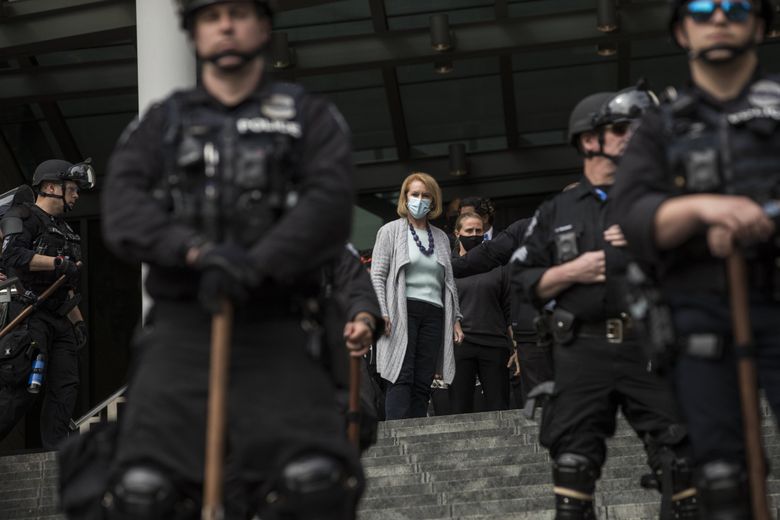
Random? No way. Orders from above? At least in some cases, yes.
How come so many cops do that? Not one or two. Not one department, or two departments. It is a general feature of police culture. Is it tolerated? Allowed? Encouraged? Promoted? Doesn’t matter. It happens. It is part of the culture.
– – — — —– ——– ————- ——————— ————- ——– —– — — – –
Neither issue, police standing in solidarity with brutality, or police hiding their identities, neither is an issue of “one bad apple” – they both point to structural, cultural problems with modern US police departments.
A little more about Chaz
It’s been a month to the day since the world lost Eric Chasanoff to Covid, and a month to the day since the New York City teacher/blogger universe lost Chaz’s School Daze.
I wrote about Chaz in this space – my immediate reaction to his passing. Many others wrote, too. I submitted something to UFT Honors, and they used a few of my words. And then one of the editors suggested I leave a comment – and I did:

I also went back through more of his writing. I had forgotten that Eric had endorsed me for UFT Exec Board not just in the last election, but every time I ran. 2019. 2016. 2013. 2010.
Our views tended to coincide on contractual and labor issues. But we diverged, mostly on issues related to race, poverty and integration. In recent years I commented less, as his readership (at least in the comments) drifted towards the right.
But our first disagreement? I was in favor of demoting Pluto from planet status. Eric gamely defended the micro-planet (see comments).
Police 2: The early history
Bodycams are not mentioned in the Constitution, because the technology did not exist, and police did not exist.
What? No police in 1776? Nope. (and not in 1789 when the Constitution was ratified.
So where did the police come from? And when?
The when is easier. Philadelphia – 1828. NYC – 1845. Baltimore – 1853. Boston – 1854. Chicago – 1855. Newark – 1857. Pittsburgh – 1857. Cincinnati – 1859. New Haven – 1861. Washington DC – 1861. Cleveland – 1866.
New Orleans stands apart – as it had a series of organizations, some of which may have constituted actual police departments, some which may not, on and off from the early to the late 19th century. The earliest, from French colonial times, were more of night watches than police forces. I would date the modern force to 1877, when a futuristic, integrated force was attacked by an all white force.
Before police? many cities had “night watch” systems which variously guarded property (especially in warehouses and shipping centers) or protected public morals (anti-saloon and anti-prostitution). They were often rotating volunteers, often overseen by constables. Police departments in the north did not grow out of the night watch system, but replaced it.
There were also private security guards. Shipping companies cleverly were paying for guards. They campaigned for a modern, professional police department so that they could offload the cost of security onto the public. And they succeeded. Now police patrols guarded the companies’ goods, and they did not have to pay guards.
And in the south? Slave catchers?
A few years ago Time Magazine printed a fascinating article on the origins of police departments.
Police 1: There are good people…
I hear it said. I have known some. There are good people who are cops. My neighbor. Good guy. You might know some, too.
But there is Chauvin. You’ve seen the video, or at least part of it. Cold indifference as he snuffed out a life. George Floyd’s life. Eighteen prior investigations. OK, so one bad apple.
How many departments have “one bad apple”? Or better, do any departments not have one? Armed, uniformed. How much damage could one bad apple do? We should not ask that question.
Do departments weed these guys out? throw them out? Not Chauvin. This is the public’s safety at stake. Does every PD wait until there is incontrovertible evidence that the apple is bad? Do some PDs wait until even after that? There were eighteen prior investigations of Chauvin. The club where he worked privately got complaints that he was excessively rough with people.
In fact, police departments, with uniforms, ranks and weapons attract, especially in a culture where Dirty Harry is glorified, some people with violent, even sadistic tendencies. They are not screened out well enough at recruitment, and they are not weeded out. Problems seem to be systematically ignored. While officially all police departments practice deescalation, clearly there are officers (in every department??) who do not. They are not weeded out for “failure to deescalate.” Videos of aggressive altercations inspire more nut jobs. They are not isolated aberrations. They are attracted, and their tendencies develop are fertilized while in blue.
With the history of the treatment of Blacks in this country, and with the everyday use of force and harassment by police against Black people, and with the practice of policing minority neighborhoods more aggressively, there is an attraction for racists to join police departments. Which police department screens and rejects recruits for deep-seated racism and prejudice? Which weeds them out when racist tendencies are revealed? On the contrary, racists, surrounded by other racists, engaged in race-inspired violence and harassment, actually recruit more police to informal racism.
Police Departments, with their toleration of violent behavior, and their toleration of racism, become recruiting grounds for far right and racist organizations. Which police department actively rid themselves of members of the Klan, Nazi groups, and other ultra-right organizations?
Let’s say that most departments don’t actively encourage this culture. Probably a few still do. But even those that don’t encourage, they tolerate it.
So, yeah, I know. My neighbor’s a cop, and he’s a good person. And, I know, “it’s a few bad apples”…
But we are talking about an organization that doesn’t really try to keep out its bad apples, hangs onto its bad apples, and lets the bad apples spoil other apples.
So yes, there are good people in the PDs. That’s not the problem. The Police Departments are.
Dear Young People who are my students
Dear Young People who are my students,
Sometimes life imitates art.
Late last night the Public Theater canceled a virtual event for Monday. “In this time of national trauma” they wrote in their email, “when the Covid crisis has so disproportionately impacted the Black community, when the injustices of our way of life have been made so clear, it just feels wrong for us to sail ahead… This is a time for mourning and reflection”
I had started to write your calendar. I stopped.
I thought about the letter from the Student Government, which I read yesterday:
“It is not enough to “not be racist”. We must ACTIVELY be anti-racist and be responsible citizens who listen and take actions as we fight for justice and equality.
“We, the HSAS community, stand in solidarity with the Black Community. We urge all of you to do everything that you can to help the Black Lives Matter cause. We urge you all to commit to anti-racist practice and dismantle the white supremacy that blatantly exists in our society, anti-blackness in America and the police brutality that is continuously occurring in our country.
Earlier today I reposted on Facebook the message of an alum from 2011:
“To me, teaching is a matter of life and death. In black and brown communities, schools can honestly make or break your future. I do not take my position lightly—especially considering I am an Afro-Puerto Rican woman who chose to teach in the very same community I grew up in. I have many experiences in my own education where had I not had the proper support, i would probably not be where I am today. I know firsthand that the education system in this country does not actually care about our black and brown babies. So please. If you are an educator…—stop being silent on the issues pervading our communities.
And just moments ago another alum, class of 2009, gave me permission to share his words:
“The system is broken and our law enforcement system has failed us several times. I have been a victim of unnecessary police brutality SEVERAL times. From walking to the store to get some food. To being outside of my home working on my car. I was stripped of my rights, slammed to the floor, attacked, searched and demoralized. Not because I committed a crime. I was treated this way because I was a black man who happened to look “suspicious”. I’m tired of cringing every time I see a cop driving behind me… This is the sad reality, truth, guilt, and shame we must carry with us as a country. We need change! What do you stand for? I’ll stand with those who stand up for the true message of this tragedy. ENOUGH IS ENOUGH!”
He closes with these words of Dr. King:
“In the End we will remember not the words of our enemies but the silence of our friends
The murder of George Floyd is one crime, but represents for many the seemingly never-ending string of murders, central to the history of the United States. The racism that has been with us since our foundation, if it is allowed to remain, will guarantee that each month, each year, more names of Black men and women will be added to this list. This cannot continue. The pain needs to end. Enough is really enough.
I would like to think of ways to stand in solidarity with the victims of racism, in solidarity with Black teachers, Black students, and the Black community. I want to consider the way racism infects the fabric of our everyday life, including our schools, including this school, and what can be done about it.
When faced with complex issues, I like to remember these words of John Reed: “There are only two sides. And whoever is not on one, is on the other.” I know I must act. The silence that Dr. King speaks of is not only silence. It is complicity.
I am suspending my classes for today, for Monday, June 1, to allow time to mourn, to reflect, to speak.
Office hours will continue, 8AM – 10AM as usual, but not as usual: for you to express yourselves, to share thoughts, fears, doubts. To ask questions. To consider a better future, and how we might get there. I will be there to listen, to support you.
I will print a regular calendar for Tuesday, with a short assignment for seniors and a shortened assignment for juniors. The notes from Chapter 7, which were due today, are pushed back to Tuesday. I will send out instructions for requesting a college recommendation in Tuesday’s calendar (short version, I always say yes).
I hope you join me for coffee, and if not, hope you engage in reflection and discussion on your own or with friends and family,
Jonathan Halabi
June 4 – Mulgrew responds
I wrote yesterday about the DoE demanding we assign work for June 4 (and for June 9 in elementary schools) while we were supposed to be doing professional development.
The Chancellor did not even bother telling us, and he was assigning us to give busy work. Inconsiderate. Disrespectful.
I also bemoaned the lack of official response from the UFT, over a full day after the news came out.
– – — — —– ——– ————- ——————— ————- ——– —– — — – –
Update – Sunday afternoon the UFT sent out a message to members over Mulgrew’s signature. He couldn’t stop the DoE’s stupid plan, but he took a shot at the Chancellor: “Educators may provide enrichment activities to students, but they should not be asked to give students busy work. Educators’ engagement with students is so much more than that, and those immense contributions should not be devalued.”
Members will be frustrated, but will appreciate the line about “busy work” – which is clearly what the Chancellor was asking for.
And me? I’m glad that it took only two days to speak to members. But there’s still room for improvement.
– – — — —– ——– ————- ——————— ————- ——– —– — — – –
Me? I will assign a week’s worth of work on Monday, with an intro. Students come to discuss the questions with me during the week, (they choose from my daily office hours) while they are working on it. I also do mini-lessons on some of the trickier content for small groups during office hours. I’ll tell them to keep working Thursday, but that there won’t be office hours that day.
– – — — —– ——– ————- ——————— ————- ——– —– — — – –
Here’s the whole of Mulgrew’s note:
Dear Jonathan,
The Department of Education has clarified what is expected of teachers, related service providers and other staff on June 4 and June 9. While students will be engaged in learning on both days, educators will be receiving professional development on June 4 and engaged in clerical duties on June 9. Teachers are not expected to engage students on either day.
June 4 is a professional development day for teachers, related service providers and other staff. June 9 is a clerical day for teachers, related service providers and other staff in elementary, middle and District 75 schools. On those days, students are expected to independently complete work set up in advance. The DOE will provide learning materials teachers may share if they believe they will be helpful.
The DOE clarified the expectations in a letter to parents.
Educators may provide enrichment activities to students, but they should not be asked to give students busy work. Educators’ engagement with students is so much more than that, and those immense contributions should not be devalued.
Thank you for all that you have done and continue to do for our students and their families.
Sincerely,

Michael Mulgrew
UFT President
June 4 is a PD Day – but…
I thought that June 4 would be a non-instructional day. That’s how it is for high schools in New York City. Every year for two decades, since Brooklyn-Queens Day was extended to the whole city. In my school we do placement exams for our incoming 9th graders. There’s PD. Elementary schools also have June 9.
And Thursday a UFT leader confirmed it (and complained that the DoE was slow to tell us), yup, Professional Development day.
So it came as a surprise yesterday when I heard that June 4 would be instructional. There must be a mistake? I checked my e-mail. Nothing.
But on the chat pages I learned the truth – the Chancellor wrote, Friday evening, to parents and families, and not to teachers.
Apparently a letter to principals followed. The key paragraph: “June 4 will be an instructional day for students, meaning that we still expect all students to be engaged in remote learning even as you and your teachers are engaged in professional development. Teachers are not expected to engage students on June 4; instead, schools should set students up in advance of June 4 with independent work for the day, or provide students with centrally provided materials, which will be made available early next week.”
Simply put, give them work on Wednesday, go to PD on Thursday, and ignore kids’ e-mails on Thursday. I bet a lot of teachers could do that. But some of us cannot. And some of us will not. It is bad practice. Kids try new work, they need guidance. They may have questions. They can get stuck. For those of us who are teaching live – just how can we do both?
Friday night surprises. This is not this Chancellor’s first time dropping bad surprise news on us, indirectly, Friday, after hours. That’s when he let slip that he was banning Zoom immediately (which he walked back Monday, three days later, to a gradual phase out, and which has since been brought back). It’s also when de Blasio announced that Good Friday and Passover were work days.
Why do they do this? Because they are thoughtless. Because they have little respect for teachers and other school workers. Because they think they can get away with it. And because, so far, they have in fact gotten away with it.
There’s something else going on. People are asking, why isn’t the UFT doing anything about this? And others are answering that the UFT is fighting this. But that answer is not coming from Mulgrew. People are hopping mad, or frustrated, or too exhausted to complain, and nothing from the union President. What do I think? I think the UFT is fighting this. I think the central leadership is allowing the rumors that they are fighting to filter out.
But I think a better leadership would speak directly to the membership.
This has been an apparent problem on several occasions over these last ten weeks. Maybe the most frustrating was getting only a series of lawyerly-worded statements about live teaching, and pressing and pressing for weeks before we finally got an unambiguous “you do not have to live teach” from Mulgrew.
In that case, the lawyers were probably writing the statements.
This time? They might be delaying until they have spoken to the DoE and resolved this. Possible, but a lousy reason not to tell us what’s going on. Sometimes they are shy about communicating when they don’t think they have a win. Also a lousy a reason. Maybe they are debating what to say to the members. Well, ok, maybe, but it’s been over a day. Get to it.
Slow communication with members – or letting rumors reach members before official word does, that’s bad for the union.
Not Today
I am in process of writing about lots of things.
- Teaching graphing (for some classes of ugly functions)
- Slamming the College Board, hoping to help sink them
- Questions about teaching in September
- Stories from my UFT Chapter
- Cuomo and nursing homes
- Thinking more about Chaz
- Social distancing
- Hikes
- Keeping pressure on the UFT leadership not to sacrifice our safety (I hope it is not necessary, but, you know, trust. And verify)
- Staying Healthy
- Logic Puzzles
But not today.
And in the back of my mind was a post about the presidential election.
- I was going to say, mostly to progressives, many of whom supported Bernie,
* go ahead, defeat Trump. But if you do, that’s not enough.
* And go ahed if it’s too much for you, don’t vote. But if that’s your act, that’s not enough. - I was going to say that you need to keep fighting on the issues, no matter your attitude to the election.
Do not pause, I would have said, the fight for
* taxing the rich, for
* medicare for all, for a
* fight against the destruction of the environment.
* For bail reform and an
* overhaul of the “criminal” justice system, for
* fair wages, for
* housing justice.
Do not pause those fights, I would have said, they must be continued, everyday.
But I’m not saying that today. Not today.
Today all eyes are on Minneapolis. All thoughts should be on George Floyd – murdered by a cop showing callous indifference to the life he was smothering.
Thoughts should be towards Ahmaud Arbery, executed for “jogging while Black.”
Our voices should be saying their names. And other names. Why are there always so many names? Tamir Rice. Sandra Bland. Look them up. Say them. Find the names. You cannot find them all. This is not a two minute exercise and on with your life.
There are thousands of names. There are names we cannot say. There are victims of police violence. And victims of lynching. And victims of a penal system that criminalized vagrancy to reenslave Black men. And victims of slavery. There are 232 years of names of Black people, mostly men – from the founding of this country. There are over 100 years more, from the founding of the colonies.
This land has allowed hundreds of years of acceptable violence, including executions, of Black people. And if the “law” looks away or the “law” does the killing, it amounts to the same thing. The “law” is ok with this violence toward Blacks.
I am not rallying for a few days, and moving on to the next cause.
I am remembering the victims whose names I know.
And I am committing myself, for today, and for the future, and for until this nightmare is ended. I am committing myself to struggling to end it, until we end it.
March 13, March 17, May 26: me/school
Friday, March 13. That morning was an activity day at our school, “SpringFest”. The school play (I’m the advisor) had also been scheduled for that morning, but Lehman College shut the theater the previous day. Plus, two of our actors, without understudies, were not feeling well (I don’t think it was COVID).
During SpringFest several of us distributed a petition, addressed to de blasio, Carranza, and Mulgrew and everyone signed.
My entire faculty (HS of American Studies at Lehman College) just petitioned the @NYCMayor and @DOEChancellor to close #nycpublicschools Do it! #CLOSENYCPUBLICSCHOOLS ! What are you waiting for? @UFT #UFT #HSAS pic.twitter.com/7E5HUfu1dS
— Jonathan (@Jd2718x) March 13, 2020
https://platform.twitter.com/widgets.js
And then we had remote parent teacher conferences (we’d SBO’ed that date – it was not the citywide date). Most teachers made their calls from home, but I stuck around. It was surreal.
The day ended at 3. This photo must be about 3:15.
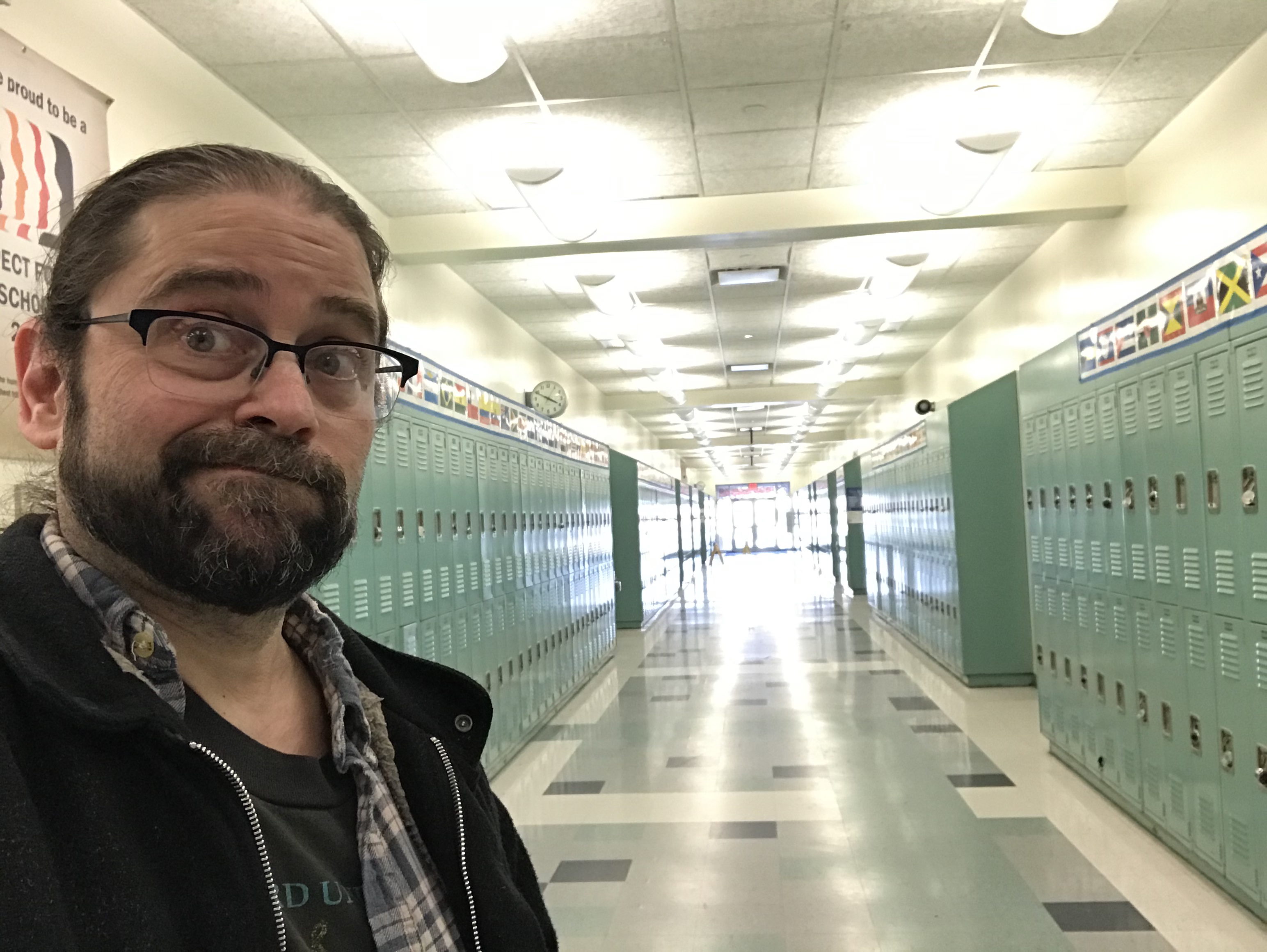
The Mayor kept insisting he would keep schools open – Thursday, Friday (above), Saturday, Sunday, and finally Sunday afternoon, as he lost ally after ally, de blasio finally surrendered to the pressure. Students would stop going to school, but teachers were assigned in-school training for remote teaching Tuesday, Wednesday, and Thursday.
We will never know how the sickout planned for Monday would have gone. But teachers were nervous about their safety, even going in without kids.
The training itself was strange. There was no pre-packaged pd. No one knew how to do what we were about to try to do. The few people who had a clue were actual teachers. And even they mostly knew enough for their own class. Teachers who did not know much about what they were doing helped others who knew less, but we were all guided by central DoE staff who knew literally nothing. Staff learned how to use Zoom (which Carranza then banned 17 days later, and just unbanned in May). And we stumbled through the day, trying to maintain “social distancing” which we were just starting to learn about.
I focused on a few basics I thought I would need to teach remotely. And after that, why come back and put myself at more risk?
I took a photo of myself and left after the first day, and did not return.
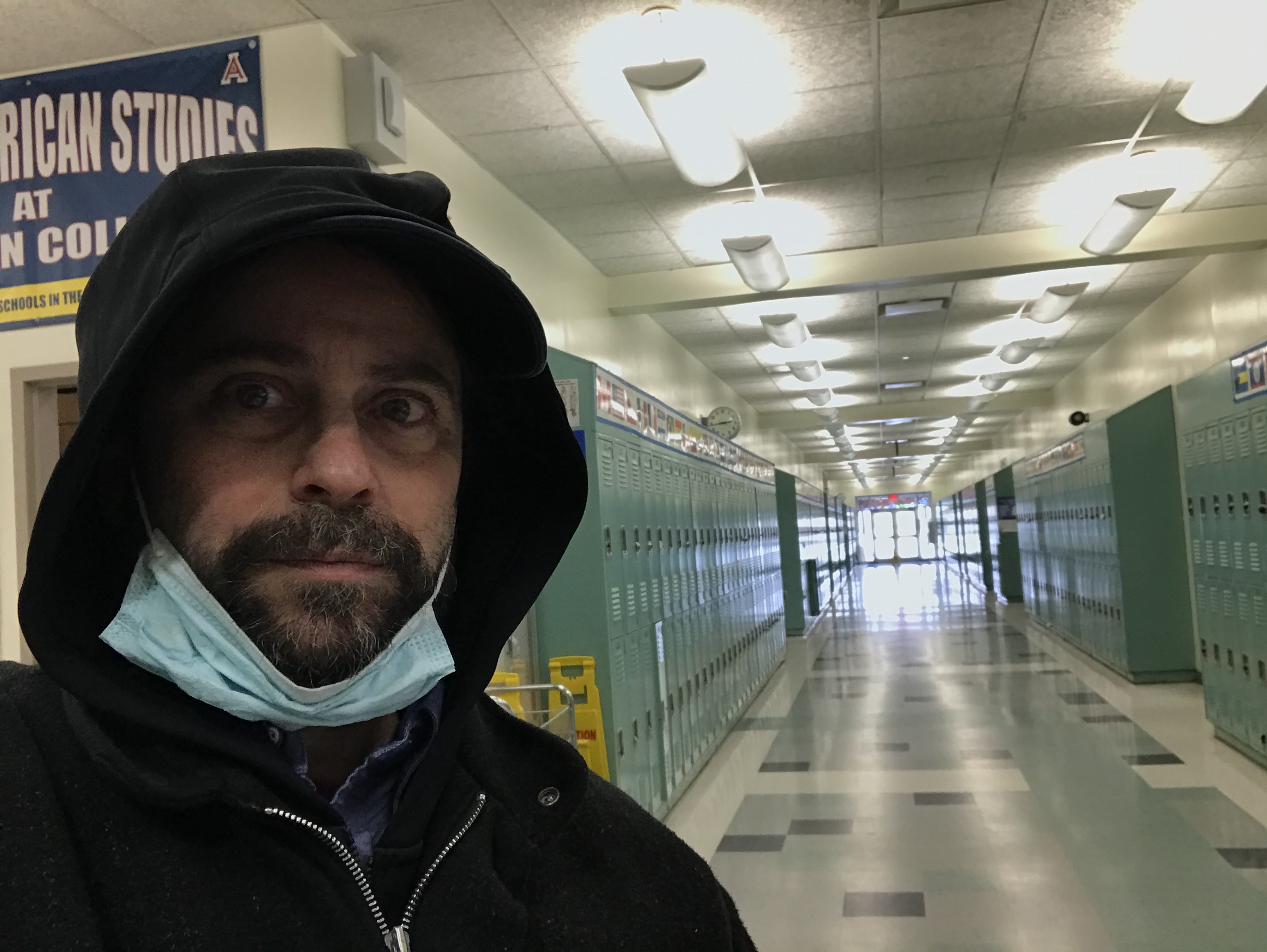
Fast forward nine week. (with five weeks left). We know more. We will make it to the end. We are wiser. But exhausted.
The parking lot next to my school is a COVID-19 testing site, with state troopers and orderly lines of cars.
Our garden is overgrown. Litter is accumulating.
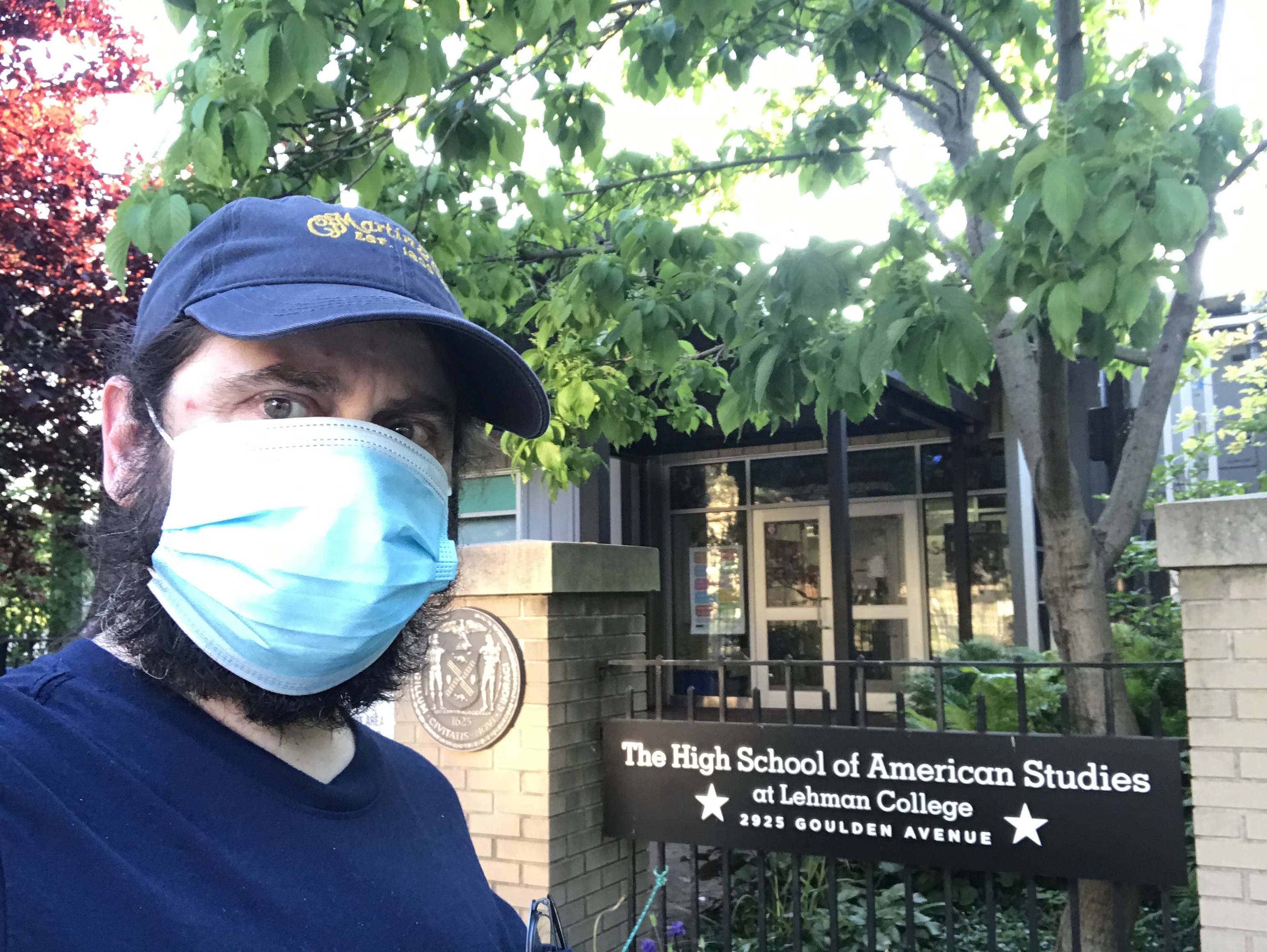
This is yesterday. And I am so ready to move on.
Getting a conversation going about September
What will September look like? What needs to happen for us to be safe enough to go into school? If we are remote, based on our experience so far, what would you do the same? What would you change up? Does a hybrid model make sense? Testing? Live lessons?
We had a chapter meeting coming up. And so, in preparation, I sent out a survey. It was explicitly NOT to tabulate, but to stimulate thought processes: “This is a “thought survey” – questions are to think about and to discuss.” This was not a vote. We were not in a position to set even school policy, let alone DoE policy. But it was good to bat around possibilities, concerns, insights.
The chapter meeting discussion, scheduled for half an hour, ran a full hour. And some people submitted their responses. I had not expected that. That was not my plan. Others asked if we could share the results with each other. So I rewrote the survey to incorporate points people made in the discussion, and redistributed it. (I will tabulate results, but, internally, for my chapter only.)
The survey was a good way to get discussion going. So I’m sharing the original, and the updated versions (if you would like a word document version, let me know):
Original Survey
Survey
Mid-May, 2020
This is a “thought survey” – questions are to think about and to discuss. UFT members in several schools are doing these.
For each question, choose the best answer, or answers, or think of your own.
I would prefer not to return to work in the building until:
- There is a vaccine
- Medical experts say it safe
- One particular person says it is safe – who? ___________________
- I get the sense that there are many fewer people getting sick
- I’m ok going back as soon as it is opened
Necessary safety measures include:
- Everyone is tested
- Masks
- Shields
- Gloves
- Temperature testing
I would prefer not to return to work in the building until social distancing (six feet):
- is possible at all times
- is possible at most times, including the classroom, but not all times
- is possible at all times, but less than 6 feet is ok
- social distancing is not important to me
If we could see our students, in our classrooms, once a week, but remote teach at other times, and maintain social distancing (a hybrid model)
- I would not want this – too complicated
- I would not want this – sounds rushed/don’t trust the distancing
- I would not want this – wait until we could open properly
- I would want this
While we are remote, which live methods do you use?
- Live lessons – mandatory
- Live lessons – recorded for viewing later
- Live Discussions
- Live Tutoring/Review sessions/Extra Help
- Live Office Hours
- Other
- None of the Above
While we are remote, which live methods do you like?
- Live lessons – mandatory
- Live lessons – recorded for viewing later
- Live Discussions
- Live Tutoring/Review sessions/Extra Help
- Live Office Hours
- Other
- None of the Above
If we are teaching remotely September – December – what changes would you want to make?
Revised/Expanded Survey
Survey – Revised
Mid-May, 2020
This survey is voluntary. The responses will be shared with HSAS UFT members only.
For each question, choose the best answer, or answers, or think of your own. Feel free to ignore questions that are not relevant or interesting.
I would prefer not to return to work in the building until:
- There is a vaccine
- Medical experts say it safe
- One particular person says it is safe – who? ___________________
- I get the sense that there are many fewer people getting sick
- I’m ok going back as soon as it is opened
Necessary safety measures include:
- Everyone is tested
- Masks
- Shields for adults
- Shields for kids
- Gloves
- Temperature testing
When it comes to cleaning I am most concerned with
- How thorough the cleaning will be before we return
- How thorough the regular cleaning will be once we return
- Specific training for the cleaners
I would prefer not to return to work in the building until social distancing (six feet):
- is possible at all times
- is possible at most times, including the classroom, but not all times
- is possible at all times, but less than 6 feet is ok
- social distancing is not important to me
If we could see our students, in our classrooms, once a week, but remote teach at other times, and maintain social distancing (a hybrid model)
- I would not want this – too complicated
- I would not want this – sounds rushed/don’t trust the distancing
- I would not want this – wait until we could open properly
- I would want this
There has been talk about other hybrid models. Which of these might make sense:
- Separate AM/PM groups of kids
- Alternating A and B days
- More face to face time with younger students (9th, maybe 10th)
While we are remote, which live methods do you use?
- Live lessons – mandatory
- Live lessons – recorded for viewing later
- Live Discussions
- Live Tutoring/Review sessions/Extra Help
- Live Office Hours
- None of the Above
Which live methods would you choose for your classes, if we teach remotely next year?
- Live lessons – mandatory
- Live lessons – recorded for viewing later
- Live Discussions
- Live Tutoring/Review sessions/Extra Help
- Live Office Hours
- None of the Above
Uncertainty
- The DoE should plan as if we are going to go back to school in September
- The DoE should plan as if we are teaching remotely in September
- The DoE should make plans for either contingency
- The DoE should make a decision (presumably remote) now, to take away the uncertainty
Live Teaching approaches
- It is good if each teacher / class has its own best approach to live teaching
- It is good if the school has a schoolwide policy on live teaching
- I am okay with what others do, as long as I can do what is best for my classes
- I would like time to be set aside for each teacher to use for live teaching, and then let them choose how to use it
Remote scheduling
- If we are remote, I would like a set daily time for each of my classes
- If we are remote, I would like a set daily time, but don’t expect kids in regular class groups
- If we are remote, I would like a set weekly time for each of my classes
- If we are remote, I would like a set weekly time, but don’t expect kids in regular classes
- The way we are now is fine.
Where do you fall on the question of remote tests?
- No multiple choice
- Has to be essays
- Not worth doing them
- They should be timed
- They should be untimed
How have you modified deadlines?
- Late the same day is ok
- Usually give a few more days
- Give about double the normal time
- Barely maintain any deadlines
How important is it to get students back into the building? Are there compromises we would make to achieve that?
Who knows how to teach remotely?
For the past nine weeks 70,000 New York City teachers have been teaching remotely. So have, I don’t know, three million more? across the US. But I know more about New York City.
So who doesn’t know how to teach remotely? Pretty much anyone who has not tried it. Mayors and Governors and Presidents, Members of Congress, State Legislators, Senators… None of them really have a clue – which, by the way, our governor has demonstrated quite adequately.
Who else doesn’t know how to teach remotely? I’d say pretty much every school system administrator, including the vast majority of principals and assistant principals. And also 100% of central administrators, at least here in New York City. They’ve thrown all the planning on us, and then while we are figuring things out throw us curves. Not only do they lack knowledge that would be useful to us in figuring out remote teaching, they lack empathy.
And then there’s us. Teachers. Trying to teach remotely. There are teachers out there who were already doing “flipped classrooms” or lots of video lessons. They had an easier adjustment. But even they could not anticipate the variety of problems students would have with the technology at home – without the “safety net” of in-class discussions. Some teachers were already familiar with Zoom or Google Meet Ups, which was an advantage. But most of us were new.
In the “planning week” (Tuesday, Wednesday and Thursday, after schools shut for students) we came up with something. Actually, a lot of somethings. It seems like there were hundreds of approaches, maybe thousands of variations.
And then reality hit. Most of our plans? Nah, didn’t work. The technology wasn’t up to it. Or the kids couldn’t deal with the mandatory tech issues. Or the DoE did not make tech available as they had promised. Or the DoE changed what software we were to use. Or it was just TOO MUCH. Or we learned later that grading online can be complicated and slow and overwhelming. Or we learned that our interactions with students were very different from what we expected. Or we needed to leave more time to deal with social/emotional interactions.
Teachers have been revising, and revising, and revising again. If we were building a house, what we have today would look better than what we started with late March – but better is relative. Imagine safety pins, paper clips, nailed on boards and tar paper… glue… newspapers… This is like the famous “repair an aircraft while in flight” – except we did not start with something that flies. More like throwing supplies off a cliff, and trying to assemble something that flies before they hit bottom.
That’s why messages from politicians, other teachers, or union leaders that seem to say “we’ve got this” really piss me off. We are getting better. And maybe a few teachers “got this.” But most of us don’t. We are better than two months ago, we have some ideas for going forward, but we are not there, we are not nearly there.
In answer to “Who knows how to teach remotely?” I would answer “No one, yet. Teachers are getting there, some faster than others. The politicians and educrats need to listen to teachers.”
What next?
If we are still teaching remotely in September, we need to do it more thoughtfully.
Hmm. That sounds like we were not being thoughtful in the Spring. Nothing could be further from the truth. We tried as best we could, but Cuomo and de Blasio and Carranza did not give us a chance.
If we are still teaching remotely in September, we need to be assigned time to plan. Not rushed time. Real time.
They could have given us the time in June, but they are awfully late for that now (as a significant number of teachers have already planned their classes through mid- to late June.) Actually, they could have given us time off in June, to make up for surprise-cancelling April break (Cuomo), and then taking away the religious holidays on top of that (Cuomo and/or de Blasio).
By the way, the four days in our Cumulative Absence Reserve do not make up for the seven days, nor for the unnecessary stress. Did I mention lack of empathy?
How about designating a few days in June for contingency planning? And then, if we are opening remote or hybrid, the first week in September for remote planning?
I’m not sure that’s enough.
What kind of planning? What parameters?
As we experience our first tastes of remote teaching, it is becoming apparent that there are huge shifts in pedagogy, and shifts in content. Many of our in-person activities don’t work. Lessons designed around whole class discussion, where we expect kids to adjust as they hear other ideas – those don’t work the same, or don’t work at all. Entire units need replanning. And the quantity of material taught has to be adjusted downward.
And assessment has to change, for almost every teacher, for almost every class. Some of us will move to no testing. Others will adopt an interesting variety of platforms. More projects. And assessment may move in directions that none of us anticipate today.
This is not just lesson replanning. This is rewriting curricula. It is not a one day task. It’s probably not a one-week task.
On top of that, those of us teaching tested grades or classes that end in a Regents Exam – we need to know how Chancellor Betty Rosa and the Regents will adjust what is being tested.
Which will mean curriculum redesign.
You know what’s worse? Not knowing. Not knowing if we will start remote. How long we will go remote. If we will transition from Remote –> Hybrid –> Live.
As we learn, we really should have time to adjust our plans. We are not looking to avoid work. But we want to be in a place where we can do our best for our students. Andrew Cuomo, bill de blasio, Richard Carranza – does that matter to you? Do you care how well our students are being served? We do.
TDA: Sustainable (continues Socially Responsive) Fund
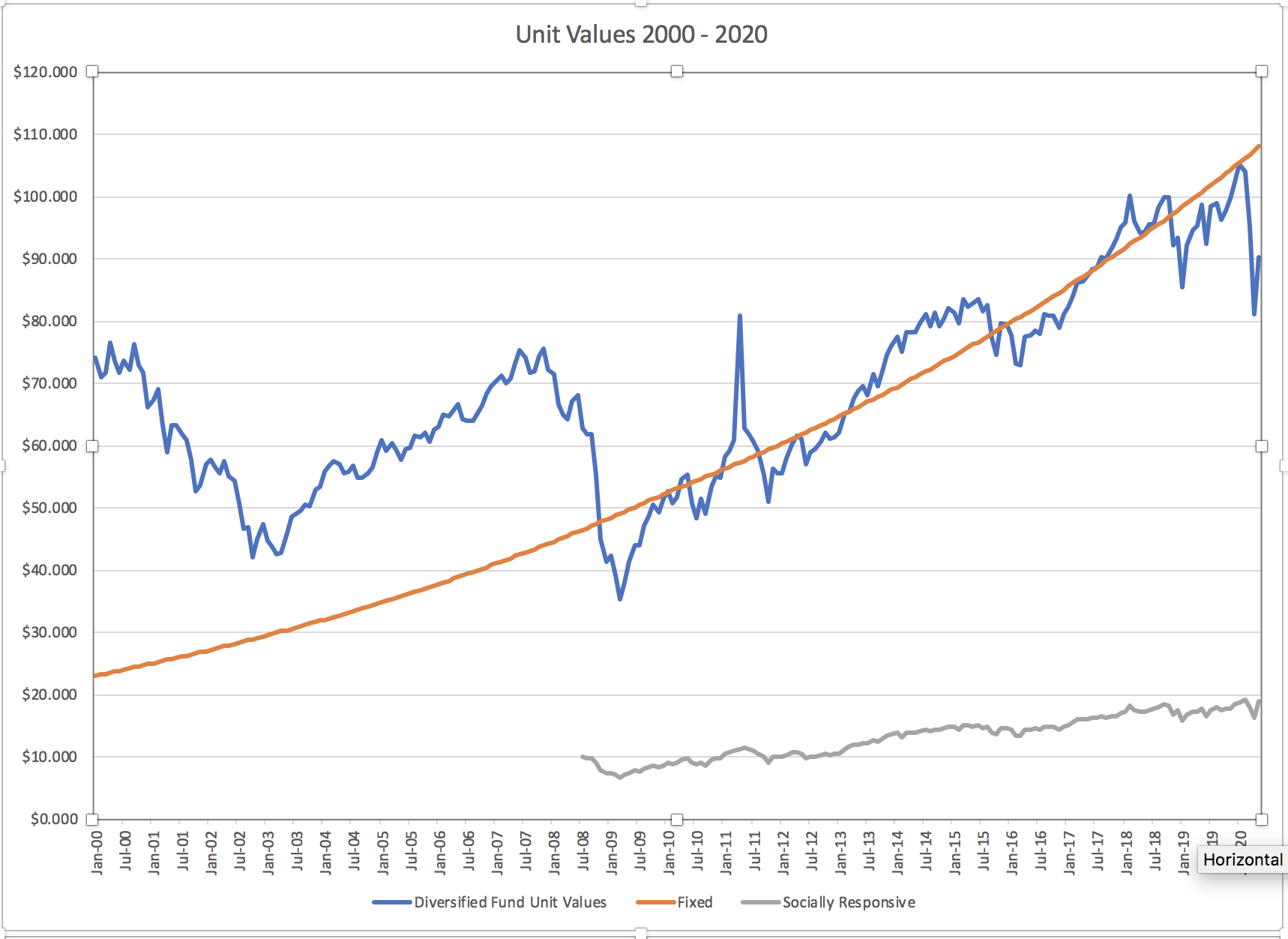
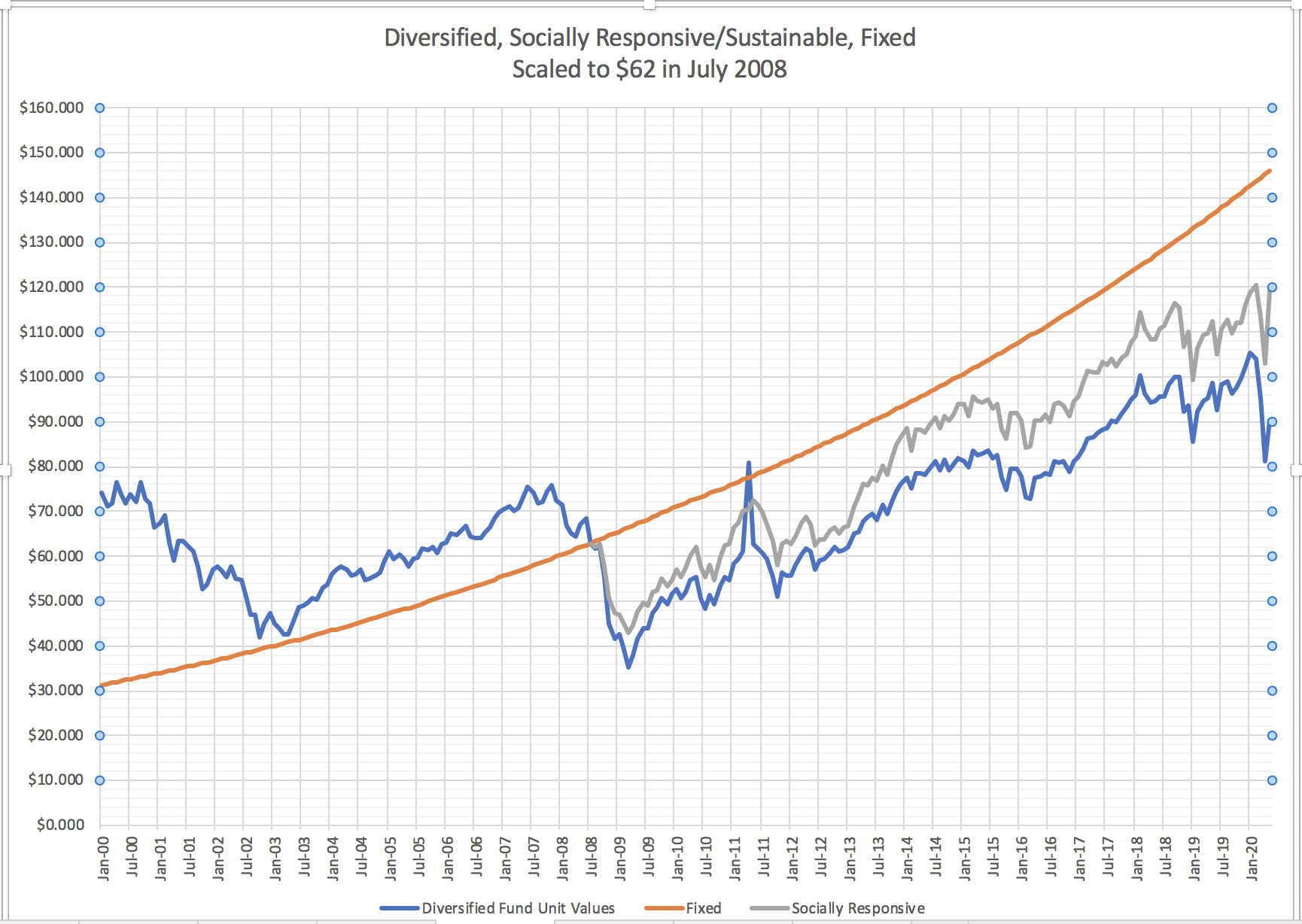
The Socially Responsive Fund started in July 2008 (with a unit value of $10). There were several funds started at the same time. How has it fared?
At first glance, it seems to have slightly but consistently outperformed the Diversified Equity Fund. More interestingly, it set a new high in January 2020, and stands ABOVE that point in May 2020, today. I do not know why. I am not a financial analyst.
New York City teachers who contribute to a TDA have several choices of funds.
Quick note – the Socially Responsive Fund was ended and a Sustainable Fund started last October (2019). I do not know the difference. Funds were automatically moved from the former to the latter.
I previously posted a graph of the Diversified Fund, and compared it to a fixed investment. Since there are no fixed “units” I matched them arbitrarily at January 2010. This time I will make all three equal at July 2008.
Notice, this is not analysis. I am not a financial analyst. For one thing, no one has the option of buying in at July 2008 – that’s long past. And no one buys in all at once – meaning there is not really a “correct date” to set the funds equal for the sake of comparison.
Anyway, two graphs, one with the actual unit values, the second scaled to make them equal July 2008:
And the raw data (the fixed values are set at $18 in January 2000. This is arbitrary on my part)
| Date | Diversified Fund Unit Values | Fixed | Socially Responsive |
| Jan-00 | $74.220 | $18.00 | |
| Feb-00 | $71.086 | $18.12 | |
| Mar-00 | $71.665 | $18.24 | |
| Apr-00 | $76.533 | $18.37 | |
| May-00 | $73.769 | $18.50 | |
| Jun-00 | $71.763 | $18.63 | |
| Jul-00 | $73.669 | $18.76 | |
| Aug-00 | $72.281 | $18.89 | |
| Sep-00 | $76.444 | $19.02 | |
| Oct-00 | $72.885 | $19.15 | |
| Nov-00 | $71.865 | $19.28 | |
| Dec-00 | $66.328 | $19.41 | |
| Jan-01 | $67.534 | $19.54 | |
| Feb-01 | $69.120 | $19.67 | |
| Mar-01 | $63.228 | $19.81 | |
| Apr-01 | $59.113 | $19.95 | |
| May-01 | $63.277 | $20.09 | |
| Jun-01 | $63.336 | $20.23 | |
| Jul-01 | $61.900 | $20.37 | |
| Aug-01 | $60.945 | $20.51 | |
| Sep-01 | $57.696 | $20.65 | |
| Oct-01 | $52.638 | $20.79 | |
| Nov-01 | $53.766 | $20.93 | |
| Dec-01 | $57.135 | $21.07 | |
| Jan-02 | $57.709 | $21.21 | |
| Feb-02 | $56.530 | $21.36 | |
| Mar-02 | $55.518 | $21.51 | |
| Apr-02 | $57.547 | $21.66 | |
| May-02 | $55.073 | $21.81 | |
| Jun-02 | $54.528 | $21.96 | |
| Jul-02 | $50.928 | $22.11 | |
| Aug-02 | $46.829 | $22.26 | |
| Sep-02 | $46.952 | $22.41 | |
| Oct-02 | $42.026 | $22.56 | |
| Nov-02 | $45.038 | $22.72 | |
| Dec-02 | $47.348 | $22.88 | |
| Jan-03 | $44.843 | $23.04 | |
| Feb-03 | $43.846 | $23.20 | |
| Mar-03 | $42.624 | $23.36 | |
| Apr-03 | $42.752 | $23.52 | |
| May-03 | $46.057 | $23.68 | |
| Jun-03 | $48.607 | $23.84 | |
| Jul-03 | $49.115 | $24.00 | |
| Aug-03 | $49.698 | $24.17 | |
| Sep-03 | $50.575 | $24.34 | |
| Oct-03 | $50.311 | $24.51 | |
| Nov-03 | $52.934 | $24.68 | |
| Dec-03 | $53.522 | $24.85 | |
| Jan-04 | $55.993 | $25.02 | |
| Feb-04 | $56.928 | $25.19 | |
| Mar-04 | $57.611 | $25.36 | |
| Apr-04 | $57.003 | $25.53 | |
| May-04 | $55.520 | $25.71 | |
| Jun-04 | $55.947 | $25.89 | |
| Jul-04 | $56.883 | $26.07 | |
| Aug-04 | $54.801 | $26.25 | |
| Sep-04 | $54.914 | $26.43 | |
| Oct-04 | $55.703 | $26.61 | |
| Nov-04 | $56.503 | $26.79 | |
| Dec-04 | $58.976 | $26.97 | |
| Jan-05 | $60.909 | $27.16 | |
| Feb-05 | $59.282 | $27.35 | |
| Mar-05 | $60.546 | $27.54 | |
| Apr-05 | $59.243 | $27.73 | |
| May-05 | $57.824 | $27.92 | |
| Jun-05 | $59.463 | $28.11 | |
| Jul-05 | $59.684 | $28.30 | |
| Aug-05 | $61.706 | $28.49 | |
| Sep-05 | $61.408 | $28.69 | |
| Oct-05 | $62.071 | $28.89 | |
| Nov-05 | $60.611 | $29.09 | |
| Dec-05 | $62.582 | $29.29 | |
| Jan-06 | $63.038 | $29.49 | |
| Feb-06 | $65.061 | $29.69 | |
| Mar-06 | $64.864 | $29.89 | |
| Apr-06 | $65.757 | $30.10 | |
| May-06 | $66.618 | $30.31 | |
| Jun-06 | $64.315 | $30.52 | |
| Jul-06 | $64.128 | $30.73 | |
| Aug-06 | $64.037 | $30.94 | |
| Sep-06 | $65.387 | $31.15 | |
| Oct-06 | $66.430 | $31.36 | |
| Nov-06 | $68.431 | $31.58 | |
| Dec-06 | $69.661 | $31.80 | |
| Jan-07 | $70.413 | $32.02 | |
| Feb-07 | $71.280 | $32.24 | |
| Mar-07 | $70.152 | $32.46 | |
| Apr-07 | $70.788 | $32.68 | |
| May-07 | $73.261 | $32.90 | |
| Jun-07 | $75.354 | $33.13 | |
| Jul-07 | $74.093 | $33.36 | |
| Aug-07 | $71.679 | $33.59 | |
| Sep-07 | $72.005 | $33.82 | |
| Oct-07 | $74.399 | $34.05 | |
| Nov-07 | $75.726 | $34.28 | |
| Dec-07 | $72.353 | $34.52 | |
| Jan-08 | $71.460 | $34.76 | |
| Feb-08 | $66.717 | $35.00 | |
| Mar-08 | $65.133 | $35.24 | |
| Apr-08 | $64.299 | $35.48 | |
| May-08 | $67.195 | $35.72 | |
| Jun-08 | $68.275 | $35.97 | |
| Jul-08 | $62.888 | $36.22 | $10.000 |
| Aug-08 | $61.869 | $36.47 | $9.892 |
| Sep-08 | $61.936 | $36.72 | $9.963 |
| Oct-08 | $55.357 | $36.97 | $9.177 |
| Nov-08 | $45.089 | $37.22 | $8.041 |
| Dec-08 | $41.509 | $37.48 | $7.529 |
| Jan-09 | $42.493 | $37.74 | $7.479 |
| Feb-09 | $39.175 | $38.00 | $7.167 |
| Mar-09 | $35.364 | $38.26 | $6.844 |
| Apr-09 | $37.945 | $38.52 | $7.113 |
| May-09 | $41.505 | $38.78 | $7.565 |
| Jun-09 | $43.979 | $39.05 | $7.877 |
| Jul-09 | $44.033 | $39.32 | $7.768 |
| Aug-09 | $47.180 | $39.59 | $8.264 |
| Sep-09 | $48.744 | $39.86 | $8.338 |
| Oct-09 | $50.532 | $40.13 | $8.734 |
| Nov-09 | $49.387 | $40.41 | $8.455 |
| Dec-09 | $51.621 | $40.69 | $8.713 |
| Jan-10 | $52.629 | $40.93 | $9.059 |
| Feb-10 | $50.713 | $41.17 | $8.804 |
| Mar-10 | $51.840 | $41.41 | $9.139 |
| Apr-10 | $54.716 | $41.65 | $9.543 |
| May-10 | $55.347 | $41.89 | $9.883 |
| Jun-10 | $50.806 | $42.13 | $9.155 |
| Jul-10 | $48.310 | $42.38 | $8.810 |
| Aug-10 | $51.433 | $42.63 | $9.202 |
| Sep-10 | $49.212 | $42.88 | $8.716 |
| Oct-10 | $53.481 | $43.13 | $9.500 |
| Nov-10 | $55.253 | $43.38 | $9.938 |
| Dec-10 | $54.825 | $43.63 | $9.972 |
| Jan-11 | $58.207 | $43.88 | $10.577 |
| Feb-11 | $59.246 | $44.14 | $10.712 |
| Mar-11 | $61.050 | $44.40 | $11.176 |
| Apr-11 | $80.881 | $44.66 | $11.189 |
| May-11 | $62.750 | $44.92 | $11.505 |
| Jun-11 | $61.897 | $45.18 | $11.368 |
| Jul-11 | $60.624 | $45.44 | $11.076 |
| Aug-11 | $59.225 | $45.71 | $10.689 |
| Sep-11 | $55.426 | $45.98 | $10.075 |
| Oct-11 | $51.100 | $46.25 | $9.208 |
| Nov-11 | $56.249 | $46.52 | $9.979 |
| Dec-11 | $55.541 | $46.79 | $10.085 |
| Jan-12 | $55.630 | $47.06 | $9.998 |
| Feb-12 | $58.119 | $47.33 | $10.263 |
| Mar-12 | $60.467 | $47.61 | $10.700 |
| Apr-12 | $61.719 | $47.89 | $10.939 |
| May-12 | $61.156 | $48.17 | $10.693 |
| Jun-12 | $57.035 | $48.45 | $9.909 |
| Jul-12 | $59.120 | $48.73 | $10.120 |
| Aug-12 | $59.543 | $49.01 | $10.159 |
| Sep-12 | $60.744 | $49.30 | $10.443 |
| Oct-12 | $62.048 | $49.59 | $10.543 |
| Nov-12 | $61.110 | $49.88 | $10.365 |
| Dec-12 | $61.532 | $50.17 | $10.562 |
| Jan-13 | $62.174 | $50.46 | $10.624 |
| Feb-13 | $65.154 | $50.75 | $11.332 |
| Mar-13 | $65.582 | $51.05 | $11.706 |
| Apr-13 | $67.617 | $51.35 | $12.109 |
| May-13 | $68.781 | $51.65 | $12.061 |
| Jun-13 | $69.567 | $51.95 | $12.306 |
| Jul-13 | $68.243 | $52.25 | $12.224 |
| Aug-13 | $71.550 | $52.55 | $12.777 |
| Sep-13 | $69.543 | $52.86 | $12.454 |
| Oct-13 | $72.107 | $53.17 | $12.993 |
| Nov-13 | $74.633 | $53.48 | $13.496 |
| Dec-13 | $76.199 | $53.79 | $13.746 |
| Jan-14 | $77.656 | $54.10 | $14.061 |
| Feb-14 | $75.061 | $54.42 | $13.288 |
| Mar-14 | $78.365 | $54.74 | $14.032 |
| Apr-14 | $78.382 | $55.06 | $14.035 |
| May-14 | $78.290 | $55.38 | $13.949 |
| Jun-14 | $79.626 | $55.70 | $14.184 |
| Jul-14 | $81.078 | $56.02 | $14.469 |
| Aug-14 | $79.251 | $56.35 | $14.099 |
| Sep-14 | $81.499 | $56.68 | $14.533 |
| Oct-14 | $79.271 | $57.01 | $14.359 |
| Nov-14 | $80.542 | $57.34 | $14.566 |
| Dec-14 | $82.029 | $57.67 | $14.932 |
| Jan-15 | $81.363 | $58.01 | $14.926 |
| Feb-15 | $79.846 | $58.35 | $14.538 |
| Mar-15 | $83.661 | $58.69 | $15.184 |
| Apr-15 | $82.492 | $59.03 | $15.046 |
| May-15 | $82.918 | $59.37 | $14.993 |
| Jun-15 | $83.538 | $59.72 | $15.096 |
| Jul-15 | $81.738 | $60.07 | $14.760 |
| Aug-15 | $82.668 | $60.42 | $14.913 |
| Sep-15 | $77.419 | $60.77 | $14.033 |
| Oct-15 | $74.680 | $61.12 | $13.710 |
| Nov-15 | $79.632 | $61.48 | $14.632 |
| Dec-15 | $79.588 | $61.84 | $14.599 |
| Jan-16 | $77.773 | $62.20 | $14.349 |
| Feb-16 | $73.218 | $62.56 | $13.402 |
| Mar-16 | $72.947 | $62.92 | $13.465 |
| Apr-16 | $77.546 | $63.29 | $14.379 |
| May-16 | $77.866 | $63.66 | $14.362 |
| Jun-16 | $78.512 | $64.03 | $14.571 |
| Jul-16 | $78.102 | $64.40 | $14.323 |
| Aug-16 | $81.078 | $64.78 | $14.938 |
| Sep-16 | $80.958 | $65.16 | $14.968 |
| Oct-16 | $81.042 | $65.54 | $14.881 |
| Nov-16 | $78.955 | $65.92 | $14.534 |
| Dec-16 | $81.062 | $66.30 | $15.026 |
| Jan-17 | $82.351 | $66.69 | $15.227 |
| Feb-17 | $83.973 | $67.08 | $15.702 |
| Mar-17 | $86.227 | $67.47 | $16.099 |
| Apr-17 | $86.533 | $67.86 | $16.067 |
| May-17 | $87.440 | $68.26 | $16.055 |
| Jun-17 | $88.399 | $68.66 | $16.415 |
| Jul-17 | $88.681 | $69.06 | $16.308 |
| Aug-17 | $90.261 | $69.46 | $16.531 |
| Sep-17 | $90.080 | $69.87 | $16.285 |
| Oct-17 | $91.800 | $70.28 | $16.596 |
| Nov-17 | $93.288 | $70.69 | $16.714 |
| Dec-17 | $95.100 | $71.10 | $17.125 |
| Jan-18 | $95.898 | $71.51 | $17.322 |
| Feb-18 | $100.326 | $71.93 | $18.216 |
| Mar-18 | $96.212 | $72.35 | $17.606 |
| Apr-18 | $94.245 | $72.77 | $17.260 |
| May-18 | $94.459 | $73.19 | $17.251 |
| Jun-18 | $95.640 | $73.62 | $17.584 |
| Jul-18 | $95.605 | $74.05 | $17.711 |
| Aug-18 | $98.198 | $74.48 | $18.113 |
| Sep-18 | $100.006 | $74.91 | $18.539 |
| Oct-18 | $99.877 | $75.35 | $18.333 |
| Nov-18 | $92.192 | $75.79 | $16.959 |
| Dec-18 | $93.484 | $76.23 | $17.480 |
| Jan-19 | $85.504 | $76.67 | $15.786 |
| Feb-19 | $92.173 | $77.12 | $16.910 |
| Mar-19 | $94.744 | $77.57 | $17.398 |
| Apr-19 | $95.432 | $78.02 | $17.436 |
| May-19 | $98.700 | $78.48 | $17.892 |
| Jun-19 | $92.578 | $78.94 | $16.694 |
| Jul-19 | $98.450 | $79.40 | $17.608 |
| Aug-19 | $98.938 | $79.86 | $17.950 |
| Sep-19 | $96.264 | $80.33 | $17.452 |
| Oct-19 | $97.765 | $80.80 | $17.796 |
| Nov-19 | $99.678 | $81.27 | $17.812 |
| Dec-19 | $102.435 | $81.74 | $18.444 |
| Jan-20 | $105.276 | $82.22 | $18.871 |
| Feb-20 | $104.047 | $82.70 | $19.178 |
| Mar-20 | $95.393 | $83.18 | $18.049 |
| Apr-20 | $81.142 | $83.67 | $16.396 |
| May-20 | $90.415 | $84.16 | $18.926 |
Yesterday’s Town Hall
A friend took notes
Here they are
(I know other versions are out there)
UFT TOWN HALL MEETING (via phone)
May 21, 2020 @ 3:15 pm
Michael Mulgrew, speaker, then member Q&A
MICHAEL MULGREW:
-
- Many thanks to everyone; things are constantly changing
- We are definitely OFF Memorial Day (1st official day off since Feb. break)
- Spring Break:
-
-
- UFT challenged; it got ugly. CAR days are in but still seeking full compensation
- Still seeking full compensation for those 7 days
- Was the peak of the virus in terms of loss of life (68 UFT members/ 54 from the retired chapter)
- Possible future action regarding these deaths
- Received our raise and should have budgets shortly
- THE BIG TWO QUESTIONS: How to we ensure our safety/ How do we protect our livelihoods (economy)
- Last Few Days? How do teachers “close up shop” safely? Guidance pending?
-
- Summer school:
-
-
- 6 weeks remote learning
- Postings go live tomorrow (May 22)
- Will include clear definitions of remote learning nomenclature (Ex: “synchronous” “asynchronous” with protection from labor management
- Very clear that these terms are only during this emergency situation
- Delay in summer school information was the city’s fault
- A massive amount of students; WILL STUDENTS COME?
- How many teachers will we need?
-
- SEPTEMBER: 3 possibilities
-
-
- 1. There is a vaccine/ cure and we return normally (unlikely)
- 2. Full remote learning (definite possibility as more city children get sick
- 3. A hybrid of remote and in-building learning
-
- HYBRID Thoughts (part time in school/ part time remote)
-
-
- Staggered schedules?
- Schools in cohorts, like A/ B/ C… 2 cohorts/ building/ day?
- Have to analyze building space; shared spaces,
- Teacher focus groups already planning– inspiring ideas already happening
- What needs to be done before teachers and students can return to school buildings?
- Will follow CDC guidelines, not DOE or Tweed
- Which teachers will be remote vs. in school?
- Schools cannot be programmed by Central. Each school building is too unique.
- Likely a whole new workflow will emerge; a whole new way of teaching and learning
-
- The BUDGET⇒ SAFETY + ECONOMY (LIVELIHOODS)
-
-
- BUDGET/ ECONOMY
- Petitioning city council that education budgets NOT be cut
- Huge national fight already; AFT first organization to petition the government to save school budgets
- Most state budgets are coming out July 1; NY’s came out April 1. Government is putting out cuts soon.
- Cuomo seems to want to wait for Senate budget first
- Huge political game; really disgusting how they talk about how importance education is, then take away funding
- SAFETY
- Do all kids need masks? What about temperature checks
- Each school needs/will have a dedicated NURSE
- CLASS SIZES need to be smaller ⇒ MORE teachers needed not less (yet hiring freeze?)
- Suggested having wills/ healthcare proxies in place just in case
- BUDGET/ ECONOMY
-
- THE HEROES ACT
- Federal aid package that has passed the House and goes to McConnell and Senate soon
- Petition says it MUST include monies for teachers/ education without loopholes
- Text ‘LIFELINE’ to 306-44 to “sign” the virtual petition
- Q&A
-
- Q: When will we know which method of teaching for September?
- A: Board of Ed already a month behind/ no one is making decisions; UFT predicts a hybrid method (subject to change, of course); Already planning for it and will be following CDC guidelines; certain staff will be doing full time remote: hopefully BY THE THIRD WEEK IN JUNE
-
- Q: What about D75 schools? (bad reception; question skipped)
- A: They are being thought about and planned for.
-
- Q: When will we get an updated calendar?
- A: UFT/ DOE agreed about it a month ago; DOE refusing to release it, afraid that “something will change” (of course it will). Need a calendar ASAP to be able to do SBO votes/ Comp Time positions; CAN vote on Comp Time positions now, but many chapters prefer to do their votes all together.
-
- Q:(from a nurse at a Regional Enrichment Center) What’s up with the RECs during the summer?
- A: Can pull most back; A need to rotate people out/ seek volunteers to stay in; NO ONE will be forced to work through the summer
-
- Q: What about teacher evaluations? Observations? What about the non tenured/ tenure process?
- A: SED says no teacher evaluations; People CAN still get tenure and less continuances this year. SED needs an executive order to waive evaluations; Cuomo must pass it; would need a “waiver” but can’t do evaluations without changing the contractual agreements
-
-
- Q: Should we have some sort of “Day of Action” to drum up support for THE HEROES ACT? Social media blast?
-
- A; Sure, and love the enthusiasm!
-
-
- Q: D75: so hard to keep students with very severe needs apart; impossible to not share toys/ supplies
-
- A: We will hear from these sites to help discover what is realistic; similar issues to early childhood learning
-
- Q: Remote Learning for September: Are there checklists? Guidelines to follow?
- A: How can there be checklists? Working on those definitions of terms (mentioned previously) to help clarify what can and can’t be asked of us. Remote learning can’t and doesn’t function like a “traditional school day”. Impossible to insist what everyone must do. Checklists sound like they would come out of DOE central and not from the UFT, because we need teachers to last through the year and not burn out!
-
- Q: How will accommodations be made for members with underlying conditions?
- A: Criteria will be put into place. Remote/ vs. in-person. Schools will have to do some social distancing, but it is still a gathering of people, which will always carry some risks. We will get our safety intel from CDC and science, not Tweed.
-
- Q: Teachers who are parents; how do we handle conflicts between our work/ kid’s school schedules?
- A: We will all have to do our best. There WILL be problems to work out. Daycare systems will be in place for essential workers, as teachers are.
A new syndrome, renamed
We are very concerned with the sudden emergence of a set of inflammatory symptoms in children infected with COVID-19.
Multisystem Inflammatory Syndrome has recently been reported in youngsters – from infants through teenagers. It was first reported in New York City, where there are several deaths associated with it. It looks like another disease – Kawasaki.
The name of the syndrome was Pediatric Multisystem Inflammatory Syndrome (PMIS). Unfortunately New York City is full of bureaucrats who like to pronounce acronyms – and after being met with snickers for saying “PMIS is rising rapidly” (try reading that out loud) they changed what they call it (notice the name of the pdf) to the hard-to-pronounce-like-a-sex-joke Multisystem Inflammatory Syndrome in Children or MIS-C.
Buffoon – Bumbler – Brilliant?
Trump the buffoon, de Blasio the bumbler, but Cuomo’s been brilliant?
Not so fast!
The nightly news version, the press conference version, that fits.
Trump blusters, brags, bullies. He exudes confidence in his intellect and abilities, despite ample evidence to the contrary.
He really wants to be good at this, he wants to sound official, and somber, and caring, but de Blasio’s meandering, whining, pleading, plodding press conferences inspire mostly sighs.
Cuomo stands out. He’s punchy. He’s sharp. He’s confident. He’s cogent. He cares. He’s realistic.
Donald the Buffoon, Bill the Bumbler, and Brilliant Andrew. Case closed?
Not so fast.
When the bar is set at “not completely insane” Cuomo clears it pretty easily. But we should not be using such a low bar.
Cuomo grabbed more emergency powers than were reasonable, and then abused them: to cut aid to localities (schools and health care) and to take revenge on political opponents.
But the crisis, right? Hasn’t he been a shining light in the storm? Well, no. Take an hour, read this Propublica piece. (might take you 20 minutes, took me 40, deserves an hour). Or, here, let me pull out some highlights. The article contrasts the response in NY State and California, with a lot about NYC and San Francisco, as well. Cuomo and de Blasio get blasted. Strangely, de Blasio, even with criticism, comes off better than he does from his press conferences. Another low bar.
Anyway, skim the highlights, and then go read the full piece.
Two Coasts. One Virus. How New York Suffered Nearly 10 Times the Number of Deaths as California.
On March 17, de Blasio suggested a “shelter in place” order as in California. Cuomo blocked it: ““shelter-in-place” sounded like it was a response to a nuclear apocalypse. Moreover, Cuomo said, he alone had the power to order such a measure.” The order came five days later. With exponential growth, and a doubling time of less than five days, that delay may have doubled the total number of New York deaths.
“No later than Feb. 28, federal officials warned the country that a deadly pandemic was inevitable. It is from that point forward, they say, that any individual state’s actions should be judged.” But ““Governors don’t do global pandemics,” Cuomo said.”
“While New York’s formal pandemic response plan underscores the need for seamless communication between state and local officials, the state Health Department broke off routine sharing of information and strategy with its city counterpart in February”
The article is not kind to de Blasio either: “For his part, de Blasio spent critical weeks spurning his own Health Department’s increasingly urgent belief that trying to contain the spread of the virus was a fool’s errand. The clear need, as early as late February, was to move to an all-out effort at not being overrun by the disease, which meant closing things down and restricting people’s movements.”
The disconnect between de Blasio and his own Health Department played out — perhaps decisively — in late February and early March. The events of those days have been reconstructed through notes kept at the time by the city official alarmed by what they were seeing — the diminishment and disregarding of one of the world’s most respected local health departments. The official’s notes show that late February was the first opportunity for de Blasio to have absorbed what his department was warning about. It didn’t go well. “He said all the wrong things,” the official wrote after a Feb. 26 news conference.
All eyes are on the federal government’s lack of stockpile (and rightly so). But the article points out Cuomo’s responsibility: “New York’s pandemic preparedness and response plan, first created in 2006 and running to hundreds of pages, predicted the state’s health care system would be overwhelmed in such a situation, and it highlighted two vital necessities: a robust and up-to-date state stockpile of emergency equipment and protective gear, and a mechanism for quickly expanding the number of hospital beds available. Despite repeated requests, New York state health officials would not say what was in the state’s stockpile at the start of 2020, but it clearly wasn’t adequate.”
But while the state’s plan makes clear its obligation to be adequately prepared, Cuomo over many weeks sought to portray the federal government as the culprit for the crisis in shortages of protective gear and medical equipment such as ventilators.
As for expanding hospital capacity, it was not until March 16 that Cuomo designated a task force to engineer greater numbers of beds, demanding a 50% increase in capacity in 24 hours. “You could make an argument that it should have happened a month before,” said Michael Dowling, the chief executive officer of Northwell Health, the largest hospital organization in the state and one of the health care leaders Cuomo appointed to the task force.
The state’s performance once New York fell under siege from the disease has also been challenged. State Health Commissioner Howard Zucker — one of a half-dozen advisers who made up Cuomo’s brain trust during the crisis — has been pilloried by the local press for his decision to allow nursing home residents who tested positive for the disease to be returned to those homes. The administration reversed its position this week.
Meanwhile, the New York State Nurses Association has sued the state Health Department and its commissioner for failing to adequately equip front-line medical workers with protective wear and allowing hospitals to order nurses sickened by the virus back to work.
…when the March 2 news of community spread surfaced in New Rochelle, Cuomo urged calm. The state, he proudly noted, had successfully confronted a wide variety of health scares over the years. “We are fully coordinated, and we are fully mobilized, and we are fully prepared to deal with the situation as it develops,” Cuomo said. “This isn’t our first rodeo.”
Retiring Advanced Placement
The College Board cannot plan a test, give a test, guarantee fairness, catch cheaters, or tell the truth.
This has been a rough week for them, with the AP Fiasco, and a long time coming. Even favorable coverage bends unfavorable.
Let’s run through the list:
- They get schools to give appropriate space for free, and crumble when forced to come up with something themselves. They made no attempt to guarantee an appropriate environment for test-takers.
- They get schools to plan administration for free, and when left to their own devices, fail. There were student taking tests at midnight. And at 2AM. And at 4AM.
- They count on teachers to proctor and prevent cheating. Left to their own devices, they insult everyone with bullying “Don’t Cheat you Cheaters!” threats (which are as ineffective as they are insulting), pretend to be teens and try to entrap students (and are instantly found out), and fail to prevent actual cheating (as a google trends search of “how do you find an integral,” “progressive era,” “angular momentum,” or “active transport” quickly reveals).
- They fail to develop an app (students know how to use apps), fail to obtain sufficient bandwidth, and then lie through their teeth, blaming teenagers when the teenagers actually followed the directions.
- And instead of rectifying their mistake, they rescheduled exams for June – including rescheduling some at conflicting times.
What do we need these clowns for?
Curriculum?
There are many “AP Curricula” out there – we can continue using them without these clowns being involved. Schools and districts may also have their own high level courses – or courses that should have been considered “high level” but were not considered so without the AP imprimatur.
Test?
Hell, most teachers in my school know ±1 what their students will score.
Or even better, forget the tests. AP exams are way before the end of the year… replace them with performance-based assessment of projects or original writing, or research or creative work. This could be better than APs. Can you imagine students spending time applying their knowledge, rather than cramming? And we get more time to do the work. No one will want to go back.
Postscripts
We have a moment. Now is the time to move to get the College Board out of our public schools.
We should carefully examine ANY private company that is intruding into public education.
We will look back on this, years from now, and wonder why it took so long.
TDA: Diversified, Fixed – 2000-20
The Diversified Fund Unit Values are available on the TRS website. I put them into a chart starting in 2010, and I got asked to push it back.
The fixed return was 8.25% until December 11, 2009, when it dropped to 7%. Here’s the deal that delegates voted overwhelmingly for. The UFT used to have the story on its website, but they cleared out their archives. I kind of care, because Jack Miller took a FANTASTIC photo of me speaking in opposition (below) but I also care because documentation of history matters. Norm wrote two lines about it, but that’s not the same thing.

Anyhow, there’s something challenging about making this chart – where to index the fixed? Make the two amounts equal in January 2000 would give one impression – and I think that would be the default. But I chose to show them as equal January 2010. In any case it is the comparative shapes, rather than raw numbers, that are of interest. Also, and I am not an analyst, this is an ongoing investment, so you don’t drop your money in at the beginning and watch. In other words – I’ve made a somewhat pretty picture, but the analysis is probably much more complicated.
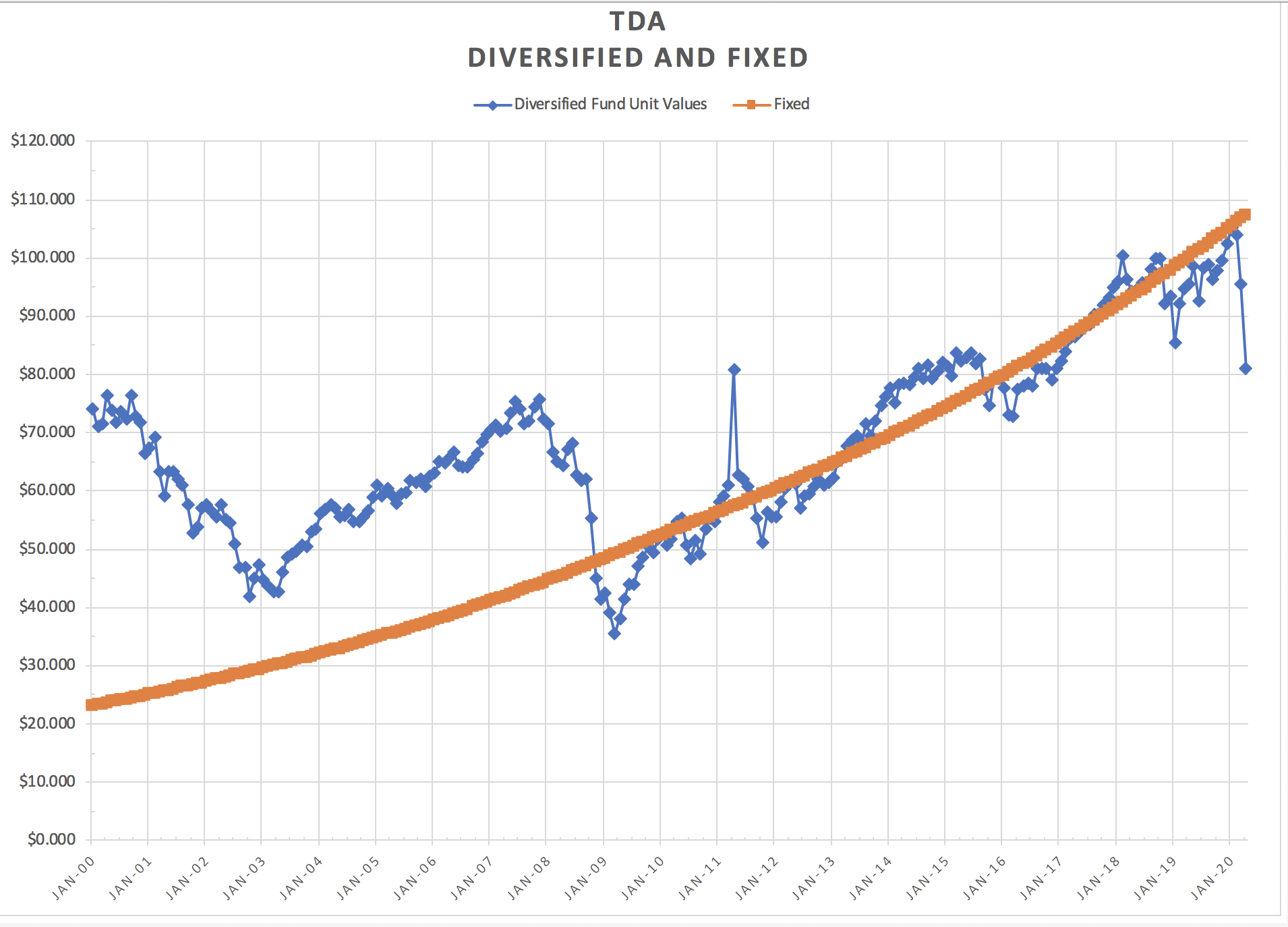
And here’s the raw data (to be proofread or analyzed, or anything you like)
| Date | Diversified Fund Unit Values | Fixed |
| Jan-00 | $74.220 | $23.14 |
| Feb-00 | $71.086 | $23.30 |
| Mar-00 | $71.665 | $23.46 |
| Apr-00 | $76.533 | $23.62 |
| May-00 | $73.769 | $23.78 |
| Jun-00 | $71.763 | $23.94 |
| Jul-00 | $73.669 | $24.10 |
| Aug-00 | $72.281 | $24.27 |
| Sep-00 | $76.444 | $24.44 |
| Oct-00 | $72.885 | $24.61 |
| Nov-00 | $71.865 | $24.78 |
| Dec-00 | $66.328 | $24.95 |
| Jan-01 | $67.534 | $25.12 |
| Feb-01 | $69.120 | $25.29 |
| Mar-01 | $63.228 | $25.46 |
| Apr-01 | $59.113 | $25.64 |
| May-01 | $63.277 | $25.82 |
| Jun-01 | $63.336 | $26.00 |
| Jul-01 | $61.900 | $26.18 |
| Aug-01 | $60.945 | $26.36 |
| Sep-01 | $57.696 | $26.54 |
| Oct-01 | $52.638 | $26.72 |
| Nov-01 | $53.766 | $26.90 |
| Dec-01 | $57.135 | $27.08 |
| Jan-02 | $57.709 | $27.27 |
| Feb-02 | $56.530 | $27.46 |
| Mar-02 | $55.518 | $27.65 |
| Apr-02 | $57.547 | $27.84 |
| May-02 | $55.073 | $28.03 |
| Jun-02 | $54.528 | $28.22 |
| Jul-02 | $50.928 | $28.41 |
| Aug-02 | $46.829 | $28.61 |
| Sep-02 | $46.952 | $28.81 |
| Oct-02 | $42.026 | $29.01 |
| Nov-02 | $45.038 | $29.21 |
| Dec-02 | $47.348 | $29.41 |
| Jan-03 | $44.843 | $29.61 |
| Feb-03 | $43.846 | $29.81 |
| Mar-03 | $42.624 | $30.01 |
| Apr-03 | $42.752 | $30.22 |
| May-03 | $46.057 | $30.43 |
| Jun-03 | $48.607 | $30.64 |
| Jul-03 | $49.115 | $30.85 |
| Aug-03 | $49.698 | $31.06 |
| Sep-03 | $50.575 | $31.27 |
| Oct-03 | $50.311 | $31.48 |
| Nov-03 | $52.934 | $31.70 |
| Dec-03 | $53.522 | $31.92 |
| Jan-04 | $55.993 | $32.14 |
| Feb-04 | $56.928 | $32.36 |
| Mar-04 | $57.611 | $32.58 |
| Apr-04 | $57.003 | $32.80 |
| May-04 | $55.520 | $33.03 |
| Jun-04 | $55.947 | $33.26 |
| Jul-04 | $56.883 | $33.49 |
| Aug-04 | $54.801 | $33.72 |
| Sep-04 | $54.914 | $33.95 |
| Oct-04 | $55.703 | $34.18 |
| Nov-04 | $56.503 | $34.41 |
| Dec-04 | $58.976 | $34.65 |
| Jan-05 | $60.909 | $34.89 |
| Feb-05 | $59.282 | $35.13 |
| Mar-05 | $60.546 | $35.37 |
| Apr-05 | $59.243 | $35.61 |
| May-05 | $57.824 | $35.85 |
| Jun-05 | $59.463 | $36.10 |
| Jul-05 | $59.684 | $36.35 |
| Aug-05 | $61.706 | $36.60 |
| Sep-05 | $61.408 | $36.85 |
| Oct-05 | $62.071 | $37.10 |
| Nov-05 | $60.611 | $37.36 |
| Dec-05 | $62.582 | $37.62 |
| Jan-06 | $63.038 | $37.88 |
| Feb-06 | $65.061 | $38.14 |
| Mar-06 | $64.864 | $38.40 |
| Apr-06 | $65.757 | $38.66 |
| May-06 | $66.618 | $38.93 |
| Jun-06 | $64.315 | $39.20 |
| Jul-06 | $64.128 | $39.47 |
| Aug-06 | $64.037 | $39.74 |
| Sep-06 | $65.387 | $40.01 |
| Oct-06 | $66.430 | $40.29 |
| Nov-06 | $68.431 | $40.57 |
| Dec-06 | $69.661 | $40.85 |
| Jan-07 | $70.413 | $41.13 |
| Feb-07 | $71.280 | $41.41 |
| Mar-07 | $70.152 | $41.69 |
| Apr-07 | $70.788 | $41.98 |
| May-07 | $73.261 | $42.27 |
| Jun-07 | $75.354 | $42.56 |
| Jul-07 | $74.093 | $42.85 |
| Aug-07 | $71.679 | $43.14 |
| Sep-07 | $72.005 | $43.44 |
| Oct-07 | $74.399 | $43.74 |
| Nov-07 | $75.726 | $44.04 |
| Dec-07 | $72.353 | $44.34 |
| Jan-08 | $71.460 | $44.64 |
| Feb-08 | $66.717 | $44.95 |
| Mar-08 | $65.133 | $45.26 |
| Apr-08 | $64.299 | $45.57 |
| May-08 | $67.195 | $45.88 |
| Jun-08 | $68.275 | $46.20 |
| Jul-08 | $62.888 | $46.52 |
| Aug-08 | $61.869 | $46.84 |
| Sep-08 | $61.936 | $47.16 |
| Oct-08 | $55.357 | $47.48 |
| Nov-08 | $45.089 | $47.81 |
| Dec-08 | $41.509 | $48.14 |
| Jan-09 | $42.493 | $48.47 |
| Feb-09 | $39.175 | $48.80 |
| Mar-09 | $35.364 | $49.14 |
| Apr-09 | $37.945 | $49.48 |
| May-09 | $41.505 | $49.82 |
| Jun-09 | $43.979 | $50.16 |
| Jul-09 | $44.033 | $50.50 |
| Aug-09 | $47.180 | $50.85 |
| Sep-09 | $48.744 | $51.20 |
| Oct-09 | $50.532 | $51.55 |
| Nov-09 | $49.387 | $51.90 |
| Dec-09 | $51.621 | $52.26 |
| Jan-10 | $52.629 | $52.56 |
| Feb-10 | $50.713 | $52.87 |
| Mar-10 | $51.840 | $53.18 |
| Apr-10 | $54.716 | $53.49 |
| May-10 | $55.347 | $53.80 |
| Jun-10 | $50.806 | $54.11 |
| Jul-10 | $48.310 | $54.43 |
| Aug-10 | $51.433 | $54.75 |
| Sep-10 | $49.212 | $55.07 |
| Oct-10 | $53.481 | $55.39 |
| Nov-10 | $55.253 | $55.71 |
| Dec-10 | $54.825 | $56.03 |
| Jan-11 | $58.207 | $56.36 |
| Feb-11 | $59.246 | $56.69 |
| Mar-11 | $61.050 | $57.02 |
| Apr-11 | $80.881 | $57.35 |
| May-11 | $62.750 | $57.68 |
| Jun-11 | $61.897 | $58.02 |
| Jul-11 | $60.624 | $58.36 |
| Aug-11 | $59.225 | $58.70 |
| Sep-11 | $55.426 | $59.04 |
| Oct-11 | $51.100 | $59.38 |
| Nov-11 | $56.249 | $59.73 |
| Dec-11 | $55.541 | $60.08 |
| Jan-12 | $55.630 | $60.43 |
| Feb-12 | $58.119 | $60.78 |
| Mar-12 | $60.467 | $61.13 |
| Apr-12 | $61.719 | $61.49 |
| May-12 | $61.156 | $61.85 |
| Jun-12 | $57.035 | $62.21 |
| Jul-12 | $59.120 | $62.57 |
| Aug-12 | $59.543 | $62.93 |
| Sep-12 | $60.744 | $63.30 |
| Oct-12 | $62.048 | $63.67 |
| Nov-12 | $61.110 | $64.04 |
| Dec-12 | $61.532 | $64.41 |
| Jan-13 | $62.174 | $64.79 |
| Feb-13 | $65.154 | $65.17 |
| Mar-13 | $65.582 | $65.55 |
| Apr-13 | $67.617 | $65.93 |
| May-13 | $68.781 | $66.31 |
| Jun-13 | $69.567 | $66.70 |
| Jul-13 | $68.243 | $67.09 |
| Aug-13 | $71.550 | $67.48 |
| Sep-13 | $69.543 | $67.87 |
| Oct-13 | $72.107 | $68.27 |
| Nov-13 | $74.633 | $68.67 |
| Dec-13 | $76.199 | $69.07 |
| Jan-14 | $77.656 | $69.47 |
| Feb-14 | $75.061 | $69.88 |
| Mar-14 | $78.365 | $70.29 |
| Apr-14 | $78.382 | $70.70 |
| May-14 | $78.290 | $71.11 |
| Jun-14 | $79.626 | $71.52 |
| Jul-14 | $81.078 | $71.94 |
| Aug-14 | $79.251 | $72.36 |
| Sep-14 | $81.499 | $72.78 |
| Oct-14 | $79.271 | $73.20 |
| Nov-14 | $80.542 | $73.63 |
| Dec-14 | $82.029 | $74.06 |
| Jan-15 | $81.363 | $74.49 |
| Feb-15 | $79.846 | $74.92 |
| Mar-15 | $83.661 | $75.36 |
| Apr-15 | $82.492 | $75.80 |
| May-15 | $82.918 | $76.24 |
| Jun-15 | $83.538 | $76.68 |
| Jul-15 | $81.738 | $77.13 |
| Aug-15 | $82.668 | $77.58 |
| Sep-15 | $77.419 | $78.03 |
| Oct-15 | $74.680 | $78.49 |
| Nov-15 | $79.632 | $78.95 |
| Dec-15 | $79.588 | $79.41 |
| Jan-16 | $77.773 | $79.87 |
| Feb-16 | $73.218 | $80.34 |
| Mar-16 | $72.947 | $80.81 |
| Apr-16 | $77.546 | $81.28 |
| May-16 | $77.866 | $81.75 |
| Jun-16 | $78.512 | $82.23 |
| Jul-16 | $78.102 | $82.71 |
| Aug-16 | $81.078 | $83.19 |
| Sep-16 | $80.958 | $83.68 |
| Oct-16 | $81.042 | $84.17 |
| Nov-16 | $78.955 | $84.66 |
| Dec-16 | $81.062 | $85.15 |
| Jan-17 | $82.351 | $85.65 |
| Feb-17 | $83.973 | $86.15 |
| Mar-17 | $86.227 | $86.65 |
| Apr-17 | $86.533 | $87.16 |
| May-17 | $87.440 | $87.67 |
| Jun-17 | $88.399 | $88.18 |
| Jul-17 | $88.681 | $88.69 |
| Aug-17 | $90.261 | $89.21 |
| Sep-17 | $90.080 | $89.73 |
| Oct-17 | $91.800 | $90.25 |
| Nov-17 | $93.288 | $90.78 |
| Dec-17 | $95.100 | $91.31 |
| Jan-18 | $95.898 | $91.84 |
| Feb-18 | $100.326 | $92.38 |
| Mar-18 | $96.212 | $92.92 |
| Apr-18 | $94.245 | $93.46 |
| May-18 | $94.459 | $94.01 |
| Jun-18 | $95.640 | $94.56 |
| Jul-18 | $95.605 | $95.11 |
| Aug-18 | $98.198 | $95.66 |
| Sep-18 | $100.006 | $96.22 |
| Oct-18 | $99.877 | $96.78 |
| Nov-18 | $92.192 | $97.34 |
| Dec-18 | $93.484 | $97.91 |
| Jan-19 | $85.504 | $98.48 |
| Feb-19 | $92.173 | $99.05 |
| Mar-19 | $94.744 | $99.63 |
| Apr-19 | $95.432 | $100.21 |
| May-19 | $98.700 | $100.79 |
| Jun-19 | $92.578 | $101.38 |
| Jul-19 | $98.450 | $101.97 |
| Aug-19 | $98.938 | $102.56 |
| Sep-19 | $96.264 | $103.16 |
| Oct-19 | $97.765 | $103.76 |
| Nov-19 | $99.678 | $104.37 |
| Dec-19 | $102.435 | $104.98 |
| Jan-20 | $105.276 | $105.59 |
| Feb-20 | $104.047 | $106.21 |
| Mar-20 | $95.393 | $106.83 |
| Apr-20 | $81.142 | $107.45 |
The College Board: Incompetent, Cruel, and Greedy
1. The College Board routinely steals space, labor, and know-how from our public schools and local school districts for administration of Advanced Placement Exams. This year, they were not able to, and the test administration was plagued by problems. I wrote a bit about that yesterday. If they ever come back in our schools, they should be paying for the space, labor, and know-how.
2. Mercedes Schneider, a dedicated education blogger from Louisiana (I met her for a second at one of Leonie Haimson’s Skinny Awards dinners several years ago) has long been on the trail these scoundrels, and their President, David Coleman. The College Board is closely associated with its Advanced Placement Exams, as well as with the Common Core.
Mercedes has a great post, running through AP “technical glitches” mostly through student tweets, and the College Board’s pathetic responses. I’ve copied some of the good stuff, but click over there and read the whole thing. She does a great job.
Major point: the College Board goofed. They did not get enough “servers” or “band-width” and because of that kids could not upload jpegs or pdfs or photos or whatever – and worse, once they were done and clicked the button – the College Board did not accept their work.
Next major point: the College Board lied and blamed the kids, the victims, for not updating their browsers (which had worked fine during the test runs.)
Last major point: the College Board lied and said 99% of the tests went fine – omitting those who did not even try – and supplying the 99% number before they could have known – and when anecdotal responses from the field indicate a much higher incomplete or unsuccessful submission rate.
3. A Pod-caster (is that a real thing?) interviews a teacher from a school in Abu Dhabi (Nate Bowling) who make a lot of interesting points, but I pick up on three:
- international students took the exams synchronously with US students. Students in Abu Dhabi had to sit for an exam at midnight; students in Singapore at 4AM
- The College Board claimed that they surveyed test-takers in advance about their access to technology, and said they had an overwhelmingly favorable response. Of course they omit that only those with good access to technology responded…
- Students who do have good access to technology, especially in poorer, crowded homes, might not have access to quiet, individual space. Imagine taking a high stakes test in a room with constant activity
4. The College Board put out big scary messages about not cheating. They get a 1*. Human proctors, trained teachers, year after year do a fine job. Districts should be compensated for their time, and for the substitutes that need to be hired. But how do I know the College Board did not do a good job? Word of mouth? Or do the cheaters leave tracks?
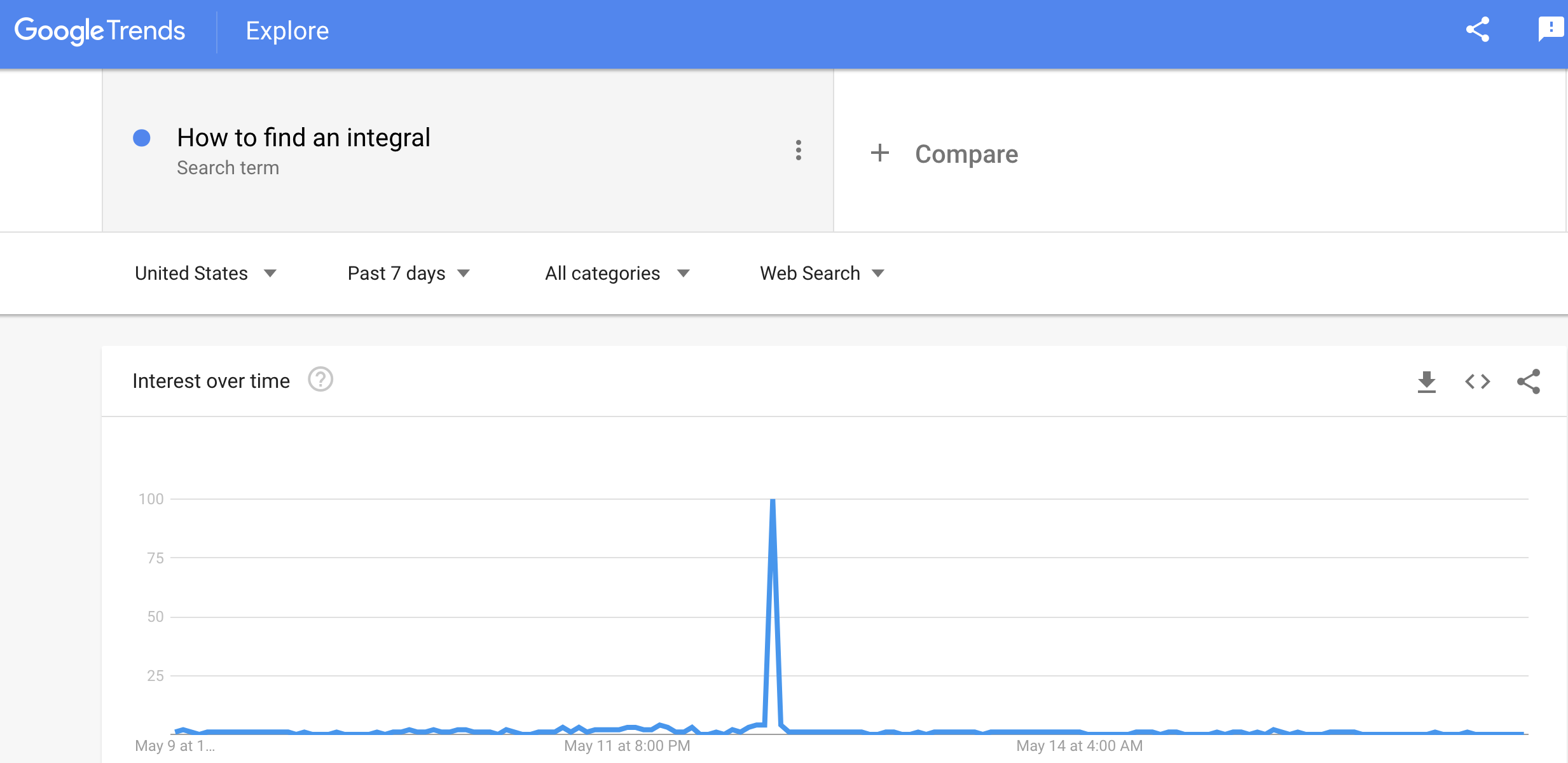

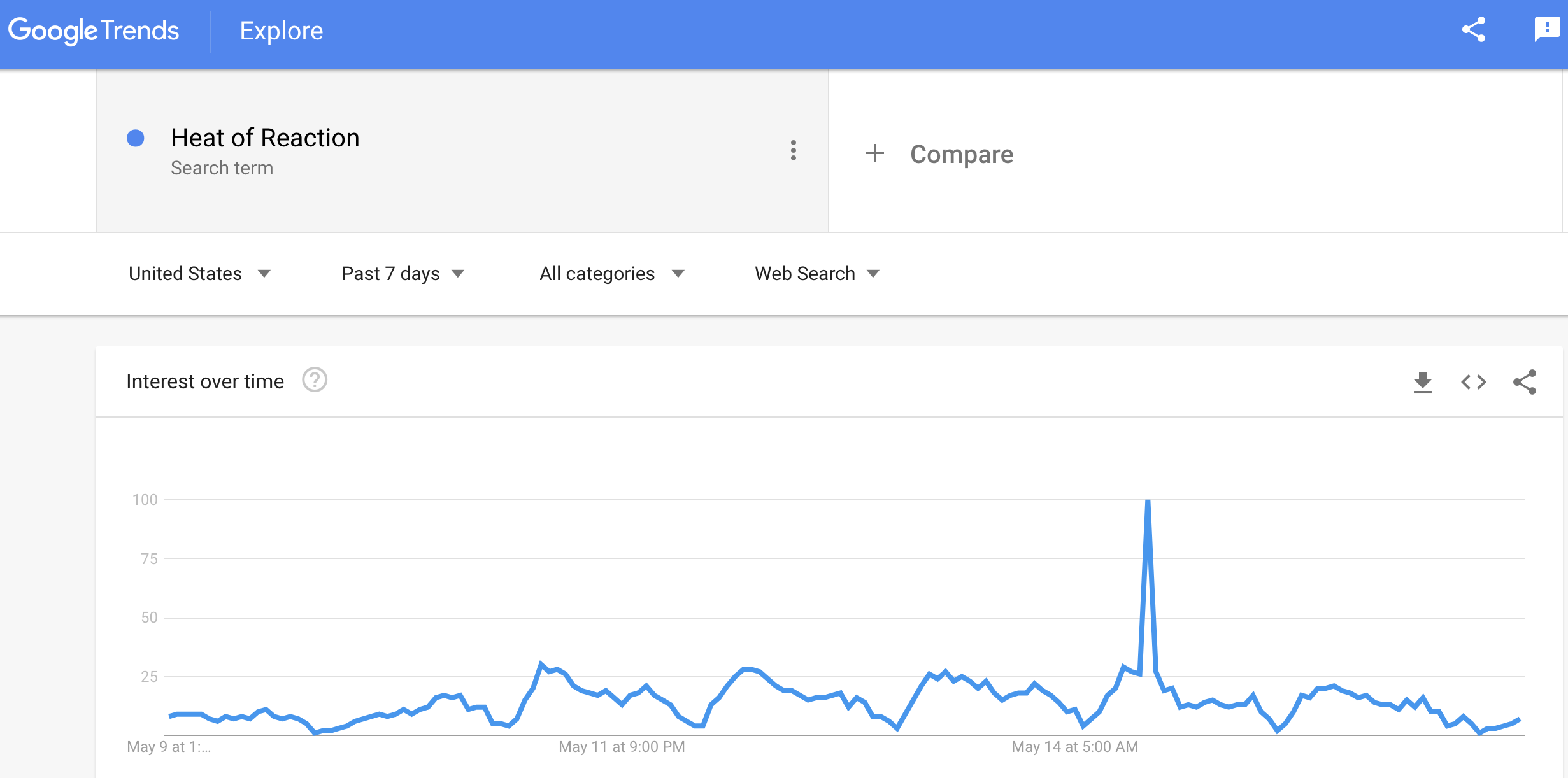
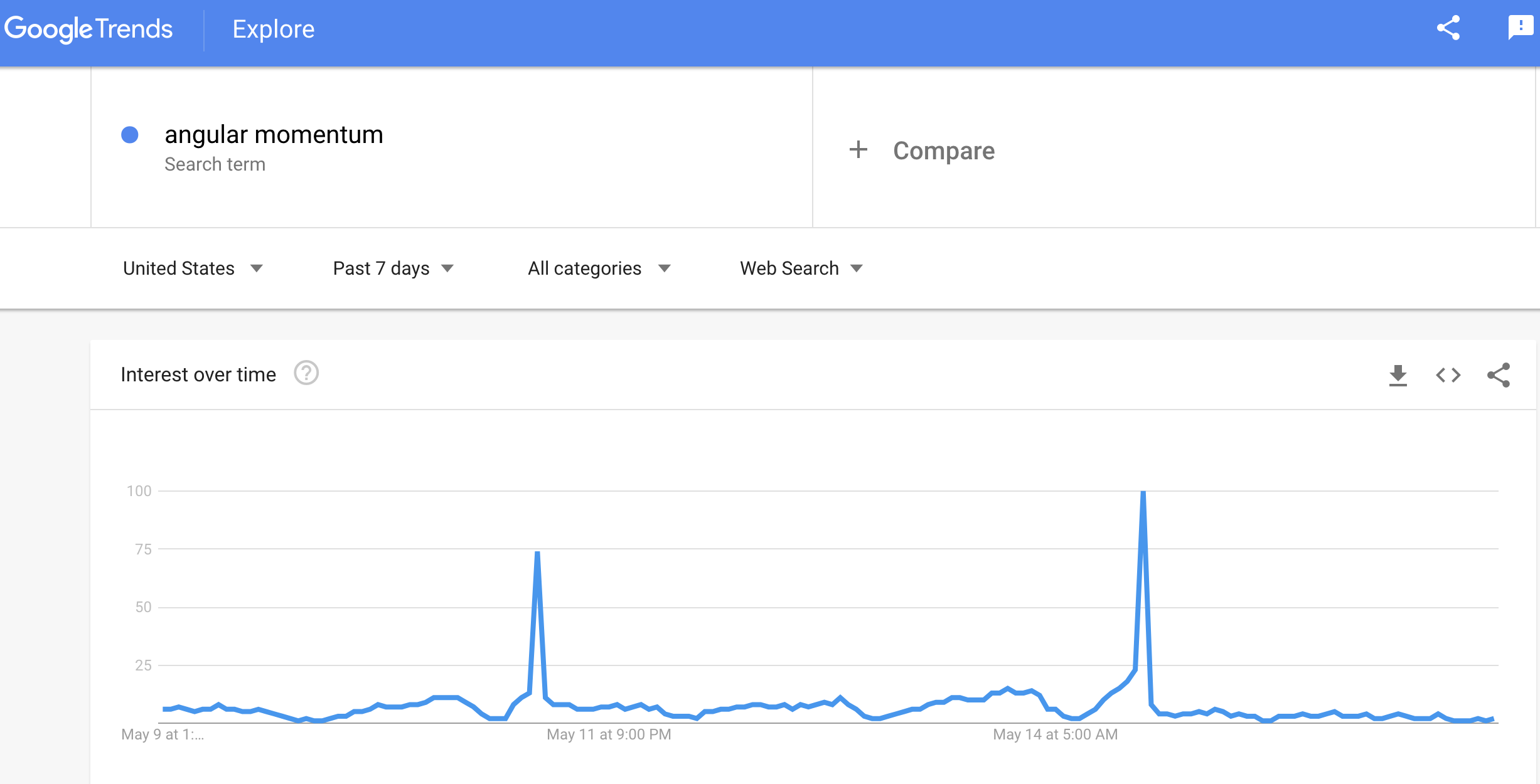
The double peak for angular momentum? There are two physics exams.
Some highlights from Mercedes Schneider’s tweet compendium:
✔@CollegeBoard While more than 99% of students successfully submitted their AP Exam responses yesterday, some who didn’t told us they had trouble cutting and pasting their responses. We took a closer look and found that outdated browsers were a primary cause of these challenges.
anam@lilanammanam Then why were the demos successful???

AP Snafus / Why is the College Board in our Schools?
In the midst of this pandemic it became clear that the College Board, a private company, could not use its favorite space for AP examinations: public schools across the country.
Why does the AP like using public school space, paid for by local governments, and not its own private space?
Let’s start by asking, what does the College Board pay school systems to use their space? Oh, and what does it pay school systems for cancelling classes? And I guess, what does it pay to families for having their children’s classes cancelled?
Nothing. Nothing. Nothing.
The College Board steals from families and local governments across the country. But the cost is built in. It’s hidden. But it is real.
The College Board also could not use its favorite proctors. Who do they use to proctor their exams? How do they pay them?
Public School teachers. And the College Board does not pay them. Local school districts pay the College Board’s proctors.
Are these unemployed teachers?
Nope. These teachers have their own classes. While they are proctoring, their classes are not being taught by their regular teachers. They are being taught by subs.
Who pays for the subs? Who compensates the public school students for not getting their regular lessons?
Local school districts. And no one.
The College Board steals from families and local governments across the country. But the cost is built in. It’s hidden. But it is real.
But COVID interrupted the College Board’s larceny. They were desperate – not only were they losing tens of millions of dollars of free labor and free space – their customer base was at stake. What would happen if schools, kids, teachers and families were not tied tightly to the importance of the tests this not for profit (but wink wink) company produces?
The College Board cobbled together a substitute. Instead of three hour exams, 45 minute exams. No proctors. And they hoped – not for the best – but for minimal negative publicity. Why should kids take these pretend exams? They started backing out. And the College Board, concerned for its own future, decided to make the exams free (of course they were still not paying for proctors or space).
Verdict?
Why were these ever anything more than 45 minute tests? (hint – $$$)
Essays are easier to upload than math work (Maybe 10% of calculus exams were lost to problems uploading – apparently the College Board tweeted additional instructions a few minutes prior to the exam. Bad move guys. Eventually they agreed to give kids another try in June. But they also blamed the kids.
Here’s some details from a report from Houston:
“With the AP physics, AP government and AP calculus tests, server issues or delays, connection drops and broken links from the e-ticket, which allows the students to log onto the tests successfully.”
College Board, which administers the tests, said their servers never came close to crashing and less than 1 percent of the more than 1 million students who have taken the tests so far encountered technical difficulties.
Firat said they’re spinning those numbers and they aren’t taking responsibility for the glitches.
“Unfortunately, College Board has done nothing but to say it’s not us, it’s you, and that shows a lot of incompetence and uncare for the students and the families at this time,” Firat said.
Here’s something from the Bay:
Ava Osborn, a senior at Oakland Tech who took her AP physics test on Tuesday, was also confounded by the online testing system and could not get answers when her completed test failed to process correctly.
“We spent two hours on hold with the College Board, and the woman on the phone basically said she couldn’t help me,” Osborn said. “I still haven’t been able to file for the makeup test.”
The College Board said on Tuesday that approximately 1% of the more than 1 million students who took the exams, given in 38 subjects, encountered technical difficulties.
That’s roughly 10,000 kids who prepared, paid $94 each and sat through the 45-minute online program.
Jones said she doesn’t believe the 1% number is accurate.
“There’s absolutely no way they could know how many people had problems,” she said. “It’s a blind statement from them that shows they have no empathy for the kids who worked so hard to take these tests.”
The College Board did not respond to The Chronicle’s requests for further comment.
And a report from suburban Chicago:
“Yesterday, “I took the AP Calculus BC exam,” said Hadlaw. “Monday, I took the AP Physics, C mechanics and AP C physics electricity and magnetism test.
“I got an email from my teacher yesterday saying that most of my class had to fill out the retake form, and presumably it’s because they ran into the exact same issue that I ran into,” Hadlaw said.
The Superintendent of District 207 said more than 7% of their students had problems. It’s another issue for students during an already stressful year.
“It’s causing consternation this spring for students who have already missed their graduations, they’re going to miss their graduations, miss proms, miss senior events, miss sporting events,” said Wallace.
He thinks the College Board should have skipped testing this year and adjusted for the situation students are in.
They did a “freebie” to hold onto their market, and did not worry about quality. And certainly did not worry about the kids. Kind of like their connection to Common Core.
Let’s get them out of our schools. Or at least make them pay to get in.
The 70th Time is the Charm – Virtual UFT Delegate Assembly
After my 69th call I switched back to my e-mail. I had a new message from my Borough Rep, with a new number, and instructions. And on call #70 I joined the May 2020 UFT Delegate Assembly, already in progress.
– – — — —– ——– ————- ——————— ————- ——– —– — — – –
Earlier in the day I had mixed feelings. I like going to live DAs. Sometimes their is corridor business. I can always schmooze. People save me seats (I’m usually late) Kate, or Eliu, used to be Alan or Lynne. Annette. We used to sit together. When I started out Dave and Cathy. Lately Arthur. But this wouldn’t be a live DA. It would be on the phone. With no one to shush my bad jokes. Or my loud jokes. And the phone’s not fun.
But I had some work. I put two resolutions onto the list to be considered – This one on protecting us from the DoE I will probably try for again in June unless the leadership has already adopted something similar – not a shock that it wasn’t gotten to – bottom of the list (#12). But they were also moving two political endorsements – and one of them I planned on speaking against.
– – — — —– ——– ————- ——————— ————- ——– —– — — – –
I have temporarily relocated north. My signal is spotty. So I preprogrammed the number in my phone, copied the code onto the phone’s notepad, and hopped in my car. Four miles ENE, by the highway on-ramp, there’s a pretty wide strip. And good signal. That’s where I was headed. Perfect day, opened the windows. And turned off the car. Then turned it on. How quickly was I going to run my battery down? Charge it, and idle? Or drain it? It was just after 4. I was going to keep changing my mind over the next two hours.
I brought my talking points up on my phone. I hadn’t written sentences, but the notes would work. The Brooklyn machine candidate had pushed everyone else off the ballot. The details, how Cuomo helped, that was too far into the weeds. But I was going to talk about Sandy, and about the machine candidate. And I would make sure that one name was more prominently mentioned. And that I tied this kind of garbage NYC politics to voter suppression. They really are first cousins. Plus Sandy is more than progressive, she’s radical. And Bella, who rarely advises me, advised me. Other organizations were just staying out of the special election. The UFT should too.
– – — — —– ——– ————- ——————— ————- ——– —– — — – –
And then it was 4:16. I’d let the minutes slip. I made my first call. Busy. My second. Busy. Third? You can guess. I found a pattern. Call number 6 got through, but I flubbed the number. And then back to the first pattern. See this?

I tweeted to @UFT – nothing. I emailed by DR, cc’ed my borough rep, VP, and Sill and Barr. I kept calling. Michael SIll wrote back with a different number to try. Now I could get through, but my code was being rejected. I kept trying
. 30… 35… 38 calls. I asked on FaceBook if anyone was having problems. Some were, some were in. Someone offered to put me on a zoom call so I could listen – but I wanted in. I wrote back to the UFT officials, and kept trying. And trying. And… Calls 68 and 69 were at 4:54. I checked my email. My borough rep had written back, with a new number for me to try. I dialed at 4:58, and was in at 4:59. That was call #70
50 + 2 + 4 + 5 + 6 + 2 + 1 = 70
– – — — —– ——– ————- ——————— ————- ——– —– — — – –
Mulgrew was giving his report. I’ve been following closely, so there was not much new. And I’m not much of one to take notes, not on his talks, where he circles back and leaves thoughts half-said so often. And when the windows were down it got loud. But when they were up the sun heated the car quickly. I tried to be not too distracted, though I may have missed things. But I did jot this down – it must have struck me: “Need to customize social distancing to your building.” I guess I thought that might be a Big Deal.
Mulgrew’s last remarks were to recognize that some people had difficulty logging on, and that we (UFT) would goof and correct our mistakes. That’s what teachers do. He apologized. I’m quick to blame him when he’s wrong. So I have an obligation to pause now and to recognize that Mulgrew’s apology was genuine, and that I appreciated it. Then came the question period. I also did not write down the questions. But they are often the most informative part of the Delegate Assembly – especially when most of the questions are not plants.
Then the motions. A Unity stalwart ate up half the ten minutes motivating a reso in support of the US Postal Service – like how much time to motivate apple pie? I missed not having people next to me. I would have predicted that she would eat up time. Might have run a pool on how many minutes. And then we voted to put it on next month’s agenda by 96% – 4%. It was kind of cool phone voting by pushing a button. And nice getting an actual count. I noticed a motorcycle in the weeds, on the opposite side of the road. Rider just sitting there. The next two resos failed to get on – one by a wide margin. The third by 49% – 50%. The guy announcing the votes, Rasheed, had the coolest voice at the DA. He should have been doing a late night FM album only show. Time was up – and we were not even close to my resolution #12.
– – — — —– ——– ————- ——————— ————- ——– —– — — – –
There were two resolutions, both to endorse in a special election for City Council. The first passed without opposition – 92% – 8%. The second they were endorsing the Brooklyn machine candidate. There was no one else, since the machine had knocked the others, including progressive community activist Sandy Nurse, off the ballot. I pushed the button to get on the speaker’s line. I had a little trouble. The Brooklyn Political Action Director motivated the machine candidate.
A DR spoke first, supporting the candidate. Another Unity exec board member spoke next. And then they called me. I was uncomfortable, sitting in the car, parked, for two hours, and asked Mulgrew how he was doing, forgetting that not all the delegates were sitting in cars trying to figure out whether to keep the engine on or off. He was fine, but didn’t like not seeing the delegates.
And then I talked a little about Sandy Nurse, that she shared our values, how she was a fine progressive community activist, housing, food, LGBTQ, how the machine’d knocked her off the ballot, and how unions, progressive organizations, and other politicians were withholding endorsement until the regular election. And that we should not endorse the machine candidate.
Ryan Bruckenthal, followed by supporting those points, and talking about how dirty the machine was. And Marv Reiskin backed the leadership. Marv used to be Political Action Director, now heads the retiree chapter. Big gun, I guess. His speech included that the machine candidate was the only one left. And that she was a public school parent – a claim that only one million New York women (and a similar number of men) could make.
In the end it didn’t matter, as the leadership wanted to go with the machine, and they prevailed 74% – 26%.
– – — — —– ——– ————- ——————— ————- ——– —– — — – –
I trust the technical stuff will be better next month. The modifications of the rules are problematic. Points of Information are generally misused. But Points of Order are not. And Points of Personal Privilege are rarely used, and in my experience, always justified.
We had nothing that needed amending, but amendments are an important part of discussion. We need to find a way to get them back in.
But the times are off. Questions are very useful. They should not be limited to 15 minutes. Honestly, at every DA they could do half an hour of questions, and that would be time well-spent. Motions directed to the agenda – and this would not have got mine up – but there needs to be more time. And Unity, if they hate a resolution, vote for it not to get on the agenda. The use of the thinly-disguised filibuster is wrong – not that anyone besides Unity could stop it.
And as we’ve learned during remote teaching, everything takes longer. I wouldn’t propose shortening the president’s report – delegates want that information. I think we should recognize that we conduct the business of the union one time each month, and that an hour 45 minutes right now is not adequate.
NYCDoE did not protect us in March – How can we trust them in September?
In March the NYC Department of Education violated protocols by not shutting schools with COVID-19 and cleaning them. They stifled reporting. They hid what was going on.
We knew that the NYC Department of Education unconscionably delayed closing schools – that was really bill de blasio. That’s not what I am writing about. That’s a policy disagreement (they were wrong).
I am writing about teachers reporting that they had confirmed COVID-19, and the DoE making up rules so they could pretend that the case was not properly confirmed, and keeping the schools open. They broke their own rules. And while an ultimate investigation might serve up a fall guy, that’s not what I care about right now. No, I care about September.
Because in September it is possible that our schools will, in one form or another, reopen. In September there will be rules in place to keep us safe. But how do we trust the DoE, who just two months ago broke rules and put lives at risk?
It’s not just here. The NEA just shared out this article from Texas: what do we do if they tell us to go in, but we are not safe?
Now, there is a UFT Delegate Assembly tomorrow. It is virtual, which will be weird. I don’t know if I would get called on if it were a live DA. But I am going to try.
I think, to help keep us safe, the Department of Education should have to show up, a real person – at a school where the staff/chapter think they are at risk. No more burying safety reports. No remote bureaucrat sending us in to get sick. Come in, explain that it is safe. We can use the UFT to monitor that they are not violating the rules.
Here’s what I submitted (to be added to next month’s agenda)
Submitted for the June Agenda
Safety Enforcement Mechanism for COVID in Our Buildings
Whereas the COVID-19 Crisis reached New York City this winter; and
Whereas in the first half of March of this year the NYC Department of Education resisted calls to close our buildings; and
Whereas guidelines in place required certain schools to be closed for a day and disinfected; and
Whereas the Department of Education appears not to have closed certain schools for a day and disinfected them when required to; and
Whereas the United Federation of Teachers is currently considering measures to ensure the safety of our members, other adults, and students when school buildings reopen, conceivably in September; and
Whereas the United Federation of Teacher’s proud history includes keeping members out of hazardous conditions, famously during the asbestos crisis;
Therefore be it resolved that the United Federation of Teachers will make it a priority in negotiations with the NYC Department of Education that no one be required to enter a building when there is question about their safety; and be it further
Resolved that United Federation of Teachers chapter-based safety committees and consultation committees will be involved in all decisions to open and close those respective chapters; and be it further
Resolved that the United Federation of Teachers will make it a priority in negotiations with the NYC Department of Education that if the Department of Education believes a building to be safe, when members do not, that they be compelled to send a representative from outside the building to that building, and that representative give presentations in the building to staff, explaining how the DoE determined it was safe to enter the building, and that a UFT representative from outside the school will stay with the DoE rep to monitor their activity and ensure compliance; and be it further
Resolved that United Federation of Teachers will continue to insist on measures to keep our members, other adults, and students safe.
Halfway Home – Remote Teaching – NYC – May 11
On March 12 we saw students in class. That was Thursday. Friday was a special day in my school – we still saw students, but not regular classes, and attendance was down. And then – no more. Tuesday, Wednesday, and Thursday the next week were PD. And classes resumed, remotely, Monday March 23. That was 49 days ago. And there are only 46 days until June 26. We are more than halfway.
Tough things I have learned so far
- Being on a computer for a full day is exhausting.
- “Remote teaching” is not the same as regular teaching. We work more, less effectively, and don’t get as far.
- Technology has lots of issues – many that we had not thought of.
- Principals who were unreasonable in person are unreasonable remotely. I have not heard even one case of an abusive admin becoming mellower in this process.
- Electronic paperwork can be worse than paper paperwork.
On the brighter side
- It’s ok to slow down.
- Taking things a week at a time is not only smart, it’s also gotten us through 8 of 15 weeks.
- We have gotten at least a little better at organizing our systems. I mean, at least I have. But I think most of us have.
This can get me to June 26. But worries for September
- What will September bring?
- Schools open?
- Schools remote?
- Schools hybrid?
- How can I program without knowing what school will look like?
- How will we stay safe in September?
- How will the union protect us in September?
That last one brings up some real questions about the UFT.
- What went wrong in mid-March?
- How can crisis response be improved?
- How can communication be improved?
Because communication IS improving, and because we are not facing an immediate crisis, I can relax, a bit, here. But these questions matter.
Seven weeks until June 26. But then ten and a half weeks until Labor Day.

 JD2718