NYCDoE did not protect us in March – How can we trust them in September?
In March the NYC Department of Education violated protocols by not shutting schools with COVID-19 and cleaning them. They stifled reporting. They hid what was going on.
We knew that the NYC Department of Education unconscionably delayed closing schools – that was really bill de blasio. That’s not what I am writing about. That’s a policy disagreement (they were wrong).
I am writing about teachers reporting that they had confirmed COVID-19, and the DoE making up rules so they could pretend that the case was not properly confirmed, and keeping the schools open. They broke their own rules. And while an ultimate investigation might serve up a fall guy, that’s not what I care about right now. No, I care about September.
Because in September it is possible that our schools will, in one form or another, reopen. In September there will be rules in place to keep us safe. But how do we trust the DoE, who just two months ago broke rules and put lives at risk?
It’s not just here. The NEA just shared out this article from Texas: what do we do if they tell us to go in, but we are not safe?
Now, there is a UFT Delegate Assembly tomorrow. It is virtual, which will be weird. I don’t know if I would get called on if it were a live DA. But I am going to try.
I think, to help keep us safe, the Department of Education should have to show up, a real person – at a school where the staff/chapter think they are at risk. No more burying safety reports. No remote bureaucrat sending us in to get sick. Come in, explain that it is safe. We can use the UFT to monitor that they are not violating the rules.
Here’s what I submitted (to be added to next month’s agenda)
Submitted for the June Agenda
Safety Enforcement Mechanism for COVID in Our Buildings
Whereas the COVID-19 Crisis reached New York City this winter; and
Whereas in the first half of March of this year the NYC Department of Education resisted calls to close our buildings; and
Whereas guidelines in place required certain schools to be closed for a day and disinfected; and
Whereas the Department of Education appears not to have closed certain schools for a day and disinfected them when required to; and
Whereas the United Federation of Teachers is currently considering measures to ensure the safety of our members, other adults, and students when school buildings reopen, conceivably in September; and
Whereas the United Federation of Teacher’s proud history includes keeping members out of hazardous conditions, famously during the asbestos crisis;
Therefore be it resolved that the United Federation of Teachers will make it a priority in negotiations with the NYC Department of Education that no one be required to enter a building when there is question about their safety; and be it further
Resolved that United Federation of Teachers chapter-based safety committees and consultation committees will be involved in all decisions to open and close those respective chapters; and be it further
Resolved that the United Federation of Teachers will make it a priority in negotiations with the NYC Department of Education that if the Department of Education believes a building to be safe, when members do not, that they be compelled to send a representative from outside the building to that building, and that representative give presentations in the building to staff, explaining how the DoE determined it was safe to enter the building, and that a UFT representative from outside the school will stay with the DoE rep to monitor their activity and ensure compliance; and be it further
Resolved that United Federation of Teachers will continue to insist on measures to keep our members, other adults, and students safe.
Halfway Home – Remote Teaching – NYC – May 11
On March 12 we saw students in class. That was Thursday. Friday was a special day in my school – we still saw students, but not regular classes, and attendance was down. And then – no more. Tuesday, Wednesday, and Thursday the next week were PD. And classes resumed, remotely, Monday March 23. That was 49 days ago. And there are only 46 days until June 26. We are more than halfway.
Tough things I have learned so far
- Being on a computer for a full day is exhausting.
- “Remote teaching” is not the same as regular teaching. We work more, less effectively, and don’t get as far.
- Technology has lots of issues – many that we had not thought of.
- Principals who were unreasonable in person are unreasonable remotely. I have not heard even one case of an abusive admin becoming mellower in this process.
- Electronic paperwork can be worse than paper paperwork.
On the brighter side
- It’s ok to slow down.
- Taking things a week at a time is not only smart, it’s also gotten us through 8 of 15 weeks.
- We have gotten at least a little better at organizing our systems. I mean, at least I have. But I think most of us have.
This can get me to June 26. But worries for September
- What will September bring?
- Schools open?
- Schools remote?
- Schools hybrid?
- How can I program without knowing what school will look like?
- How will we stay safe in September?
- How will the union protect us in September?
That last one brings up some real questions about the UFT.
- What went wrong in mid-March?
- How can crisis response be improved?
- How can communication be improved?
Because communication IS improving, and because we are not facing an immediate crisis, I can relax, a bit, here. But these questions matter.
Seven weeks until June 26. But then ten and a half weeks until Labor Day.
TDA / Diversified Fund and Fixed / 2010 – 2020
The world right now is horrible. I’m taking a break by displaying some numbers that some of my colleagues might find interesting. It should not be hard to expand this to other funds, and to expand it back (maybe to 2000), and maybe to fit in inflation as well. It is an exercise – I am not analyzing the numbers – I am not qualified.
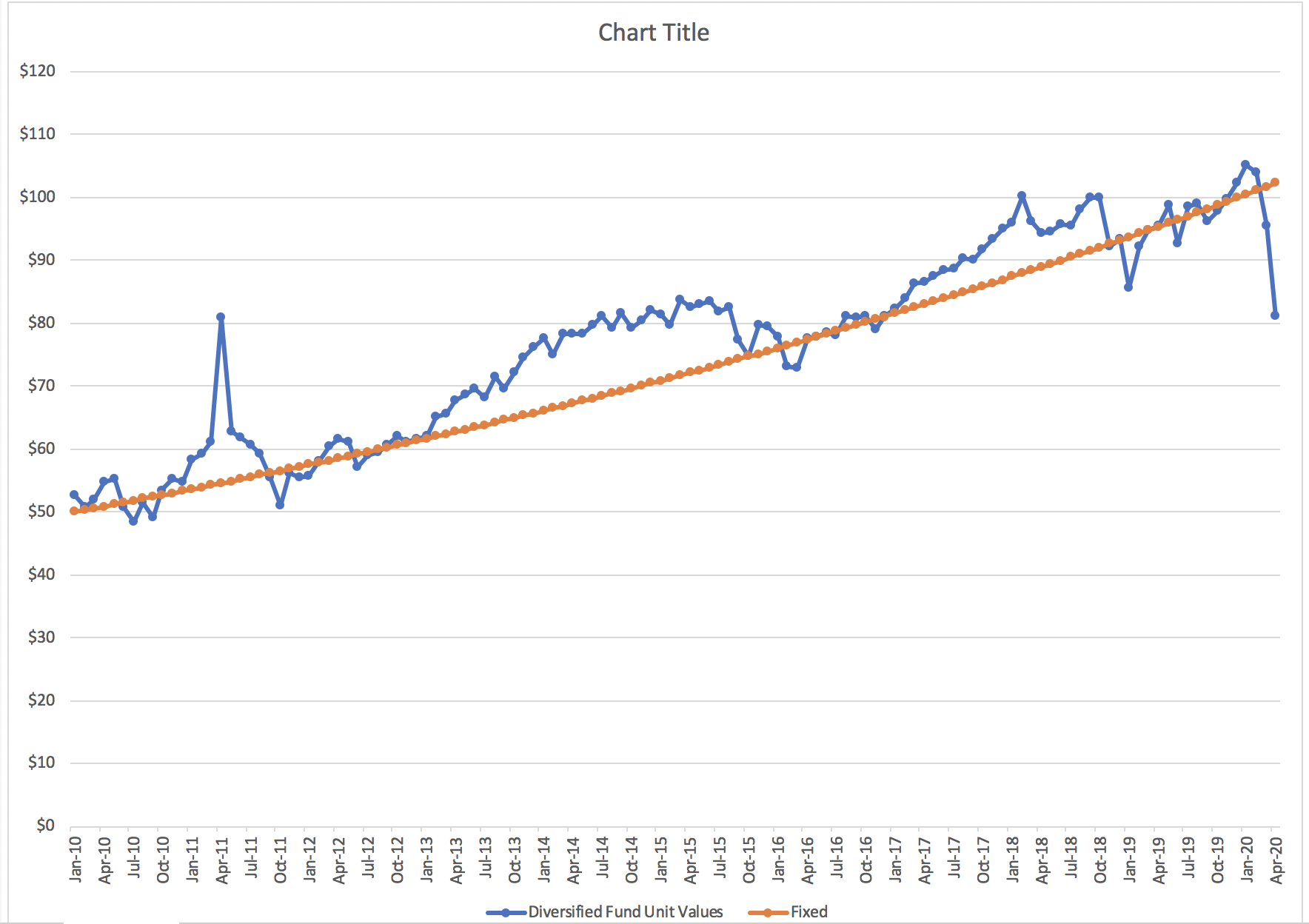
I started fixed at 50 even – once I have more stuff in, I’ll pick a common starting date and starting value.
TDA Unit Values
And now for something quite different.
Corona pounded the stock market, and naturally those who have Tax Deferred Annuities in the market also felt it (or more likely, saw it. This is future money for in-service members)
The fund that I usually hear about, I’m guessing the most popular, is Diversified Equity. In January it was over $105, and in April just over $81 – about a 23% drop. But let’s add some historical context. To start with, one year ago it was at $95. (I’ve left off the pennies). But let’s chart it out for a few years.
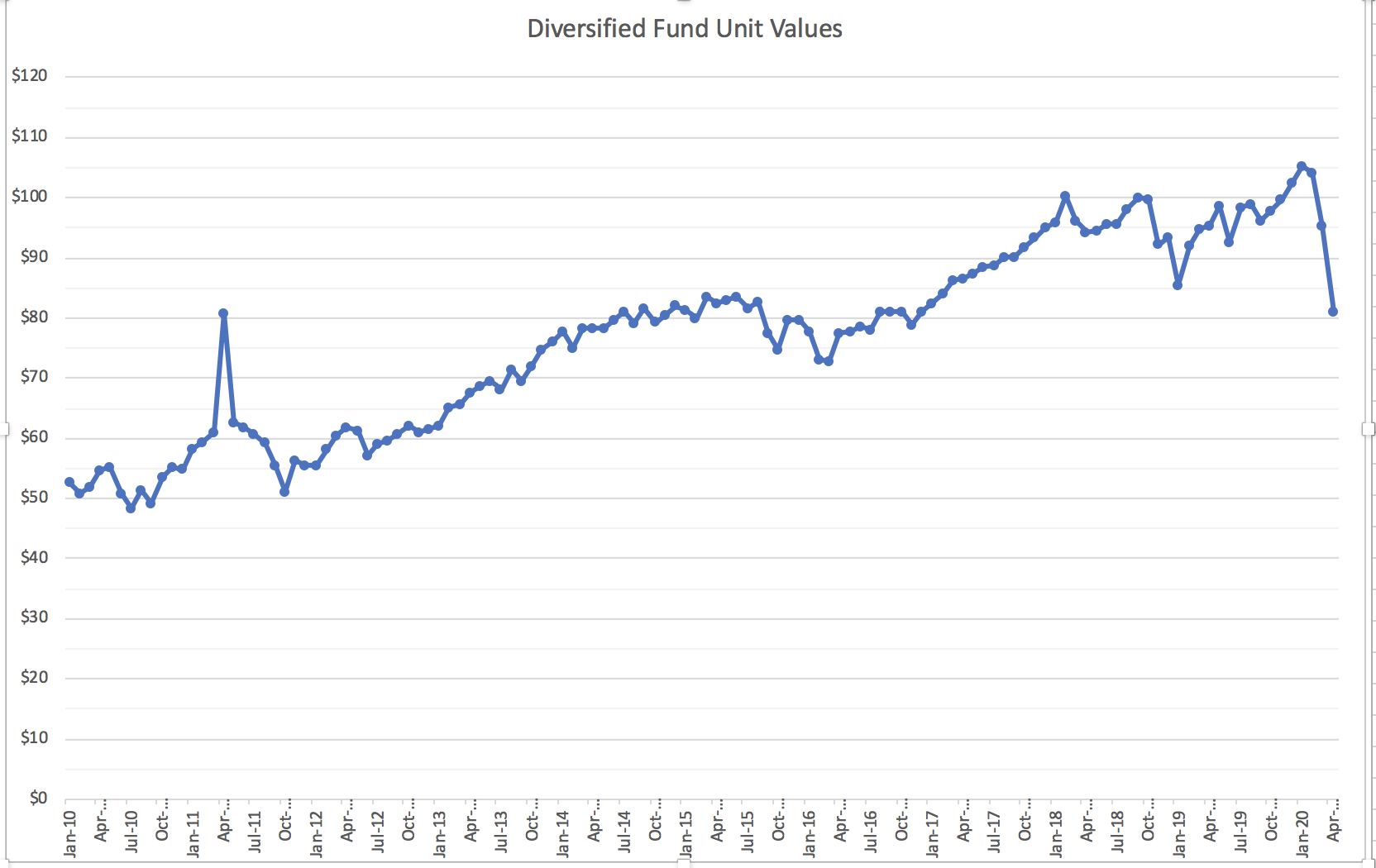
The comparison with inflation may not be useful, but $52.69 in 2010 money would be about $62.17 today.
Look, I wanted to make a chart. I’m not sure how to interpret it. That’s a lot of gain wiped out in a short time, but in the long term?
The raw data:
| Unit Value | |
| Date | Diversified Fund Unit Values |
| Jan-10 | $52.629 |
| Feb-10 | $50.713 |
| Mar-10 | $51.840 |
| Apr-10 | $54.716 |
| May-10 | $55.347 |
| Jun-10 | $50.806 |
| Jul-10 | $48.310 |
| Aug-10 | $51.433 |
| Sep-10 | $49.212 |
| Oct-10 | $53.481 |
| Nov-10 | $55.253 |
| Dec-10 | $54.825 |
| Jan-11 | $58.207 |
| Feb-11 | $59.246 |
| Mar-11 | $61.050 |
| Apr-11 | $80.881 |
| May-11 | $62.750 |
| Jun-11 | $61.897 |
| Jul-11 | $60.624 |
| Aug-11 | $59.225 |
| Sep-11 | $55.426 |
| Oct-11 | $51.100 |
| Nov-11 | $56.249 |
| Dec-11 | $55.541 |
| Jan-12 | $55.630 |
| Feb-12 | $58.119 |
| Mar-12 | $60.467 |
| Apr-12 | $61.719 |
| May-12 | $61.156 |
| Jun-12 | $57.035 |
| Jul-12 | $59.120 |
| Aug-12 | $59.543 |
| Sep-12 | $60.744 |
| Oct-12 | $62.048 |
| Nov-12 | $61.110 |
| Dec-12 | $61.532 |
| Jan-13 | $62.174 |
| Feb-13 | $65.154 |
| Mar-13 | $65.582 |
| Apr-13 | $67.617 |
| May-13 | $68.781 |
| Jun-13 | $69.567 |
| Jul-13 | $68.243 |
| Aug-13 | $71.550 |
| Sep-13 | $69.543 |
| Oct-13 | $72.107 |
| Nov-13 | $74.633 |
| Dec-13 | $76.199 |
| Jan-14 | $77.656 |
| Feb-14 | $75.061 |
| Mar-14 | $78.365 |
| Apr-14 | $78.382 |
| May-14 | $78.290 |
| Jun-14 | $79.626 |
| Jul-14 | $81.078 |
| Aug-14 | $79.251 |
| Sep-14 | $81.499 |
| Oct-14 | $79.271 |
| Nov-14 | $80.542 |
| Dec-14 | $82.029 |
| Jan-15 | $81.363 |
| Feb-15 | $79.846 |
| Mar-15 | $83.661 |
| Apr-15 | $82.492 |
| May-15 | $82.918 |
| Jun-15 | $83.538 |
| Jul-15 | $81.738 |
| Aug-15 | $82.668 |
| Sep-15 | $77.419 |
| Oct-15 | $74.680 |
| Nov-15 | $79.632 |
| Dec-15 | $79.588 |
| Jan-16 | $77.773 |
| Feb-16 | $73.218 |
| Mar-16 | $72.947 |
| Apr-16 | $77.546 |
| May-16 | $77.866 |
| Jun-16 | $78.512 |
| Jul-16 | $78.102 |
| Aug-16 | $81.078 |
| Sep-16 | $80.958 |
| Oct-16 | $81.042 |
| Nov-16 | $78.955 |
| Dec-16 | $81.062 |
| Jan-17 | $82.351 |
| Feb-17 | $83.973 |
| Mar-17 | $86.227 |
| Apr-17 | $86.533 |
| May-17 | $87.440 |
| Jun-17 | $88.399 |
| Jul-17 | $88.681 |
| Aug-17 | $90.261 |
| Sep-17 | $90.080 |
| Oct-17 | $91.800 |
| Nov-17 | $93.288 |
| Dec-17 | $95.100 |
| Jan-18 | $95.898 |
| Feb-18 | $100.326 |
| Mar-18 | $96.212 |
| Apr-18 | $94.245 |
| May-18 | $94.459 |
| Jun-18 | $95.640 |
| Jul-18 | $95.605 |
| Aug-18 | $98.198 |
| Sep-18 | $100.006 |
| Oct-18 | $99.877 |
| Nov-18 | $92.192 |
| Dec-18 | $93.484 |
| Jan-19 | $85.504 |
| Feb-19 | $92.173 |
| Mar-19 | $94.744 |
| Apr-19 | $95.432 |
| May-19 | $98.700 |
| Jun-19 | $92.578 |
| Jul-19 | $98.450 |
| Aug-19 | $98.938 |
| Sep-19 | $96.264 |
| Oct-19 | $97.765 |
| Nov-19 | $99.678 |
| Dec-19 | $102.435 |
| Jan-20 | $105.276 |
| Feb-20 | $104.047 |
| Mar-20 | $95.393 |
| Apr-20 | $81.142 |
Next Year State needs to design different tests (or cancel them again)
Reimagine this: remote learning goes slower, less effectively, than real teaching and learning.
And there is a real chance that this mode of “school” will continue into the next school year.
Ramifications? They abound. Vision for what this looks like? Andrew Cuomo brought in Bill Gates. Mistake. Gates has never gotten anything in education right. (Sign this survey; and read this for more background).
Teacher Tests
I want to focus on tests. Some teachers are still giving them. Others have stopped.
Me? I stopped giving tests two years ago, but I was giving one class quizzes right through early March. I stopped.
Most teachers stopped testing and quizzing. Some teachers shifted to take-home tests. When I was a student I preferred tests, which were actually tests, to take-home tests, which were homework assignments that got graded like tests. But that was me.
Teachers are trying to figure things out. Actual tests on one or another of those on-line platforms. Take-home tests. Papers instead of tests. Other graded assignments. Projects.
“Sit in rows and keep your eyes on your own paper” tests can’t be done, so we will muddle through with something else. And if we had to figure it out for next year, we would keep muddling through, probably a little better, because most of us goof, learn, and adjust.
State Tests
But that’s teachers. How about the state? New York State gives lots of tests. Poorly-constructed, high-stakes, mandatory tests. What’s going to happen to them?
This year, they are canceled. ELA and Math. Science. Grades 3 – 8. The Regents (high school exams). Lots of them. All canceled.
But what if this crisis continues into the next school year? Could New York State, one of the slowest in the country to order the school buildings closed for the term, New York State which has struggled to make bad tests worse, New York State whose governor didn’t even bother putting a K-12 educator on the reopening panel, could this state design tests that kids could take at home? Clearly not.
But they could copy a smarter state. Let’s just suppose they do that, that Andrew Cuomo says “we are not smart enough to design state tests that could be taken at home, but we will wait for Kansas or Oregon and copy them.” They could do that.
But getting a test-taking platform is probably the easy part. Say they get it. What will they test?
Standards vs Content
For those of you who haven’t been paying close attention, or are not from New York, this has become a tricky question. New York State does not have required content, it has “standards” – nebulously defined lists of skills kids should possess.
New York State teachers often look at sample exams or previous exams to figure out what the content should be – we want the content we should teach. New York State does not oblige.
They do not even offer us curricula – claiming that curriculum is a local decision. (Actually, I don’t think they are good enough to put together curriculum, so we may be catching a break there; there’s sometimes benefit to ignoring a lie).
Remote Teaching ≠ Real Teaching
One obvious difference is that we “cover” less material. Just. No. Way. To go at the same speed. If you are teaching 75% of what you normally teach, wow, I’m impressed. If you are teaching 100% of what you normally teach, stop sneaking into school – you’re putting yourself and your students at risk. Me, I’m teaching around 50-60% – and it’s more like I’m guiding my students through self-teaching.
In any case, if we were to do this next year, for a full year, we would be teaching less content than we normally teach. That’s clear and obvious.
So what do we teach?
In September, as we lay out our units for the year, what should we teach? Part of our calculation will be based on what the State intends to test in March or April or May or June. It is reasonable for us to want to know what the Board of Regents wants us to do. It is reasonable for us to want the NYS Education Department to tell us what they will test. And it is reasonable for us to expect the answers.
So what will they test?
I love living in a state where there are lots of smart people, but where they are massively outnumbered by decision makers. If New York State tests kids next Spring, and if remote learning has been the norm for a large chunk of the year, most kids will not have learned what kids normally learn by test time. Will New York State’s Education Department revise the tests? I think they’d have to. Will they tell us in September?
At least we have the Oneida Lake approach to content in New York. (here’s where I would normally say a mile wide and an inch deep, but New York State has this great lake – huge, freezes over every winter – 21 miles long, 22 feet deep – that’s as close as you are going to get in the real world, and no mistake, it’s in New York State). It’s probably possible to chop off parts of each course without doing massive damage.
Are the people at SED clever enough to remove content (or standards) from each of our courses, and leave the remainder at least a slightly coherent whole? I am asking the question, because it has to be asked. I am not holding my breath waiting for an answer.
One option that bears consideration – maybe remote teaching does not lend itself to standardized testing? Maybe we should continue this year’s “pause” indefinitely? I think I’d be ok with that.
Teacher Support Week
Isn’t it Teacher Appreciation Week? I actually like when my colleagues, students, parents, other teachers, and my supervisors let me know I’m appreciated.
And, not to let the moment pass – for any teacher reading this, I truly appreciate how hard you are working, under really lousy conditions. Day-to-day it is frustrating, but we know, we do.
But I got a note from Carranza. We all did. It wasn’t personal (it couldn’t be, no blame for that). He is grateful for our work, proud of what we do, and thanks us. And it pissed me off. I don’t mind getting thanked. I am furious not to be supported.
Look, we are all angry and frustrated with the circumstances that the Coronavirus has thrown us into. Is it fair to blame Carranza? For most of what has happened, no. But let’s just talk about support.
- On March 17 – 19, he directed us to report to schools to plan for remote instruction. Where was the guidance for what we were supposed to produce?
- On March 17 – 19 teachers were exploring on-line platforms. Where was the guidance for which platforms would be not allowed? (Most teachers chose Zoom, greatest functionality, most features, easiest to set-up, easiest to use. April 3 we learned that the DoE would ban it, immediately, via text. Apparently lawyers did that. April 6 we were officially informed we would need to phase it out).
- Remote learning takes different planning. Where was his guidance to principals to allow teachers more planning time?
- Remote teaching takes enormous amounts of time to grade. Where was his directive to principals to allow X hours each day for planning and grading? “Teachers will need at least 2 hours more than during normal times to plan and grade” That would have been supportive. But I think the number should be bigger than that.
- When was Carranza going to crack down on principals who are demanding unreasonable work from teachers?
If he really wanted to show his appreciation, he would make it possible for us to do our jobs with reasonable expectations, and without unreasonable demands. Carranza could show appreciation for the job we do by doing his.
Chaz
Eric Chasanoff blogged. About New York City schools. About Queens schools. About high schools. About pensions. About teaching science. About being in the ATR pool. About the UFT. About the Department of Education. About the issues that teachers face.
Eric was dedicated to his students and the profession and his colleagues. He blogged because it was important, because he had a message, because these things mattered. When the interests of teachers were at stake, he was not afraid of stirring up trouble. For Chaz, right was right.
Our blogs started around the same time. The 2005 UFT – DoE contract had awful concessions, and blogs were new, and a bunch of us got pulled in at the same time. I think he was the first who acknowledged by presence.
I remember when I first met Eric, he ran up to me in a diner on the west side. “Jonathan!” He knew me. But I looked confused. “It’s Eric!” Still confused. We had been reading each other’s blogs for five years. And I didn’t know his first name. Hard to recognize him without his light blue background. Even lately, when I went to e-mail him, I type Chaz and wonder why nothing pops up. Happened 3 days ago, when I wrote him, concerned because he hadn’t blogged in a week.
Eric and I often agreed, and often disagreed. But we respected each other. When the UFT leadership refused to create an ATR chapter, and I was on the Exec Board, we had back and forth over what we could get them to agree to. He was not satisfied with what I got passed, nor should he have been. But he did help shape what we got. Just last year I was honored to get his endorsement in the last UFT election.
The universe of active NYC Public School teacher/bloggers is shifting, and not very big. Eric was a major part of it, for over a decade. I mourn his passing. He will be missed.
Chaz’s School Daze 2006 – 2020
How can I fish without the hook?
“I’m a showman. That’s my teaching style. How can I fish without the hook?”
– W.O. Former student, current teacher
Last night a friend asked:
So, what makes it more work and harder with the distance learning? Is it just unorganized? More paper work for you?
W.O. nailed it. Succinct. I go on wordier. Here’s how I answered:
if I sit near you, and you ask me a question, I can understand from your question what you are thinking –
I can “sense” what your misconception is, and ask you a question that points you in the right direction, then confirm that you’ve “got it’
I’m good at that. And it doesn’t happen on line
I can ask a question, and hands go up – but I can read the body language in the room – are most of the kids on board? all of them? And I can adjust speed, spend extra time, or push ahead
Now, no body language
Grading – a pile of 100 quizzes, 20 – 45 minutes – depending
now the equivalent sort of assignment? At least 3 – 4 hours, maybe more
everything is a click, a download, a wait, another click
reading on the impossible screens
Grading – typing the grade, typing comments
another click to send the comment
another click to return the work
And planning – If I am going to teach a lesson – at this point 5 – 10 minutes, usually 5, to jot notes about what I need to do. Maybe I pre-plan a key example or two
Now, I need notes for the kids to read. That 10 minute lesson can take 1 – 2 hours to write out with all the details in place
I’ll add that I’m learning an inferior platform – that I have emails coming in on multiple accounts – and that tracking them takes work. In a classroom response, I can check if the child understands, and we can continue the conversation until that happens – but via e-mail I have to wait – and there’s no face to face verification.
And to top if off, all of this, exhausting and draining – and the students are learning a lot less.
I’ve written about this before –
Hello Sunshine
Do you keep social distance? (Don’t get too close). Wear a mask? (don’t go uncovered) Cover your cough? (don’t spread droplets). There’s probably a lot of things you don’t do. Good for you!
Here’s two things you CAN DO.
Get some sunshine. Be safe while you are doing it, but do it. I want to say at least __ minutes a day, but I don’t know how many. Healthline says 10 – 30 minutes. And I don’t know if they know, but they have a better chance of knowing than me. Get at least 10 minutes of sunshine a day (at a safe distance). The sun will improve your mood. It will help you produce Vitamin D. It’ll get you off your butt. Being healthier is not a vaccine, but it helps. You can do this. Every day. Stay safe. But 10 minutes of sun.
Say Hello. Ask “how are you doing?” Set a goal. One person a day. Two. Go crazy – four. Ask. Stop. Listen to the answer. Even if they are bad, they had a chance to speak. To be listened to. They’ll feel a little better. You just did good. Think about that while you feel the sun on your face.
And check it out – good song. Remember Aretha Franklin?
Six Feet in Schools just Will Not Work
What will it take to reopen schools?
A vaccine and a cure? that would mean a long time. We would have to do some real work on making remote learning more productive than it is now. There are definitely people who are thinking we will wait that long. Not me.
“Flatten the curve” – that was designed to avoid the crush of cases all at once, when the ERs or ICU beds, or doctors, or ventilators, etc, etc, could not keep up with demand. We flattened the curve somewhat, not enough, people died, many fewer than if we had done nothing. But we are past that, or passing that point, in NYC.
We will be, in the not distant future, ready to open with precautions. But what will those precautions be? And specifically in schools, are there enough precautions to be ok to open? Or will schools be an exception (among many exceptions)?
Masks – not a problem in the real world. Not a problem in schools.
Sick – stay home. The advice is right. And with those new-fangled thermometers they can at least check temperatures before someone comes in – to any building, including a school. But we should be mindful about the time this takes.
Testing – the tests need to be better – and yes, it makes sense to test everyone at the start of the year. Do we have enough tests? Are they good enough? I think the answer to both of those will be yes, but not today. By August.
Reaction Protocols when Covid-19 shows up at a school – there needs to a disinfecting protocol that is followed. Schools probably need to be shut (does 24 hours do it?) The entire school community needs to be notified. The UFT leadership needs to play an active role in enforcing notification, and protecting staff from entering a building if the DoE tries to ignore protocols. We cannot have a repeat of March.
Wash your hands – here’s a place where schools have some operational issues and some facilities issues. Are there enough sinks in the building? Is there a real soap replenishment cycle? And if there’s not enough sinks, can enough hand sanitizer stations be installed? Further, making these things available is probably not enough. How do we ensure that hands are being washed frequently enough? I’m not talking about monitors (gross) but about dedicated time to allow it to occur. And with distancing requirements, that might be a significant bit of time.
(The Department of Education should already be procuring the hand sanitizer stations. No doubt in my mind, they haven’t even thought of it).
Cover your cough – should be enforced through social pressure
Sanitize surfaces – that’s a change in how school cleaning is done, and how often. More staff? Different supplies?
No large gatherings. In the real world, some of this is obvious. Movie theaters? Sporting events (for spectators)? Broadway shows? Clubs? But do schools fall into this category?
Social distancing. That’s 6 feet. The elephant in the room is that you can’t get another elephant in there.
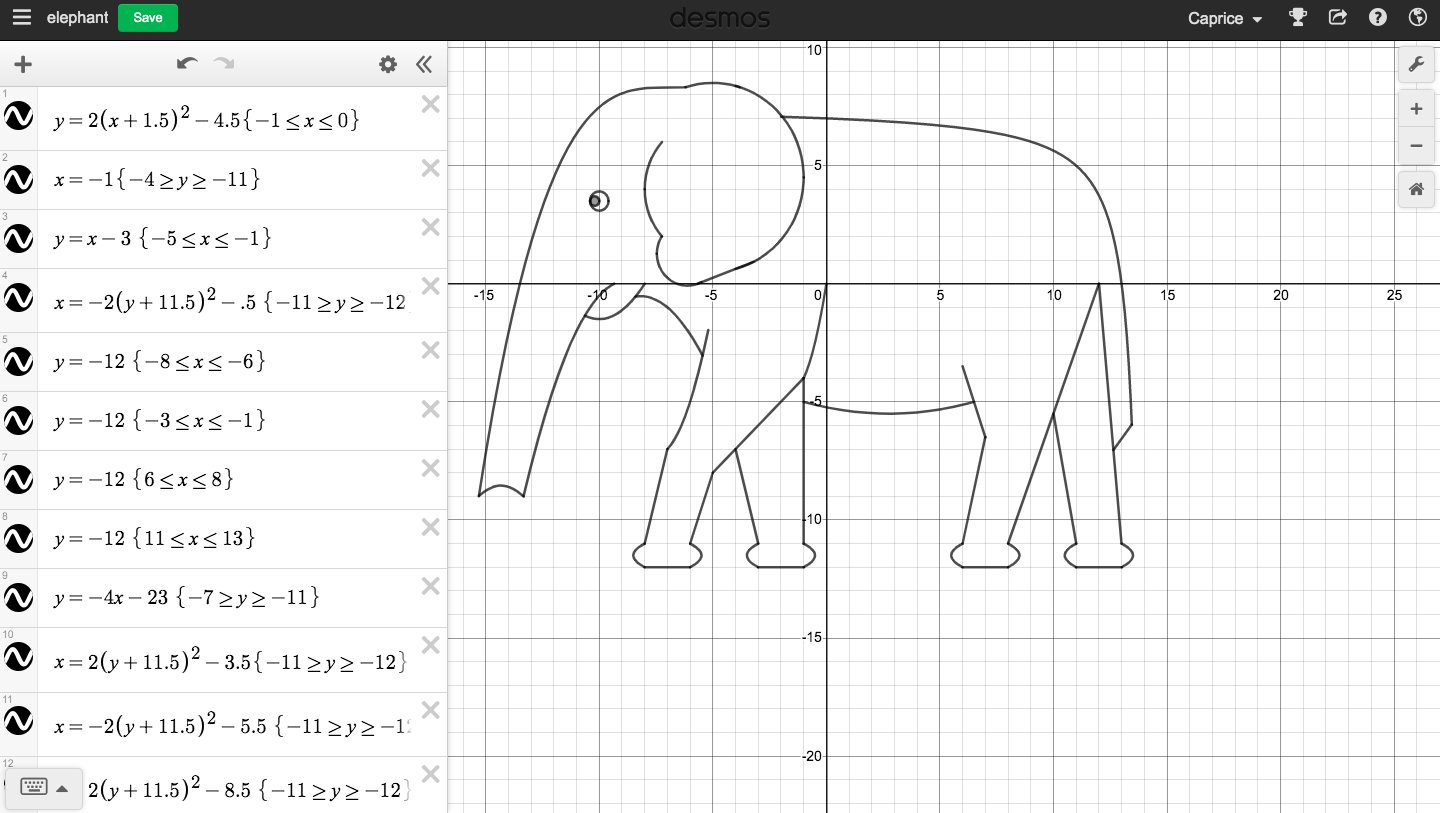
What does six feet look like in a school? I’m going to discuss my school, 13 classrooms, 400 students. YMMV
Let’s consider, when it is not possible to maintain six feet, is the problem momentary, or longer?
Entering school. Perfectly lined up, single file, 6 feet between, that’s almost half a mile. (There are other schools on the block – the single file line thing won’t work like that. Maybe a designated area in the parking lot with a 6 foot switchback line?
Lockers. OK, I can’t do this. Maybe no locker use?
Hallway. Our hall (singular) could handle one line in each direction. (that’s where the lockers are, but assume we don’t use them). I think we could work out a change of class routine, with momentary violations, but not for 400 students (our hallway gets crowded). I think the hall is 150 feet or so. Could we get a line (with some staging?) of 50 in each direction? Maybe.
Classrooms. Ours are small. There is a range, but 22×24 I think is somewhere in there. We could just about squeeze 11 – 15 students in – but 10 might be more like it. Call that 130 students.
130 students would mean we violate social distancing minimums during class change. Even if we staggered the changes, we would have concentrations near doors leaving or entering. And the time for changes would need to go from the current 3 minutes to maybe 10, to allow unbunched passing. Maybe more than 10. 15?
With those numbers, we could rotate, and see three groups of students, maybe three times every two weeks.
But wait, we have four grades? How could we run the classes that each kid needs at the right time?
I haven’t discussed art. or pe. lunch in the classrooms is fine for everyone who brings lunch. WIll there be school lunch?
Look, every building is a little different, but needing 3 independent sessions sounds about right. And 4 might be more manageable for 4 grades. And I’m not sure what good that does parents who need to work.
I don’t think there is a way to maintain 6 feet all day, but 6 as a guideline with momentary lapses might be possible.
But I didn’t discuss teaching. How do I check a kid’s work? How does a teacher hand out a test? How do we do a million little things that teachers do with students every day?
I noticed two bloggers attacked this with questions I like: Arthur and Peter.
But here’s the reality: there’s no way to run in-person school with the 6 foot guideline.
Threatened Cuts to Education Demand a different Response
Trump and McConnell won’t send money to the states. What does that mean for our schools?
Cuomo’s first pandemic, he’s treating it like a candy store during a blackout. And not like Mario who would have been helping out the storekeeper, Andy’s helping himself. Who raised him? Dumping Bernie from the ballot, getting the Working Families Party off the ballot (the way he tried before, but a judge saw through his illegal scheme), promoting the interests of his big donor pals (his reopening committee is over 50% businessmen, mostly big business. And no teachers. Out of 116 people. Except for Dennis Walcott, who I don’t think counts). He’s cutting medicare! But his deepest cuts: to localities, which will be universally, schools.
And then, outdone as usual, but still trying, bill de blasio. He and his chancellor have proposed an unconscionably high level of cuts to the schools (which will be cuts mostly to the classroom) while maintaining wasteful contracts, bloat at Tweed, unnecessary levels of administration, and lawyers (lots). He’s keeping money where it can’t help kids, and taking it from where the kids need it.
And central administration is less useful than usual. Teachers (and principals) figured out various ways to do remote teaching. Most of it functions, but not so great. A lot of it sucks. We had to do this under pressure, because we had to run “classes” – and when we noticed mistakes, we had to try to make corrections under pressure. And Central’s contribution? Failure to distribute IPads (and why IPads instead of cheap laptops?). Banning the most popular platform (that they had let us train ourselves on). Announcing a new much-anticipated grading scheme, which accomplishes almost nothing, except annoying us. And handing out resources for remote teaching THIS WEEK, to teachers who are knee deep in remote teaching.
Central administration has been late, has been incompetent, has been an impediment. But Carranza thinks they are vital.
And back to Cuomo and de blasio, which one of these two is responsible for siphoning off public school money to privates and charters, when there’s not enough for public school? Not to let Trump and De Vos off the hook – but today they are in a position to turn off money – not force anti-education policy changes (wouldn’t they wish).
The threats today are massive. They are coming from all three layers of government. Cuomo points at Trump, but at the same time he kicks us as hard as he possibly can. Trump in turn is performing for his base, who delight when he turns on New York. And de blasio? I can’t even.
That is why our response has been so massive? But what response? I see some newspaper columns. That’s not enough, guys. This is not business as usual. Where are the petitions, the campaigns, the phone calls, the email drives? Where are the virtual phone banks getting members and parents involved? Where is the outreach in solidarity with the rent cancelation and tax the billionaires community groups? Where is the recognition that this time is unlike any we have experienced.
Where is the semi-threatening potential job action language? (even if you would never follow through). Well, we have that, in the form of pronouncements from leaders. But has there been any preparation? Any involvement of membership? Any sign that the membership will be mobilized, for anything?
The strength of a union lies in its potential for collective action. We must begin to wield this power. The threats today are far greater than at any time since you became teachers. You need to toss “business as usual” out the window, or allow someone else to lead.
Sneezes and Grades
So your friend is certain he can get you to sneeze. A huge sneeze. A tremendous sneeze. He grinds some black pepper fine, wafts it into the air. You feel the sneeze start to build up. You tense up. He’s quite pleased with himself as he continues wafting. You feel the tension build, the sneeze is coming, you’re both waiting for it, he keeps wafting, you are telling him “just watch, it’s going to be huge.” A crowd gathers. Anticipation (and pepper) are in the air and… and, wait?
What happened? Tension’s gone. Nose tickled for a second there. Was that it? You tell him perplexed “I think I sneezed” – he looks disappointed (as does everyone who has started to pay attention). “My nose tickled” They look sad. You correct your tone “I sneezed.” He smiles. “It was a tremendous sneeze!”
Now, everyone knows you are lying, but your friend is a good friend, and smiles bigger, and pretends to believe you. Here, let me stop trying to describe the situation, I have the friend’s words:
|
|

How I’m Teaching Remotely during this Crisis
Once a week, back in February, a small group of juniors and seniors would bring bag lunches into Room 133. Every Tuesday. They’d take out their lunches. I’d take out mine. I’d pass out a snack – often Croatian wafers with mocha or hazelnut filling (no allergies in the room). And then we would start.
The class? I was calling it Axiomatic Arithmetic. Goal? To construct the real number system, using, for high school, fairly formal language. I wanted to make sure they got a big gulp of history along the way. And proof. I wanted to walk away with all 12 students better at understanding proof, and with some experience constructing proofs. We did some history. Learned about Peano. Picked a least bad text (doesn’t really do what I wanted, but first few chapters are heavy on proof for the naturals, integers, and rationals, and almost within their grasp). Started. Paused to relearn arithmetic (base 4, but using four strange symbols, to make it strange and make them think). Worked through Peano’s axioms. Paused to do some easier (advanced high school) proofs by induction. Now we have defined addition, and are proving associativity and commutativity tomorrow…. Yes, March 19 I wrote, and asked who wanted to continue, lunch time class, so completely voluntary. Eleven of twelve signed back up. We are down to ten now. And the live class once a week? Not so different from sitting in Room 133, except not being in 133. Great group, by the way.
Once a week, back in February, a smaller group of juniors and seniors… Same idea, different day. Set Theory, using the primary source-heavy MAA intro to Set Theory. And lunch time, Monday, just like we were in school, we meet and have a live discussion as we carefully move through the text, dwell on the language and notation, and attempt exercises and proofs.
But those are extra classes for me. My primary teaching this term is precalculus. Four sections. 101 dalma.., er, students. Before the crisis I had an interesting set-up. Homework assigned four days a week. Graded for completeness, not correctness. It was their job to correct (by asking others, by putting on the board). A few projects. And quizzes once or twice a week. The quizzes only counted if they were at least 80% right (no major errors), but could be retaken, for full credit, as many times as necessary. Could be taken? Nah. I required it.
Cool system, crushed by Corona.
So what now?
Each Monday I post reading from the text, with exercises. I attempted to provide additional notes, the kind that I would supply during a real lesson. But they are much easier to put on the board than on paper. To cover for me not being there, I needed to supply the kind of detail that I would only offer if I saw a kid with “that look” that told me they needed more. And trying to cover every question, they were just taking me a long time to write. A 20 minute lesson I might scratch out in 4-5 minutes, was taking me an hour and a half to write. I couldn’t keep up. And dropped the attempt.
Each Friday I announce which of the problems from the week I will collect for grading. And then the homework comes in. Slowly. Two-thirds exactly when due. More over the weekend. But I take everything – no idea what is going on in their real lives. And then, grading on line! How many clicks to open? Math handwriting can be bad on paper. But try reading on a screen! Why does Google Classroom have a defective zoom in feature? Comments are typed for each error or defect, whether or not it led to a deduction. Send the comment. Record the grade. Return the assignment. If the grade is low, assign replacement problems. A stack of 100 (ok, 101), should take me 20-30 minutes. Now? 3 – 4 hours.
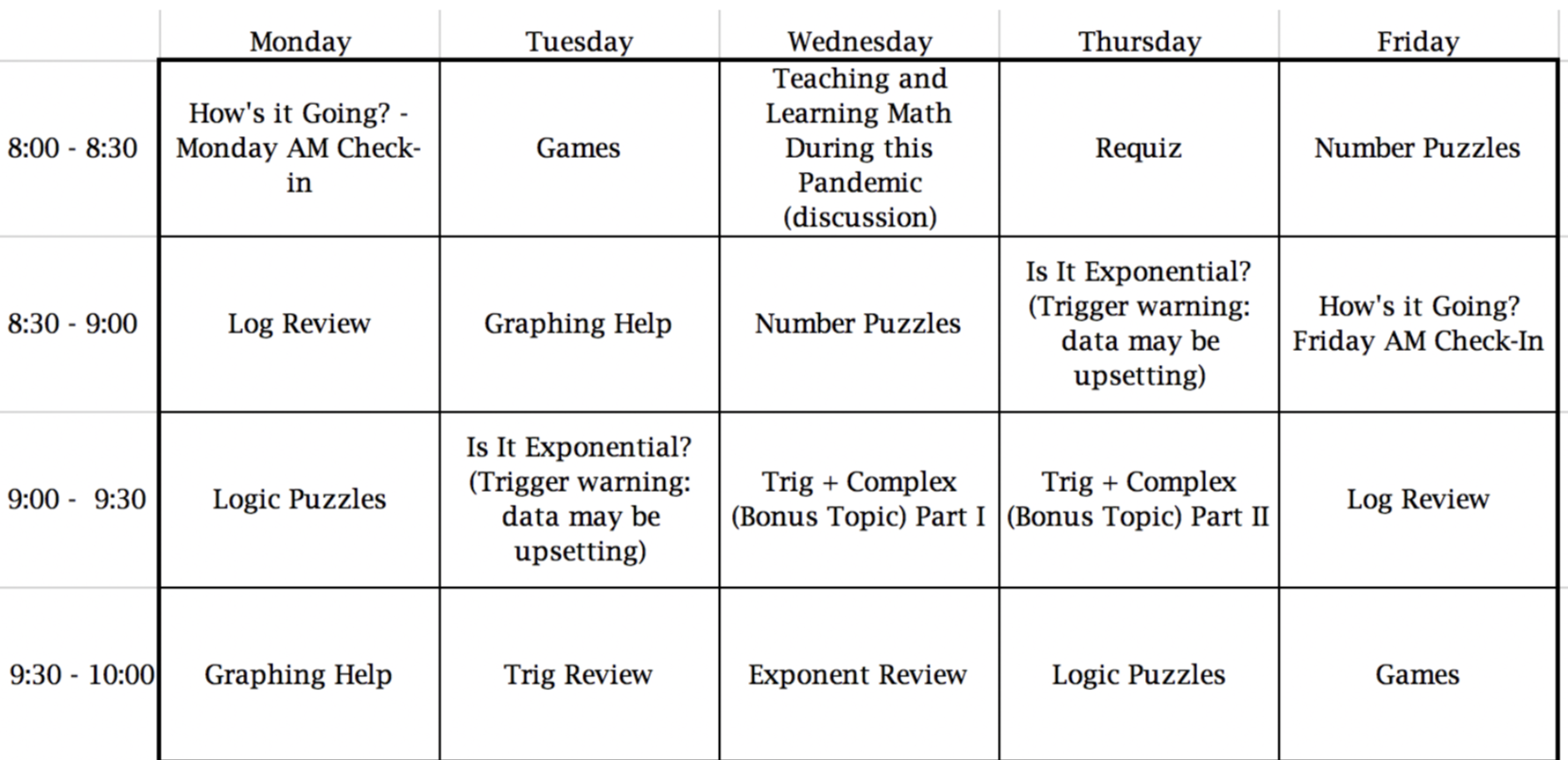
During the week I was running office hours, 8 – 10 each morning. Coffee with me. Over “vacation” I broke the time up into half-hour activities. I am continuing that. Each student should show up at least once a week, for at least 15 minutes. As a minimum I can check in, listen to how they are doing – life, school work. I ask about food and sunlight and exercise. Not sure why, but they seem like good questions. Here’s my “office hours” schedule for this week:
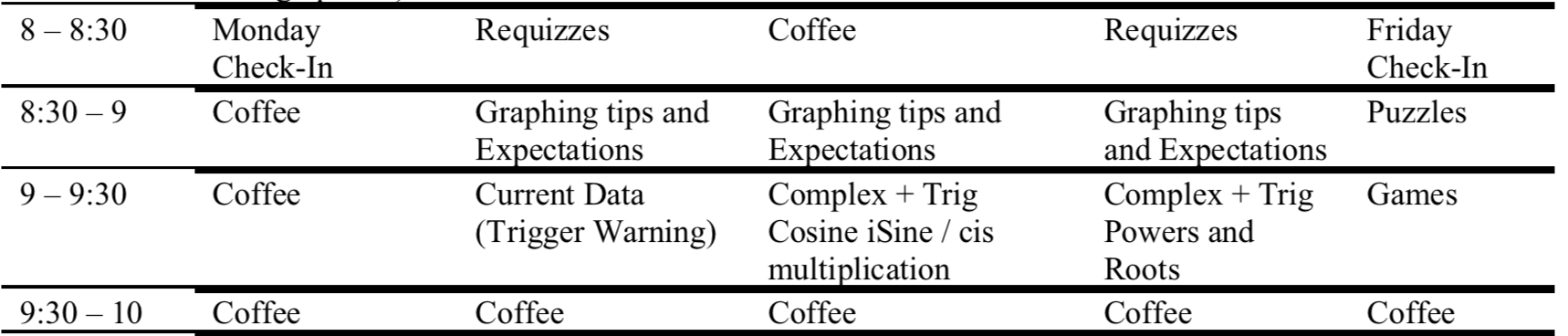
Those requizzes are left overs from before the crisis. They are awkward to run, but there’s a few kids with older quizzes, and if they want to make them up (which they should) I feel an obligation to allow them. “Current Data” is just what it sounds like. I share and we review some source data, and talk about mathematical models, and politics or next steps, if that’s the direction they want to go in. “Complex” is an extra topic, for students who want a little more math. DeMoivre, if you wanted to know. Puzzles are logic, Games are probably anagrams of student names. One of my students can rearrange her letters into Magic Lit Zone, which is a pretty cool anagram. And the graphing covers this week’s material. I’ll give instructions for anyone who needs them, and run little mini-lessons to get them started.
I am trying hard. But I am not getting very much done – certainly less than in a live class.
There are things I cannot do. I can’t watch a student, and understand they are getting stuck. I can’t listen to a wrong answer, and diagnose the misunderstanding on the spot, and help the child repair it themselves. The stuff I am best at, not available.
What I can do goes slower. I am collecting very little, and am overwhelmed by the time grading it. Tracking attendance live is far, far easier (I count the kids in each class, and conclude “all here!” or “two out – who is missing?” My little mini-lessons take more time than full lessons, and cover a fraction of the ground.
I do NOT have this figured out. I am not sure that this is even sustainable – I may need to slow it down a bit more.
Set Theory and Arithmetic, with tiny groups of highly motivated students – no issue. Live class, once a week. Doing nearly the work we would have done live. Kids absolutely are earning their quarter credits.
But precalculus? I’ll strip out some topics – and we will go to late June – and it still will be a shadow of the real course.
I am not figuring out “remote teaching” – I’m learning to cope with it. And know what? If I had to do a full term of this, I would need to sit down and think really, really hard, and talk to a bunch of really smart people. Not close to there yet. But at least next time, if there is one, we would be planning in advance.
Updated Resources (annotated)
I like tracking the data the experts are citing.
I feel an obligation to track data that politicians are citing or mis-citing (how do we know which unless we watch? The alternative is to trust them…)
Dashboard by the Center for Systems Science and Engineering (CSSE) at Johns Hopkins University
Confirmed cases and fatalities, keyed to a zoomable world map. In the US, data is county level (except NYC).
Tables, graphs, and charts for the world, and for individual countries. Current and total cases, fatalities, recoveries. Distinguishes between serious cases and others. Click on the US, and get state by state data. Some charts have y-axis that can be toggled between linear and log scales.
NY State Department of Health Covid-19 Tracker
County level data. Trends. Tests/Positives. Fatality breakdowns (county, age, race, sex). Why don’t the comorbidities include asthma and other respiratory ailments? smoking? NY State DOH, you can do better.
Colorful, if slightly busy, charts. Rate of spread by country. Fatality rates by country. Others. The upper two are updated daily. Careful with the lower ones. Thank you Emily!
One sharp chart, case trends by country. Click on the continents on the right to see more clearly. Updated daily.
For serious data folks – an attempt to capture the reproduction rate – state by state. Seems to update every day or every other day. The data is “bouncy” – I think this reflects state level sources and testing inconsistencies. They link to their math, if you like that stuff, and their science, which is challenging. It looks like The Atlantic gave original impetus to this project, but not clear who is running it now (I see names, not an organization)
UFT and DoE documents and agreements, plus resources. This matters to me, and my colleagues.
Let’s do more than wait and hope
There are important things we can do to help slow the spread of the novel Coronavirus / COVID-19. Shelter in place. Wear masks. Practice social-distancing. Minimize unnecessary trips. Etc. All of them are important. We should follow them.
But why only passive advice?
These are things not to do.
What can we DO?
Where is the advice on exercise?
Where is the advice on nutrition?
Where is the advice on sleep?
Where is the advice on smoking?
Where is the advice on emotional well-being?
Where is the advice on screen-time?
The politicians want us docile. I would prefer to DO SOMETHING to make a difference.
That is why the applause for hospital workers has been huge – they deserve it – but for many people, that’s the biggest ACTIVE thing they can do.
We need more. We need to be involved.
Ask the reporters. Ask the politicians. Ask the departments of health. Ask the public health professionals. Ask the doctors. Ask the researchers.
Let’s do more than wait and hope.
Resources
Times change, resources need replacement. Here’s a few, new to me, and I’ve been using all of them:
Worldometers Coronavirus Updates. Click a county and you get roughly as much detail, but on the country level.
Johns Hopkins’ COVID-19 Dashboard. Lots of data. And cool maps.
New York State Department of Health. County level data, plus charts, maps, comorbidities… Lags about a day.
UFT Coronavirus InfoHub. UFT and DoE documents and agreements, plus resources.
Survival of the Sheep: Considering 100 hungry points of view
A logic puzzle? Now?
I’m glad I’m back writing, but need a break between remote teaching, the UFT, the politicians and the pandemic… That’s a lot of scary stuff and frustration and unknowns… Let’s squeeze in some math to lower the temperature.
Last week I ran discussions with no outside assignments. And some of the discussions were logic puzzles, run like problem solving sessions. And I dusted off this old favorite about leprechauns, and as the kids pushed to an answer, someone said “is this the same as the wolf and sheep problem?”
I did not know the wolf and sheep problem (which I told him). But when we were done, I looked it up. Brand new problem for me, but fits right in with some of my favorites: the pirates and leprechauns. Here it is – try to reason it out for yourself:
I took the language from a page that seems to be selling a logic course – but I prefer the title I found on Braingle:
Survival of the Sheep
On an island in a far away country there is a population of 100 wolves and 1 sheep. They are the only two living species on the island. The following facts are known to be true:
- There is grass covering the whole island (grass is not considered as a living species for the purposes of the problem).
- The sheep can survive just by eating grass throughout its lifespan.
- As the grass is being eaten, it instantaneously grows back. No matter how many times it gets eaten, it will always grow back. It is therefore suitable to state that the island has an infinite supply of grass.
- The wolves themselves, unlike the sheep, are part of a very rare and intelligent species. They are actually perfectly rational beings, and can be considered as being infinitely intelligent.
- Similarly to the sheep, the wolves can also survive by eating grass throughout their whole lifespan.
- As one might imagine, the wolves prefer eating sheep than eating grass.
- If the sheep were to be eaten, it could only be eaten by a single wolf (the wolves cannot share their prey). However, there is catch:
- In this faraway land it is known that after a wolf eats a sheep, the wolf itself will become a sheep and it will therefore be in danger of being eaten by other wolves.
- All wolves are perfectly aware of this.
- If a wolf knows for sure that eating the sheep will cause him to be eaten by another wolf, then it prefers to eat grass instead.
- In the same way, if the wolf knows that eating the sheep will not put him in danger, it will eat the sheep.
Given all these facts and given the scenario from the very beginning, the question which must be answered is the following:
Will the sheep be eaten?
Put your questions/hints/solutions with work in the comments section
Who is demonstrating today? Start with: what happened in 2016?
The state capital demonstrators, nuts, right? Are these vast rightwing mobilizations in favor of infection? It would be wonderful if the right could only bring out such pitiful crowds. Paid agents of Fox? Hardly. Fox has the money to fake a decent-sized crowd. So who are they?
I think to get to the answer, we should start with another question. What happened in 2016? Not in November, but from January through the Spring.
For four years I have asked the question. And the answers have been various, but all have been disappointing. Commonly Trump opponents will pivot to how horrible his supporters are, or how stupid they are, or how Hillary won the popular vote, or how awful his policies are, or he is personally. There is often an unnecessary glimmer of self-satisfaction. There are responses that explain how Trump is wrong, or how bad his policies are. There are arguments about running a better campaign, or combatting voter suppression.
But what happened?
The election of Trump was a big shift. There have been other shifts in the political landscape. I’m thinking of the election of Reagan in 1980. Reagan was the face of a conservative wave that was taking over the Republican Party. The two wings came into conflict, and the socially liberal northeastern Republicans were defeated, and marginalized. This was an internal battle in the party.
But in 2016, Republican primary voters rejected every traditional republican to vote for Trump. Trump was a businessman with no experience in politics. He held political positions at odds with post-Reagan traditional Republican positions. This was not one wing of the GOP overthrowing the other. This was part of the GOP’s base rejecting its entire leadership. The leadership survived, but only by pledging allegiance to the outsider who usurped the throne.
What part of the Republican movement, (“movement”, because as their presence in rallies on the streets showed, they are more than just an electorate) what part of the Republican movement threw Bush and Rubio and Cruz and Christie and Kasich overboard? Because I think a good answer to that question would go a long way to figuring out what’s happen with the “Open” rallies at the state capitals.
Just looking at who voted for Trump (Nate Silver) doesn’t address where his core support came from. In the UFT, we heard that – was it 25, 30% ? – of our members voted for him (I can’t remember which number, and I don’t trust it anyhow). But in any case, Mulgrew trusted it – so much so that he rarely utters Trump’s name, out of fear of alienating his UFT voters. He started right after the election. We should have asked, did McCain and Romney get the same vote? Because otherwise, we are talking about people who flipped from Obama to Trump in the UFT, and I’ve never met one of those. Have you?
Nah, if we want to get to Trump’s core, we are not looking for UFT members. Instead, think of the early Trump rallies. You could probably think of the later ones too. The crowd was white, outer suburbs more than inner suburbs. Lots of flag symbolism, and those MAGA hats. There were no bankers, no bankers’ friends and families. These were Republicans not doing what their leaders wanted them to do.
A fascinating paper out of NYU tries to ask the question I’m driving at. Manza and Crowley find that Trump’s support, and this at the core of his vote, was less affluent than that of other Republicans, but more affluent then the country as a whole. They find it not a working class vote, but a vote of those who personally felt economic insecurity (and were white, of course).
Who are we talking about? Small business owners. Very small businesses. Perhaps some worked a regular job, as well. Or some may have once had businesses, and now did not. Screwed by the 2005 bankruptcy law, although they did not realize it until the 2008 crisis, when bankruptcies occurred in huge numbers, and being bankrupt was bad, but small and bankrupt was horrible. The bill added a means test for Chapter 7 bankruptcy, and raised filing fees from about $600 to $2500. That’s for someone going into bankruptcy to pay? Chapter 13, the alternative, let’s creditors go after future assets, not just what you have when you declare.
By the way, the bill also encouraged predatory student lending policies. And it was strongly pushed by the credit card companies. Their benefactor was so desperate to get it passed, he once inserted it in a foreign relations bill. One guess who the culprit was (or you can read all about it, here).
So there we had a ready audience for Trump – and I don’t think even he knew it was going to be there. Angry, xenophobic, with a populist anti-big business tinge. Resentful. They had a little money, but had been voting for people with a lot more money. Angry enough to throw them out. (Little irony, they backed a rich guy to do it).And yeah, angry enough to vote for a guy who may not have shared their valued. But he knew when they responded, that he had his message. Build the Wall. Insult people. Red MAGA hats.
During the primaries, they had a love affair, Trump and this crowd. And during the general. And he kept them revved up. But in DC, he started accommodating some of the old Republican leadership. And even more so, they accommodated him. Everyone in the GOP, today, at least on the surface, is a Trump loyalist. But today’s Trump may be as vile as the one from the campaign trail, but remember that Wall? The trade deals? He’s not the same.
(An aside – what happened to the traditional Republicans? Not from 1972, but from 2000, conservative, racist, anti-gay, misogynist, interventionist, deep in big-business’ pocket? Just a guess: I think they are all still there. They’ve brought Trump towards their positions. And they are, I believe, just waiting for the chance to reclaim their party, sinister plotters looking to remove this disgusting oaf who they did not invite, or to wait him out.)
And now, fast forward. Who is going to the capitals, and why? Small businessmen. White. Don’t want the government to shut their businesses. Worried about going broke. This is a piece of Trump’s original core. But there’s not so many, are there? These are not the tools of powerful rightwing groups. These are the tail that once wagged the dog. These are the soldiers who overthrew the leadership of one of the two major political parties. They just don’t seem so powerful today.
Who Wants to Return to Normal?
Well, everyone, right? That was an easy question.
But maybe not.
In the last few days I have seen that view challenged in three ways. And all of them are worth thinking about.
First, let’s think about “return to normal” – that means before the pandemic? But two months ago, it meant before Trump? How much of a difference is there?
- I saw this posted on Instagram:
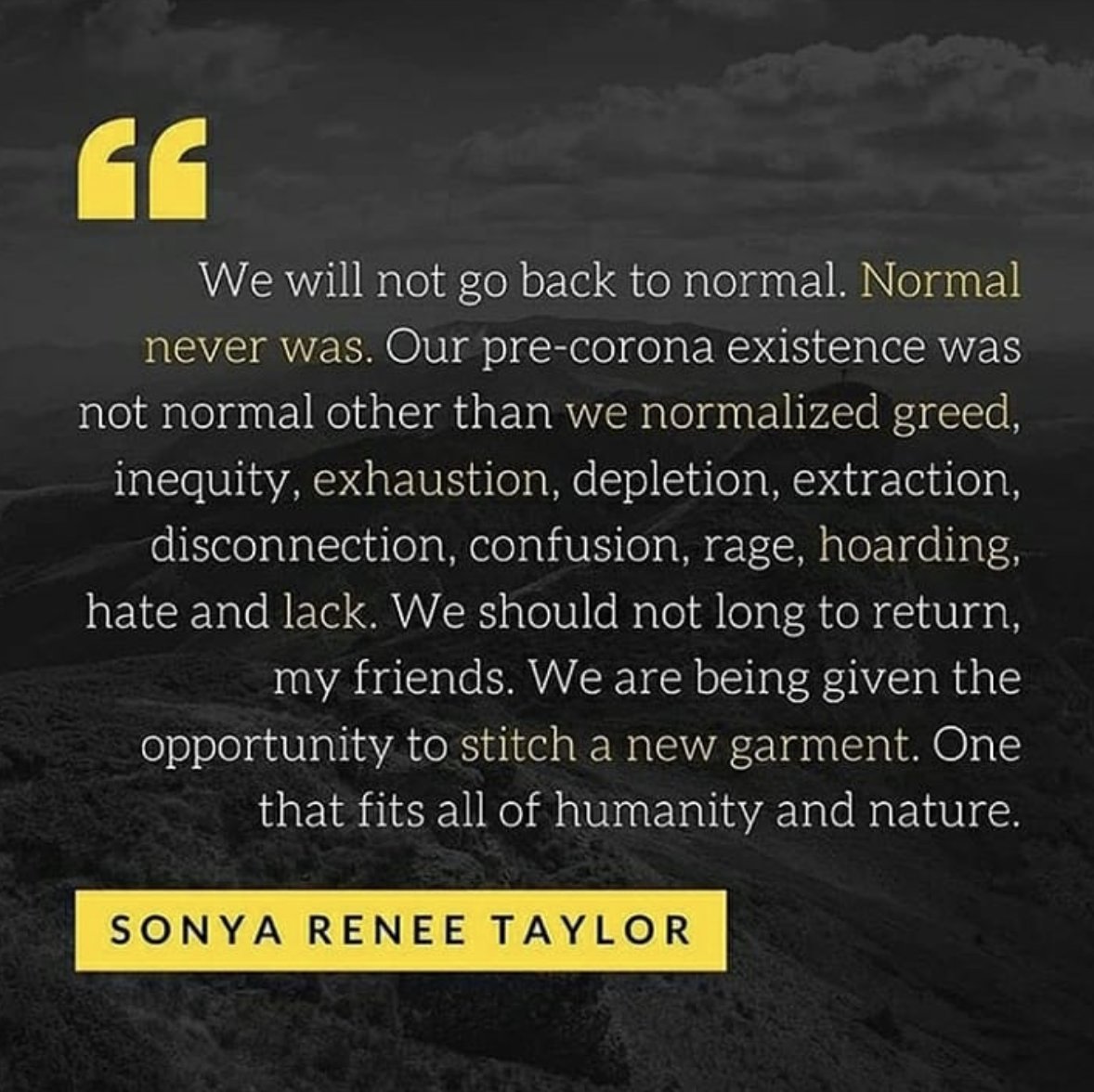
The version I saw was attributed to Brené Brown, who tweeted: “I’ve seen this attributed to me, but it’s not my quote. After digging in, we found the original and it belongs to Sonya Renee Taylor. If you’re going to share these beautiful and powerful words – please use this image with her name. Attribution matters.”
Attribution fixed, it’s all good, as Brown indicates.
2. “… the pre-Trump period gave birth to — Trump! ”
Wow. Just wow. Dial things back to 2015, and we have a country about to propel Donald Trump to the presidency. That’s not a normal place. That’s not a place I want to recreate.
3. A slew of articles, the numbers increasing in recent days, about racism and the pandemic. This is from the Atlantic. This is from the New Yorker. There are many, many more.
Here’s something a former student, now a teacher, wrote last week: ”
“Currently watching the president’s briefing as they discuss how coronavirus disproportionately affects African Americans. Fauci mentions how this is due to disparities in chronic underlying health conditions (he specifically mentions diabetes, hypertension, obesity and asthma), but, being a health educator that’s passionate about our health, I wish he would have explained WHY. It’s not because Black people are necessarily negligent in regard to health or simply don’t take care of themselves. It’s not because Black people are genetically inferior. It’s because of structural racism in this country. It’s because of the unequal access to healthcare, education and job opportunities. It’s because of the low quality of care we receive. It’s because of residential segregation that results in African Americans living in lower quality neighborhoods due to environmental factors such as air pollution, and the inability to access healthy foods and exercise.
And instead of just stating how African Americans are disproportionately “unhealthy,” I wish they would say what they are actually DOING to help us…”
And it goes beyond just the pandemic. In the dark days of December 2016 and January 2017 there were discussions, all over, about how to combat Trump. I remember being told to put questions of race aside, that they would sow disunity, and that we could work on racism after we defeated Trump. I’m sure others heard similar comments. That’s not the sort of thinking I want to return to.
– – — — —– ——– ————- ——————— ————- ——– —– — — – –
So I don’t think I want things to go back to “normal” – I want to build a better place than we had before. And as important as social distancing and the November election are, we need to do much, much more to build that place.
Highlights from Vacation Week
New York City Public Schools just finished spring break. Except we didn’t get a break. In my school we taught, but went easy on kids. Most did fewer lessons, fewer assignments. I ran discussions in three categories: games/puzzles, discussion of the world and how we are doing and how’s the world doing, and math – review or enrichment. Three sessions (half an hour each) and no outside work, and your week was done.
Highlights:
- I advised myself and everyone to “go slow” – and I followed the advice this week, and I shared it with students.
- I learned that in my school, among my students, the idea of Pass/Fail grading is not very popular –
which I only learned by engaging students in real conversation. A lot. - Monday, conversation veered to the feuding between the Mayor and the Governor. I offered that it was inappropriate. One student, a political junky, offered that no, it was incredibly entertaining, and was a nice diversion from the regular news.
- I learned several new logic puzzles, including a bunch of liar/truth-teller ones, and beautiful wolf/sheep multiple point of view logic puzzle (I love those).
- I extended deadlines, and when kids asked for more time, I asked how much more they needed, and gave it to them, and offered more help.
- I offered extra math, and some kids really wanted more…
- For the first week since this started, I did not fall further behind on grading. I caught up a little.
- Now I’m considering how to blend more discussion and less assignment into my teaching for the duration.
- I’m reeling from the number of people I know who got sick, and the number who died. And this thing has not hit me nearly as hard as it has hit others.
- I advised myself and everyone to remember those we lost, not to just move on. This week I made a point in some discussions of remembering a professor, John Horton Conway. I shared a story. I showed them Randall Munroe’s tribute. And I asked them to play with Conway’s Game of Life.
- I got outside every day. I got in two hikes. I startled a grouse, who returned the favor. I found beaver tracks. I looked into the next state.
- I wrote thank you notes to a couple of former students who are now health care workers.
- And I wrote, every day.
Remote Teaching ≠ Real School
It’s not. Not close. But I’ll save the details for another day.
Big picture: we are working. We are working hard. Many of us are working as hard as we’ve ever worked. Many feel exhausted the way we haven’t since we were first-year teachers.
While we are trying, the City and the Department of Education are making our lives hard (and some administrations – not mine – are also standing in our way). They have stolen our planning time, while asking us to plan completely new lessons and even curricula. They have allowed misguided principals to over-schedule days for those unfortunate teachers, pushing them further behind on their work. They let us learn to do live lessons on Zoom, and then surprised us by banning that tool. They took Spring Break, then Passover and Good Friday. They send some of us to useless daily meetings. Instead of consistently supporting us, the Department has wasted our time; sucked our energy.
We are doing our best to engage our students. I’m fortunate. Most of my students want to be engaged. It makes my job easer than most. And it’s not easy. It’s hard. It’s real hard. And it’s just as hard, probably harder, for teachers across the city. Easily the worst problem? Kids without internet access. And don’t get me started on meeting students’ individual needs (from their IEPs).
Remote teaching? A pale imitation of teaching. We are not face to face, answering questions, explaining concepts, drawing students out. We are not making eye contact. We can’t encourage the same way. We can’t give “the look” to get them back to their seats, or “the smile” that let’s a child know they just did very, very well. We have had to forget about plans that had been honed over the years to provoke kids’ curiosity. A computer is not a classroom.
Nor are we teaching as much. We can’t. There is a limit to how much screen time (classes + homework) we can demand of our students. And what about students without access? There is a limit to how quickly we can grade on line (not quickly). Many of us have tried to turn our lessons into scripts that students can read. Apparently my lessons (can’t speak for others here) include one or two words that tell me what to say and write for the next 3 – 5 minutes. Figuring out the script was eating up hours, to cover part of the material from a 15 minute presentation. And now I’m speaking for others: at the high school level, almost every teacher I have spoken with has dramatically reduced how much content they intend to cover each week. I thought I could do about 80% of what I normally did. Not even close. 50% would be aspirational.
So
- Trying really hard
- Exhausted
- Frustrated by the DoE, and by some administrators
- Succeeding, with mixed success, in engaging students
- It’s not the same thing as real teaching
- Covering much less material
So when someone says teachers have done a great job, I appreciate the words. But when someone says teachers have got this figured out, I’m like wtf? We’re doing our best under horrible circumstances, but remote teaching ≠ real teaching, and I said horrible circumstances?
Someone with an office job at the UFT thought it would be important to put out a positive message about all the good work teachers do, and how we support first responders and health care workers. I understand that need. But I don’t understand how someone makes an ad with smiling teachers and kids, looking relaxed, looking like “We got this!” and doesn’t understand how insulting it would be to the thousands of teachers who “don’t got this” but are, exhausted and frustrated and still trying our best and still trying to figure things out and create structure and lessons and engage our students Every Single Day.
Thoughtless, inconsiderate.
http://players.brightcove.net/73788382001/DOsUJ7wWx_default/index.html?videoId=6149641621001
How do I say “How are you?”
Remote teaching is not teaching. It is a pale imitation. It is a stopgap.
I bristle when I read “Because of your hard work and commitment, the nation’s largest school system has successfully made the transition to remote learning and support.” No, no we haven’t. This is not success. We have put emergency measures in place. We are trying to hold things together, as an interim measure, until we can start real school again. We are not succeeding, we are making due, doing the best we can, keeping the whole thing from sinking.
And part of the situation? We are “checking in” with our students more. I wrote “Slow down. Don’t say “How are you” – ask “How are you?” And slow down and wait for the answer, and slow down and listen to the answer.” And I meant it.
But how do I ask “how are you?” to elicit a meaningful response? How do I follow up? How do I interpret the answers? When do I ask for outside assistance?
And those are real questions, from me, for me. And I’m guessing quite a few more of us could use those answers.
I’ve been going on instinct, much of which is good. But I am not certain, and I do not want to reinvent the wheel.
So, teacher friends, I’m looking for resources. Articles, videos, even books. Ideas for running check-ins. Ideas for eliciting real answers, and what to do with those answers. Can you help?
I guess this would be good stuff for PD, except I usually hate PD. I’d rather have the articles, and then I can talk it over with friends.
Grading for the Pandemic Term
How are we going to do it? That’s a great question. Soon the UFT will meet with the DoE to shape guidance to schools. This would be a great moment for teachers to weigh in, which is exactly what a group from Francis Lewis has done here. I actually was invited to sit down with them (metaphorically, I’m not allowed in the same room as them irl today), but could not make it.
But after they were done, I looked at their notes, and thought, I like these. I’d like to change some stuff. So that’s what I’ll do. First comes their suggestion, then mine, then some of my thoughts. You should express your opinion, too. The more voices, the better.
1. Do no harm. Wherever students were at the time schools were closed, we agree not to lower their grades. We cannot penalize students for circumstances beyond their control.
2. Teachers shall have flexibility to use either numerical grades, or pass/ fail options. Students who may have been on the cusp of passing and show promise can receive a P as a grade. High achieving students entering or applying for colleges can still get grades of 98 or higher, for example. Teachers will have wide latitude in raising student grades for excellent work or participation as they see fit.
3. Classes based on cumulative learning will do a thorough review in September 2020, and teachers will not expect full mastery of 19/20 school year topics by that time.My suggestions:
My (jd2718) suggestions for grading (notice I am not starting from scratch – mine is the easier job)
I agree with the mayor that now is a time to show compassion for the students we serve. I understand that they and their families are suffering from enormous stress, anxiety, and perhaps even the loss of loved ones. I understand some of them lack sufficient technology to participate. I therefore propose the following policy for the remainder of our school year:
1. Do no harm. Wherever students were at the time schools were closed, we agree not to lower their grades due to circumstances related to the school closures. We cannot penalize students for circumstances beyond their control.
1a. Classes should compensate for lost opportunities to add to grades. Many students are able to raise their grades through work in the classroom. Daily reading quizzes, participation, and board work are three ways that some teachers allow to students to add to their grades through diligence or enthusiasm. We should encourage schools and classes to be creative in identifying new such opportunities.
2. Schools shall have flexibility to use either numerical grades, or pass/ fail options. Schools may choose a P/F system, or a letter grade system or a numeric system, or some hybrid. For example, a school might choose F/P and single digits for grades of 90 and above. another school might choose ABCDF. And another school might give individual teachers flexibility. Schools should involve all stakeholders in these discussions, and choose a system that is consistent with the school culture.
3. Classes that have a natural continuation next year face a special challenge. Less material will be taught. First, schools and teachers should look for units that can be dropped this spring. Second, schools and teachers should look at material that can be dropped from the course next fall. Third, schools and teachers should look at setting aside significant time at the start of the Fall for review. And fourth, schools should set aside time for teachers of spring courses to meet with teachers of the corresponding fall course in September
My explanations of some of the differences.
1. There’s a difference between many many kids who are suffering through this, and who are not able to keep up the normal level of work, and, here’s my example, a boy who has used the crisis to choose two classes that he no longer wanted to attend. Good news, I finally reached him today. But the point remains, his grade is currently falling, and he can correct it by straightening up.
1b. There are students who balance off weaker test scores with better participation. It wouldn’t be fair for participation to go away, while the tougher parts of his grade got built up.
2. I think this is good as a school level decision.
3. New York is plagued by course that are a mile wide and an inch deep. The Regents, with its implicit curriculum, makes this problem worse. But this June there are no Regents. This is an opportunity to shed some unnecessary work, and focus on fewer areas. Our last (not first) resort should be to jam in more material.
So what do you think? What do you think about the Francis Lewis suggestion? About mine?
Make suggestions, share this post, keep the conversation going.
Vacation Day I (doesn’t feel like vacation, but )
Today felt like a full day, almost. Not much prep. No grading. But I’ve opted to run some discussions.
My school advised us (we were all part of the discussion) to create a much reduced work load for the kids for this week. I also advised us (as part of the general discussion) to create a much reduced work load for ourselves. The two pieces of advice aligned nicely. Of course, advice is advice, and there were a variety of interpretations.
Most teachers just made this a super light week. Fewer assignments.
Me? I promised the kids no assignments, but asked for attendance. Sessions with no outside work. We discussed it last week – I got no objections.
So I created a rotating set of activities: discussions, games, problems solving, extra help. My job – be there. Their job – be there. (I’ll be on for 1/2 hour blocks – they show up to three over the course of the week).
Today we had a “check in” first thing. Highlight: a politics junkie student said that he liked the juvenile behavior of our Mayor and our Governor, because it was distracting him from the real news.
I did a review of logarithms the second half hour. OK, basic. A couple of questions.
The third we solved a neat logic puzzle, and then played anagrams for the last few minutes. The logic puzzle involves three prisoners and five hats. Do you know it? For anagrams, the second name we chose rearranged into “Logical Links” which was just too cool.
And the fourth we played with graphs that were not functions on Desmos. I like 

Midday I met with my Set Theory seminar. It’s only a few kids. We are reading an MAA Set Theory project, and they are struggling to learn more advanced mathematical language. Today we encountered “image” and “codomain” and the prepositions that go with mappings. The big idea was “what is a discussion of functions doing in an intro to set theory?” – and I think that worked. The big rethink was to consider functions without necessarily thinking about their graphical representations. Fun.
Finally, I am one of the advisors for our Local Outreach Tutoring Program. Some of our seniors and juniors run an afterschool with kids from nearby middle schools. Here’s a New York Teacher article describing it. That’s from last year – this year we almost doubled the program. And then Corona.
Anyhow, a junior approached me – “Hope quarantine is going alright for you and you’re staying healthy! I have some questions about LOT and I was hoping you’d be able to answer them. I totally understand why the program was canceled, obviously there’s no way to do it now, but I was wondering if thee’s any way we could continue some of our lessons or teach something virtually?…”
My answer, of course, was “highly unlikely” – but I heard her out and then heard them out – and eventually they proposed doing narration/voice over while a power point or worksheet was on the screen – and the one of the 7 middle schools I contacted was interested, and me and my co-advisor were clear that the quality had to be so high that we would not need to play a major role.
Today they screened for me their first lesson. OK, it was poetry, so I am not certain how good it was. But it looked good. And the other teacher had read and approved their script. And I’m working hard? Yes, yes I am. But the kids somehow found time to continue to do local outreach, and produced high quality work, while adjusting to all of the other demands on them, and keeping up with the pretty heavy workload (it should be getting easier) that my school assigns? I am working hard. They are working harder.
Yup, I worked a lot today, but I ended the day pretty pleased. And tomorrow is lighter…
Welcome to Vacation Week
My calendar says that this is vacation week. My calendar is now wrong. School buildings in New York City are shut, but schools are open. Teachers are “remote teaching” from home, including during what was originally scheduled as vacation week.
Governor Andrew Cuomo ordered us not to have vacation (actually, it was a funding order, but same effect). My union, the UFT, was unhappy, talked to him (did not negotiate. Discussions, not negotiations), and looked at his favorability ratings (upper 70s) and decided not to fuss. How could I call it “caving” if they were not entitled to negotiate? I don’t know.
Cuomo’s rationale was that we are babysitters, and without us giving lessons in trigonometry or grammar, 1.1 million Juniors are going to run amok in the streets. Now, plenty of kids are afraid to go out now. And for the others, many will listen to the Governor and the Mayor and their parents and Samuel L Jackson and stay… Let me try again. And for the others, many will listen to the Governor and the Mayor and their parents and stay home. And for the others… lessons in grammar and trig? Not sure they will sign in. Cuomo should have gotten them all Animal Crossing. That would have worked.
In any case, we are on for the week, and the UFT and Carranza work out a deal. “Working with the union, the DOE has devised a series of themed days of activities that focus on family, community service and social emotional learning.” Not quite Animal Crossing (they should really think about that – community building with cute animated mammals), but not a bad idea. The suggested activities – not so great – but at least the idea was ok.
Of course, since many of the activities were not ready out-of-the-box, many teachers got slammed with more exceptional planning. This has not been right. Give teachers time to do some decent planning, and we will do our best. But without time? Come on.
But there will be a world of difference between “The Plan” and what’s happening in schools.
- Some schools will do the theme days, more or less as written. (I’m betting mostly elementary schools)
- Some schools will do the theme days, but then add teacher responsibilities for paperwork, or for particular live hours, etc, breaking the spirit of the agreement.
- Some schools will not really do the themes, or not do them at all, but will dramatically decrease the workload on students (my school. Probably most high schools?)
- And some schools will not really do the themes, or not do them at all, and will maintain the same overload of work on teachers and students that they have been doing the last three weeks.
So here’s the question, here’s my question, what are we (the union) doing about schools in the second, and especially the last category?
- Are we waiting for members to “discuss” differences with the principals so that there is no UFT intervention until Friday when it is too late?
- Are we jumping on the complaints, and is the DR bringing them to the principal and then the superintendent in the same day?
- Or, even better, are UFT Reps checking in on each school, making sure they are complying with the spirit of the agreement?
The emotional/physical damage being done to members in schools with abusive scheduling, paperwork, planning, and reporting practices is an order of magnitude worse when we are isolated in remote learning environments. We literally do not have a colleague in the next room to help us, or just listen to us.
And this goes beyond “Spirit Week” – this changeover to remote teaching is draining, and exhausting every day. A lunk principal hurts our colleagues badly. Extra meetings, excessive contact hours, bizarrely impossible demands to recreate a “normal” day – these things take a daily toll that is incredibly destructive. The “Go Slow, Go Cautious, Wait Until Members are Ready to Fight” approach was always wrong, but today it would be cruel beyond belief.
If the UFT is pivoting to more vigorously keeping principals in line, we should hold all the reps to the standards that our best reps set. And if that pivot is not happening, we need to find a way to name the schools where the abuse is occurring, and to push the reps and their higher ups, (and also to reach out to parents and politicians)
It’s true more than ever. An injury to one is an injury to all. And one day of abuse is one day too many.


