A counting problem, and a real problem with counting
How many ways can we give eleven identical candies to four children? it is obviously possible (necessary) for some to get more than others, and there is not even a guarantee that each child gets something.
That’s equivalent to asking how many solutions there are to:

Now, you could give all eleven to the oldest, all eleven to the second oldest,… Or ten to the oldest and one to the second oldest, and ten to the oldest and one to the second youngest… This is going to be a long-ish list. In fact, I chose numbers just big enough that listing them would be an awkward exercise.
Solving the same problem, with smaller numbers, might help. Let’s give three candies to three kids:

Now we can make a list. I’m just writing numbers. 201 means two for the oldest, none of the middle, one for the youngest.
300, 210, 201, 120, 111, 102, 030, 021, 012, 003.
That’s ten ways.
But how do we scale this up?
One way, a common way, is to turn the numbers into a graphic. Lay the three candies out, and like the divider at the supermarket checkout, put in a physical barrier between the first kid’s loot and the second’s. For 201 we can write ++//+. The pluses represent candies. So this is two candies for the first kid, then a divider, then another divider right away which means nothing for the middle kid, and one candy after the last divider for the littlest kid. If instead we were giving all three to the middle child, that would look like: /+++/. Nothing for the oldest, all in the middle, nothing for the youngest.
Why are there three pluses? Three candies. Why are there only two dividers? There is one less divider than the number of kids.
So we can restate our problem as: How many arrangements are there of //+++?
Well, that’s a question with a well-known answer: 
A small, but important note: Any slash-plus pattern can be converted into kids and candies: //++//++++++/+ would be 002061. And any candy-kid distribution can be converted into slashes and pluses: 222201 would be ++/++/++/++//+.
We might as well answer the original question. Eleven candies? four kids? That’s all the arrangements of eleven pluses and three slashes: +++++++++++/// which is 
– – — — —– ——– ————- ——————— ————- ——– —– — — – –
The April COVID-19 surge took John Horton Conway from us. Otherwise, he might have told us who created the Confederate monument that stands in combinatorics, that we need to take down.
Conway paid attention to credit. While on sabbatical in 2013 I took a Number Theory class with him. His historical tangents were fascinating. He not only knew who had come up with “if and only if” – but over a half century later, he was still a little jealous. And a little annoyed that his “unless and except unless” or some such, which he thought much more useful, never came into popular use. He kept track of politics, too. There was a story about a German mathematician with questionable choices of friends during the war… I often think that I should have ignored the number theory, and instead taken detailed notes on the mathematicians. The gossip-y stuff would have filled a paper, or maybe been the start of a book…
– – — — —– ——– ————- ——————— ————- ——– —– — — – –
My “pluses and slashes,” or “pluses and dividers,” I have been calling them that for a while. I privately chose not to use the more common name. John Horton Conway probably could have told me who came up with the common name – and whether they were being clever, or cute, or political.
In any case, *||**|*** for 1023 is conventionally referred to as “stars and bars” and if not an intentional Confederate monument is at least an unnecessary and unwelcome Confederate reference.
– – — — —– ——– ————- ——————— ————- ——– —– — — – –
I was talking to Sue Van Hattum yesterday, and she had not realized this, and was – rightly – horrified. She posted on Facebook. I told her I would blog about it. Which I am doing.
I checked my shelf. A dozen books on the topic, and only one reference I could find (they may be there, but unindexed). But on the web? All over the place. Lots of guides for secondary school mathematics. Texts in computer science and discrete mathematics. And some lecture notes by college professors.

– – — — —– ——– ————- ——————— ————- ——– —– — — – –
Where next?
- Get a new name
- Get rid of the old name
I admit that the old name “sounded” nice – it rhymed. And in comparison “pluses and slashes”? Meh. But I’ll take it. A better suggestion would be, well, better. Art of Problem Solving uses Balls and Urns (as well as the other), but that doesn’t really sound better. And it does not translate into this: ++//++/+. I don’t see balls and urns. I see pluses and slashes. Sue suggested a relationship to 11001101, and there is a one to one correspondence, but the 0s aren’t really dividers, and I’d like to save them for something else.
And no need to wait for 1. before moving on 2. Do them both, simultaneously. Reach teachers, mathematicians, and eventually publishers? This should be easy.
Outsmarted by Michael Mulgrew
I submitted a resolution to move away from blended learning last month. It was next on the agenda, 3 minutes left in the motions period, and they didn’t even tell me to get ready to speak. Mulgrew filibustered away the full 3 minutes.
So I was going to reintroduce the resolution this month.
Background – The UFT/DoE blended learning plan never made much sense pedagogically. It was going to disorganize teaching when we needed to be more organized than usual.
But until today, the UFT leadership had been strongly committed to blended learning. They adopted it as the union’s position – without ever putting it up for a vote.
So I was going to reintroduce it. But I got outsmarted.
I never got the email to submit a resolution, I thought, so I wrote to Leroy Barr and asked what was up. He told me it had been emailed on Sunday.
Sunday? What? I looked through my old emails. And found it.
The email came on Sunday. I opened it. I did not recognize it as the email to submit resolutions. Bad on me.
Here it is:


See. I got outsmarted.
Consolation prize – for the first time since May I heard Mulgrew raising some doubts about blended (it is at the root of all of our operational complaints. Well, he didn’t blame blended, he blamed the DoE for not being able to implement blended. But that’s just face-saving. This time the problem was blended, not the DoE.)
Sum of the Digits
A little math puzzle.
I haven’t posted one of these in a while.
Consider the sum of the digits of three-digit numbers. For example, 311, sum is 5. 420, sum is 6. 911, sum is 11.
Try any or all of these:
- What is the average sum of the digits of a three-digit number?
- What is the most common sum of the digits of a three-digit number?
- How many three-digit numbers have the property that the sum of their digits is 12?
Solutions later this week (or in the comments – up to you!)

Which COVID numbers do you check?
Before Thanksgiving NYS Governor Andrew Cuomo held a press conference where he talked about how low New York State’s COVID numbers were, and how bad the numbers were in other places. North Dakota. Wyoming. He said Wyoming again and again, each time slowly, carefully forming each syllable like he was doing physical therapy for his jaw and tongue. “Wyoming.” He made it sound strange, foreign. I’ve learned that we do not make fun of names. Andrew needs that lesson.
Before Thanksgiving Wyoming had a case rate of about 130 out of every 100,000 residents. New York State had a rate of 25 out of every 100,000. As of yesterday those numbers were 73 and 51.
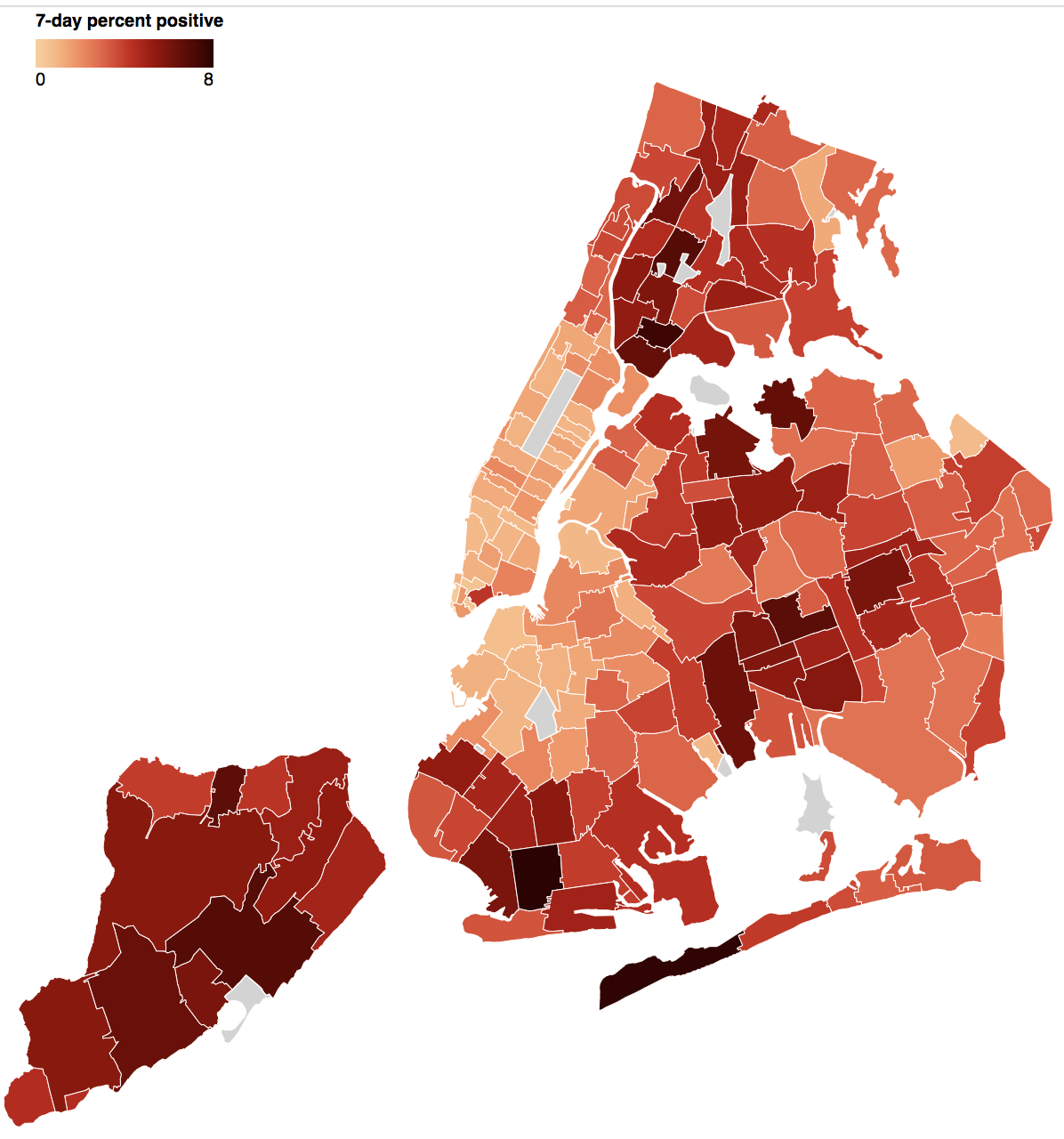
At Thanksgiving my neighborhood was middle of the pack in the Bronx as far as test positivity – around 3-4%. Today the middle of the pack in the Bronx is over 6%. My neighborhood is at 8.6%. Brooklyn’s at 5.5% Manhattan’s at 3.0%. Queens at 6.0%. And Staten Island at 8.9%. (actually, these are moving averages from 4 – 10 days ago. To find out today’s rate, I’ll need to check in 4-5 days).
There were 4000 COVID positives in New York City yesterday. Before I go further, a joke:
The Lord Chancellor frantically alerts the English King (English so that I don’t have to translate the story) – “sire, the French are invading!” The King asks “How many knights do I have in my kingdom?” “Three thousand nine hundred and eighty-five sire” “Round them up!” “Four thousand, sire”
Yesterday there were 3985 COVID positives in New York City.
Where I am pulling numbers from?
Indirectly much of this comes from the COVID-19 Dashboard by the Center for Systems Science and Engineering at Johns Hopkins University which clearly is doing a great job. But I have trouble figuring out what I want from there. And for NYC, the source makes more sense. So here are the websites I consult daily:
NYC Health Department of Health COVID-19: Data page. I keep it set at the default (Latest), scroll down to the “Percent Positive and Test Rate of Molecular Testing by ZIP Code” and I look at the map (that comes up first, but also at the table, and at the “By Borough” which gives graphs of positivity rates over time.
I go each morning to a page NPR maintains – Coronavirus Is Surging: How Severe Is Your State’s Outbreak? – and scroll down to a big old honeycombed map of the US. I scroll over each state and see what the latest case rates are. These are those numbers “out of 100,000.” Apples to apples, and the numbers move slowly over time. The data comes from the Johns Hopkins site, but nicely packaged and easier to access.
Finally, I go to the good old World-o-Meter, go straight to the World-o-Meter New York State page, click “yesterday” (because that data is complete) and sort by “new cases.” That brings the five boroughs to the top, which is how I found 3985 for yesterday, which is like 10 times higher than not all that long ago.
I may follow up and explain how I read these sites (some of which is straight-forward, but some of which is not).
Going to UFT Meetings
There are people with perfect attendance and that’s not me, but I do like going to union meetings, and my attendance is pretty good.
There are four different kinds of United Federation of Teachers meetings I attend. And all of them have changed during the pandemic.
DR Meetings
At my DR’s meetings we have a small group. It’s possible to have real discussion. And when I have very specific issues in my school, I can have a private conversation and get answers. Chapter Leaders meet each other, socialize. Eat. Sometimes we have similar problems. And when the DR makes a point, CLs can give specific examples, reinforce the point, clarify.
During the pandemic the DR meetings have become less rich. Losing the food hurts. Forget the line that food brings people to meetings – it’s true – but it’s the wrong people. Losing food hurts because the quality of conversation over food is generally higher. People focus better, listen better. Losing the social aspect hurts. I talk with who I sit with. And on a zoom? I am on my couch. Is it possible to get specific questions answered? Yes, but… not really in the flow of the meeting. I am better off sending an email or placing a phone call. And chapter leaders do not hear each other.
In August, when there was strike talk, large meetings were organized. They were on zoom. People talked. Communicated in the chat. I think the UFT leadership hated those meetings. Hated hearing voices that disagreed with them. This was not regular opposition people (who are actually fairly disciplined, and follow meeting rules) – but regular members who blurted stuff out. I think, as a result, many UFT meetings switched to no-chat options. My DR did. I don’t know if it was his decision, or if it was an instruction from the borough or 52 Broadway.
So at my DR meetings now, I see who else is there (unless they are on with a phone number). And we can chat via text during the meeting. And he does take questions from members.
Chapter Meetings
My meetings are different. I hold chapter meetings about once a month. The pandemic has, in a strange way, been good for Chapter Meetings. Attendance in normal times is 60-80%. During COVID it’s been more like 75-100%. Almost everyone talks. Everyone is heard. During key moments – for example when we were trying to agree on a reopening plan and trying to get the principal to agree to an exception – almost everyone has participated, actively, with an understanding that we would reach broad consensus before making major decisions – in other words, we heard all the voices, and those voices mattered. I miss the Entemann’s, but the chit chat still happens, the chat is active, and chapter meetings still feel quite social.
Delegate Assembly
The Delegate Assemblies are a different matter. In theory they are the highest decision making body of the United Federation of Teachers. In practice they are theater. Generally all decisions have been made in advance. The leadership hates discussion, and will minimize it. Times when delegates speak are tightly time-limited. The question period had been too short, and was made shorter by the leadership planting questions (items that could have gone in the main report) stealing time from actual questions. At several DA’s I have made motions to extend the question period. Resolutions the leadership wants to pass, pass. When they are not high enough on the agenda, they change the order. Opposition resolutions are prevented from being placed on the agenda by carefully controlled votes.
But the Delegate Assemblies are important. The president’s report might be the same report he gave somewhere else the day before, but for many delegates and chapter leaders, it is the first time they are hearing it. Many take diligent notes. In that theater that is the DA the leadership and opposition often gauge how strong the leadership support is, or how much opposition there is on a particular issue. It doesn’t stop Unity from getting exactly what it wants – but it can modify how much they try to get next time.
They also gather a lot of people. I often go to a DA with a list of stuff I’m going to take care of – check up on something that hasn’t been moving, make a request for a speaker, let someone know how something turned out. Other people reach out to me. When I blogged more, I was often approached by individuals from the leadership who were concerned about the accuracy of something I had written, or who wanted to make sure I knew that an issue I had raised was being addressed, or totally the DoE’s fault.
And socially, they are interesting. People meet. They chat. They talk. Some sit and make snarky comments.
The food’s nothing special – a piece of fruit. But it goes. It usually gets finished.
The pandemic has really changed the Delegate Assemblies. They are via phone. There is no one to chat with, there are no union officers or employees to conduct business with, you can’t sit with your Rep. But I am in touch with people via text and twitter and facebook, and it’s not like being 100% alone. The question period has been extended. That’s positive. And there are fewer planted questions. Also positive. But I wonder, and most of us wonder, if the questions are being screened. Losing the pear? That wasn’t a meal. But there is no opportunity to amend (they’ve revised the rules of order) – and amendments were where quite a bit of interesting stuff happened (not always from the opposition, which tends to put up entirely different motions. Discussion is still limited. Last DA I was victimized by Mulgrew’s filibuster. Weird. I had no idea he felt threatened by one chapter leader suggesting blended learning sucks. In June I spoke well and Unity put up a high ranking speaker to remind the delegates not to be swayed by strong rational arguments. And even with restricting how much they have to hear from delegates, they dare not stop it entirely. The claim that the Assembly is a democratic body is very important for the union leadership. And for the rest of us, there is a chance of speaking. With the electronic vote totals, you get the actual amount of support/opposition on a given question. And it still is, formally, the highest decision making body. I dare not skip it.
High School Division Meeting
When I first started, John Soldini was HS VP, and there were maybe 100 high schools (and 100 high school chapter leaders) in the UFT. It seemed to me that most of them attended John’s meetings. The high school division concentrates opposition (the reasons for that are complicated, and deserve a separate post, maybe a few, and some serious discussion and input from others). In any case, John’s meetings were boisterous affairs, as he held his own among chapter leaders, half of whom had voted for him, half against him (roughly). Information got out, objections were heard, arguments were had, people ate something, and went home. Tell you what, everyone paid attention.
The high schools got broken up into mini schools, and we got to 200, 300, 400, and now 450 high schools. The break ups had a complex combination of causes, but one reason Unity signed on so hard at first had to do with breaking up concentrations of opposition. Later, as the DoE announced school closure after school closure, the UFT’s Unity leadership made schools fight as a school against closure, rather than fighting closure as policy, for the same reason.
Before this reached its peak Soldini retired and the next guy was a one term place holder, but after him, Unity put in the equivalent of BESE or PROMESA, an insufferable VP, hostile to high schools, who did his best to destroy the division. Meetings were worthless. Attendance plummeted. I recall Chapter Leaders being outnumbered by staff and paid reps at meeting after meeting. Yes, I was one of the few CLs who bothered to regularly show. I remember one, at 52 Broadway, with four Bronx HS chapter leaders, and NONE from any other borough, with maybe 17 people in total. If any of you are reading this, it was me, Alan, Sam, Zulma. Miss you guys.
So when Janella Hinds became VP, even without majority support in the high school division, things had to be better. And she was smart and engaging, and not afraid of conversations, even when people disagreed. It was worth doing work to build the high school meetings. And they did improve. But it was hard to maintain. Rotating half the meetings into the DR meetings in the boroughs was a smart idea. But even I travelled to them less often (I made one in Staten Island. Just once.) Those meetings brought together interesting people – in a large enough meeting for some back and forth, but small enough that people got a chance to talk. There was information. Questions really got answered. Food was ok. Conversations were good. In the last few years, however, I found myself attending fewer.
I went to a pandemic high school meeting yesterday. No food, of course. And chat was disabled, not a surprise. But we could not even see who else was attending. There were several presentations… and while there was an opportunity to ask a question IN WRITING there was none to speak, none to engage with each other. I tried texting people who I thought might be there. They hadn’t joined, or they left in boredom.
We listened as panelists spoke to each other. They spoke about virtual content and virtual content specialists. I did learn how central Blended Learning is to what the UFT is doing today. The Mayor announced he wants more kids 5 days in person, and keep others remote, and fewer blended. Even the writer for the Times wrote this week that shuffling between in person and remote was awkward. But at the UFT HS meeting no one who was allowed to speak was drawing back from blended; they were doubling down. Perhaps my suspicion is not correct, maybe the UFT leadership did not propose blended to the DoE back in May or June. But in any case, they are 100% on board today, more than Tweed is. More than City Hall is.
I should have signed off. But I was in the kitchen cooking, and did not want to miss if the webinar turned into a meeting. “We’ve heard what you said” “We would like to engage in conversation” and “We want to talk to all of you” were phrases, addressed without irony, at an entirely muted audience.
It felt like being a captive audience for an infomercial. I waited until the end. And then I felt dirty for having been there.
Stunningly Oblivious
On Thursday, November 19, all school buildings (NYC public schools) were closed.
Today, December 7, New York City elementary schools buildings are reopening.
This is not because the situation has gotten better. It has gotten worse. Much worse. There is a huge wave of COVID moving across the United States. The case rate in NYC was 3% when buildings closed. The case rate today is over 5%. Hospitals across the country are reaching capacity. Cities, states, regions are bracing for shutdowns. Indoor gatherings are being restricted. Outdoor gatherings are being restricted. New Jersey yesterday imposed a 25-person maximum on outdoor gatherings.
Not everyone is reacting with proper concern. Many Trump supporters are refusing social distancing and masks. In NYC a bar owner was arrested yesterday, not for flouting public safety (which he had done) but for trying to run down a deputy who was enforcing COVID restrictions. And there are some restrictions in place. But more are needed in New York State. And Andrew Cuomo has dithered. As the surge begins he has avoided updating the state’s color zones. And in NYC Carranza, de Blasio, and Mulgrew are sending children and staff back into schools.
We know that the virus spreads in schools. Masks, conduct, ppe can mitigate that spread, but they cannot stop it. I know in my school, in March, one room where a significant number congregated, and several became infected. With more care we can slow the spread. We cannot stop it. Testing is a mitigation measure, not a prevention measure.
But why gather large groups in the first place? They are not bringing school back. Less than a third of students want to attend in person under current conditions (most choose remote learning), and of that 30%, only about a third came in each day before the 11/19 shutdown. That’s 100,000 out of 1,100,000 – Will they magically get the numbers to be better?
Perhaps they will get shorter rotations, with more schools on a daily or every other day schedule (rather than every other or every third). So 50% of the eligible kids. But half the system (6-12) stays remote. And only 30% are opting for this hash anyhow. Someone should get Tweed to release attendance, but today’s insanity probably brought 70,000 or so children into buildings. We should get the real number. That is maybe 6% of NYC’s school children. Over 90% of our learning and teaching continues to occur on-line, where there is little planning resource being devoted, little media attention, and no COVID spread.
I watched Mulgrew’s press conference this morning.
You would have thought that they had a safe way to reopen all of NYC schools full time. They have a way to bring in one out of every 15 children.
You would have thought there was a cure. They have measures to mitigate the spread.
And you would have thought that we were about to, nationally, take control of the situation. That will come, but in this moment we are facing a rising wave, propelled forward by Thanksgiving gatherings, and about to be accelerated by Christmas gatherings.
Opening schools now? Stunningly oblivious.
Mulgrew Didn’t Do It
Two weeks ago Bill de Blasio announced New York City schools would be moving to all-remote. A strange story has developed. It is not true
Here is the false narrative: The schools should not have been closed; the schools should reopen; 3% is too low a trigger to close schools; and Mulgrew and the United Federation of Teachers are to blame.
The most prominent proponents of this myth are Andrew Cuomo and The New York Times. And it is a myth. False.
When Mulgrew heard the news he was flummoxed. Astonished. Flabbergasted. Taken aback. The UFT, he said, had fought hard to OPEN the schools. The report that the UFT had set an artificially low trigger for closure, he said, was not true. That 3%? That was the Mayor’s. And, for good measure, Mulgrew added that he would be happier with the Governor’s zone approach (true) and that he himself had suggested that approach in the summer (possibly true. Sounds familiar. I can’t find it in writing.)
But Mulgrew’s short answer: what The New York Times were claiming – false. He didn’t say Cuomo was wrong, because he doesn’t say that, but we know. And I can confirm that Mulgrew was correct.
– – — — —– ——– ————- ——————— ————- ——– —– — — – –
The spring was miserable for students and teachers. The teaching was not even close to what we do in person. And it was really hard on everyone. We were exhausted. We were suffering from all the screen time. We wanted nothing more than to return to our classrooms. And I was eager to help plan for the return.
When social distancing and space numbers came out, I wanted to help. And I worked on the numbers. And I talked to people. And I realized, nope. Not in NYC, not with these numbers of students, not with such limited space. And, importantly, not with the people we have at the top doing the planning without input from people who are capable of planning (who are not the people at the top).
By early summer I was advocating a remote opening. The City’s blended plans were nuts. (I was predicting they would lead to chaotic situations in the schools – that did not transpire, mostly because, and I did not foresee this, the huge majority of parents refused to send their kids into the buildings). But it wasn’t just the chaos. The blended plans were disorganized. They would disrupt instruction.
I called and organized. Discussed. Met. Blogged. I was fighting, every step of the way, against de Blasio and Carranza.
At first I didn’t get what was going on with the UFT leadership. Mulgrew began every meeting by saying “the numbers” “New York City” “safety” “we have an obligation to open”
With time it became apparent. I was fighting every step of the way against de Blasio and Carranza. And Mulgrew. There had been, formally or informally I do not know which, an agreement. Blended learning, I heard whispers, had been initially a UFT proposal to the DoE.
When we tried to get the union to release members’ opinions – some sort of feedback – some sort of survey – nothing. They didn’t want it. They had already made their minds up.
When the intractable problem of lunch arose we got a note – written in UFT Teachers Center language, explaining how “instructional lunch” was cool.
When the DoE flubbed ventilation checks (and allowed its inspectors to talk to principals) the UFT stepped in. The UFT sent in inspectors – not safety folks, but caucus members. They were instructed not to talk to folks in the schools, inclusing chapter leaders. And they filled in, often partially, some checklist, but they did not declare rooms fit or not fit to be used.
As July rolled into August members were getting edgier. There were more obvious problems in the “plans” and more obvious gaps in safety. The leadership preferred talking about safety, set some relatively low bars (eg. ppe must be delivered) and began some strike talk (which did not go well).
Mulgrew was doing what he could to handle member restiveness. And the focus on safety (where changes could happen) made a lot more sense for him than on school planning and organizing (which, constrained by “blended learning”, was irreparable.)
And during that focus on safety, de Blasio offered up the 3%. That’s a tighter trigger than anywhere else in the state. It was a gift to Mulgrew, to help him quell member unrest. And it helped a little.
– – — — —– ——– ————- ——————— ————- ——– —– — — – –
Michael Mulgrew has been working tirelessly since at least June to open New York City school buildings.
He has ignored contrary advice. He has avoided soliciting opinions from union members.
He has “explained” questionable City policies such as “instructional lunch” and “blended learning” – and may have even proposed them to the Department of Education.
When the DoE revealed its incompetence (ventilation checks) Mulgrew put his apparatus to work to give the appearance that schools were being inspected.
And yes, when de Blasio proposed 3%, Mulgrew gladly accepted it – because it made it easier to sell a September reopening to a suspicious membership.
– – — — —– ——– ————- ——————— ————- ——– —– — — – –
But when The NY Times and the NY Governor accuse Mulgrew of sabotaging reopening by insisting on a 3% threshold? They are being willfully dishonest. Mulgrew has put reopening before all else – a fact which leaves many members concerned.

In a twist, de Blasio’s latest screw-up is not his worst
Over the last nine months Bill de Blasio has gotten a lot wrong. Almost every announcement has been late, off-base, and off kilter. He kept schools open when they should have been closed, he canceled break when students and teachers needed it, he announced policies without consulting teachers, families, principals, he came up with half-assed “models,” he insisted schools were opening on time, he announced without notice that opening was delayed a few weeks… His pattern – late, without consultation, lacking details, winging it, and – for the most part – wrong, without careful consideration, without real planning, without forethought.
That makes today’s announcement at least a little different. There were a couple of elements that were not completely wrong.
- Elementary schools come back 12/7. D75 comes back 12/10.
So, those dates are arbitrary. And maybe 3% was a low trigger, maybe not, but all the precents are higher today, and rising. My neighborhood, middle of the pack, is at 4.5%. My school’s neighborhood is over 6%. Announcing return dates now is – I don’t know. Really dumb? But it’s political. He got scolded by the governor and the Times’ education writer, and he’s showing them – full stop. Instead of making the best decisions for our schools, families, teachers, students, he’s showing them. Really dumb.
- High schools and middle schools are not coming back for now.
Ok, so that is more interesting. Treating different grades differently is something that needed to be considered. I am not taking credit, many people have talked about this, and it’s been done in other countries. But I mentioned it in these pages back in June and July. That’s when it should have been thrown out – not as a directive by fiat, but for discussion by schools and school communities, by families, by teachers, by the union.
There are tricky issues here – equity among families, equity among teachers. In July we could have thrashed them out, talked them through. Now? No discussion, just imposed.
Also, and this is obvious, we are looking in our rear view mirrors at wasted planning time, wasted scheduling time. Organizing schools for remote would have been far easier than what we were forced to do. And the best schedule for remote would NOT have been the same as the schedule we ended up using for blended in many cases. However, when I asked in the programmers group, most programmers (and this is a pretty with-it group) had at least built in a parallel remote schedule, so that when the switch came (and most of us thought it would) we were ready.
There is another kind of wasted planning time: pedagogical planning. Working to organize a solid remote class is different than working on blended. And it is not just methods and content. We need to tailor our teaching to appropriate amounts of screen time. We could have, we should have spent the summer preparing for all-remote, and the fall refining it.
- In person school gets converted from blended to full-time, as possible.
For most classes, for most students, for most teachers, blended sucks. It is far worse than in-person. And it is worse than remote. So a proposal to drop blended, that’s good, right?
In fact, didn’t I just propose something similar? Less than two weeks ago I wrote a resolution, submitted it, waited my turn, and listened as Mulgrew wasted a few minutes to prevent it from being discussed. What was the key part?
Be it further resolved that the United Federation of Teachers will explore models other than “blended learning” for our schools, including fully in person for certain groups of students and fully remote for all others, and also including fully remote for everyone
Remote for all. Or remote for most, fully in-person for some. Isn’t that what the mayor just proposed?
I proposed “exploring” possibilities – implying that those involved would be part of the discussion. That’s, apparently, not the mayor’s way.
What happens when you act impulsively, make decisions without planning? In this case, two problems emerge:
- You confuse people. His message did not say “since so few kids opted for in person school, we think we can move some schools from two cohorts to one cohort and have that cohort in every day while maintaining social distancing” etc. Notice how poorly he explains himself (from 3:15 – 3:55 in this Youtube).
- You create gross unfairness and inequity. Five day a week instruction was not on the table this summer when parents chose whether to send kids in or not. Five day a week instruction was not on the table earlier this month when parents chose whether to opt back in. Parents said yes or no, mostly no, to the blended nonsense that de Blasio could not peddle. And now, out of spite, or out of carelessness, de Blasio is taking parents’ – and let’s be clear, mostly Black and Brown parents’ – sensible rejection of blended learning, and saying since you wouldn’t sign up for his blended mishmash, he won’t let you sign up for fully in-person school.
There should have been a process – not rushed – over the summer – where this was worked out. It would have been possible to think about giving families choices. It would have also been possible to think about which grades and which classes should be prioritized.
But fairness and equity go out the window when the mayor responds to political pressure instead of prioritizing the needs of students, teachers, and schools. His plans probably won’t be implemented, but that’s because of the COVID numbers. That’s not a silver lining.
Should we talk about blended learning? Some in the UFT do not think so
I submitted a resolution to this month’s Delegate Assembly – to move away from Blended Learning. I am attaching the text at the bottom. I submitted as late as possible – five minutes before the deadline – assuming that I would be #14 on the list and it would not come up. I was a bit surprised – there were only two submissions. The Stop Blended Learning reso would come up.
However, with today’s closure, no one is teaching blended tomorrow. And the agenda included a dozen resolutions, and #1 and #12 I really want to vote on (#1, Black Lives Matter, has already passed).
So I was prepared to withdraw the resolution for today. I drafted what I would say:
Jonathan Halabi, Chapter Leader, High School of American Studies at Lehman College. – bear with me for a moment. We really do need to talk about blended learning. All of our members need to be part of that conversation. But we have a dozen important resolutions coming up; I want to get to them all. And, with today’s announcement, no one is teaching “blended” tomorrow. Michael, I’m not making a motion today. Let’s move the agenda.
But I didn’t get a chance to graciously withdraw the reso. The leadership of the United Federation of Teachers filibustered. Mulgrew dragged out the first motion, and added three minutes of commentary after, until the motion period had run out. I cannot recall another time when they killed so much time that only one motion came up during the ten minute motion period. Why is the UFT Leadership unwilling to discuss “blended learning”? We really do need to talk about it. There could have been honest disagreement in July. But today we have experience, and we should be discussing that experience (and probably concluding that “blended” is the worst option for most students, teachers, classes, and schools.
A Call to End Blended Learning
Whereas the pandemic has caused a crisis in our schools, and
Whereas it was incumbent upon New York City to examine ways to open schools, and
Whereas New York City attempted to implement “blended learning” and
Whereas “blended learning” has not proved to be a viable model for most of our students and schools;
Therefore be it resolved that the United Federation of Teachers recognizes that “Blended Learning” has not worked and will communicate this understanding to our partners in the New York City Department of Educaiton and
Be it further resolved that the United Federation of Teachers will explore models other than “blended learning” for our schools, including fully in person for certain groups of students and fully remote for all others, and also including fully remote for everyone, and
Be it further resolved that the United Federation of Teachers will negotiate with the Department of Education to implement models other than “blended learning” in our schools.
Black Lives Matter / United Federation of Teachers Resolution
Thanks to Arthur Goldstein for sharing this in advance.
Delegates and Chapter Leaders should always, where feasible, receive resolutions, memoranda, etc in advance of a vote. I’m not sure why this does not always happen. Perhaps our leaders are used to dealing with members of their political caucus, Unity, whose members always vote as they are told, and don’t need to see the documents. But perhaps the resolutions for tomorrow’s Delegate Assembly will be sent out early enough in advance (this afternoon or evening?) for us to have a chance to read them before being asked to vote.
In any case, this is a good resolution. I will support it. I am especially interested in the five points at the end:
- End Zero Tolerance discipline in schools
- Mandate Black and Ethnic Studies in schools
- Hire more Black educators
- Fund more counselors, social workers, and mental health specialists
- Fully integrate our schools with proper and equitable funding for librarians, PSAL sports, and access to technology.
Each of them addresses something that is really necessary today. I am glad to see #3 – not enough of us are aware how Bloomberg/Klein’s policies targeted Black educators, and shifted hiring away from Black educators. My school is working on #2 right now. And frankly, I would put #4 higher on the list. And am I reading 5 correctly, it calls, among other things, for integrating our schools? Wow, completely needed.
Black Lives Matter resolution
WHEREAS, the United Federation of Teachers reaffirms Black Lives Matter, and
WHEREAS, the statement Black Lives Matter means that until people of African descent are treated with dignity, humanity, and respect in all areas of our society and the barriers to their safety and health and full participation in the economy and wealth creation are dismantled, all lives do not matter, and
WHEREAS, our work is grounded in the fight for fairness so that every person we serve achieves their highest good, and
WHEREAS, throughout our history, our union has demonstrated that belief, time and time again, through our collaboration with and support for local and national organizations working toward the equity, access, and empowerment of every student and family we serve, and
WHEREAS, representation of and participation in heterogeneous communities allow each of us to grow in our understanding of the human condition and establish our role in the improvement of our society, and
WHEREAS, anti-Black police violence continues to take place in the United States without accountability; and
WHEREAS New York City represents nearly 60% of NY state’s total population of Black students, and
WHEREAS, we recognize that our students are harmed in our schools as the result of ongoing systemic problems, including segregation, funding disparities, and lack of equal access to academic, artistic, professional and cultural opportunities, and
WHEREAS, we know that these systemic barriers consistently, disproportionately impact Black students; and
WHEREAS, the UFT supports culturally responsive educational practices, including but not limited to, efforts to diversify New York City’s educational staff so that it more closely reflects its student population, and the expansion of Black studies as well as Asian, Latinx, Native American studies programs and LGBTQ history in our Pre-K-12 classrooms, and
WHEREAS, the UFT has supported recruitment, training and retention initiatives including, but not limited to, NYC Men Teach, the NYC Teaching Fellows, the Success via Apprenticeship Program, Today’s Students, Tomorrow’s Teachers, and the Young Men’s Initiative; and
WHEREAS, we are personally and professionally committed to the health and well-being of every student and staff member in our schools; therefore, be it
RESOLVED, the UFT reaffirms our commitment to policies, initiatives and movements that promote respect for and inclusion of Black students and educators and move affirmatively to make it a reality, and, be it further
RESOLVED, that the UFT continues to urge its members to amplify our demand for justice, change and equity by supporting Black Lives Matter at School Week of Action scheduled for February 2021 and other activities in the schools throughout the year and, be it further
RESOLVED, that the UFT will bring the 13 Guiding Principles of the Black Lives Matter Movement* to the entire school year by participating in and sharing resources from the National Black Lives Matter at School Steering Committee’s new initiative, its Year of Purpose; and be it further
RESOLVED, that the UFT will join annually with the AFT, NEA and NYSUT and proactively encourage its members to invest in critical reflection and honest conversation in school communities, for people of all ages to engage with issues of racial justice; and be it further
RESOLVED, that the UFT will call for members to: participate in the planning of community forums and the creation and implementation of age-appropriate Pre-K-12 curricular resources; utilize the Culturally Responsive-Sustaining Education Framework (CRSE); and initiate school and community discussions around the actions needed to affirm racial justice; and be it further
RESOLVED, that the UFT continues to recruit, develop and retain a membership that reflects the demographics of the city in which we work and, be it further
RESOLVED, that the UFT will call for members to: use tools such as the AFT “Share My Lesson” website, including titles such as, Teaching About Bias, Diversity and Social Justice; exchange lesson ideas, instructional materials and resources about these socially relevant topics with one another; use the tools of the NYSUT Civil and Human Rights Committee and of the BLM at School Curriculum at www.blacklivesmatteratschool.com (in the public domain); and share resources from Teaching Tolerance, NEA Ed Justice during Black History Month and beyond, and be it further
RESOLVED, that the UFT reaffirms its past, present and future commitment to providing inclusive educational opportunities including, but not limited to scholarships, community partnerships and events that support the advancement of students of color, and be it further
RESOLVED, that the UFT seeks reapportionment of city and state funds to bring resources into Black communities to foster self-determination and awareness through education, entrepreneurship, home ownership and the means to reverse generational economic disparities and, be it further
RESOLVED, that the UFT proactively engage in the necessary work to dismantle inequities in our systems through its coalition partners so that our students and families have access to employment, affordable housing and quality healthcare and, be it further
RESOLVED, that the UFT will continue to work with local, state and federal elected officials to secure permanent housing for our homeless students and students in temporary housing, and be it further
RESOLVED, the UFT stands in solidarity with Black students and educators as well as all communities of conscience, in the struggle for a more supportive, equitable and fair school system and society, and be it further
RESOLVED, that the UFT will commit to making demands along with student groups such as IntegrateNYC and Teens Take Charge and call on the NYC Department of Education and City Council to work towards undoing systemic racism and in so doing to:
- End Zero Tolerance discipline in schools
- Mandate Black and Ethnic Studies in schools
- Hire more Black educators
- Fund more counselors, social workers, and mental health specialists
- Fully integrate our schools with proper and equitable funding for librarians, PSAL sports, and access to technology.
When we return from remote…
Will New York City public schools switch to all remote? Wrong question. First of all, it’s not “will we go remote?”, but “when will we go remote?”. But that’s not the right question either.
When we return from all-remote, how will we return? Because blended learning sucks. There’s the question. In the real universe, in person regular school is best. Remote is bad. But blended is the worst.
Already there are schools that have made their instruction remote, and do academic, emotional and social support in school. There are other schools where students come into the building, and sign onto zoom classes. There are other schools which are blended in name only, where instruction only happens when the kids come to the building. And then there are schools where the teachers are assigned to teach in person AND remote. Many of those teachers will burn out.
Blended, the way Carranza and de Blasio defined it, and the way Mulgrew pitched it, is not the reality in most NYC schools. Didn’t make sense. Couldn’t be.
The hand off between two teachers per class was unrealistic. The erratic in school / out of school schedule is problematic. Curricula were not redesigned for this strange modality. And the agreement to almost double class size for blended remote was ridiculous.
What other options do we have? My question is about what happens when the positive rate in NYC drops back down.
Short version:
- Expand the RECs
- Banish Blended. Bring some students in full time. Teach the rest fully remotely.
- Real PD, practitioner-led, for remote teaching.
- Lower class size
- Adjust curricula. Adapt curricula.
- Expand prep time.
- Go easy on the kids.
- Suspend standardized testing.
- Expand the Regional Education Centers. “Staffed by DOE employees and community-based organization partners, the centers provide children with three daily hot meals, remote learning time with their teachers, and activities like art, music, and physical education, as well as social and emotional support.” The RECs do not replace school. But the REC centers provide social and emotional support. They provide social interaction. And they free up schools, during this dangerous time, to focus on teaching.
- Banish Blended. Didn’t work. Instead of giving 100% of our students (actually more like 28%?) a bizarro part in-school part at-home experience, let’s create something that comes much closer to normal for our students with greatest need (based on age, ability, or academics), and focus on doing the best we can with remote for the rest.
- Return to regular, in person, daily learning for select schools, grades, or groups of students. This will involve a lot of staff, because social distancing demands the groups stay small. Prioritize younger grades and groups of students who most need regular instruction.
- Keep entire grades and schools fully remote. The schools already doing this are reporting that fully remote works far better than blended.
- Develop real PD for remote teaching. That means teachers who are actually teaching sharing best practices. Some schools have done a good job with this. But Carranza is not chancellor of some schools, he is chancellor of NYC public schools, and he is responsible for ALL of them. That means a mandate for real remote PD, teacher led, across school lines (by District, Affinity Group, Borough, Content Area, Grade, etc). It’s so frustrating that we did not use our time in June for this, or at the start of September. But Carranza needs to create the time.
- Return remote class sizes to DoE limits. Better, lower them to 24 across the board, so that a full class (plus teacher) fits on a small zoom screen.
- Recognize how hard remote school is on students. Set reasonable screen time expectations and workload expectations.
- Recognize how hard remote school is on teachers. Expand preparation time. Minimize non-teaching responsibilities.
- Recognize that teachers cannot teach as much, students cannot learn as much, in a remote setting as in a regular setting (both of which, by the way, are better than blended).
- Clarify that this year we are not teaching to tests. If teachers are held responsible for standardized test scores this year, they will be forced to press too much work on their students.
- The DoE should suspend test-based components of teacher evaluation for this school year.
- The DoE should advocate for the Regents to announce that 3 – 8 testing is suspended for the year, now. The Regents are likely to get around to it, but by not making the announcement early, they put unfair curricular pressure on students and teachers.
- The DoE should advocate for the Regents to announce that June Regents are suspended for the year, now. The Regents are likely to get around to it, but by not making the announcement early, they put unfair curricular pressure on students and teachers.
- Get the College Board out of our schools, and let them take their AP exams, which they will once again make last minute changes to, and once again flub the administration of, with them. (Failing that, the NYC DoE should bill the College Board for administrative costs associated with registering students for the exams and supporting exam administration.)
There’s a question that’s bothering me. Where did blended come from in the first place? The DoE insiders I talk with have insisted that “blended” was not a DoE proposal, but that it came directly from the UFT leadership. They’ve certainly stubbornly defended it. I’d love to hear directly from the UFT leadership.
de Blasio’s Friday the 13th Problem
Wind the clock back eight months. Friday the 13th. Of March. Bill de Blasio, bluster and fury but no conviction, insists that schools are staying open. It was the wrong decision (soon to be reversed). And, because it was last minute, with a last minute reversal, disruptive. The time for planning was harried and disorganized, and our schools suffered all spring as a result.
Today. Friday the 13th. He’s really still mayor? Parents and teachers and schools should “be prepared” to go remote for a short period of time.
We just finished, by the way parent-teacher conferences. Which came after “Fall Fest” activities (mostly remote) for our students. That was today. November 13. Friday.
Thinking back, our last parent-teacher conferences came after our last “Spring Fest” activities (in person). That was March 13. Friday.
I’m not complaining about moving to fully remote. I think it is necessary. I am complaining about last-minute decisions. I am complaining about the mayor’s lack of planning, and the negative effect that lack of planning has on schools, students, teachers.
I’m also repeating – none of this was necessary. Many of us, probably most of us, knew that the “blended learning” models were a mess. We knew that safety would be an issue. Some of us knew that the quarantining and spread around the Thanksgiving Holiday would be insurmountable.
Blended learning is disruptive. Shifting between in person and remote is disruptive. We need less disruption. We need careful planning. We need a mayor who plans.
And we need to move to remote – Monday sounds good. And we need to stay there until things are actually safe.
What a Lovely Day
The sun is shining. People are in good moods, for obvious reason. The leaves are still on the trees, but in an array of greens, yellows, oranges, reds…
When we go to school tomorrow (many of us) the windows will be open, allowing the lovely New York City air to fill our rooms, replacing the air we exhale…
If someone is spreading the virus, it gets into the air, attached to droplets and aerosols and all those technical things that really just mean “floating bits of virus.” Now, just because it is present, that doesn’t mean you get sick. That depends, at least partly, on how much is present, and how long it hangs around.
That’s where the lovely weather comes in. Open your windows, and a small difference between pressure inside and outside will move the air. The more times each hour you get a fresh batch of outside air replacing the air you and your students have exhaled, the safer you are.
You are also on the safer side if the number of people in the room with you is low. I hear that only a quarter of NYC students are physically attending school – the majority are learning on-line. And even those quarter – they don’t come every day. They might come every other, or every third, or less. That puts our schools daily somewhere under 10% of capacity – which is pretty good for limiting the spread of the virus.
You can also filter the air. Not really “you” – the school can. But the filters would need to be HEPA or MERV-16, or at least MERV-13 to get the virus out. It sounds like most schools don’t have these. And the schools that do, most have them attached to their air-conditioning systems. But not the heating systems.
It is a lovely day today. Today we do not need to worry about what is about to happen to our classrooms. But we should. In the next two weeks we might have consistently nice weather. We might get lucky. But that luck will not hold for all of November and all of December. It will get cold. AC has already shut down, and heating systems will rev up, and circulate un-filtered air throughout our buildings, including your classroom.
What do we do when it is too cold to open the windows, but too dangerous not to?
Where is the plan?
For his part, de blasio is trying to increase in-person attendance, and increase the risk. Being mayor makes him in charge, it does not make him smart. And Carranza does what he’s told.
There has been a lot of time for the ventilation and filtration systems to be installed. If they have not, then the building is not safe to occupy when it gets too cold to open windows.
We need to rely on the UFT – even though the leadership seems heavily invested in keeping buildings open. If you will have a ventilation problem when the heat gets turned on – bring it to the Chapter Leader, have them escalate the issue within the union. Remind them they have an obligation to keep our students and their members safe. Remind them that even before Labor Day they knew:
“For most schools, maximizing outside air intake and eliminating recirculating air is a short term solution until winter, but with the mild outside weather now it is achievable and needed until the remainder of the MERV-13 filter shipment arrives.”
How Many Kids are Attending NYC Public Schools?
Should be an easy question. How many kids are in school? Turns out, schools have been “open” for a month, and no one seemed to know how many kids were in them.
Open? Well, in this weird blended/staggered way, with most instruction taking place through Zoom. That includes kids who opted to stay home all the time. Kids who come in every other, every third, or every nth day, and receive half, two-thirds, or n-minus-one nths of their instruction remotely. And kids who come to school, go sit in a room, and log onto their classes.
But the mayor and the leaders of my union say schools are open… And certainly the buildings are open. And some staff are reporting.
So how many kids? On any given day? NYC public schools have 1.1 million students. But lots have opted for remote. Those who are coming into school are coming in every 2nd day, or every third day, or less frequently than that. And some who are scheduled to come in stay home on any given day.
Two weeks back I took a guess: 50 – 110k.
But now the Mayor has filled in some blanks. In person attendance is 82.9%. And 280,000 students are attending school. We still don’t know how many are on a 2-day cycle, how many 3-day, and how many longer. But at least a third are on 2-day and a third are on 3-day.
That brings us to between 90,000 and 105,000 students in NYC school buildings each day. That’s between 8% and 9.5%. When people in charge note that the virus is not spreading in NYC public schools, they don’t mention that the buildings are under 10% of capacity.
Being elected Mayor, or anything else, gives someone an office. It doesn’t confer superior intelligence.
– – — — —– ——– ————- ——– —– — — – –
Apologies for the pause in posting. I’ve been exhausted by the world, by the country, by my city, and by my union.
Quarantined and Disrupted
Glanced down at my phone to see who was texting. Today. Middle of the day. It was a former student. Now a teacher herself. Middle school. Why was she texting from work? She’s teaching in person. The text cleared things up.
Quarantined
She was unceremoniously sent home, to quarantine. One of her students is positive.
Disrupted
So she’s already been tested, and with some luck will be negative. But the teacher is home. Class moves to fully remote. They are disrupted. But is this a surprise? They were already doing some weird “in one day, out the next” kind of thing. Maybe every third day? I should ask. And there was weird recorded lessons, or live stream… I don’t know the details. But the class was already disrupted.
Every class in the city has already been disrupted. At best – at best – classes are 50% in person. Every third day is more common than every other day, and there are schools on less frequent rotations than that. Each school is different.
Little side note: this does not mean that each school chose what it thought was best. The DoE’s insistence on a full rotation with daily instruction outside of as well as inside of school, and the UFT’s insistence on “blended learning” straight-jacketed most schools. Some were able to go through the necessary hoops to get “exceptions” accepted – but remember how the first schools that decided they wanted to go remote were shot down? The schools chose, unless the Chancellor wanted them to choose something else.
As September passed, a new disruption developed: many schools offer in building instruction – via the internet. Students, mostly in some high schools, come to school, open a lap top, and zoom into their classes. At least they get a consistent daily experience. Bizarre, but consistent.
Who cares about educational disruption?
The Mayor, the Chancellor, and the UFT President have been focused on getting students and teachers into school buildings. There has not been any serious discussion of how education looks when a child gets to every third class, or has two teachers who may not be talking. I’ve yet to hear of any PD for teachers on how to keep the three parts of a class on the same page, when they are coming different days for the “in-person” lesson.
A fully remote program would be far less disruptive. But the Mayor, the Chancellor, and the UFT President have been focused on getting students and teachers into school buildings.
Maybe the Disruption is Not So Bad (math time)
There’s about 1.1 million students in NYC. About half have moved to fully remote. That leaves 550,000. Some schools are on a 2-day rotation, more are on a 3-day rotation. There are others on 4 or more. Call the average 3. That brings us to about 180,000 students each day. 6% of schools have been shut (Red Zone). 170,000. The City has been hiding attendance numbers. I’ve heard that several large schools have gone de facto fully remote. Bronx Science? Stuyvesant? Dozens of kids each day. What’s the real number? 110,000? 80,000? 50,000?
Disruption is disruption. But at 110, or 80, or 50 thousand – we are not talking about Gotham-scale disruption. We are talking about San Diego, Austin, or Wichita scale.
And?
Normally I’d end with a barb. Another day that. Today I just want my student to be ok.
Commutative? Who Studies “Commutative”?
It could come in any grade. It could come up in almost any mathematics course in the United States today. But why? What is “the Commutative Property” and why do we study it? Has everyone always studied it?
I may need some help from the mathematicians who read this blog. Which probably means Joel. Maybe Owen. Back in this blog’s heyday I had literally hordes – maybe 8 or 9 – who peeked in. How far I’ve slipped.
A Little Math (skip ahead)
The real numbers (or, for most of us, “numbers”) are commutative under addition. That means that a + b and b + a have the same value, (assuming a and b are numbers, or, in more technical language, “real numbers”). When people say “The Commutative Property” – and by people I mean People who are not Mathematicians – they mean this fact, which educators label “The Commutative Property of Addition.” They label a similar fact “The Commutative Property of Multiplication,” ie ab = ba. Some teachers also teach students that division and subtraction are not commutative, which is usually fine, but sometimes puzzles children who are still wondering why “five minus seven” is different from “take five from seven.”
There are other properties, and they matter just as much. And they all have longer names, or descriptions, than we remember, or than we usually use. We use shorthand. There’s the Associative Property of Addition for Real Numbers, and the Associative Property of Multiplication for Real Numbers. There’s the Distributive Property of Multiplication over Addition or a(b+c) = ab + ac. There’s a special number called the Additive Identity (that’s just zero) and another called the Multiplicative Identity (that’s just one). And there’s a few more fancy sounding properties for pretty simple ideas like Closure and Zero Product.
Back to Reality
So here I am, last week, teaching kids a bit about matrices. We are multiplying them, and I am stalling. This is a new operation, on a new object. They need more practice multiplying, more fluency, before I introduce what comes next. And instead of assigning all the odd exercises, I decide that I will find interesting things to do that will require some multiplying, and give them some practice. And so I decide that we will decide which properties hold for which operations for matrices.
Those would be two by two matrices with real valued entries, but I’m going to stop right there before I bore the both of you who already know this stuff and make the rest of you’s eyes glaze over. But I also stopped right there for the kids.
The Question
Commutative Property? I ask. Why do we study the Commutative Property?
And the clever answer “so that we know 7 + 3 is the same as 3 + 7” is just so wrong, because little kids who can’t pronounce Commutative (communative?) figure that out on their own. And I ask about the other properties, and the attempts to answer are noble, but universally wrong. They don’t know.
Would they be shocked to know that I have really old math books (1880s – 1930s) on my shelf, and that they do not contain the word “commutative”? No, not shocked, and not properly impressed by my old books. Barbarians. But I flip to the place where the properties should be, and I open the index for the books with them, and, not there.
Getting to the Answer
1960 I tell them. 1960 is roughly the dividing line. I type Спутник on the screen. Even the class without native Russian speakers gets it. Sputnik. Horrified to have been beaten into space by this beeping medicine ball, the United States vowed to close the Space Race by adding the words “Associative” and “Commutative” to every preteen’s vocabulary. And by teaching us basic set theory at a very young age. The New Math. Kids got some fancy vocabulary. I did. By second grade I knew what each one of these symbols {⊂, ⊊, ∩, ∪, ⊄, ∈, ∉} meant. I knew them well. I don’t understand why that didn’t get me a job at NASA. Most of my current students did not recognize any of those symbols. Those who’d seen any of them, it was the curly brackets. Or if they’d seen any of the others, it was one or two, and in 8th grade or later.
We do an etymology detour. Who can correct me? I told them the “S-” in Sputnik is cognate with English “Co-,” that the “-put-” in Sputnik is related to “path” in English, and that the “-nik” means “doer” or “-er” or “person. Thus Sputnik roughly equals “with+path+person” or more naturally, “traveling companion.” If you are good with etymology, I feel shakiest with put~path. Help a fellow out.
One Last Detour
But before I get a chance to ask if Transposition Distributes over Matrix Multiplication, I have students in one class probing further. How could the US catch up in the space race? Wasn’t this “The New Math” thing worth trying? Nope. I don’t think so. The US does just fine going back to its bread and butter when it comes to science and technology – importing scientists. And the kids talked about Operation Paperclip and Werner Von Braun.
The New Math and Werner Von Braun in one discussion? Sounds like a Tom Lehrer playlist. Next week.
Two Geometry Puzzles
I haven’t asked a math question in a long, long time. Not sure if anyone who does them is still reading…
Can a Polygon Be Constructed?
Under what circumstances is it possible, given n ≥ 3 segments, to form a polygon?
Or, if you prefer, under what circumstances, given n ≥ 3 segments, is it not possible to form a polygon?
The segments may be connected in any order.
Can a Quadrilateral, but not a Trapezoid, be Formed?
Are there four segments from which it is possible to construct a quadrilateral, but from which it is not possible to construct a trapezoid?
The segments may be connected in any order.
Lump Sums Delayed, on Average, 4 1/2 months
Thursday, two days ago, Bill de blasio announced NYC would not pay UFT members the lump sum payments owed them on time. Michael Mulgrew announced that the UFT would fight – by going straight to arbitration.
The arbitrator, on Friday, ordered the city to pay half the amount in two weeks (October 31 instead of October 15), and the other half July 1, 2021.
The payment was the last and largest chunk left over from when Bloomberg refused to negotiate fairly with us. When de blasio came in we got a new contract, but some of the money owed us was pushed forward. And instead of being retroactive, it was made into “lump sums” – more about that, later.
This affects members who worked 2009-11. We should be aware that for the many members hired after that, they experienced the events of the last few days as a fight between City leadership and Union leadership, just as they have experienced much of the news from the last seven months. Does anyone know how many in service members have no financial stake in this? I am guessing 40-50%, but I could be wildly off.
In my school only 5 or 6 members are not due a payment – but we are probably not typical. At the other end of the spectrum, members who are paycheck to paycheck, or who had spent the lump sum in advance, or who had upped their TDA without backup, they still will hurt – but now they are looking at making some of that up at the end of the month.
- UFTers are still getting the money owed them. Members were relieved. For most members who were owed money the delay is annoying, but they had worried about not getting paid at all.
- The Mayor sought to unilaterally delay payment. And he succeeded.
- The Mayor sought an indefinite delay. He failed.
- The arbitrator limited the delay, but did not order the City to comply with the contract they had signed. The Mayor got away with violating the contract, without penalty.
One week before that last payout, de blasio announces “…the Department of Education is unable to make a lump sum payment to active and retired UFT employees as had been scheduled for this month…”
- The Mayor did not bother consulting the UFT leadership in advance (I believe). Our union leadership’s overall strategy has been to earn “a seat at the table” – and clearly here, it failed.
A union’s potential strength comes from its ability to unite our members in action. Our leadership, though, thinks that our strength comes from being good at politics and hiring good lawyers. If they were right (they are not) these events would never have unfolded. The best they could do under those circumstances was go the arbitration route – and the limited loss (delayed payment) was the best they could possibly have produced.
Why Lump Sums, not Retroactive Payments?
I want to add a word about retroactive payments. Those would have been payments for all the money each UFT member had earned between the contract’s start date and when the contract was signed (five years?), had they actually been retroactive.
In Mulgrew’s Thursday night video he says “lump sum payment, retro payment, it’s known by different names…” But he knows the right name. It is a lump sum payment.
What’s the difference? If you got fired, you would not get the pay. If you quit, you would not get the pay. If you left service with 30 years in at age 53 (that happens), but did not file for retirement until age 55, you would not get the pay. At least initially, if you moved from a teacher line to a principal line, you would not get the pay. And if you died in service, AFAIK, your family was not entitled to the pay. A final insult for the families of our Covid-19 victims from the Spring. All of these people would have received retroactive pay, had Mulgrew negotiated for retro. He did not.
Why did the UFT leadership bargain for lump sums rather than retroactive payments? Because they could predict firings and discontinuances and resignations. Because actuaries could calculate how many teachers would die before 2020. And every payment so “saved” meant more money for the rest of us. Mulgrew and his lieutenants were trying to put the highest number possible on our increases – even thought the monetary value had already been agreed upon with the City. They were focused on selling the contract, on getting the biggest possible yes vote. They should have focused on the needs of our members, and on fairness.
This is why they backloaded increases. And why they chose lump sums, which eliminated those were fired, who quit, or who died, (and thus would not vote on the contract or in union elections) instead of retroactive payments.
Back in 2014, Mulgrew was clear: “Retro is not a God-given right.” When asked if the families of teachers who die before accumulating the full retro will receive the lump-sum payments, Mulgrew stated “This has always been worked out. Nobody’s looking to hurt a family in distress. We’ll work it out.” This does not appear to have been true.
Robbery in Broad Daylight
Bill de blasio walked up to NYC teachers – on a weekday this time.
Think about that. Through this whole pandemic he has saved his announcements for Friday. After the work day is over. Or over the weekend. He is a coward. Schools closed? Sunday. Vacation lost. Friday. Zoom banned. Friday. Passover and Good Friday stolen? Friday. He skulks in the shadows.
But not this time. He walked right up to us and stole money, in front of the whole world. It is a brazen, daylight robbery. Or at least an attempt. It is Trump-worthy.
Over a decade ago, under that slimeball, Mayor Bloomberg, teachers worked under an expired contract. He wouldn’t negotiate fairly. And we were not going to sign yet another concessionary deal. Teachers were still smarting (and still are) from the massive concessions that Weingarten and her lieutenants made on our behalf in 2005. So when the contract expired in 2009 we kept working….
When Bloomberg left we negotiated with de blasio. In 2014 we completed an ok agreement – the raises started right away, but de blasio complained that he did not have the money in hand to pay the back raises from 2009 – 11. The UFT leadership should have negotiated for full retroactivity. Instead they negotiated a series of precarious “lump sum” payments, with caveats attached. The City paid 1/8 in 2015, 1/8 in 2017, 1/4 in 2018, 1/4 in 2019, and the last quarter was due next week. Hmm, a bit more than that, since interest has been accruing. The last quarter was set to be the biggest quarter.
So now, a week away from the last part of this deal, de blasio says no, he’s not paying us what we worked for, what we are owed, what we unfairly let the city hold onto for a decade.
Why is the coward brave?
- He figures that no one will open the city’s books, and realize that the money is actually there.
- He figures that teachers will look bad demanding money on top of our regular pay. He figures it will look to outsiders like we are demanding a bonus.
- He figures that the world will not realize that this is pay that we earned, long ago, and that teachers were essentially forced to loan back to the City.
- He knows that only about half the current UFTers are due the money.
I wish I believed he had miscalculated.
A facebook friend wrote:
I earned a salary in 2009 and I was only partially paid.
NYC asked if they could pay me later for what I had earned, they asked me to wait until 2020, and I said Ok.Now, I will not get that salary that I earned 11 years ago, ever? Soon? And I’m told only days before? As if I didn’t have bills lined up for it?
Addendum: teachers do not get bonuses when the city is soaring in revenues… asking us to “help” the city when it is below revenue expectations is then inappropriate.
Mulgrew wrote:
Those payments are overdue wages that go back to 2009 and 2010, when then-Mayor Bloomberg refused to grant educators the same wage increases other municipal workers received.
We are entitled to this money, and the city is obligated to make us whole.
Because of a clause we insisted on including in the 2014 contract for just such a possibility, we are taking the city to immediate arbitration. With arbitration, we don’t have to file a grievance or go to court, which could take months or years.
Our hearing before an independent arbitrator is already scheduled for tomorrow. At that hearing, we will demand that the city uphold the agreement it made with us.
Over these last five months, members and delegates and chapter leaders and executive board members have asked Mulgrew about “retro” – and he assured them each time that the money was there and that the payments were not in play. Either he knew and deceived the members, or he didn’t know – but how could he not know?
The right answer: “The money is there, we expect them to make the payment, but we have to be careful with City Hall – we work with them but we never fully trust them” – we did not hear that answer. Why not? Was Mulgrew too busy working with de blasio and Carranza on blended lunch and instructional learning, and did not want to upset them by delivering such a blunt message to the members?
Some points:
- Many of us do not live paycheck to paycheck – but some of us do. And some of us have already spent the money that was due in a few days. Who will help them?
- The union encourages members to up their TDA % for a one time bump from the lump sum payment. Now those people who listened will not only not get their lump sum, but they will get a huge chunk of their pay taken out – it is too late to fix this. Who will help them?
- The City has been wasting money 30 different ways over these last few months. Overpaid managers. Silly contracts. Hiring non-essential staff.
- Police are an issue. The City paid massive NYPD overtime to police peaceful protests. There has been no defunding of the police – there has been a huge increase in police funding.
- The City knew about financial problems in May. Or June? They got worse with no stimulus package. But whatever the date, they could have approached the UFT. A few months in advance. A month in advance. To talk. Not with an ultimatum. Not one week in advance.
- By declining to engage with the UFT leadership, when it was possible, by publicly urinating on Michael Mulgrew, de blasio shows that he is neither impressed by the UFT’s potential strength, nor appreciative of Mulgrew’s concessions.
- Mulgrew’s strategy of sacrificing UFTers’ rights in pursuit of a foolish reopening plan earned him (and us) no respect from the City. Concessions are bad. Concessions with no consideration? Who does that?
- In 2014, to win a larger ratification vote, Mulgrew made the payments look larger by backloading them, and by stringing them out for years. This was dumb.
- From now on, money up front. Don’t let Mulgrew or the next Mulgrew sell you a bill of goods.
Is there anything we can do beyond arbitration?
This really is horrible, especially for those UFTers who were due the money and are in bad financial shape.
But lump sums aside, the big fight that should be happening right now, is not happening right now. We still need to move our system to fully remote. And we are unlikely to succeed until the UFT leadership gets on board.
Where do you eat lunch?
Where teachers eat lunch is an easy question during normal times. Do you eat socially, in a teachers’ room? In a teachers’ cafeteria? Do you eat in an empty classroom? Do you bring lunch? Do you go outside? Buy something around the corner?
But in a pandemic, the equations change. None of the guidelines and rules I have seen – about teacher programs, safety, procedures, etc etc – none of them mention safety for adult meals – yet teachers are expected to remain in school buildings for 6 hours and 20 minutes.
How is staff lunch handled in your school? I am really curious. Leave me a comment, or an email. What I have heard makes me think that most schools are ok. But not all.
Does your principal demand you stay in the building? Talk to your Chapter Leader.
Is there a teachers’ room? Do you know the socially distanced capacity? Talk to your Chapter Leader.
Is there other space where you can eat socially distanced? Talk to your Chapter Leader.
I have heard about schools where each of these is an issue. Please do not “suck it up and deal with it” – your safety is important. Talk to the Chapter Leader if there is not a safe place to eat while maintaining proper social distancing.
The NYC Department of Education is your employer. You are their employee. It is their responsibility to keep their employees safe. By not even addressing employee safety they have been grossly negligent.
It is the Wild West out there. In “normal” times there are many schools where the union is unable to enforce the contract. And now? 1800 sets of norms in 1800 schools? But while it is hard, the stakes have never been higher. If something is wrong, go to your Chapter Leader. The issue may need to go to the District Rep, and even the Borough Rep.
The UFT leadership is dead wrong for not advocating for full remote – but they still have to protect their members – us. If there is a safety issue – including nowhere safe for staff to eat – report it!
I’m so sorry
I really am.
I mean, good luck tomorrow. But many of us worked so hard! I poured my heart into stopping tomorrow from coming. It just wasn’t enough. I wish I could have contributed more, but I don’t have the reach, or the influence.
My colleagues. High school. Middle school. This day should not have happened.
de Blasio was dead set on opening. The Chancellor followed the Mayor’s direction. And the UFT leadership has been saying since June that with the rate low we had to open.
It was obvious to me, and to almost every teacher I know, that the right course of action was to go remote – to announce it early, to give people time to prepare for it. And planning this takes time. But we needed to get the UFT leadership on board. That never happened.
So now, if you have to go in, be careful.
If things are off, talk to your Chapter Leader, report it. Call the UFT call center at 212-331-6311 directly. That’s for missing safety supplies, iffy ventilation, protocols that aren’t being followed, and even general disorder (which, in a pandemic, is a safety issue)
Me? I have an accommodation to work remotely. I’ve been coming in to work on the program, and consult with the principal, but tomorrow I’m teaching from home.
Is it possible to change minds this week? I dunno. If things go well, and let’s hope they do, it will be hard to change minds immediately. But we should not give up. All the facts, all the arguments are still there, still on our side. Eventually we will go remote. Let’s hope it happens before people get sick.
We should not be willing to give up. I am still fighting.
Please be careful, NYC elementary school teachers
This is not your fault. This was not your decision.
Odds are, no one asked you, the person who knows the job best, what you thought. What you think.
The planning for today, Tuesday September 29, the first day of elementary school in NYC, that planning has been dumped on principals. Some principals are smart and clever. But no principal has been trained in organizing a school to operate.
I’m not there, and I’m excited and nervous for the first day. I am not the only high school teacher who is terrified of those little kids – I do not know how you do it.
I hope the little ones are used to seeing adults in masks by now. I know first day meltdowns occur, and hope you get lucky and have none. But thinking about that makes me tens.
I’m more concerned by procedures – in those schools where the principal was not necessarily so great at the planning details. How smooth is the entry? Is social distancing more or less maintained? Have they figured out what to do with kids who come on the wrong day? Or has your school been absolutely excellent at making sure that parents only come on the right day? Is there a good procedure for moving kids to your room? I guess double lines are out… I love double lines. I’m hoping that once they are in your room they are in better hands, and the teaching (socially distanced of course) takes over and provides structure. Even us high school folks make classroom rules – though probably not as creatively as you.
All of those entry procedures (and dismissal, too), all of that was up to the principal to plan. 1800+ principals. How many of them got it right? And of the ones who got it right a month ago, how schools have the necessary staff to make it happen? The superintendent and executive superintendent signed off – but they did not really look. How kids line up on their way in? How they get to classes? In most cases that’s your principal’s handiwork. In most, it should be okay.
But I’m worried about those of you in places where the morning brings chaos. Chaos, during a pandemic, is a safety issue. Chaos tomorrow will be a bigger issue than ventilation. If your school experiences chaos, have the Chapter Leader contact the District Rep and the UFT Hotline. And if the CL is not there, you can call the main UFT call center number 212-331-6311. (Why do we have a call center? That’s like calling a government office, or the cable company).
This is cruel. We all know that this system should be remote, needs to be remote. No one asked us. No one asked you. But if you are there tomorrow, I know you will do your best to take care of the kids, to take care of yourself. Please report any problems with safety or procedure (smaller things that can be handled by your school, bring them to the school leader and/or the UFT CL). And I know what you really love, teaching the little ones, and you will finally get a chance after almost seven months…
But be careful. And good luck.
Stupid Zoom Trick 1
Teaching this way is not like real teaching. Maybe a pale facsimile. And that’s not a real classroom. But I still need to find ways to have fun.
This story needs some context. You may know that I stopped giving tests. But I live in a world, and teach in a world, with tests. One of my ‘classes’ this term is one term advanced – scheduled to take a Regents Exam in January – a Regents Exam that will never happen.
How do I avoid spending a horrible zoom-term prepping for an exam that won’t happen? I need to convince the kiddos that it is not necessary. And how do I do that? I’m lucky. My students are good at taking tests (that’s the nature of the school). Their instructor in the Spring was good. He taught, pretty well, over half the material on the Regents. And the scoring scale is bizarre – associating passing with earning one-third of the points. (Really. Look.)
So I gave a Regents, in three parts, so that we don’t have to do any more testing or test prep this term. They did a Part I during an asynchronous class (some of them ran over, but no biggie). They did a Part II (eight short answers) in a class period. And Parts III and IV are homework (Haven’t looked at them yet, but after Part I almost everyone had ‘passed’ which rose to 100% after Part II).
Oh, the stupid zoom trick?
They did Part II in class. A test that doesn’t count. Establishing a base count. They’d already passed, or just about. Relax, relax… And I sent them to break out rooms to relax and work. 28 students. 28 break out rooms. And I popped in, room after room. Got to more than half. Saying hi. Asking them a bit about themselves. Chatting. meeting them a little. Just a small thing to make up a tiny bit for not actually meeting them.
Ventilation 3
No one signed off on your building’s ventilation being safe. The DoE report documented conditions. The UFT inspector documented some conditions, and asked the custodian, or whoever they found on duty, about others. no one signed off on your building being safe.
This is a summary. The only new ground in this post is at the end, about heating. I wrote about ventilation twice before, here and here. And today everyone is caught up in discussion of the CSA resolution, which is important. But I am trying not to get so caught in the news of the day that I forget about the news of the year (we are not yet remote, and need to get there for the safety of ourselves and our students and our city).
No one measured airflow in your rooms. (In 99% of cases). They checked that some airflow existed (toilet paper or streamers). They needed to measure. This is not an expense item. It is a time item. And despite DoE and UFT assurances from late June and early July, the process did not actually start until mid- or late- August.
Spaces might be safer under certain conditions. Those conditions might include the position of the door, or which windows are open. A fan might be required. To my knowledge school personnel have not received any such recommendations.
Ventilation that is filtered (HEPA or MERV-13 or higher) should be treated differently than ventilation that is not filtered at that level, or not filtered at all, or absent. School staff should have instructions about how to treat these spaces differently. To my knowledge school personnel have not received any such instructions.
The DoE has not released ventilation guidelines*. The UFT has not released ventilation guidelines. We (members, chapter leaders) cannot evaluate our spaces against guidelines, because the internal guidelines have not been shared with us. We cannot point to a ventilation report that has marked our spaces as “safe” because the reports (DoE and UFT) do not mark spaces as safe.
None of this means that your classroom is dangerous. it means we don’t know. You don’t know. And if you are suspicious, there is not a report out there saying you are ok; there is a not a person who decided that your room presents no risk or low risk. That is worrying.
* DoE guidelines are vague and are not quantifiable. The existence of exhaust does not ensure adequate air-exchange. At crucial lines the DoE assures is that issues have been addressed, without addressing issues.
Also, Heating
When it gets cold, heat gets turned on. Heat in most of our school buildings does not come through the same vents as our air conditioning. It comes through base boards and radiators. Most of our schools do not have “ventilated heating.”
That toilet paper test? In most schools it would fail during heating season. Why do they do the toilet paper test? To see if air is coming into the room through a ventilation system – so that they can surmise that the air in the room is being exchanged with outside air. They want to know, or should want to know, and we need to trust that there are N number of “air-exchanges” per hour. The more air exchanges per hour (the more quickly the air is changed out), the safer the space. When a roomful of air leaves, some of the droplets leave it with it. When new air arrives from outside, that’s good. Air comes in through ducts that often carry A/C, and leaves through “returns.” And in my school, those same ducts carry the heated air when it gets cold.
But in most schools, heated air does not arrive like that. Heat comes as in as warmth that “radiates” from radiators – that’s not a flow of air into the room. The air is not being exchanged. The air is not being filtered.
is this a far off issue? Last year the highs in late October were in the low 50s. Last year the high on November 2 was 50º, on November 8 was 41º, and on November 13 was 34º. That’s not atypical for the last few years. Heating season officially starts October 1 in NYC, but there will almost certainly be serious need by mid-November. So this heat stuff will become an issue, probably between 4 and 7 weeks from now. That’s close.
We are starting school for elementary schools on Tuesday, and we do not have a plan to keep the air we breathe safe for a full month.
Will opening windows work? Well, when it’s cold, that will be uncomfortable. And I heard a high-level elected UFT official this past week mooting opening the windows a crack. But opening a crack lets less air in. On the other hand, outside pressure is higher in the winter, so even with a crack, perhaps a stream of cold air will rush in. But when a room has a cold draft, kids (and adults) will scoot away from the cold air – remember, social distancing? Not a good idea.
He also talked about pre-filtering air before heating it, and one or two other crackpot ideas. I did not hear anything that had a chance of working.
Take away? Ask in your building if your heat is ventilated. And if not, ask them today (well, Tuesday) about the plan for cold weather, because it is about to arrive, and because there probably is no plan.
More on Ventilation
I met a ventilation expert Thursday, and another Saturday
Expert I
I brought a ventilation expert to my school. Thursday. He, and his student, and me, the principal, and a member of my consultation committee walked through a whole bunch of spaces. They brought instruments to measure airflow, not streamers or toilet paper. They measured, observed, took notes. And they made recommendations for needed repairs, for filter inspection cycles. And they made recommendations for occupancy once MERV-13 filters are installed, and them made recommendations for occupancy before MERV-13 are installed. (Differences involved position of occupants, opening windows and doors, spaces to leave empty, where to position purifiers, etc). Based on these recommendations we feel far better.
Also, they explained some of the science. That also helps. I learned about vents and returns, and CFM and humidity and temperature, and air exchanges, and even about crack calculations. They talked about pressure differences, which reminded me of discussions of potential and voltage in high school physics. I was curious about how the air actually moved, and the expert described the shape of the flow, and where actual boundaries formed. His student quietly told me that he wished there was a way to make the air temporarily visible, so we could actually watch the movement.
That reminded me of a project I proposed decades ago. I was in my second year of high school physics, and after studying some simple wave patterns on drumheads with some neat ideas about visualizing them, we talked briefly about fluid flow (It’s complicated). I thought I might visualize some simple kinds of flow, and we discussed taking a small tank and using crystal of a magnesium salt that would dissolve light purple into water. I never got any further than talking about it, but for a moment Thursday I thought about getting some glittery purple dust into the vent, to watch it flow… (not realistic, but inspired me to write this, about, in part, that high school class.)
They also told us that we were fortunate – our ventilation system was well-designed (I was surprised). We are also fortunate, our heating is ventilated, which is not the case in most schools. Most schools have ventilation disasters scheduled for the day the heat comes on. And no one is talking about it. We should come back to this.
Anyway, why go to all that trouble of bringing in experts? Because none of the reports we had gotten said that we were safe, that the ventilation was okay. None of them, not the year-and-change old BCA report, not the DoE’s current report, not the UFT report, none said we were safe. None told us where to avoid putting desks. None told us which windows to open, whether fans should be on, whether doors should be closed. And even the information that they did include, well, no. Trust the UFT report, when we the leadership is hellbent on opening? Trust the DoE report? What, am I and my members stupid?
Expert II
I was at a market. Saturday. Bought some very tasty, very overpriced apples. On my way out I heard a guy telling his companions something about toilet paper. He was talking about school ventilation. He was explaining something. I focused – he actually knew something. “Excuse me” I couldn’t help myself, and then we began to talk. He was in a lot of schools. An inspector. “For the DoE?” Yes, but a contractor. It was one of his colleagues who got caught on video with the toilet paper on the stick.
Toilet paper on a stick is actually useful – it can tell you if air is flowing, or not. Binary like that. I agreed, but mentioned that in my school I’d brought someone in with meters. My new expert got excited. “That’s what you really need! You need to know cfm! You did the right thing!” He became animated. I explained that I didn’t trust the DoE or the UFT on this, and he agreed vigorously.
After the toilet paper on the stick incident, they were ordered not to talk to anyone who was watching them work. But, he felt, it was all for show anyway. “If they wanted to get this right, they would have started in July. They would have measured.”
Then I asked about heating, and yes, most of our schools will have big problems, but his companions had been waiting patiently, but we’d been talking almost ten minutes, so I said goodbye.
But get that – the guy who worked ventilation inspections for the DoE thought I was right to bring in an outside expert, actually got excited.
Summary
The experts spoke the same language. They both value science. And they were not impressed by the politics that are taking place.
To decide what to do with a space, they agreed that we should take air flow measurements. They agreed that the proper filters were important. And they both recognized that getting this right takes time.
Questions
Ask yourself this – who told you the ventilation in your building was fine?
Did they tell you which doors to keep open, and which to keep closed? Did they recommend placement of purifiers? Did they recommend places not to set up a work space? Did they tell you which windows to open?
And did they warn you about what would change when the heat gets turned on?


