Protest Principal’s Racist Epithets
In reaction to alleged racist comments linked to two teachers being terminated, and another being forced out, leaving not a single Black teacher at Pan American International HS in Elmhurst, Queens, a protest has been called for next Monday, noon, at Tweed.
This is what the organizers have written: (except I’m linking the Times for media, couldn’t find PIX or NYC links)
WHAT? Picket demanding an immediate, rapid and unbiased investigation by the Chancellor’s office into allegations that a Queens Principal called African American teachers she was firing “big lipped,” “nappy haired,” and “gorillas.”
WHEN? 12 noon, Monday July 8th.
WHERE? In front of Chancellor Walcott’s offices at DOE Headquarters in Tweed Courthouse, 52 Chambers St., Manhattan (4/5/6/N to City Hall)
ENDORSEMENTS Teachers and staff from PAIHS Elmhurst and around the city, Councilwoman Jullissa Ferreras, Kevin Powell and BK Nation [List of endorsements in formation].
CONTACT:
Peter Lamphere, peter.lamphere@gmail.com, 917-969-5658
Kevin Powell, kevin@kevinpowell.net, 718-399-8149
WHY? Pan American International High School will be without any African American teachers next year, because two teachers have been fired after a Queens Principal, Minerva Zanca, made racist comments about them in closed-door meetings with her assistant principal. The third African American teacher is leaving the school because of severe budget cuts to her hugely successful Theater program which were racially motivated.
We demand that there is a full investigation into these allegations and, if they are substantiated, that the DOE hold the principal accountable to its zero-tolerance policy against discrimination. We also demand that the discontinuances of the personnel involved (Teachers John Flanagan and Heather Hightower and AP Anthony Riccardo) be reversed.
Local Councilmember Julissa Ferreras says “The allegations brought against Ms. Zanca are very serious and concern me deeply. As a representative of an extremely diverse district, I cannot and will not stand for this type of behavior.”
Kevin Powell, president of BK Nation, adds “It is not only important to have high standards for our public school teachers but we must also support the good ones, like these teachers, who are completely dedicated to their young people. I find it unacceptable that a principal can engage in this kind of conduct without any repercussions. We are not going to stop until due justice and process is served here.”
See media coverage in The New York Times for more details.
Commencement
Today, I guess, is my commencement. Not my graduation, but the beginning of a sabbatical, a year without teaching, a year for study.
Funny, the word commencement. And the word graduate. Kids finish four years and think they are done. But commencement does not mean ending. It means the start (of something else). And to graduate is to measure, to put a mark on to say how high you’ve just reached. The marks on the side of a measuring cup are graduations. So are the pencil scratches in the hallway, marking each child’s height… So that year end ceremony? We’re are sending the kids out to do their next thing, with a mark on them, saying how high they’ve reached so far…
Anyway, today is my commencement. I will not work for the next fourteen months, while I study mathematics (Real Analysis and Algebra at the CUNY Graduate Center, if all works out right).
Yesterday and the day before I wrapped up some pieces, so that I could move forward. My school hired a one year leave replacement. (Principal showed me the name of the guy he was interviewing and ended up hiring – it was a former student of mine. Nice). I set up my delegate and a member of my consultation committee to share my chapter leader duties in my absence, and Wednesday they began carrying out duties without me (I will be available to answer questions). I cleared a bunch of junk out of the room where I’ve been teaching (for ten years…) The day before I ended my commitment at my co-op (after four years). The way has been cleared for a good beginning.
Yesterday, as it wrapped up, I also got a chance to look back. Alumni began arriving around 11, and trickled through all afternoon. I helped a kid line up an internship. Talked to others about the first year away at school. Discussed courses. Living in strange cities. New friends. And then our last faculty meeting. There was cake for three of us – one wedding, one retirement, one sabbatical. I’d never seen a sabbatical cake before, and didn’t realize I was part of it!
And then the dinner celebration: Dosas and uthappams in Jackson Heights with two dear friends.
So today something new commences. I’m preparing for classes, and for a different pace to life. I have a series of New Years quality resolutions. I’ll get working on them soon. There may be travel plans, but nothing beyond Indiana so far, there will be time. The actual school stuff – books, registration, studying in advance – that will come, but not quite yet. No, today a new feeling commences, and it is wonderful.
The Fixation With Standardized Test Scores
Lynne Winderbaum takes down the new NYC Teacher Evaluation System and standardized test scores
I wish Governor Cuomo [link] and Mayor Bloomberg [link] were not on record as wanting to fire teachers. I wish that Race to the Top did not force unproven reforms on states in order to compete for a piece of the pie or be left empty-handed. Although some may disagree, there is a disquieting feeling among teachers that the goal of all of these changes to evaluation is to be able to fire them. Observations long ago ceased to be an exercise in training and improving classroom skills and became “gotcha” evidence to support getting rid of certain teachers (and not for their pedagogy in many cases but for their age, their union activities, their whistle blowing, their refusal to do things contrary to the contract, etc). This year, in the Bronx district that includes DeWitt Clinton High School, the superintendent has denied tenure to 100% of his probationary teachers! There is tremendous political pressure to hold teachers accountable and responsible for the poor outcomes that embarrass the mayor and the DOE. Plus the corporate environment that is in place at Tweed and in corporate run charters and affiliated small schools would be unrestrained if teachers become at-will employees.
That’s why forcing an “ineffective” rating on teachers based on unreliable and wildly varying test scores [link] is really an effort to make any and all teachers, including tenured teachers, vulnerable to firing. In the past, few teachers lost their licenses for u-ratings. They were made to change schools, they were fined, but they did not lose their livelihood. In this climate, that is no longer the intention. Just listen to what Cuomo, Bloomberg, the press, and the “reformers” are saying. “Bad” teachers are the problem and they must be fired, therefore they demanded a new evaluation plan. To add insult to injury, a new evaluation plan was foisted on teachers’ unions to avoid blame for a $700,000,000 loss of funding through Race to the Top grants.
So now we have one. We had thought that the state districts approved a new plan allowing for 40% of the rating to be based on test scores. The UFT was able to reduce that in a plan subjecting city teachers to a test score component of 20% while the union negotiated the rest based on what are called “multiple measures”. Now we see that Commissioner King has imposed a system where no other subcomponent can trump test scores [link]. It demands an “ineffective” rating based on test scores alone. It has not escaped notice that page 37 of the document states “In addition, the parties indicated in their testimony – consistent with legislative intent – that all teachers rated ineffective in both measures of student learning subcomponents must be determined to be ineffective regardless of their score on the Other Measures subcomponent”. The new law, 3012-c explains a mechanism by which teachers whose test scores fall in the lowest band cannot achieve enough points to be rated anything but “ineffective”. This codifies the fact that “multiple measures” will not come into play in a teacher’s evaluation if the discredited and inaccurate testing results fall below the designated level. In effect then, it is possible for a teacher’s evaluation to be based solely on test scores.
And even tenured teachers, who used to be innocent until proven guilty by DOE evidence, now must walk into a hearing in a system whose goal is to remove “bad” teachers and defend themselves or risk losing their certification to teach. The additional hurdle of a “validator” must be factored in and if that person turns thumbs down, the teacher is clearly at risk for firing.
No tenured teacher has ever had to face this threat. We served three years of probation to learn our craft and show that we have met the requirements for tenure and then, barring any clearly demonstrable evidence of incompetence in the classroom or misconduct, exclusive of unreliable test scores, we were safe from arbitrary and capricious risk to our jobs. And most of the good we do cannot be measured at all.
As veteran teachers know, and our students will attest, much of the growth and support we offer is intangible and cannot be quantified. This system only feeds the appetites of those non-educators who want to rid the system of staunch union teachers and eviscerate the fairness enshrined in collective bargaining agreements. It suits their vision of the future of public education where teachers are not skilled and caring professionals but employees who can be hired and fired as in the corporate world. We shall see if such a future attracts the best and the brightest to the profession. We shall see if it helps our students or improves outcomes.
by Lynne Winderbaum, retired ESL teacher, JFK HS, and former Bronx High School UFT District Rep
Last class for a while
My next lessons will be in September, 2014
I taught three review lessons today. Review lessons. My school goes into finals tomorrow, state tests next week.
And then?
My next lessons will be in September, 2014. I have, in the interim, a sabbatical.
I’ll be taking rigorous math classes (I think a lawyer would tell me to say “rigorous,” that’s what the DoE wants). But I can do better. I’ll be taking hard math classes… no. I’ll be taking real math classes, at the City University Graduate Center.
I’ll also be developing myself professionally. Really, not on paper. I’m going to this conference, Math Circle stuff, with Sue, second week of July. (Think there’s still space, if you are interested.) I’ll be visiting schools where they do cool math things during the year.
I’ll be doing union stuff, out of my school (two members of my committee will be standing in for me in my school. busy year for that.)
And I’ll reflect on blogging; I keep wondering what to do with it.
And I’ll take a deep breath. It’ll do me good.
How are unannounced observations not part of a “Gotcha” system?
The teacher chooses.
1 formal, 3 drive-bys, one unannounced (these are minimums)
or
6 drive-bys, one unannounced (these are minimums).
Sounds like “gotcha” to me.
We’ll see the details when they are posted.
Chapter Leader’s Notes: Mayoral forum at the Bronx UFT
Notes by Donald March, chapter leader of Christopher Columbus HS
Bronx Mayoral Forum. May 8, 2013. Christine Quinn, Bill DeBlasio, Bill Thompson, John Liu
As has been the case at these forums or late, Christine Quinn arrives ahead
of the pack and is allowed to speak and take questions first. She is a rather
forceful speaker but could not shake the fact she presided over the City
Council when term limits were thrown out the window to allow the Mayor
to seek a third term. She tried to attain platitudes or favorability with the
crowd but a distinctive flat hollowness and mistrust plagued her debate
performance. In short, few if any, felt she was in the best interest of this
City, our children or of this Union. She strongly favors portfolio schools!
Following Ms. Quinn was Bill DeBlasio, Public Advocate of the City of New
York. A towering man whose voice and physique captured everyone’s
attention. He pointed out how he and the Mayor have fought being on the
opposing ends of most issues. He’s not for closing any more schools and
wants a moratorium. He hasn’t decided if he would like to continue with
Mayoral control but lambasted the selections of Klein, Black, and Walcott. He
even told the story of calling Cathie Black to have a face to face with her and
being told by her she did not have permission to speak with him! Bill wants
guaranteed kindergarten for all New Yorkers and three added hours of after-
school programs for middle schools. He is against co-mingling of schools in
large campus setting, especially if the new schools are charters. He wants
to tax the wealthy to pay for the extra services. He seemed supportive of a
more democratic approach to governing the City and was very favorable to
the outcomes desired by this Union.
The third debater was Bill Thompson who was as down to earth a person as it
gets. His style was to govern from the bottom up and did not hold back one
bit on his attacks on the Bloomberg administrations failings. He is strongly
pro child, parent, and teacher. He wants NY to be an education City and
not have an education Mayor. He is for Mayoral control but wants to pair
back the veto proof power of the Mayoral majority on the PEP Panel. He is
strongly against co-mingling of schools on campus’ like ours. In favor of a
moratorium on closing schools. He seems affable and was received warmly
by the crowd.
The fourth debater was John Liu, New York City Comptroller. An actuary
by trade and a graduate of Bronx Science. He seemed very at home with
the crowd, the issues and with the future of our pensions. He stated at any
given time, his office has between 10 and 15 on-going audits of Tweed. The
Mayor scrambles the numbers and uses editorial boards to cover the truth.
They have had Liu under continual investigation for four years and he freely
discussed the issues with being under such public scrutiny. He’s for limited
Mayoral control, a moratorium on school closings and more complete audits
of all areas of the Bloomberg Administration. He was well received despite of
the dark clouds that surround his campaign’s fundraising from 2009.
Best lines of the night….
“The Mayor fails to realize his view
– that there was no City of New York before him and there will be none after him –
has no basis in reality!”
— Bill DeBlasio
“Pension costs sky rocket Unions will bankrupt the City”
headline from 1914
— John Liu
Donald March was first elected chapter leader of Christopher Columbus HS for the 2001 – 2002 school year. I was his deputy for the first year. He is the longest continuously serving Bronx HS Chapter leader.
Pythagoras Day, 2013
Which theorem does every schoolboy know? The Pythagorean Theorem, of course!
In a right triangle, in a plane, the sum of the squares of the legs equals the square of the hypotenuse. (The Scarecrow gets it wrong. He should have held out for a real brain. Or a slide rule.)
That’s 
So Friday I taught the theorem to my algebra classes. And tomorrow we will talk about today’s event: May 12 2013, 5/12/13, a calendar date that makes a Pythagorean triple

Of course we will waste spend considerable class time tomorrow moaning the fact that so few of us marked this special event, but cheerfully noticing that we get another chance in such a short time. And then we will engage in the tedious business of locating when else in our lifetimes we have allowed such a date to pass, without noticing, and when else in our lifetimes such a date will arrive, for us to celebrate.
Others may celebrate π Day, or 2π day, or e day (February 7, 2018, by my reckoning, a big day here if this blog still exists). A few years back I dismissed “square root day. But Pythagoras Days are neither so common as to be ho hum, nor so rare as to be once in a lifetime. I have long appreciated them.
Pythagoras day is clearly the prince of the mathematical holidays. I hope you enjoyed yours.
A mathematical notation query: Whence cis?
I know a little about complex numbers and complex functions. Just a little. And along the way I picked up a nice piece of compact notation: 

My question is a little one, but a historical one. When did this notation come into use, and where? If I pick up a text in another language, will I also find cis?
Why the Courage of Dr. Virginia Barden Matters
by Lynne Winderbaum
March 19 marked 4 years since 400 of us rallied against the abusive behavior of Iris Blige the “leader” who never taught a class herself and holds no teaching certification. http://www.youtube.com/watch?v=3GsiWBO4AI4
I never thought that I’d be sitting here in 2013 and still writing about the injustice of keeping Iris Blige in a position of authority.
The catalyst that sparked the rally was the removal of beloved teacher Raqnel James. Ms. James was a veteran, tenured teacher with an unblemished satisfactory record. But she was more than satisfactory–she was dedicated to her students and one of their favorites. But Ms. James took one of Blige’s friends, Raquel Pottinger-Bird to court for being in arrears on rent owed to her. Pottinger-Bird was given a job by Iris Blige at Fordham Arts after being disciplined in Georgia for complicity in irregularities during standardized testing. Sheet1 – Macon.com The problem for Blige was that Ms. James had tenure. So how to get rid of her? One day Blige produced a letter threatening her life and the life of her child that she claimed was left for her by James. In this way, James could be criminally charged, deported to Jamaica, and out of Blige’s and Pottinger-Bird’s lives. Fortunately, James was granted permanent residence in the US and after three years of inexplicable postponements in the Bronx Criminal Court and three years of being out of work, she was finally found not guilty in December, 2011. There was never any evidence against her and why the case was not immediately dismissed is an interesting question that ties to why Iris Blige still gets away with this misbehavior. Interesting also is why there were no perjury charges forthcoming against Blige based on the sworn testimony about the alleged letter from the assistant principal who purportedly “found” the letter. James is now teaching again at a different school.
The Office of Special Investigations looked into charges that Ms. Blige threatened to withhold the diplomas of any students who participated into the after-school demonstration protesting the removal of Ms. James and abuse at the hands of Blige. She was also banning them from all senior activities. Blige had students pulled out of class and threatened with suspension. One was removed as editor of the school newspaper. The UFT obtained the names of 19 of these students and gave them to Investigator Robert Smalls. It was a clear violation of Chancellor’s Regulation A-421 prohibiting language that caused emotional distress. And these kids were frightened and crying when I spoke to them. There was no action by the Department of Education.
Since the time of the demonstration Iris Blige has been found guilty by the Department of Education of ordering her administrators to hand out career-threatening unsatisfactory ratings to teachers she wanted to remove before they ever observed their teaching! Their punishing rating was predetermined. For this dishonesty and abuse of power she was fined a mere $7500 and allowed to keep her job. That’s the price of ruined careers. http://gothamschools.org/2011/01/21/bronx-principal-keeps-her-job-after-imperiling-the-jobs-of-others/comment-page-1/
Rosa Hidalgo crossed paths with Iris Blige at a job fair one summer. Ms. Hidalgo had a young daughter but was willing to leave a successful administrative career in the private sector to “give back” to her community and become a teacher. Blige personally recruited her at the job fair and Hidalgo accepted a position. For two years and ten months (out of the required three probationary years) she was a satisfactory teacher. She had 100% passing rates for her students on the Spanish Regents. She took professional development classes on her own time and loved her job. As time for her tenure decision grew close, she was suddenly found unsatisfactory and had her probation discontinued. In layman’s terms, she was fired. I testified at her appeal of the firing. The reason Blige gave was that Hidalgo was not properly teaching a certain special education student in her class. At the hearing it came out that not only that student, but a dozen special education students were put in Hidalgo’s mainstream class by Blige in total violation of their IEPs and their rights to smaller classes and additional trained personnel in the classroom. The panel voted unanimously to overturn the discontinuance and return Ms. Hidalgo to her job. Again, one can ask how these things happen but the Superintendent, Elena Papaliberios, overturned the unanimous decision of the panel and upheld the termination of Ms. Hidalgo. Another loved and dedicated teacher removed. Her crime? She joined Dr. Virginia Barden on a UFT chapter committee. Union activity does not bring job security to a probationary teacher.
Blige’s school has received four years of A ratings, whatever that arbitrary figure has come to represent. But be it noted that the assistant principal who reported irregularities on Regents exams to the OSI was also removed and transferred out right after the investigators came to the school.
There are so many other stories and some of the teacher-victims bravely spoke in the video of the rally linked above.
Throughout it all, Iris Blige felt threatened by the Union and the climate of fear at Fordham Arts made it hard to find a strong figure to stand up for the suffering teachers. The first chapter leader, Rick Coscia, was also a well-loved teacher. Coming to the school with him for his hearing was like returning with a rock-star. Blige had him removed on mysterious charges and he spent two years out of the classroom. Lacking evidence of anything other than Iris Blige’s unsupported cheating allegation which was recanted by the assistant principal who was forced to “document” it, Coscia was finally and just as mysteriously released from captivity to resume his successful career at another school. One chapter leader disposed of! The next chapter leader was so afraid of Blige that when he wanted to file a grievance against her for a contract violation, he begged me to do it as UFT District Representative. When Dr. Virginia Barden became chapter leader, Blige met her match. Barden was fearless and stood up for her terrorized members. So Blige put her in a closet. Now she is another chapter leader who now has been removed as well. But Blige and her tyranny go on.
[Lynne Winderbaum, retired ESL teacher from JFK, longtime Chapter Leader, and through much of the Bloomberg years, our Bronx UFT HS District Representative, fought tirelessly against bullies like Blige.]
UFT Elections: Second Place?
Out of all UFTers, how many voted for each caucus?
Time series from 2004 – 2009. (once with all UFTers, once with all in-service members)
Percent by caucus, out of all UFTers

Percent by caucus, in-service vote, out of all in-service UFTers

Notes and comments:
I don’t have a good way to separate non-slate votes from non-votes – in any case the numbers of non-slate votes are relatively small.
The worrisome decline in turnout is most apparent.
These charts reinforce the point about the combined non-Unity vote being fairly constant.
These charts graphically highlight the declining vote for Unity.
A winning strategy for any of the three caucuses will involve reaching the non-voting majority. Reaching those who do not vote is hard, but important. When MORE shifted instead to attacking New Action to skim off votes (which they did, with some success), it looks like they were reaching for second place instead of making a difference. Interesting.
UFT elections: Unity’s shrinking vote totals
There is no way to sugarcoat the results – Unity’s vote totals fell hard in the 2013 elections. Worse for the ruling caucus, despite an uptick in 2010, this follows an equally dramatic drop in 2007.
| Elem | IS/JHS | HS | Functional | Retired | |
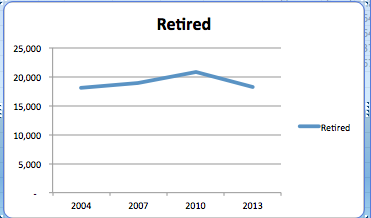
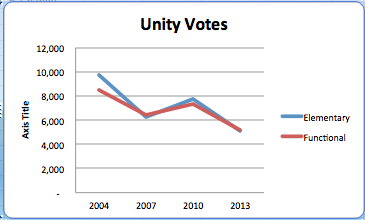
| 2004 | 9,757 | 2,794 | 2,893 | 8,464 | 18,067 |
| 2007 | 6,252 | 1,499 | 2,183 | 6,464 | 18,864 |
| 2010 | 7,761 | 1,981 | 2,595 | 7,337 | 20,744 |
| 2013 | 5,111 | 1,185 | 1,592 | 5,167 | 18,155 |
Retiree totals for Unity are flat:
But totals in each in-service division show sharp downward trends:

A friend suggested this reflects decreasing numbers of teachers with tenure – that tenured people probably vote Unity in the same proportion as years ago. This seems possible, as a contributing cause, but easy to overstate. The totals (below) suggest that people who used to vote Unity stopped.
Subtotals and totals:
| Teacher | Inservice | Grand | |
| Subtotal | Subtotal | Total | |
| 2004 | 15,444 | 23,908 | 41,975 |
| 2007 | 9,934 | 16,398 | 35,262 |
| 2010 | 12,337 | 19,674 | 40,418 |
| 2013 | 7,888 | 13,055 | 31,210 |
Ten thousand in service members stopped voting Unity, or retired. But their number of retiree votes did not go up. Any analysis points in one direction: Unity has not replaced significant numbers of the votes it has lost.
How dramatic are the drops?
Unity vote percentage drop by division 2004 – 2013
| 2004 | 2013 | % Change | |
| Elementary | 9,757 | 5,111 | -48% |
| IS/JHS/MS | 2,794 | 1,185 | -58% |
| High School | 2,893 | 1,592 | -45% |
| Teacher Subtotal | 15,444 | 7,888 | -49% |
| Functional | 8,464 | 5,167 | -39% |
| In Service Subtotal | 23,908 | 13,055 | -45% |
| Retirees | 18,067 | 18,155 | 0% |
| Grand Total | 41,975 | 31,210 | -26% |
Remember that this has occurred while the non-Unity vote has stayed small, but fairly constant. (Despite votes flipping this election from New Action to MORE, or last election from ICE/TJC to New Action)
My guess is that Unity doesn’t care much, as long as they win. And despite the dramatic looking numbers, they are not close to losing.
(note: I am not certain if all retiree numbers are reported as non-weighted. Weighting can change the percentages in the grand total only)
UFT elections: another look at New Action and MORE votes
We’ve already seen that votes flipped to New Action from ICE/TJC in 2010, and back to MORE in 2013.
But has the overall non-Unity vote changed? I’m hardly the first to draw this conclusion. It has changed, but not much.
Let’s start with the raw numbers:
| Year | ELEM | MS/JHS/IS | High School | Functional | Retirees | |||||||||
| NAC | I/T/M | NAC | I/T/M | NAC | I/T/M | NAC | I/T/M | NAC | I/T/M | |||||
| 2004 | 556 | 1,239 | 311 | 422 | 700 | 1,417 | 512 | 990 | 1,558 | 872 | ||||
| 2007 | 562 | 1,337 | 273 | 444 | 521 | 1,524 | 548 | 1,032 | 1,616 | 1,061 | ||||
| 2010 | 978 | 703 | 421 | 248 | 774 | 1,369 | 1,175 | 708 | 2,234 | 1,037 | ||||
| 2013 | 534 | 1,140 | 161 | 398 | 452 | 1,430 | 754 | 951 | 1,880 | 1,490 | ||||
–
Let’s examine non-Unity votes taken as a single unit:
| Year | ELEM | MS/JHS/IS | High School | Functional | Retirees |
| 2004 | 1,795 | 733 | 2,117 | 1,502 | 2,430 |
| 2007 | 1,899 | 717 | 2,045 | 1,580 | 2,677 |
| 2010 | 1,681 | 669 | 2,143 | 1,883 | 3,271 |
| 2013 | 1,674 | 559 | 1,882 | 1,705 | 3,370 |
It might be hard to absorb from a table how uninteresting these numbers are. Try a graph:
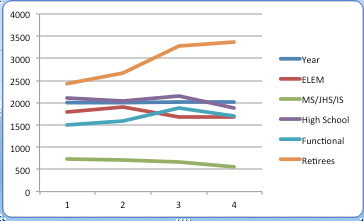
The overall flatness is quite apparent. But there are some exceptions. The total number of retirees voting for a caucus other than Unity has increased in absolute terms. Both New Action and the other group(s) have benefited. A second shift, small, and hard to see in the noise, New Action has a small but real increase in votes among functional, leaving that line slightly higher. And the seeming dip in middle school? Illusion, as voters in 6-12 and K-8 schools vote in the other divisions, and there are more such schools today.
Remember, these flat lines are in the context of falling turnout, falling absolute numbers of total votes. The next post on this topic will look more closely at that context, and offer some analysis.
UFT Elections: votes for New Action, MORE
In the election that ended last week, New Action lost to MORE in every division except retirees. I knew we would lose high schools, and win retirees. That did happen. I thought we would win functionals, and that the races in middle school and elementary school would be close. That did not happen.
–
Look at those numbers. MORE would seem to have won a substantial victory. (I/T/M refers to any and all of ICE, TJC, and MORE)
| Year | ELEM | MS/JHS/IS | High School | Functional | Retirees | |||||||||
| NAC | I/T/M | NAC | I/T/M | NAC | I/T/M | NAC | I/T/M | NAC | I/T/M | |||||
| 2013 | 534 | 1,140 | 161 | 398 | 452 | 1,430 | 754 | 951 | 1,880 | 1,490 | ||||
–
Looking at the numbers from 2010 and today, it seems that MORE flipped a chunk of votes from New Action.
| Year | ELEM | MS/JHS/IS | High School | Functional | Retirees | |||||||||
| NAC | I/T/M | NAC | I/T/M | NAC | I/T/M | NAC | I/T/M | NAC | I/T/M | |||||
| 2010 | 978 | 703 | 421 | 248 | 774 | 1,369 | 1,175 | 708 | 2,234 | 1,037 | ||||
| 2013 | 534 | 1,140 | 161 | 398 | 452 | 1,430 | 754 | 951 | 1,880 | 1,490 | ||||
–
Looking at the numbers going back two elections, a different pattern seems to emerge. New Action flips votes from ICE/TJC in 2010, but they come back to MORE in 2013.
| Year | ELEM | MS/JHS/IS | High School | Functional | Retirees | |||||||||
| NAC | I/T/M | NAC | I/T/M | NAC | I/T/M | NAC | I/T/M | NAC | I/T/M | |||||
| 2007 | 562 | 1,337 | 273 | 444 | 521 | 1,524 | 548 | 1,032 | 1,616 | 1,061 | ||||
| 2010 | 978 | 703 | 421 | 248 | 774 | 1,369 | 1,175 | 708 | 2,234 | 1,037 | ||||
| 2013 | 534 | 1,140 | 161 | 398 | 452 | 1,430 | 754 | 951 | 1,880 | 1,490 | ||||
MORE’s 2013 numbers under Cavanaugh fall short of ICE’s 2007 numbers under Wainer (except retirees)
–
Pushing the returns back to 2004, it now looks like the anomalous year was 2010. And 2013 is neither the worst year for New Action, nor the best for ICE/TJC/MORE. That’s actually bad news for New Action – this election was, in relation to the other opposition caucus, fairly normal.
| Year | ELEM | MS/JHS/IS | High School | Functional | Retirees | |||||||||
| NAC | I/T/M | NAC | I/T/M | NAC | I/T/M | NAC | I/T/M | NAC | I/T/M | |||||
| 2004 | 556 | 1,239 | 311 | 422 | 700 | 1,417 | 512 | 990 | 1,558 | 872 | ||||
| 2007 | 562 | 1,337 | 273 | 444 | 521 | 1,524 | 548 | 1,032 | 1,616 | 1,061 | ||||
| 2010 | 978 | 703 | 421 | 248 | 774 | 1,369 | 1,175 | 708 | 2,234 | 1,037 | ||||
| 2013 | 534 | 1,140 | 161 | 398 | 452 | 1,430 | 754 | 951 | 1,880 | 1,490 | ||||
–
But back to 2010, what might explain the shift? It was, I believe, a more optimistic year. Mulgrew was new, and we preferred his style, and when Weingarten proposed a lousy teacher evaluation system, he said she didn’t get it. He didn’t agree to the outline of the NY State teacher evaluation law until after the election. New Action’s 2010 vote total may have been swelled by voters who wanted to support Mulgrew, but refused to do so on the Unity line.
The ICE/TJC/MORE vote seems to match up most closely between 2007 and 2013, as does the New Action vote, though slightly depressed in 2013 for both caucuses. The Retiree category is an exception, with both groups stronger among retirees in 2013 than they were in 2007.
Changing Membership, Changing Electorate
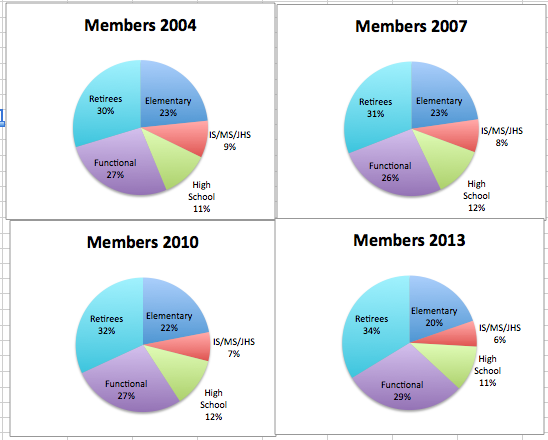
This is a time series of charts, showing UFT membership and votes by division for the 2004, 2007, 2010, and 2013 elections. I created the charts from the numbers of ballots mailed and the number of ballots returned, which has been part of the reported election results, including this year.
Raw numbers, by division, by year, with turnout percentages are included at the bottom of this post.
Members by Division, by year
Voters by Division, by Year
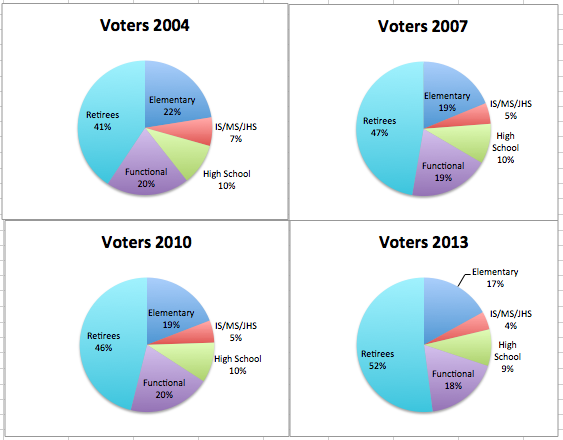
It is also worth noting that the areas represent different numbers of members, and of voters.
Members
2004 – 154 thousand
2007 – 164 thousand
2010 – 170 thousand
2013 – 176 thousand
Voters
2004 – 56 thousand
2007 – 49 thousand
2010 – 56 thousand
2013 – 45 thousand
The jump in the percentage of votes cast by retirees is a direct result of the constitutional amendments raising the cap on how much retiree votes count. New Action strongly opposed those amendments. Retirees cast 53% of the votes, an absolute majority, in this election.
The special decline in middle school votes may be due to how teachers in in K-8 or 6-12 schools are categorized. I do not know if this is the correct explanation.
In the course of a decade, the number (not percent) of teachers voting has fallen from 21 thousand to under 13 thousand, and whereas teachers cast just under 40% of the vote nine years ago, they cast exactly 30% today.
| Division | Year | |||
| Mailed | Returned | % voting | ||
| ELEM | 2004 | 35,511 | 12,170 | 34% |
| 2007 | 36,912 | 8,904 | 24% | |
| 2010 | 36,907 | 10,286 | 28% | |
| 2013 | 34,163 | 7,311 | 21% | |
| IS/JHS | 2004 | 13,489 | 3,720 | 28% |
| 2007 | 12,841 | 2,384 | 19% | |
| 2010 | 11,697 | 2,880 | 25% | |
| 2013 | 10,807 | 1,875 | 17% | |
| HS | 2004 | 17,455 | 5,399 | 31% |
| 2007 | 19,799 | 4,568 | 23% | |
| 2010 | 19,931 | 5,197 | 26% | |
| 2013 | 19,040 | 3,800 | 20% | |
| Teachers | 2004 | 66,455 | 21,289 | 32% |
| Subtotal | 2007 | 69,552 | 15,856 | 23% |
| 2010 | 68,535 | 18,363 | 27% | |
| 2013 | 64,010 | 12,986 | 20% | |
| FUNCTIONAL | 2004 | 40,424 | 10,829 | 27% |
| 2007 | 42,614 | 9,133 | 21% | |
| 2010 | 45,889 | 10,622 | 23% | |
| 2013 | 51,040 | 7,698 | 15% | |
| Inservice | 2004 | 106,879 | 32,118 | 30% |
| Subtotal | 2007 | 112,166 | 24,989 | 22% |
| 2010 | 114,424 | 28,985 | 25% | |
| 2013 | 115,050 | 20,684 | 18% | |
| RETIRED | 2004 | 45,082 | 21,998 | 49% |
| 2007 | 50,208 | 22,427 | 45% | |
| 2010 | 53,560 | 24,795 | 46% | |
| 2013 | 58,537 | 22,462 | 38% | |
| TOTAL | 2004 | 151,961 | 54,116 | 36% |
| 2007 | 162,374 | 47,416 | 29% | |
| 2010 | 167,984 | 53,780 | 32% | |
| 2013 | 173,587 | 43,146 | 25% |
See turnout analysis here.
UFT Elections – Sitting at the Count
I arrived. Hotel meeting room, for a large meeting, set up with rows of tables with ballot counters doing something… sorting? flattening? stacking? In front were some more important looking tables. I missed the scanners and monitors – I was looking for something else.
(Click here for Part I of this piece)
In the back, right, were the observers. I found Joel Berger, then found Mike Shulman. They were not wearing their concern on their faces, but I felt it. Before walking out with Mike I said hi to some of the Unity people and some of the MORE people. The Unity people looked bored, and perhaps a bit tired. The MORE people were relaxed.
Mike and I found a quiet place to sit around the corner. We looked through the participation numbers… down 30% across the board. We talked about what that means… not good. And Mike talked about MORE outpolling us 2:1 and 3:1… let me explain.
No results had yet been announced. But one (time consuming) stage in the vote takes each ballot and scans it. An image appears on a monitor for a second, and the next ballot scans. By watching the monitor it is possible to count a number of consecutive votes. Now, as Unity dominates most divisions, it is tempting to count MORE vs New Action for a while (easy to do, as there are breaks when Unity ballots are on screen), and extrapolate.
But that ratio (which is easy to exaggerate – take several samples, worry about the most alarming) does not tell whether there were any breakthrough type numbers. Were there numbers of votes that significantly exceeded what ICE and TJC had done previously? Had New Action’s totals shrunk beyond previous lows in any significant ways? The answer to both, at 1 PM, was we did not know. When the day was done we learned that the answers were “No” and “No.”
Back in the room I graded, paced. Jack Miller took some posed photos. I chatted with Amy and Eileen and Leroy, and with James (and a bit Ellen. really just a hello with Joan). People say what they are supposed to say, more or less, when discussing politics and elections. Which made a brief discussion with a guy from Unity and a guy from MORE about their children’s schools a welcome break. I wandered up to the monitors, and tried to sample ballots.
And then the American Arbitration Association guy announced the first results – high school and middle school. He only announced slate votes – split ballots would not be added in until Friday. And in high school Unity had 1592, MORE had 1430, and New Action had 452. The seven endorsed by New Action and Unity (including me) outpolled their MORE opponents 2042 to 1430. And the only race where there was any doubt was now decided.
I stayed for two more rounds of announcements covering Elementary, and Functionals, then Retirees. Mike stayed with me. Joel left. The MORE people looked less relaxed as they realized that they had not been so far from winning the high schools. I wonder if they were doubting their decision not to meet with New Action to discuss this election back last summer. Unlikely. They were more likely annoyed that New Action’s high school candidates had, with Unity votes, beaten MORE’s candidates.
As the results came in, a batch at a time, I tabulated them. And I worked them over. And I began to look for patterns. New Action ended down from 11% to 9%, which was disappointing, but no disaster. MORE was at 13%, up from ICE/TJC’s 8%, good, but no breakthrough. Unity’s total fell from 81% to 77%, which does not sound so bad, but in fact, is (I’ll discuss that in a follow up post). And the total vote fell from 53 thousand to 43 thousand, which is a problem for our union.
In any case, I ran back to school (after five now) to pick up the completed work my coverages had left in my box.
UFT election turnout is concerning
Reviewing data since 2004, participation in UFT elections is down across the board. In 2007 there was a drop, an uptick in 2010, and a big drop in 2010. This trend was stronger than any variation among the divisions, including retirees. Here are the percents by division, followed by the divisional data displayed as a line graph…
| 2004 | 2007 | 2010 | 2013 | |
| Elementary | 34% | 24% | 28% | 21% |
| Middle | 28% | 19% | 25% | 17% |
| High | 31% | 23% | 26% | 20% |
| Functional | 27% | 21% | 23% | 15% |
| Retirees | 49% | 45% | 46% | 38% |
| Subtotals | ||||
| Teachers | 32% | 23% | 27% | 20% |
| In Service | 30% | 22% | 25% | 18% |
| Total | 36% | 29% | 32% | 25% |
The same data, graphed:
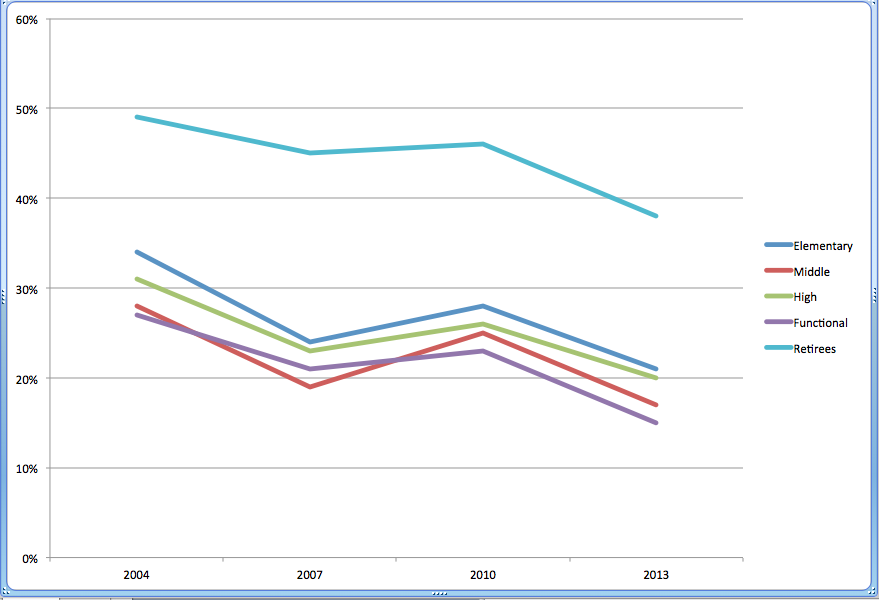
The drop from 2004 to 2013 in each teacher division is between 35% and 39%. The drop for retirees over that same time period is 22%, and among functionals 44%.
The big trend is clear. But what of the bigger drops in 2007 and 2013, and the uptick in 2010? My working assumption is that the blow from the 2005 contract was demoralizing, and is reflected in 2007. In 2010 Mulgrew was new, and had just publicly opposed Weingarten on using test scores to rate teachers. And today? Danielson, teacher evaluation looming, how many years of Bloomberg, etc. The overall trend is less voting, but that trend is magnified by demoralizing events and conditions.
So why the overall trend? TFA, NYCTF, low retention…? But there are not so many TFAers as there once were, and that number has not been increasing. Anecdotally I believe that NYCTF retention is getting a little better. And those categories don’t effect retiree vote, which has dropped a little slower than the rest, but moves the same direction in each election.
Could the delayed vote (April instead of March) made a difference? I think not. And that would just be 2013. And it would not affect retirees.
Could the influx of functionals (home care workers) make a difference? Not really. Our addition of charter school teachers, home care workers, nurses, etc, account for making the purple line in the graph change places with the red line, nothing more. Discounting the growth of the division, turnout for 2013 would have been 18%.
I think there are two major factors. First, there is an overall mood of demoralization. There is a sense that no matter what we do, things will go badly. And second, too many new teachers are indifferent to the UFT (and we do too little to address this).
It certainly had been the case nationally under 8 years of Bush, but despite several important improvements (health care jumps out), four and a half years of Obama have not improved the lot of teachers or the conditions in the schools. Retirees earned benefits over years in the workforce, and are watching renewed targeting of Social Security and Medicare. Few of us can answer the “Are you better off…” question in the affirmative.
And certainly in our schools, the demands of the current system are utterly demoralizing and frustrating: punishing quantities of paperwork, impossible requirements, colocations and school closings, the ongoing ATR pool, endless testing and test prep, maltreatment at the hands of abusive administrators. The union has pushed back in some places, and we have prevailed in several instances, (we won twice on school closings, that was huge), but those are the exceptions.
The second major factor contributing to the decline in turnout, I think, is that newer teachers don’t vote. And this is a system that is bottom-heavy with newer teachers. Even after the partial hiring freezes of the last few years, it seems clear that the proportion of senior teachers has dropped, and of newer (maybe not brand new) teachers has risen. And the UFT enrolls, but does not induct, new teachers. There is a difference between making people members on paper (sign this card, and then the Health and Welfare form), and making them feel like, think like they are part of an organization that unites them with their colleagues.
When I started blogging, in 2006, before I joined New Action, I knew that retention was one of the biggest challenges facing our school system and our union. I knew that weak chapters were tied to the retention crisis. And I knew failing to recognize the crisis makes things worse. I’ve learned a lot since then. I would add other factors, I would add nuance. And while I knew that rebuilding/repairing chapters was a big job, it is far bigger than I understood, and with the loss of 7 years it has become far, far harder. But I believe that addressing new teacher induction would directly address voter turnout (among other things).
Organize. Build. Involve. From the chapter up, with support from the top. There needs to be a strong, two-way link, from member to chapter leader to district rep to officers and vice versa. Communication must move in both directions. There need to be strong relationships in the chapters. And this need, this lack, should inform much of what we do. This this is not sufficient to solve our turnout problems (demoralization and new teacher indifference to the UFT), but it is necessary.
– – — — —– ——– ————- ——– —– — — – –
The full data set shows the same trend, but also reveals the relative size of each division, and changes in the relative size of each division. The next post will analyze those numbers.
UFT elections – first impressions
Last Thursday noon-ish I left school. I had been offered release for a full day, but chose to stay for all but my last two classes.
The UFT vote count was underway. I was on my way to the 57th Street Holiday Inn, to watch the American Arbitration Association process the UFT votes.
I texted Mike Shulman, New Action cochair, to get a sense of how things were going, before I got on the train. I was concerned going in. I thought New Action’s vote would fall, and Unity’s would fall, and MORE’s would probably finish ahead of New Action. But I thought we had a chance to edge them. I also was worried that we might lose our 3 high school seats, including mine, on the executive board (we were safe to hold our 7 at-large). Mike’s reply text was not positive: turnout was down about 20% across the board, and MORE was beating New Action 3:1 everywhere.
The train ride I was trying to imagine the worst. Losing the seat would at least lift the responsibility that comes with it. And New Action has a core of support, a few percent, that is unshakeable. We would have seven seats, and we would do work. But there could be no spin, no self-delusion, nothing to make the drop in turnout into anything but trouble. And if MORE had an electoral breakthrough, New Action’s safe 4-5% would not necessarily mean much.
It turned out, New Action’s result was disappointing, but not a disaster. MORE had a stronger than expected showing, but no breakthrough. The biggest losers were Unity and the UFT as a whole (not for the same reason).
(Story continues here)
I’ll talk about the count, and analyze the vote in the coming days. I may even look back at the campaign… but it’s a bit early.
Last day, light day, good day, for flyering
New Action campaign literature was distributed in schools across New York City. The UFT ballots were mailed last Wednesday, and Wednesday, Thursday, and Friday last week were our most intense days. We also used the two weeks before vacation.
Now is late. Many people mailed in their ballots when they arrived, Friday or Saturday. Others may have tossed them. Too many. Honestly, even if you vote for one of the wrong slates (Unity or MORE), it is better to vote… But that’s a different post.
So, now is late. But we had bypassed some Bronx high schools, and today a team covered some. And this afternoon I went into one: Grace Dodge.
What good can it do, handing out literature after so many have already voted? I was thinking that, as I was thinking of ditching my assignment.
But as I arrived, and met one person after another who knew me, or who knew who I was… I met the chapter leader, good guy, running with the wrong slate. I met a woman from my first school – we hadn’t seen each other in years. We worked in the same “house” when I started, back in 97. I met a guy from another school, coming for per session… we worked with the Columbus people last year, to help get the UFT involved in organizing the “Chase Chase” rally against a sexually harassing principal. I met teachers in the school, with questions about their working conditions. I heard a paperwork issue. I got questions about being in a phase out school, which I never have been, but the Grace Dodge people are.
I put flyers in the boxes in the two mini-schools. In one I recognized a name on a box, the daughter of a scoundrel who has intentionally done incalculable harm to students, teachers, and communities in the Bronx. But the daughter? she is our colleague, and a teacher, and I hope she develops good union consciousness and ends up nothing like her father. (I had to take a minute and convince myself of this, having cringed in horror, on seeing his name on her box).
But the best? By the Grace Dodge mail boxes. Schmoozing and talking. Trying to have three conversations at once. A young guy says “Mr. Halabi” (no question mark at the end) “Mr. Halabi, do you remember me?” He’s mid-20s, big shoulders, but not tall, beard. I don’t recognize him. “It’s me,” and he said his name, and I still didn’t know.
The young man had been my student for five weeks in a summer bridge program, in 2000. The kid, who I now recall, but barely, looked nothing like the man who spoke to me this afternoon. One was 13, from West Africa. Today’s was 25, graduate of a college in the midwest. He was subbing, and wanted pointers on landing a regular job. I may have been more helpful today than 13 years ago… but I must have done something good that he remembered me all these years later… I smiled.
I also found a few people who said they hadn’t voted, and I may have picked up a couple votes.
For distribution, covering a lot of schools is important. But today I had the chance to go slow, listen to people, share ideas and experiences. And see a former student. I walked out smiling.
MORE was not interested in an electoral bloc with New Action
New Action approached MORE in August to discuss, among other things, the upcoming UFT elections. MORE set its slate two months later, and only then agreed to meet New Action, making discussion of an electoral bloc or alliance impossible.
On July 31 of last summer, the New Action executive board met. We were discussing one item only: the 2013 UFT elections and our relations with Unity. For a number of reasons, some obvious (impending teacher evaluation which we oppose) some less obvious, there was significant doubt about maintaining our relationship with Unity.
Four proposals went in: (1) maintain our relationship with Unity, (2) do not participate in the elections, (3) run an independent slate in the election, and (4) approach MORE.
By the end of that day we had eliminated only the second option. And we had designated members to make initial, informal approaches to Unity and to MORE.
The decision to approach MORE was not easy, there was some real support, and some solid opposition. We chose to frame the approach to be about both election and non-election issues, to avoid giving the impression we were about to begin negotiations. By late August we had reached out, informally, to two leading members of MORE. And we waited. They asked for a formal request, which we were not inclined to make (in the spirit of the direction our Exec Board had given us.)
Do MORE’s members know that MORE essentially rebuffed an approach by New Action, from before last Labor Day?
And we waited. And waited. September came and went. We put off our decision, waiting for feedback. October came. MORE announced their slate. We got the message. At the next New Action meeting we reduced our choices to running with Unity or running alone. And then, at Halloween, MORE suggested we meet.
And we did meet. Late November. New Action was already making election arrangements with Unity. Which left the six of us (3 New Action, 3 MORE) with a slightly strange conversation. It seemed slightly productive at the time, and certainly cordial. For an account see New Action and MORE representatives met in November.
By delaying a meeting with New Action until after it had set its slate, MORE made clear that they had no interest in pursuing a joint slate.
The UFT elections and a mayoral endorsement: where does each caucus stand?
Would you trust a leadership who wants to sit out the mayoral race?
In 2009, the UFT failed to endorse a candidate. Bloomberg won a close race over Bill Thompson.
Unity wanted to sit that election out, and used a parliamentary trick to avoid even discussing a Thompson endorsement.
New Action endorsed Thompson and tried to bring the UFT on board. We endorsed early, even while another attractive candidate, Tony Avella, was still in the race. But Tony stood not much of a shot, and beating Bloomberg was our priority.
MORE did not exist. But it’s predecessors, ICE and TJC did. And they sat the election out. No endorsement.
Do MORE’s candidates know that their caucus will likely take no position in the mayor’s race?
2013? Unity has not tipped its hand. There will be a debate at the next DA. Good. Members worry that we might endorse Quinn in the primary, or that we might sit the primary out, letting Christine Quinn in by default.
New Action opposes a Quinn endorsement, but would consider John Liu, Bill DeBlasio, or Bill Thompson.
But MORE? MORE will not endorse a candidate. Do we really want to get Christine Quinn by default? If you care about the UFT’s candidate in this primary and election, you have to wonder about MORE.
How many names should a UFT caucus have?
I dunno. One?
My caucus, New Action, was formed by the merger of Teacher Action Caucus with New Directions. And they (I wasn’t a teacher back then) kept the New and the Action, so that it was obvious where New Action Caucus came from.
But MORE? MORE has more names than your average caucus. (Actually, is it a caucus or a coalition? They say caucus, but then what’s ICE?)
MORE came from GEM. And from TJC. And ICE supports MORE. Or are they part of MORE? And GEM, which is most of MORE (?) came from TJC and some other people and part of ICE. And one could assume that there are more letters in this MORE soup.
One thing the letters don’t do, they don’t fit together. There is no clue in MORE’s name about its relationships to any of the groups that helped create it.
A handful of professional oppositionists bounce from election to election, renaming themselves, picking a different focus, always thinking they have finally figured out what’s holding them back, how this time they can finally break through and create a movement that’s going to shake things up, overtake New Action, and take the union by storm.
But nothing will change. That cycle of poor election results and failure to win broad support isn’t due to a tactical error or picking the wrong issue or including the wrong letter in their new acronym.
Is New Action really independent?
New Action is an independent caucus.
We have an electoral agreement with Unity – we endorse their presidential candidate – Mulgrew. They cross endorse several of our exec board candidates. For high school exec board, we run 3, they run 4, and all are cross-endorsed.
On the basis of this electoral agreement, MORE’s bloggers claim we are not an independent caucus. MORE implies the same thing in its literature. And they are wrong. New Action has separate membership from Unity. We do not follow their discipline. We have our own Exec Board. We make our own decisions.
During the election, New Action differentiates itself from Unity. We raise positions on issues that we think are important, sometimes in agreement with, often opposed to Unity policy.
But there are three years between elections. What happens then? New Action‘s record is strong. We support the leadership on many issues. But we decide whether to do so or not. We oppose the leadership where they are wrong.
Go to Norm Scott’s blog. He has a picture of me speaking against raising pension contributions for future employees. That was the best speech at that DA (and no ICE people spoke, if I recall correctly). Against a Unity-endorsed position (that some good people mistakenly wither voted for or abstained on. They were dangling the return of the two days in August that Weingarten sold the DoE)
On the constitutional amendments last year – Mike Shulman and myself spoke – strongly – against them at the Exec Board. And then Shulman was the strongest speaker against at the DA. I remember some of the MORE comments were less than coherent. And New Action put out literature urging delegates to vote no.
On the Teacher Evaluation work… New Action has opposed this every step of the way… from supporting Mulgrew when he said Weingarten’s proposals would not work in NYC, to opposing him on RttT, and on the evaluation itself. Now, we weren’t silly enough to demonstrate against Mulgrew after the evaluation deal blew up (we just got a temporary reprieve) – but our record has been consistent. Our literature has frequently warned about what was coming. I should not write in detail about the Evaluation Committee, but MORE supporters on that committee know that I (and I think I am the only New Action person there) I have at each meeting both constructively contributed to the issue immediately in front of us, and made clear that we need to find a way out of this.
On embarrassing things in the field – New Action brought the massive extensions of probation of two years ago forward (DRs knew, but seem not to have been reporting). MORE bloggers were squawking about Galaxy flagging – but it was New Action that brought it to the leadership last Spring, and got the issue brought to PERB.
Do we always oppose the leadership? No. (I’m not writing “of course not” because ICE had people on the Exec Board once. Jerky behavior IS possible). There are many more issues where we agree than disagree, and the exec board minutes reflect that.
More Additional posts to follow
I’ll follow up with
- why the electoral arrangement is good for the members, good for Unity, good for New Action.
- There’s another sort of issue that we bring to the Exec Board – social issues, and they deserve a separate write-up.
- There’s the mechanics issue of how New Action handles individual issues on the UFT Exec Board (What do we do if we agree, disagree, amend, want to offer a resolution, etc)
- There’s the question of why MORE is campaigning like this – not sure I’ll bother going there.
The campaign is pretty much over 6 days from now. We’ll see how much I get written. No promises.
A Middle Fish Messed with the Tests in Atlanta
The smallfry and minnows were the teachers and students. And bigger than those, but still near the bottom: principals. Which makes former Atlanta Superintendent Beverly Hall definitely a “Middle Fish” What of the big fish? The national figures who promote this crud? And the sharks – the hedge fund guys and corporations who make profit off denying kids quality education?
Most of the thoughts I’ve had on the Atlanta testing scandal, others have already had them. I shall quote liberally:
Definitely read Fred Klonsky’s: The culture that created the Atlanta cheating scandal.
The title says most of it. He reprints his own talk on cheating from just this last February.
His brother Mike, at Small Talk: It’s Duncan’s Race To The Top that should have been indicted
Of course this scandal is really just a symptom of a much larger problem and Duncan bares as much responsibility for it than the 35 who were indicted. It’s his test-crazy Race To The Top, a continuation of No Child Left Behind that is behind the cheating wildfire.
Leonie Haimson at NYC Public School Parents: Cheating in Atlanta; but didn’t it happen here too?
the evidence suggests that the much the same has happened over the last ten years in NYC. The only difference is no effort or resources have been put by the city or the state into uncovering the phenomenon; in fact, quite the reverse.
Under Bloomberg and Klein, the numbers of staff members monitoring test taking has fallen, and the DOE stopped doing the sort of routine erasure and score swing rate analysis which the Board of Ed had done previously. (These methods suggested the anomalies in Atlanta).
In this very blog, Lynne Winderbaum wrote about myriad cheating scandals at Kennedy HS in the Bronx. But the investigations stopped short of any findings about principals and assistant principals (and superintendents, and chancellor). To be clear, there is an interest among all the test mongers NOT to investigate the cheating that results from their policies. Principals and Superintendents may look away, but Mayors and federal officials, testing companies and test-prep companies all have an interest in this testing/fake accountability culture. Cheating comes with the territory.
I read off a listserve an opinion that the middle fish getting in trouble (Hall and Rhee) are two people of color who have risen, and that the billionaires get off while they take the heat. Hmmm. I might buy that for Hall. Not for Rhee. No.
Final thought – the investigation. They caught some teachers. They offered immunity for testifying against principals. And they used principals against Hall. It’s like an episode of Law & Order. Could make a movie. (have you seen that new standardized test cheating drama?) Maybe not.
Shaking up traditional geometry
My proof-based geometry course is a proof-based geometry course. But I can still shake things up: Logic, Non-standard Theorems, Construction, Construction, Student-generated reference materials (for use on tests)
Were I to stick closely to my text (Jugensen/Brown/Jurgensen), most of my readers would recognize the course instantly as the more or less standard geometry course that’s been taught in the United States for a century. Of course the amount of proof has been substantially reduced from fifty years ago, but the idea, the sequence, they are the same. This is a course in proof, but also in reasoning. It is the only axiomatic system that most high school students explore.
And I hate teaching it. Ugh. So I “innovate” – though I suspect that all of my innovations are quite old, and have been done before.
1. Open with a unit on logic, and logic proofs. For those of you from NY State who recall the proofs in Course II, no, more, harder. Include extraneous statements. Teach more rules of replacement and rules of inference, and prove the rules before using them. Venn Diagrams and Euler Diagrams and truth tables. Consistency. And indirect proofs. This was a big unit.
2. Have students create their own glossaries/reference sheets. Allow/insist on constant revisions and updates. Allow/insist that the students bring their reference sheets to each quiz and test.
3. Construction. Fully one quarter of the class periods devoted to construction. Some standard construction. A lot of more creative stuff. We have a set of Michael Serra’s geometry books, and his opening chapter has been a nice resource.
4. Construction. Students must have the tools with them at all time. Quick constructions often become parts of ordinary non-construction lessons.
5. Oddball theorems. There are two types of deductive proof that students encounter.
The kind of deductive proof we more often associate with high school geometry presents a diagram with some given information and asks the student to prove another piece of information. What is being proven is usually already clearly true to the eye.
The other kind is to prove a theorem. The book does this for the students. Or I do it in class. And then we use the theorem. Sometimes the proof of a second version of the same theorem is offered as an exercise. And then, if this were the 1970s or earlier, we would ask the students to memorize these proofs, and recite them on a test.
But this is wrong! Proving theorems is at the core of what mathematicians do. The students need to be asked to prove theorems. But all the good ones are taken. So I will ask students to prove less-known, less-useful theorems. Practice doing the real thing.
(Getting to oddball theorems came out of discussions with math bloggers 2 – 4 years ago. Don’t remember exactly who, and exactly when, but the list of helpful suspects includes Ben-Blum Smith, Pat Bellew, f(Kate), PO’ed Teacher, and the Math Curmudgeon. I think Ben is the likeliest to have hosted this sort of discussion.)
The Parallel Postulate and an unfortunate Pedagogical Shortcut
the text goofs, big, and two freshmen are able to do what the book says cannot be done
I teach very little Geometry. It is my least favorite high school course*. But I am teaching Geometry this term. Two sections. Advanced freshmen, who took Algebra in the Fall.
I do lots of “reasoning” preparation before we get to points, lines, planes, postulates, and proof…
So here we are, in March, delayed start (delayed by choice), following our text (Jurgenson Brown Jurgenson) pretty closely, and the text goofs, big, and the kids have enough preparation that they do what the book implies cannot be done. Well, two of them do. But they’re 9th graders, right?
What the hell is the Parallel Postulate?
When I was in school, I thought it was “given a line and a point not on that line, there is exactly one line parallel to the given line passing through the given point.” According to our textbook, the postulate they offer is “given two parallel lines cut by a transversal, corresponding angles are congruent.” And then there’s Euclid. Strange guy. His version: ” If two lines are drawn which intersect a third in such a way that the sum of the inner angles on one side is less than two right angles, then the two lines inevitably must intersect each other on that side if extended far enough.”
Turns out, you can take your pick. Postulate one of these, and the others, plus a host more, can be proven as theorems. Sum of the angles of a triangle = 180. And I emphasized this. We can postulate one, and then prove the others, and we can choose which to postulate (ok, we’ll go with the book. But in theory…) Oh, and so we postulate that corresponding angles formed by a tranversal cutting parallel lines are congruent, and we prove as consequences a bunch of related stuff, including the 180 degrees in a triangle.
Next day… I write the converse on the board, and ask them to prove it (If corresponding angles are congruent, lines must be parallel). I’m going to let them frustrate, just a bit, and then tell them, yes, this is a theorem, not a postulate, but we’re not proving things this tricky yet. But I got two surprises.
1a. A student suggested proof by contradiction. Took our postulate. Used a theorem (if lines are parallel, same side interior angles are supplementary). Assumed same side interiors are supplementary, and that the lines do cross. The contradiction comes from the sum of the angles in the resulting triangle. Nice.
1b. A student (another) suggested a different proof by contradiction. He let the corresponding angles be congruent, but the lines not parallel. And then he added a parallel line to the picture (the angle between them is where the contradiction appears). None of the t’s were crossed or i’s dotted, but the direction was good.
2. Why did I not consult the book before altering my lesson??? The book lies. It should say “The converse of our version of the parallel postulate is a theorem. We do not have the tools to prove this theorem yet; we will prove it later, when we learn the special kind of proof that is required” But it says something else. It says that we have another postulate.
Ouch. I spent weeks readying my students for working in an axiomatic system. The game is to postulate as little as possible, but we have to postulate some things. We’d even studied, a bit, Bolyai, Lobachevsky, and the parallel postulate.
(We also did an extended logic unit, where they proved and proved, and even proved by contradiction, which is how I got two proofs)

 JD2718