Analyzing UFT Election Results: My Data
Over the next ten days or so I will subject the recent UFT election results to some analysis. There is more here than
- Unity won 66% – 34%
- Unity’s vote totals were lower than usual
- United for Change raised its vote in most divisions
- United for Change won the high schools.
The real story will be more complicated. It might not be much more interesting. But as we ponder “what next?” it is important to have as complete a picture as possible of what just happened.
I will be using historical data. I have some historical data, going back to 2004. Some I took from Dave Kaufman. Some I compiled myself. 2019 has a different source; I’d like to double check it. And in 2016 some of the data appears altered – I myself may have been the culprit, as I wrongly adjusted for retirees’ percentage of a vote.
If you have corrections, please send them in.
If you would like the Excel file, please write to me.

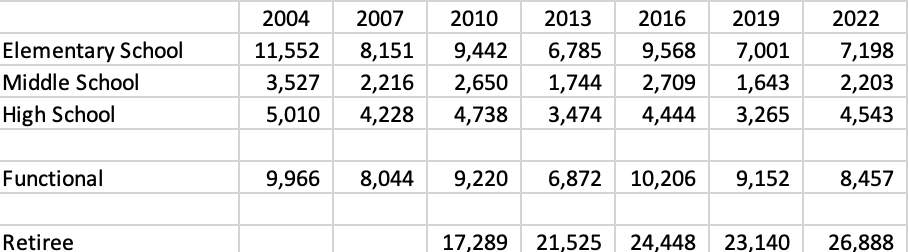
My results by division, both number of votes, and percents:
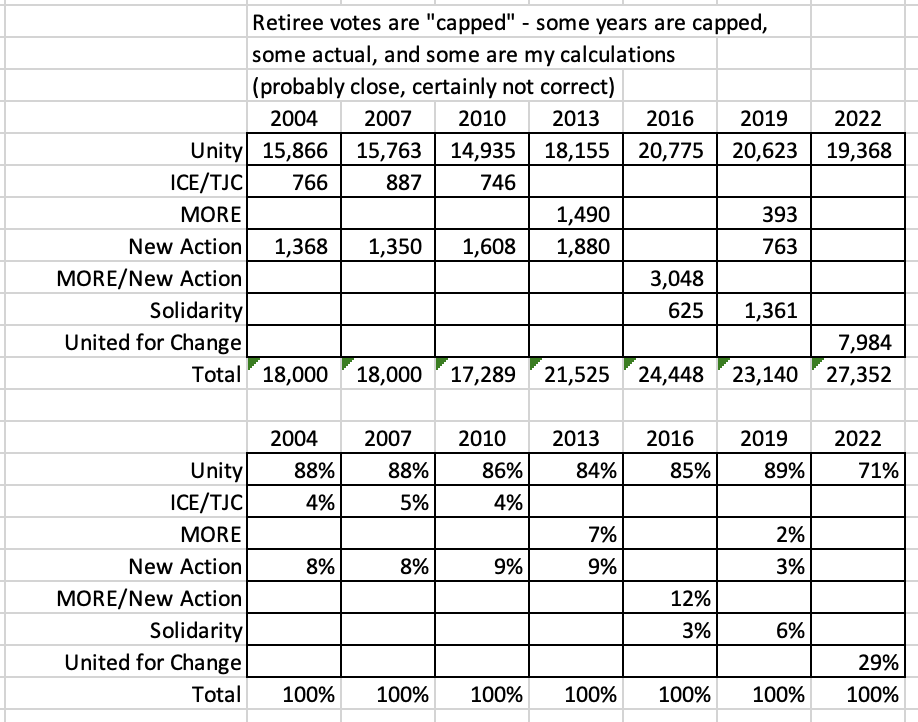

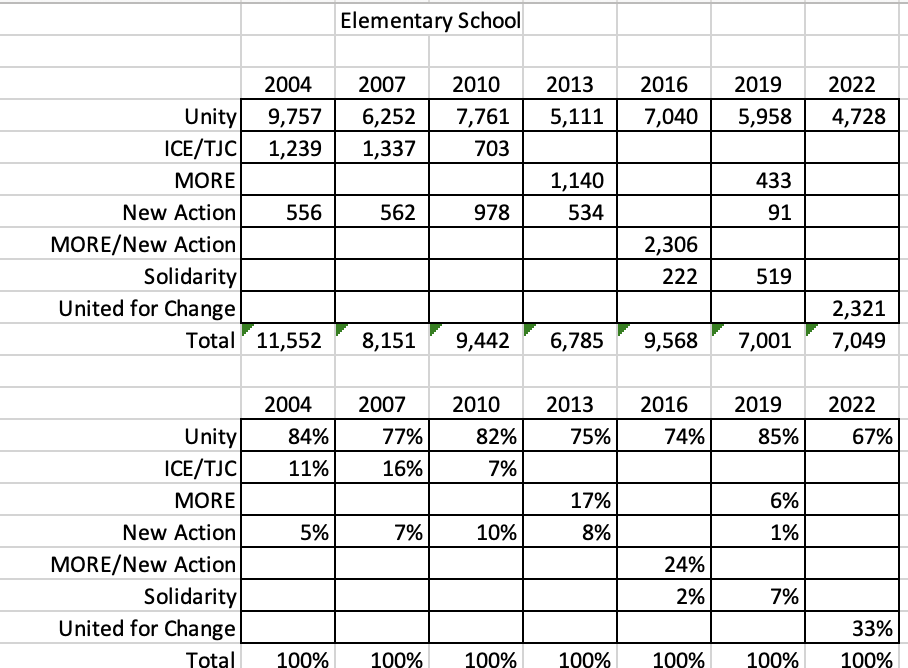
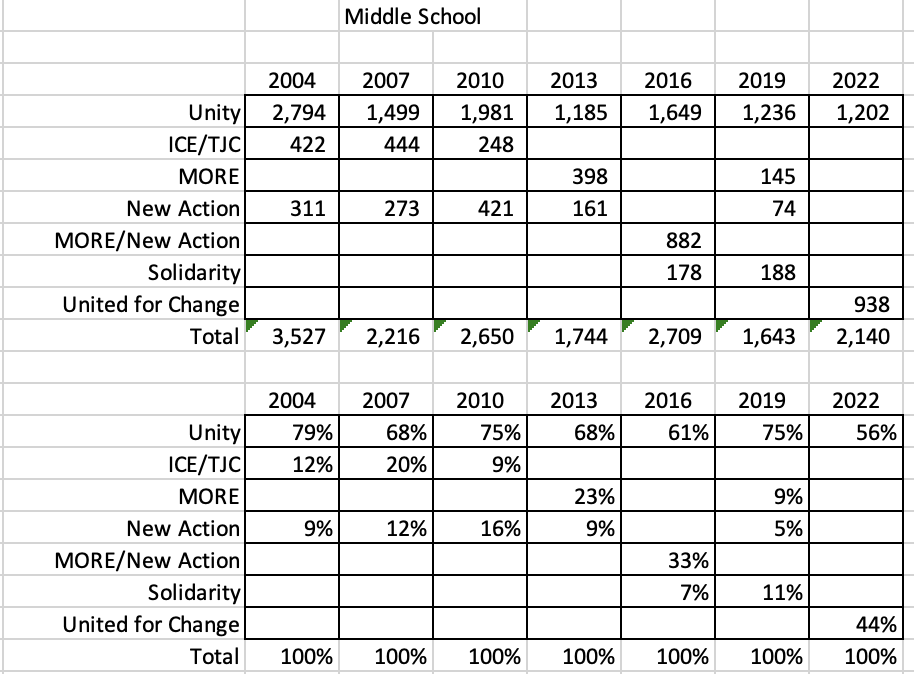
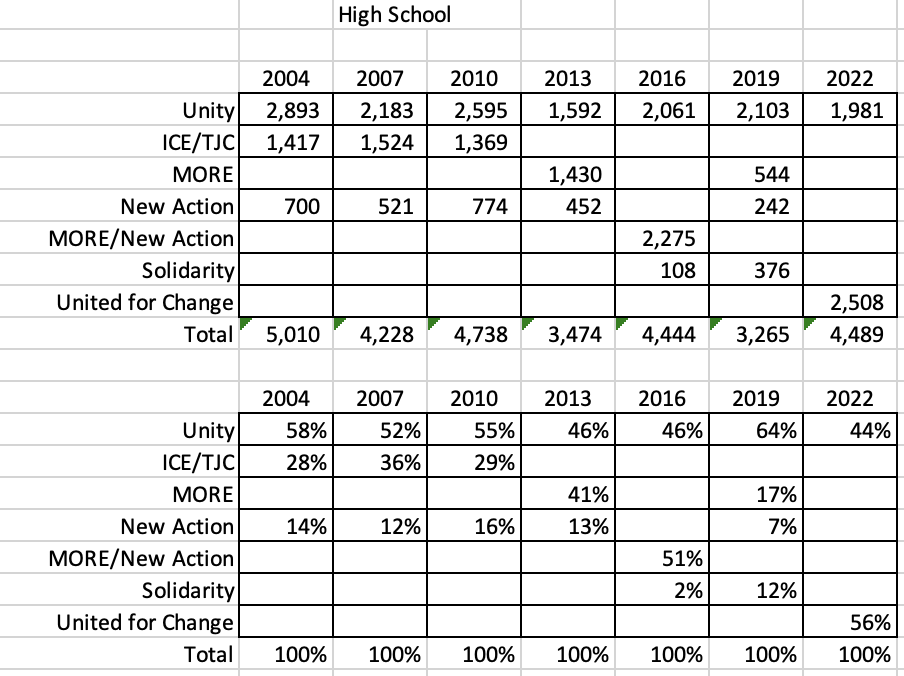
Unofficial numbers (fixed up a little)
I corrected my previous post. Some of the numbers for retirees were funky – I’ve adjusted them. Some of the turnout numbers (mostly retiree-related) were off. I think I got the retiree slate vote thing correct, or close to correct, this time.
I corrected the charts in the previous post – but I’m putting them here, for convenience.


Good Luck
Good luck to those who won their UFT elections. Good luck especially to the United for Change high school winners.
But congratulations? I’m not so sure. With 79.5% of teachers not voting, I’m not sure that congratulations are in order for any of us. Unity won among teachers 11.88% to 8.65% for United for Change. Out of every 34 voters, 4 chose Unity, 3 chose United for Change. 27 did not vote. (numbers do not include D75 teachers – but those numbers should be similar).
In the coming days I will have more analysis of numbers. More analysis of how each side performed vs each other, but also vs our respective goals (or my estimate or guess of those goals).
But for now – some needed discussion
Engagement
- how will you increase member engagement? I do not mean voter turnout (and yes, we want to increase that). But low turnout is reflective of low engagement. And addressing that underlying problem, deep problem, is crucial. The strength of the union comes from its ability to unite the activity and energy and power of our members, and today that strength appears suspect. And that is a generous assessment.
Out of every 34 voters, 4 chose Unity, 3 chose United for Change. 27 did not vote.
Will this discussion happen within each side from the election? Will it happen within caucuses in United for Change? Or will all of us come together to address this?
Medicare
- the bit of engagement that seems to have increased, seems to have increased among one group of members – retirees. And pretty clearly that was driven by one issue – Medicare vs Medicare Advantage.
Will Unity continue to secretly deal with health care and the MLC? Or will we look together at the magnitude of the funding problem, and work together for solutions that are acceptable to our members? I don’t know. My gut says not to trust Unity – but the right thing to do is to set aside that mistrust, at least for the moment, and give them a chance to reassess.
I’ll get back to numbers and analysis.
But for today, good luck.
More unofficial numbers
Maybe not “more” – maybe “better organized”

Yasmin Colon read us the numbers. Aloud. When she finished the ballots returned list, my hand shot up. The numbered return column didn’t add. She knew. Three ballots had problems, is that what I had noticed? People were kind of looking, weirded, at least a little, that I noticed 7,498 + 2,297 + 4,782 + 8,869 + 27,451 ≠ 50,900. I didn’t have the heart to explain, or the energy, frankly, that no, I had not added the numbers, just their last digits…
Unity scrapes out a win – United for Change takes high schools
Short quick post. Fuller results later. All of these numbers are unofficial.
Unity took the overall vote with 66%, their lowest result in – honestly, I thought ever. Soldini told me the elections in the 1960s were tight. So their lowest total in at least 50 years.
Retirees – Unity 71%. They usually score 85-90.
Functional – Unity 68%. They usually score 75-80%.
Elementary – Unity 67%. They usually score 75-80%
Middle Schools – Unity 56%. They usually score 60 – 80%
High Schools – United for Change 56%. This division leans opposition, but has swung back and forth.
Teacher total – Unity 58%. United for Change 42%. This is low. Unity has been between 65 – and 80%
Even the incomplete results are incomplete
I wasn’t there to complain.
Missing Easy Numbers
This morning I was teaching. UFT Election chair Carl Cambria shared the number of votes per division (they are in the table, below), and Dave Hickey said that 198,900 ballots were mailed. Every other election he’s included how many were mailed in each division, which is helpful to understanding the other numbers we are seeing. But not this time.
When I arrived (almost 4) that breakdown was still not available. And I was not able to get it. “Tomorrow.” Nuisance.
Late Votes Counted
The deadline was receipt at AAA 8 AM Monday. A Monday is bad, and what is this 8AM nonsense? They decided (I assume the election committee?) to include ballots received Monday and Tuesday. Which is fantastic. About 1600 more votes.
(we should have probably checked to make sure these ballots were not from Arizona, right?)
Subtraction by Addition
But now we have less information, because all of the vote counts shared by division are now wrong. The total vote is up 1600, but we do not know what division those votes fall in.
A Surprising Nugget
Dave Hickey shared that he saw a pile of about 200 retiree ballots that were not slate (voted for individuals, not caucuses). That makes 99% slate voting. In the previous election retirees voted slate 95% of the time. We verified that this was approximately correct. That is a very big change. Was this election a referendum on Medicare? Turnout was up, although we wanted more, and there was quite a swing to UfC, though we wanted more, so yes, maybe yes. I’m a bit surprised. I expected more Unity voters to check off 11 officers, and omit Mulgrew. Maybe they either stuck, or switched completely.
Neither a Shocking Upset, nor a Resounding Vote of Confidence
I laid out two results in the last two days, both extreme. Neither the amazing United for Change upset nor that romp that would stop Unity from reexamining course happened.
A Table and A Chart, both bad
Since I don’t know where the extra 1600 votes belong, both the table and the chart are wrong. But close. I’ll do better graphics and numbers when they are available.
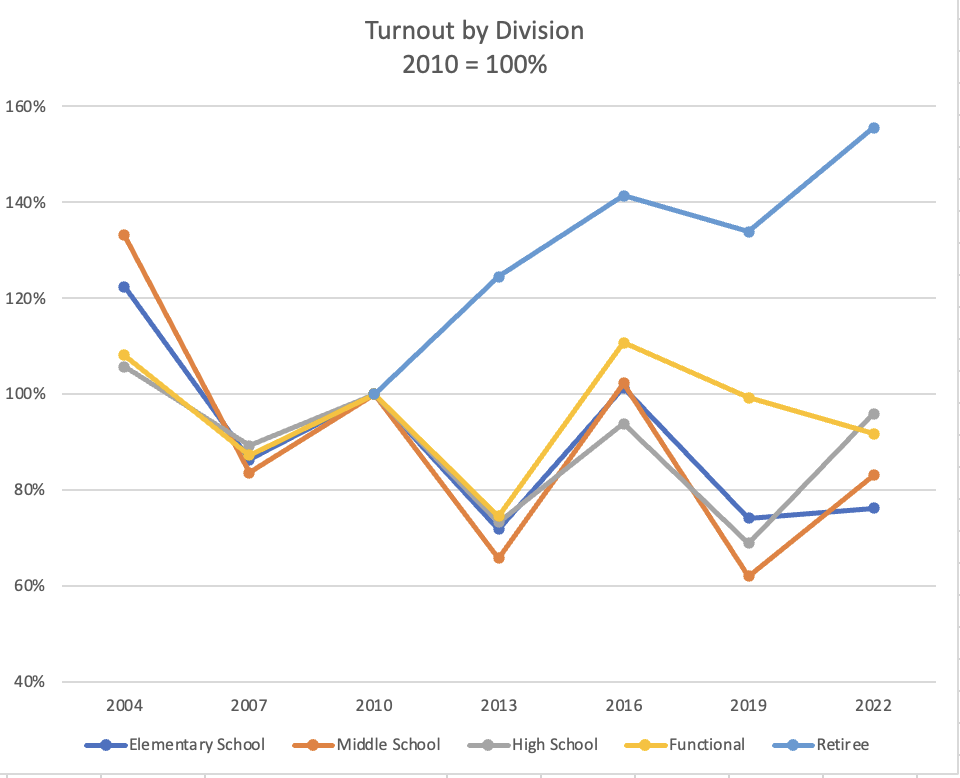
For now, the chart is just raw turnout by division, by year. I am missing two years of retiree data – what I had was just the cap number for those years.
The graph treats 2010 as 100% for each division, and you can see patterns. 2022 (still missing numbers) seems to roughly return to 2016 levels, after a dip in 2019. Wonder what happened to elementary? And the retirees are their own story (Medicare Advantage).
What Would a Big United for Change Win in the UFT Elections Look Like?
We have a hot United Federation of Teachers election.
The ruling Unity caucus, in power since the UFT was founded, currently controls 100% of the Executive Board. Every officer belongs to Unity. Also, every Borough Representative, every District Representative, every Special Representative belongs to Unity. And Unity uses some of these representatives to keep a lock on its control.
In 60 years Unity has always won the Elementary School division, always won the functional division. It is true that the lost the Middle School division once or twice, but that was decades ago. And they have lost the High School division many times, most recently 2016, though they won it back in 2019 and currently hold it.
Unity has always won the overall election – half the seats are at-large, all the officers are at large – and has always won it by a comfortable margin. In 2016 they got 76%, which I believe was their lowest total ever. In 2019 they climbed back to 83%.
On the other hand, incumbent president Michael Mulgrew is the least popular UFT president, well, ever. Unity looked weak and spineless during the pandemic. And our retirees, long a bulwark of Unity’s support, learned a year ago that Unity was forcing them off Medicare, into a private program. The retiree vote for the opposition (Retiree Advocate) in an election as the news was breaking rose from 15% to 30%. These were signs.
The various opposition groups coalesced into one coalition: United for Change. (I am the High School Vice Presidential Candidate for UfC). They nominated a large number of delegates, and probably reached more members in more schools than any opposition campaign in memory.
The expectation, I am guessing, is that in this environment Unity’s vote total falls, a lot. Losing 10% or 15%, would be a big deal. That would probably mean United for Change wins the High School division, and maybe even the Middle School division. That would mean controlling 11/102 seats on the Executive Board.
But is a bigger win for United for Change possible?
What Would Constitute a Really Big United for Change Win?
If somehow United for Change moved 20% of the vote, won the High Schools and Middle Schools, but put the other divisions into play, that would be a big win.
A really big win would tip things a few points further, and United for Change would win the overall vote, even by the narrowest of margins.

What would it look like?
Maybe 30% was just the beginning among the retirees, and they swing far further. Maybe a lot of non-voters are motivated to protect Medicare by voting, and those votes go overwhelmingly to UfC.
Maybe we cement our hold on the high schools, surge in the middle schools, and build some margin. And maybe we make enough ground up in the Elementary Schools to even things out. We could win two of the four divisions, and the at large seats. That would give us 70/102 Executive Board seats. We would win the 11 officer positions we are contesting. I would have a seat.
How Would United for Change Have Pulled This Off?
Mostly? Turnout. For this to happen, Unity’s threat to Medicare would have had to energize retired members who usually do not vote to do so. And they would have had to break heavily for UfC. Teachers in the schools would have to be even more tired of Mulgrew than we imagined, and non-voters became voters. And inchoate anger about the pandemic and the world would also have motivated teachers and others to vote for the first time. This scenario imagines teacher turnout soaring from 24% in 2016 and 18% in 2019 to somewhere between 35% and 40%. Notice, that is still low, too low. But it would require a pretty big increase in teacher vote.
So this scenario requires an almost unimaginable increase in turnout. But if turnout does surge, is there any doubt that the new voters would break heavily for United for Change and against Unity? That part makes sense.
Also, there would need to be former Unity voters switching sides. Something around 10%. Now, there certainly are defections, especially among retirees. And I have heard of some in service Unity people, including former chapter leaders switching. 10% seems like a lot. Another factor might be split ballots. At the count tomorrow we will see – are there Unity ballots that omit officers? one in particular? several? Each slate vote that becomes a split vote hurts Unity a little – though not as much as a defection.
There are other factors that we know about. United for Change made the case that voting for Unity was voting for Medicare Advantage. In this scenario, many members would have heard this, and either are already Medicare age, have relatives who are Medicare age, or are deeply committed to the New Deal and Great Society, and will vote to protect those programs
The pandemic hit the elementary schools differently than the high schools. United for Change has fewer campaigners in elementary schools, so we may have missed trends. Perhaps one of those trends was anger over having to go back into schools first (before high schools) and instructional lunch (much more a lower grades thing).
There are UFT members with strong opinions on pandemic policy – masks (in favor of them, against them), vaccines (mostly in favor, but some fervently opposed) – and just about all members with strong opinions are angry at Unity, or at least the person of Mulgrew. United for Change did not campaign for the “anti-vaxx” vote. No. But I bet they voted against Mulgrew – either by boycotting the election, or, in this scenario, by voting for UfC.
And then Mulgrew-fatigue may be even far greater than I imagine.
But United for Change did the work. We reached more schools with literature than any opposition ever has. Our messaging was sharp. Our print media was much better than Unity’s, and our social media was so good, they copied us.
I think we could have done more to increase turnout. But in this scenario, it turns out that our get out the vote efforts were particularly successful.
And of course our slate looked pretty good. And running women for the top officer slots was probably a smart move.
For all of this to have happened, it would turn out that the United for Change outreach, while extensive, was exceptionally effective. And it would mean all the new voters we think we encountered ended up voting. And many people we did not meet directly ended up voting for the first time. And it would mean that a significant number of Unity voters secretly voted for United for Change, or split their ballots. And it would mean that the retirees who said they were switching to opposition did so.
What happens next?
In this scenario, United for Change will win the Officers, and most of the Executive Board seats. Unity will retain one vice presidency, and 31 seats. I expect that Unity will challenge this result. There might be litigation. I hope not. I hope that wiser people than Mulgrew put the interests of the union over their desire to retain power.
In office, UfC will move quickly on a number of items.
- As rapidly as possible we will hold elections for District Reps.
- We will open the books on the Stabilization Fund, and review options. We will take Medicare Advantage off the table.
- We would probably open the proceedings of the contract negotiating committee to the membership as a whole.
- And we would prepare, super fast, for the AFT Convention (in Boston, starting July 14).
Between the results being announced, and us taking office July 1 we would need to meet and make many more decisions – but those are the first that I am confident we agree on. There might be some long term changes in staffing – but short term I expect (and do not know) that aside from a handful of key changes, we would want to make certain that the organization has a continuity of functioning.
I don’t know that UfC as a whole has given this much thought – but I would want to reach out to and consult with members of Unity Caucus who continue to serve the UFT. And I would especially want to reach out to the 30 or so Unity Executive Board members. Establishing a collaborative relationship would be essential – even if we do not always agree.
Members would notice right away. More information. More openness. Better responses.
How Likely is this Upset?
Definitely possible, but not very likely. United for Change has consistently received positive campaign feedback – but just not at the level of the teacher vote doubling or a full 10% of Unity switching sides. We will make gains, maybe big gains – but literally doubling the vote? Some signs are promising. Unity people are telling us that they switched. Even a couple of candidates told us they voted against themselves. We are surprised to encounter cluster of retirees who we thought were apolitical who have been actively spreading the word. And we have run into elementary school teachers who just want a change – in ways that we did not expect. But at this scale for this to happen? I don’t think so.
Maybe a 5% chance that this happens? But I think that is high. Maybe a 2-4% chance – about 1 in 25 to 1 in 50. That seems right. Not out of the question, but highly unlikely.
What Would a Big Unity Win in the UFT Elections Look Like?
We have a hot United Federation of Teachers election. Incumbent president Michael Mulgrew is the least popular UFT president, well, ever. The ruling Unity caucus, in power since the UFT was founded, looked weak and spineless during the pandemic. And our retirees, long a bulwark of Unity’s support, learned a year ago that Unity was forcing them off Medicare, into a private program. The retiree vote for Unity in an election as the news was breaking fell from 85% to 70%. These were danger signs.
The various opposition groups coalesced into one coalition: United for Change. (I am the High School Vice Presidential Candidate for UfC). They nominated a large number of delegates, and probably reached more members in more schools than any opposition campaign in memory.
The expectation, I am guessing, is that in this environment Unity’s vote total falls, a lot. They got 76% in 2016 (the larger oppo groups united) and lost 7 Exec Board seats (out of 102). In 2019 they won the seats back with 83% of the vote against a three-way divided opposition.
What Would Constitute a Big Unity Win?
If somehow Unity kept its vote over 70%, and held onto 100% of the exec board, that would be a big win.
What would it look like?
Maybe it turns out that 70% was their low-water mark among retirees, while retirees had just heard the Medicare Advantage news. Unity might actually raise their total a bit from there. 75%?
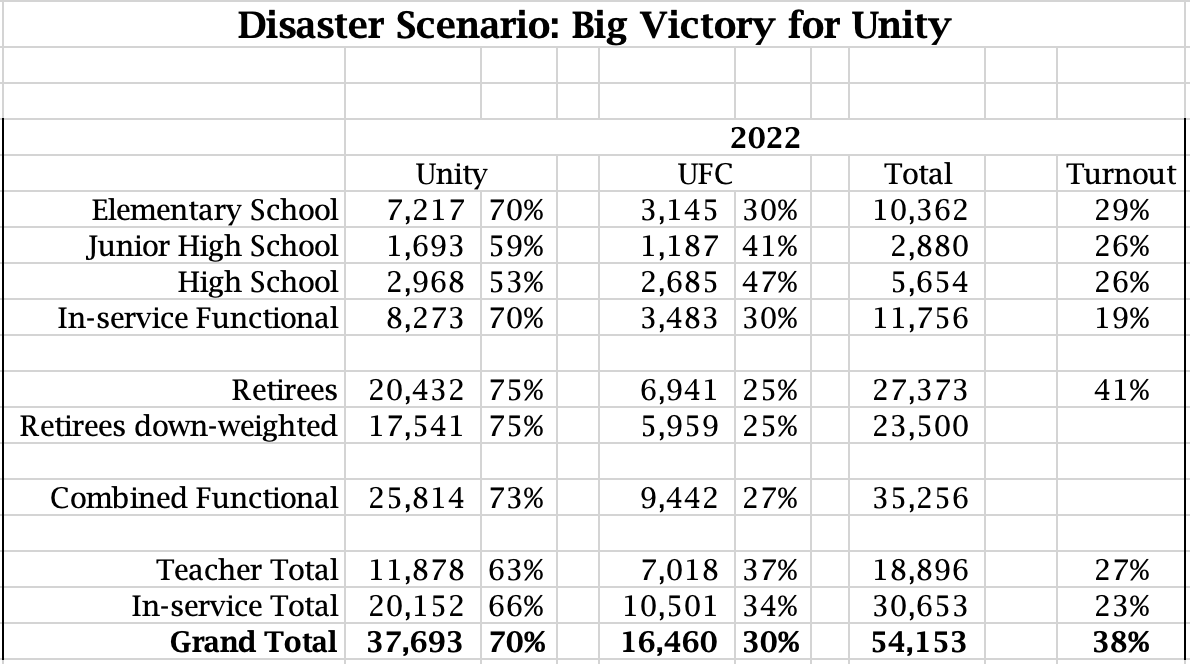
Sure, they might lose a few votes in each division (Elementary School, Middle School, High School, Functional), but not that many. Perhaps I have been overestimating the dissatisfaction over the pandemic? And some of the really bad policy was in 2020-21, which right now seems long ago? In 2019 they won 85%, 75%, and 64% Elementary School, Middle School, and High School respectively. They should lose votes, but maybe down to a manageable 70%, 60% and 51%, sweeping the seats (winner take all by division).
How Would They Have Pulled This Off?
They hid Mulgrew for the last four months. And maybe it worked. In December Mulgrew looked potentially the biggest vote-getter for the opposition – he was so unpopular. I begged Unity to drop him, for the good of us all, to no avail. Unity instead hid him, buried him. They canceled his events. They kept him off the campaign literature, and where they had to include him, did not make him noticeable. I went to the Unity Facebook page the other day. I could not find a single mention of him.
They shut up about Medicare. And people forgot. We have had almost two months of radio silence. Timing worked in Unity’s favor. A judge ruled in favor of retirees, and stopped the current implementation plan. But he showed the City and Mulgrew and the MLC how to work around the ruling (stop offering the old plan). But did Unity/Mulgrew jump at this? No. He is waiting for the campaign to end. They correctly judged that silence on Medicare during voting would save them votes. Just last week, after most of the ballots were cast, Mulgrew began sharpening his knife.
They put out good looking literature, with a unified theme. I wonder if they hired a pro? Seems like it. A media consultant to tell them what appeals to teachers. The irony of it. Some of the on-line stuff had serious issues with bad color choices that didn’t show, but the print stuff was fairly solid. And they did a full round of mailings, at least to ES, MS and HS teachers.
They highlighted individual members, especially in-service (and really in-service, full-time teachers, counselors, paras, etc). This gave them a better chance of having people campaign actively in schools, which they were never good at, but have gotten worse over the years.
They put pressure on supporters to cheat. We had pretty typical DR violations (mixing campaigning with union work, making it seem like voting for Unity was part of a union member’s responsibility, “branding” election work with union logos) but we had more lower level candidate violations (for example, lots of blocked access to mail boxes – which access is supposed to be guaranteed.)
And they successfully avoided a massive increase in turnout. Both sides knew that getting new voters to vote was key for the opposition. But Unity pulled every card they had – no electronic voting, no in-school voting, tricky ballot with double envelope, early deadlines for replacement ballots, conducting the election over break. They suppressed the vote. And in this scenario, they were successful, turnout barely rises.
For this to have happened, it would turn out that the United for Change outreach, while extensive, had been pretty completely ineffective. And it would mean all the new voters we think we encountered ended up not voting. And it would mean that the retirees who said they were switching to opposition changed their minds at the last minute.
What happens next?
In this scenario, Unity will draw the worst possible lesson. They will breathe a deep collective sigh of relief, and decide that all is good with the United Federation of Teachers.
Unity will decide there was nothing wrong with what they were doing. Mulgrew will remain president, for the indefinite future. Medicare Advantage will get restarted, and retirees will have to scramble to keep fighting it. Nothing will change?
Actually, something has been changing. The current course is corrosive. Unity/Mulgrew have been turning off members, badly, especially since March 2020. The support for the UFT from within the UFT has never been lower. Cynicism has never been higher.
Yes, Unity would have won. But with teacher turnout ticking up a few points, say as high as 27%, that still leaves almost ¾, a supermajority, disconnected.
Our union has been moving, slowly but steadily, in the wrong direction. The disconnect between membership and leadership has never been greater. This outcome will confirm Unity on the same path, a path to slow, steady decay of the UFT.
How Likely is this Disaster?
Definitely possible, but not very likely. United for Change has consistently received positive campaign feedback – probably not nearly enough to win it all, but more than enough to stop this doomsday scenario. Teachers are still angry about the UFT’s inconsistent advocacy during the pandemic. Even hidden, people remember it is Mulgrew running. Retirees do not seem less concerned with Medicare than they did a year ago – if anything, more of them are engaged on the issue.
Maybe a 10% chance that this happens? But I think that is high. Maybe a 5% chance – about 1 in 20. That seems right. Not out of the question, but not likely.
Chaz
Two years and three days ago New York City teachers lost a friend, and an advocate. Most of us knew him as “Chaz” – famous from his blog “Chaz’s School Daze.”
But his name was Eric Chasanoff. Eric was an earth science teacher – and before that, a meteorologist – a weather man. His second career started roughly the same time as mine – September 1997
Chaz was hired at Jamaica High School, and became well-integrated in the school community. He taught, coached multiple sports, and served on the School Leadership Team.
Until one day there was an accusation made against him. This was the early 2000’s, and school reformers were going after teachers’ protections, unions, and livelihoods. And the gutter press was happy to oblige. Chaz was victimized, faced charges leading to dismissal, and survived. He was certainly not the only older man put in that position.
I digress: A member of Michael Mulgrew’s staff used to write attack articles against accused teachers.
Chaz survived. But he was horrified to see, in the 2005 contract proposal, that important protections were being stripped away. Teachers were to be suspended without pay on the accusation of sexual abuse. Punish first, and then due process. I “met” Chaz on line around this time – arguing over exactly this policy on EdWize – the UFT’s long-forgotten blog. Leo Casey defended stripping teachers of their rights – those of us who noticed, including me and Chaz, were incensed.
His blogging began around that time – his first post is from 2006, and continued until a few days before his passing. He wrote 1,935 times, quite an extensive assemblage.
He wrote about himself, sometimes. And he wrote about odd topics that appealed to him. We debated way back then the correct status of the planet Pluto.
But mostly he wrote about schools. He wrote about fairness. He stood up for teachers. And Eric understood how vulnerable a teacher under attack could be. After his case was over, he got moved to the ATR pool, and bounced from school to school. He stayed upbeat. He wrote about the system. He was so unassuming that teachers usually didn’t realize that Eric was Chaz.
He directed a lot of fire at the chief’s of the DoE – Bloomberg and Klein, and then Walcott, but he kept it up for de Blasio, Fariña, and Carranza. He wrote about DoE policies, major and minor. But he was most focused on things that made it hard to teach high school.
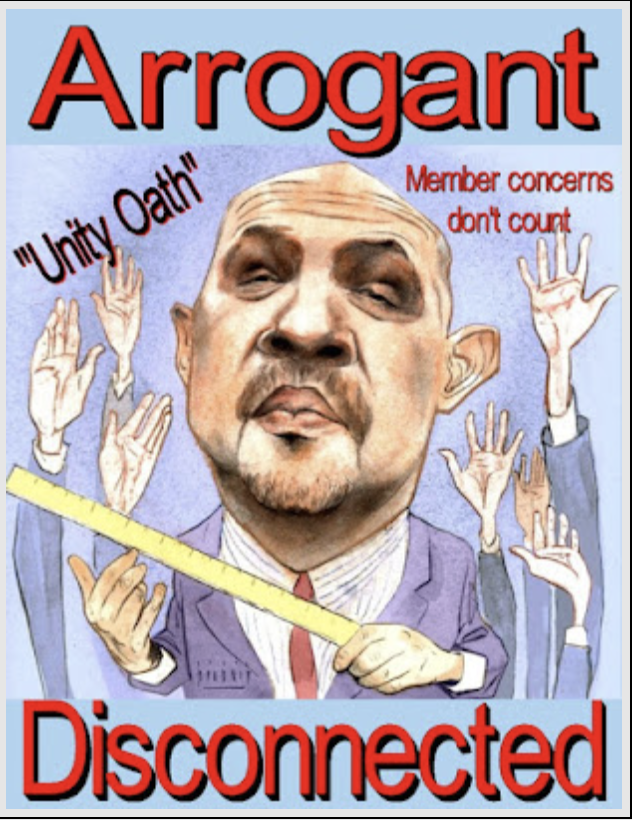
Chaz had no tolerance for bad union policy. He mercilessly went after leaders who he thought put teachers in harm’s way. Most frequently on the receiving end of Eric’s critiques: Michael Mulgrew.
Chaz also wrote about politics. I am a leftist. He was not. I found him middle of the road on many issues, with a slight lean in my direction. But slight. He did not vote for president in 2016. I do not believe he would have in 2020, either. We disagreed quite often. School integration. Foreign policy. Even testing.
But Chaz judged people by what they did, not what they believed. The people he treated with respect had a wide range of beliefs – but they all stood up for teachers, for fairness. For Chaz, fairness was a bottom line.
On April 26 he blogged about school budgets. He had been writing every two or three days, right through the pandemic. Super regular rhythm. Then on April 28, 29 nothing. I noticed on the 30th. On May 2 I emailed him:
No response. Next day I wrote to his former DR, and his Borough Rep. Amy answered on Monday – he was sick, family was being private. And on Tuesday his son announced on his blog that Eric had passed.
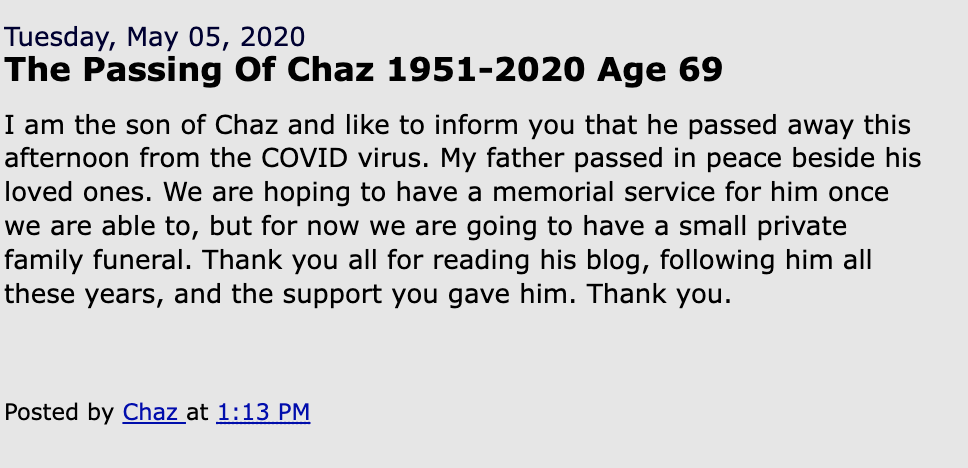
Please click through the comments. Look at that outpouring. And look what they say. About him. Look at all those “little guys” – just regular teachers who depended on Eric for straight information, or who looked to him because he told the truth, or just felt better because he gave them a voice.
Many of us memorialized him. NYC bloggers I regularly read, James Eterno, his former chapter leader at Jamaica High School, Arthur Goldstein, the chapter leader in a school Eric worked in as an ATR, me. Others. Norm Scott. NYC teacher-bloggers recognized him as one of us. Those posts, they all say different things about him. Bookmark this page, and when you have time, read them all.
The UFT was starting a memorial site, and it seemed to me that it mattered, so I filled out the form as best as I could to get the ball rolling. I think James picked up the slack – he knew Eric, personally, and I didn’t, actually.
I like this story: “I remember when I first met Eric, he ran up to me in a diner on the west side. “Jonathan!” He knew me. But I looked confused. “It’s Eric!” Still confused. We had been reading each other’s blogs for five years. And I didn’t know his first name. Hard to recognize him without his light blue background. “
The UFT Honors post for Eric is a nice one. They quoted James and me. And then the editor asked if I wanted to leave a comment. And I scratched my head. All of us had been writing about teacher-blogger Eric Chasanoff. Others had more stories, and better stories than I did. And then I remembered.
Way back when Eric was starting blogging, when he was defending Pluto’s planet status, he wrote something that stuck in the back of my mind. A girl’s basketball coach had a huge star. And against a weaker opponent, they were going to win. But the coach kept the star in, kept his team playing hard, and the final score, 137-32, is painful to imagine.
Chaz wrote:
* Don’t run up the score on an inferior opponent.
* Keep your best players out once it is a blowout.
* Never embarres another team.
* Show class and be a role model for your players.
Undefendable – Eric Chasanoff
And I shared this on his UFT memorial, and wrote “It was that same sense of right and wrong that motivated his defense of teachers. And it is that sense of class, and that dedication to fairness that I will remember.” and Eric’s son, Bryan, responded:
That is a great example of my father and one he lived by. I remember times when he coached my teams that we were up 5-0 in soccer and my father would sub out the best players, switch positions and even run 10 players instead of 11 to try to keep the game as competitive as possible. Our team always won the sportsmanship award every year whether we finished 1st or 8th place.
And everything everyone thought about how attuned he was to treating teachers with fairness, turns out he thought everyone should be treated that way.
Eric shared his choices in UFT elections for the 2010, 2013, 2016, and 2019 elections. He is not around in 2022. And everyone who is voting has already voted – it is too late to change anyone’s mind. So I think it is okay to share how I think he would have voted this time.
His issues would not have changed. But he would have added some great disappointment over how the leadership navigated the pandemic. He would be vocal in his opposition to the Medicare Advantage scheme. He knew science. No doubt in my mind where he would have stood on vaccination. And he would have been delighted that all the opposition groups had come together.
But he would have continued to frustrate me, and vote for individuals, not a slate. He voted on his personal take, on a person’s politics, but more on a person’s character, and most on what that person actually did or didn’t do for the members.
There will be opposition people on this list. But there will be Unity people. And Eric never felt a need to vote for every seat, if he did not have someone to vote FOR. There are names he never encountered before. He might have supported a few of them, but I do not presume to know, and I will not guess on an unknown quantity. But for people who’s names were previously on the ballot I will pretend to know what Eric would have done:
For President: Camille Eterno. He endorsed her twice in the past, and denounced her opponent many times.
For Secretary: LeRoy Barr. I know, right? But Eric endorsed LeRoy before, and endorsed few MORE members in 2019. And remember what I wrote just above.
For Assistant Secretary: Mike Sill. Endorsed twice, including 2019. I’m more sure of this one.
High School VP: Me. It is true, Eric endorsed Janella once. But he endorsed me all four times that he wrote about the elections. And while I complain about his ticket-splitting, in fact he split his ticket more than once to support me, though he did not support most of the people I was running with.
VP At Large Education – by my rule, I should leave this blank. But Gloria Brandman has been such a powerful leader on the Medicare issue, I think she would have won his vote.
Exec Board Functional – I’d like to believe that he would check off all the UFC candidates – but his track record here says he would vote for Norman Scott and no one else.
Exec Board at Large (all based on past performance)
- Jay Werner (UFC)
- Ellen Fox (UFC)
- Mike Schirtzer (Unity)
- Mike Shulman (UFC)
- Greg DiStefano (UFC)
- Mindy Rosier-Rayburn (Unity)
- Richard Covelli (UFC)
- Angela Artis (Unity)
- James Eterno (UFC) – it is just a fluke that Chaz mentioned James just 3 times – in fact, Chaz showed more enthusiasm for James than for any other candidate, ever.
- Peter Allen-Lamphere (UFC)
- Amy Arundell (Unity)
Here is the list of everyone Chaz wrote about voting for:

A pause to remember
I didn’t even know it.
COVID was all around us, dominated the news. Schools had closed, and were now reopening remotely. I was reeling, not only from the “big picture,” but having just lost a colleague of 18 years. It was a car accident, but somehow it felt related to the pandemic. He was visiting a home-bound friend in New Jersey. March 25, 2020.
My father, 82, is the youngest son of a youngest son – and my grandfather had kids late. All my father’s cousins are older than him. Most are gone, but the rabbi in Queens, Moishe Kwalbrun, must have been late 80s. I don’t think we would have recognized each other in the street. But his mother and my grandfather were sister and brother, who arrived together, with their mother, in December 1923. On a ship from Amsterdam. I don’t know how they got to Amsterdam from the Ukraine – maybe a ship from Odessa? I used to hear about Moishe from my uncle, with whom he regularly talked philosophy and politics and probably much more. I learned in May that Moishe died of COVID-19 at the end of March, 2020.
On April 4 a peace officer in my school, a decent guy, a thoughtful guy, a good person who cared about us, died of COVID.
On April 4, 2020 the father of an alum, a housing rights activist, died of COVID.
We have a PS/MS down the block from us (a little further than that, since the by the “block” I mean the reservoir, and there are no cross streets on that side). I coordinate an after school activity with them, and one of the Assistant Principals was my contact, and she died of COVID. April 6, 2020.
On April 11, 2020 Winston, a retiree, a Unity member (who had once run with New Action) but just such a nice decent guy, always with a smile and a greeting and a kind word, died of COVID.
John Horton Conway was my professor for one course. He used to call himself the greatest living mathematician, but stopped making that claim April 11, 2020, Doomsday, when he died of COVID.

On April 16, 2020, a regular member of New Action, long timer, retiree, died of COVID.
These people were unconnected. It felt random. It was disorienting. Left me off balance. And then the numbers slowed, and the news stopped. One week passed. Another.
And then this:
He wasn’t. Blogger, teacher, advocate for those who could not fight for themselves, Eric Chasanoff, died of COVID. May 5, 2020.
Today is the second anniversary of Eric’s passing. I will say another word or two about Eric and my memory of him, tomorrow.
A Necessary Pause
This is a pro-choice blog
We have been consumed with the UFT election. Understandable. It is local. It matters. It is closer than it has been in the past. But the world moves forwards.
Or, in the case of this country, and the Supreme Court, backwards.
Roe v Wade has been the law since I was a kid. Yes, I knew this was coming. No, it was not inevitable. And no, this has nothing to do with Jill Stein.
First take. We need some massive protests, massive pressure on the politicians and the courts.
Second take. We should be combining this with pressure on infrastructure, jobs. But mostly, other aspects of health care. We should be demonstrating to protect women’s right to choose, AND against the Bipartisan Murder of Medicare.
Third take. What sort of country is this, where this is even a question? Even if only a third of the population are against a woman’s right to control her own body… Jeez, what a sick place.
Fourth take. The Supreme Court is not about to make abortion illegal. It is about to decide that the question is up to the states. States rights? That’s a strange set-up, right?
There is something wrong with this set-up
Fifth take. So a country sets up its highest court in a way that makes it highly likely that court will be conservative. And the evidence is there. Proslavery for as long as possible. Antilabor for as long as possible. Anti-civil rights. And where there had been the slightest break forward, where the court began to move away from misogyny, boom, they come right back. I guess the problem is the court? Or the country that chooses to set up its highest court this way.
Sixth take. Who set up the court? Founding Fathers set up a court in a way that almost guarantees it will be conservative. A senate that over-represents rural areas that will be socially conservative, and even backwards. And fifty feudal fiefdoms (they only set up thirteen, but there’s the model), so even if ideas of progress reach parts of the country, smaller and more rural fiefdoms can stop that progress. The fiefdoms are called “states” but I figure you figured it out.
Seventh take. I didn’t answer. Who set up the court so that it was backwards, the Senate so that it overweights the influence of socially conservative areas, and the states, so that backwardness is allowed to fester? That would be a group of white men, half owned human beings as property, and the balance included their bankers and financiers, their shippers and suppliers. They wrote a constitution, which I learned in school was a masterwork of compromise, writing, and statecraft. Might need to unlearn some of that.
So, yes, today we must join the fight for a woman’s right to choose. It is not good enough to protect that right in our City and our State – but across this third of our continent. And we must join to that fight the fight to properly fund healthcare, and to make it available to all who live here.
But we must also cast a distrustful eye on the government, with divided and hard to pin down responsibilities, often leaving the most important, intimate decisions to the most reactionary parts of society. And perhaps with intent. We must review the founding documents, admit they were “defective from the start,” and look for something better.
Democracy—government by the people, or directly responsible to them—was not the object which the framers of the American Constitution had in view, but the very thing which they wished to avoid…The efforts of the Constitutional Convention were directed to the task of devising a system of government which was just popular enough not to excite general opposition and which at the same time gave to the people as little as possible of the substance of political power.
Teaching American History
In the United States at the present time we are trying to make an undemocratic Constitution the vehicle of democratic rule. Our Constitution embodies the political philosophy of the eighteenth century, not that of today. It was framed for one purpose while we are trying to use it for another.
Teaching American History
Friends don’t let Friends Forget to vote
The math is simple. Ballots are due Monday. 9AM. If they arrive Saturday I guess they are safe. Which means mailing them Friday is not a good idea, and even Thursday is dicey.
The UFT text doesn’t warn people that today is probably the last safe day.
Now you know. If you were holding onto that ballot, send it in. Today.
But you know people in your school. How many of them thought they had until Monday to vote? Straighten them out. Friends don’t let Friends miss the deadline.

If Mulgrew wins…
Last week at the Municipal Labor Coalition (MLC) Michael Mulgrew and Harry Nespoli and others resumed disparaging the NYC Organization of Public Service Retirees (NYC OPS Retirees).
Is it notable that Nespoli/Mulgrew are bashing NYC OPS Retirees?
NYC OPS Retirees fought the MLC for public opinion and in the courts, and won the first few skirmishes. NYC OPS Retirees prevented, for now, the MLC’s attempt to force retirees out of Medicare into a private MAP plan (Medicare Advantage Plus).
They helped convince many retirees to question their unions’ leaderships, and a third of retirees to opt out of the plan. (The cost of opting out, $191 per month, or about $2300 a year, is substantial. Retirees on fixed incomes who were willing to spend that much money must have been convinced that Anthem, Nespoli, Mulgrew, etc were lying about MAP being just as good as Medicare).
NYC OPS Retirees won a series of court battles. The latest, on March 2, blocked the City from attaching a price tag to traditional Medicare, while forcing retirees to choose.
Didn’t Mulgrew keep fighting?
No. He announced that he no longer supports the April 1st implementation date (which was now impossible anyhow). He mumbled that “retirees deserve better” – but he wasn’t talking about Medicare Advantage Plus (which he called “sound”) but rather about a better sales pitch and smoother implementation.
Mulgrew mumbled a few words, went silent, and disappeared
And then he went silent. Mulgrew is getting pummeled in the ongoing UFT election over Medicare Advantage. He is avoiding the topic as much as he can.
When a Unity person argues with me, I am ready. They can say “Jonathan, your coalition is crap” and I can answer “Mulgrew and Medicare” and they run away crying.
So for this entire election Unity has avoided talking about Medicare. And they have been trying to hide Mulgrew (canceled events, leaving his name out of the NY Teacher, keeping his face off their leaflets)
And what has changed?
The UFT election is almost over. Ballots are being mailed in. On May 10 they will be counted. Word is that turnout is up, which worries Unity. Unity relies on low turnout to maintain its hold on power. But Mulgrew may have learned that turnout is not up enough to defeat him. Or he may be guessing. Or getting ready. Last week’s episode was probably a trial balloon.
And after the election, if Unity/Mulgrew win?
We now know the direction they will go in. Full out attacks on the defenders of Medicare, starting with the NYC OPS Retirees. Mulgrew, Nespoli and their gang will characterize the retirees as lying and spreading misinformation. They will try to revive claims that giving up Medicare will bring retirees wonderful silver ‘benefits,’ claims that have already been proven false. They will spread rumors and accusations about the motives of the Retirees.
Thursday’s The New York Times article (Medicare Advantage Plans Often Deny Needed Care) or Friday’s Daily News article “Health Plan Hit: City Retirees Risk Loss of Care in Switch” (or Report: Medicare Advantage Plans Wrongly Deny Care, Physician Payments from MedPage, for those of you who refuse to pay for the Times) may have thrown some cold water on the MLC’s strategy, but most likely that will just delay their scheming a few days or weeks. The attacks on the retirees will come.

And then they will propose THE SAME MEDICARE ADVANTAGE PLUS, but with a new implementation scheme. Since the judge narrowly ruled on the opt out – rumor has it that the MLC is planning to find a way to eliminate the opt out altogether, or to take away the choice of traditional Medicare. o
And what can we do?
- Expect the attacks to come. Fact-check each of them (you can do your own research, but I recommend NYC OPS Retirees’ website and NYC OPS Retirees’ Facebook page. There is also the PTPM Facebook page. I think the PM is “Preserve Medicare”). And for those of you in the United Federation of Teachers, there is Retiree Advocate (Facebook) (Twitter) that I highly recommend, and one day hope to join.
- Spread the word.
- Vote! Look, every vote counts in this election. We might still defeat Mulgrew/Unity. And that would stop this plan in its tracks. But even if we don’t, the margin matters. When Mulgrew receives the lowest vote total for a Unity presidential candidate in UFT history, that will send a message. But how low can it go?
The vast majority of late votes will come in for United for Change. And if you mail yours in soon, it will be counted. But far too many, thousands, of ballots never get mailed. Did you mail yours? It just takes two minutes. Do it. Did your friends vote? If you know five people, and you think they all voted, ask. I bet one or two didn’t. Get them to take care of it. And you have just changed your voting power from 1 to 3. You have tripled your voice.
Complacency is our enemy. Information is good for us. Activism is our friend. Because if Mulgrew wins, he’s coming for our healthcare. We will need our collective activism to protect Medicare.
Politics? or Power? 2. Mail-in Ballots
Some of the big issues in the current UFT election are not really about politics, and policy. Some of the issues are just attempts by the current leadership, Unity Caucus, to hold onto power.
How we vote
The American Arbitration Association runs the election. Ballots are mailed to each member, at home. Members check off the slate of their choice, or individual candidates of their choice, put the ballot in an envelope, put that envelope in another envelope, and drop it in the mail.
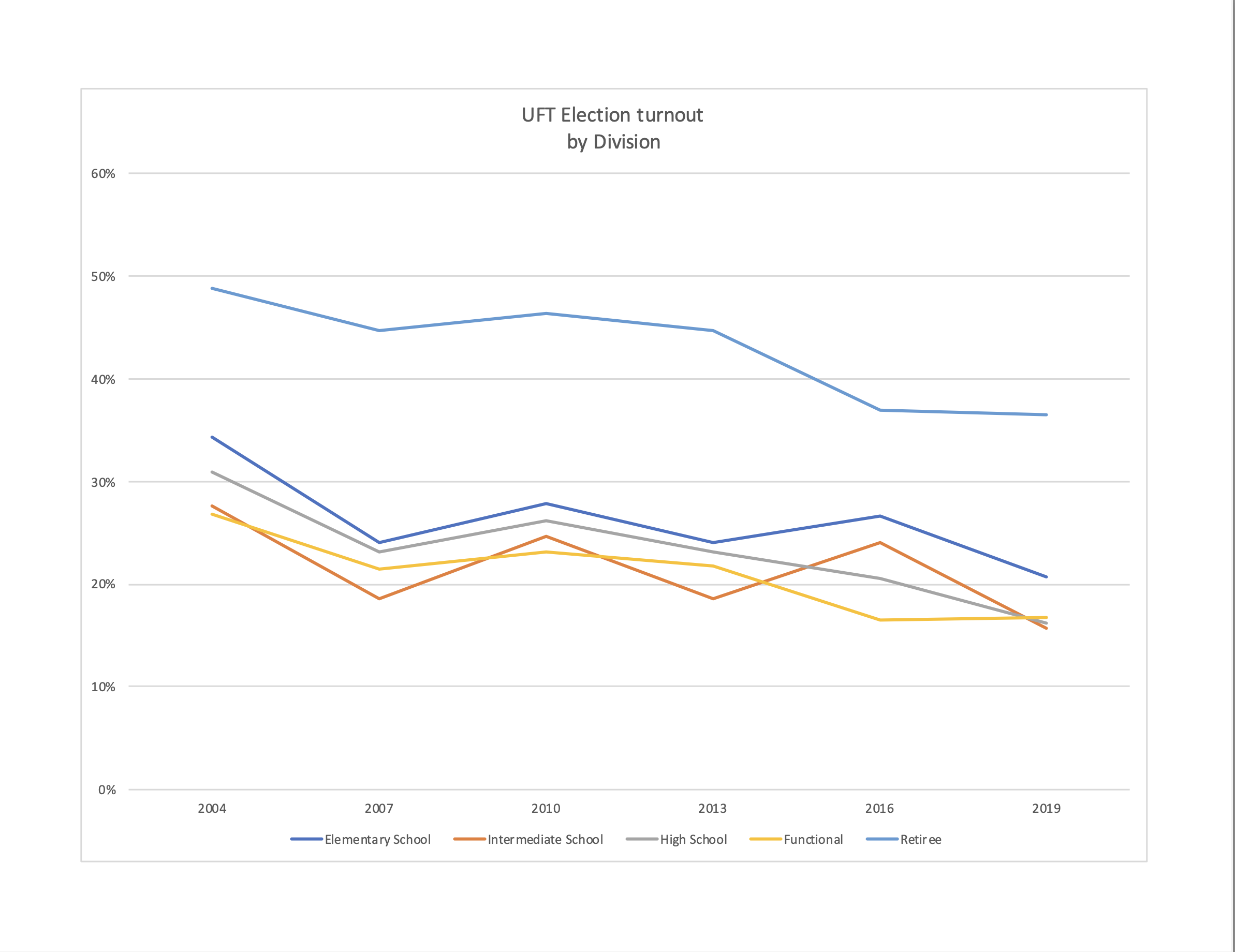
How bad is that? Not terrible. Many members manage to vote. But not good. Many, many more members don’t manage to vote. For every retired member who votes, two more do not vote. For every in-service member who votes, three more don’t vote.
Low turnout
Ballots get lost. People forget. The ballot is 12 pages long with over a thousand names – it can be overwhelming. But whatever the reason, turnout is low.
Turnout is so low, that if these numbers were elections for president of a country, we would wonder if democracy in that country would survive.
Ways to raise turnout
The most obvious step is to move to electronic voting. Electronic voting is easy, and fast, and reliable, and safe. It is secure. At yesterday’s Contractual Empowerment SBO Workshop Michael Mulgrew stated “We are using Election Buddy. Our job is to make it easier for you, the chapter leaders, to do your work.” Election Buddy is what the chapter leaders want, and Unity agrees, for SBO votes. But Unity makes lame excuses for insisting on mail in ballots.
Another approach would be to send ballots to schools, as we do during contract ratifications. When everyone is voting around us, we tend to vote at the same time. Turnout for voting on contracts is MUCH higher than voting for UFT elections.
Who benefits from low turnout?
Unity. Unity is not very popular, but counts on paid staff working the schools to deliver votes from a committed core. They count on winning a committed core, and then having most members not bother to vote. The higher the vote totals, the greater the risk to our current leaders.
We are using Election Buddy. Our job is to make it easier for you, the chapter leaders, to do your work.
Michael Mulgrew, April 27 2022, speaking about SBO votes. In UFT elections, apparently, his job is to make it hard to vote.
Think of it this way. Unity won a large victory in 2019. But they won about 39,000 votes, Solidarity 3600, MORE 2500, and New Action 1500. But 151,000 UFTers did not vote. Unity won with just 19% of the members.
After each election Unity says it will take steps to improve turnout, and then does nothing. Their position has nothing to do with good policy, or good election policy, or good connections with the members or chapter leaders. It has everything to do with clutching tightly to power by keeping the vote totals low.
How can you fight voter suppression?
The most obvious way – vote. Make the effort. Find your ballot. Fill it in. Put it in the secret envelope. Put that in the postage paid envelope. And mail it. If you let them suppress your vote, they win.
If United for Change wins this election, we will immediately change this. We will consider different options to make it easier to vote, and implement what will work. Let’s strike a blow against voter suppression!
Politics? or Power? 1. Vice Presidents
Some of the big issues in the current UFT election are not really about politics, and policy. Some of the issues are just attempts by the current leadership, Unity Caucus, to hold onto power.
Vice Presidents
I am running for High School Vice President. I think I have a good chance to get the most votes from members is high schools. But that’s not good enough to win. Because everyone votes for the HS VP – elementary teachers, middle school teachers, all other titles, and even retirees. Same goes for the Elementary School VP, and the Middle School VP.
Why does this obvious unfairness exist? Each division used to vote for its own VP. But then…
In 1985 Michael Shulman (New Action) beat George Altomare (Unity) and became high school vice president (the full story is longer – Unity challenged their own election, forced a second election that Shulman also won, and thereby delayed Shulman from taking his seat until January 1986). Unity so hated losing this seat, that the next chance they got, they amended the constitution, because they knew their hold on high schools was weak, but their hold on elementary was stronger, and on retirees even stronger.
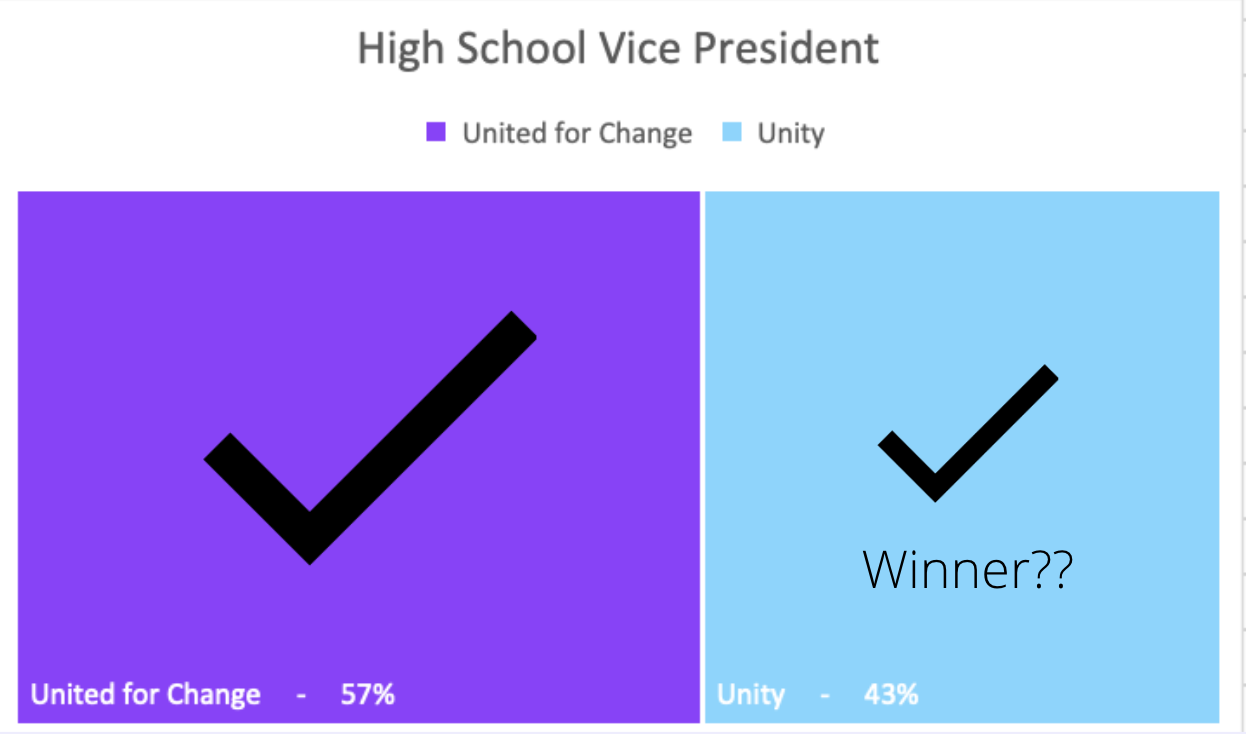
Unity won’t let each division choose its own VP. This is not a position that comes from what is fair, what is principled, or what makes sense. It was a conscious decision to promote power over what is right.
How fair would it be if residents of Albany for NYC Mayor? Then why is it fair for retirees to vote for the Elementary School Vice President?
If United for Change wins this election, we will sweep, perforce, all of the VP spots, and all of the officer positions. One of the first things we will do is take steps to amend the constitution, so that VPs can once again be elected by their own division. Let’s strike a blow for representation and fairness!
Deadline for replacement ballots is Monday 4/25
If you have not yet voted in the United Federation of Teachers elections – there is still time – but not much.
Ballots were mailed to members’ houses. They need to be mailed back and received by May 9.
If you already voted, great!
If you have not yet voted – where is your ballot? If you found it – that’s fine. Fill it out and put it in the mail.
But if you cannot find your ballot… Monday – that’s probably TODAY, depending on when you read this – is the deadline for requesting a replacement.
Call: (800) 218-5524
or
Email: UlerioS@adr.org
The deadline for requesting a new ballot is 5PM Monday (that’s April 25).
What if UFC Wins? #5b – leadership – Policy-Making
The United Federation of Teachers’ leadership structure would change with a United for Change victory. But how?
Last week I printed a short piece with a list of candidates for Exec Board at Large. United for Change was mostly teachers. Unity was mostly full-time for the UFT, or District Reps, in other words, people who are not working in schools today, or are working just one class a day. And I posted in the online NYC teachers facebook page, where it got some attention.
Problem was, I had a point, but the picture is actually more complicated. A few said that once UFC was in power, our list would look the same. Several thought I was asking to make DRs teach a full class load (absolutely not!) Someone said it felt like a cheap shot, and while that was not my intent, it does leave me wanting to share fuller thoughts, potentially to generate real discussion. But in doing so, I want to talk about much more than just the Exec Board.
#5 Leadership Structure
I am the UFC candidate for High School Vice President. If we win I will be one of 12 members of the administrative committee (AdCom) and will help shape the new leadership’s agenda.
I cannot speak for our Coalition – these are decisions that need to be made. But I know our platform, and have a good idea about some decision.
We want greater rank and file voice and control of our union, including of general policy. We want greater union democracy. But how will that look? What steps will we take?
Two Tasks of Leadership
I am discussing two varieties of leadership tasks in the union:
- representing members, and
- making policy.
And I treat them as separate, although there is invariable some overlap. My previous post was about representation. This one is about policy-making.
Setting UFT Policy
- Chapter
- Chapter Leaders
- Officers
- Executive Board
- Delegate Assembly
Chapter / Chapter Leaders
Chapters and Chapter Leaders? Sure. Which SBOs to pursue, and which not to. What goals the chapter sets. What issues deserve priority. A well-functioning chapter actually joins the members and the chapter leadership in making quite a bit of local policy.
But Chapters and Chapter Leaders? You are correct. That’s not what the bulk of this post is about – just didn’t want to omit something this important.
Officers/AdCom
Day to day, the Administrative Committee meets and consults to suggest and implement policy. This is the president, the vice presidents, all the other officers. I think AdCom brings in additional department heads, and others, but I am not certain.
In theory the Administrative Committee carries out the directions it gets from the Delegate Assembly and the Executive Board. In practice, the United Federation of Teachers has been run top-down by Unity Caucus – and the AdCom tells the Exec Board and the Delegate Assembly what to approve.
The officers are directly elected by the membership as a whole. Retiree votes are capped – last time each retiree got something around 0.96 of a vote. Vice presidents are also elected by the membership as a whole, in other words, at large, even when they represent a particular division.
United for Change has not discussed any change in how AdCom is composed. We will propose that VPs be elected directly by their divisions. What sense does it make for retirees to vote on the Elementary School VP, or elementary teachers to vote for the High School Vice President? And we may propose a Vice President directly responsible for retiree issues.
The bigger changes would be in the relationship between the AdCom, the Executive Board, and the Delegate Assembly.
The Executive Board
The Executive Board meets twice each month, September through June. it is the intermediate policy setting body, in theory, and in practice.
In theory, it takes direction from the Delegate Assembly, and sets policy for AdCom. It also takes suggestions from AdCom and forwards them to the DA. It also questions officers on how policy is being implemented.
In practice the Exec Board approves directives from the AdCom, and passes them on. Unity members of the Executive Board generally sit in silence, raising their hand to signal they are voting as they are supposed to.
It is different when there are opposition representatives on the board. I was on the Executive Board for 11 years. Then, hard questions were asked. We would discuss resolutions, sometimes supporting, sometimes opposing, sometimes amending. We would bring our own resolutions. We brought members from schools who had issues that they were not getting help with, to speak at the “open mike.” That did not change the results of most of the votes, but it did change the tenor of the meetings.
But I am concerned today not about which caucus(es) have seats on the exec board. I addressed that question, somewhat, in my argument for proportional representation.
I am concerned with WHO should serve – the composition of the body.
The basics, though the numbers shift between divisions, as the balance in the schools changes from election to election: 12 elementary school, 4 middle school, 7 high school, 19 “functional”, 48 “at large” and the 12 officers, for a total of 102.
Unity tends to bulk up the board with full-time union employees, and with District Reps (who teach one class a day, same as VPs). I decided to underline this point by publishing a list of who United for Change was running, and who Unity was running, for the 48 At Large spots:

Is this an accurate picture? Does it represent a different outlook?
Some Unity supporters pointed out that United for Change is not in power now – we have no full-timers. True.
Some pointed out that District Reps are teachers. True. And that they face the same conditions in schools as any other teacher. Not quite true.
And some asked: is UFC proposing that DRs teach full teaching loads? The answer to that is – No. Absolutely not. It is appropriate and correct and best practice for the District Reps to teach one class, and only one class, to allow them some connection to the classroom, while freeing them for time to engage in representational activity.
So who should be on?
There are two major leadership tasks – representation, and policy-making. The Executive Board makes policy. That does not mean that people with representational responsibilities – one United for Change candidate suggested that District Reps do not belong – I disagree. But nor should there be an expectation that those with represent members are the best people to be making policy. It depends on the individual.
It would be better if more of the decision makers were full time in school members.
But that is not an absolute statement.
Some district reps are good at representing, and that is what they should do. But others may have an interest in shaping policy, in suggesting changes, in fine-tuning what we do. It may turn out that DRs who sit silently on the Executive Board today, actually have valuable ideas to contribute. It may turn out, if UFC wins and DRs come from several caucuses, that there are new DRs who have a knack for policy. I would not presume to exclude them.
Borough Reps even more so. A borough rep gets perhaps the fullest range of pressures and demands – from DRs, from Central, from the special offices, from Chapter Leaders, and sometimes directly from rank and file members. Does that mean that Borough Reps should automatically be on the Exec Board? No. But they are uniquely situated, and might bring good perspective. It depends on the individual.
There are offices in the UFT that run things, or administer programs. Their leaders and top workers serve those programs or offices first. I think each major office or program should be represented by someone who speaks for that office at the Executive Board, but without a say in making policy. I’m thinking foremost about pension, the welfare fund, and grievance. I might also think about political action, if there ever was a teacher in charge again. Their representatives can supply the Executive Board with valuable information – but they should not take seats, should not take part in the votes.
The Director of Grievance comes and gives reports to the Exec Board, answers questions, but does not have a seat. I think that is correct. There are two representatives of the Welfare Fund on the Exec Board. I like Geoff, and Joe has been personally helpful to me when I’ve had issues. But the Welfare Fund should be following the organization’s direction – and should be reporting to us on how things are going. It should not have vote(s) in setting policy. Pension will always have representation on the board through two officers: the treasurer, and the assistant treasurer. But that should be it. In this case there is a third rep on the Executive Board – nicest guy, helpful – this is a Unity person, and I have nothing but good things to say about David Kazansky, and on top of all else just a really decent guy – but that does not mean that reps from departments should be taking seats on the Board.
So, in response to the question, if UFC wins, won’t we have fulltimers on next election? I say yes, we will, but not nearly as many as Unity puts there.
Also, we want people who will speak up.
Further, we should look at the Functional Division. It is an assemblage of reps from many chapters. Some of those chapter are large enough – certainly retirees are, probably paraprofessionals, perhaps others – that they should be able to elect their own representatives. Large groups could be separated from Functionals, making this a more representative body.
And finally, the divisions should be larger, maybe increase each 50%. Guarantee more seats for high schools, for paras, for elementary. And do this by reducing the number of At Large seats.
The Delegate Assembly
In theory the Delegate Assembly is the highest decision making body of the United Federation of Teachers. In practice it has been a rubber stamp for the Executive Board and ultimately, AdCom.
There is no easy fix. Elect officers who are committed to developing rank and file strength would be a good start.
But the basic set-up of the Delegate Assembly is ok. Each school gets a delegate for every 100 or part of 100 members. Each school also has a chapter leader, who doubles as a second (or third, etc) delegate.
There is a problem, structural, with the Retired Teachers Chapter – they send hundreds of delegates, elected in a winner take all election. That has to stop. We need proportional representation for those delegates.
There are issues with disrespect shown towards members, with abuse of the privileges of the chair – but those are mostly not structural issues.
There are issues with rules of order, with the standing agenda, and those are worth addressing. The Delegate Assembly, if it is to set policy, needs a report from the officers that shares needed information. But Unity has perverted this into an hour and fifteen minute ramble. The business portion of the meeting is reduced to about 20 minutes, which is inadequate. Debate is short, and party line, and usually involves a quick vote, if we get to that.
For the Delegate Assembly to even begin to perform its policy-making work, it must have adequate information, and adequate time. This could be addressed by time-limiting the president’s report. It could also be addressed, in part, by restoring Chapter Leader meetings to once a month, separate and apart from the DAs. A long president’s report (still shorter than today), followed by a long question and answer would be valuable. And it would free up DA time to set policy.
Another aside: some schools give up their right to have a delegate, and hand the seat to the DR, who teaches one class in the school. This is wrong. Members should not give up their right to have voice in policy, and being a DR should not entitle someone to a seat on a policy making body.
Setting Policy II
Things today are stood on their head. The AdCom sets policy, and the DA votes yes. In a bottom-up sort of system, real feedback from the Delegates would shape policy, and would help us avoid some of the gross errors that Unity has recently been made. Top-down leads to mistakes – so why do they insist on top-down?
Not allowing people to disagree to speak means having stupid fights over stopping people from speaking. If your ideas are better, let them speak, you answer, and after debate, if your ideas are really better, you will win? Part of the top-down control seems aimed at stopping people who disagree with you from speaking.
Hell, if I were Unity, I’d let me speak. I can be 100% right, and Unity can still signal its faithful and get a lockstep vote against me. I’ve seen it happen, at the Exec Board, where they could not deny me the mike, but could still win every vote 95 – 7. If you can win any vote, any time you want, on any issues – why put so much effort into stopping people who disagree from speaking?
What if UFC Wins? #5a – leadership – representation
The United Federation of Teachers’ leadership structure would change with a United for Change victory. But how?
Last week I printed a short piece with a list of candidates for Exec Board at Large. United for Change was mostly teachers. Unity was mostly full-time for the UFT, or District Reps, in other words, people who are not working in schools today, or are working just one class a day. And I posted in the online NYC teachers facebook page, where it got some attention.
Problem was, I had a point, but the picture is actually more complicated. A few said that once UFC was in power, our list would look the same. Several thought I was asking to make DRs teach a full class load (absolutely not!) Someone said it felt like a cheap shot, and while that was not my intent, it does leave me wanting to share fuller thoughts, potentially to generate real discussion. But in doing so, I want to talk about much more than just the Exec Board.
#5 Leadership Structure
I am the UFC candidate for High School Vice President. If we win I will be one of 12 members of the administrative committee (AdCom) and will help shape the new leadership’s agenda.
I cannot speak for our Coalition – these are decisions that need to be made. But I know our platform, and have a good idea about some decision.
We want greater rank and file voice and control of our union. We want greater union democracy. But how will that look? What steps will we take?
Two Tasks of Leadership
I will discuss two varieties of leadership tasks in the union:
- representing members, and
- making policy.
And I will treat them as separate, although there is invariable some overlap. In this post I will look at representation. I will save policy-making for a separate post.
Representing Members
- Chapter Leaders
- District Representatives
- (Special Representatives)
- (Further “up the chain”)
Chapter Leaders
Chapter Leaders are, for most of our members, the only union representative they interact with. Chapter Leaders are a critical part, the most critical part of our union. They must have a strong link with their members. Members vote for their Chapter Leader. That helps maintain that connection.
There has been a push over the last few years from 52 Broadway to improve how Chapter Leaders report, sometimes to their District Reps, sometimes to Central. I’ll talk about this later. But partially missing from those initiatives and discussions is how Chapter Leaders report to their members – it’s there, but without enough emphasis. There is a system for giving bonuses to Chapter Leaders who do a good job – but the categories measured are all how well the CL reports to Central or carries out directives that Central looks for. Completely missing? There is no value assigned for holding chapter meetings, for distributing minutes to chapter members. It is possible to get a top score (which is worth quite a bit of money, up to $1000) without holding a single chapter meeting or communicating with members.
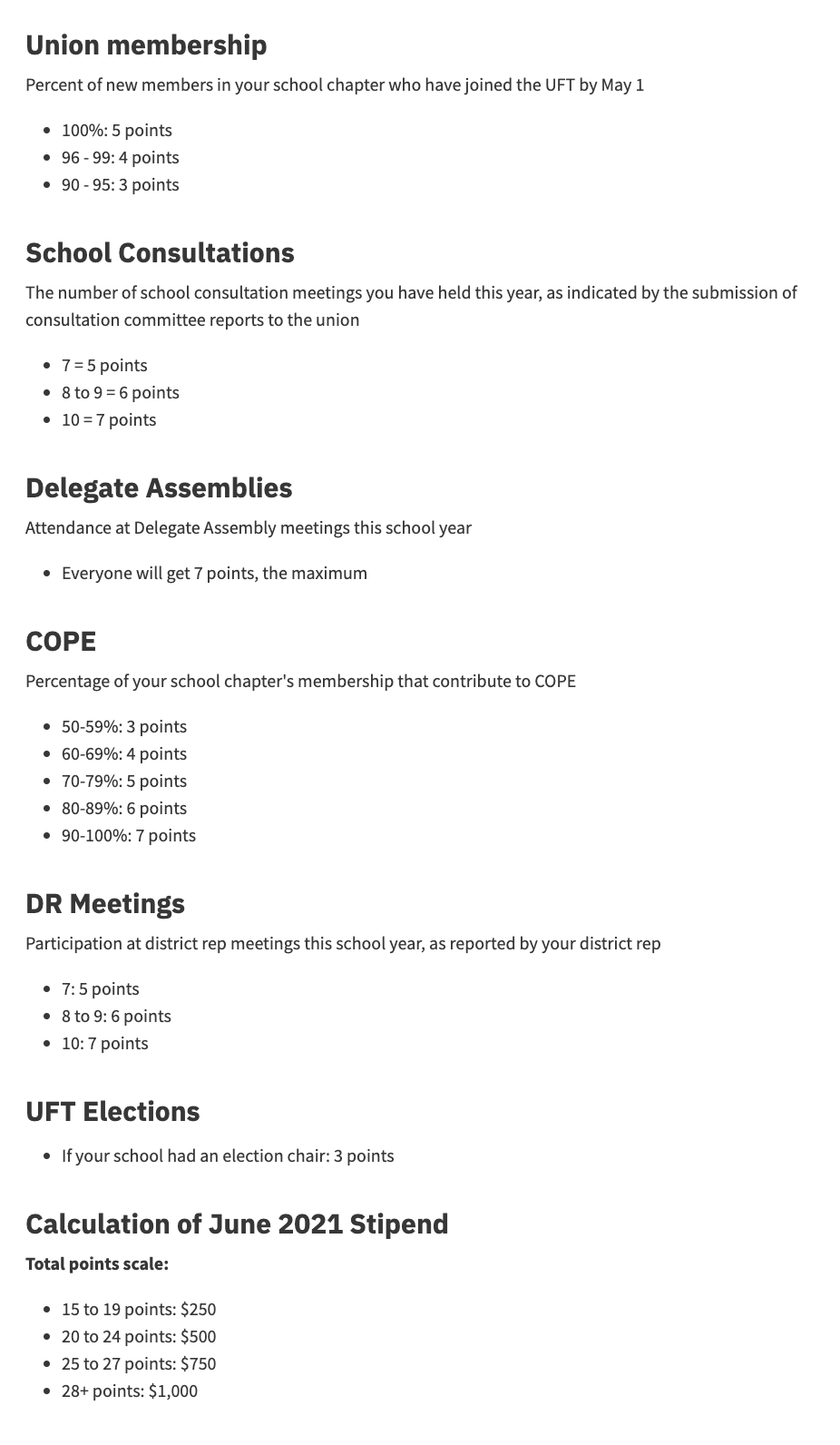
Summary: Chapter Leaders are currently elected by their members. That is how it currently is, and how it should be. There is not enough emphasis on Chapter Leaders communicating with their members (sharing with the members, listening to the members). Most good chapter leaders figure this out anyway, but there should be encouragement from UFT Central.
District Representatives
District Representatives are Chapters Leaders’ first point of contact. I think most Chapter Leaders have their District Rep’s phone number, and use it. When we have issues (I’m saying “we” as a longtime Chapter Leader) the District Rep is the first one we reach out to. When I filed my first grievance for my chapter, not a particular member, and the borough office did not want to take it, it was my District Rep who fought for my school.
If the Chapter Leader is the day to day face of the union for most of our members – who do those Chapter Leader turn to each day? That is the district rep. The link between CL and DR is one of the most critical for the ongoing functioning and health of the union.
Chapter Leaders should vote for their District Reps. This is, in fact, the way things were until 2002, when Unity leadership used a disruptive Board of Education (starting to call itself the Department of Education) restructuring into regions to claim that Chapter Leaders could no longer be organized consistently into districts, so the elections were off, and from now on DRs would be appointed by the UFT president.
The relationship between District Rep and Chapter Leader, this crucial link, was, over time, badly damaged by this change. At first there was no visible difference. But as time went on, we began to lose things. CLs no longer looked at the DR as one of them, as their rep, with access and time. This was Randi’s emissary, or Mulgrew’s emissary, in their district. The DRs stopped depending on needing to meet the needs of their CLs – instead their primary responsibility was to their employer in lower Manhattan. Central sees it too. Look at all the things CLs report directly to central, bypassing the DR. Central has made it possible for DRs to be appointed who are not Chapter Leaders in the district, or not even from the District. There is no respect for the CL/DR relationship.
When I was a new CL, my second DR was appointed, but she would have been elected. She was one of us. And this was Bronx High Schools – we had been decimated by bad DoE policy, including policies designed to force our schools to close. And the union was not always properly understanding, and had in fact participated in some of the voluntary closing of schools. Yes, I am still bitter. But here we had a DR who was one of us, who we trusted to bring our concerns to staff meetings downtown, who would be our voice. But also, when our DR said something was important and had to be done, we would jump to do it. We have few, if any, of those DRs today.
Under the current presidential appointment system, we do have District Reps who serve their members well. But we also have had individual District Reps absolutely ignore the needs of their schools, and stay in the job indefinitely. Such festering sores are corrosive. They breed cynicism within our union. They eat away at this critical link. Under this system, Mulgrew gets 100% loyalty, and CLs may or may not get good representation.
Under an elected system, things would be different. Mulgrew could not count on 100% loyalty from a District Rep. But the CLs would choose someone to represent them. If that person does the job, they’d be reelected. If they don’t, they wouldn’t. Notice, by the way, if the person cannot work with the Director of Staff or the officers, odds are they could not serve their CLs well, and would be unlikely to be reelected.
To be clear, this becomes a representational, rather than a political, position. I’m going to mention a real name here – District 25 DR Lamar Hughes. I don’t think we know each other more than to nod or say hello. I’ve seen his social media during the campaign – not only has it been hardcore Unity, it has been, in my opinion, unfair. I’ll stop there. He might say the same about me. Right, you’ve got the picture. I’ve got a negative assessment of where he stands politically. But if United for Change wins the election and we move to elections for DRs, and if Lamar serves his Chapter Leaders well, I expect that he would be reelected. And if he continues to represent well, I’d expect him to be reelected again, and again, and again. And that is right, and that is good. Because the DR should not serve at the pleasure of the president, but should serve as the representative of their Chapter Leaders, the elected representative of the members in each school.
Think about it. An elected District Rep is a stronger District Rep. And a CL who helps elect their DR will also be more responsive to their DR. They will feel a sense of some control, some ownership, over the broader life of the union.
Summary: District Reps should be elected by Chapter Leaders. But they are currently appointed by Mulgrew. That should change. The link between CL and DR is critical to the health of the union. Steps (beyond election) must be taken to repair this link.
Special Reps
In the early 2000s Bloomberg and Klein created lots of small schools, mainly by destroying large schools. But this meant many more principals, and many more chapter leaders. This screwed with representation. If we went from 25 Bronx high schools to 120, even though the number of members stayed the same, the number of schools, principals, and issues – all soared.
Different boroughs tried different things at different times. But basically, special reps got brought in to spread the load. In some cases the high school district got split between DR and Special Rep. In other cases smaller high schools got spun off to district-based DRs. Some Special Reps got high schools that were tied together by type or size or theme. I experienced several models directly, and learned about many others by speaking with Chapter Leaders in other schools and other boroughs.
One model stood out as the best: In the Bronx, right after the school break-ups, a special rep came in and split the high schools with the DR. But we continued to meet as a single high school district. We preserved that relationship among our schools, our Chapter Leaders, in our borough. And while Lynne Winderbaum was my DR, and Mary Atkinson repped the other schools, there was no problem with me asking Mary something, or someone in one of Mary’s schools running something by Lynne. We remained one district, with two reps. They functioned as a team, and we avoided being fragmented. I should also add, we had pretty good meetings. Attendance could have been better, but the presentations were solid, and the questions and discussion after were rich.
I don’t know from the District Rep and Special Rep point of view if that was a successful model. I would speak to them and ask. But from a chapter leader point of view, that was better than anything that has come since. And from my point of view, better than any models being run elsewhere. If it is reasonable for the Reps, I’d like to see it at least tried in other places. And if Mary and Lynne think it wasn’t so great, I’d like to look at ways of replicating the parts that Chapter Leaders liked.
One issue with members/chapter leaders/schools being repped by special reps rather than DRs would be what would happen if we moved to elections. We (UFC) have not discussed this – and I assume that elections would be in order – but there are important distinctions between Special Reps and District Reps, and maybe we need to look closer at the details.
Further on the Chain
It is not clear to me – maybe someone inside can clarify – how information and representation works between District Reps and – hmm – who? There is a Director of Staff. There are borough offices with Borough Representatives. And there are the officers, including the president. I’m going to leave this piece alone, for now.
But a word about the borough representatives. I do not think
Chapter Leader : District Rep :: District Rep : Borough Rep
is an adequate or an accurate analogy. The borough reps have a broader portfolio than that, which includes, yes, working with DRs, but also tracking many member services, running an office, coordinating events, etc.
Part of the United for Change platform calls for moving to the election of Borough Reps. I disagree with that line in our platform. First, I don’t know who would vote. Second, if we decided, for example, all members in the borough, what would they be voting for? Since the position consists of a wide range of managerial, representational, communication, and organizational tasks, and since the position is not inherently political, I don’t think an election makes sense. We vote for mayor, but not for Commissioners of Sanitation or Transportation – and there is good reason for that. Similar here.
Next
I will follow up with a post on the other side of leadership: Policy Making.
What Difference Would Proportional Representation Make?

How would United Federation of Teachers elections change if United for Change wins this election?
We would raise turnout, perhaps by moving to electronic voting (it works fine for SBOs). District Representatives would be elected by their Chapter Leaders (the system we used to have). Vice Presidents would be elected by their actual members (instead of “at large”), as it used to be.
I wrote about these things yesterday. They are all things the UFT used to do (DRs, VPs) or things we do in another context (electronic voting).
But I proposed proportional representation. That would be new. Why would this be a good idea? (I’m looking, for the purposes of this discussion at Exec Board + VPs only.)
If my only reason was: “There would be more opposition seats” that would be valid for me to raise, but in that case the benefit would only be to me and my allies, and probably shouldn’t be taken too seriously. But there is much more.
Fairness
Proportional representation would be fairer. Needs no explanation. High school seats are usually determined by a few hundred votes, yet the 1000-2000 who voted the other way get zero representation (this goes for opposition, when we lose, or for Unity, who gets shut out unfairly when the opposition wins).
More representative
Well… How can we have a union where one party lost a third of the high school votes, a quarter of the middle school votes, a sixth of the elementary votes, but still win all 102 seats? Only by leaving that third of high school votes, quarter of middle school voters, and sixth of elementary school voters with no representation. Or, think about 2016 – Unity won 46% of high school votes, but got zero seats.
Better discussion
As things are currently, a Unity leader makes a proposal, and then the Unity representative vote yes. There is minimal, if any, discussion. What discussion there is is usually praise. And yet there are people in the schools, not represented by the Unity reps on the exec board, whose ideas are never heard. Having more varied representation would bring some of those voices to the table. This would lead to, conceivably, richer discussion. This would lead to, certainly, some discussion where there is currently none.
Better outcomes, better resolutions
I’d like to give examples, but over the last three years, the timeframe we should focus most on, there has been no opposition on the Executive Board. That’s a bad situation, during this crisis, when proposals and approaches and decisions most needed to be shaped by member input, by a variety of voices – instead Unity reported, and the board mostly nodded and raised their hands.
Unity would have maintained huge majorities in 2019 and 2016 under proportional representation, had we already adopted it. They could have passed anything they liked. But there would have been discussion, conversation, debate, objections. What ideas don’t improve when they are subject to careful review? When the proposers have a chance to explain them, or defend them?
Could Unity resolutions be blocked by a minority under proportional representation? No. Could those resolutions, subject to questioning and debate, be strengthened or improved? Yes. It is a distinct possibility. And this applies to more than just resolutions – everything about our approach to the DoE or the politicians should be subjected to critical review.
Healthy debate will make our resolutions, our decisions, our initiatives better.
Better elections
The level of tension around UFT elections gets high. Much of what is said is invective. There are no debates. In social media there are platform documents from one side, vague promises to stay the course from the other, promotion of personalities. There are also false accusations and cheap shots. I blame one side far more than the other – but I blame the system most of all. The winner-take-all nature of these elections guarantees that scoring points matters much more than treating each other with respect. The stakes are THAT high.
Of course the big prize, the office of president, would continue to be Winner-take-all. There’s no other way. But the Executive Board can be elected on the basis of proportional representation, and that would make a great difference.
With proportional representation, instead of winner take all, we would know in advance that we were going to win some seats, and it would be a question of how many. An opposition caucus would be competing to expand its voice – not struggling to maintain its existence.
For example, in the high schools this time, United for Change would be pretty sure of winning at least 3 of the seats, Unity would be pretty sure of winning 3, or at least 2 seats – and the competition would be over the 6th and 7th seats, not the whole lot of 7.
In the Elementary Schools there are 12 seats at stake. Could Unity get 10? or just 9? or 8?
Every group running would be strongly motivated to run hard in every division. No caucus would take a division for granted. But with the stakes lowered, no caucus would be fighting for survival, just for a larger number of seats. And no caucus would be fighting to control everything, just to increase its margin.
And with those real stakes, but lowered stakes, we would be able to have a clash of ideas, instead of insults. Members would be able to choose between different policy directions, rather than superficial arguments.
Elections could engage members with ideas. Elections could drive member engagement with the union. Elections with proportional representation could make the United Federation of Teachers a better union.
What if…
Take a look:
2016


UFT Executive Board 2019 as it would have been with Proportional Representation (right)
Unity – Yellow; MORE/New Action – purple; Solidarity – green
A third group would have gained voice. Unity would have gained some high school representation; MORE/New Action would have gained some reps at other levels. Overall, Unity would have still won every vote, if they voted lock-step.
2019


UFT Executive Board 2019 as it would have been with Proportional Representation (right)
Unity – Yellow; MORE – red; New Action – blue; Solidarity – green
Unity would have maintained an overwhelming majority on the Executive Board, and would have passed anything it wanted. Yet under proportional representation they would have also heard from other voices in schools.
What if UFC wins? #4 Elections
Elections! If United for Change wins, there will be a whole lot of changes…
And some of them will effect elections.
#4 Elections
I am the UFC candidate for High School Vice President. If we win I will be one of 12 members of the administrative committee (AdCom) and will help shape the new leadership’s agenda.
I cannot speak for our Coalition – these are decisions that need to be made. But I know our platform, and have a good idea about some decisions.
Chapter Leaders
Chapter Leaders are, for most of our members, the only union representative they interact with. Chapter Leaders are a critical part, the most critical part of our union. They must have a strong link with their members. Members vote for their Chapter Leader. That helps maintain that connection.
We serve our members. We are chosen by our members. Election of Chapter Leaders is necessary for the health of our union. United for Change will maintain direct elections of Chapter Leaders by their members.

Strange (maybe?) personal thought: Thirty years ago Chapter Leaders served two-year terms. Was the move to three year terms an improvement? That could be an interesting discussion, though it is not part of anyone’s agenda today. Elections take work to organize. That’s a minus. But they engage members in the union. That’s a plus. And if they tried to move President, Senate and Congress from 4 years, 6 years and 2 years to 6, 9 and 3 – people wouldn’t be so happy. I think this is a discussion worth having, but not today. It’s not obvious to me which way such a discussion would go (but I’d love any discussion that really engaged our chapter leaders).
Delegates to the Delegate Assembly
Delegate election happens along with Chapter Leader Election, and is mostly a non-issue… except…
There are multiple delegates from some chapters. That usually doesn’t matter much – but in larger chapters, especially functional chapters, especially the Retired Teachers Chapter (RTC), that’s a whole lot of delegates.
Last Spring Unity won 70% of the vote in the RTC. Retiree Advocate (today, running wth UFC) won 30%. Unity won roughly 200 delegates. UFC won 0. This is just wrong.
UFC would move us towards proportional representation, at least in the RTC, perhaps in all functional chapters. I don’t know how technically feasible or desirable this would be in school-based chapters. A constitutional amendment may be required – but we would look into that.
District Representatives
United for Change favors a return to election of District Representatives. This will happen if we are elected. It was wrong to move to a system of presidentially appointed DRs. The link between Chapter Leaders and District Reps is a critical one, and making them less responsible to each other was a serious error.
How soon will we make this change? As quickly as we can. I would expect to see elections, fast.
I also think that DRs should be elected from amongst Chapter Leaders in the district (Unity changed those rules). This job should be for people to serve their district, their schools, their members, their chapter leaders. It should not be a “stepping stone” position. UFC has, however, not discussed this at that level of detail.
Interesting question: how many current DRs (all Unity) would win if they ran? If their Chapter Leaders got to vote? Or got to challenge them?
My guess – a third would win. A third wouldn’t stand a chance. And the last third might be interesting.
Vice Presidents
Divisional Vice Presidents should be elected by their respective divisions. This is how it used to be – until Michael Shulman of New Action won the High School Vice Presidency. Unity responded, when it could, by making all VPs “VP at large” and having everyone, all divisions, all functional chapters, all retirees, having all of them vote on, for example, the elementary school VP. The right to elect the elementary school VP should be returned to elementary school teachers.
This change will require an amendment to the constitution. Instead of electing 7 At Large VPs, we would elect: VP Elementary Schools, VP Middle Schools, VP Academic High Schools, VP Career and Technical HS, VP Special Ed, VP Non-DoE, and, finally, one VP At Large.
Executive Board
I can think of three large changes to the Executive Board
- Proportional representation within divisions, and within the “at large” group. It is absolutely ridiculous and actually kind of offensive that these seats are winner-take-all. How can they be actually representative of their division. This is not in the UFC platform, but I think we would have broad agreement. It is not addressed in the constitution, so I don’t know if we would need an amendment, or if it would be better to go another route.
- Separate divisions for large functional chapters. There is no reason that Paraprofessionals must be lumped in with “functional” – they deserve to have a designated division within the Executive Board. Same with Retirees. I do not not know how the rest of UFC thinks about this, but it is worth a discussion. Specific divisions would have to be named – and this would need to be a constitutional change – so if there were support, it would require the full amendment process.
- Increase the size of each division’s representation – and decrease the At Large. There are 12 officers, 42 divisional, and 48 At Large positions. That’s almost half at large? The number At Large should be cut at least in two, while increasing representation for Middle School, Paraprofessionals, other Functionals, etc. This, today, is my opinion alone. But if we are looking at the Exec Board, and considering changes, I would suggest this, and I think it makes enough sense that it would at least get serious consideration.
NYSUT, AFT, and NEA Delegates
We favor proportional representation. These positions are not mentioned in our constitution, but the change to proportional representation should be taken just as seriously for NYSUT delagates as for Exec Board and Functional Chapter Delegate.
How we vote
The current system seems designed to suppress turnout. United for Change would immediately investigate systems of electronic or in school voting, and choose the method most likely to produce a secure election, but also an election with high turn out.
A more honorable leadership would be mortified by the chronic low turnout in UFT elections. In-service turnout has hovered around 25%, and in middle schools has been as low as 17%. Those numbers should have provoked a committee, a study, recommendations, and a new system. They indicate a crisis. Instead, Unity is comfortable with low turnout, as long as they are returned to office.
A United for Change victory will be translated into a voting system that tries to reconnect our disconnected members, that engages the majority of our members in union elections.
So how would this have played out?
Had all these changes been in place before the 2016 elections, there would have been much higher turnout. There would have been more divisions. There is no way to see what effect those things would have had. But what if the system were the same, but 1) VPs were elected by division, 2) Exec Board members were elected proportionately in each division, and at large, and 3) AFT/RA delegates were elected proportionately.
My calculations below are rough, and assume one common method of allocating seats proportionately. The real numbers could have been a bit higher or lower, but would have been close to this.
2016
What happened
Unity won all the officers.
Unity won 100% of Elementary School, Middle School, and Functional Exec Board seats. Unity won 100% of At Large Exec Board seats. MORE/New Action won the High School Exec Board seats. Exec Board total: 95 Unity, 7 MORE/New Action.
Unity won all 750 conventional delegates.
What would have happened
Officers: Unity would have won 10 or 11. MORE/New Action would have won Academic HS VP, and possibly Career and Technical HS VP
Exec Board
- Exec Board Elementary School: 8 Unity, 3 MORE/NAC
- Exec Board Middle School: 3 Unity, 2 MORE/NAC
- Exec Board High School: 3 Unity, 4 MORE/NAC
- Exec Board Functional: 15 Unity, 3 MORE/NAC, 1 Solidarity
- Exec Board At Large: 37 Unity, 10 MORE/NAC, 1 Solidarity
The total for the Exec Board would have roughly been 76 Unity, 24 MORE/New Action, 2 Solidarity
Delegates (rough calculation): Unity 570, MORE/New Action 160, Solidarity 20.
2019
What happened
Unity won all the officers.
Unity won 100% of Elementary School, Middle School, High School Functional Exec Board seats. Unity won 100% of At Large Exec Board seats. Exec Board total: 102 Unity, no opposition.
Unity won all 750 conventional delegates.
What would have happened
Officers: Unity would have won all the officers.
Exec Board
- Exec Board Elementary School: 9 Unity, 1 MORE, 1 Solidarity
- Exec Board Middle School: 4 Unity, 1 Solidarity
- Exec Board High School: 4 Unity, 1 MORE, 1 New Action, 1 Solidarity
- Exec Board Functional: 16 Unity, 1 MORE, 1 New Action, 1 Solidarity
- Exec Board At Large: 40 Unity, 3 MORE, 1 New Action, 4 Solidarity
The total for the Exec Board would have roughly been 85 Unity, 6 MORE, 3 New Action, 8 Solidarity
Delegates (rough calculation): Unity 625, MORE 40, New Action 25, Solidarity 60.
Summary
A Unity victory will lead to more of what we currently have. More backroom deals. More Executive Board meetings with hands being raised in unison, with no real questions or debate. More trashing opponents, and refusing to engage members in real discussion. And whatever policy mistakes they are making today and have made recently, they will continue to do exactly the same. There will be no voice for those who disagree. And, as we can see, those who serve on elected bodies, but were put there by Unity, serve in silence. They serve Unity, not their members.
A United for Change victory would lead to a fairer election system, with more vibrant discussions. We will make sure that minority voices are heard. Eliminating much of the “winner-take-all” voting would help elevate the clash of ideas over the current cheap shots. Proportional representation would not change who wins an election. The majority will still be the majority. But proportional representation would bring significant other voices into leadership. United for Change will welcome serious discussion. We know that that backroom is not the place to finalize plans. We want fuller discussion and debate – which lead, ultimately, to better policy.
I trust our members to consider proposals carefully. I value their thoughts, ideas, suggestions. There will be differences, and some ideas will be rejected. But a union leadership that silences voices in advance, that refuses to hear them, to let them be heard – a union leadership that plots in secret and demands that leaders acquiesce to policy rather than discuss/make policy – that leadership should not be leading.
It is time for a change. Vote United for Change.
United Federation of ________???
Our union represents many school workers – counselors, therapists, secretaries, paras, nurses, and of course teachers. I’ve probably missed some titles. We also represent titles outside of schools. But who do we represent the most of? Teachers. It’s even in our name. The United Federation of Teachers. Maybe it should be United Federation of School Workers – more accurate, if less snappy – but for today, no. We are the UFT.
You’d expect a lot of teachers to be involved in running our union. And that’s what we find – or – more precisely – former teachers who call themselves teachers even though they are no longer in a classroom, no longer teaching. I get that for officers – they need to be on full-time (though the VPs, including my opponent, teach one class a day. That’s a good thing.)
But when we get to the 102 member executive board, there are but 29 designated teacher slots. Who fills the rest? District Reps, who teach one class a day – but usually that “class” is substitute coverage or bus duty. Full timers – people who work full time at the UFT, and out of the classroom.
Is that the way it should be? Is there an alternative?
I compared United for Change (my coalition) candidates for Exec Board at Large with Unity candidates. I think the results pretty dramatically reveal what each group thinks about whether teachers should run the United Federation of Teachers.
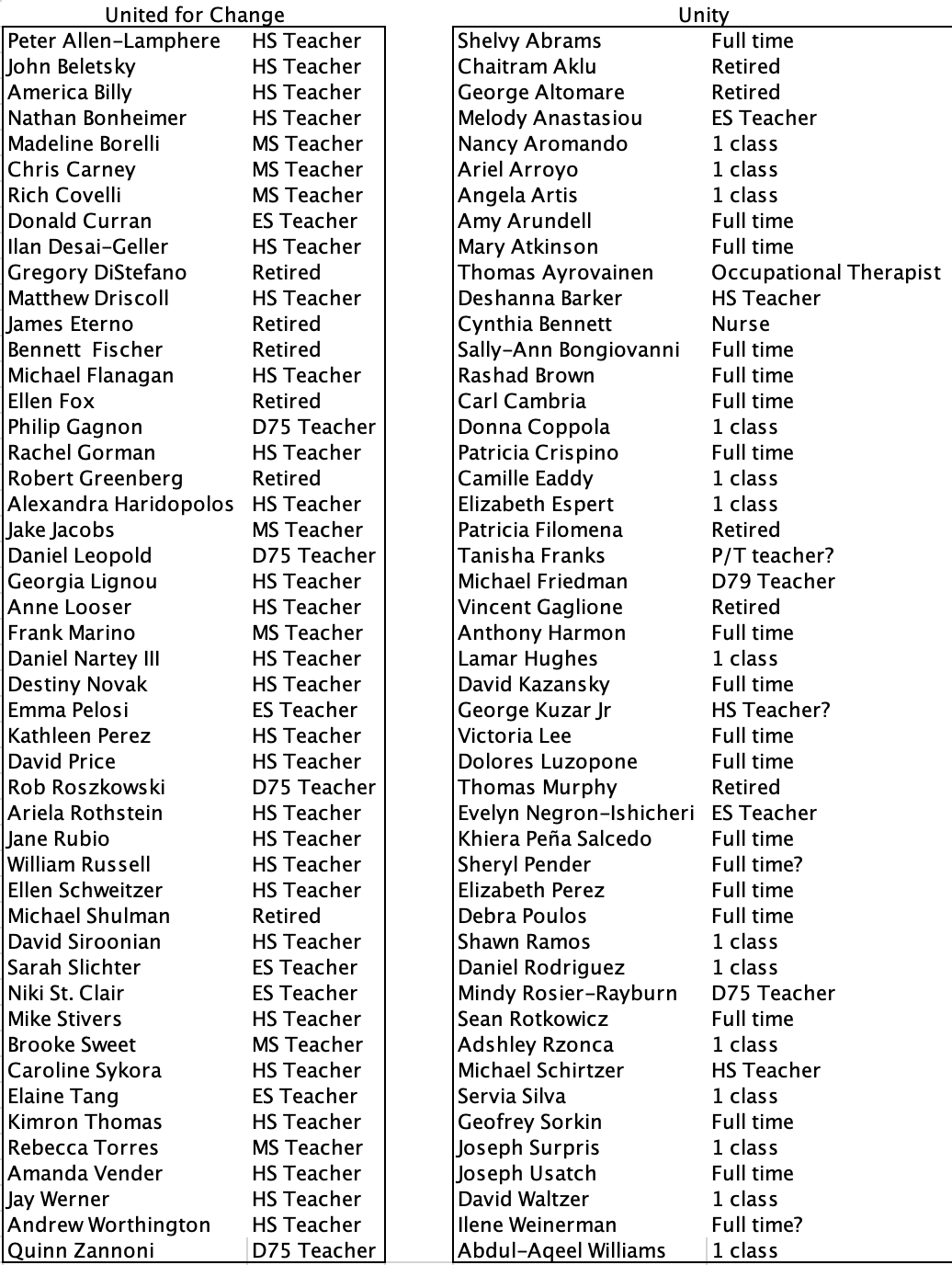
Those “1 class” folks are District Reps – it is possible that some teach a class, but most do sub coverages 1st period, or bus duty. I am unsure of some of the Unity folks – please send me corrections if you notice something wrong. I also might have the level wrong on some of our UFC candidates. Same thing – send me a correction if you notice something.
I think there are some very good people on the Unity side – the problem is not individuals. The problem is the overall – the concept that teachers only have a marginal voice in how a teachers’ union is run.
A United for Change leadership will center the voice of in-service teachers (and paras, secretaries, OTs, PTs, counselors, etc). This is a good change.

Vote for change. Vote for United for Change.
What if UFC wins? #3 $$$
Money!
This is a UFC virtual round table, talking about raises.
#3 Raises
I am the UFC candidate for High School Vice President. If we win I will be one of 12 members of the administrative committee (AdCom) and will help shape the new leadership’s agenda.
I cannot speak for our Coalition – these are decisions that need to be made. But I know our platform, and have a good idea about some decision.
We want raises above inflation. That’s in the United for Change Platform. The City Comptroller is already talking about 0%, 0%, 1%. Something has to give.
How would a United for Change leadership attack this? (and based on their record, what would Unity do?)
The Set Up
Today a Bronx math teacher who is a former Bronx HS Chapter Leader, and my former student asked me:
“How are you getting our raise to adjust to inflation? How could NYC afford that??”
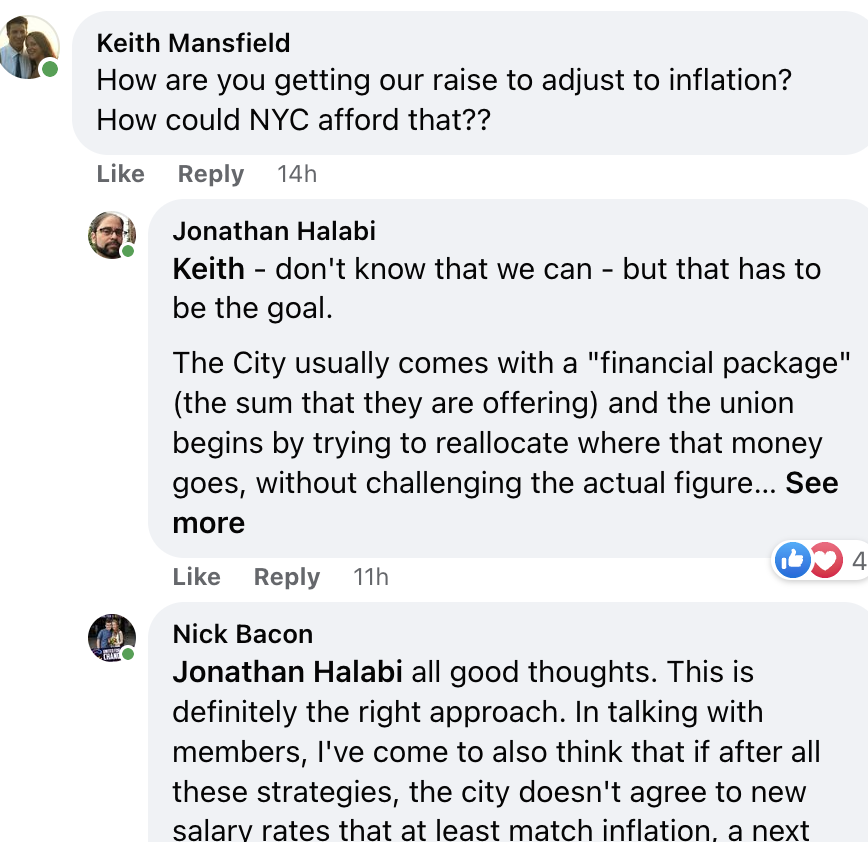
I tried an answer – I ran a little long – it was hard. And then United for Change High School Exec Board candidate Nick Bacon (New Action Caucus) replied. And privately United for Change High School Exec Board candidate Ronnie Almonte (MORE) replied. I publish, below, the question and the three responses, as a sort of virtual round table.
The Round Table
- Keith M – a Bronx math teacher
- jd – me, the UFC candidate for HS VP
- NB – Nick, a UFC candidate for HS Executive Board. I think he will win.
- RA – Ronnie, another UFC candidate for HS Executive Board. He should win, too.
KMS: “How are you getting our raise to adjust to inflation? How could NYC afford that??”
jd: don’t know that we can – but that has to be the goal.
The City usually comes with a “financial package” (the sum that they are offering) and the union begins by trying to reallocate where that money goes, without challenging the actual figure.
So #1, by not accepting the City’s first number.
Unity likes to report on a lowball number from the City, and then after negotiations report on the actual number, which is higher. It’s a deceptive practice, with the members being deceived. Already they have used the Comptroller’s 0% 0% 1% to lower expectations – so what is their intent? Get us to 1% 1.5% 2% and make us feel grateful?
So #2, by not sharing fake numbers with members, or sharing numbers with context.
What happens next is important. The City says “0, 0, 1” and Unity usually says – “lets trade off some savings to the city (give backs) so we can report a larger number” This is done in private, in secret.
#3, we share the City’s offer with the membership, and begin discussions within our chapters, throughout the union, about how we should counter. We do not negotiate in secret.
#4 We could accept 0 0 1. We could accept health care give-backs to raise the numbers to 1 1 2 or something like that (just kidding – Unity might do that, but UFC is not trading away healthcare – never). We could shift the money in other ways.
Unity’s premise has always been, accept the City’s number, but repackage it to make it look acceptable to the members.
#5 We could challenge the budget. The Comptroller’s budget is, in elements, neoliberal. It sees providing service and paying salaries as necessary evils. COVID funding is dropping? The Comptroller looks to see how many people need to be laid off – never what tax breaks to developers need to be eliminated. And the current budget, the biggest single cut is to the Department of Education (one third of the total cuts). We should show the budget to members. We should have our own experts offer alternate City Budgets – A budget for people, schools, for the people of NYC.
There are also alternatives to just using the negotiating table.
#6 A fight to change the size of the package, and to challenge the budget would need to be robust. We could campaign to force the City to raise its offer – work with community groups, parents. We could demonstrate, rally. We could build support within our union, and from our allies. This looks like what more militant unions around the country have done.
This is not a possibility with Unity in charge, with Mulgrew meekly accepting what Adams offers, and seeking to hide from members how small the package really is, or trading away horrible give-backs to make the bottom line look larger.
NB: Jonathan Halabi all good thoughts. This is definitely the right approach. In talking with members, I’ve come to also think that if after all these strategies, the city doesn’t agree to new salary rates that at least match inflation, a next idea is to agree to the de facto pay decreases only under the condition of an end to extended days. Yes, if the city can’t afford to pay us the inflation-adjusted pay rate we agreed to years ago in exchange for Monday and Tuesday time, we don’t just passively accept it; we push to reduce our work week, possibly even starting with this as the only scenario under which an absurdly low pay increase would be accepted. At least then we have time to earn the lost money elsewhere. I suspect that this could lead to buy in from parents, whose kids can currently only do after school programs Wednesdays through Fridays as a result.
RA: This is great Jon, thank you. I would also say that money is always there – NY has the most billionaires in this country, and Wall Street is loaded with dough. Like you mentioned, instead of accepting the city’s figure, we fight for a larger share of the pie. Of course, to do so requires power – something we have less of if we, like UNITY, restrict ourselves to the respectability of the negotiating table. This is why it’s crucial to build a strike-ready union. Our ability to withdraw our labor is our greatest weapon. When we’re organized, we can credibly threaten our use of it. UFC’s priority is to organize our chapters and empower them with transparency and democratic involvement in union business. Our strategy puts us in a better position that UNITY’s to win good contracts.
And?
This is a discussion, not a decision, and not a proposal. There are voices yet to be heard. And yet you see the direction some of us are thinking in. We would welcome your comments, thoughts, contributions. And please, feel free to disagree. The open exchange of ideas (without rancor, if possible) helps produce better policies.
And yes, engaging members in ongoing discussion, and asking members to engage in such discussions in their chapters, that is part of what United for Change intends to do.
What if UFC wins? #2 Medicare
What if UFC wins? How do we save Medicare? How do we keep our Platform commitments around healthcare?
#2 Medicare
I am the UFC candidate for High School Vice President. If we win I will be one of 12 members of the administrative committee (AdCom) and will help shape the new leadership’s agenda.
I cannot speak for our Coalition – these are decisions that need to be made. But I am relatively confident about some decisions.
Overall Policy
The United for Change platform reads:
No Corporate Interests in Education and Healthcare: We will fight to remove private greed from our
United for Change Coalition Platform
profession, our livelihood, and our schools.
● Reverse privatization of Medicare for NYC municipal retirees. No in-service healthcare givebacks.
Support single payer public healthcare.
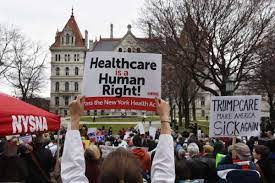
Medicare Advantage Plus
At this moment, the privatization of Medicare (Mulgrewcare) is stalled. There was a successful retiree campaign. And while Mulgrew could try to bring it back, if he is defeated, UFC will not.
In-service Givebacks
There have been in-service giveback in healthcare in the last two contracts. Bigger copays. Forcing new teachers into HIP. Probably more stuff. Reversing those? I don’t know. Could be tough. But if UFC wins we have committed to not bargaining for further cuts. (Notice that language – UFC will not bargain for further cuts. Unity HAS bargained for healthcare cuts. I’ll get to that in a bit).
Single Payer
Support for single payer is the UFT’s official position already. But when the New York Health Act came up, Unity said no no no, we don’t support single payer in New York State, only federal single payer. And then when it looked like the NY Health Act had a chance, Unity joined with insurance companies to actively campaign against healthcare for all – Mulgrew was the most prominent labor leader to support Aetna over New Yorkers.
It will be easy to switch our position back, since it is our official position already. And then there is real work. The current version of the bill does not include retirees who live out of state – we will need to work with bill’s sponsors to correct that before it can pass. (Here I am, saying we should take a seat at the table. That’s usually Unity’s position – and they give up all kinds of stuff to get there. But with the NYHA, Unity has been saying no to our allies. UFC will talk with our allies.)
A little history
In 1995 a 0-0 contract was defeated by the membership. Leadership could have learned “listen more closely to members before proposing a contract.” As chapter leaders, we know this. We should never offer up an SBO except when we are certain the SBO will pass resoundingly.
Instead leadership drew the wrong lesson. They vowed to make the money in each contract look bigger than it actually was.
Swapping time for money under Bloomberg made the percent look higher. It was a trick, an illusion. And it was suggested and supported by Unity.
Offering $1000 or $500 bonuses at the start of a contract gives the illusion of more money, but the one time payments, which now arise every other contract, would easily be quickly exceeded by even the smallest percentage raise.
But the worst is from the last two contracts. To make the percentage increases look bigger, provisions for “health care cost savings” were included in those contracts. The City would put an extra percent or two in active members pockets, and the union would work out a way to guide extra dollars into the stabilization fund to even the score.
But the calculation went sour. The union’s obligation outweighed the City’s. Finding some waste at a hospital or two was not enough. They reworked our insurance to increase copays, to create tiers of hospitals. They forced new members in HIP for their first year. Just a year ago Mulgrew thought changing that to five years was worth looking at.
And it’s still not enough. Fast forward to today, and Unity is looking for extra sources of money. What do they see? A way to make money by playing with retirees’ health care.
We can argue back and forth about Medicare Advantage vs Medicare for today’s retirees. It’s probably an individual decision. (We should not argue about which program would be part of a better society, which we would want for coming generations.)
Is there a problem today?
What would UFC do? We would need to look at the actual finances of the Stabilization Fund.
How bad is the situation? I don’t know. And I don’t take Mulgrew’s word for it. We will look. We will let our members see. We will bring in experts to look.
And together, openly, we will decide if there are immediate steps that must be taken.
But we will not know until the real information is out in the open. And the only way to get there is to change our leadership.
What if United for Change wins? #1
What if UFC wins? Should we clean house? Or tidy the corners?
#1 Personnel
I am the UFC candidate for High School Vice President. If we win I will be one of 12 members of the administrative committee (AdCom) and will help shape the new leadership’s agenda.
I cannot speak for our Coalition – these are decisions that need to be made. But I am relatively confident about some decisions.
What about people? How will we marry the need for change with the need to keep the union functioning?
Officers
Obviously all of the officers would be replaced. The current officers would return to teaching, or retire. When Michael Shulman (New Action) beat George Altomare (Unity) for high school VP, Unity sued, won a new election, and Mike won again. Then George retired. But who knows – some of these officers might be more comfortable returning to the classroom.
District Representatives
District Reps are easy – it is a UFC platform priority to return to election of DRs, presumably as before, by Chapter Leaders. There might be details to work out, but this could happen pretty much right away. I am not sure if that call belongs to the President, the Staff Director, or AdCom, but it is one decision or one quick vote. The fascinating part – which current District Reps would run? And which current District Reps would win? There are some who are genuinely popular with their Chapter Leaders and provide good service, who would win, and some horrible DR’s who should save themselves the embarrassment. But which are which, and what of those in the middle?
Vice Presidents
VPs are currently elected at large – but it is another priority to have VPs elected by division. That process is more complicated, requiring a constitutional amendment – and probably would take months – and would take effect for the 2025 elections.
Employees in the Departments and Boroughs and Offices
The practice of hiring people based on political loyalty (or caucus membership) and not competence or ability to serve the members – that Unity practice would be immediately ended.
But that does not answer the question of current employees.
What would happen to the UFT employees in the offices and departments – both at central, and across the five boroughs? Huge question, and one that is not in our platform, and not up to me alone.
The union would require major change – but the union would also need significant continuity. We must continue to function. Questions of who have been serving our members well, and who have not, would be a big part. Also who is willing to work with new leadership, and who is not. And who is willing to follow new policies, and who is not. Again, this is not my call, but I have a strong opinion
I’ll say this: Much of the full-time staff was hired because they were loyal to Unity. But membership in Unity should not, in and of itself, be disqualifying. That’s my opinion.
Would there be a process of reapplying for those jobs? Or general performance reviews? Would this happen right away? Or after some time? Would some jobs be exempt? I can’t say at this point.
I can see the argument that clerical positions are not political. And on a related note, I’d like to see the “call center” eliminated, and a return to retired UFT members on the switchboards. Contracting out is gross. That our union does it sickens me. Every time I hear about members lost on hold, my blood boils.
It is my opinion that, today, competence is not spread evenly through the offices and the boroughs. The amount of change would necessarily vary.
Think of it this way – there are highly competent people who joined Unity as the only route they saw available to do work on behalf of members. And there are others who joined Unity as a stepping stone to doing less work than a classroom teacher.
Does this imply that a clear majority of those working for the UFT today would still be working for the UFT after a UFC victory? Perhaps.
A specific category of interest would be the Special Reps – appointed and unelected. There is a wide variety of people in those roles – from the very valuable, to some others… I can think of people that I could not imagine capable of adequately serving our members. And I can think of people who no one would possibly want to lose.
There are high profile names who members speak of highly. I am not embarrassing anyone by calling them out here – but there are definitely people I trust, and many members trust, who should remain central to the functioning of the UFT.
PM Staffers
What about PM Staffers? These are full time DoE employees, UFT members, who have after-school jobs at UFT central or a UFT office. Many work in borough offices.
These are full of aspiring Unity loyalists – many who are looking for a route to a better job. But there are also those who are quite valuable to our members. I would be in favor of a process of reviewing all of these many appointments, and changing some, but aggressively confirming that those who provide valuable service to our members will continue to do so.
And again, going forward these jobs would be properly posted, and open to any UFT member. The days of hiring based on caucus, with a UFC victory, will be over.
Staffing
Big picture: Is the UFT overstaffed? Or is it understaffed? Or just right?
That’s a good question to end on, because I know the answer.
The answer is, today we do not know.
First step would be to name a committee, or a person, but probably a committee, focused on staffing questions.
And one of their first tasks would be need to be a full review – of staffing levels, and of what that staff does.
Last Note
These are my thoughts/opinions. DR and VP election is in the UFC platform. The rest need to be decided. And I am writing about policies and decisions, some of which, if the UFC wins, will be made without me. Some, I may participate in deciding. But I thought it was worth sharing a few thoughts as ballots start reaching members.
Playing with Doomsday in Math Class
John Horton Conway died of COVID-19 on April 11, 2020. That was a Saturday, as my Number Theory students will tell me.
This past week I taught them about Doomsday, Conway’s quick mental date calculation tool. It was fortuitous that we reached “applications of congruence mod Z” around the second anniversary of his passing.
Here’s how it works: January 3, February 28 (or January 4, February 29 in a leap year), April 4, May 9, June 6, July 11, August 8, September 5, October 10, November 7, and December 12 all fall on the same day of the week. (Go now and check your calendar, if you need to. I will wait). But that’s a pretty awkward looking list. Let’s try again:
4/4, 6/6, 8/8, 10/10, and 12/12. There’s the evens.
Now, if you remember “working 9 to 5 at the 7/11” you can get the odds:
5/9, 7/11, 9/5, 11/7. Nine to five, backwards and forwards. Seven-eleven, backwards and forwards.
That leaves February 28 or 29, or, as I call them, March 0.
And finally January 3 or 4, but I’ve got nothing cute there.
So the day of the week 1/3 (or 4), 3/0, 4/4, 5/9, 6/6, 7/11, 8/8, 9/5, 10/10, 11/7, and 12/12 fall on is the same in any year, and Conway called that day Doomsday, and called days that fell on them “Doomsdays.”
So if you knew that Doomsday 1999 (in class we paused here to play the song. We like our math with some cultural enrichment) was a Sunday, you would know that, for example, 12/12/99 was Sunday. And with a little ingenuity, add 14 and the 26th was a Sunday and subtract 1, 25, and Christmas 1999 was a Saturday. (pause here so you can look it up). The 4th of July? Well 7/11 is Doomsday, Sunday in 1999, so exactly one week earlier was also a Sunday. Veterans Day? November 11? Well 11/7 is Doomsday, Sunday in 1999, so four days later (or three days earlier, if we are clever) is Thursday. And Labor Day? I bet you get that one easy.
So how do we get the Doomsday for a particular year? There are 4 parts to this little calculation:
- If it’s a 20xx date, start with Tuesday (not for Two thousand, but that’s a good way to remember). If it’s a 19xx date, start with Wednesday (I have no good way to remember)
- Then look at the xx part of the date, and divide by 12. How many times does 12 go in? Add that to the day from part one.
- When you divided by 12, what was the remainder? Add that to the day in part 2.
- Take the remainder from part 3, and divide by 4. How many times does that go in? Add that to the day in part 3.
We need an example: 1957.
- It starts with 19, so W
- 57 divided by 12? 12 goes in 4 times. Add 4 to Wednesday (or take away 3) = Sunday
- When we divided 57 by 12, what was the remainder? 9. So add 9 to Sunday – but wait, add 7 then 2, either way, Tuesday.
- The remainder from part 3 was 9. Divide that by 4. And 4 goes into 9 two times. So Tuesday + 2 = Thursday. Done.
Doomsday 1957 was Thursday. Halloween was Thursday. September 5 was Thursday (so September 2 was Labor Day).

Another example: 2020:
- It starts with 20 which sounds like 2, Tuesday
- 12 goes into 20 once, add one to Tuesday. Wednesday.
- 20 divided by 12 has a remainder of 8. Which is 7+1. Add a week to Wednesday. Still Wednesday. Add one more. Thursday.
- The remainder in part 3 was 8. Divide that by 4, we get 2. Add 2 to Thursday = Saturday
Doomsday 2020 was Saturday. March 13? Well March 0 was doomsday, Saturday, so two weeks later, March 14 was Saturday, and the day before that was March 13, which must have been a Friday.
And April 11? Since 4/4 is Doomsday, Saturday, April 11 is also Saturday. And also Doomsday. Which in a strange way is appropriate for the date of Conway’s passing. At least it would have given him something to boast about.
By the way, I didn’t ask you to check March 13, 2020. Most of us already know by heart, that was our last regular Friday in New York City Public Schools before the pandemic closure.
Anyhow, by the end of the week I was pretty sure my students had annoyed many of their friends and family members by practicing their Doomsday skills in the cafeteria and at the dinner table. Today I looked straight at the class: “What’s today’s date?” “April 8” “Friday!” (weird pause) “Am I right?”
Just silly fun. But I showed them video of Conway describing his method. I remembered, and that mattered to me.
A two year memorial is not usually a thing, but March/April 2020 were such a trauma that it is important. I sent out a reminder to our staff a week ago, we passed the two year mark for a colleague, and also for a peace officer who worked in our school. And I commit to remembering my other fallen friends, colleagues, relatives over the coming few weeks. Some people want to move forward, and close that door, but it is too soon to forget.
And that’s something small, but significant, that I’d like to address, if we sweep in the elections (I know, I know, long shot, but we’ve been challenged to think). I have been to maybe 150 – 200 Delegate Assemblies. I must have attended 200 or so UFT Exec Boards. How many moments of silence have I stood for? No idea. 50? 100? 200? I think all but a handful, literally a number I could count on one hand, have been for members of Unity Caucus. If we win I swear that I will push us to recognize good people of every caucus, and people of no caucus.
Memory should outweigh politics.


