Who will negotiate better paraprofessional pay in NYC?
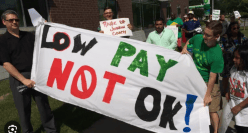
Raises for teachers in NYC are about to kick in. And raises for secretaries. And for counselors. And for paraprofessionals. And for every other title within the NYC Department of Education that is represented by the United Federation of Teachers.
But the raises are not all the same. Paras near the bottom of the scale will get raises of $800 a year. Some teachers, also UFT members, will get over $5000. I am NOT saying that teachers should get less. I AM saying that paras should not get less.
It’s tough making it on para pay. And then a tiny raise on top of it? Many paras are already in desperate financial situations. Living in NYC on under $32K? That’s tough. Lots of second jobs, third jobs, and scraping by.
Is the City screwing the Paras?
So why is the City intentionally screwing the paras? Or is it?
Unity Caucus and the UFT President, Michael Mulgrew, a member of that caucus, claim that the City screws the paras by insisting on “the pattern” and that “the pattern” means that everybody gets the same percent raise.
The “pattern” is a problem for us. It really harms all of us, all City workers. But it’s not “the pattern” that’s screwing the paras. Let’s dig in.
And “the Pattern” is…
“The Pattern” is the size of the financial package that goes to a bargaining unit in city/labor negotiations. When a contract is done, the City proudly announces that it is “pattern conforming” – that’s about the grand total, not about any individual title. That sum, often hundreds of millions, or for some unions, over a billion, is hard to fathom.
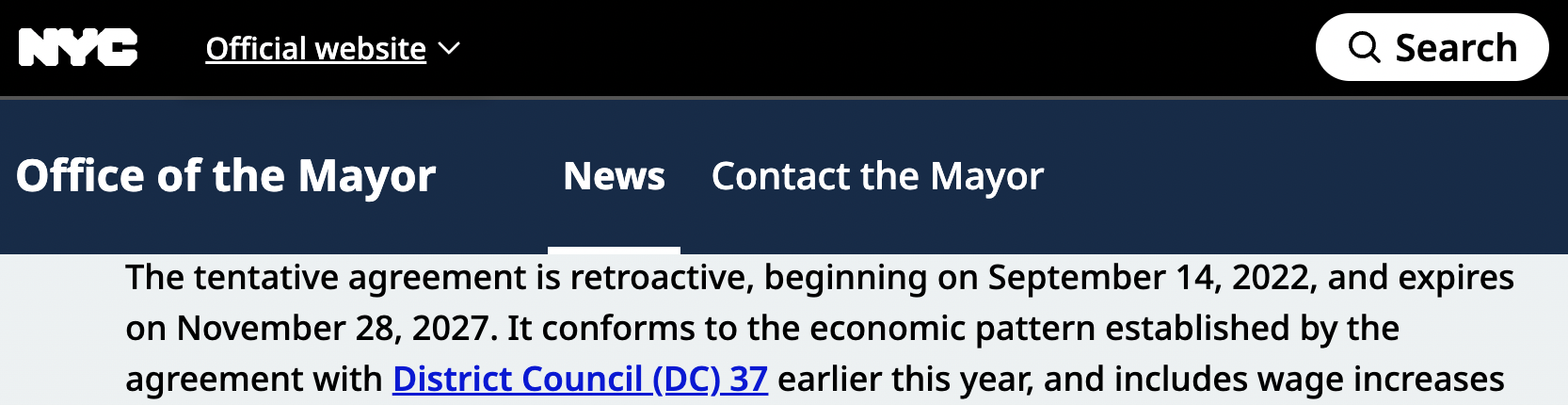
It is easier to understand as a percent. In 2021 DC37 set a pattern. The real number was an overall percent, and represented billions of dollars. But it was expressed in the headlines as 3, 3, 3, 3, 3.25%. Easier to understand, especially as that’s what hits your wallet. But notice, that DC37 agreement was not the 3, 3, 3, 3.25, and 3.5% of the UFT agreement.
How can different percents conform to the same pattern? Each contract had an overall dollar value, and each involved additional money.
- DC37 had a flat ratification bonus ($3000, non-pensionable, but still with a $ amount attached)
- DC37 had a fund to raise the pay of their lowest paid workers (effective mid-contract they set an $18/hour minimum).
- The UFT had retention payments (bonus money, non-pensionable, but still with a $ amount attached)
- The UFT agreed to a Virtual Learning Program (which the City counted as a cost-cutting program)
There were more items – I’m not sure which were most significant. Apparently the percents can be altered.
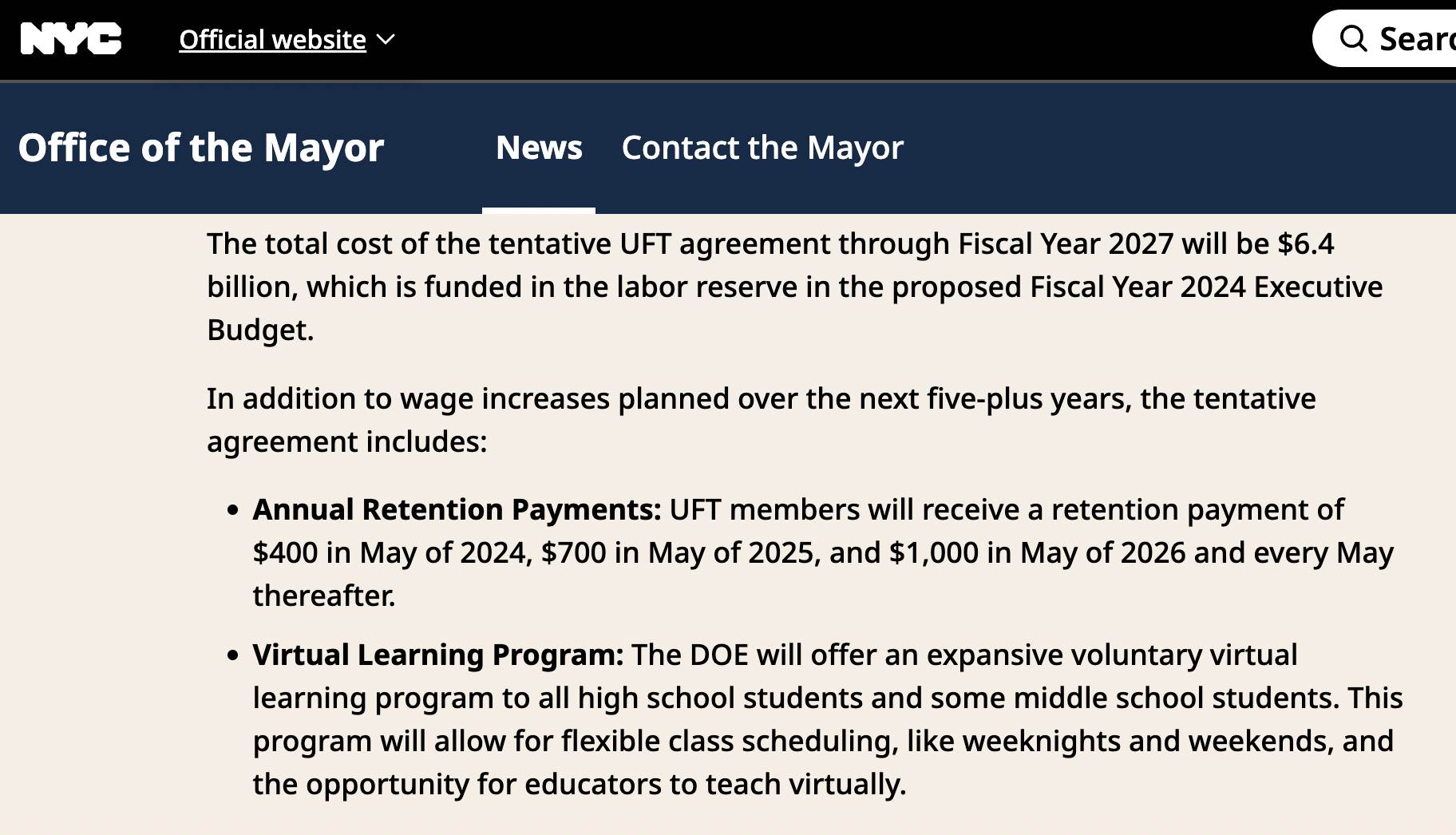
The pattern, according to the City, held. That’s because the total cost to the City for each bargaining unit moved the same amount. That’s not about any individual’s wages.
In the 2005 UFT contract, the percents did not match what we were told was “the pattern” – not close. Teachers worked extra time, and the City paid for the extra time. That was a trade, not a break in the pattern. Does the City believe that every city worker should be getting the same percent increase? Or that the overall monetary value of the agreement with each bargaining unit conform?
Later in the decade there was concern about retention. Again the UFT negotiated something different – a five year longevity payment (we still have it) to bump up pay at the point when teachers were in danger of quitting. If we looked at percents, different teachers received different amounts. Every teacher with at least 5 but less than 10 years got a bigger percentage than other teachers. But it was a “pattern conforming” agreement.
At one point under Bloomberg the City offered bigger teacher raises, by freezing pay for counselors and paraprofessionals. We (rightly!) said absolutely not. But what does that say about Mulgrew’s interpretation of the pattern? Does the City believe that every member must get the same percent?
The Pattern IS a problem
The pattern means that when the City negotiators sit down with negotiators for any individual union, they do not intend to bargain over the overall value of the contract. And each union accepts that. I would like to dig deeper. This seems really wrong. But it seems to have been established in City Law.
We need more experience here. I’m not a law-expert or whatever you call those things. But it looks like we (NYC) have a NYC Collective Bargaining Law passed the same year as the Taylor Law. Among other things it establishes a requirement for “good-faith negotiations” on mandatory bargaining issues, – and courts and arbitrators have found that establishing a baseline economic pattern is legally defensible as a good-faith negotiating position—reflecting the city’s overall budgetary constraints and fixed pools of funds—provided the city does not outright refuse to listen or negotiate unique non-pattern issues with individual unions. Doesn’t make it right. I’ll keep digging. And would appreciate help from anyone with deeper knowledge.
I do know that under extraordinary circumstances, unions have a process that allows them to break the pattern. TWU did that at least once. And we could try to make the case that miserable para pay is such a circumstance that justifies breaking the pattern.
But the bottom line is that when a union sits down with the city, they already know how much money they are going to get – their job is to distribute it. Most goes directly into wages. Lately they’ve been diverting some into bonuses (bad choice – the number looks bigger for the day the bonus arrives, but leaves base pay – and ultimately a lifetime of pensions, lower). But money goes into other programs and payments. The City costs out everything. Next time the union offers a giveback, ask how much extra wage increase we got in return; that’s exactly how it works. Time for Money (2005) was obvious – but those trades happen in every negotiating round.
Our Union has been the problem, too
How come some UFTers get $5000 raises and other UFTers get $800 raises? First – try to get $5000 for everyone. That is the right thing to do. The best approach. And if not, get the biggest raise for everyone possible.
But that is not the UFT’s approach. This goes back to Shanker. Biggest raises for the people making the most. Corollary? Smallest raises for the people making the least. Not ok. Not remotely ok. This is a pattern, but it is not the City’s pattern. It is Shanker’s, Unity’s, and sadly the UFT’s.
Best response: negotiate the biggest raise possible – the same number, the same dollars and cents – for everyone, across the board.
That would be much, much fairer. And it might light a fire to get us moving on trying to break the pattern.
Mamdani says he wants to address para pay. Now our union leaders need to rise to that challenge – negotiate a fair contract for our paraprofessionals.

 JD2718