4 new articles on Teach for America / (no more TfA here, please)
New article by Barbara Miner on TFA.
Looking Past the Spin: Teach for America
– – — — —– ——– ————- ——– —– — — – –
And from the Great Lakes Center for Education Research and Practice:
Teach For America: A False Promise
June 9, 2010
– – — — —– ——– ————- ——– —– — — – –
Here’s a new book:
Learning on Other People’s Kids
Becoming a Teach For America Teacher

Barbara Torre Veltri, Ed. D, Northern Arizona University
– – — — —– ——– ————- ——– —– — — – –
Professor Su Jin Jez, of Sacramento State’s Public Policy and Administration Graduate Program, has coauthored an education policy brief titled, “Teach For America: A Review of the Evidence.”, but I can only see this review (the brief seems to be locked from outsiders)
– – — — —– ——– ————- ——– —– — — – –
And my thoughts?
They leave. Usually in two years. By design.
In neighborhoods where schools are one of the few stable institutions, they destabilize them.
They collaborate poorly.
Most carry sharp anti-union animus.
The make our faculties whiter. Younger. Richer.
They keep jobs from those who would stay and work to improve a school.
They almost guarantee that a brand new teacher will be in the classroom two years down the road.
– – — — —– ——– ————- ——– —– — — – –
There is a cost to a school – regularly replacing teachers.
There is a social cost to a school and a community – lack of stability.
There is a cost to the system – we actually pay TfA to supply these temps – and we pay more than for a regularly certified teacher.
Part of what we pay TfA goes for anti-union propaganda. Some may go for pro-test-prep propaganda.
– – — — —– ——– ————- ——– —– — — – –
Were there a teacher shortage, perhaps the case could be made… but probably not.
But we have no teacher shortage here in NY. We have a retention problem. And TfA is part of that problem.
TfAs leave their schools. I read a few days ago about another one. But it’s not some scattered anecdotes – 2 years and out is the norm.
Even the TfAs who (oh, the horror) keep teaching? They rarely stay at one school. Three I know personally, still teaching, something amazing like eight years. And one has been stable (only two schools). But the other two? 5 schools and 4 schools.
Last year was the Freeze. Few TfA got in. this year the Freeze continues. So again, few should get in.
But there is no need for TfA. Not in NYC. They should not be hired here. Even after the Freeze lifts.
– – — — —– ——– ————- ——– —– — — – –
(TfA teachers, once they are in, are teachers like anyone else. They need to be nurtured and protected, same as we would for any new teacher. Hmm. Same as we should for any new teacher.)
(This post is not about NYC Teaching Fellows. Not the same beast.)
June 2010 Integrated Algebra Regents Part IV
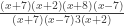
37. Express in simplest form:




38. See photo.
 I would recommend creating a table to show how many students in each interval:
| Interval | frequency |
| 41 – 50 | 2 |
| 51 – 60 | 3 |
| 61 – 70 | 5 |
| 71 – 80 | 8 |
| 81 – 90 | 6 |
| 91 – 100 | 6 |
Number of students? 30. Could have read that from the original cumulative frequency histogram.
Higher than 70? 8+6+6 = 20
Median? That’s the 15th/16th students (from top or bottom, same person). Has to be sitting in the 71 – 80 interval (12 above, 10 below)
Same frequency? 81-90 and 91-100 both have 6.
39. On the set of axes below, solve the following system of equations graphically for all values of x and y.


I’ll describe the graphs, but I don’t know how to show the result.
The second graph is a line, slope is negative 2, passes through (0,4). Toss (1,2) and (2,0) on the graph, use a straightedge to connect them and extend to the edges of the graphing area provided.
The first graph is a downward-opening parabola. I have 4 points to start with: (0,12) (easy), (-6,0) and (2,0) (solutions) and (-2,16) (vertex). Throw in (-4,12) (from symmetry) and connect the five points. Should look ok.
We’ve got (2,0) as the first intersection. Check it if you like (good idea, even though they didn’t ask you, but we already know it works in both equations). And it looks like (-4,12) is the second point. We know it works in the parabola. Good idea to check in the line (yup, it’s good).
Circle the intersection points (I would)
Write: “The solutions are x = 2, y = 0 and x = -4, y = 12” or “… are (2,0) and (-4,12)
June 2010 Integrated Algebra Regents Part III
34.
Given: A = {18, 6, -3, -12}
Determine all elements of set A that are in the solution of the inequality
There are two good approaches:
a) Plug in each value
b) Solve the inequality for x
a)
18? 
6? 
-3? 
-12? 
Therefore only -12 is in A and is a solution to the given inequality
b)


and we quickly conclude that only -12 meets that condition.


* Getting rid of denominators is not necessary, but it can make it easier to manipulate the numbers and expressions
35. Graph and label the following equations on the set of axes below

Explain how decreasing the coeffecient of x affects the graph of the equation 
Hmm. the first is a V-shaped graph. Start at (0,0) and graph y = x in the first quadrant, and graph y = -x in the second.
For the second, start at (0,0) and do the same thing, but with slopes one-half and negative one-half (a flattened V, kind of like a seagull)
Your calculators can make the pictures. If you push the MATH button, and move one across on the top, to NUM, “abs(” is the first item on the list. You graph y = abs(x). Done.
Decreasing the coefficient flattens the graph. It slows how quickly it rises. It decreases the slope on the right side… Decrease it to 0 and you get a horizontal line. Decrease it past 0, for example to -2, and it makes the graph sink into the 3rd and 4th quadrants. Neat that the corner (the vertex) stays at the origin.
I wonder how we will grade this.
 36. (see photo)
I assume (and am not certain) that we will look for the following:
- A straight line, drawn with a straight-edge (a ruler is good) that passes near most of the points.
- The y-intercept should fall between 1 and 3 (just above 2 looks very good).
- The line should extend to at least the 18th month, and probably the 20th month. It should cross the 18th month line somewhere between 12 and 16 thousand dollars.
- You should write something like “the prediction line I have drawn shows that they will have not reached their goal of $20,000 profit for their 18th month of business”
- I would probably mark (18,20) on the graph and label it “goal” but they did not ask for that.
- Notice, the table with numbers at the top? Perfectly safe to completely ignore.
This part was worth 9 points, 3 points each. I do not know how they will penalize errors. From past experience, they force most part-credit down to 1 point (few are awarded 2), but I do not know that that will be the case here.
June 2010 Integrated Algebra Exam Part II
31. Alexis calculates the surface area of a gift box as 600 square inches. The actual surface area of the gift box is 592 square inches. Find the relative error of Alexis’ calculation expressed as a decimal to the nearest thousandth.
Error = 

Deduct a point if you used 600 as the divisor, deduct a point if you misrounded (that’s not exactly how teachers figure it, but works out more or less the same)
 32. Perform the indicated operation: -6(a – 7)
State the name of the property used.
-6a + 42
Distributive
Count them as 1 point each.
33. See photo.
Label the angle (I’m calling it B). sinB = 30/50, so B = 
June 2010 Integrated Algebra Regents Exam 15 – 21
 15. (2) 2
Lines are parallel when their slopes are equal (or when both are vertical). y = 2x – 7, slope is 2. if we transform y – kx = 7 
16. (4) one-half the difference of n and 3
Hmm. It’s half the parentheses. Half of what? Half of… the difference.
17. (3) 40. But this one is a guess.
I think they mean the median (second quartile…. $latex \frac{2}{4}$ ?) Halfile? LOL, I like that. So if we pretend that these are twelve students in a class, the halfile, I’m sorry, I mean “median”, that would be the average of the two middle numbers, 35 and 45. But how in the world does this question make any sense at all? Why would anyone want to know this? Absolutely beyond me. And I’m still not sure I’ve interpreted this mess correctly.
18. (4)
I like to spread this sort of thing out: 

19. (3) 3
Plug in, that’s fastest. Or find the big common denominator, 6, and rewrite as 
20. (1) 9
I would suggest symbolizing this, then plugging in: 


 21. (1) [5, 12)
The square brackets mean “or equal to” and the parentheses do not.
June 2010 Integrated Algebra Regents Exam 22 – 27
 22. (4) It may be biased because the majority of drivers surveyed were in the younger age intervals.
I don’t know how to explain this. Choice (1) is no good since under-16s don’t drive. Choice (3) is no good because who cares who did the survey, if it was done right. Choice (2) says lots of ages were surveyed, but Choice (4) is better, since the sample seems to be overwhelmingly skewed to under 35 and even under 25s.
23. (2)
You can do this in two steps. Multiply both sides by 2: 


 24. (1)
Since these expressions have a common denominator, just add the numerators.

25. (4) 6,000
There are lots of ways to get this answer. I prefer to change one and a half to 1.5 minutes. 
26. (4) 336
There are 8 choices for the first letter times 7 for the second times 6 for the third. These arrangements are also called permutations and can be expressed as 
27. (2) 3(x – 3)(x + 2)
Want to know a great trick? Write the original expression in the calculator as a function: 

Another trick – multiply each of the answers back together. Three will match the original, and pick the most-factored one.
And not a trick, factor it. Start by pulling out the 3 (now only choices (1) and (2) are possible). See if you can go another step (you can)
June 2010 Integrated Algebra Regents 28 – 30
 28. (4) Quadrant IV
Some people can see this without graphing. Good for you if you are one of them!
If not, graph it. On the calculator choose y = 2x, move to the left of 
29 (2) 44.1
The area of the rectangle is 6×5 = 30
The area of the semicircle is half the area of the circle, or 
30. (1) $6,600
Find the new total (plug-in) 
June 2010 Integrated Algebra Regents 11 – 14
 11. (3) (the table with Quiz Average and Frequency)
“Bivariate Data”? They mean two variables. Frequency is just a count of averages, not a second variable. All the others – height and weight, gallons and miles, speed and distance, they all have two variable.
12. (3) c = 2, d = 2
You could graph both equations, if you are using the calculator, change c to y and d to x and transform the first to get y = -3x + 8 and y = 4x – 6, and see where they cross.
Or you could blog the cs and ds into both equations, and find the pair that works in both.
 13. (4) The V-shaped graph (absolute value)
If it’s a function, each x goes with one y, or no ys, never more than one.
Putting it visually, if it is a function, a vertical line cannot hit it twice. And the other three fail that test.
14. (3) 3
A fraction is undefined if its denominator is 0.
You could plug each value in. Works fine.
or you could factor the denominator (x+3)(x-3) and realize that -3 or 3 will make the whole thing 0,
or you could graph y = (x – 2)/(x^2 – 9) and see where it “goes crazy” (gap or vertical asymptote).
June 2010 Integrated Algebra Regents 6 – 10
 6. (3)
There is a slight wording problem that shouldn’t have bothered anyone. Call the chance 15 out of 40 total, express it as a fraction, and reduce to lowest terms.

7. (3) 2x + y = 5
Plug x = 1 and y = 3 into each equation. Only choice three gives a true equality.
8. (3)
Simplify 

 9. (2)
Tangent is opposite over adjacent. Better, if the angle is at the origin (something like A = (0,0), B = (48,0), and C = (48,14)), then the tangent is the slope of the hypotenuse. You do probably want to sketch the triangle.

10. (1) (1, -4)
Plot each point, see which falls in the doubly-shaded region.
June 2010 Integrated Algebra Regents 4 – 5

4. (2)
Change in y over change in x. Up 3, across 5.

5. (1) vertex: (1, -4); axis of symmetry: x = 1
The vertex is the lowest or highest point, (1, -4), and the axis of symmetry is the line that slices the parabola into two mirror images, x = 1.
June 2010 Integrated Algebra Regents 1 – 3
 1. (4) {H,P,S}.
The Set + Its Complement should combine to make everything (the universe). With no overlap. They kind of imply that set U is everything, the universe, but don’t really, which bothers me a little.
2. (4) 30
Cheddar with mustard, whole wheat
Cheddar with ketchup, whole wheat
Cheddar with mustard, rye
Cheddar with ketchup, rye
Cheddar with mustard, cinnamon raisin
Cheddar with ketchup, cinnamon raisin
That’s 6 for cheddar, then 6 more for Swiss, etc. 2 x 3 x 5 = 30 (multiplication principle)
3. (3)
Add like terms.
I like checking by plugging in 10: (4620 – 3) + (3300 – 55) = (7920 – 58).
Some people check by plugging in 1, but that’s dicier: (4 + 6 + 2 – 3) + (3 + 3 – 5 – 5)…. that’s 9 + 2, and only one answer gives 11.

Algebra test and answers – will be here later today
Update Saturday morning
 - it is taking longer than I anticipated.
 Some answers are already up. (main page)
 The rest will dribble in over the course of today.
In the comments section Jennifer has a link to a list of answers. --- jd
The June 2010 Integrated Algebra Regents started today at 1:15.
The exam and the answers will be posted here sometime after 8PM around midnight. You might want to check in the morning.
(Teachers get stressed differently than kids do, but we still get stressed. I just came in after an almost 4 hour walk. Rough week. I’ll get over it, but posting the algebra got delayed.)
June 2010 Integrated Algebra Regents – what to expect
First time given: June 2008
Questions: 30 multiple choice (2 each, 60 points), 3 part IIs (2 each, 6 points), 3 part IIIs (3 each, 9 points), 3 part IVs (4 each, 12 points)
Total Points: 87
Passing Score (all 6 previous exams) to earn a 65: 30, 30, 31, 30, 30, 30
Score needed to earn a 90: 75, 77, 76, 77, 77, 76
Some tips –
You have 3 hours. That means that you have time to come back. If a question seems too hard when you first encounter it, skip over it.
In fact, I tell my students that they should go through the exam several times… and the first time? They should only answer the questions where they are positive.
If you are concerned about passing – after the first time you go through the test, count how many multiple choice you are positive of, and multiply by 2. Are you close to 32? 32 is probably safely a passing score. If, for example, you know have 11 right for sure, take a deep breath. You have 22 points, and need 8 – 10 more, which is a reasonable target.
Work backwards from the answers! Try them all in the calculator to see which ones work. That could be worth 2, 3, even 4 extra answers.
When you are done with what you know, you are not done! Go back, and try everything again. And when you really don’t know anymore:
- for the multiple choice, guess. No blanks!
- for Parts II, III and IV, write something. No blanks! Here we can give partial credit, but only if you have tried to start….
Square root of x squared is…
[Update:
Commenters have convinced me that my objection was over-picky,
and I am backing off my contention - jd]
I think New York State doesn’t know. That would explain their answer to the Integrated Algebra 2 and Trigonometry Regents #32. They got it wrong…
Let’s look.
We want to simplify
Simple, right? That should be x.
Let’s test.
| x |  |
 |
| 1 | 1 | 1 |
| 0 | 0 | 0 |
| -1 | 1 | 1 |
Look at that! When x is non-negative we get x, but when x is negative we get -x (in other words, the opposite, a positive number)
Looks like 
Now look at NY State’s problem: Express 
See the trap. Watch NYSED fall into it…
Really, few of us teach students about this detail. And you’ll survive. But we should be telling you.
To the students who are here to read and write about math regents…
Welcome. This place, jd2718, is a math teacher’s blog, mine. It’s open for discussion of the Regents – of problems, procedures, answers, scores, credit…Comment on the tests (not on each other!) If you know more than the person asking a question, help them. If you have a question, ask. Someone will jump in to help. Being nice, right, and brief would be a good thing.
Where’s the Algebra 2 / Trigonometry Conversion Chart?
Not here yet.
NY State is cheating. Well, no, but sort of.
NY State hired a private company to cheat for them. They are peeking at your scores, and after they’ve counted and mulled and counted some more, they will decide on the passing score. And the 85 score.
Here’s the long version: Read more…
Algebra 2 / Trigonometry Regents – full list of multiple choice questions
Update: answers to multiple choice:
3,2,3 / 1,4 / 3,3,4,4 / 1,2,1,1 / 3,3,2 / 1,1 / 1,3,2 / 3,1,1 / 1,4,4
I can’t scan. But I can take pictures. All 27 questions, in 9 images, below the jump. Read more…
June 2010 Algebra 2 and Trigonometry Regents – how was it?
June 17 update: click for the full multiple choice section: Part I images.
The exam itself was not bad, without many iffy questions.
Some notes:
Very few questions were embedded in artificial context – just 7 for my money. This is a huge change from B. (someone could argue that 25 is artificial context – if you ignore the words “Ms. Hill asked her class to…” it goes away. And the later probability and counting problems, 36 and 38, those don’t seem wildly artificial…)
29 gave kids a list of test scores in a frequency table, and asked them to calculate the population standard deviation to the nearest tenth. Part 2 question? Work must be shown? Most kids will straight up calculator this…. and the state says fine, full credit for the answer with no work. Ah, the flexibility of modern educators…
There are complaints that there is no constructed response question related to logs or exponentials – but I don’t care.
There are complaints that naming the asymptote (#31) should not have been on the test. Perhaps, but just one point.
What do you think?
Can we count on you Wednesday afternoon?
Can we count on you for June 16?
Dear JONATHAN ALL OF US,
The mayor called off thousands of teacher layoffs at the 11th hour. But our schools still face massive cuts. After-school programs, music, band, academic intervention services — all the things that spark and enrich learning will be stripped from our schools if these cuts happen.
I know that you have always fought for your students. We all became educators in the first place to help and protect children.
That’s why I’m asking for your participation now. Please join parents, community members and fellow city workers on Wednesday, June 16 at 4 p.m. at City Hall.
If you’ve already signed up for the Save Our City rally, thank you!
If you haven’t, use our online form to sign up now.
Let’s remind our elected leaders that the children of New York City should be their priority.
Sincerely,

Michael Mulgrew
Join Barbara Bowen at major City rally Wednesday!
Dear PSC Member,
We constantly hear about the “budget crisis” in New York City, but the truth is that the City has a surplus of more than $3 billion. Mayor Bloomberg wants to apply that surplus to next year’s budget, and is pursuing an agenda of budget cuts this year designed to shrink public services and undermine public employees. The mayor’s budget calls for hundreds of layoffs of City workers, drastic cuts to CUNY, and reduced funds for labor contracts.
The City labor movement is fighting back—and I’m inviting you to be part of that effort. Please do everything you can to join me at the massive rally this Wednesday, June 16 at City Hall. CUNY faculty, staff and students will march to the rally from the PSC office, at 61 Broadway, leaving at 3:30. March with us if you can, or join us at the rally from 4-6pm. Look for PSC signs on the corner of Broadway and Chambers Street. Bring your colleagues, your friends—anyone who believes that the city is richer, not poorer, for the presence of the public sector.
The larger the turnout from the PSC, the stronger our message to the City not to cut CUNY, not to use the present economic conditions as an excuse to dismantle public services. I look forward to seeing you there:
Wednesday, June 16
Leave the PSC Office, 61 Broadway, at 3:30
Or join us at City Hall, Broadway and Chambers Street from 4-6pm.
For more information, contact Rob Murray at the PSC: rmurray@pscmail.org, 212-354-1252.
In solidarity,
Barbara Bowen
President, PSC
Integrated Algebra II and Trig – last minute tips
Know your exam: 88 points. Of them, 54 are from 2 point multiple choice. 16 are from 2 point short answer. Think about that. The multiple choice are worth the same as the first 8 short answer. Go through them carefully, they deserve the same time as the short answer.
Don’t rush the Multiple Choice – they are worth as much as the first eight short answers
Why do I write this? You know. You have done it, or seen others do it. When there are bubbles to bubble or choices to choose, we tend to work more quickly. Do not rush the multiple choice. Solve them forward, solve them backward, whichever works. When you come back, try solving them a second way.
Don’t skip short answer questions. I mean, yes, skip them the first time through if you don’t know how to do one. But go back and try and try.
No Blanks
No blanks. At the end of the exam, when you’ve really done what you can do, do more. Fill in every multiple choice that is still blank. Eliminate one or two crazy answers. Narrow it down. And guess.
And no blank short answers. You don’t know? At least try to start the problem. Write down relevant information. Take a shot at the first step. And the next.
Yes Break(s)
3 hours is too long to stare at math. Force yourself to take brief breaks. Dozing off? Bad no no. You lose control of time. Staring into space? Also a problem. But trying to recall the full lyrics to your favorite song? That’s good. Takes 4-5 minutes, and sends you back to work fresh. Using the bathroom? Also good. Pushing your legs against the inner legs of your chair? That’s exercise. Isometric. And it is good. Try to remember what you had for dinner all last week? Also good. Gives you a limited break. And make sure whatever you do to break the time, that it is limited to a few minutes.
Your target is….
We don’t know. And won’t know. I like low 40s and through low 50s for the pass score. There is an AMTNYS discussion… Keep track of your points. Count them on your breaks. Actually, counting the points you are certain of is a sort of break.
…42 – 52?
What will the Algebra II Trig Regents look like?
A brand new regents arrives tomorrow: Integrated Algebra II and Trigonometry. The basics:
First time given: June 2010 (tomorrow)
Questions: 27 multiple choice (2 each, 54 points), 8 part IIs (2 each, 16 points), 3 part IIIs (4 each, 12 points), 1 part IV (6 points)
Total Points: 88
Passing Score to earn a 65: Estimates range from 35 to 50
Score needed to earn a 90 (last 6 times): Estimates range from 70 to 78
A good PD day
I hate admitting it. PD is deadly. Dreary. Depressing. In many schools. At many times. But NYC PD is worse than most. So many administrators going through the motions. So many teachers going through (meaningless) motions. And it’s worse, of course, for the teachers. The administrators often don’t have to sit through the entire things.
And Brooklyn-Queens day? We want to grade, prepare for regents, pack up for the summer even? Anything but sit and get lectured. PD in June? Sick.
But I have to confess – yesterday in my school? Worthwhile.
Next year we have our first completely blind student, and personnel from District 75 ran two half hour sessions. The second, about the technology the student will use, was absolutely fascinating. Could have been a chunk of a Nova episode. And then they stayed around the school and offered to help teachers navigate the place (blindfolded, with cane). I was too busy. Scared actually. But I saw a bunch of my colleagues trying to find the center of the hall, avoid obstacles, get to a room, find a door handle… And in the earlier sit down parts, no one was bored. It was fascinating. And useful (especially for those who will be teaching the student next year, but all of us will potentially be his teachers in the future).
Then we had department meetings. My department set its own agenda. We had some inventory issues – we broke up the work. One important piece went back to the main office. We did a quick check about collection and recollection (books and calculators) for the end of classes and the Regents. Less than 10 minutes, necessary, and done. And then we had a long discussion about recutting a course: our Precalculus will be reconfigured next year, but we needed to decide how. I’ll discuss some of the details in a future post (perhaps), but the big idea was ending up with about 8 major units, and lining them up with our students’ needs. There are fine points to be figured, but we did a fairly good job. And some issues started out looking like they’d be contentious, but we let the discussion run, and in the end we were all pretty much on one page.
Finally, we had orientation for our incoming 9th graders. I was only peripherally involved… but little kids are cute. And they were excited, and nervous, and it was fun to watch. Highlight for me: seeing a little crowd from the middle school where I’d helped out with math team a few times. Second highlight: recognize a boy they’d competed against in math competitions (he was the only one from his school), and having them all run over and make friends.
The awful 2-point question and NYSt math tests (4, 8, Regents)
The other day the NY Post screamed in horror that in New York State students receive partial credit on math questions.
But aside from multiple choice, true/false and fill-in-the-blank, most math teachers routinely award partial credit. What gives?
The Post is mostly wrong. Not a big surprise. There’s an interesting discussion involving at least one Bronx math teacher in the comments section of a post at Gotham Schools.
But the Post’s shock is not completely a manifestation of their special blend of ignorance and hyperbole. Something is wrong with the questions they cite, and that something is 2. 2 points. Quite simply, where partial credit is to be awarded, it is necessary to divide up points appropriately. And “2” leaves not enough room to do it well.
For example, I’m looking at the sample exam for Integrated Algebra II/Trig (my kids sit for the real thing next week).
There are eight free-response (ie, partial credit) 2-point questions. Here’s a few examples:
Find to the nearest minute the angle whose measure is 3.45 radians.
Forget for the moment that radians are customarily multiples of π. Let’s look at the work. Convert radians to degrees by multiplying by 180/π. Now, if the kid uses 3.14 for π, he gets 197.77. But if he uses the π button on the calculator, he gets 197.67.
In New York State π = what it says on the calculator, and π ≠ 3.14. That’s important to know in life, because it might be on the regents.
So the poor schlump actually has to occasionally do calculations, is more familiar with the 2 decimal place approximation of π, and correctly converts 197.77 to degrees and minutes. That’s 197 degrees and .77 left over, times 60 (60 minutes in a degree), 46 minutes. New York State wants 197.67 which is 197 degrees and 40 minutes.
Another gets 197.77, and just leaves it.
Another kid has been taught to trust the calculator, gets 197.67, and writes 197 degrees, 67 minutes.
Another kid sees the number is not in terms of π, and understandably misreads the problem as a conversion of degrees to radians, and multiplies by π/180, obtaining 23π/1200.
Another says: 6.3 radians is a bit more than a circle, so 3.45/6.3 is about 55%, times 360 is 198.
And another converts 3.54 radians to degrees and minutes.
And another converts to 197 degrees, 40 minutes, and 14 seconds.
And another multiplies by 360/π, gets the wrong answer, but accurately converts from 395.34 to 395 degrees 20 minutes.
All of these are worth something. All show some skill, some understanding, but some sort of conceptual error, some sort of computational error, or both. But are all of these responses worth the same thing? To New York State, yes. Each of those is a one point response. But math teachers would far rather have a 4 point question, where some of these are worth 1, some worth 2, some worth 3… Partial credit only works if it can be awarded sensibly.
Another example, also from the sampler:

First, how do we solve it? Some variation possible here
1. Note that x ≠ 3 (otherwise those denominators would be 0, big no no).


or
2. Find a common denominator, throw away the common denominator, and check.

3. Add fractions and cross multiply



In any event, how many steps are involved? How many places to lose a point? But this is a two point question. And not all of the mistakes are equal. Is a sign error equivalent to forgetting to restrict the domain? I don’t think so. But the regents do. What if a kid got to the next to last line in the last example, and stopped. Partial credit? Sure. But the same as the kid who finished and didn’t check. And the kid with an early arithmetic error that led to a solution of -3. Had he restricted the domain, he would have stopped without a check. How many points off? ONE. One point off. They are all 1-point errors, because with a two-point question, there is no other kind of deduction possible.
– – — — —– ——– —– — — – –
So why does New York State use two-point free-response questions? Idk. But I do know that “The Field” – teachers, have complained bitterly, and been ignored. Especially at the high school level, where questions involve multiple steps, having higher point values allows teachers to assign appropriate partial credit.
Math B comes to an end
A week from Tuesday the very last Math B exam will be given.
Disaster from the beginning, after the impossible circle fiasco Math B’s arbitrary difficulty has been tempered by a slightly easier conversion chart.
First time given: June 2001
Questions: 20 multiple choice (2 each, 40 points), 6 part IIs (2 each, 12 points), 6 part IIIs (4 each, 24 points), 2 part IVs (6 each, 12 points)
Total Points: 88
Passing Score (last 6 times) to earn a 65: 48, 46, 47, 49, 46, 46
Score needed to earn a 90 (last 6 times): 77, 77, 76, 76, 77, 75
What next? Most of the Math B content will show up in the Algebra 2/Trig regents. Some of it has already shown up in the new Geometry regents. Students going for an advanced regents diploma will now need all 3 math exams, instead of A and B. I believe the state is allowing A + Integrated Algebra 2/Trig for the advanced regents diploma.

 JD2718