A child’s non-commutative model of multiplication
I was playing math with a niece and nephew a few weeks ago. Really, just playing games. And challenges.
We played who can get to 12 (by adding 1s or 2s). I wasn’t going for a rule, but my niece was close, so we (sister-in-law helped) got her to discover that 9 was a good number. And so was 3. And my nephew (younger) wasn’t going to discover it, but once his sister announced it, he kind of sort of followed.
We played puppies and kittens (game I learned from Sue Van Hattum. Adopt as many puppies as you like. Or as many kittens. Or an equal number of each. And – here’s a twist – whoever adopts the last furry animal loses). The two kids played with each other (I watched), and while the girl discovered some strategy, it was not a complete solution, and the two seemed to enjoy it.
I broke out some wonderful dice that my games mentor gifted me. Blue dice have the numbers 5 – 10 on the sides. Red dice have 0 – 5. 2cm, wood. I gave my niece one red, and I rolled one blue, and we saw who got higher. I won two or three rounds before she called me on it. Then I gave her two red dice, and him one blue one, and they rolled against each other, sum of the red against the blue. And then I gave her five red dice, and him 2 blue dice, and they both had some quick adding to do. They played for almost fifteen minutes, and needed to be stopped. Completely engaged. (And no, not a fair game. I didn’t calculate the probability, but the expected value favored the younger child. Intentionally, to help maintain interest).
I pulled out some graph paper (1/2 inch) and some crayons. Here I didn’t involve my nephew (I asked him to draw me something), but I drew a rectangle for my niece, 4×3, horizontally oriented. I counted the boxes (12) and the lines on the outside (14). I asked her if she could make another 12 box rectangle. She copied mine. I asked her if she could make a different 12 box rectangle. She drew a 2 unit high rectangle, and counted, and closed it at 6 wide. I asked her to draw another 12 box rectangle. She drew a 6×2, but this one vertically oriented. I asked her to count lines for each rectangle – 14, 14, and 16.
My sister-in-law asked my niece if she could write a multiplication for each rectangle. Not where I was headed. But I understand that it is not obvious to non-teachers that not every encounter with mathematics needs to reach “fruition.” And it was fine, the girl knows a little bit about multiplication, so I sat back, and watched.
Next to the 4×3 she wrote 4 x 3 = 12. Next to the next 4×3 she wrote 4 x 3 = 12. Next to the 6×2 she wrote 6 x 2 = 12. Next to the vertical 6×2 she wrote 6 x 2 = 12, and started to cross it out. My sister-in-law started to speak, to interrupt the process, but I motioned to let my niece continue, and she did. And after crossing out 6 x 2 = 12, my niece wrote 2 x 6 = 12.
I was delighted. My sister-in-law was concerned. She wanted her daughter to see that 4 x 3 and 3 x 4 were the same thing. I did not. I thought the girl was in a good place, was developing a strong sense of multiplication, and would transition nicely, later. So I intervened to assuage her mother’s concerns while only denting, not exploding, her non-commutative model. I turned the paper, and let her conclude that a 4 x 3 could be a 3 x 4 if you looked at it differently. And I asked if 3×4 had the same number of boxes as 4×3. She answered without pausing. And 2×6 and 6×2? Ditto. Right, 4×3 and 3×4 in her mind were different things, with the same answer, and that’s ok.
I dragged out the rectangles challenges by asking if there was a different rectangle with 12 boxes with even more lines. She was stuck, so I drew a 1×12. She carefully counted. 26 boxes. I asked if that was the most, she was not sure, I began to draw 1/2 by something, counting half boxes with her along the way (she was good at counting by halves!), and she was certain that there were more lines. She counted anyhow. My brother, who had only watched part of this, asked if we would ever be done (with the most lines) and she articulated nicely a “keep cutting in half” approach.
Then I taught them Set (or rather, what makes a set. I turn teaching someone how to play Set into an enjoyable game itself. I’ve done this with high school and middle school students for years. The first day we never play). And then I sent them some turn-taking rules that I thought would be better for adults playing with little kids, and kids of different ages playing together. (I played these rules on Thanksgiving, 2 math teachers and a 2nd grader, fun for all).
I never wrote about going to the Math Circle 2013 summer conference a few months ago, at Notre Dame. But I believe my experiences there had some influence on this story.
New York City’s Next Schools Chancellor
There’s been much discussion of who the next chancellor should be. I’m not going to name names. I don’t know that anyone would listen to me. And I don’t know that I really know enough.
Instead, I think I can describe things that would be good, and things that would be problems. And where someone who wanted to look for a candidate might find one.
- Experienced educator. Some real time as a teacher. I’d like ten years, might settle for five without complaint, but five is pushing it. Would be nice if the person had some time with extra responsibility before becoming a principal, but that’s not necessary. Like being an AP, or playing some extra role(s) while still a teacher. Needs to have been a successful principal. I’d like ten years, might settle for five, but that’d be kind of weak. Might have gone on from there in any number of directions…
- Experienced public school educator. And “privately-managed public school” is not a public school.
- New Yorker. An out of towner is certainly not a huge problem, and there are plenty of icky New Yorkers, but all else being equal, a New Yorker is better.
- TfAer? Absolutely not. Absolutely unqualified on the basis of career path alone. Let them run their anti-education think tanks, their testing companies. (quick nod to the TfAers who have turned on TfA. Like this good one. Or that brave one. Good people, not for Chancellor.)
- No active “reformers.” The landscape is littered with anti-public education reformers, jumping from job to job, seeking new cities and communities to victimize. We don’t need one here.
- No one who has personally done grave damage to NYC’s schools.
An experienced educator, taught ten years, principal ten, might have gone on to bigger and better. Worked/works in NYC. Not TfA. Not an anti-public education reformer.
Where should we look?
- Current, long-serving, sitting principals? Would a principal who had never served higher in the bureaucracy be able to handle such a huge system? Probably not, but, with a strong team…
- Someone at the top of the current bureaucracy? The higher we look, the more likely they’ve played the role of an active anti-public education reformer. Plus, at the top today, few have sufficient experience as educators. Suransky and those who have worked closely with him should not be considered. House needs to be cleaned.
- Someone who rose in the bureaucracy, but not all the way up? That gets interesting. How many real educators, with real experience, are there, mid-level. And how many are good people, and good educators? And how many are high enough up to have a handle on running a big system? Some. I think there are some there, and I think it is a good place to look. Just recently 7% of NYC principals signed a poorly considered letter in support of keeping the network structure in place (the networks need to go, the principals were wrong). Leave the letter aside, these principals were writing in support of network leaders who actually support their schools in ways that the schools appreciate. These network leaders, I’m sure there are others, may be a very good place to look.
- Someone who rose in NYC, but left for other educational pursuits? Depends on who, but this might also be a fruitful place to look. One of the names being bandied about is Kathleen Cashin, fits this profile (some people are fans – I’m not wild about her curricular choices – but I’m not naming names, so, enough). Betty Rosa does as well. And I’m sure there are more.
- Someone from outside NYC? Besides the obvious (I just indicated that this is a deficiency), where in the country are there people in education who are looking for jobs, not anti-public education reformers, not TfA? It is possible, but perhaps unlikely.
I’m not picking a name. But I’ll judge the choice against these criteria, as soon as De Blasio becomes mayor and makes it.
Vote as many times as they let you
Get up early tomorrow. Vote before breakfast, and as many more times as they let you.
I hear people talking about all the things De Blasio might not do. Sure. And it’s worth saying so… No illusions.
But tomorrow, you know that most important thing De Blasio won’t do? He won’t be Bloomberg. Vote as many times as they let you.
Also, Letitia James. Vote for her, too. Public Advocate. Sometimes they become Mayor.
And also, that casino thing? My union says to vote for it. The money will go for education. Just like the Lotto money… Hmmm. That didn’t happen, did it? And building casinos? To prey on those who are addicted to gambling? Look, if you want to fund education in NY State, tax the rich. They pay much less today than they did under Andrew’s father. Just bring the rates back to where they were. No on One.
As many times as they let you.
How did last Spring’s Geometry turn out?
I shook up the curriculum for an off-track Geometry last Spring. It’s worth looking at how it went.
In this post I review what the changes were, and summarize the results. I will follow up with more detail in the coming weeks.
In my school, the “advanced” math group, as freshmen, do one term of algebra (usually harder stuff) in the Fall, and take the first term of geometry in the Spring. 2012-2013 I had both of the off-track sections, and rewrote chunks of what I was doing. More significantly, I restructured the course in a way that seemed to me to be a little radical.
(I clearly miss the classroom. My mind instantly goes to little radicals: me, the square root of two…. puns are better with an audience)
1. Open with an extended logic unit, with proof. Much more than the old Regents Logic. Include extraneous statements. More rules of replacement and rules of inference, and prove the rules before using them. Venn Diagrams and Euler Diagrams and truth tables. Consistency. And indirect proofs. 4 weeks.
2. Have students create their own glossaries/reference sheets. Allow/insist on constant revisions and updates. Allow/insist that the students bring their reference sheets to each quiz and test.
3. Construction. Fully one quarter of the class periods (every Friday) devoted to construction. Some standard construction. A lot of more creative stuff. A set of Michael Serra’s geometry books – a good resource. Students required to have the tools with them at all time.
4. Oddball theorems.
a. Most high school geometry proof is 1. diagram + 2. some given information = 3. prove something that is already obviously true.
b. The other kind of proof is to prove a theorem. The book does this for the students. Or I do it in class. And then we use the theorem. Sometimes the proof of a second version of the same theorem is offered as an exercise. If this were the 1970s or earlier, the students would memorize theorem proofs, and recite them on a test.
But this is wrong! Proving theorems is at the core of what mathematicians do. The students need to be asked to prove theorems. And all the good ones are taken. So I ask students to prove less-known, less-useful theorems. We practice doing the real thing. We talk about the difference between proving a theorem, and doing a proof-exercise from the book. We approach them slightly differently. And we write them differently.
So how’d it go?
1 We covered all the material I intended to cover. Some of the time given over to construction embedded other topics. At other times the experience with construction allowed the students to move through material more quickly.
2 Most students experienced success writing proofs. Students recognized the difference between theorem proofs and ‘exercise’ proofs. Some students were taken with proof by contradiction. One asked if he could use it all the time. (Irony here, on homework in a graduate course earlier this month, the professor asked me to not to use indirect proof where direct proof was easily available)
3 The construction experience was overwhelmingly positive, and added to course, without causing us to skip material. Most students were pleased with what they were able to produce.
4 The logic unit did not detract from the course. However, not all students ‘felt’ the connection between the logic proofs and the geometry proofs.
5 I got resistance from a small number of students to learning things that would not be on the Regents Exam, exacerbated by the difficulty of the material.
6 I polled both sections at the end of the term about what they liked best: Logic, Construction, or “Proof Geometry” – and was surprised to find that one section overwhelmingly preferred geometry, with logic second and construction last, and the other section was divided between geometry and proof, with construction last. This did not seem consistent with how engaged they were during the construction periods.
I will follow up, with much more detail, in the coming weeks.
M & M 2014 Goodbye
Two months in the fall of 2014. Two retirements I’m glad I witnessed. Of course I am writing about Mariano Rivera and Michael Mendel.
Both Yankee fans (one in pinstripes).
Both ended long careers
Both in New York.
And I was at both of their goodbyes. (In fact, I was at Mariano Rivera Day at the Stadium, and then at his last game. I was there when Jeter and Pettite took Mariano out for the last time, which is probably my #1 all time Yankee Stadium moment)
I did not get bobbleheads for either of the 2014 NYC Goodbye M & Ms (I chose to skip the Rivera bobblehead game, and Mendel apparently did not have a bobblehead day. I might have gone.)
I liked both of them from the first time I saw them – Mariano as a shaky starting pitcher. Do you remember – unhittable until the first hit, and then he would collapse? Mendel as a regular at UFT stuff.
I sat in the front rows at their goodbyes. With Fran Miller who got the guards to let her sit in the handicapped seating at the top rail (because her hip was painful), and with Michael Shulman who was friends with people at the friends of Mendel table.
Both got standing ovations, and I stood and applauded. A lot.
But I never met Rivera. I met Mendel. Spoke with him lots of times.
Rivera’s a baseball player. A star. He got paid a lot of money to play a game. He did play it well. But we cheered him on as he entertained us, and as he benefited. We are no longer talking about similarities.
If you don’t know who Michael Mendel is you’ll probably never know who he is. He was a teacher. And he worked for the members (paid by the union.) Now, I might say about lots of people at 52 Broadway that they work for the union, and that would be true. It’s not insulting. Could say it about Michael Mendel. But some people, you always know they are working for the members. Mendel was one of them.
At his retirement dinner, Amy Arundell and Adam Ross emceed. They were really good.
Larry Becker, DoE Human Resources, he killed. Made fun of Mendel for claiming knowledge of rules that were only written down on cocktail napkins or pages torn form desk calendars, and eventually pulled out an actual agreement, framed, written on a page torn from a calendar, with about five more stories and anecdotes in between. The audience howled. You listened to that, and you knew, this guy respected Mendel, he liked Mendel. Not only was delivery sharp, but he must have spent hours writing and revising that speech. You don’t that for just anybody. You prepare for something that matters. For Larry Becker, Mendel mattered.
Weingarten, Mulgrew, and Howie Solomon also spoke. And then Michael spoke.
There were times over the years that I loved what Mendel was saying. He was a lion with the DoE, when he had to be. He got indignant when members were wronged. It offended his sense of decency.
But we belong to different caucuses. There were times he agreed with what I said. And he told me so – and I appreciated that. It is such a nice thing when someone goes out of their way to say something nice. And there were times we disagreed. I remember one time I spoke quite clearly, and opposed to the direction our leadership was trying to take us. Many people were angry at me that day. But the next time he saw me, Mendel came up to me and said “Jonathan” and he may have been wagging his finger a little, “Jonathan, I disagree completely with the what you said, but I wanted you to know that you spoke very well.” Mensch.
And it wasn’t just me. He knew we are on the same side. He knew how to disagree, but also how to say a kind word. He even knew how to apologize, a rare enough skill these days. Remember his last DA? Megan (don’t know if she was TJC or MORE at the time) had presented a resolution a year or two earlier that Unity did not like, but also that was riddled with errors. Mendel took the floor to oppose it, and though there was no danger of losing the vote, he went entirely over the top in attacking and mocking it… And at the last DA he apologized, publicly. Not for opposing the resolution, but for expressing himself in an unfraternal sort of way. Mensch.
There were times he just got it wrong… but even then, he was doing what he thought was best for the members. Even when Mendel raised his voice at me (he thinks he didn’t, but he did), even then, he was “animated” because he thought what I was proposing was bad for the members. I never minded that. I wanted to change what he thought, of course. But how can you mind when a leader is passionate because he cares about the members? I’d rather get yelled at by Michael Mendel then be politely addressed by some of the snakes slithering around the system.
I liked Mendel’s speech.
He defended teaching – as a profession. “I don’t like it when people tell young people not to be teachers” I applauded nervously, because I myself have been waffling on my own advice-giving lately. The teaching part is wonderful, but I worry about how awful the system has become.
He wished for the day when teachers will again decide what to do and how to do it in their classrooms.
He told stories. Funny. Silly. He could have told about going head to head with some of the bozos at the DoE. But the story he chose to highlight is one about a member, a weak man who needed some help, and how Mendel yelled (yelled) at a Board of Ed guy, yelled at him to do the right thing by his employee, and how the Human Resources guy did just that.
Mendel standing up for someone too weak to defend himself.
If the principal thinks you are good, that should count…
The new NY State teacher evaluation law (APPR, 3012c) says that if a teacher is ineffective on the State and Local measures, that all the regular in-school stuff, the principal’s judgment, observations, don’t count. And that is wrong.
New Action introduced a resolution at last night’s UFT Executive Board making changing this aspect of the State Law a legislative priority for the UFT, and engaging the mayor-elect in jointly lobbying for change.
LeRoy Barr moved to table this resolution, and the Unity majority voted to do so, thus the resolution was not acted upon.
– – — — —– ——– ————- ——– —– — — – –
Last June Mulgrew wrote to members about the evaluation system John King proposed:
“The commissioner’s plan is professional and fair and is designed to help teachers improve their skills throughout their careers. ”
But in September, with a groundswell of member complaints, Mulgrew changed his tune. His public utterances make it sound like the entire problem is with the Local Measures (MOSL).
Unity is not yet ready to admit that the state law itself is a problem. Maybe because Unity helped write it.
– – — — —– ——– ————- ——– —– — — – –
But the resolution did not attack the entire state law. We focused on a particularly egregious requirement. I can’t tell you why Unity chose to table. Perhaps they are thinking it over. Perhaps they will be there, but not quite yet. Or perhaps they are stubbornly supporting 3012c.
But this is so egregious – if your principal says you are good, that might not count at all – that perhaps all Unity was doing was protecting its members from voting no on something that was completely wholesome and right and matched what the members need. It would not be the first time that they have used the “motion to table” to spare their members having to vote no on a no-brainer: in 2009 when I moved the endorsement of Bill Thompson, Unity did not force their members to vote no – instead they moved to table.
Reclaiming the Promise
Yesterday the AFT sent out an e-mail under Weingarten’s signature – I must have gotten five copies. They announced a “Reclaiming the Promise” campaign.
The part I liked said:
This is why we are asking you to stand with us and push back on privatization, austerity, mass schools closures, and test fixation, which have not moved the needle in the right direction. It is time we reclaim the promise of public education — not as it is today or as it was in the past, but as it can be — to fulfill our collective obligation to help all children succeed. This will be central to our work in the coming years, and the AFT executive council passed a resolution this week formalizing this as AFT policy.
But as this is the AFT, I am tempted to read between the lines. “Push back on privatization” vs “end privatization” – is that me being picky? Are “mass school closures” bad, but single ones ok? Does “test fixation” mean the AFT still likes standardized testing, just in more measured amounts?
For some of those, I may be being unreasonably picky, for others, time will tell. But my attention was drawn somewhere else.
“Reclaiming the promise of public education is about: Fighting for neighborhood public schools that are safe, welcoming places for teaching and learning”
This went out under the signature of Randi Weingarten, who fifteen years ago, in a series of closed-door meetings, conspired to take away every neighborhood high school in the Bronx.
This is not a question of small schools versus large – although that was certainly part of the conspiracy. Breaking up large high schools was combined with “school choice” in such a way that not a single child in the Bronx was left with a high school associated with their neighborhood or community.
Look, I want to stop privatization, end austerity, stop school closures, massively reduce high stakes testing… And I want every child to have a good neighborhood elementary school, middle school, and high school. I promise.
But I think the person nominally in charge of the effort should come clean about her own past role in disenfranchising communities.
Nice guy. Can’t run a school
In some schools a staff hates the principal – thinks he’s horrible, doesn’t trust him. Sometimes a staff adores a principal – thinks she does a great job, takes her at her word.
But what would you think if a staff likes the guy in charge, but doesn’t think he can run a school?
At one charter school in Manhattan, three out of four teachers trust the principal. But wait. Only one out of seven think she is an effective manager. At the Leadership Institute in District 9, in the Bronx, over 80% trust their principal, but only a third think she makes the school run smoothly. And at Invictus Prep, a charter school in Brooklyn, 95% of the teachers trust the principal at his word. But only half think he’s competent.
The 2013 Learning Environment surveys reveal this situation to be more common than one might expect. At 96 schools, at least one in five staffers thinks the principal trustworthy, but not competent. And in over 200 more schools at least 10% of the staff makes the same assessment.
These schools are not distributed evenly across the City. Charter schools are over-represented (8% of city schools, but 17% of the top of the list). Fifteen districts have only 0 – 2 schools on the top of the list.
Think about the teachers filling in the survey. They bubbled a negative answer, so they weren’t so scared of retaliation that they were sugarcoating their responses. And they did check off “I trust him at his word,” so they weren’t, in anger, bubbling all bottom scores for their principals. This is a group of honest survey-takers. They considered each answer, and they meant what they wrote. Which is not to say that the message was always “my guy’s incompetent.”
Individual schools bear individual scrutiny. The slightly higher than expected numbers of middle schools may reflect the real challenges presented by that age group. The overrepresentation of progressive schools (Debbie Maier’s Central Park East I is right near the top, along with a copycat, River East Elementary) may indicate a mismatch of expectations between leadership and staff at that type of school. Or maybe not. There are schools with a recently appointed principal, who has not settled in, or with a principal appointed after the surveys were conducted. The principal of a school targeted by the DoE is sometimes treated like a lame duck by the staff. Consider this list a flag… a flag to look more closely. Being here does not mean that any individual school has a problem.
But 300 schools? There are not reasonable explanations for all of them, or most of them. This is part of Bloomberg’s legacy – swarms of incompetent principals. A tough old principal could tell all of Tweed to go to hell, because she knew she could teach, she had authority based on competence, knowledge, experience. But Bloomberg didn’t want that. His administrators have no real skill set to fall back on. And by crumbling our schools into mini-schools, Bloomberg created much more demand for administrators than there were qualified candidates. The Leadership Academy, especially, created scores if not hundreds of principals with insufficient pedagogical training, and lacking good management habits. Many are the authoritarian monsters that have been written about in these and other pages. But apparently many have chosen to be nice and fly below the radar.
So what should we do with nice guys who can’t run schools? Help them get better??? (that seems like a lot of work) Worry about their ability to rate us? (yes, but they are nice) Worry about their ability to train us? (yup) Send them for career counseling? The questions are insane, but that’s what Bloomberg has done to us.
Some technical stuff: I am reporting only part of the list, 231 schools. If 100% of the staff think a principal is trustworthy, and 80% think he’s competent, I don’t think that’s worth talking about. But if 60% trust her, but only 40% think she can do the job, I think that one belongs. So a rule? I put no school on the list where 80% of the staff reports the principal is effective. All schools with gaps of 20% or more are on the list. And if two thirds of the staff reported the principal to be an effective manager, I looked for a fall off of at least 15%. Otherwise, I used 10% as the cutoff.
Here’s the list. Please bear in mind, there are many possible explanations for a school’s inclusion. The reader is encouraged not to draw conclusions from a school’s presence on the list, but to use it as a starting point.
List of schools where many teachers agree or strongly agree “I trust my principal at his word” but disagree or strongly disagree “My principal is an effective manager who makes the school run smoothly”
| D | B | Sch Name | Type | 2a. I trust the principal at his or her word. (Agree strongly or Agree) | 1g. The principal at my school is an effective manager who makes the school run smoothly. (Agree Strongly or Agree) | 2a minus 1g. (I trust the guy, but he can’t run a school) |
| 84 | M | Broome Street Acad Charter Sch | HS | 86% | 27% | 60% |
| 84 | K | Invictus Prep Charter Sch | MS | 96% | 48% | 48% |
| 9 | X | Ldrship Institute | HS | 82% | 36% | 45% |
| 4 | M | Central Park East I | ES | 69% | 23% | 45% |
| 4 | M | River East Elementary | ES | 65% | 21% | 44% |
| 14 | K | PS 250 George H. Lindsay | ES | 90% | 52% | 38% |
| 84 | K | New Dawn Charter HS | HS | 88% | 50% | 38% |
| 17 | K | Intl HS at Prospect Heights | HS | 90% | 53% | 37% |
| 8 | X | Sch for Tourism & Hospitality | HS | 88% | 51% | 37% |
| 5 | M | KAPPA IV | MS | 75% | 38% | 37% |
| 8 | X | Archimedes Acad – Math, Sci & Tech Apps | MS/HS | 74% | 37% | 37% |
| 7 | X | Young Leaders ES | ES | 55% | 18% | 37% |
| 3 | M | WEST PREP Acad | MS | 93% | 58% | 36% |
| 1 | M | Tompkins Square MS | MS | 95% | 60% | 35% |
| 32 | K | Bushwick Ldrs HS for Acad Excellence | HS | 85% | 50% | 35% |
| 7 | X | PS / IS 224 | MS | 73% | 38% | 35% |
| 84 | X | New York City Montessori Charter Sch | ECC | 100% | 66% | 34% |
| 29 | Q | Community Voices MS | MS | 87% | 53% | 34% |
| 13 | K | The Urban Assembly Unison Sch | MS | 50% | 17% | 34% |
| 84 | X | New Vsns Charter HS for Humanities II | HS | 100% | 67% | 33% |
| 13 | K | Freedom Acad HS | HS | 55% | 22% | 33% |
| 84 | K | Bushwick Ascend Charter Sch | ECC | 33% | 0% | 33% |
| 2 | M | BUSINESS OF SPORTS Sch | HS | 83% | 52% | 32% |
| 32 | K | Evergreen MS for Urban Explor | MS | 66% | 33% | 32% |
| 9 | X | HS for Violin & Dance | HS | 82% | 50% | 31% |
| 2 | M | Quest to Learn | MS/HS | 77% | 46% | 31% |
| 12 | X | E.S.M.T- IS 190 | MS | 93% | 65% | 29% |
| 3 | M | PS 242 Young Diplomats Magnet Acad | ES | 75% | 46% | 29% |
| 28 | Q | JHS 008 Richard S. Grossley | MS | 70% | 42% | 29% |
| 2 | M | PS 198 Isador E. Ida Straus | ES | 61% | 32% | 29% |
| 24 | Q | IS 093 Ridgewood | MS | 81% | 54% | 28% |
| 84 | X | Hyde Leadership Charter Sch | ES/MS/HS | 76% | 49% | 28% |
| 25 | Q | PS/MS 200 Pomonok Sch & STAR Acad | ES/MS | 75% | 47% | 28% |
| 28 | Q | Jamaica HS | HS | 94% | 66% | 27% |
| 27 | Q | PS / MS 114 Belle Harbor | ES/MS | 79% | 53% | 27% |
| 2 | M | Liberty HS Acad for Newcomers | HST | 77% | 50% | 27% |
| 12 | X | Entrada Acad | MS | 50% | 23% | 27% |
| 2 | M | MS 131 | MS | 93% | 67% | 26% |
| 23 | K | Frederick Douglass Acad VII HS | HS | 88% | 61% | 26% |
| 24 | Q | PS 088 Seneca | ES | 73% | 48% | 26% |
| 1 | M | PS 134 Henrietta Szold | ES | 69% | 43% | 26% |
| 84 | Q | Acad of the City Charter Sch | ECC | 67% | 40% | 26% |
| 32 | K | PS 151 Lyndon B. Johnson | ES | 66% | 39% | 26% |
| 12 | X | PS 044 David C. Farragut | ES | 39% | 12% | 26% |
| 27 | Q | PS 045 Clarence Witherspoon | ES | 70% | 45% | 25% |
| 84 | K | Bklyn Excelsior Charter Sch | ES/MS | 87% | 63% | 24% |
| 30 | Q | Baccalaureate Sch for Global Education | MS/HS | 81% | 57% | 24% |
| 7 | X | Samuel Gompers CTE HS | HS | 66% | 42% | 24% |
| 84 | X | Academic Leadership Charter Sch | ES | 64% | 40% | 24% |
| 4 | M | JHS 013 Jackie Robinson | MS | 50% | 26% | 24% |
| 25 | Q | PS 107 Thomas A Dooley | ES | 100% | 78% | 23% |
| 23 | K | Bklyn Democracy Acad | HST | 100% | 77% | 23% |
| 13 | K | Acad of Arts & Letters | ES/MS | 88% | 65% | 23% |
| 9 | X | Urban Sci Acad | MS | 87% | 64% | 23% |
| 5 | M | Choir Acad of Harlem | MS/HS | 73% | 50% | 23% |
| 11 | X | The Bxwood Prep Acad | HS | 71% | 47% | 23% |
| 13 | K | MS 596 Peace Acad | MS | 61% | 39% | 23% |
| 2 | M | THE HS FOR Lang & DIPLOMACY | HS | 58% | 36% | 23% |
| 25 | Q | PS 164 Qns Valley | ES/MS | 93% | 72% | 22% |
| 11 | X | Baychester MS | MS | 93% | 71% | 22% |
| 25 | Q | North Qns Community HS | HST | 86% | 64% | 22% |
| 11 | X | Acad Schol & Entrep’ship: A Coll Bd Sch | MS/HS | 85% | 63% | 22% |
| 14 | K | Frances Perkins Acad | HS | 64% | 43% | 22% |
| 29 | Q | Qns Prep Acad | HS | 59% | 36% | 22% |
| 84 | M | Harlem Village Acad HS | HS | 53% | 30% | 22% |
| 24 | Q | PS 110 | ECC | 33% | 11% | 22% |
| 17 | K | Bklyn Acad of Sci & the Environment | HS | 97% | 76% | 21% |
| 11 | X | PS 021 Philip H. Sheridan | ES | 94% | 73% | 21% |
| 9 | X | IS 219 New Venture Sch | MS | 90% | 69% | 21% |
| 84 | K | Achievement First Crown Hts Charter Sch | ES/MS | 89% | 67% | 21% |
| 27 | Q | PS 273 | ECC | 86% | 67% | 21% |
| 1 | M | Neighborhood Sch | ES | 87% | 65% | 21% |
| 21 | K | IS 096 Seth Low | MS | 84% | 64% | 21% |
| 84 | K | The Ethical Comm’y Charter Sch (TECCS) | ES | 81% | 59% | 21% |
| 15 | K | PS 261 Philip Livingston | ES | 78% | 57% | 21% |
| 11 | X | PS 087 Bx | ES | 77% | 56% | 21% |
| 84 | M | Renaissance Charter HS for Innovation | HS | 73% | 52% | 21% |
| 1 | M | PS 137 John L. Bernstein | ES | 67% | 47% | 21% |
| 84 | K | Fahari Acad Charter Sch | MS | 66% | 44% | 21% |
| 18 | K | Urban Action Acad | HS | 64% | 43% | 21% |
| 10 | X | HS for Teaching & the Profs | HS | 63% | 42% | 21% |
| 19 | K | World Acad for Total Comm’y Health HS | HS | 45% | 24% | 21% |
| 16 | K | Sch of Business, Finance & Entrep’ship | MS | 93% | 73% | 20% |
| 84 | M | Harlem Village Acad Ldr’ship Charter Sch | ES/MS | 93% | 73% | 20% |
| 31 | R | IS R002 George L. Egbert | MS | 82% | 61% | 20% |
| 2 | M | PS/IS 217 Roosevelt Island | ES/MS | 80% | 60% | 20% |
| 14 | K | PS 059 William Floyd | ES | 80% | 60% | 20% |
| 29 | Q | PS 134 Hollis | ES | 79% | 59% | 20% |
| 6 | M | MS 322 | MS | 77% | 57% | 20% |
| 17 | K | MS for the Arts | MS | 74% | 53% | 20% |
| 8 | X | Gateway Sch for Envmntl Res & Tech | HS | 62% | 44% | 20% |
| 9 | X | THE FAMILY Sch | ES | 60% | 40% | 20% |
| 19 | K | PS 328 Phyllis Wheatley | ES/MS | 58% | 37% | 20% |
| 1 | M | Henry Street Sch for Intl Studies | MS/HS | 97% | 79% | 19% |
| 27 | Q | Rock’y Pkwy HS for Envmntl Sust’bility | HS | 95% | 77% | 19% |
| 18 | K | IS 068 Isaac Bildersee | MS | 87% | 68% | 19% |
| 11 | X | Bx Aerospace HS | HS | 82% | 63% | 19% |
| 12 | X | PS 212 | ES/MS | 72% | 53% | 19% |
| 18 | K | Cultural Acad for the Arts & Scis | HS | 72% | 53% | 19% |
| 10 | X | JHS 080 The Mosholu Parkway | MS | 63% | 43% | 19% |
| 2 | M | The Urban Assembly Acad of Govt & Law | HS | 48% | 29% | 19% |
| 3 | M | MS 256 Academic & Athletic Excellence | MS | 44% | 25% | 19% |
| 23 | K | PS 327 Dr. Rose B. English | ES/MS | 90% | 73% | 18% |
| 11 | X | Bx HS for the Visual Arts | HS | 91% | 72% | 18% |
| 29 | Q | Pathways College Prep Sch: Coll Bd Sch | MS/HS | 89% | 72% | 18% |
| 21 | K | Rachel Carson HS for Coastal Studies | HS | 87% | 70% | 18% |
| 29 | Q | PS/MS 147 Ronald McNair | ES/MS | 86% | 67% | 18% |
| 17 | K | PS 167 The Parkway | ES | 83% | 66% | 18% |
| 14 | K | PS 034 Oliver H. Perry | ES | 85% | 65% | 18% |
| 30 | Q | PS 212 | ES | 83% | 64% | 18% |
| 2 | M | Legacy Sch for Integrated Studies | HS | 81% | 63% | 18% |
| 17 | K | Bklyn Sch for Music & Theatre | HS | 78% | 59% | 18% |
| 12 | X | PS 195 | ES | 67% | 48% | 18% |
| 8 | X | Bx BRIDGES HS | HS | 92% | 75% | 17% |
| 10 | X | Kingsbridge Intl HS | HS | 83% | 67% | 17% |
| 17 | K | Acad for Col Prep & C’r’r Explor: Coll Bd | MS/HS | 85% | 67% | 17% |
| 84 | K | Success Acad Charter Sch Bed-Stuy 1 | ECC | 79% | 61% | 17% |
| 11 | X | Bxdale HS | HS | 77% | 61% | 17% |
| 13 | K | PS 270 Johann DeKalb | ES | 75% | 58% | 17% |
| 15 | K | Sec Sch for Law | MS/HS | 72% | 54% | 17% |
| 75 | X | PS X012 Lewis & Clark Sch | D75 | 59% | 42% | 17% |
| 19 | K | Cypress Hills Collegiate Prep Sch | HS | 92% | 76% | 16% |
| 29 | Q | Jean Nuzzi Intermediate Sch | MS | 89% | 73% | 16% |
| 2 | M | The UA Sch of Design & Construction | HS | 88% | 72% | 16% |
| 16 | K | Upper Sch @ PS 25 | MS | 89% | 72% | 16% |
| 26 | Q | PS 133 Qns | ES | 86% | 70% | 16% |
| 28 | Q | PS 050 Talfourd Lawn ES | ES | 83% | 69% | 16% |
| 1 | M | University Neighborhood HS | HS | 84% | 68% | 16% |
| 20 | K | IS 30 Mary White Ovington | MS | 84% | 68% | 16% |
| 84 | K | Lefferts Gardens Charter Sch | ECC | 83% | 67% | 16% |
| 15 | K | PS 124 Silas B. Dutcher | ES | 74% | 57% | 16% |
| 4 | M | PS 050 Vito Marcantonio | ES/MS | 68% | 52% | 16% |
| 6 | M | IS 218 Salome Urena | MS | 63% | 48% | 16% |
| 10 | X | Thomas C. Giordano MS 45 | MS | 54% | 38% | 16% |
| 25 | Q | Leonard P Stavisky Early Chldhd Sch | ECC | 43% | 27% | 16% |
| 18 | K | PS 233 Langston Hughes | ES | 95% | 79% | 15% |
| 20 | K | PS 971 | ECC | 92% | 77% | 15% |
| 84 | K | Community Partnership Charter Sch | ES/MS | 91% | 76% | 15% |
| 5 | M | New Design MS | MS | 86% | 72% | 15% |
| 4 | M | Mosaic Prep Acad | ES | 85% | 71% | 15% |
| 19 | K | EAST NEW YORK MS OF EXCELLENCE | MS | 85% | 70% | 15% |
| 10 | X | DeWitt Clinton HS | HS | 84% | 70% | 15% |
| 13 | K | PS 054 Samuel C. Barnes | ES | 85% | 70% | 15% |
| 8 | X | JHS 125 Henry Hudson | MS | 83% | 69% | 15% |
| 75 | M | PS M094 | D75 | 82% | 67% | 15% |
| 31 | R | Gaynor McCown Expedit’ry Learning Sch | HS | 81% | 66% | 15% |
| 10 | X | PS 246 Poe Ctr | ES | 80% | 65% | 15% |
| 12 | X | PS 092 Bx | ES | 79% | 65% | 15% |
| 3 | M | HS of Arts & Tech | HS | 77% | 61% | 15% |
| 84 | M | New Heights Acad Charter Sch | MS/HS | 75% | 60% | 15% |
| 13 | K | Urban Assembly HS of Music & Art | HS | 72% | 58% | 15% |
| 6 | M | PS 325 | ES | 67% | 52% | 15% |
| 10 | X | Marie Curie Sch for Med, Nurs, Hlth Profs | HS | 65% | 49% | 15% |
| 10 | X | PS / IS 54 | ES | 47% | 32% | 15% |
| 9 | X | PS 163 Arthur A. Schomburg | ES | 48% | 31% | 15% |
| 5 | M | Acad for Social Action: A Coll Bd Sch | MS/HS | 45% | 30% | 15% |
| 29 | Q | PS 038 Rosedale | ES | 43% | 28% | 15% |
| 29 | Q | Math, Sci Research & Tech Magnet HS | HS | 42% | 27% | 15% |
| 30 | Q | PS 151 Mary D. Carter | ES | 36% | 22% | 15% |
| 3 | M | The UA Sch for Green Careers | HS | 21% | 6% | 15% |
| 15 | K | Sec Sch for Journalism | MS/HS | 20% | 5% | 15% |
| 9 | X | Bx HS of Business | HS | 78% | 64% | 14% |
| 24 | Q | Pioneer Acad | ES | 70% | 57% | 14% |
| 14 | K | JHS 050 John D. Wells | MS | 69% | 55% | 14% |
| 8 | X | Banana Kelly HS | HS | 68% | 55% | 14% |
| 22 | K | PS 052 Sheepshead Bay | ES | 53% | 39% | 14% |
| 3 | M | Richard Rodgers Sch of The Arts & Tech | ES | 50% | 36% | 14% |
| 31 | R | PS 030 Westerleigh | ES | 46% | 31% | 14% |
| 3 | M | STEM Institute of Manhattan | ES | 29% | 14% | 14% |
| 21 | K | PS 238 Anne Sullivan | ES/MS | 77% | 63% | 13% |
| 23 | K | General D. Chappie James MS of Sci | MS | 76% | 63% | 13% |
| 29 | Q | PS 156 Laurelton | ES/MS | 75% | 62% | 13% |
| 12 | X | Wings Acad | HS | 74% | 61% | 13% |
| 7 | X | PS 018 John Peter Zenger | ES | 74% | 61% | 13% |
| 12 | X | THE CINEMA Sch | HS | 69% | 56% | 13% |
| 1 | M | Collab Acad Sci, Tech, & Lang-Arts Ed’n | MS | 67% | 53% | 13% |
| 84 | K | New Hope Acad Charter Sch | ES | 67% | 53% | 13% |
| 22 | K | PS 236 Mill Basin | ES | 61% | 49% | 13% |
| 31 | R | PS 74 FUTURE LEADERS ES | ECC | 60% | 47% | 13% |
| 3 | M | PS 165 Robert E. Simon | ES/MS | 55% | 42% | 13% |
| 9 | X | SHERIDAN Acad FOR YOUNG LEADERS | ES | 54% | 41% | 13% |
| 17 | K | PS 022 | ES | 51% | 38% | 13% |
| 13 | K | Sci Skills Ctr HS Sci, Tech, Creative Arts | HS | 50% | 36% | 13% |
| 31 | R | PS 036 J. C. Drumgoole | ES | 48% | 35% | 13% |
| 7 | X | Mott Haven Village Prep HS | HS | 36% | 23% | 13% |
| 28 | Q | Young Women’s Leadership Sch, Qns | MS/HS | 26% | 13% | 13% |
| 84 | M | The Opportunity Charter Sch | MS/HS | 79% | 66% | 12% |
| 29 | Q | Law, Govt & Community Service HS | HS | 76% | 65% | 12% |
| 75 | X | PS 168 | D75 | 77% | 65% | 12% |
| 18 | K | PS 135 Sheldon A. Brookner | ES | 76% | 63% | 12% |
| 23 | K | PS 178 Saint Clair Mckelway | ES/MS | 77% | 63% | 12% |
| 4 | M | PS 096 Joseph Lanzetta | ES/MS | 75% | 62% | 12% |
| 84 | K | Explore Excel Charter Sch | ES | 74% | 62% | 12% |
| 9 | X | IS 313 Sch of Leadership Development | MS | 71% | 60% | 12% |
| 21 | K | PS 288 The Shirley Tanyhill | ES/MS | 72% | 60% | 12% |
| 84 | K | Summit Acad Charter Sch | MS/HS | 71% | 59% | 12% |
| 12 | X | Sch of Performing Arts | MS | 71% | 58% | 12% |
| 6 | M | Washington Heights Acad | ES | 69% | 57% | 12% |
| 9 | X | Acad for Lang & Tech | HS | 68% | 56% | 12% |
| 19 | K | PS 306 Ethan Allen | ES/MS | 63% | 52% | 12% |
| 7 | X | Hostos-Lincoln Acad of Sci | MS/HS | 64% | 52% | 12% |
| 4 | M | PS 007 Samuel Stern | ES/MS | 56% | 43% | 12% |
| 11 | X | PS 068 Bx | ES | 56% | 43% | 12% |
| 22 | K | PS 139 Alexine A. Fenty | ES | 53% | 41% | 12% |
| 75 | K | PS K140 | D75 | 49% | 37% | 12% |
| 10 | X | PS 024 Spuyten Duyvil | ES | 48% | 37% | 12% |
| 15 | K | Bklyn Sch for Global Studies | MS/HS | 36% | 24% | 12% |
| 10 | X | PS 091 Bx | ES | 35% | 23% | 12% |
| 84 | K | Explore Charter Sch | ES/MS | 77% | 66% | 11% |
| 28 | Q | PS 048 William Wordsworth | ES | 75% | 64% | 11% |
| 75 | M | Manhattan Sch for Career Development | D75 | 74% | 63% | 11% |
| 14 | K | PS 018 Edward Bush | ES | 75% | 63% | 11% |
| 19 | K | Bklyn Lab Sch | HS | 67% | 56% | 11% |
| 7 | X | JHS 162 Lola Rodriguez De Tio | MS | 67% | 56% | 11% |
| 84 | X | Tech Intl Charter Sch | MS | 67% | 55% | 11% |
| 10 | X | In-Tech Acad (MS / HS 368) | MS/HS | 67% | 55% | 11% |
| 28 | Q | PS 082 Hammond | ES | 60% | 49% | 11% |
| 22 | K | PS 361 East Flatbush Early Chldhd Sch | ECC | 50% | 37% | 11% |
| 8 | X | Antonia Pantoja Prep Acad: A Coll Bd Sch | MS/HS | 40% | 29% | 11% |
| 9 | X | PS 073 Bx | ES | 70% | 61% | 10% |
| 16 | K | PS 005 Dr. Ronald Mcnair | ES | 70% | 60% | 10% |
| 31 | R | PS 022 Graniteville | ES | 68% | 58% | 10% |
| 27 | Q | PS 043 | ES/MS | 68% | 58% | 10% |
| 5 | M | PS 200- The James Mccune Smith Sch | ES | 59% | 49% | 10% |
| 9 | X | PS 199X The Shakespeare Sch | ES | 58% | 49% | 10% |
| 8 | X | Women’s Acad of Excellence | HS | 58% | 47% | 10% |
| 11 | X | PS 111 Seton Falls | ES | 59% | 47% | 10% |
| 31 | R | PS 016 John J. Driscoll | ES | 48% | 37% | 10% |
| 8 | X | JHS 123 James M. Kieran | MS | 45% | 36% | 10% |
| 75 | M | PS M079 Horan Sch | D75 | 47% | 36% | 10% |
| 19 | K | Essence Sch | MS | 40% | 30% | 10% |
Not so good at running a school
200 schools in New York City report that their principal is not “an effective manager who makes the school run smoothly.”
At the bottom of the pile: Hamilton Heights School, an elementary school in District 6, uptown; Foundations Academy, a high school in District 14, Brooklyn; and Bushwick Ascend Charter School. In these three schools, not a single teacher reported that their principal was competent.
This number includes charters, and is out of approximately 1800 public schools and charter schools in NYC. They are based on the Learning Environment Surveys – which are worth very little, but in this case, with teachers nervous about school closings, and nervous about whether the surveys are fully anonymous (I think they are), seem credible. The flip, all positive answers from a school, is iffier – as the principal could have watched teachers fill the surverys out. But the norm is mostly positive responses. So such a large number negative on any one question raises questions.
It’s worth noting, Bushwick Ascend has two sister schools, Brownsville Ascend and Brooklyn Ascend, both lower middle of the pack. There would seem to be a story with Bushwick Ascend. Foundations Academy brought in a new principal three years ago, and while teachers thought the old guy was competent (and trusted him), the new guy got the benefit of the doubt, with half trusting him his first year. And none trusted him last year.
Bushwick Ascend and Foundations are also at the top of the “Principal does not communicate with us” list.
It is worth pointing out that as iffy as the flip might be – it is there. Most teachers in most schools reported that their principal is competent. In almost 1100 schools there is nothing in the competence part of the survey that would raise an eyebrow. In 238 schools every single teacher agreed or strongly agreed that their principal is an effective manager. And in fourteen schools every single teacher strongly agreed.
The school’s whose principals got perfect ratings from their teachers are:
| 2 | M | Union Sq Acad for Health Sciences | HS |
| 5 | M | Teachers College Community School | ECC |
| 30 | Q | Academy for New Americans | MS |
| 8 | X | Bronx Academy High School | HST |
| 84 | M | Harbor Sci & Arts Charter School | ES/MS |
| 18 | K | Kurt Hahn Expdtnry Learning School | HS |
| 2 | M | PS 527 East Side Sch / Social Action | ECC |
| 9 | X | Young Women’s Leadership Sch Bx | MS |
| 18 | K | South Shore Ed Complex Yabc | YABC |
| 21 | K | Abraham Lincoln Yabc | YABC |
| 28 | Q | PS 354 | ECC |
| 31 | R | P.S. 026 The Carteret School | ES |
| 4 | M | Global Technology Preparatory | MS |
| 84 | M | Dem Prep Endurance Charter School | MS |
The other 200 schools where the teachers reported their principals are incompetent are scattered across the city – all levels, almost all districts. Only District 16 in Brooklyn and District 26 in Queens have none.
That list follows. (I will post the ENTIRE list, including all the schools where the principal was rated well, in a separate post, to be linked here).
(Note, I created a “score” by weighting the responses A, B, C, D and converting to a number. I’ve used 0 – 100.)
| D | B | School Name | 1g. The principal at my school is an effective manager who makes the school run smoothly. | ||
| Type | Percent Negative | Score (100 best, 0 worst) | |||
| 6 | M | Hamilton Hts Sch | ES | 100% | 5 |
| 14 | K | Foundations Acad | HS | 100% | 6 |
| 84 | K | Bushwick Ascend Charter Sch | ECC | 100% | 17 |
| 15 | K | Sec Sch for Journalism | MS/HS | 95% | 10 |
| 3 | M | Urb Assembly School for Green Careers | HS | 94% | 8 |
| 21 | K | Bklyn Studio Sec Sch | MS/HS | 89% | 21 |
| 24 | Q | PS 110 | ECC | 89% | 33 |
| 12 | X | P.S. 044 David C. Farragut | ES | 88% | 25 |
| 28 | Q | Young Women’s Leadership Sch, Qns | MS/HS | 87% | 20 |
| 3 | M | STEM Inst of Manhattan | ES | 86% | 24 |
| 13 | K | The Urban Assembly Unison Sch | MS | 84% | 34 |
| 12 | X | P.S. 102 Joseph O. Loretan | ES | 84% | 34 |
| 7 | X | Young Leaders ES | ES | 82% | 29 |
| 9 | X | P.S. 132 Garret A. Morgan | ES | 80% | 23 |
| 30 | Q | P.S. 151 Mary D. Carter | ES | 79% | 20 |
| 4 | M | River East Elementary | ES | 79% | 34 |
| 1 | M | Marta Valle HS | HS | 78% | 23 |
| 10 | X | P.S. 091 Bx | ES | 78% | 26 |
| 23 | K | P.S. 150 Christopher | ES | 78% | 30 |
| 30 | Q | P.S. 127 Aerospace Sci Magne | ES/MS | 77% | 25 |
| 13 | K | Freedom Acad HS | HS | 77% | 29 |
| 7 | X | Mott Haven Village Prep HS | HS | 77% | 33 |
| 12 | X | Entrada Acad | MS | 77% | 36 |
| 25 | Q | P.S. 165 Edith K. Bergtraum | ES | 76% | 27 |
| 4 | M | Central Park East I | ES | 76% | 28 |
| 15 | K | Bklyn Sch for Global Studies | MS/HS | 76% | 29 |
| 19 | K | World Acad for Total Cmmty Health HS | HS | 76% | 30 |
| 2 | M | Manhattan Village Acad | HS | 76% | 32 |
| 3 | M | M.S. 256 Academic & Athletic Excellence | MS | 75% | 29 |
| 75 | K | P.S. K141 | D75 | 74% | 26 |
| 84 | M | Broome Street Acad Charter Sch | HS | 74% | 36 |
| 4 | M | J.H.S. 013 Jackie Robinson | MS | 74% | 37 |
| 29 | Q | Math, Sci Research and Tech Magnet HS | HS | 73% | 30 |
| 17 | K | P.S. 181 Bklyn | ES/MS | 73% | 31 |
| 25 | Q | PS 242 Leonard P. Stavisky Early Chldhd Sch | ECC | 72% | 29 |
| 1 | M | New Explorations into Sci, Tech and Math HS | ES/MS/HS | 72% | 32 |
| 2 | M | P.S. 001 Alfred E. Smith | ES | 72% | 33 |
| 29 | Q | P.S. 038 Rosedale | ES | 72% | 33 |
| 6 | M | P.S. 192 Jacob H. Schiff | ES | 72% | 34 |
| 8 | X | Antonia Pantoja Prep Acad: A College Bd Sch | MS/HS | 71% | 26 |
| 2 | M | HS of Graphic Communication Arts | HS | 71% | 31 |
| 25 | Q | P.S. 029 Qns | ES | 71% | 34 |
| 2 | M | Urban Assembly Acad of Govt and Law, The | HS | 71% | 35 |
| 5 | M | Acad for Social Action: A College Bd Sch | MS/HS | 70% | 33 |
| 10 | X | I.S. 254 | MS | 70% | 33 |
| 3 | M | P.S. 087 William Sherman | ES | 70% | 33 |
| 84 | M | Harlem Village Acad HS | HS | 70% | 34 |
| 19 | K | Essence Sch | MS | 70% | 43 |
| 19 | K | P.S. 213 New Lots | ES | 69% | 31 |
| 31 | R | P.S. 030 Westerleigh | ES | 69% | 37 |
| 10 | X | P.S. 095 Sheila Mencher | ES/MS | 68% | 31 |
| 9 | X | P.S. 163 Arthur A. Schomburg | ES | 68% | 31 |
| 32 | K | P.S. 145 Andrew Jackson | ES | 68% | 38 |
| 10 | X | P.S. / I.S. 54 | ES | 68% | 39 |
| 2 | M | P.S. 198 Isador E. Ida Straus | ES | 68% | 39 |
| 17 | K | Paul Robeson HS | HS | 67% | 28 |
| 84 | K | Urban Dove Charter Sch | HST | 67% | 33 |
| 18 | K | P.S. 279 Herman Schreiber | ES | 67% | 35 |
| 19 | K | P.S. 149 Danny Kaye | ES | 67% | 35 |
| 27 | Q | Frederick Douglass Acad VI HS | HS | 67% | 36 |
| 32 | K | Evergreen MS for Urban Exploration | MS | 66% | 33 |
| 32 | K | Bushwick Community HS | HST | 65% | 36 |
| 2 | M | THE HS FOR Lang AND DIPLOMACY | HS | 65% | 38 |
| 15 | K | Sch for Intl Studies | MS/HS | 65% | 38 |
| 5 | M | P.S. 175 Henry H Garnet | ES | 65% | 38 |
| 11 | X | MS 142 John Philip Sousa | MS | 65% | 40 |
| 31 | R | P.S. 036 J. C. Drumgoole | ES | 64% | 34 |
| 8 | X | J.H.S. 123 James M. Kieran | MS | 64% | 35 |
| 3 | M | PS 166 Richard Rodgers Sch The Arts & Tech | ES | 64% | 36 |
| 10 | X | P.S. 024 Spuyten Duyvil | ES | 64% | 43 |
| 5 | M | KAPPA IV | MS | 63% | 34 |
| 17 | K | P.S. 022 | ES | 63% | 34 |
| 75 | K | P.S. K140 | D75 | 63% | 34 |
| 27 | Q | P.S. 215 Lucretia Mott | ES | 63% | 36 |
| 75 | M | P.S. M079 – Horan Sch | D75 | 63% | 37 |
| 8 | X | Archimedes Acad for Math, Sci and Tech Apps | MS/HS | 63% | 39 |
| 29 | Q | Qns Prep Acad | HS | 63% | 39 |
| 9 | X | Leadership Inst | HS | 63% | 42 |
| 13 | K | Sci Skills Ctr HS for Sci, Tech & Creative Arts | HS | 63% | 43 |
| 31 | R | P.S. 016 John J. Driscoll | ES | 62% | 37 |
| 22 | K | P.S. 361 East Flatbush Early Childhood Sch | ECC | 62% | 37 |
| 19 | K | P.S. 328 Phyllis Wheatley | ES/MS | 62% | 38 |
| 13 | K | P.S. 282 Park Slope | ES/MS | 62% | 41 |
| 10 | X | Thomas C. Giordano MS 45 | MS | 62% | 42 |
| 29 | Q | P.S./I.S. 295 | ES/MS | 62% | 42 |
| 13 | K | MS 596 Peace Acad | MS | 62% | 47 |
| 7 | X | P.S. / I.S. 224 | MS | 62% | 50 |
| 22 | K | P.S. 052 Sheepshead Bay | ES | 61% | 36 |
| 6 | M | P.S. 173 | ES | 61% | 39 |
| 32 | K | P.S. 151 Lyndon B. Johnson | ES | 61% | 43 |
| 22 | K | P.S. 139 Alexine A. Fenty | ES | 60% | 43 |
| 9 | X | SHERIDAN Acad FOR YOUNG LEADERS | ES | 60% | 45 |
| 9 | X | THE FAMILY Sch | ES | 60% | 46 |
| 84 | X | Academic Leadership Charter Sch | ES | 60% | 47 |
| 84 | Q | Acad of the City Charter Sch | ECC | 60% | 51 |
| 28 | Q | J.H.S. 008 Richard S. Grossley | MS | 59% | 43 |
| 75 | X | P.S. X012 Lewis and Clark Sch | D75 | 59% | 46 |
| 7 | X | Samuel Gompers CTE HS | HS | 59% | 46 |
| 10 | X | John F. Kennedy HS | HS | 58% | 41 |
| 30 | Q | William Cullen Bryant HS | HS | 58% | 43 |
| 29 | Q | P.S. 035 Nathaniel Woodhull | ES | 58% | 43 |
| 3 | M | P.S. 165 Robert E. Simon | ES/MS | 58% | 44 |
| 2 | M | The 47 Amer Sign Lang & English Lower Sch | ES/MS | 58% | 45 |
| 10 | X | HS for Teaching and the Professions | HS | 58% | 45 |
| 18 | K | Urban Action Acad | HS | 57% | 36 |
| 84 | K | Imagine Me Leadership Charter Sch | ECC | 57% | 38 |
| 24 | Q | P.S. 071 Forest | ES | 57% | 39 |
| 2 | M | N.Y.C. Museum Sch | HS | 57% | 41 |
| 1 | M | P.S. 134 Henrietta Szold | ES | 57% | 42 |
| 14 | K | Frances Perkins Acad | HS | 57% | 43 |
| 10 | X | J.H.S. 080 The Mosholu Parkway | MS | 57% | 44 |
| 8 | X | Gateway Sch for Envmentl Research & Tech | HS | 57% | 48 |
| 11 | X | P.S. 068 Bx | ES | 56% | 42 |
| 4 | M | P.S. 007 Samuel Stern | ES/MS | 56% | 44 |
| 10 | X | P.S. 9 Ryer Avenue ES | ES | 56% | 45 |
| 84 | K | Fahari Acad Charter Sch | MS | 55% | 40 |
| 2 | M | Art and Design HS | HS | 55% | 41 |
| 6 | M | M.S. 326 – Writers Today & Leaders Tomorrow | MS | 55% | 43 |
| 27 | Q | P.S. 045 Clarence Witherspoon | ES | 55% | 46 |
| 27 | Q | P.S. 197 The Ocean Sch | ES | 54% | 40 |
| 4 | M | P.S. 146 Ann M. Short | ES | 54% | 41 |
| 10 | X | Grace Dodge CTE HS | HS | 54% | 43 |
| 2 | M | Quest to Learn | MS/HS | 54% | 44 |
| 10 | X | P.S. 306 | ES | 54% | 45 |
| 20 | K | P.S. 205 Clarion | ES | 54% | 45 |
| 2 | M | Murry Bergtraum HS for Business Careers | HS | 54% | 46 |
| 3 | M | P.S. 242 – The Young Diplomats Magnet Acad | ES | 54% | 46 |
| 1 | M | P.S. 137 John L. Bernstein | ES | 54% | 56 |
| 25 | Q | PS/MS 200 – The Pomonok Sch & STAR Acad | ES/MS | 53% | 42 |
| 11 | X | The Bxwood Prep Acad | HS | 53% | 43 |
| 27 | Q | M.S. 053 Brian Piccolo | MS | 53% | 45 |
| 21 | K | I.S. 281 Joseph B Cavallaro | MS | 53% | 46 |
| 28 | Q | P.S. 139 Rego Park | ES | 53% | 47 |
| 10 | X | Fordham HS for the Arts | HS | 53% | 47 |
| 6 | M | I.S. 218 Salome Urena | MS | 53% | 48 |
| 31 | R | P.S. 74 FUTURE LEADERS ES | ECC | 53% | 49 |
| 84 | K | Invictus Prep Charter Sch | MS | 53% | 50 |
| 11 | X | P.S. 111 Seton Falls | ES | 52% | 41 |
| 22 | K | P.S. 236 Mill Basin | ES | 52% | 44 |
| 3 | M | P.S. 333 Manhattan Sch for Children | ES/MS | 52% | 45 |
| 25 | Q | P.S. 201 Discovery Sch for Inquiry & Resrch | ES | 52% | 46 |
| 8 | X | Women’s Acad of Excellence | HS | 52% | 47 |
| 24 | Q | P.S. 088 Seneca | ES | 52% | 47 |
| 12 | X | P.S. 195 | ES | 52% | 48 |
| 24 | Q | I.S. 73 – The Frank Sansivieri IS | MS | 52% | 48 |
| 6 | M | The Mott Hall Sch | MS | 52% | 49 |
| 84 | X | Hyde Leadership Charter Sch | ES/MS/HS | 52% | 50 |
| 13 | K | UA Inst of Math & Sci for Young Women | MS/HS | 51% | 38 |
| 30 | Q | Newcomers HS | HS | 51% | 41 |
| 84 | K | New Dawn Charter HS | HS | 51% | 46 |
| 27 | Q | J.H.S. 226 Virgil I. Grissom | MS | 51% | 47 |
| 28 | Q | P.S. 082 Hammond | ES | 51% | 48 |
| 9 | X | P.S. 199X – The Shakespeare Sch | ES | 51% | 49 |
| 5 | M | P.S. 200- The James Mccune Smith Sch | ES | 51% | 51 |
| 10 | X | Marie Curie Sch for Med, Nrsng and Hlth Profs | HS | 51% | 54 |
| 31 | R | P.S. 6 Corporal Allan F. Kivlehan Sch | ES | 51% | 54 |
| 28 | Q | P.S. 080 Thurgood Marshall Magnet | ES | 50% | 43 |
| 11 | X | P.S. 108 Philip J. Abinanti | ES | 50% | 44 |
| 18 | K | HS for Innovation in Advertising and Media | HS | 50% | 45 |
| 14 | K | Sch for Legal Studies | HS | 50% | 46 |
| 1 | M | P.S. 184m Shuang Wen | ES/MS | 50% | 47 |
| 29 | Q | Bus, Computer Apps & Entrepreneurship HS | HS | 50% | 48 |
| 32 | K | Bushwick Leaders HS for Academic Excellence | HS | 50% | 48 |
| 75 | K | P.S. K077 | D75 | 50% | 49 |
| 5 | M | Choir Acad of Harlem | MS/HS | 50% | 51 |
| 16 | K | P.S. 028 The Warren Prep Acad | ES | 50% | 52 |
| 8 | X | Sch for Tourism and Hospitality | HS | 50% | 55 |
| 9 | X | HS for Violin and Dance | HS | 50% | 56 |
| 2 | M | Liberty HS Acad for Newcomers | HST | 50% | 58 |
| 3 | M | P.S. 191 Amsterdam | ES/MS | 49% | 46 |
| 19 | K | P.S. 306 Ethan Allen | ES/MS | 49% | 47 |
| 21 | K | I.S. 303 Herbert S. Eisenberg | MS | 49% | 48 |
| 24 | Q | P.S. 58 – Sch of Heroes | ES | 49% | 48 |
| 10 | X | P.S. 085 Great Expectations | ES | 49% | 50 |
| 24 | Q | Pan American Intl HS | HS | 48% | 41 |
| 4 | M | P.S. 38 Roberto Clemente | ES | 48% | 44 |
| 25 | Q | P.S. 120 Qns | ES | 48% | 45 |
| 24 | Q | P.S. 007 Louis F. Simeone | ECC | 48% | 47 |
| 4 | M | P.S. 050 Vito Marcantonio | ES/MS | 48% | 48 |
| 6 | M | P.S. 325 | ES | 48% | 49 |
| 14 | K | P.S. 250 George H. Lindsay | ES | 48% | 50 |
| 2 | M | Business of Sports Sch | HS | 48% | 50 |
| 17 | K | MS for the Arts | MS | 47% | 46 |
| 12 | X | P.S. 212 | ES/MS | 47% | 46 |
| 29 | Q | Community Voices MS | MS | 47% | 46 |
| 9 | X | P.S. 064 Pura Belpre | ES | 47% | 47 |
| 2 | M | P.S. 111 Adolph S. Ochs | ES/MS | 47% | 48 |
| 17 | K | Intl HS at Prospect Hts | HS | 47% | 48 |
| 1 | M | Collab Acad of Sci, Tech, & Lang-Arts Educn | MS | 47% | 49 |
| 13 | K | P.S. 067 Charles A. Dorsey | ES | 47% | 49 |
| 31 | R | P.S. 041 New Dorp | ES | 46% | 49 |
| 1 | M | Sch for Global Leaders | MS | 46% | 49 |
| 6 | M | Harbor Hts | MS | 45% | 43 |
| 30 | Q | I.S. 230 | MS | 45% | 48 |
| 29 | Q | PS/IS 268 | ES/MS | 45% | 48 |
| 14 | K | P.S. 017 Henry D. Woodworth | ES | 45% | 50 |
| 84 | K | Excellence Boys Charter Sch | ES/MS | 45% | 50 |
| 10 | X | In-Tech Acad (M.S. / HS 368) | MS/HS | 44% | 49 |
| 15 | K | P.S. 124 Silas B. Dutcher | ES | 43% | 45 |
| 15 | K | P.S. 038 The Pacific | ES | 43% | 49 |
| 27 | Q | P.S. 043 | ES/MS | 43% | 50 |
| 12 | X | Performance Conservatory HS | HS | 42% | 45 |
| 9 | X | P.S. 126 Dr Marjorie H Dunbar | ES | 42% | 49 |
| 13 | K | P.S. 270 Johann DeKalb | ES | 42% | 50 |
| 1 | M | The STAR Acad – P.S.63 | ES | 41% | 49 |
| 28 | Q | Qns Gateway to Health Scis Sec Sch | MS/HS | 40% | 49 |
| 2 | M | P.S./I.S. 217 Roosevelt Island | ES/MS | 40% | 49 |
| 6 | M | P.S. 152 Dyckman Valley | ES | 40% | 50 |
| 5 | M | I.S. 195 Roberto Clemente | MS | 40% | 50 |
| 1 | M | P.S. 110 Florence Nightingale | ES | 39% | 50 |
| 2 | M | Baruch College Campus HS | HS | 38% | 50 |
A Moratorium on the Consequences of Testing?
What exactly does that mean?
Well, the UFT passed a resolution at Wednesday’s Delegate Assembly (10/9), calling for such a moratorium. And that’s it. It’s a call.
It doesn’t commit UFT resources. It doesn’t call ON anyone in particular, to DO anything in particular. It simply puts the UFT on record, opposing one piece of the awful process that has been going on (testing, Danielson, Common Core, Progress Reports), and continues to get worse.
The consequence of this moratorium is that the UFT has hiccuped. There is a pause in our support for this evaluation system, however partial that pause is. And that change, from gung ho, matters. It is a beginning, an opening.
When the resolution was first presented at the Monday Executive Board (October 7), I rose to oppose much of the basis of the resolution. “We have and will continue to have major disagreement over this evaluation system.” But I supported the resolution – the “resolved” won’t be enacted by the city or the state, but if it were, it would delay for a full year any teacher being fired by this system, it would delay by one year a new set of “progress reports” used to torture schools, it would halt for one year holding students back based on test scores. It would have nothing but positive effect.
In New Action’s leaflet at the DA, we took the same position:
New Action sharply disagrees with the UFT leadership regarding the Common Core, the new Teacher Evaluation system (or even the need for one), and the potential abuse by administrators in issuing “ineffectives” to teachers. But we wholeheartedly agree with the call to put a moratorium on consequences for high stakes standardized tests.
And I attempted to get the floor at the Delegate Assembly to make the same points.
Two speakers opposed did get the floor. Vince Wojsnis of MORE spoke well against the Common Core, and against the entire evaluation system. But instead of supporting the resolution and pushing to go further, MORE opposed it. Now, they had not seen it until they arrived (or Monday evening at the earliest, if their people who observed the UFT Exec Board told them about it). And on short notice it is hard to carefully consider a complicated resolution. But the short time is only part of the story. There is also the “primary reaction.” And MORE’s primary reaction is knee-jerk opposition. I wonder if critical support even occurred to them. The Union moved, a little, Wednesday, and MORE left themselves opposed.
They may have also been in poor humor for a related reason. They called for a demonstration on the street in front of the Delegate Assembly, and had quite a poor turnout.
Their bad humor about the turn of events (demonstration, and painting themselves into a corner at the DA) may also explain a spate of attacks on New Action on MORE/GEM/ICE supporters blogs in the two days since the DA. I count five, including on MORE’s official website. They know New Action opposes the evaluation system and tying evaluation to test scores, they know New Action opposes the Common Core, they know the resolution was introduced by Unity, not New Action, and they know that New Action is an independent caucus, but when MORE gets worked up, they lose it, and write or say things they know to be untrue.
In any case, the union moved a tiny bit forward on Wednesday. That in and of itself is significant. We must push much further. The immediate effects, the abuse, all the day to day stuff tied to the evaluation system, it all needs to be resisted. (The UI grievance on lesson planning is a good, positive example). And we must keep up pressure to address the system as a whole: to renegotiate as much of it as possible, and to actually undo the state law that put APPR into place in the first place.
Evaluation Backlash
As the new evaluation system rolls forward in New York City’s public schools, the volume of complaint, not yet resistance, but complaint, is growing.
Our task force on testing was right six years ago – when it said teachers should not be evaluated on tests.
Mulgrew was right in January 2010 – when he said Weingarten’s proposals to evaluate teachers based partially on test scores would not fly in New York (at least under Bloomberg). By the way, NYSUT has removed Weingarten’s speech from its website.
But Mulgrew was wrong in May 2010 when he swung and supported the Race to the Top proposal for New York State. He lined up NYSUT and the UFT in favor of the new state law… paving the way for NYS’ RttT application…
For three years Mulgrew has been saying that teachers want a new evaluation system. I don’t think think I’ve met those teachers. I don’t think they are working in in New York City. I don’t think more than a few of them exist. One teacher (out of 30) in my small school thought we needed a new evaluation system. She realizes now that she was wrong.
– – — — —– ——– ————- ——– —– — — – –
Multiple measures. Weingarten has been saying that tests are one thing that should be looked at. UFT leadership says the same thing. But the state law says that if a teacher’s scores on the test portions (40%) are low, that teacher is rated ineffective – halfway to a firing. This is not multiple measures. This is 1) teacher is rated on test scores, 2) if those are ok, then and only then are other measures (really just principal’s evaluation) taken into account.
– – — — —– ——– ————- ——– —– — — – –
Despite the state law, the UFT and NYC DoE did not negotiate an evaluation system. The January 2010 Mulgrew was wise to distrust the DoE’s negotiations – the May 2010 Mulgrew was foolish.
State Commissioner King imposed a system on NYC this June. The DoE and UFT made proposals, and King raggedly split some of the difference. (Portelos published the proposals here). There is important stuff for teachers in the differences, but there are huge problems in the similarities. In June the UFT claimed that we “won.” That seemed inaccurate. Today Mulgrew implies that teacher complaints are due to the UFT proposals not being adopted. That seems highly unlikely.
– – — — —– ——– ————- ——– —– — — – –
Measures of Student Learning (the 20% and 20%) were reviewed at the schools this Summer. And in many cases schools chose to blend scores, to assign a generic score to many teachers. And I think, in many cases, this was the way to put as few teachers as possible, given the awful system, in harm’s way. And privately, some in the union leadership agreed.
However, when teachers arrived in September, and learned they would be evaluated on the scores of kids not in their classes, maybe not based on their subject! Wow! There were furious complaints. And from a teacher’s point of view, this made absolutely no sense. (What’s missing, is that the entire system made no sense, and that if each teacher’s rating rested on a larger number of scores, that it would be less susceptible to the erratic bounces in student test scores on high stakes tests, including the sometimes erratic scores on NYS tests)
In the schools, principals were not sure how to handle the new system, and all kinds of interesting things have emerged. Principals mandating lesson formats, principals not holding mandated goal setting conferences, principals rating the wrong items, etc, etc.
With each abuse or mistake, the number of teacher complaints grows.
– – — — —– ——– ————- ——– —– — — – –
At the September 9 Citywide Chapter Leaders Meeting, Mulgrew spoke about the City failing to supply curriculum to most schools. He talked about problems with implementation. But he asserted the need for a new evaluation system, asserted that teachers wanted it (who?) and made caustic remarks about teachers who don’t get observed, and don’t want to be observed.
At the September 16 special Delegate Assembly, Mulgrew again spoke about the evaluation. This time he emphasized that King had sided with the DoE on important aspects. And he talked about teachers being evaluated on kids who were not theirs (without mentioning that in the crazy system King imposed, based on the law May 2010 Mulgrew supported, this may have been the best way to insulate teachers from crazy test score fluctuations, which occur with amazing regularity in New York State). He did not remark on teachers who do not like being observed, but again asserted that teachers wanted a new evaluation system. He was shifting, slightly, in the face of the growing backlash.
At the September 23 UFT Executive Board, New Action submitted a resolution affirming our contractual rights vis a vis lesson plans. The leadership, having already launched a Union Initiated Grievance on this very subject, collaborated on revising the resolution, which passed with bipartisan support. (It goes to tomorrow’s Delegate Assembly).
At the October 7 UFT Executive Board, several officers submitted a resolution calling for a moratorium on consequences – to kids, teachers or schools – from high stakes testing. LeRoy Barr strongly motivated (Mulgrew was absent) affirming both the leadership’s ongoing belief in a new evaluation system (and the Common Core), and the need for a moratorium on consequences.
(I rose to remind the body that there are strong disagreements, philosophical disagreements about evaluation, and that they needed to be hashed out, but not today, as the call for moratorium deserved unanimous support. Someone asked me later why I got up to say nothing… I don’t think that was nothing)
So at tomorrow’s Delegate Assembly there will be a split message.
The leadership will speak in favor of a “good” new evaluation system, will assert that the State Law is fine (and if pressed, remind members that is the law, but not remind members that the UFT and NYSUT helped craft it), might baldly assert that teachers wanted this.
The leadership will also push resolutions reasserting our contractual and historic rights regarding lesson plans, and calling for a moratorium on consequences for high stakes testing.
The former is a problem. The evaluation system for NYC should be renegotiated, and the State Law should be massively revised, or simply repealed. We must continue to challenge the need for this evaluation system, the fairness of rating teachers on student test scores, the weakening of tenure rights.
The latter represents progress. It is important that while this system is in place, that we as a union fight the individual problems that the system causes, either by design, by DoE incompetence, or by DoE malice. It is good that the leadership hears the members’ complaints. The leadership is responding, partially, but responding, to members’ complaints, to the evaluation backlash.
Smallest uninteresting sequence?
In a course I have been asked to play with the Online Encyclopedia of Integer Sequences (OEIS, oeis.org).
OK, so I shot in my birth month, day, and year (divided into two two-digit numbers), just to see what I would bring up. And the answer was, nothing. I was a little surprised (especially since my birth year is 64, which is, I figure, a good number for finding a sequence, being a square and a cube and a power of two and all that). And my sequence of four numbers was strictly ascending.
So I remembered some nonsense about the first uninteresting number (was it Hardy and Ramanujan playing? Silly, right, if 1 is interesting, and 2 is interesting, and … once you get to a number that is NOT interesting, well, that fact makes it interesting).
So, can we do the same thing, play the same nonsense for a sequence? What is the smallest sequence not in the OEIS (and can we use that fact to wrangle a place for that sequence, and a real citation, in the encyclopedia?)
So let’s look for the smallest sequence of four terms (ascending) that’s not in there. Why 4? Because that’s where I started. Why ascending? Because there have to be some arbitrary rules… and this one is useful.
Certainly we have a problem with the idea of “small”. We could defined the size of the sequence to be the highest number in the sequence (like comparing junk poker hands), so 2, 10, 11, 13 (not in there), is smaller than 2, 10, 11, 14 (not in there) because we begin by comparing the 13 and the 14… Or should we look at the sum of the 4 terms, in which case 3, 4, 5, 19 (not in there) is better? Or the sum of the squares…
And once we decide what small is, we would still need to find it…
By the way, 1,2,3,n is not in there, for what smallest value of n?
It will soon be time to end this election
In the Spring, the UFT worked out a strategy to find a candidate for mayor – someone who could catch Quinn, beat her in a runoff, and go on to win the general election.
The choice came down to Bill De Blasio and Bill Thompson. John Liu, who the UFT really likes, still had the campaign finance thing hanging around his neck.
We liked both Bills. We said (or our leaders said) that their education policies were similar. And I believe that. But our leaders also said that Thompson had the easier path to victory, and that was the determining factor in the endorsement.
Back in 2009, I moved a Thompson endorsement at the Delegate Assembly. Shot down. Four more years of Bloomberg. This time the union leadership would be directly involved.
Now, it turned out a little differently than we planned. Our first and second choice finished first and second, but not in that order. We got an anti-Bloomberg. An anti-Quinn. We should be pleased with the result.
(The UFT can also claim credit for Scott Stringer’s victory. There is no question that the UFT endorsement was decisive in the Comptroller’s race)
There is still a possibility of a run-off in the Mayoral race, but it is looking slimmer by the hour. But it may take a week to determine for sure. We should not wait that long.
When the numbers look nearly impossible (we are already very close) we should speak with Thompson. He is a friend of the union. And we endorsed him. But a brutal run-off benefits no one, not when the candidates are our top two choices anyhow.
It is time to focus on undoing the Bloomberg legacy, and protecting students, teachers, schools, and communities from its lingering after-effects. Let’s do what it takes to start that sooner, rather than later.
Runoff looking unlikely
As the remaining precincts report results, De Blasio stays narrowly, but clearly, over the 40% threshold.
At this moment, based on the NYTimes count (updated every ten minutes), he is at 40.25%, with about 70 precincts left to report.
There are 19,000 paper ballots, including absentees, to be counted, but he would need to take under 31.5% of those ballots to be pushed into a runoff.
In addition, some of the totals for a minor candidate, Randy Credico, seem to have been misreported high (1000 votes in a precinct in the Norwood section of the Bronx, and in one of the precincts that covers the Dyckman houses. Most precincts report less than 200 votes, with 450 usually the max for this election). Removing those counts would mean De Blasio would need a mere 27% on the paper ballots.
In addition, the largest group of remaining precincts this morning was in the area south of the Cross Bronx, north of 153, east of Park Avenue… and that looked likely to push down De Blasio’s numbers. There were 70 uncounted precincts there. There might be 70 more uncounted in the entire rest of the City. And these precincts did deliver under 40% for De Blasio, but the turnout was light enough that they did not make a great change in the total. And the remaining precincts includes one group that should be good for De Blasio (Cobble Hill), one that should be bad (part of Washington Heights), and the rest mixed… in other words, the remaining precincts are highly unlikely to change the game in any major way.
Will there be a runoff?
The NYTimes election map I like shows the following votes not yet counted (don’t know if this is accurate)
- Staten Island – 2 precincts
- Brooklyn – Cobble Hill – 7 precincts. (probably good for De Blasio)
- Brooklyn – west of Flatbush, scattered – 7 precincts (some Thompson, some De Blasio)
- Brooklyn – north of Eastern Parkway – 6 scattered precincts ( 2 Thompson, 4 De Blasio)
- Brooklyn – Canarsie, East NY, 11 scattered prencincts (about half and half)
- Rockaway – 6 scattered precincts (all near the 40% line, might hurt De Blasio slightly, or be a wash.)
- The rest of Queens 9 scattered, won’t help De Blasio, probably won’t hurt much, either
- Washington Heights east of Broadway, mostly between 155 and 163 – 14 uncounted precincts. These will pull down De Blasio’s numbers, a little.
- The rest of Manhattan – 7 scattered, neutral overall
- A swath of the south Bronx, south of the Cross Bronx, west of Metro North (Park Avenue), down to about 153rd. In adjacent precincts turnout was light, and De Blasio polled in the 30 – 35% range. There are 70 or so precincts here. This will pull De Blasio down, but the low turnout may mitigate the effect.
- The rest of the Bronx – 10 scattered, hard to predict, probably most close to the 40% mark, so little impact. (Most are near my house – one of the neighborhoods that shows up with swatches of mixed colors on the election map…)
On the precincts still not counted, De Blasio will slip close to 40% even (he was at 40.195% this morning, tweaked down to 40.187% as some Highbridge numbers came in), but probably will not fall below.
And then there’s absentee ballots. Since they were cast earlier, and De Blasio has been on an upswing, that might suggest that they will pull him down a bit. But I really don’t know who casts absentee ballots in NYC. I don’t know how military voters will vote. So that’s a huge question mark, still.
But expect when 100% of the precincts are in, if De Blasio remains over 40, even by a hair, for pressure to come down on Thompson and the UFT to concede.
(more about that, later)
Cool election map
It’s the next morning and we still don’t know if Bill De Blasio won the Democratic Primary by 40% – enough to avoid a run-off.
The New York Times provided a nice map. Go, look, play.
There are buttons on the right to “filter” the map. Push, for example, “Hispanic Areas” – there are two categories of things to notice. First, notice how the colors just changed. Red (Liu) and Yellow (Quinn) faded a bit. And the Green (Thompson), and the Blue (De Blasio) look about equal. Look at the table on the left – it confirms in numbers (34% – 29%) what you are seeing.
Next, notice it is now showing you in which parts of the city at least half of the voters are Hispanic. There’s my borough (of course) but also Washington Heights, Inwood, East Harlem, Jackson Heights, Bushwick, Sunset Park, etc.
Right above the table is a “slider” – move it to the right, until it says 75%. Now you can see the parts of the city where at least three quarters of the residents are Hispanic. You also see that the voting pattern changes – this is no longer close, but a dead heat. Move the slider again, to the left, until you get to 25%. Then hit the “flip” button. you are now looking at the parts of the city where the Hispanic population is less than 25%. Notice all the yellow, as Quinn’s numbers are better here.
Try White, or Asian, or Black. There are interesting things buried here, both about where people live, and about how they voted.
Don’t skip “Income” and “Home Owners”. You can predict how Quinn did among higher income voters. But I bet you wouldn’t have guessed that Thompson was especially strong in home-owning neighborhoods in the outer boroughs… Slide it up to 75%.
Campaigns on Broadway
I walked a half marathon yesterday, and passed quite a few campaign workers along the way.
The walk started before 1, at 23rd and Eighth. I walked to Columbus Circle, then switched to Broadway, stopping near Columbia for tacos and cucumber margaritas. By the time I made it to 238th, there was little sunlight left.
I saw workers for many campaigns, mostly City Council. But there was literature, here and there, for each of the major candidates for mayor.
Christine Quinn – I saw one person carrying a Quinn sign, in the 20s. In the 140s I saw a guy with a 32BJ t-shirt and a political slogan, but Quinn’s name was absent.
Bill De Blasio – Saw quite a bit on the Upper West Side – mostly for him alone. There were some multi-candidate handbills in that neighborhood that included him. He apparently had a Saturday UWS appearance that was being promoted. He also showed up on one or two multiple candidate thingies in the 170s.
Bill Thompson – nothing – until 139. I saw three groups of UFTers (139, somewhere in the 160s or 170s, and one in the Bronx) handing out his stuff. I also saw a few multiple candidate signs, putting him together with people who the UFT has not endorsed.
John Liu – no hand bills. His stuff was in a scattering of shop windows, starting on the UWS, and all the way up. Some of them were Chinese businesses – but I started looking – some were not.
Anthony Weiner – I noticed two discarded handbills by the parking lot for Twin Donut at 218 Street. I had just been around the corner Thursday, having dinner with a few colleagues at the Indian Road Cafe (and noticed a former UFT president having a group Rosh Hashonah dinner – maybe I should have said hello, but I felt awkward intruding).
I guess I was a bit surprised by how little mayoral stuff was happening – but maybe handbills in the street is no longer the way to go.
Lack of Communication
100 schools in New York City report that their principal does not “encourage open communication on important school issues.”
Trailing all, not a single teacher responding to the survey at Bushwick Ascend Charter School agreed that their principal encourages communication. Foundations Academy high school in Brooklyn, where no one trusts the principal, no surprise that over 80% doesn’t think the principal communicates openly, either. Over 80% of the teachers CS102 in District 12 in the Bronx (also topping the no trust list) and the Urban Assembly Unison middle school in Brooklyn (what? the Unison School?) also claim their principals don’t encourage open communication.
The other 100+ are scattered across the city – all levels, almost all districts. The full list follows.
Now, I don’t place much stock in these surveys. The flip, all positive answers from a school, are iffier – as the principal could have watched teachers fill the surverys out. But the norm is mostly positive responses. So such a large number negative on any one question raises questions.
(Note, I created a “score” by weighting the responses A, B, C, D and converting to a number. I’ve used 0 – 100 this time, instead of 0 – 10.)
| D | B | # | School Name | School Type | 1e. The principal at my school encourages open communication on important school issues. | |||||
| Strongly agree | Agree | Disagree | Strongly disagree | Percent Negative | Score (100 best, 0 worst) | |||||
| 84 | K | 793 | Bushwick Ascend Charter School | ECC | 0% | 0% | 33% | 67% | 100% | 11 |
| 13 | K | 351 | The Urban Assembly Unison School | MS | 0% | 17% | 67% | 17% | 84% | 34 |
| 12 | X | 102 | P.S. 102 Joseph O. Loretan | ES | 0% | 17% | 67% | 17% | 84% | 34 |
| 14 | K | 322 | Foundations Academy | HS | 0% | 17% | 33% | 50% | 83% | 22 |
| 30 | Q | 127 | P.S. 127 Aerospace Science Magne | ES/MS | 8% | 14% | 20% | 59% | 79% | 24 |
| 1 | M | 509 | Marta Valle High School | HS | 17% | 6% | 17% | 61% | 78% | 27 |
| 6 | M | 192 | P.S. 192 Jacob H. Schiff | ES | 0% | 23% | 64% | 14% | 78% | 37 |
| 9 | X | 132 | P.S. 132 Garret A. Morgan | ES | 14% | 9% | 23% | 54% | 77% | 28 |
| 3 | M | 402 | THE URBAN ASSEMBLY SCHOOL FOR GREEN CAREERS | HS | 0% | 24% | 32% | 44% | 76% | 27 |
| 10 | X | 95 | P.S. 095 Sheila Mencher | ES/MS | 2% | 22% | 34% | 41% | 75% | 28 |
| 75 | K | 141 | P.S. K141 | D75 | 9% | 17% | 28% | 47% | 75% | 30 |
| 15 | K | 463 | Secondary School for Journalism | MS/HS | 5% | 20% | 35% | 40% | 75% | 30 |
| 21 | K | 690 | Brooklyn Studio Secondary School | MS/HS | 3% | 24% | 29% | 45% | 74% | 29 |
| 19 | K | 510 | World Academy for Total Community Health High School | HS | 0% | 29% | 33% | 38% | 71% | 30 |
| 30 | Q | 151 | P.S. 151 Mary D. Carter | ES | 11% | 18% | 25% | 46% | 71% | 31 |
| 2 | M | 414 | N.Y.C. Museum School | HS | 29% | 0% | 7% | 64% | 71% | 31 |
| 24 | Q | 293 | Civic Leadership Academy | HS | 14% | 14% | 57% | 14% | 71% | 42 |
| 1 | M | 539 | New Explorations into Science, Technology and Math High School | ES/MS/HS | 7% | 22% | 25% | 45% | 70% | 30 |
| 19 | K | 213 | P.S. 213 New Lots | ES | 8% | 23% | 31% | 38% | 69% | 34 |
| 10 | X | 91 | P.S. 091 Bronx | ES | 10% | 23% | 23% | 45% | 68% | 33 |
| 20 | K | 205 | P.S. 205 Clarion | ES | 11% | 20% | 33% | 35% | 68% | 35 |
| 18 | K | 279 | P.S. 279 Herman Schreiber | ES | 6% | 26% | 42% | 26% | 68% | 37 |
| 25 | Q | 165 | P.S. 165 Edith K. Bergtraum | ES | 2% | 32% | 25% | 42% | 67% | 32 |
| 30 | Q | 555 | Newcomers High School | HS | 7% | 27% | 36% | 31% | 67% | 37 |
| 28 | Q | 896 | Young Women’s Leadership School, Queens | MS/HS | 10% | 23% | 37% | 30% | 67% | 38 |
| 5 | M | 175 | P.S. 175 Henry H Garnet | ES | 4% | 30% | 57% | 9% | 66% | 43 |
| 27 | Q | 260 | Frederick Douglass Academy VI High School | HS | 10% | 24% | 52% | 14% | 66% | 43 |
| 75 | M | 79 | P.S. M079 – Horan School | D75 | 18% | 18% | 12% | 52% | 64% | 34 |
| 17 | K | 22 | P.S. 022 | ES | 13% | 25% | 13% | 50% | 63% | 34 |
| 10 | X | 254 | I.S. 254 | MS | 3% | 33% | 50% | 13% | 63% | 42 |
| 2 | M | 439 | Manhattan Village Academy | HS | 14% | 24% | 5% | 57% | 62% | 32 |
| 31 | R | 30 | P.S. 030 Westerleigh | ES | 19% | 19% | 29% | 33% | 62% | 41 |
| 26 | Q | 172 | Irwin Altman Middle School 172 | MS | 17% | 21% | 34% | 28% | 62% | 42 |
| 17 | K | 181 | P.S. 181 Brooklyn | ES/MS | 8% | 31% | 24% | 37% | 61% | 37 |
| 19 | K | 149 | P.S. 149 Danny Kaye | ES | 8% | 31% | 28% | 33% | 61% | 38 |
| 4 | M | 497 | Central Park East I | ES | 15% | 23% | 38% | 23% | 61% | 43 |
| 24 | Q | 296 | Pan American International High School | HS | 8% | 32% | 20% | 40% | 60% | 36 |
| 32 | K | 151 | P.S. 151 Lyndon B. Johnson | ES | 4% | 36% | 40% | 20% | 60% | 41 |
| 30 | Q | 152 | P.S. 152 Gwendoline N. Alleyne School | ES | 3% | 37% | 43% | 17% | 60% | 42 |
| 6 | M | 368 | Hamilton Heights School | ES | 0% | 42% | 17% | 42% | 59% | 34 |
| 27 | Q | 215 | P.S. 215 Lucretia Mott | ES | 29% | 12% | 24% | 35% | 59% | 45 |
| 29 | Q | 248 | Queens Preparatory Academy | HS | 27% | 14% | 27% | 32% | 59% | 45 |
| 75 | X | 12 | P.S. X012 Lewis and Clark School | D75 | 24% | 18% | 41% | 18% | 59% | 50 |
| 29 | Q | 492 | Mathematics, Science Research and Technology Magnet High School | HS | 21% | 21% | 16% | 42% | 58% | 40 |
| 84 | K | 785 | Imagine Me Leadership Charter School | ECC | 14% | 29% | 29% | 29% | 58% | 43 |
| 31 | R | 16 | P.S. 016 John J. Driscoll | ES | 15% | 27% | 31% | 27% | 58% | 43 |
| 27 | Q | 53 | M.S. 053 Brian Piccolo | MS | 26% | 16% | 21% | 37% | 58% | 44 |
| 23 | K | 150 | P.S. 150 Christopher | ES | 18% | 24% | 29% | 29% | 58% | 44 |
| 29 | Q | 295 | P.S./I.S. 295 | ES/MS | 17% | 24% | 41% | 17% | 58% | 47 |
| 8 | X | 367 | Archimedes Academy for Math, Science and Technology Applications | MS/HS | 26% | 16% | 32% | 26% | 58% | 47 |
| 28 | Q | 680 | Queens Gateway to Health Sciences Secondary School | MS/HS | 23% | 19% | 19% | 38% | 57% | 42 |
| 10 | X | 660 | Grace Dodge Career and Technical Education High School | HS | 26% | 16% | 18% | 39% | 57% | 43 |
| 2 | M | 1 | P.S. 001 Alfred E. Smith | ES | 11% | 32% | 32% | 25% | 57% | 43 |
| 12 | X | 44 | P.S. 044 David C. Farragut | ES | 8% | 35% | 42% | 15% | 57% | 45 |
| 6 | M | 173 | P.S. 173 | ES | 13% | 30% | 13% | 43% | 56% | 37 |
| 4 | M | 38 | P.S. 38 Roberto Clemente | ES | 12% | 32% | 24% | 32% | 56% | 41 |
| 28 | Q | 139 | P.S. 139 Rego Park | ES | 4% | 40% | 43% | 13% | 56% | 45 |
| 84 | X | 491 | Academic Leadership Charter School | ES | 12% | 32% | 48% | 8% | 56% | 49 |
| 8 | X | 295 | Gateway School for Environmental Research and Technology | HS | 25% | 19% | 50% | 6% | 56% | 54 |
| 3 | M | 241 | STEM Institute of Manhattan | ES | 0% | 44% | 22% | 33% | 55% | 37 |
| 6 | M | 326 | M.S. 326 – Writers Today & Leaders Tomorrow | MS | 17% | 28% | 22% | 33% | 55% | 43 |
| 24 | Q | 110 | PS 110 | ECC | 11% | 33% | 44% | 11% | 55% | 48 |
| 1 | M | 378 | School for Global Leaders | MS | 4% | 42% | 33% | 21% | 54% | 43 |
| 8 | X | 123 | J.H.S. 123 James M. Kieran | MS | 36% | 9% | 6% | 48% | 54% | 44 |
| 84 | X | 346 | South Bronx Classical Charter School | ES | 13% | 33% | 29% | 25% | 54% | 45 |
| 31 | R | 36 | P.S. 036 J. C. Drumgoole | ES | 16% | 30% | 33% | 21% | 54% | 47 |
| 15 | K | 462 | Secondary School for Law | MS/HS | 25% | 21% | 29% | 25% | 54% | 49 |
| 10 | X | 45 | Thomas C. Giordano Middle School 45 | MS | 19% | 27% | 35% | 19% | 54% | 49 |
| 9 | X | 163 | P.S. 163 Arthur A. Schomburg | ES | 11% | 37% | 16% | 37% | 53% | 41 |
| 32 | K | 564 | Bushwick Community High School | HST | 22% | 26% | 17% | 35% | 52% | 45 |
| 75 | K | 140 | P.S. K140 | D75 | 13% | 36% | 26% | 26% | 52% | 46 |
| 15 | K | 497 | School for International Studies | MS/HS | 11% | 37% | 30% | 22% | 52% | 46 |
| 10 | X | 475 | John F. Kennedy High School | HS | 17% | 31% | 17% | 34% | 51% | 43 |
| 24 | Q | 71 | P.S. 071 Forest | ES | 27% | 22% | 14% | 37% | 51% | 46 |
| 6 | M | 325 | P.S. 325 | ES | 15% | 35% | 20% | 30% | 50% | 45 |
| 25 | Q | 29 | P.S. 029 Queens | ES | 21% | 29% | 21% | 29% | 50% | 47 |
| 27 | Q | 43 | P.S. 043 | ES/MS | 15% | 35% | 30% | 20% | 50% | 48 |
| 22 | K | 361 | P.S. 361 East Flatbush Early Childhood School | ECC | 13% | 38% | 34% | 16% | 50% | 50 |
| 11 | X | 142 | MS 142 John Philip Sousa | MS | 19% | 31% | 31% | 19% | 50% | 50 |
| 26 | Q | 67 | J.H.S. 067 Louis Pasteur | MS | 24% | 26% | 28% | 22% | 50% | 51 |
| 2 | M | 432 | MURRAY HILL ACADEMY | HST | 27% | 23% | 27% | 23% | 50% | 51 |
| 31 | R | 55 | P.S. 055 Henry M. Boehm | ES | 14% | 36% | 40% | 10% | 50% | 51 |
| 10 | X | 437 | Fordham High School for the Arts | HS | 22% | 28% | 33% | 17% | 50% | 52 |
| 13 | K | 419 | Science Skills Center High School for Science, Technology and the Creative Arts | HS | 23% | 27% | 33% | 17% | 50% | 52 |
| 2 | M | 550 | Liberty High School Academy for Newcomers | HST | 23% | 27% | 36% | 14% | 50% | 53 |
| 19 | K | 311 | Essence School | MS | 10% | 40% | 50% | 0% | 50% | 53 |
| 12 | X | 251 | Explorations Academy | HS | 28% | 22% | 33% | 17% | 50% | 54 |
| 29 | Q | 496 | Business, Computer Applications & Entrepreneurship High School | HS | 22% | 28% | 44% | 6% | 50% | 55 |
Lack of trust
Over 100 principals in New York City are not trusted by their staff, according to the Learning Environment Survey results for 2012-13, released earlier today.
I don’t place much stock in the surveys as a whole – but when half the staff says “I don’t trust you” something’s going on. We’ll look at other questions, and more details, later, and always with a grain of salt.
Which district has the least trustworthy principals? None. Or all. They are scattered throughout the system. And at all levels. (Well, I’m listing none from Districts 16, 20, and 26, and only one each from 7, 18, 22, and 23). Three charter schools made the list.
At Foundations Academy, a high school in District 14 in Brooklyn not a single teacher trusts the principal (down from a miserable 50% last year). At the Joseph A Loretan School (CS102) in District 12, not a single teacher trusts the principal. They are in the process of being phased out. Here’s those two, and the next hundred:
| Dist | School Name | School Type | 2a. I trust the principal at his or her word. | |||||
| Strongly agree | Agree | Disagree | Strongly disagree | Negative | Score | |||
| 12 | P.S. 102 Joseph O. Loretan | ES | 0% | 0% | 83% | 17% | 100% | 2.77 |
| 14 | Foundations Academy | HS | 0% | 0% | 50% | 50% | 100% | 1.67 |
| 06 | Hamilton Heights School | ES | 0% | 8% | 15% | 77% | 92% | 1.03 |
| 21 | Brooklyn Studio Secondary School | MS/HS | 3% | 8% | 45% | 45% | 90% | 2.33 |
| 23 | P.S. 150 Christopher | ES | 11% | 6% | 33% | 50% | 83% | 2.60 |
| 15 | Secondary School for Journalism | MS/HS | 5% | 15% | 35% | 45% | 80% | 2.67 |
| 03 | THE URBAN ASSEMBLY SCHOOL FOR GREEN CAREERS | HS | 0% | 21% | 41% | 38% | 79% | 2.77 |
| 09 | P.S. 132 Garret A. Morgan | ES | 14% | 9% | 17% | 60% | 77% | 2.57 |
| 02 | Manhattan Village Academy | HS | 14% | 10% | 19% | 57% | 76% | 2.70 |
| 01 | New Explorations into Science, Technology and Math High School | ES/MS/HS | 7% | 18% | 24% | 51% | 75% | 2.70 |
| 30 | P.S. 127 Aerospace Science Magne | ES/MS | 6% | 20% | 12% | 63% | 75% | 2.33 |
| 28 | Young Women’s Leadership School, Queens | MS/HS | 3% | 23% | 37% | 37% | 74% | 3.07 |
| 01 | Marta Valle High School | HS | 11% | 17% | 11% | 61% | 72% | 2.60 |
| 03 | STEM Institute of Manhattan | ES | 0% | 29% | 43% | 29% | 72% | 3.37 |
| 84 | Imagine Me Leadership Charter School | ECC | 14% | 14% | 43% | 29% | 72% | 3.77 |
| 02 | N.Y.C. Museum School | HS | 21% | 7% | 14% | 57% | 71% | 3.03 |
| 10 | I.S. 254 | MS | 3% | 27% | 47% | 23% | 70% | 3.67 |
| 19 | P.S. 213 New Lots | ES | 8% | 23% | 23% | 46% | 69% | 3.10 |
| 02 | High School of Graphic Communication Arts | HS | 8% | 25% | 28% | 40% | 68% | 3.40 |
| 25 | P.S. 165 Edith K. Bergtraum | ES | 2% | 30% | 28% | 40% | 68% | 3.13 |
| 75 | P.S. K141 | D75 | 4% | 28% | 32% | 36% | 68% | 3.33 |
| 06 | P.S. 192 Jacob H. Schiff | ES | 0% | 33% | 48% | 19% | 67% | 3.80 |
| 17 | Paul Robeson High School | HS | 17% | 17% | 0% | 67% | 67% | 2.83 |
| 24 | PS 110 | ECC | 11% | 22% | 56% | 11% | 67% | 4.43 |
| 84 | Bushwick Ascend Charter School | ECC | 0% | 33% | 50% | 17% | 67% | 3.87 |
| 03 | P.S. 087 William Sherman | ES | 13% | 20% | 43% | 23% | 66% | 4.07 |
| 10 | P.S. 091 Bronx | ES | 11% | 24% | 21% | 45% | 66% | 3.40 |
| 02 | P.S. 001 Alfred E. Smith | ES | 4% | 32% | 29% | 36% | 65% | 3.50 |
| 18 | P.S. 279 Herman Schreiber | ES | 6% | 29% | 39% | 26% | 65% | 3.83 |
| 32 | Bushwick Community High School | HST | 17% | 17% | 26% | 39% | 65% | 3.70 |
| 07 | Mott Haven Village Preparatory High School | HS | 9% | 27% | 41% | 23% | 64% | 4.07 |
| 10 | P.S. 095 Sheila Mencher | ES/MS | 2% | 33% | 43% | 21% | 64% | 3.83 |
| 13 | P.S. 282 Park Slope | ES/MS | 12% | 24% | 36% | 28% | 64% | 4.00 |
| 15 | Brooklyn School for Global Studies | MS/HS | 0% | 36% | 36% | 28% | 64% | 3.60 |
| 15 | School for International Studies | MS/HS | 4% | 32% | 32% | 32% | 64% | 3.60 |
| 17 | P.S. 181 Brooklyn | ES/MS | 6% | 30% | 19% | 45% | 64% | 3.23 |
| 19 | P.S. 149 Danny Kaye | ES | 3% | 33% | 28% | 36% | 64% | 3.43 |
| 30 | P.S. 151 Mary D. Carter | ES | 11% | 25% | 18% | 46% | 64% | 3.37 |
| 25 | P.S. 029 Queens | ES | 0% | 37% | 26% | 37% | 63% | 3.33 |
| 12 | P.S. 044 David C. Farragut | ES | 8% | 31% | 31% | 31% | 62% | 3.90 |
| 27 | Frederick Douglass Academy VI High School | HS | 14% | 24% | 43% | 19% | 62% | 4.43 |
| 32 | P.S. 145 Andrew Jackson | ES | 0% | 38% | 41% | 21% | 62% | 3.90 |
| 06 | P.S. 173 | ES | 4% | 35% | 13% | 48% | 61% | 3.17 |
| 30 | William Cullen Bryant High School | HS | 20% | 20% | 25% | 36% | 61% | 4.17 |
| 05 | P.S. 175 Henry H Garnet | ES | 13% | 26% | 43% | 17% | 60% | 4.47 |
| 08 | Antonia Pantoja Preparatory Academy: A College Board School | MS/HS | 7% | 33% | 20% | 40% | 60% | 3.57 |
| 19 | Essence School | MS | 10% | 30% | 60% | 0% | 60% | 5.00 |
| 01 | School for Global Leaders | MS | 0% | 42% | 42% | 17% | 59% | 4.20 |
| 01 | The STAR Academy – P.S.63 | ES | 5% | 36% | 41% | 18% | 59% | 4.27 |
| 10 | John F. Kennedy High School | HS | 3% | 38% | 21% | 38% | 59% | 3.53 |
| 25 | P.S. 201 The Discovery School for Inquiry and Research | ES | 10% | 31% | 46% | 13% | 59% | 4.60 |
| 27 | P.S. 215 Lucretia Mott | ES | 12% | 29% | 24% | 35% | 59% | 3.93 |
| 29 | P.S./I.S. 295 | ES/MS | 17% | 24% | 38% | 21% | 59% | 4.57 |
| 11 | MS 142 John Philip Sousa | MS | 19% | 23% | 27% | 31% | 58% | 4.33 |
| 11 | BAYCHESTER ACADEMY | ES | 26% | 16% | 47% | 11% | 58% | 5.23 |
| 29 | Mathematics, Science Research and Technology Magnet High School | HS | 16% | 26% | 11% | 47% | 58% | 3.70 |
| 84 | Urban Dove Charter School | HST | 17% | 25% | 33% | 25% | 58% | 4.47 |
| 29 | P.S. 038 Rosedale | ES | 14% | 29% | 0% | 57% | 57% | 3.33 |
| 30 | I.S. 230 | MS | 8% | 35% | 27% | 30% | 57% | 4.03 |
| 30 | Newcomers High School | HS | 7% | 36% | 33% | 24% | 57% | 4.20 |
| 03 | M.S. 256 Academic & Athletic Excellence | MS | 6% | 38% | 25% | 31% | 56% | 3.97 |
| 21 | I.S. 281 Joseph B Cavallaro | MS | 8% | 36% | 27% | 29% | 56% | 4.10 |
| 24 | Pan American International High School | HS | 8% | 36% | 8% | 48% | 56% | 3.47 |
| 25 | P.S. 242 Leonard P. Stavisky Early Childhood School | ECC | 9% | 34% | 34% | 22% | 56% | 4.30 |
| 29 | P.S. 035 Nathaniel Woodhull | ES | 18% | 26% | 41% | 15% | 56% | 4.90 |
| 02 | Murry Bergtraum High School for Business Careers | HS | 12% | 33% | 24% | 31% | 55% | 4.20 |
| 05 | Academy for Social Action: A College Board School | MS/HS | 10% | 35% | 30% | 25% | 55% | 4.33 |
| 06 | M.S. 326 – Writers Today & Leaders Tomorrow | MS | 22% | 22% | 22% | 33% | 55% | 4.40 |
| 19 | World Academy for Total Community Health High School | HS | 0% | 45% | 23% | 32% | 55% | 3.77 |
| 24 | P.S. 071 Forest | ES | 20% | 25% | 16% | 39% | 55% | 4.20 |
| 31 | P.S. 030 Westerleigh | ES | 17% | 29% | 26% | 29% | 55% | 4.50 |
| 08 | J.H.S. 123 James M. Kieran | MS | 39% | 6% | 12% | 42% | 54% | 4.70 |
| 02 | Art and Design High School | HS | 14% | 33% | 36% | 17% | 53% | 4.80 |
| 09 | P.S. 163 Arthur A. Schomburg | ES | 16% | 32% | 16% | 37% | 53% | 4.27 |
| 09 | P.S. 064 Pura Belpre | ES | 16% | 32% | 24% | 29% | 53% | 4.53 |
| 10 | Grace Dodge Career and Technical Education High School | HS | 18% | 29% | 24% | 29% | 53% | 4.53 |
| 10 | P.S. / I.S. 54 | ES | 15% | 32% | 35% | 18% | 53% | 4.80 |
| 24 | P.S. 290 | ECC | 13% | 33% | 33% | 20% | 53% | 4.60 |
| 27 | M.S. 053 Brian Piccolo | MS | 32% | 16% | 11% | 42% | 53% | 4.63 |
| 28 | P.S. 139 Rego Park | ES | 6% | 42% | 32% | 21% | 53% | 4.47 |
| 75 | P.S. M079 – Horan School | D75 | 25% | 22% | 19% | 34% | 53% | 4.60 |
| 02 | Urban Assembly Academy of Government and Law, The | HS | 9% | 39% | 22% | 30% | 52% | 4.23 |
| 04 | P.S. 146 Ann M. Short | ES | 9% | 40% | 36% | 16% | 52% | 4.77 |
| 10 | P.S. 024 Spuyten Duyvil | ES | 16% | 32% | 23% | 29% | 52% | 4.50 |
| 31 | P.S. 016 John J. Driscoll | ES | 15% | 33% | 19% | 33% | 52% | 4.33 |
| 21 | I.S. 303 Herbert S. Eisenberg | MS | 29% | 20% | 12% | 39% | 51% | 4.63 |
| 22 | P.S. 361 East Flatbush Early Childhood School | ECC | 16% | 34% | 38% | 13% | 51% | 5.13 |
| 24 | P.S. 007 Louis F. Simeone | ECC | 10% | 38% | 22% | 29% | 51% | 4.27 |
| 24 | P.S. 58 – School of Heroes | ES | 17% | 32% | 23% | 28% | 51% | 4.60 |
| 27 | P.S. 197 The Ocean School | ES | 33% | 15% | 6% | 45% | 51% | 4.50 |
| 31 | P.S. 036 J. C. Drumgoole | ES | 24% | 24% | 13% | 38% | 51% | 4.43 |
| 75 | P.S. K140 | D75 | 13% | 36% | 18% | 33% | 51% | 4.30 |
| 02 | The 47 American Sign Language & English Lower School | ES/MS | 28% | 22% | 28% | 22% | 50% | 5.20 |
| 03 | P.S. 166 The Richard Rodgers School of The Arts and Technology | ES | 6% | 44% | 39% | 11% | 50% | 4.83 |
| 04 | J.H.S. 013 Jackie Robinson | MS | 20% | 30% | 30% | 20% | 50% | 5.00 |
| 10 | Fordham High School for the Arts | HS | 22% | 28% | 39% | 11% | 50% | 5.37 |
| 12 | Entrada Academy | MS | 21% | 29% | 43% | 7% | 50% | 5.47 |
| 13 | Science Skills Center High School for Science, Technology and the Creative Arts | HS | 23% | 27% | 20% | 30% | 50% | 4.77 |
| 13 | The Urban Assembly Unison School | MS | 17% | 33% | 33% | 17% | 50% | 5.00 |
| 14 | Automotive High School Yabc | YABC | 0% | 50% | 25% | 25% | 50% | 4.17 |
| 17 | P.S. 022 | ES | 13% | 38% | 0% | 50% | 50% | 3.83 |
| 31 | P.S. 041 New Dorp | ES | 11% | 39% | 25% | 25% | 50% | 4.53 |
Why did the UFT endorse Thompson?
The UFT leadership say that they looked at all the candidates, and chose the one with the surest path to victory. Does that seem plausible?
As we close in on the NYC Mayoral primary in less than a week, the range of outcomes is three:
- De Blasio wins outright
- De Blasio / Thompson runoff
- De Blasio / Quinn runoff
Given those choices, and given that De Blasio is not a bad guy for the United Federation of Teachers, how did the UFT end up endorsing Bill Thompson?
The UFT leadership say that they looked at all the candidates, and chose the one with the surest path to victory. Does that seem plausible?
Well, certainly they didn’t really look at Christine “greased the skids for Bloomberg” Quinn. And probably not Anthony (don’t insert joke here) Weiner. And probably not the Republicans. And I like Sal Albanese, but… you know.
Coming through the winter, and especially coming out of the UFT elections, the leadership went through the process of choosing candidate. And while they claimed to be open to all of them, eyes were really on De Blasio, Liu, and Thompson.
Recall, in January, Quinn was way ahead of the pack. The UFT line was that we could move De Blasio, Liu, or Thompson into a run off, knock off Quinn, and then win the general election. And while today Liu is going nowhere, eight months ago there was still a glimmer of hope that he could put the campaign financing thing behind him.
Quinn has half a decade of making life easy for Bloomberg. Notably, she organized the term-limit extensions. I am glad the UFT leadership want to defeat her, but back in January I wasn’t sure. Remember, when she did that term-limit stuff, there was a healthy bit of self-interest in play. Politicians look out for themselves – that’s not news. When the UFT leadership kept the organization from fighting the term-limit extension (we could have defeated it), and then killed the possibility of working for Thompson (who lost by only 5 points), that’s not acting in self-interest. That’s blundering, massively. But would the UFT leadership fault Quinn for doing out of self-interest what they themselves did out of….? Well, Quinn did enough else to bother us that we won’t get an answer to that question. We do know that the leadership does not want her.
In the Spring, Mulgrew and Egan described a long slow process of interviewing each of the candidates, and making them lay out their path to victory, and making them lay out benchmarks along the way, medial targets, if you will. Egan reported that they looked at the teams, at the financing. The UFT ran candidate forums (fora?) in each borough, and did some straw polling. In all they claim to have collected a massive amount of data. Insiders claimed that just days before the endorsement a decision had not been made. (though by this point, Liu was clearly out of the running – he just couldn’t shake the campaign finance thing).
My caucus, New Action, had already weighed in, ABQ (here in February, and here in April, and here in June). We would be okay, we said, with De Blasio, Liu, or Thompson. But we wanted a guarantee that the UFT would not support Quinn. In our own discussions, we were divided about equally four weighs (D/L/T/ any of the above). Personally, I liked Liu but thought he might not be able to get past the campaign financing thing.
The 3rd group, MORE, as I predicted, is sitting out the mayoral race, although they took an explicitly anti-Thompson position. They’ve either implicitly or explicitly taken an anti-Quinn position – I think implicitly. It seems that their voices are divided between De Blasio and not participating in the process, although their voices are united in mocking the leadership for Thompson’s current standing in 2nd or 3rd place.
So dial back to June. Quinn’s at 30 or so, De Blasio, Liu, and Thompson are each around 10, Weiner’s just jumped in. Is it plausible that the UFT was looking for the one of the three with the easiest path?
Let’s start with something else – are the differences between the three so great that this would have been an unreasonable approach? No. On issue after issue, Thompson and De Blasio are close. De Blasio’s better on colocations. Thompson’s a little better on mayoral control. De Blasio has some slumlord support. Thompson has Meryl Tisch in his campaign. Neither one of them would be 100% our guy, but both would be far easier to work with than Bloomberg (or Quinn).
But what about some negative comments by each towards us? Thompson in 2009 after we didn’t endorse him, and De Blasio in 2013 after we didn’t endorse him? I don’t put much stock in sour grapes comments. Though Unity and ICE (now MORE) liked the Thompson “no raise” comment because it let them say “see, we were right not to endorse him” (and to earn us four more years of Bloomberg).
So, I’m claiming the differences are not that great.
Was labor support lining up in such a way that the UFT should have let that be a major, if not THE major factor? Nah. Unions were divided, all over the place, with a few even supporting Quinn. As of today, the list looks something like:
- De Blasio: 1199 SEIU, CWA Local 1, UNITE/HERE, PSC (CUNY professors and professional staff)
- Liu: AFSCME DC37, AFSCME DC1707, CWA 1180, IBEW Local 3
- Quinn: RWDSU, 32BJ SEIU
- Thompson: UFT, Teamsters 237, Firefighters, TWU Local 100
Labor support was dispersed.
So it was plausible, to me at least, that the leadership was really looking for the best path to victory for a candidate who is neither Bloomberg nor Bloomberg-lite.
On June 19 AdCom voted in the morning to endorse Thompson. (I wasn’t there, of course). But I was at the Executive Board that afternoon, where Egan and Mulgrew laid out in great detail the process they had used to decide which candidate to go with. They examined the campaign staff, the candidates’ claimed routes to victory, benchmarks along the way. They examined the results of the straw polls at the UFT candidate forums (fora?) in each borough. They shared the results of the straw polls. But they didn’t share anything else. Paul Egan did not tell us why we believed that Thompson’s path to victory was easier than De Blasio’s. Mulgrew did not comment on Liu’s campaign team. Egan did not tell us where Thompson thought he needed to be in June, and did not provide evidence that Thompson’s campaign had hit that benchmark. The leadership essentially said – “Here we have a great process that we never had before. Now trust us that we used it well, and we’re giving no details.”
One leadership loyalist stood up and said we should have endorsed Thompson in 2009. Glad he did (I made the motion to endorse four years ago at the DA, shot down by Egan and LeRoy Barr). There was a question about whether Thompson would hold 2009 against us. And that was it.
The same scene played out at the DA. One real question – why not De Blasio? – was completely ignored. The “great new process. now trust us” pitch worked just fine, especially since the delegates knew there were only two choices, and probably thought Thompson had the edge (especially since Weingarten had personally endorsed Thompson weeks in advance. A proud local would have admonished the national president for speaking out of turn.)
Did the leadership really use the process they described? It’s the simplest answer to why they endorsed Thompson. It is most likely the real answer. But it is impossible to know, because they shrouded their new and improved process in secrecy. (It’s also frustrating that the people who did not fight Bloomberg when he overturned term limits, and did not endorse Thompson in 2009 when he could have toppled Bloomberg, were essentially saying “trust us.”)
With the criteria the leadership says they applied, could Thompson as a choice have made sense? Let’s look at what happened after.
- 30/10/10/10 Quinn – DB/L/T
- Weiner’s numbers increase, and he moves into first place. He takes points from Quinn, and from the undecided column. (many progressives worried that we might face a Weiner Quinn runoff)
- Weiner implodes, again. But some of his numbers return to Quinn, most move to De Blasio (maybe that’s just what the polls look like superficially. I still don’t quite understand the politics of that shift).
- By the time of De Blasio’s strong ads (Dante!) he had momentum, passed Quinn, and has broken 40% in one poll.
- Thompson, in the meantime, has slowly risen, recently passing Quinn for second place in the polling.
None of this was predictable. It’s possible they were convinced that Thompson had the better shot. I can still see a path for Thompson to pull it out – De Blasio misses 40% by a little bit, Thompson edges Quinn, and in the run-off the party regulars favor Thompson, and his percentage of the Black vote increases as the portion of the electorate with sufficient motivation to turn out for what is essentially a special election, that group leans clearly Thompson.
Or not. The UFT will work to push Thompson into the runoff. The UFT will work to push him past De Blasio. But a runoff may not happen, or De Blasio may beat Thompson head to head. But in either of those cases, the UFT will help De Blasio beat the Republican. Either we crown Thompson, or we give late support to De Blasio, but in either case the next mayor will not be a Bloomberg clone.
On not going in
I have officially been on sabbatical since August 1. I attended classes last Thursday. But today, my “not going in” day, today it feels official.
Best wishes to all my colleagues on their first day. It feels strange not to be joining you.
I won’t miss the year out of the classroom. I needed a break.
I am nervous for my colleagues in my school with all the chapter leader stuff that I have done for over a decade. But two UFT committee members are filling in. I briefed them (well, I think) in the Spring. They can (and will) reach me as problems arise. And they’ve already shown themselves willing to take extra steps to inform themselves. They should be fine without me.
I am nervous for my colleagues, and for everyone, with the new evaluation. I would learn more by being directly in the school. And I’m good at working things out. Problems get dealt with in my school, often before they become a big deal. But I know the direction my MOSL committee chose, and I would have supported it. And as issues come up, they will figure them out. And I’ll hear about them. And about issues throughout the system. I’m still on the UFT Executive Board, and I assume that ramifications and consequences of this system will come up frequently. And honestly, I won’t miss being experimented on, the first year. It sounds bad, I know. I’m not okay with anyone being subjected to this system. But, yeah, there is a bit of a personal sense of relief.
(I did not plan it this way. I wanted my sabbatical last year, but they were suspended 2012-2013 as part of a DoE / UFT agreement to prevent layoffs).
I am happy for my classes. I’ll save details for later, but I ended up at Queens College, taking three graduate classes in mathematics each term. Queens College may not be Brooklyn or Lehman, but it is a leafy, peaceful campus, and the commute is reasonable. And I like my professors.
I am happy to be studying math.
What else is on the agenda?
I’ll still participate in union activities outside of my school. As I mentioned above, I want to follow the new evaluation system closely.
I will try to visit mathematics classrooms. I have a list of about a dozen schools to start with. Not all high school. Not all NYC.
Get out of town on some of my longer weekends. And maybe a couple of bigger trips on breaks (I usually feel too stressed to take those during the year – this year should be different)
Pick a project, or two. LeafSnap is cool, and looks easy, and maybe I could cover a bunch of local blocks. (it uses facial identification software, repurposed as leaf identification software, to identify street trees.) I’ve already learned a little about trees (from the Bronx River Alliance folks – Hey Morgan! – , and from books, and from walking and looking).
Or maybe putting together a map/photo archive of the step streets in the Bronx – a project that’s been on my mind for years.
Some good habits – maybe skate, maybe swim, definitely walk more… Read more… More movies…. Museums… Maybe even plays.
Oh, and as of today, I’m back to blogging. Let’s see how it goes.
A question about (the change in) testing
The frequency of tests in schools probably hasn’t changed much in the last few generations… but the type of tests, their nature, duration, consequences… those have changed.
“Was your education harmed by the lack of today’s testing program?”
When I was a kid a few decades ago, we took classroom tests at about the same rate (I think) as kids take them today. We also took bubble-in standardized tests every year or two during elementary school. Iowa. Lorge-Thorndike. There was no preparation. We generally did not see the results. In my state, at that time, there were no standardized high school exams. New York had regents, which some, but not all, kids took.
Today there are annual tests in English and math, grades 3 – 8, and a pile of Regents exams, minimum of five required. Students see the results of their exams, and in some cases important decisions are based on those results. (middle schools look at them, high schools look at them, promotion decisions are made based on them, the Regents are required for graduation). Schools prepare students specifically for these exams.
But there’s a question, just one, that I want to ask today. “Was your education harmed by the lack of today’s testing program?”
Unfortunately, the people I’d most like to ask, I don’t think they will answer. But that shouldn’t stop us from asking them.
Oh, and as you do ask, you can safely take their silence as a “no.”
(I think the question needs rewording. “Would your education have been better if you’d had today’s tests?” “What skills or knowledge did you miss by not taking today’s tests? Idk. But suggestions are welcome)
Why did charter scores fall more?
Stephen Krashen warned (in advance, in a letter to the NYDN):
…Robert Linn of the University of Colorado and his colleagues have shown that test scores are typically low when a new test is introduced. Then the scores improve, about one to two points a year, as students and teachers get more familiar with the test. This is not because of brave new “rigorous” curricula; the improvements stop after a few years, after students and teachers have adapted to the new measures.
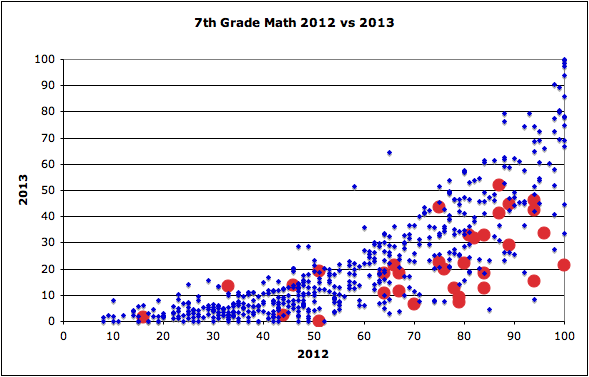
Tomorrow’s test scores
Everyone involved in New York City educational policy – all levels of the DoE, the mayor, the UFT, the education reporters, pundits, activists – all are waiting for tomorrow’s scores.
And it’s a crock.
The scores will tell us nothing, except how students did on a test – a test that means very little at all.
The individual scores will tell us (well no, we won’t see the individual scores) how individual students did on one test…
This test was designed to “align” with the “Common Core” – but we know that test designers – NYS and private – lack the skill to produce a “good” test, whatever that might look like. Think of mistakes on Regents Exams (past year, math only: 1, 2, 3, 4, 5, 6, 7). Think of Speedy, the Blusterous Pineapple.
Even if the tests were well-written (I should stop there, contrafactual), but even if they were, alignment with the common core seems unlikely. Here a group of principals posit that the NYS exams focused on the testable part of the standards. They also point out that nine hours over three days becomes a test of stamina. (Folks, three hours of a hard exam is a test of stamina. Sitting still for three hours of anything for these kids, except video games…)
But even if the test were well-written, and aligned with Common Core, (again, I don’t believe either one), in mathematics Common Core represents itself as a coherent 1 – 8 whole. For 1 – 3, kids have had regular math, and for 4th grade only something that schools allege is CCLS-aligned (dubious claim). But even were that claim true, the students were being tested on material with three years of pre-req, that they did not have.
And then, were the tests well-written, CCLS-aligned, and fair, what of it? Do we think “the Common Core” is what kids should know? Most of us don’t have much of a grasp of what’s in the Common Core. Certainly the politicians don’t know. What would lead anyone to believe that this is a worthwhile exercise?
But even if we agreed that Common Core is something worthwhile (I don’t. Most people who say they do don’t actually know what’s in there), and even if we agreed that the tests were fair, and that they were aligned with the CC standards, and that they were well written, there would be a problem…. A big problem.
The tests, were they worthwhile, fair, aligned, well-written, the tests show the performance of individual children. There is nowhere, nothing, except in fairly ugly politics, that suggests that aggregating these kinds of scores reveals anything about teachers, schools, or entire school-systems. There is only one exam I know of (NAEP) which is designed to do this. And even that <smh>.
I’m not making the argument here that individual student test scores don’t paint a picture of teachers, schools, or school systems. I will let the evidence (complete lack of any scientific study, but a plethora of social-science/political studies with low standards for data analysis and low confidence levels) speak for itself. The research that exists is conclusion-driven (junk) – and is designed to punish schools, communities, teachers (once through simple shaming, now through a tenure-weakening evaluation system that uses these test scores of questionable value – or perhaps no value at all)
But tomorrow? Tomorrow all the players in NYC education, and even in national education, will speak to the numbers. They will analyze, spin, contort. Shael (why isn’t he looking for a job yet) Polakow-Suransky already sent a dog-ate-my-homework e-mail to principals (yesterday).
They will not mention that the tests were unfair, poorly written, not aligned to CCLS. They will not mention that we don’t know if CCLS are worthwhile. They will not mention that the tests were designed to assess students, not teachers, schools, or districts. They will instead pick apart the numbers they see – empowered by the democratizing and dumbing down effect of having Excel on every reporter’s computer, enabling them to “analyze” numbers, whether they understand them or not, whether the numbers have meaning, or, as in this case, do not.
It will be tempting for people of good will to look, too. It will be tempting to draw conclusions about Bloomberg’s sad legacy, or Walcott/Suransky’s poor management. But we should not.
These numbers are not meaningful. They represent 9 hours of punishment for children across the city. They represent dumb test prep, wasted class time. They represent the opening wedge in the new evaluation system that is designed to make it easier (and more arbitrary) to fire teachers. They represent profits for testing companies. They represent support for Duncan’s anti-education Race to the Top. To use these numbers is to concede to the profiteers, the anti-public education ideologues, the politicians, the DoE itself.
I don’t care about tomorrow’s test scores. Neither should you.
Starting Sabbatical
No news.
Sabbatical officially started yesterday, but nothing much has changed. I’m relaxed, but I’m relaxed every summer. I’m making August plans, but that’s normal. I checked my August 1 pay – I want to see how big the cut in take-home will be – but the cut will hit next check.
It is true that I am registering for classes next week. And I purchased three of my four books already. And I am making arrangements to visit schools in the Fall.
Anything else? A possible string of minor league baseball games (there’s a dozen teams, counting collegiate, within an hour of the City) Movies. A little exercise. Maybe summer skating.
But Day 2 of Sabbatical, no news yet.

 JD2718