AFT Convention 2016 – Wrap Up
AFT Convention 2016. Ended three days ago. What do I take away from Minneapolis?
This was a better convention then my two previous. It was very different from my two previous, 2010 and 2014.
- There was a presidential endorsement. Which meant a lot of supporting speakers, the usual cast of politicians, plus the candidate. That was different, neither better nor worse, just what the AFT does. But it ran through the convention, from the first day to the last, with regular digs at the RNC in Cleveland.
- Social Justice. Fairness. Equality. Fight back against hospital consolidation (and conglomeration). ¡Si se puede! Remove block on funding for research on gun violence. Support work of the AFT Racial Equity Task Force. No more Flints. Stand with Planned Parenthood. Girls and Young women’s education. And a special order of for safe communities and racial justice (these should have been separate resolutions. I mentioned in a previous post that the motivation for this was the most electric speech of the convention).
- Economic Justice. Against income inequality. Oppose the TPP. Crackdown on offshore tax havens. End out-of-control drug prices. Rein in abusive medical billing and crippling debt. Overturn Citizens United. Fight against student loan debt. Ending garnishing social security to pay student debt. Planning for the wave of state and local public employee retirements. Paid sick days. More accurate COLA for Social Security. Protect and expand the Social Security Safety net. Full funding.
- Fighting in education and nursing. Fight against unfair employment practices in higher education. Sepsis awareness. Professional standards for healthcare workers. Support, respect PSRPs. Summer nutrition programs. Safe schools for all. Organizing (three resolutions)
- No hot K-12 issues. My previous two conventions were dominated by the ruling caucus from the UFT, Unity, introducing and fighting for pro-reform k-12 resolutions. Last convention Michael Mulgrew threatened to punch anyone who tried to take away “Common Core.” This time? Nothing like that. The ESSA resolution was positive/neutral. And the CTE resolution was positive. And the AROS resolution got a lot of attention from progressive unionists.
ESSA Resolution Highlights: Fight for Neighborhood Schools (what a change that would be for NYC), elevate teacher voice, framework of indicators broader than test scores, better and fewer tests, better teacher evaluation / multiple measures / no value added (still not good enough, but a huge step back from a few years ago), good PD (ugh)…
What is AROS? Alliance to Reclaim Our Schools. It coordinates union/community action in support of public schools, and has organized two major national “walk-ins” (not walk-outs). The resolution promises support for local action, and builds for coordinated local action involving at least 1000 schools in October.
An equivocal charter resolution did not come to the floor. The AFT leadership is not ready yet to oppose charters (or oppose high stakes testing). But they did have the sense not to push their unpopular positions forward and disrupt the proceedings.
Reasonable resolutions are one thing, undoing the damage the AFT contributed to by trying to compromise with the reformers over the last decade is another. We are not there yet.
- More negotiating in committee, or outside of committee, less yelling on the convention floor. More talking and testifying on the floor. That’s just what happens when there’s fewer hot issues. People got up and spoke to resolutions that might not have been paid much attention – and explained why they were important. It meant we heard from a lot of regular delegates, from all over the country. That was good, very good. There was only one, marginal caucus in opposition. Their procedural arguing got tiresome, but not disruptive.
- No pro-war resolutions. We had a resolution against the global privatization of education and public services, and an anti-Islamaphobia resolution. What a nice change from previous years when we had to listen to official speakers channel the war criminal Dr. Kissinger. Unfortunately, the resolution to support academics in Turkey did not make it to the floor. And as the convention opened, Turkey’s government was stretching their counter-coup into the schools and universities. That being said, the resolution would have done little more than raise awareness.
Summary: The AFT was consumed by the presidential endorsement, and kept the rest calm. The convention did a solid job on social justice, racial justice, and economic justice. The AFT is not yet ready to reverse course on the bad compromises they made with anti-public education reformers in the last decade plus, but they are slowly backing away.
Here is a link to many of the resolutions.
Here’s my tweets from the convention: @jd2718x
Here’s my blog posts:
- AFT Convention 2016 – Days 3 and 4
- AFT Convention 2016 – Meeting the President
- AFT Convention 2016 – Day 2
- AFT Convention 2016 – Day 1
- AFT Convention 2016 – Prequel Chicago
There’s one more post coming – about visiting Minneapolis, about meeting people, about sightseeing, about food, about conversations (don’t worry, if you are reading this, I’m not writing about that conversation)… but this is it on the big issue politics.
AFT Convention 2016 – Days 3 and 4
AFT Convention 2016 wrapped up in Minneapolis yesterday. Here’s a little about the last day and a half.
A pattern began to develop. Each resolution was followed by a little positive discussion, perhaps an attempt at an amendment, and the question was quickly called. This was both good, ok, and not so good.
It was good because these were, on the whole, solid resolutions. Attack Economic Inequality. Oppose TPP. Crackdown on Offshore Tax Havens. Against out of control Prescription Drug Prices. Rein in abusive medical billing and crippling debt. Fight back against consolidation in health care. ¡Si Se Puede! Remove the Block on Funding for Gun Violence Research. Overturn Citizens United. The Fight Against Student Loan Debt. Legislative Initiative to Rectify Unfair and Detrimental Employment Practices in Higher Education. End the Garnishment of Social Security to pay Student Loan Debt (this really happens? outrageous!) Defeating the Global Movement to Privatize Education and Public Services. Immigration and Islamaphobia. Hand in Hand (about an integrated Israeli school).
This was also good because much compromise was reached in advance, in committee. But there’s an aspect to this that’s just ok – those compromises did not get reported out, and it meant that delegates got a slightly incomplete picture.
Calling the question fast was not so good. While it was a forgone conclusion that each resolution would pass, it was important for delegates to hear WHY the resolutions mattered – and delegates often rose to passionately explain exactly that. Cutting off discussion early stopped people from sharing what mattered to them. Also, there were amendments, and while some were off-base, several were not, and calling the question early not only prevented them being discussed, it also prevented some of them from being heard. On several occasions Randi Weingarten intervened to rescue a discussion that was being cut short, but she was left in the awkward position of violating the rules of order to do so. Finally, there was one AFT VP who consistently called the question early, and while much of the audience consistently cheered him, the whole act, both calling and cheering, seemed more like a joke and less like what we expect from thoughtful representatives.
There were special orders of business. A Special Order of Business to support Mexican Teachers’ Rights passed, but with passionate opposition from a delegate who objected to calling on the SNTE and CNTE to collaborate. SNTE, she alleged, collaborated with the government against the CNTE, the dissident union which is being repressed. And EON/BAMN tried to introduce several Special orders of business, none added to the agenda, as their speakers began to frustrate many of the delegates with their tactics.
And then there was the “Fighting for Safe Communities and Racial Justice for our Citizens and our First Responders” special order. LeRoy Barr gave the best speech of the entire convention. First, the issue, at least in my mind, overrode much of the others that were being discussed, maybe all of the others. This country has “made much progress” but still fails miserably here. Further, LeRoy spoke powerfully, and you felt the room move. His timing kept the delegates attention riveted. His volume, loud here, quiet as he read names, and names, and names, added to the effect. We will remember that speech for a long, long time. (I’m inquiring to see if there is video)
Beatrice Lumpkin, a veteran of … I missed it … 60 years? More? About 90 years old? Gave a talk that started me thinking “that’s sweet” and then wowed me with her radical unionism and commitment to justice. I liked her talking about Hunter College and CIO organizing, but I liked it even more when she talked about Black Lives Matter.
Michael Mulgrew got called up to speak about organizing – although I’m not sure he addressed that topic. He did ask delegates to tweet out the hashtag #ApologizetoMyLittlePony for Trump accusing Michelle Obama of plagiarizing (I did tweet it), and then led the delegates in singing happy birthday to Karen Lewis, President of Chicago Teachers Union, AFT Local 1 (but she was not there to hear it.)
Day 3 ended with AFT elections – the room was cleared, and only delegates could return. Arthur Goldstein and I wandered upstairs and found a nice vacant glass-domed vestibule that gave a view into downtown.
Day 4 was rapid-fire. Election results (Randi Weingarten reelected with 98%) A few speakers, including Dolores Huerta, co-founder of the United Farm Workers. Six committees. Eighteen resolutions. And then Solidarity Forever, and we were done.
I tweeted a bunch. You can find them here.
Many of the resolutions were published. You can find them here.
And I will do a wrap-up in a day or so. And maybe a travelogue. Maybe not, since I didn’t do much.

AFT Convention 2016 – Meeting the President
Not that one. Obama’s not here in Minneapolis. And not the next one – she left. And not the AFT President. I’ve met Randi many times before, argued with her, agreed with her, e-mailed, etc. And not Mulgrew, we’ve met.
This is the story of how I met the President of AFT Local 1, the Chicago Federation of Teachers, Karen Lewis.
OK, so I could have walked up to her and said hello, but my story is a little more convoluted.
Four days ago, before the AFT Convention, I was in Chicago, debating Fred Klonsky. Actually, I was staying with Fred and Anne. But little debates broke out. Yankees vs Cubs. Hillary vs Jill.
But our strangest debate was about the relative importance of Belief vs Acts in Judaism. Both Fred and I have tenuous links, not enough to claim expertise. Anne suggested we ask Karen. So we did. Fred texted her a series of questions. Each of which she answered with a question. Quite appropriate, we thought.
So I’m off to Minneapolis and Fred says I have to meet Karen. The first day I look a little for her, but don’t really know where to look. I don’t find her. Fred texts, says Karen expects me.
I look harder Day 2. Still don’t find her. I start introducing myself to Chicago delegates, and asking “Where’s Karen?” At drinks that evening I meet Michelle Gunderson (we’ve been tweeting/retweeting each other). Fred is a good calling card with Michelle (really, with all the Chicago people). And the fact that we won seats in NYC, people get that this is a big deal. Anyhow, Michelle tells me that Karen has not been in for all of the sessions, but that she will contact me when Karen is available.
Next morning I go to contact Michelle – can’t message her. Hmmph. But as I walk out, I see her, and we exchange numbers. Session proceeds.
It Unfolds
At 11:34 I got a message “Meet me at mic 5 so we can introduce you to Karen” I dropped my phone, mid-tweet, left the computer open on a letter I was writing. The mics are spread around the room, I checked, 5 was behind me, towards the back. I briskly walked over. Michelle smiled, said “he’s going to take you to Karen.” There was a CTU delegate who I had met briefly the day before. He headed off, with me half a step behind. We reached the far side of the floor. “Over there, she’s waiting for you” and he motioned up the aisle. He turned away.
I walked 15 steps to two people, standing in the aisle. I said hello as Karen turned to me, and introduced myself. Here I am, speaking to the president of a fighting local, sort of a teacher union hero, and we proceed to chat about militant unionism? Nope. Prayer (dovening) and the Lubavitch. I even forget to wish her happy birthday. Schmuck.
But that’s how I met Karen Lewis.
AFT Convention 2016 – Day 2
AFT Convention 2016. Day 3 will start in a few hours. I’m writing a post each day from Minneapolis. Day 2:
I’m still “tweeting” – little snippets, sometimes with a snapshot. You can follow me @jd2718x
On Day 1 the speakers, including Hillary Rodham Clinton, were what I could see, the business of the AFT – the action – took place in committee, where I could not go. On Day 2 most of the “action” was on the convention floor.
I missed the credentials report, but there’s about 2600 delegates.
Dues increases passed, and more money for a solidarity fund set aside as well.
The human rights amendment all passed – Racial Equity, Against Deportation, and School Safety and Educational Opportunity for Lesbian, Gay, Bisexual, Transgender, Queer and Questioning Students.
Mark Dayton, governor of Minnesota, spoke, and was well received. My favorite line? “If our Navy were underperforming, we would set up charter navies, or homeschool our naval commanders?”
Michael Mulgrew motivated the endorsement of Hillary Clinton, which passed – I’m guessing here – over 95%, maybe 97-98%
The hot part of Day 2 was not on the floor. The St. Paul Federation of Teachers and a neighborhood organization organized a march from the convention center to a downtown Minneapolis bank:
Please join educators from the Saint Paul Federation of Teachers, and Minneapolis Federation of Teachers along with community and labor allies to mourn the unjust killing of Philando Castile and demand justice for his life and for Black lives across the country.
The timing was tricky. The event was scheduled to start at 4:00. They were scheduled to step off at 4:30. And Randi was cooperating, all was good, until Randi announced that the convention was behind schedule and that the Educational Issues Resos would come up after the speaker from the Israeli Knesset. How could delegates do both? Speakers argued over the agenda, suggested moving the guest to after the business. Randi bickered. CTU President Jesse Sharkey did it right when he said for delegates who wanted to march AND to participate in the ed issues debate, what did Randi suggest. She responded that if delegates left, and there was not a quorum, then business would not continue. How do you reason with that? Then she put the MoK on for a longish talk (I left).
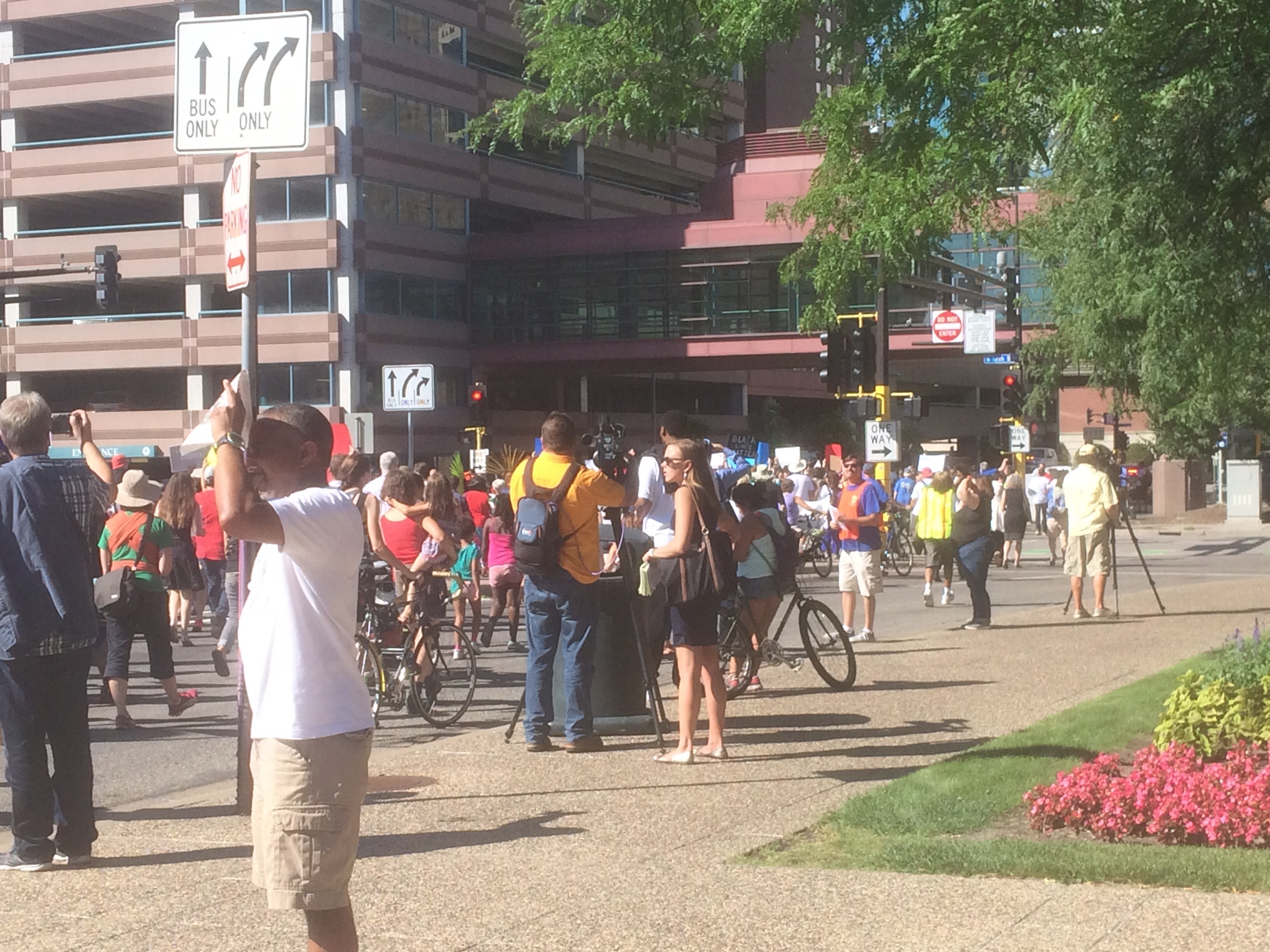
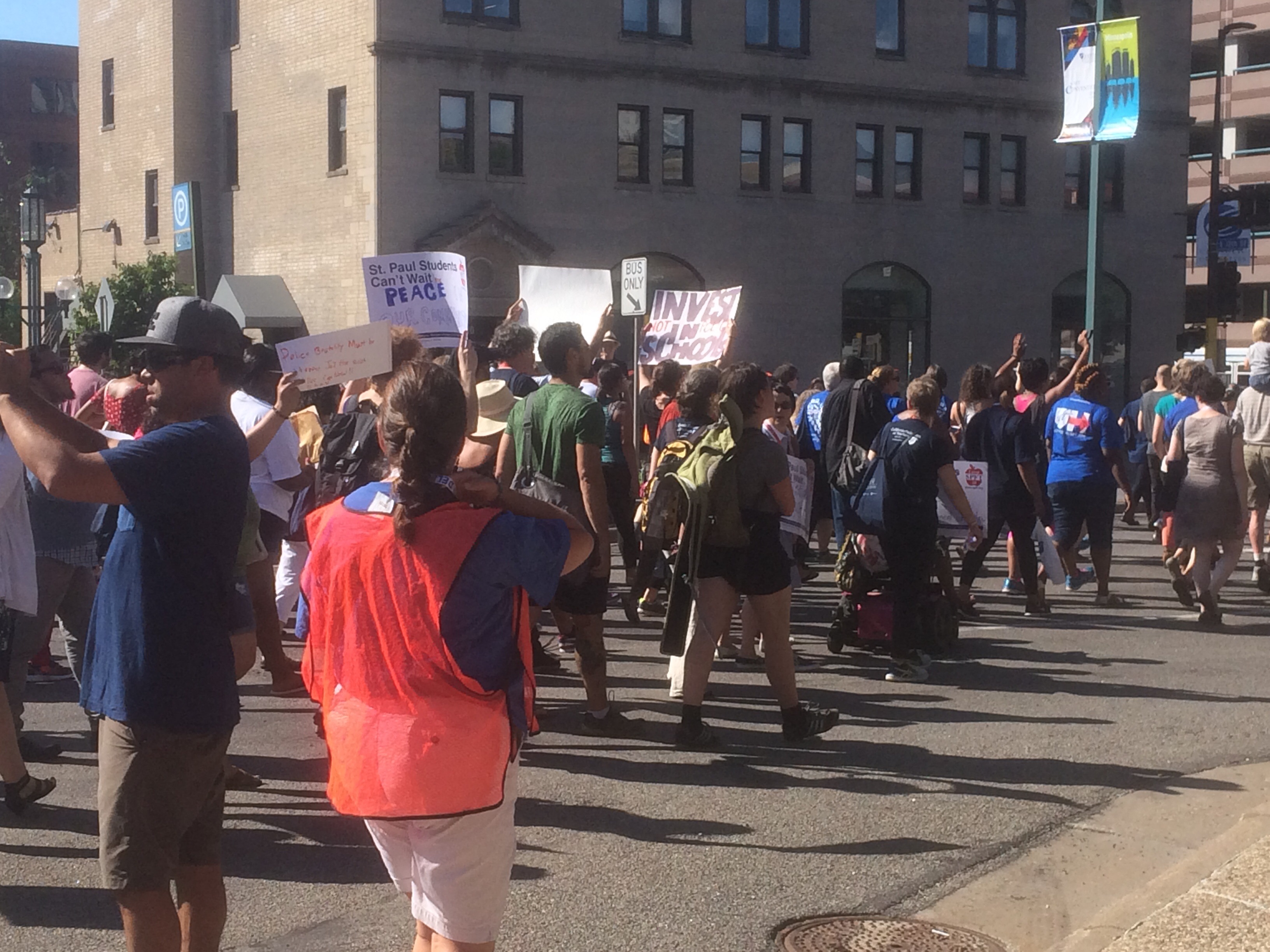
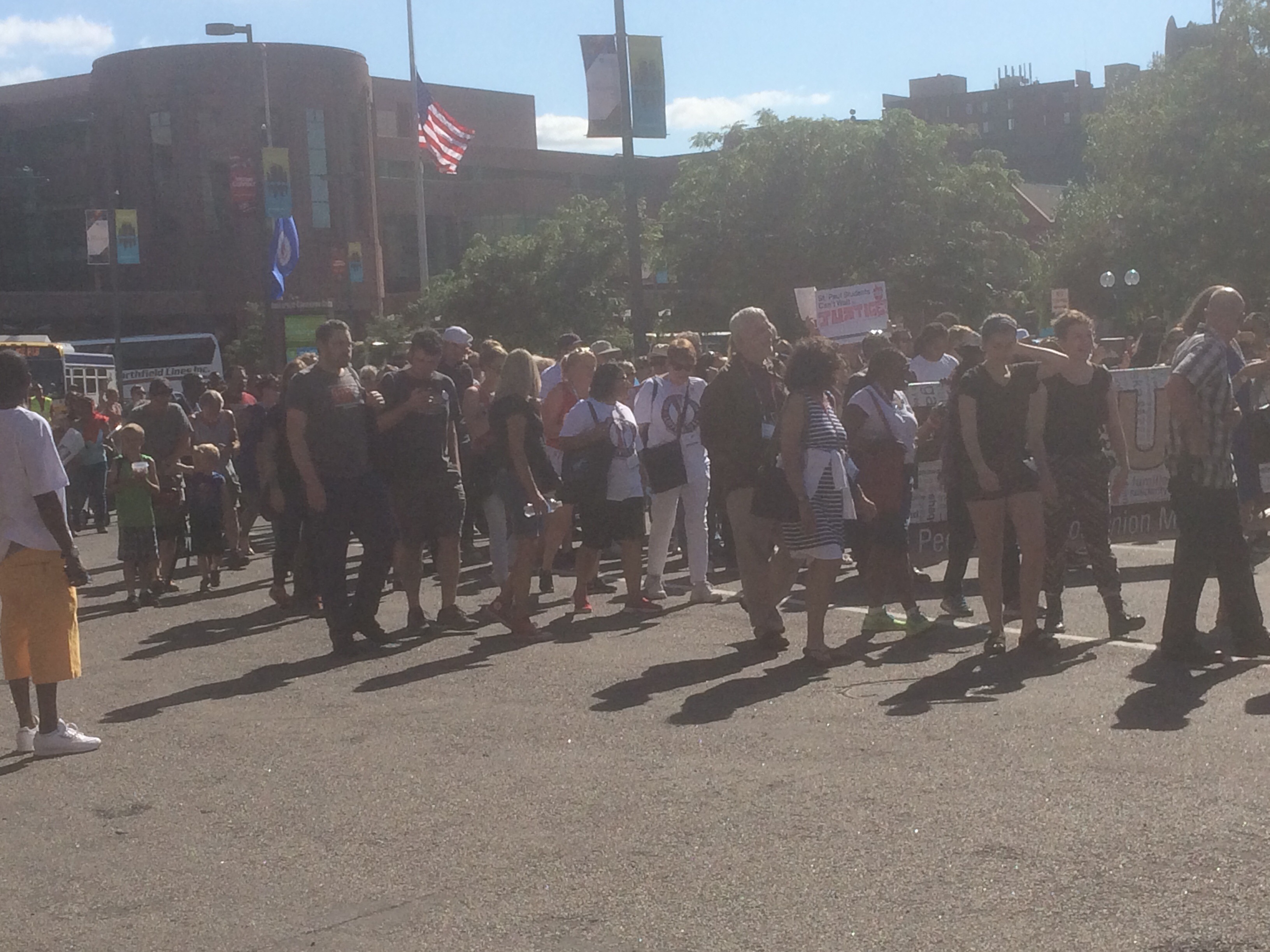
The march was good-sized, and good-spirited. I saw them off, and went back inside.
I do not know much about the Alliance to Reclaim Our Schools, but that resolution had support from UTLA and CTU and the Boston Federation of Teachers and others, seeking to join with local communities in struggles for public education and our schools. I have the impression that this is the direction that some of our more progressive locals want to move in. A nice detail from debate – a delegate from LA, Cecily Myart-Cruz, wanted badly to speak, and felt like she was unfairly cut off (it was just procedure, but in the moment must have seemed unfair). CTU President Jesse Sharkey was the next speaker called on, and he ceded his time to Myart-Cruz, who then spoke with passion. Class act, Sharkey.
Later that evening I went to a bar for drinks and talks with members of rank and file caucuses. I wanted to see my Minneapolis friends, the ones I met on in Havana in 2014. But I also met a bunch of people from Chicago, and from other locals around the country. And the MORE people were there, Jia Lee spoke, and it’s been nice having easy conversation with my new allies.
//platform.twitter.com/widgets.js
Here is a link to many of the resolutions that have passed so far.
AFT Convention 2016 – Day 1
AFT Convention 2016. Day 2 is about to start. I’ll write a post each day I’m out here in Minneapolis. Here’s Day 1:
Came in during the preliminaries, registered as a visitor, made my way into the hall, Larry Carter, UTNO president, now Louisiana Federation President, was the first to say hi. Cool. I met Larry 8 years ago, as an AFT volunteer in New Orleans. They got it tough in NOLA, and they keep fighting.
I met up with Lisa and Gladys from MORE in New York City, and began watching. Randi Weingarten was giving a meat and potatoes speech, nothing stood out, except her applause line for Hillary Clinton only got about half of the room standing, and not very loud. She asked for a warm welcome when Clinton arrived.
I checked in on Twitter. I don’t tweet well, but my volume is not bad: about 40 tweets yesterday. You can follow me @jd2718x if you really want to.
And then there were committee meetings, and nothing for non-delegates to do. I got my press credential (blogging).
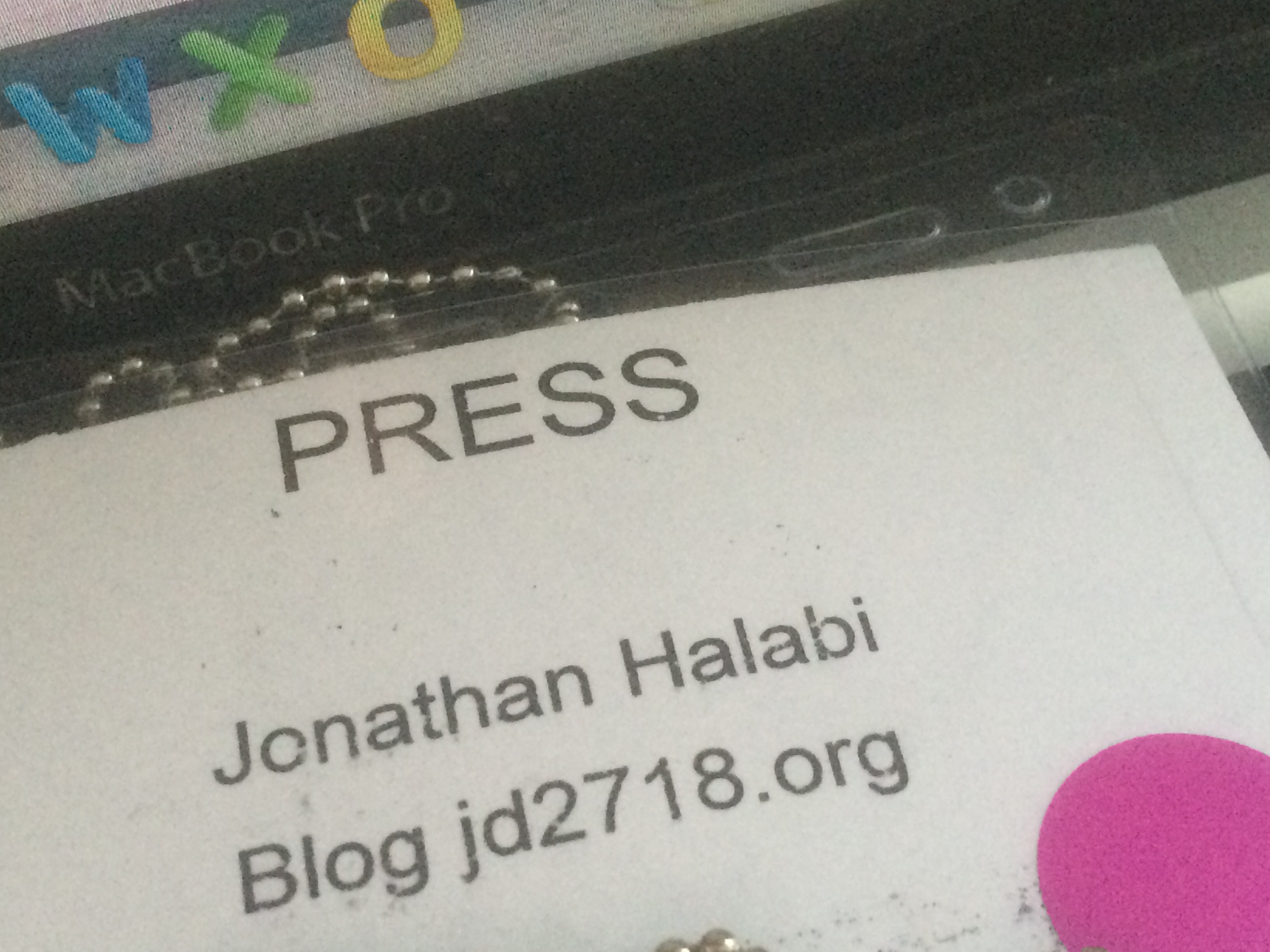
Met other people I hadn’t seen, mostly in two years. Penny from the summer volunteer program. Tom who went door to door for Obama with us in Philly in 2008. Kombiz. Bobbie who disagrees with me about politics, but who’s really on the same page when it comes to geometry, and so on…
Found the other MORE people: Gloria, Jia, Norm, and Arthur. Arthur needed a real delegate to “vouch” for him to get his visitors pass – Manhattan HS DR Alice O’Neil helped out. And then the three of us, me, Norm, and Arthur, went around towards the press entrance. The whole audience was getting scanned, airport style. But the three of us? Personally searched, scanned and frisked by friendly secret service agents.
We entered the huge hall, and it was empty. We took seats with an obstructed view – the other press section was even further away. And we chatted. And wrote. And fidgeted. It was maybe 2:30. Slowly the room began to fill. The 4:30 start time came, and passed. And around 5:30 the show got going.

There were a series of warm-up speakers. Steve Zimmer, president of the UTLA school board (Los Angeles) did a nice job revving the audience up. (I couldn’t help thinking he looked like Peter Russo from House of Cards).
Al Franken was funny. He got into the weeds a bit, on education policy – but he knew what he was talking about. NCLB and ESSA, and testing. He had a nice riff on mental health in schools (but when I tweeted it, Susan DuFresne from Washington replied, nice stuff, but where’s the accountability from congress)
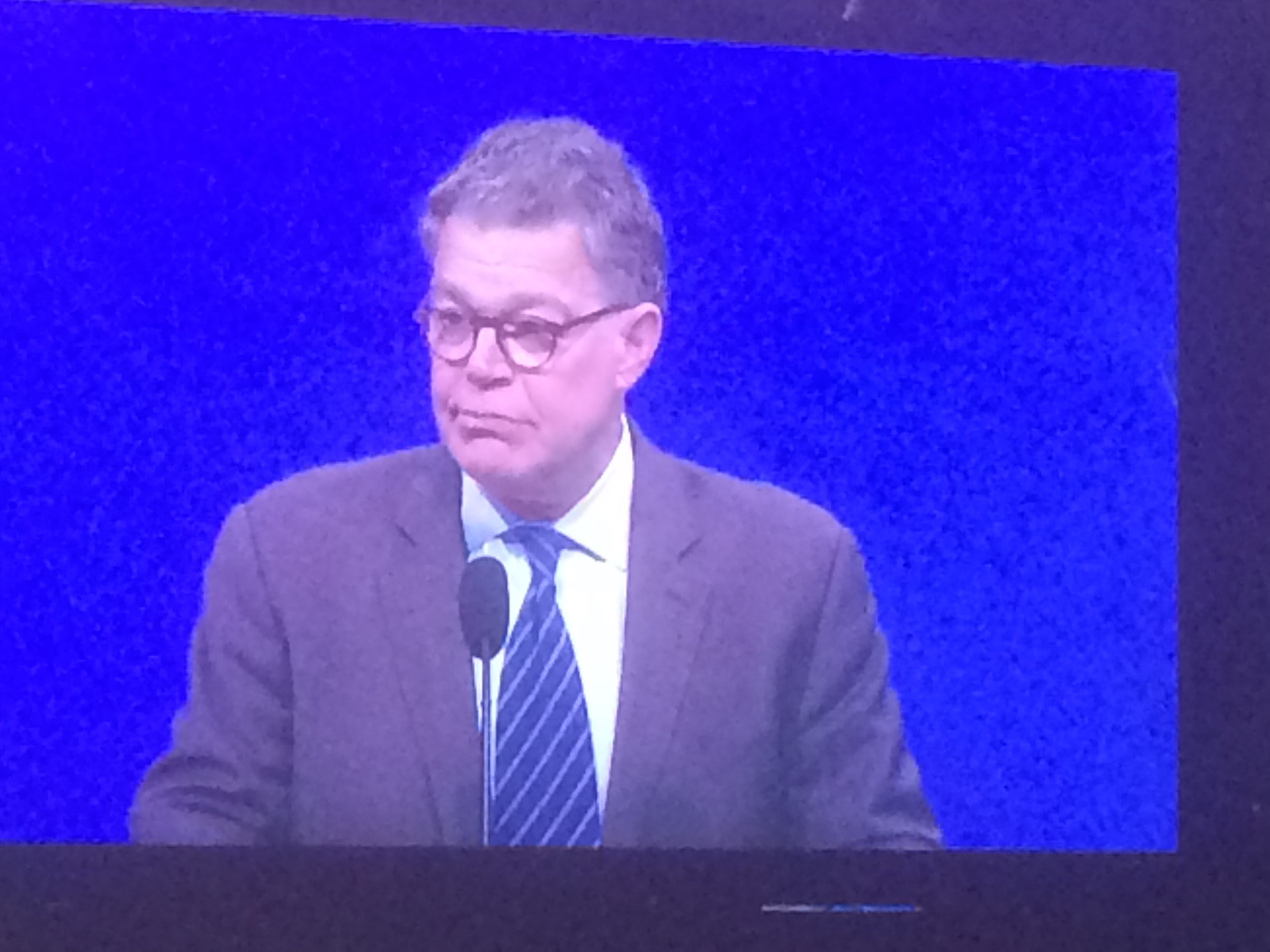
He also flubbed Randi’s name. Weingardner.
Arthur was worried about how hard it was for Amy Klobuchar, Minnesota’s senior senator, to follow Franken. No need. She’s been doing this a long time, has followed him, Al Franken, many times. She’s a top flight senate Democrat, and as of two weeks ago there was some Klobuchar Veepstakes speculation.
Klobuchar told stories about kids. Good speech stuff. She was funny – not as funny as Al Franken – but funny. Best line was about Wisconsin: “We love Wisconsin, because in Minnesota we can see Wisconsin from our porch.” Tell me she’s not interested in the VP slot! Delegates ate her up, applauded and cheered. But her second best response was when she thanked the Bernie Sanders supporters in the room – the cheering drowned her out, but leveled off when she thanked them for working for Hillary. And her biggest line was the wind up as she closed, asking for a commitment to work for Hillary.
Weingarten spoke. She’s just not a very good speaker, but at least this wasn’t embarrassing, like in LA two years ago. The delegates loved that Walter Mondale was in the hall, and gave him a standing ovation as he waved.
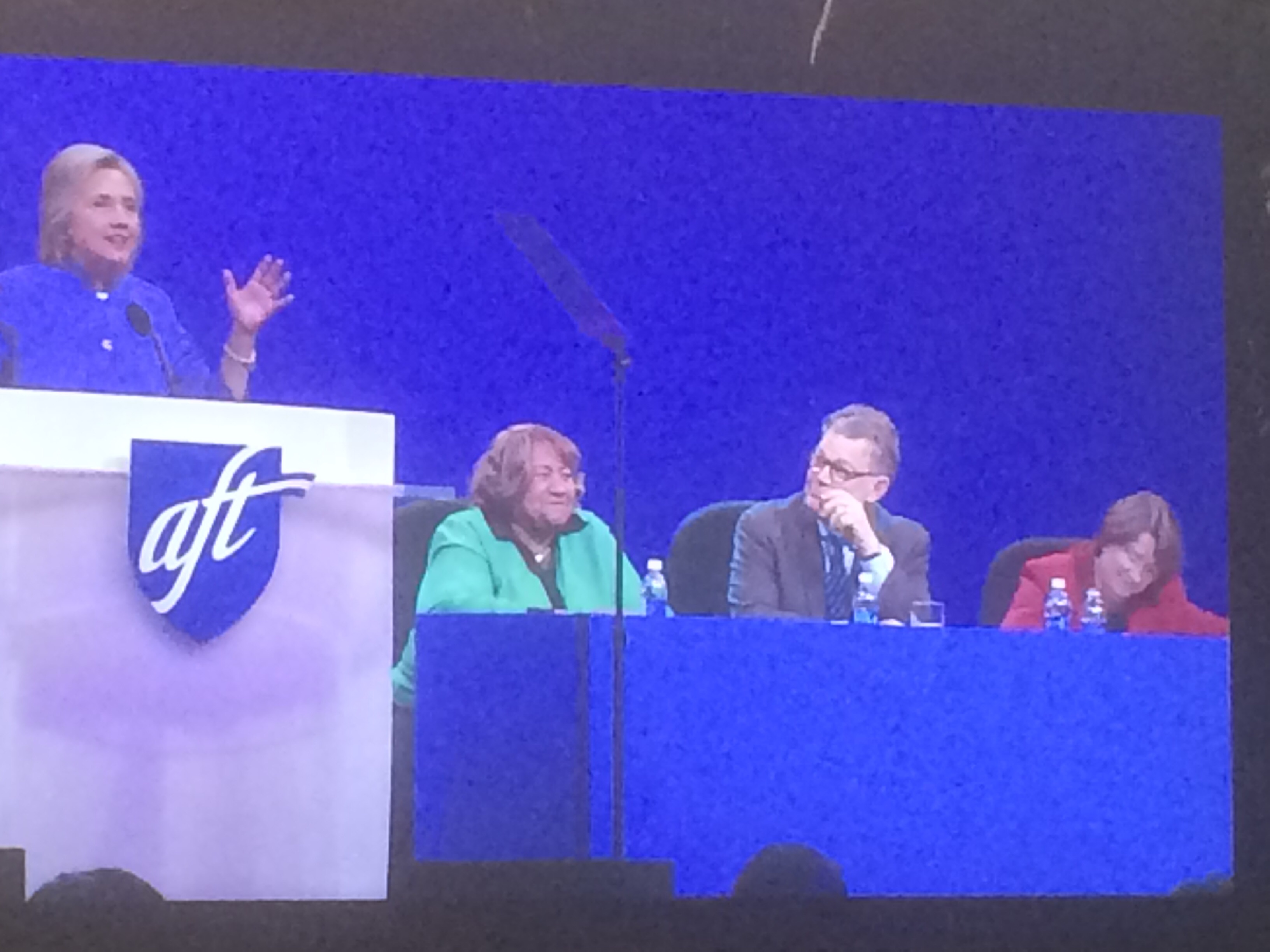
And then came Hillary Clinton. It must have been 6:30 or so that she went on. “Four and a half hours” Arthur said – “but it barely seems like three” I answered. There was no “half-standing ovation” this time – the crowd roared approval for her as she began. I made no attempt to capture the whole speech – here’s a few notes:
- When Clinton mentioned Philando Castile, the Black man killed here by police two weeks ago, protesters began a “Hands up! Don’t shoot!” chant. There were maybe a dozen protesters, and for a few seconds they distracted the audience, but Clinton kept speaking. A woman shouted “stop the deportations.” But the initial organized response was to out-shout them, which seemed more disruptive than the protest. Eventually they surrounded the protest signs with Hillary signs. The speech rolled on.
- Charters. Instead of the longer spiel she gave at the NEA, this was just one line, delivered quickly and with no pause so that there was no room for reaction: “Where there are great public charter schools we will learn from them.” You know what? It’s still bullshit. I’d like someone to show me what a good public school has copied from a charter school. Even better, since I know UFT people will have a response, how about one public school that has copied one thing from the UFT’s charter school. I’m not holding my breath.
- Progressive policy I – Free college tuition at public universities for families making less than $125k
- Progressive policy II – Constitutional Amendment to end Citizens United
- Progressive policy III – Universal health coverage. Is this new ground for her?
- The anti-Trump lines were among the best received.

And that’s it. A political speech. A little of who she is. A lot of what the audience wanted to hear. She does speak quite well.
AFT Convention 2016 – Prequel Chicago
Before Minneapolis, there was Chicago.
Minneapolis. 2016. AFT Convention 2016. Three out of four. AFT 2010, AFT 2014, and now AFT 2016. I’m a visitor. And a blogger-reporter. I’ll be posting one blog post each evening. But it’s too early for that.
This is a prequel-post. I am sitting in the press section, waiting for a former cabinet member and current candidate for president to address the hall. But I’m thinking of Chicago. Not Chicago 68, and not the Chicago Fire, but the Chicago of my last two days, vacation days, staying with Fred Klonsky and Anne Lowry Klonsky in Logan Square.
Great visit. We played “missed social cues” Sunday morning. No one was keeping score, but Anne clearly won. Sunday dinner at Logan Square. And the visit started the day before at Logan Square. Waiting for Fred by the El station, and what’s on my right? A Norwegian Church. And on my left? Prairie. Real prairie. Welcome to the Midwest.

Fred drove me out to Forest Park, Waldheim Cemetery. Saw the memorial to the Haymarket martyrs, heroes of labor, Elizabeth Gurley Flynn’s stone, and a field of graves of national and Chicago leaders of the Communist Party.


We drove through Hyde Park. Fred showed me where the first chain reaction took place (I got a photo) and where Obama’s house is (way too much security, couldn’t get close, no picture). We saw some Frank Lloyd Wright stuff, too.

The worst part of the trip has no photos. Miles of public housing on the south side were missing, knocked down by Rahm Emmanuel. The schools that served the projects? Miles of them. Empty. Half-empty. Taken over by privately run (charter) schools. The saddest? DuSable High School. Looks like it was THE high school for the Black Community on the south side. Half empty. Facing urban fields across the street, blank spaces where thousands used to live.
There was an unworldly good chicken curry dinner, Anne freshly ground and combined the spices. A good argument over Trump and the Republicans (is there still a national republican party?) And another argument over who to vote for. (If 99% of African Americans vote for Clinton, can you vote for someone else? And is the main threat, Trump, such a threat that the goal in this election is beating him by as much as possible?) And over the relative roles and importance of belief vs following the law in Judaism. Anne referred us to Karen Lewis, who expertly answered our questions with questions.
And there was Wrigley. My first visit inside the friendly confines, ever. Against Texas, a sellout, and Fred got us seats in section 503. The highest section. Deep deep deep left. Next section over? Rooftop of a building across the street. (one of which hosted a wedding. Vows were 15 minutes before the first pitch). Wrigley is a great stadium. Old, clunky, friendly, feels intimate. And even from section 503, great views. In fact, spectacular, panoramic views. Perfect for watching a home run sail out (Rangers, sorry). And for watching an acrobatic catch in the ivy.


With Lake Michigan in the background.
And that’s it. A two-day AFT/Minneapolis prequel.
Certified UFT Election Results – Part I
The American Arbitration Association delivered certified election results (2016). They differ only slightly from the preliminary results reported here, but now with much more certainty attached.
These results are by slate, MORE/New Action vs. Unity. AAA supplied slate totals. But a third guy* ran with some individual followers, not enough to be a slate. For that group, for each division I considered the votes each officer and each divisional exec board member received, and I reported the lowest figure – which is the greatest number possible that did not split the ballot.
I excluded 20 staff members (AAA reports them in the grand total, but, correctly, not in any division.) I assume those were 20 UNity votes.
**Retiree votes are down-weighted according to the UFT Constitution. They are capped at 23,000 votes. This explains most of the (slight) discrepancy between totals and slate totals (Unity 39,176 to MORE/New Action 10,743 vs Unity 39,094 to MORE/New Action 10,658).
I will, in no particular rush, follow this up with analysis. Next up will be turnout – both by division and by district.
| 2016 Votes | ||||
| Division | Mailed | Returned | % Voting | |
| Elementary | 36,002 | 10,031 | 27.9% | |
| Middle | 11,249 | 2,854 | 25.4% | |
| High School | 19,861 | 4,744 | 23.9% | |
| Teacher Total | 67,112 | 17,629 | 26.3% | |
| Functional | 59,359 | 10,801 | 18.2% | |
| InService Total | 126,471 | 28,430 | 22.5% | |
| Retirees | 62,958 | 24,452 | 38.8% | |
| Grand Total | 189,429 | 52,882 | 27.9% | |
|
|
||||
| Division | Unity | MORE/NAC | Indiv.* | Total slate-y |
| Elementary | 7,022 | 2,295 | 222 | 9,539 |
| Middle | 1,637 | 873 | 178 | 2,688 |
| High School | 2,043 | 2,243 | 108 | 4,394 |
| Teacher Total | 10,702 | 5,411 | 508 | 16,621 |
| Functional | 7,633 | 2,251 | 323 | 10,207 |
| InService Total | 18,335 | 7,662 | 831 | 26,828 |
| **Retirees | 20,045 | 2,893 | 184 | 23,122 |
| Grand Total | 39,176 | 10,743 | 1,456 | 51,375 |
|
|
||||
| Division | Unity | MORE/NAC | Indiv.* | |
| Elementary | 73.6% | 24.1% | 2.3% | |
| Middle | 60.9% | 32.5% | 6.6% | |
| High School | 46.5% | 51.0% | 2.5% | |
| Teacher Total | 64.4% | 32.6% | 3.1% | |
| Functional | 74.8% | 22.1% | 3.2% | |
| InService Total | 68.3% | 28.6% | 3.1% | |
| Retirees | 86.7% | 12.5% | 0.8% | |
| Grand Total | 76.3% | 20.9% | 2.8% |
Race
This weekend I advised someone:
- Speak the Truth
- Work for Change
- It’s not about you
I need to heed my own words. It’s not about me, either. And it is important.
I’ll have more to say, soon.
Something Fishy with NY State CC Algebra Regents Scores
New York State Common Core Algebra was administered six times from June 2014 to January 2016. The content was of mixed quality. The wordiness was evident, and was designed to trip up weaker readers. And the scale (86 raw points available) was incredibly tough on stronger students (deductions for petty errors had a magnified effect on higher scores).
And this exam, yesterday? Similar, though perhaps wordier. But the scale is new and different and no one told us in advance, and there’s something going on, and the state has given us plenty of reason to question their judgment and their decisions.
Here’s the number of “raw points” needed to reach 100, 90, 85, 80, 75, 70, and 65 for the first seven exams. See which one is different?
| Exam | Jun-14 | Aug-14 | Jan-15 | Jun-15 | Aug-15 | Jan-16 | Jun-16 |
| 100 | 86 | 86 | 86 | 86 | 86 | 86 | 86 |
| 90 | 78 | 79 | 79 | 79 | 78 | 79 | 76 |
| 85 | 73 | 75 | 74 | 75 | 74 | 74 | 67 |
| 80 | 67 | 70 | 67 | 69 | 67 | 68 | 51 |
| 75 | 57 | 60 | 57 | 59 | 55 | 57 | 39 |
| 70 | 40 | 42 | 40 | 40 | 40 | 40 | 32 |
| 65 | 30 | 31 | 30 | 30 | 30 | 30 | 27 |
| 0 | 0 | 0 | 0 | 0 | 0 | 0 | 0 |
The State did explain itself. They sent out a memo explaining there was no real change. See if you can read this: june16algonemaintenance.
I couldn’t. I wrote requesting clarification.
The Backbone of our Union – Volunteers or Staff?
At a small Bronx demonstration a few years back I heard a chant: “Who are we? UFT!” Ouch. The demonstration, aside from three or four activists, was entirely paid staff from the Bronx UFT Office. This was not the UFT.
The UFT is a membership organization. There are tens of thousands of us. But the leadership of our union is unable or unwilling to mobilize the membership. Perhaps they have given up on ever being able to mobilize the membership. Instead, they think of themselves as the union, and they think of the members as a passive constituency. This is a gross misunderstanding of what a union is.
The Backbone of a Healthy Union
They also misunderstand what a healthy union should look like. The UFT should have a backbone. And our current leadership looks in the wrong place to find the group that should makes it up.
Not the officers and staff on the 14th floor. Not the appointees and paid staff in the borough offices. And not the mass of members, mostly unorganized. The backbone of our union should be the one thousand five hundred chapter leaders.
The members in each school make up a “chapter.” And every chapter elects a chapter leader. Chapter leaders are, today, the only leaders of the union directly elected by the members they directly serve.
Defending our Union
When the Friedrichs case threatened to defund our union, our leadership reacted. They searched for ways to continue to collect dues, and to protect what we had. They acted as if a union’s ability to fund itself is vitally important. And it is.
But what about when your backbone is attacked? What happens when a principal announces that he can take out a chapter leader with impunity? That he is not afraid of the UFT, because the UFT won’t fight? This cannot go unchallenged. It must be stopped. Our response to an attack on a chapter leader must be at least as vigorous as our response to a political attack.
In the coming days you will hear about a Chapter Leader being singled out by an anti-union principal. This principal must be challenged. It will be a test of our new New Action and MORE Executive Board members if we can convince the UFT leadership to rise to face down this bully.
These words cannot anymore be empty: An injury to one is an injury to all.
Skinny awards, this Thursday
Please come to the annual Class Size Matters Skinny award dinner honoring Juan Gonzalez and Robert Powell onJune 9 –just a few days away — it’s always one of the most joyful events. For more information or to buy tickets seehttps://www.nycharities.org/events/EventLevels.aspx?ETID=9085
I forgot I was going, never have gone before, until Norm Scott posted a reminder. Bought my tickets two weeks ago. Can’t believe I already forgot.
The Skinny Awards are the opposite of the Broad Awards (Eli Broad, anti-public ed reformer, rich guy. Get it Broad ≠ Skinny?)
Leonie Haimson orchestrates it – she’s pro-public education, anti-testing, pro-all kinds of other good things. I’m curious. You should be too. If Thursday is open, join me there.
UFT Election Results – some discussion
Some initial thoughts on the UFT election, based loosely on New Action discussion earlier this week.
- This result (winning high schools, increased overall vote) was the result we were looking for. Sure, a breakthrough elsewhere would have been fantastic, but it was not expected.
- The decision to run with MORE (rather than approach Unity, run with Solidarity, run on our own, or sit the election out) was the right decision.
- The alliance was necessary for winning the high school seats. Would not have happened otherwise.
- Discussion of “pizza parties” – huge result from Francis Lewis (CL Arthur Goldstein) – where else did the parties occur (real leadership required to run them?)
- There was a definite uptick in support we got from the schools. All of us met “old friends” (not including MORE folks) who indicated that they were delighted to be able to vote for us, since they had been unwilling to support Mulgrew.
- MORE’s leadership in the Opt-Out movement clearly made a difference in elementary and middle schools.
- Distribution was smooth. The additional week was useful. (Side discussion of being completely blocked from one campus). The contacts with several hundred chapter leaders enabled wider distribution. (that’s a topic we need to return to)
- Our committee that first met with MORE did a great job setting things up, paving the way forward.
- Working with MORE went smoothly throughout, with only a handful of glitches, most (not all) of which were attributable to not having worked together previously.
- We met a significant number of in-service MORE activists with lots of energy.
- Mulgrew 91%, 84%, 76%. Others will notice.
- Retirees voting is highly unusual. We do not know of other unions that do this. However it would be easier to make this point if we were winning more than one of the four divisions of in-service members.
- The second division we are closest in is Middle Schools.
A few notes
- High Schools gave the Common Core Algebra II / Trigonometry today, and most were not in session. Mine? In session. A few classes got moved around. But otherwise regular day.
- I said “Tribonacci” in one class, and a couple of girls started giggling. It lasted half an hour.
- Voted SBOs today, and began to plan UFT luncheon. End of the year is really approaching.
- I’m following a hot argument between Chaz and NYC Educator (In post and comments here, and post and comments there.) I should write something…. But for now, one thing I notice is the language directed at new teachers. “Inexperienced” is fair. “Newbie” sounds intentionally insulting. I wish we wouldn’t hurl insults at the people we need to stay…
- Last regular UFT Exec Board Monday next week. Last High School meeting Wednesday next week, Central. Last DA Wednesday June 15.
- I’m going to the AFT Convention in Minneapolis in July. If they let me in (I think they have to). This time I don’t get to vote, and certainly I don’t get to speak. I liked speaking in Seattle (just once, and I probably shouldn’t have). Let me know if you’ll be in Twin Cities and want to hang out… (I’m also planning a ball game at Wrigley, and another at Miller Park.
More Worksheets?
It’s a point of pride for me…
That phrase should warn me that I’ve stepped outside of “rational”
… pride for me to use very few worksheets.
I think this year I’ve used fewer worksheets than any of my previous 17 years of teaching.
My first year – 1997 – I was a young teacher with some promise, and senior math teachers in my department tried to help me – not with my math, which was strong, but with classroom management, which was not. Estelle (her real name) visited my class – bedlam – and suggested that instead of writing out a long, lousy lesson plan, that I instead design a worksheet that contained all the problems I intended to do in class, plus some extras. She sat with me, I recall the daylight drifting across the table in the teachers’ room, we were alone, and laid out a row of four similar problems. “Do this on the board, do the next with them, and then ask them to do the third, faster students may try the fourth.” Then she started the next row, with four more problems, but with a new level of complexity (perhaps they included minus signs).
I had not, to that point, understood anyone’s advice about how to run a class. I was probably destined for one year and out – pretty common among new teachers in NYC in 1997, especially alternate certification (read – no student teaching). But Estelle’s advice was about how to construct a worksheet, with a logical progression. It was math. I picked up my pen and completed the work she had started. She praised the effort. I thought the lesson had been pedagogical – but it was a classroom management lesson, and it may have been the pivotal moment that kept me a teacher.
Worksheets were easier to design than lessons were to write in “Education School” format – so that was good. But all of a sudden, more kids were coming in and getting to work, paying attention. Damned if attendance didn’t even get a little better. In retrospect – it was Estelle’s Developmental Worksheets. Kids liked getting paper in their hand, with a clear expectation of what to work on. By my 3rd or 4th year, well-designed daily worksheets were my thing. I prettied them up, included homework assignments, challenge problems, starting typesetting them, but the basic structure stayed the same.
They were also my worksheets. I MADE them. But I started picking up bits of criticism about worksheet use, not directed to me, but directed to math teachers in general, about the lack of variety, dullness, repetition, the use of worksheets as a crutch. And I began cutting back. Which was easy, as I’d been overusing them. And cutting back more. And more. And I was still successful. It became a point of pride… and that’s where I got in trouble.
I realized these last two weeks, as I have occasionally gone for a worksheet of my own design, that I’d reduced sheets to a rarity. I’d also forgotten how well some kids respond to sheets. And in seeking variety, I had eliminated one form of lesson – I’d reduced variety.
Estelle’s Developmental Worksheet, is ironically, the mainstay of my lesson design. It’s just in the lesson now, and not on a sheet.
Next year some lessons will have worksheets. Not every day. But more than this year, or the previous year. A little variety should trump irrational pride.
Deciding not to Vote in UFT Elections – A Rational Choice?
Pretend you check into a resort, plan on staying there three weeks. It’s an unusual place with an assortment of lodgings: a big hotel, some smaller hostels, bungalows, cabins… And there seem to be crazy guests running all over the grounds. Turns out most guests are short term, like you, but there’s a reasonable number of long-termers.
One day there’s a huge ruckus over shuffleboard. One long-term group has agreed with management to slightly shorten the hours the courts are open, and the other, slightly more disheveled looking long-term group is angry and yelling. You move on, because the argument was weird, and you don’t play shuffleboard. Maybe you’ll try to keep your distance, spend more time with short-termers.
Later that week there’s a todo about whether the hotel should be managed as one entity, or whether there should be one manager per floor. The calmer group likes the new plan, and it makes some sense, more personal. Not that it will matter to you, but they are fighting right outside your door, so you’re forced to think about it.
 The next day some of the same people are fighting again – this time one of the pools, the nice outdoor one you prefer, is going to be cleaned more regularly – well that makes sense – but will be unavailable a few more hours each day. The disheveled group is angry again, and this time they have a point. The pool matters to you, but you are only here two more weeks anyway. And the calm group does all the talking with management anyway.
Few days later, they come around to your door with two petitions – one of them to get the windows replaced with better windows before winter, and the other to leave the windows alone, but lower room rates by 3%. The disheveled people are apoplectic. The windows are SOO important. And they have a point. And they were right about the pool. But you won’t be here in the winter, even if you feel bad for them, and that discount would be useful… You sign for the lower rate.
Finally, with just a week left, you learn there will be a new liaison to management – one of the cleancut people, or one of the sad disheveled ones. You can go to the third floor to help make the choice, but it’s at the same time as when the pool is open, and you really need that swim.
It was a rational choice.
– – — — —– ——– ————- ——– —– — — – –
Obviously I’m thinking of many newer teachers. When many sit out the UFT election, I do not believe they are being apathetic. That implies that this stuff matters to them. I believe they are making a rational choice, a choice based on being a “short-termer” – someone with little invested in changing the system.
There are a lot of lousy reasons not to vote. Apathy is one of them. Feeling distant from the decision-making is another. Too many undelivered ballots is a third. And we can do better in all those areas.
And, honestly, both sides in this election did better outreach than in the past. Getting the teacher vote to move from 20% to 27% is a big deal – credit all around. And having the election committee run a serious, non-partisan Get out the Vote operation was impressive.
But what about those short-termers? How do we make voting – forget that. How do we make involvement in the union a rational choice for them?
It is something that both sides have an interest in addressing. There are plenty of issues that divide us. This one draws us together.
Retention. Better retention would help. But how we get there is not easy.
I started blogging in April, 2006. Ten years and a month ago. For those of you who were counting. And guess what I wrote about first? Retention. Maybe there were some ideas there worth thinking about. Take a look.
UFT Election Results – Mandates?
Turnout was up in every division – but still far too low. If “I didn’t bother to return my ballot” was a candidate, he would have swept every office, every division.
Voters tend to be more involved, more active. Their voices should be heard. But let’s be careful about the responsibility to represent members (what the winners actually earned) and a mandate.
Let’s take a look. I’m going to use teacher votes only, since I am most certain of them.
President. This time Mulgrew got 16.2% of all eligible teachers, Jia Lee got 8.2%. 74.8% Not Voting.
Last election: Mulgrew 14.1%, Julie Kavanagh 4.6%, 81.3% Not Voting. Time before Mulgrew 21.2%, Kit Wainer 3.4%, 75.4% Not Voting.
Elementary School Exec Board. This time Unity 19.8% to MORE/New Action 6.5%, with 73.1% not voting.
Last time Unity 15%, MORE 3.3%, New Action 1.6%, 80.1% not voting. Time before Unity 21%, New Action 2.6%, ICE/TJC 1.9%, Not Voting 74.5%.
Middle School Exec Board. This time Unity 14.7%, MORE/New Action 7.9%, Other 1.6%, Not Voting 75.8%.
Last time Unity 11%, MORE 3.7%, New Action 1.5%, 83.8% Not Voting. Time before Unity 16.9%, New Action 3.6%, ICE/TJC 2.1%, Not Voting 77.8%.
High School Exec Board. This time MORE/New Action 11.6%, Unity 10.5%, with 77.3% not voting.
Last time Unity/New Action 10.8%, MORE 7.5%, 81.7% not voting. Time before Unity/New Action 16.9%, ICE/TJC 6.9%, Not Voting 76.2%.
Participation in the elections has clearly improved, but it’s not enough. All of us, every caucus, have a strong interest in seeing even greater participation next time around. And I think that means greater participation in everyday union life in the schools. Which means inactive chapters need to become active. Inactive members have to get involved. And in schools without chapters, we have to help start them.
Especially in high schools, the break up of our traditional schools made it harder to maintain regular union functioning – which both makes our organizing efforts in the mini-schools more important, and serves as a reminder that we must be advocating the reassembly of some of our large high schools.
UFT Election 2016 – Good News Good News for MORE / New Action
- We won the high schools. This was the race worth watching (no one knew the result in advance). Margin was just over 200 votes…
- Look at this….
In 2004, ICE/TJC had 1,239 elementary votes, NAC had 556, combined 1,795.
In 2007, ICE/TJC had 1,337 elementary votes, NAC had 562, combined 1,899.
In 2010, ICE/TJC had 703 elementary votes, NAC had 978, combined 1,681.
In 2013, MORE had 1,140 elementary votes, NAC had 534, combined 1,674.
In 2016, MORE/NAC had 2,306.
Together, we got the best result in over a decade.
In 2004, ICE/TJC had 422 middle school votes, NAC had 311, combined 733.
In 2007, ICE/TJC had 444 middle school votes, NAC had 273, combined 717.
In 2010, ICE/TJC had 248 middle school votes, NAC had 421, combined 669.
In 2013, MORE had 398 middle school votes, NAC had 161, combined 559.
In 2016, MORE/NAC had 882.
Together, we got the best result in over a decade.
In 2004, ICE/TJC had 1,417 high school votes, NAC had 700, combined 2,117.
In 2007, ICE/TJC had 1,524 high school votes, NAC had 521, combined 2,045.
In 2010, ICE/TJC had 1,369 high school votes, NAC had 774, combined 2,143.
In 2013, MORE had 1,430 high school votes, NAC had 452, combined 1,882.
In 2016, MORE/NAC had 2,275.
Together, we got the best result in over a decade.
In 2004, ICE/TJC had 990 functional votes, NAC had 512, combined 1,502.
In 2007, ICE/TJC had 1,032 functional votes, NAC had 548, combined 1,580.
In 2010, ICE/TJC had 703 functional votes, NAC had 708, combined 1,411.
In 2013, MORE had 1,140 functional votes, NAC had 951, combined 2,091.
In 2016, MORE/NAC had 2,232.
Together, we got the best result in over a decade.
UFT Elections 2016 – Some initial results
There was no slate report by division. Instead I used the lowest total of any candidate in that division
Grand total is rounded
Retiree totals are back-calculated. I ignored the cap on retiree votes. These retiree numbers are calculated, not real, and likely to be significantly off, and only marginally better than nothing.
The grand total may exclude several functional non-DoE or non-school titles. It also includes per diems, etc. This leaves, in my mind, some questions both about the functional and the retiree numbers I am reporting
| Division | Mailed | Returned | % Voting | |
| Elementary | 35606 | 10,026 | 28.2% | |
| Middle | 11197 | 2,856 | 25.5% | |
| High School | 19539 | 4,747 | 24.3% | |
| Teacher Total | 66,342 | 17,629 | 26.6% | |
| Functional | 46731 | 10,953 | 23.4% | |
| InService Total | 113,073 | 28,582 | 25.3% | |
| Retirees (back calc) | 62,991 | 24,464 | 38.8% | |
| Grand Total | 176,064 | 53,046 | 30.1% | |
| Division | Unity | MORE/NAC | Portelos | Total slate-y |
| Elementary | 7,040 | 2,306 | 222 | 9,568 |
| Middle | 1,649 | 882 | 178 | 2,709 |
| High School | 2,061 | 2,275 | 108 | 4,444 |
| Teacher Total | 10,750 | 5,463 | 508 | 16,721 |
| Functional | 7,651 | 2,232 | 323 | 10,206 |
| InService Total | 18,401 | 7,695 | 831 | 26,927 |
| Retirees (back calc) | 20,775 | 3,048 | 625 | 24,448 |
| Grand Total | 39,176 | 10,743 | 1,456 | 51,375 |
| Division | Unity | MORE/NAC | Portelos | |
| Elementary | 73.6% | 24.1% | 2.3% | |
| Middle | 60.9% | 32.6% | 6.6% | |
| High School | 46.4% | 51.2% | 2.4% | |
| Teacher Total | 64.3% | 32.7% | 3.0% | |
| Functional | 75.0% | 21.9% | 3.2% | |
| InService Total | 68.3% | 28.6% | 3.1% | |
| Retirees (back calc) | 85.0% | 12.5% | 2.6% | |
| Grand Total | 76.3% | 20.9% | 2.8% |
UFT Election turnout – Results later today (day 2)
UFT election results should be available this afternoon (Friday), not Thursday as I had originally believed. Yesterday I wrote about five things to look for (who wins high schools, did the generic and partisan Get out the Vote efforts reverse the trend of falling turnout, did Unity vote stop falling, would the combined opposition see a significant uptick, and would the middle schools become close).
We already have the answer to one question: turnout improved to better than 2007 levels (though not 2004) in all teacher divisions – probably in functionals, too, though I am not certain we are comparing apples to apples there. The number of retirees voting increased, but I am uncertain of the percent.
I’ll talk more about all the numbers in the coming days, but this is what I wrote down yesterday (sorry no spreadsheet yet):

UFT Election Results Later Today – Five Things to Look for
Turns out, I will be at the count. I will blog/tweet about results later. I will be at the New Action/MORE celebration around 6.
#1 Least important in the long run, but most immediately interesting – Who wins the high school division? Unity’s totals over the last four elections have ranged from 1600 to 2900. The combined opposition (though never before actually combined) from 1800 to 2100. I really have no idea who will win, but expect it to be close.
#2 Most important in the long run: Will turnout stop falling? Will it begin to rise? Teacher turnout has run from 32%, 23%, to 20%*. Will the decline continue? The union did a reasonable job of generic get out the vote e-mails to chapter leaders. I would consider anything from 20% and lower to be extremely concerning, and anything from 25% up to be a good sign (though the higher turnout, ironically, might make it less likely, this go-round, for MORE/New Action to take the high schools.)
#3 Will the combined opposition vote, now that New Action and MORE are running together, see an uptick? The last four rounds, including 2010, the teacher vote for the opposition has been between 4400 and 4600. That’s dead flat. MORE’s outreach on Opt Out, the combined campaign, with coordination and minimizing duplication, and some enthusiasm generated by a decade-long divide being bridged, that should make a difference. I would be disappointed with no increase.
#4 Has Unity halted their collapsing vote? Unity’s raw vote fell 25% or more in all divisions from 2004 to 2007 and 20% or more in all teacher divisions from 2007 to 2013*. I think they will stop falling – their remaining voters are more hard-core. But I’m not sure. They really don’t have a rational appeal, aside from the incumbency. But they benefit from generic GotV, and they have operatives who lean pretty hard on members.
#5 Will the middle schools be close? Unity in the last few years has devoted some effort to reaching out to our most-neglected division – but the numbers involved are so small, and the 6 – 8 test pressure so great, there is a slight chance they have pushed this division into play.
* I exclude 2010 from trend numbers. There was a large uptick for Unity, and a switch from ICE/TJC to New Action – pretty clearly a result of teachers being excited for the fresh face replacing Weingarten.
Postscript? Will the write-in candidates’ votes be low enough to expose their irrelevance? Portelos got himself on the ballot, but didn’t make slate status because he couldn’t be bothered to help the rest of his team collect signatures. This is not an organization but an ego with followers. Over 1000 I would be worried. 200-300 is about right. Less than 200 and the “emPORer” has no clothes.
Many NYC High Schools got treated badly by Bloomberg/Klein – when do we fix the damage?
My caucus brought the following resolution to the UFT Executive Board June 1, 2015 – 51 weeks ago. The Unity leadership tabled it, and never brought it back.
Who cares if we have a friendly mayor and an educator as chancellor if we are not asking them to make the schools better?
The following resolution was submitted by William Goldman, Jonathan Halabi, Douglas Haynes, Margaret Hobson-Shand, Francisco Pena and Michael Shulman.
Motion: To approve the following:
RESOLUTION ON ACADEMIC, COMPREHENSIVE AND CTE HIGH SCHOOLS
WHEREAS, the DOE has closed many academic comprehensive and CTE high schools since the late 1990s; and
WHEREAS, large parts of the city have left students and parents with no large schools to choose; and
WHEREAS, in some cases elementary and middle school students have been placed in schools with high school students; and
WHEREAS, hundreds of small high schools have been created to replace large schools often without replicating the numerous curricular options, services and extra-curricular activities that the large schools once offered; and
WHEREAS, the campus school model has led to the DOE creating multiple administrations in each building leading to increases in cost and bureaucracy; and
WHEREAS, large academic, comprehensive high school buildings were designated and built to accommodate one school, but forcing several schools to share space often leads to poor utilization of the cafeteria, auditorium, gyms, or their use at peculiar and limited times of the day; and
WHEREAS, large academic, comprehensive high school buildings were designed and built with a single wing of science labs, a single wing of music rooms, of art rooms, and other and specialty rooms, leaving those specialty rooms inaccessible to students from small schools once the building has been dissected; and
WHEREAS, in many small schools there are predominantly inexperienced staff members who face serious challenges enforcing the UFT Contract and protecting members’ rights; and
WHEREAS, in a December 4, 2002 UFT Delegate Assembly resolution the UFT affirmed our commitment to “encouraging a variety of educational settings for students and staff,” but decried the lack of foresight and planning; and
WHEREAS, in May 2005 the UFT’s Small School Task Force issued a groundbreaking report, recommending changes to how small schools are created; and
WHEREAS, the efficacy of using one building to house multiple schools had not been studies or evaluated; be it
RESOLVED, that the UFT should establish a committee which will:
- Study the efficacy of the campus school model
- Review the conclusions in the UFT’s Small School Task Force report
- Determine what options, activities and community experiences have been denied students in campus buildings
- Determine which campus schools have had some success and why
- Evaluate the effect of breaking up large school shave had on the UFT Chapters
- Examine the practices that have enabled some small chapters to address these challenges; and be it further
RESOLVED, that this committee shall make recommendations, including but not limited to, how to increase cooperation among the schools in a campus, improvethe delivery of services to students, develop a greater sense of community and cohesion within the buildings, and/or how to reconstitute some of the large academic, comprehensive and CTE high schools; and be it further
RESOLVED, that this committee shall make recommendations for helping strengthen chapters and support chapter leaders in campus schools.
Motion: To table.
Carried
UFT Elections – I’d like your vote
Hi,
You’ve probably received your UFT Election ballot, and may be considering your options.
Let me share my thoughts.
First, turnout is important. Last election only 18% of in-service teachers voted – that sends a terrible message. No matter who you end up supporting, please vote, and please encourage your members to vote.
But I’d also like to urge you to vote for the MORE/New Action slate. You can read the standard literature here: http://files.uft.org/more-caucus.pdf I mean, it’s good literature. Read it. But that’s not what I want to discuss.
Fariña:
Fariña has been a disappointment. Most of us think so, including people on both sides in the election.
MORE/New Action – we would have asked her to get rid of 200 lawyers. We would have asked to end the crazy funding system that discriminates against experienced teachers. We would have asked to revise or throw out the Quality Reviews. We would have insisted she crack down on (and in some cases remove) abusive administrators.
UNITY leadership has done NONE of this. I don’t think they disagree with all of it; they just have other priorities.
Priorities:
Unity has prioritized writing and rewriting the teacher evaluation law and NYC’s plan. They have devoted considerable resources to getting MOSL right (that’s a waste, isn’t it? MOSL will never really make sense). They are committed to using test scores as part of teachers’ evaluations (see Mulgrew’s comments at the April DA). Many working teachers, probably most of us, do not agree.
High Schools:
I like high school people, including people running against me. But where are the high school issues on the UFT agenda?
Why are we still sending people out of the building for scoring regents?
Why have we not addressed campus issues? Why aren’t we combining schools where the little schools aren’t working?
And why are we not insisting that incompetent or abusive principals get removed?
We need leaders who will make high schools a priority again.
Personnel:
Who will you elect to the 7 high school executive board seats? With Unity? Unity voters are only choosing 3 full-time teachers.
But when you vote MORE/New Action, you are filling 7 seats with 7 full-time teachers. We represent large schools, small schools, alternative schools, transfer schools, consortium schools, and a specialized high school.
Arthur Goldstein, Chapter Leader Francis Lewis HS in Queens. Teaches ESL. The best NYC education blogger there is. You might know him as nyc educator http://nyceducator.com/
Mike Schirtzer, Delegate, Leon Goldstein HS in Brooklyn. Social Studies.
Ashraya Gupta, Delegate, Harvest Collegiate in Manhattan (that’s a consortium school). Chemistry.
David Garcia Rosen, Bronx Academy of Letters. Social Studies. David has been the driving force in getting PSAL teams for small schools.
Kuljit Ahluwalia, Queens Academy. Science. KJ was the former Chapter Leader at Canarie HS.
Marcus McArthur, Satellite Academy, Manhattan. Special Ed. Marcus is an activist, an advocate, and a writer http://nycwritingproject.org/2015/09/nycwp-voices-test-day-by-marcus-b-mcarthur/
And me. Jonathan Halabi. HS of American Studies at Lehman College. Chapter Leader since 2002. Mathematics.
Here’s a picture I like:
That’s me, at a DA, speaking against a Unity proposal. The proposal was good for me, personally, but it would have meant that new teachers would pay into the pension for their entire careers, instead of just 10 years.
Some people have to speak up for what’s right. You should vote for them.
Please mark the MORE/New Action box on your ballot, and return it.
Please urge your friends, members, and colleagues to vote, and encourage them to vote for MORE/New Action as well.
Jonathan Halabi
Chapter Leader, HS of American Studies at Lehman College.
How to vote MORE/New Action in the UFT Elections
Shamelessly pilfered from Lauren Cohen (with one from Megan Moskop, and logo, I assume from Dan Lupkin)


UFT Elections – Ballots arriving – Big day in the field
Today ballots began arriving in members’ mail at home. And New Action had a busy day in the field.
Four teams in three boroughs (Brooklyn, Queens, the Bronx) and a few individuals got over 5000 pieces of MORE/New Action literature into 60 or so schools. The team in the Bronx alone delivered flyers to 1250 UFT members in 21 schools.
We will finish up literature distribution on Monday, and then we have a full court press for Get out the Vote.

Resolution “For Appropriate Supervision”
This resolution was presented at the UFT Executive Board, and tabled for revisions. I wrote about it last week. Find below the actual text.
The “field supervisors” don’t know the teacher, the students, or the schools. How could they possibly have meaningful conversations with the people they are observing? Many of them become the “field assassins” Chaz identifies.
The system of ATR field supervisors wastes money, tortures members, and is a misuse of trained administrators. It needs to be ended.
For Appropriate Supervision
April 18, 2016
Whereas both the Danielson Framework and Teaching for the 21st Century envision consistent conversations between teachers and supervisors; and
Whereas these conversations are informed by the content of the class and associated standards, by the curriculum being followed, by the students assigned to the class, by the pedagogical orientation of the school, and by the culture of the school; and
Whereas some supervisors have more knowledge of all or some of the content, standards, curriculum, students, school pedagogy and school culture than other supervisors; and
Whereas teachers should go through observation cycles with the leader of the school or the most appropriate supervisor available; and
Whereas there exists a class of supervisors – ATR Field Supervisors – who are disconnected from students, from content, from school-specific pedagogy, from school-specific culture and who thereby are unable to engage in the rich conversations envisioned both in the Danielson Framework and Teaching for the 21st Century; and
Whereas ATR Field Supervisors perform a function that others could more appropriately perform, and could be assigned instead to productive roles;
Therefore be it resolved that the United Federation of Teachers will convey to the Department of Education our concern that some teachers are being observed by other than the most appropriate supervisor, and be it further
Resolved that the United Federation of Teachers will immediately open discussions with the Department of Education to reassign administrators who are currently ATR Field Supervisors to appropriate assignments, and be it further
Resolved that the United Federation of Teachers will feature a series of New York Teacher and website articles on the appropriate role and function of supervisors in our school system.

 JD2718