July 21 UFT Town Hall
A friend took notes
UFT Town Hall : July 21st, 3:15pm-4:45pm
With Michael Mulgrew
We know there are so many unanswered questions.
People got upset at City Hall because Mulgrew said it was 60/40, 60 we are not opening, because we do not have a plan. We are not going to go back to school if the schools are not safe. Every week that goes by, when there is still not a plan, it gets less likely. We are not childcare, we are educators. We know we need good childcare, but it isn’t our responsibility. We are happy to hear the Mayor last week say that he knows it is his responsibility and not ours.
You will be hearing a lot in the news today and tomorrow about the Heroes Act. We can’t do the different things we need to do, remote learning or opening school buildings, without it. Thank you to all the people who have advocated for the Heroes Act, teachers and parents. At this moment, it seems that Democrats and Republicans are fighting over who does more for education, which is a good sign.
Our priorities as always are:
- Safety
- Profession
- B. Livelihood
At this moment, NYC, in the last 14 days, we had 1.17% positive tests, and if we continue on that path, the state will greenlight the city to reopen the schools. The state will evaluate city plans, and if everyone will be safe.
Yesterday, with the AFT, we sued Florida because they want to open schools in 3 weeks and they are at 21% positive cases. These are tough decisions. We have a lower number, but we still don’t have a final plan that makes sure we are safe. Today the governor closed down some bars that were not following guidelines, and added more states to the list that must quarantine when traveled from.
The medical accommodation process has started. We have had 3k teachers apply so far, but it will be many more. You should apply for a medical accommodation if you meet the criteria.
By August 7th, we should have the numbers for which parents are opting for remote only in the Fall.
When we talk about in-person instruction, we are talking about how to make everyone safe. We should not have individual schools deciding this. If we do not open, we are 100% remote. All instruction will be done remotely. If we do open, a minimum of 60% will be done remotely. We are following CDC guidelines. The remote instruction really needs to be built out because that is the majority of instruction that will be done next year no matter what. Their central system can not provide for all schools, so schools will be able to decide on individual systems.
Everyone must wear a mask and stay 6 feet apart in schools. Some teachers or other staff may need more PPE given the risk of the work they do (i.e. nurse getting close to students).
Ventilation and airflow is a very big deal. There are certain schools with a lack of ventilation and airflow that will not be able to open. We are testing all the schools now.
All PPE has been ordered, as has the cleaning supplies, including “liquid covid cleaner,” which they will spray everywhere and kills covid. We are changing the air filters inside the school building, which does not allow covid to circulate.
Should everyone be tested before school starts? We need to do this. If the school opens, what happens? Doctors recommend random intermittent testing in schools. Monitor, monitor, monitor. Monitor neighborhoods with covid numbers.
We have to plan in case we do open. Right now, Mulgrew says it isn’t safe, we could not open today. But we have to plan for it in case.
Remote instruction is clearly going to be the majority of instruction. Accommodation can only be given to teachers with medical conditions, but he’s hoping because we will need so many teachers remotely, that we can accommodate some teachers with family situations who need to work from home – but this is not guaranteed.
How do we coordinate in-person instruction and remote instruction with the multiple people teaching each part? We will need to have common curriculum scope and sequence so that teachers can plan together for continuity of instruction. This is a huge challenge. The frustration is that the DOE has not given any instruction on how to do this to principals.
How do we work with schools that have many teachers who need accommodation, and other schools who don’t need accommodations for teachers, and then we need to share teachers for remote learning.
There is nothing stopping high schools from making certain classes remote only, and some schools are already doing this.
We are better on the safety side, because we have agreements on masks, cleaning supplies, etc. Although we don’t have the money for it, we agree on how to be safe. We are very behind on the instruction side. Principals union is also frustrated, because they feel the DOE is not offering a real plan. So if you ask Mulgrew today, he would say, no we are not opening. But if we can get all these plans together, money for safety, and the DOE meets all the requirements, then we could go back. But we have no trust and no faith in the DOE because of what they did to us in March.
This is not easy stuff. We have never faced anything like this. The biggest fear we have is that because the rest of the country is not doing what they are supposed to do, that the virus will come back into this city, and we will have to shut down anyway.
Priorities! Remember! Safety, livelihood, and profession.
We need childcare for our children. We are working with parents. We have shifted this onto the Mayor, who says he will create a plan. Regardless of if we open or not, we need a childcare plan for the whole city! People need to be able to work.
This is the worst summer of Mulgrew’s professional career.
We are preparing for either option, open or close.
We are not a childcare institution!
We always prepare, and are always ready to move in any direction we need to in order to serve our students. But this is not just about the students, it’s about us too.
We understand there is so much fear right now.
This decision will not be made, to reopen or not, until the last week of August or the first week of September (!!!)
Medical Accommodations:
If you have one of the accommodations on the list, is there any way you are denied? If you are granted remote, will you be attached to the same school?
Yes same school, and probably grade. If you have one of the conditions, the DOE has been very good, they said anyone with a condition will be approved. They have not denied anyone so far. There is no excessing for someone with a medical accommodation!
What progress has been made in hiring nurses for schools?
We have told City Hall and DOE that we are not opening without a school nurse in every school.
Principal was advised that students do not need to wear masks while they are seated if they are 6 feet apart.
No. If a child has a certain disability, they Might qualify for some kind of PPE adjustment for working with a child who cannot wear a mask. You should tell your principal that she works for the NYC DOE and not the DOE NYS.
Are buyouts happening?
We are negotiating right now, but no one is going to do anything about finances right now until we see what the federal government is going to do about it. The city is about $9 billion in the red. The mayor has threatened 20,000 layoffs, and we said, fine, then we definitely won’t open. I’m not holding my breath about getting the buyout.
If we are doing the hybrid model, will teachers be in charge of in person teaching and remote teaching?
No. If you had 30 kids, you would have 3 classes, so you would need to report to the building every day. You cannot be responsible for both. Schools need to load their curriculum online, and not every school has this. You could get a teacher who might teach live 1-2 classes, and then remote on the other days of the work week.
What will happen for teachers in Westchester who need childcare? How will the remote and in person teacher work together?
If you are teaching “elements of the story” on Monday remotely, then they would have to teach that also on the same day in person. This is why I think everything is going to get really bogged down to tell you the truth because this is an insane amount of coordination.
If you test positive for covid, what will happen?
Your CAR will not be affected, and you will need to test negative after the 14 days quarantine, before you go back to live instruction, so it might be 21 or 28 days out.
If I don’t have AC in our class, are we really expecting the kids to wear masks?
Yes we are. We might have a mandate because of airflow that you might have to keep your windows open anyway. Would not shock me if some buildings could not open because airflow is not enough. I am laser focused on airflow right now.
Who will be doing temperature checks and questions on exposure for the hundreds of thousands of children entering the building every day?
We are asking every school to create a building response team, but the issue is, who will take the risk? We had schools where no one wanted to take a child to the covid quarantine room. We will have guidelines, but the school needs to create their own plan that works for their school.
If the DOE says we are going back, and the UFT says we are not going back, what happens?
All I am going to say on this call is that I am preparing for what to do if they do that and we do not think it is safe.
I went to get covid tested today, and they said it would be 14 days until I have the results. What pressure can the union apply to speeding up the testing? I went to CityMD [btw this is slow – don’t go to urgent care- go to a public hospital for a 3 day turn around.]
If you go to a place that has to send it to a national lab, it’s going to take 14 days because of the other states blowing up with covid. You need to go to a place where there are local labs, which can do 2 day turnaround. They could get everyone in the DOE tested in 10 days if they were given 2 weeks notice.
If I teach another subject than I am trained for, will I be asked to teach it in this situation, such as performing arts?
We are really going to need the outlet to be creative, I know we have figured out how to do this remotely, so we will definitely need this!
We are going to have to repeat the lessons for each of the cohorts we have, but that makes it hard to complete the yearlong curriculum. Will we be responsible for completing it?
We need scope and sequence adjusted for this. We are working with the DOE right now.
How do parents feel?
The DOE poll reported as 75% of parents wanting to return to schools is inaccurate. The actual DOE poll said this: 25% ready to send their kids back, 25% don’t want to send their kids back, and 50% have a lot of questions. They are on the same page as us, which is great.
Are the retro payments/raises coming?
They are there as of now. If the Heroes Act comes through, we will have to see what are the details. Even with it, I don’t see us getting through the next 2-3 years without layoffs. NYC may change as a city, and then our population will change.
What will happen for D75 classes where diapers need to be changed, etc.
We will need more PPE for these teachers. We are still working on a plan. Students with more medical conditions may need to stay home. If we do not have a plan, we will not open it. We need training on how to wear PPE appropriately, as if we are in a hospital setting.
We work in the main office with 8-10 people, how will we be protected?
You will get masks and plexiglass up everywhere. And airflow tested for every room to make sure it’s proper.
If a teacher thinks a child is sick, will they be trusted?
You need a nurse, send them to the nurse.
What about the Spring days we worked?
We are going into arbitration for full pay for those 7 days.
What will the protocol be for PE?
Your school will have to pass the ventilation protocol. If you have windows open, and social distancing, they will be fine, calisthenics for kids, not using sports equipment because of cleaning. Ask your principal: is there a solution? If not, then it needs to be remote.
How long will the reasonable accommodation be for?
This would be for the period of this health crisis, unless you have a health condition that clears up. [Not sure what conditions would “clear up” – pregnancy?]
What accountability will there be for nightly custodial deep cleans?
They have been very responsive, they have bought the materials, and we have said very clearly that we need these cleaning protocols in place, because in March, the Mayor said we had cleaning and all the supplies, and it was a lie. If something does not happen, then it will automatically kick in UFT and DOE to step in and fix the issue immediately. The school will not open that day if it is not safe.
The deadline for accommodations is July 31st, what if you find out you are pregnant after that?
It’s fine, you are allowed to apply for a medical accommodation at any time, it is federal law. We just asked you to do it if possible by July 31st so we can fast-track it. If you have a question, please call us!
What if you do not live where you work for childcare? I will be late to school every day because I will have to drop off my child.
We don’t know yet because there are so many unanswered questions. We are asking schools to work out as much as they can, and if not, we will help you.
Where are all these remote teachers coming from?
The average class size in NYC was 28. This year it will probably be 12. We will need double the teaching force if we did all in person. Every remote accommodation teacher will be remote. Any DOE employee with a teacher certificate will be deployed to teach either remotely or in person. But I can’t answer that question because there is not a plan. We are not going to have 60 kids in a remote class to be clear.
What will the schedule be in Fall?
We are using blocked format from principals and programmers. Cohort A comes in Monday, you do 4 periods, Cohort B comes in Tuesday, you do 4 or 3 periods. Then the rest of the day is lunch and coordination with remote instructors. It becomes too complicated with 7 periods and lunch. Recreating the old school day is not the most efficient or effective way to do this.
What about the MOSL and evals?
We have not worked on this yet! Do not think about this! Eval cannot be reliant on MOSL.
We are having conversations about standardized tests for next year with the state. But we have to do safety first and foremost.
Parents cannot do work and support their children doing remote learning, so what are we doing to support these parents, such as paid leave?
We’ve done so much previously, like fighting for paid parental leave and living wages.
Can a school go fully remotely?
No they cannot. We are still at IF we can even open. But a school will most likely not be approved for a fully remote plan on their own. The odds are going up that we will be fully remote the longer we don’t have a plan. We are hopeful about the Heroes Act, but that’s not the only factor. All of this training is being built out, which he didn’t have time to discuss today. We gave the responsibility to the individual schools to plan because the DOE was not giving us good results. The DOE did not do this correctly in March, so now we have to do the right thing moving forward. I don’t know if we will be opening our school buildings in September. I do know we will be in session for schooling. As I said, if I had to make this decision right now, I would say no, we aren’t opening the school buildings. Thank you all for taking your time to be on this call. We will have a couple more of these town halls before the end of summer.
Discussing Safety while Looking at Educational Justice and Equality
My primary focus for the last few days, weeks, months, has been safety. And Black Lives Matter. And the pandemic. But for the last few days, as the NYC Department of Education has issued directives that they have mislabeled “plans,” it has been just safety.
A friend asked me to reframe the conversation in a way to bring the needs of vulnerable children forward
How do we effectively manage for safety concerns while ensuring the most vulnerable learners actually get an education?…Some of our students, they are not learning for a myriad of reasons. And, some are. We are framing the conversation without holding the most vulnerable learners in mind and merely thinking about safety but from our personal perspective. That will get us to a flawed system.
I think she was right. And as I began to talk to teachers I found quite a few who agreed – not close to the majority though. And the trickiest part? There’s no space. There’s no DoE or UFT fostering these kinds of discussions. We need this space to exist. Or we need to create it. I’m not sure how.
In any case, a tremendous contribution to this discussion came across my desktop yesterday. I am sharing excerpts below, and the whole thing is linked here.
The title is “A Teacher’s Response to Medical Health Guidelines around Re-opening Schools” and it is by V Serrano Bautista, and it appeared in Medium. Bautista is an Oakland-based early childhood educator and an executive Board member of the Oakland Education Association.
Here’s a few lines – but you should click the link and read the whole thing.
…the fear of how the working class and/or poor children will fare if schools continue to be closed. As a student who grew up working class and experienced severe trauma as a young child, I understand the concern; public schools offer their communities immense support…
Pivoting to distance learning was a significant burden for me… it also really laid bare how much of what I do, is so dependent on relationships…
This pandemic has offered… clarity … laying bare many ways we have failed families and children by solely relying on the few but crucial services we offer in public schools AND have also accepted that teachers should bear the brunt of stabilizing society.
We have little to no parental leave, so that ALL families can BOND when there is a new life joining the family…We have accepted that poverty and hunger are not a pandemic of its own, but a normal …we have no federal paid sick leave so parents can stay home with their sick child… we have no sick leave for parents to take when they themselves are sick …
Pre-pandemic, our schools have existed and thrived, as well as offered what they could, on the backs of devoted teachers, school site workers, and principals, many of whom have SACRIFICED their own well-being, time with loved ones, and often, their own health to do right by their communities.
The idea of “learning loss” is incredibly frustrating, due to the inherent assumption that children do not learn from their communities and their families. Learning is a complex and relationship-based process that children … undergo EVERY SINGLE moment of their lives; that we as a society do not value what children learn from their families and communities …is an inherently classist and racist orientation that speaks to our largely limited perspective. …
…teachers and school staff have always assumed the risk and responsibility of keeping our students and families safe. Despite the risks we take for our students and their families, we are left out of the discourse to inform our own working conditions, even though we understand our conditions and needs, the best.
Instead of the medical establishment and public health experts recommending that we reopen schools for “the sake of the children” or to address “learning loss,” they should really reflect on why they are deciding that the adults in schools should AGAIN be assuming the risks to return to an even more dangerous and deadly status quo.
Instead of the medical establishment and public health experts recommending that we reopen schools for “the sake of the children” or to address “learning loss,” they should really reflect on why they are deciding that the adults in schools should AGAIN be assuming the risks…
Why aren’t medical practitioners demanding Medicare for All so that every single child and family can access medical services and be able to seek care when they are ill?
Where is the call from the medical establishment for mental health support services OUTSIDE OF SCHOOLS… instead of asking teachers to continue to act as untrained mental health counselors?
…why aren’t medical professionals pushing our government, at all levels, to institute a universal basic income so that both our families who lived in poverty pre-pandemic and all families who are struggling with the loss of income during this time, will not starve or become unhoused?
It goes on. Please don’t settle for my excerpts, but click the link, it’s a wonderful read, well-worth the 12 minutes.
NYC Safety Plan for Schools – Needed, Doesn’t Exist
Each school is working, planning. Shouldn’t each school come up with a safety plan? Isn’t each school unique?
Schools do need to apply safety guidelines to their individual situations. But those guidelines need to come from the New York City Department of Education – a citywide safety plan. And, as of today, no dice.
There is a New York State document, reopening guidance. But it is the NYCDoE’s responsibility to use it come up with district health and safety policies.
I’m a “programmer.” I schedule my school. My progress is limited by the NYCDoE not meeting this basic responsibility to the schools.
Entry and Movement
There are decisions that need to be made locally. How the kids enter the building for instance. Each building is different.
But that decision cannot be made until the New York City Department of Education has laid out guidelines. For example, will there be temperature checks? Does social distancing need to be maintained during entry? Who monitors the lines to come in so that social distancing is maintained? If that involves teachers, that involves scheduling.
How do kids move in the hallways? I saw vague reference to one-way stairs and hallways. Of course, my school has one hallway, making a one-way hallway an “interesting” idea. Are we required to create staggered movement during the day? Staggered dismissal?
The NYCDoE may say it is up to each school to comply, but what exactly are we attempting to comply WITH?
Non-teaching space
We schedule classes in rooms. We are not used to “scheduling” administrative space – but that’s in the cards. Where will teachers sit when they are not teaching? Will teachers who are not in-person teaching be in the building? The NYCDoE has to make that decision, or announce that it is up to each school. (In my building this is a huge issue. Any building where space is tight needs to think about it – but no answers until the NYCDoE has a plan).
In other words: Will teachers who are not teaching in-person be required to teach remotely, but from the building? (or can they stay home?) Should remote teachers wear masks? If they should be in schools, how do we provide space?
The DoE mentioned assigning nurses to every school. Do schools need to clear space for a nurse? (we don’t, we have a school nurse with an office).
Quarantine Room. Every school must have one, I think. Does it have to be a room exclusively dedicated to that purpose? How big must it be?
Lunch
Not only do we need to plan space for teachers to be when they are not teaching, we need to schedule
- space for teachers to eat lunch, and
- an adult to be with students (in small groups?) when they have lunch
The details may be up to each school, but within guidelines set out by the NYCDoE.
NY State has some lunchtime guidelines, but there has not been a description from the NYCDoE of what the safety requirements will be for lunch. The NYCDoE has not issued guidelines. Schools cannot plan lunch (10% of the day? 15%?) until those guidelines come out.
Teaching Space
The New York City Department of Education sent around estimates of how many people fit into each room. They were wrong. In most schools. Schools wrote back with corrections. The NYCDoE sent out new numbers. In many schools, in my school, still very wrong. Do I schedule for the socially-distant number of students that my principal and I agreed on? Or the cramped number probably cooked up by some non-educator? Why were our corrections rejected? (Or ignored). Can we still get the numbers corrected?
State guidelines say that we should not mix kids if possible. This is a high school. Is there a directive to put kids into non-mixing groups? Or do we get a high school exemption?
Very seriously, there are rooms with bad air circulation / bad ventilation. When will we find out if repairs are being made so that we can use the room?
There are Many More Safety Questions
These are unanswered safety questions that have an impact on scheduling. Unfortunately there are many more unanswered safety questions than this. Here’s a list. (and there is another list in the comments.)
Here’s one not on the list – if we clear space in rooms by moving out furniture, where does the furniture go? Here’s another – how do we conduct safety drills? Here’s another – has the Department of Education actually bought enough masks and hand-sanitizer stations?
This is not a School-by-school Issue – NYCDoE is responsible for Issuing Guidelines
Almost all safety policy needs to be devised centrally, and implemented locally. But there is no central direction.
You know what I think? I think de Blasio and Carranza don’t have answers. I think they know they do not have answers. I think they are hoping principals “wing it” – so that the mistakes that happen can be blamed on principals.
Heroes Act Matters for NYC Schools (but too late for September)
The Heroes Act would send money to the states, and NY State would send some to localities, including NYC, which could then spend it on essential workers and teachers:
…nearly $1 trillion in aid for state and local governments so they can pay “vital workers like first responders, health workers, and teachers”
Right now, the Chancellor’s reopening plan, calls for hybrid learning. I would teach 9 kids in school, and then 9 kids the next day, etc. But who is teaching the kids at home? Mulgrew used to say the obvious – it can’t be the same teacher doing both at once. He should say that some more.
And because of that, we will need more teachers if we are to make blended or hybrid learning work.
I need to be honest with you, I don’t think will work. I don’t think the Chancellor and Mayor will figure it out, or care, so I think it is up to us to tell them 1) it won’t work, and 2) no, please stop. It would be helpful if Michael Mulgrew disassociated himself from these less than helpful remarks: “We believe a blended learning model, with students in class on some days and remote on others, balances our safety concerns with the need to bring students back.” and said instead “We are not ready. We will not be ready.”
But while we are stuck with this “plan” a key component is additional teachers. And that’s hard for a few reasons. And the first reason is money. And the Heroes Act could get us over that particular hurdle.
Schools in New York City are looking at budget cuts. At this point they are excessing teachers. (Excessing them from the school – and then they have to find a spot at another school). My tiny school is avoiding that by not replacing a retiring teacher.
We would need money just to get back to full staffing. And then we would need more teachers, so that students in school could have a teacher and students at home could have a teacher.
How many additional teachers would we need? That’s a great question. There are 70 odd thousand in the NYC public school system right now. There are teachers with partial schedules, or with assignments we might skip this year, so that we could maximize the number in the classroom (in-person or remote). Tweed desk jockeys with teaching credentials could be pushed back into service. There are economies that could be found.
But the calculations look bad. The Department of Education, were it responsible, would have provided us with an estimate. Would we actually need to double, or almost double the number of teachers? I don’t know how that could happen. Let’s assume it’s not that bad. Hire 5000? Seems like not enough. Ten thousand? Fifteen? Maybe 15 – 20k, but I’m just guessing.
And the money from the Heroes Act would go a long way to making those hires.
Here’s a logic lesson
(1) If you don’t apply, then you can’t the job.
We don’t need to know the circumstance, that probably makes sense. But you know what it doesn’t mean?
(2) If you do apply, then you will get the job.
(1) and (2) absolutely do not mean the same thing. If you don’t apply – you are done. But that doesn’t mean that applying is all that has to happen. You may have to present credentials. You may have to pass a drug test. And you certainly need to be selected.
Lesson over, now the application
(1) if Congress does not pass the U.S. HEROES Act this summer, then NYC cannot open its schools.
True. But that does not mean:
(2) if Congress passes the U.S. HEROES Act this summer, then NYC can open its schools.
No. Not true.
It means the money will be there. It does o’t mean the teachers will be there. How long will it take to hire 10,000 teachers? Where will we find them? How will they be assigned to schools?
All of those questions might have answers. None of them will be answered by September.
NYCDOE, where’s our masks?
Write your NYC Council Person / Tweet your NYC Council Person
Write politicians? I usually don’t. Most days it’s just a great big time sink. But today? Safety in schools and COVID-19? Issues they all care about. So I’m writing.
We don’t have answers from Carranza? Fuzziness from our union? Let’s ask the elected officials to get us some answers.
I wrote an e-mail version, and a tweet version. I’m writing to my NYC Council member, plus others I know.
Email version
I am a NYC public school teacher.
{if you live or work in the council member’s district, put that info here}
And I am concerned that the reopening plans are leaving safety aside. I am worried for my school. I am worried for every school.
Have they ordered PPE?
How many masks do we need for September? And how many do they have on hand? Can you find out? How are they making up the shortfall?
Where are the hand sanitizer stations? They should be installing them in every school – now. But we see nothing. Can you ask them what’s going on?
Cuomo wants better ventilation. Every school will need upgrades. But nothing is happening, in almost any building, as far as we can tell. Can you ask them for their plan, instead of vague promises?
Anything you can do to get answers will help. Either they don’t think it is important for us to know, which is just wrong. Or they don’t have enough supplies, and aren’t saying anything.
Thank you,
Tweet version
@YourNYCCouncilPerson
I’m a NYC teacher. I’m worried for my school, for all schools. Have they ordered masks? Enough? Hand sanitizer stations? Where are they? Every school needs ventilation upgrades. Are they happening?
Can you ask? On 1st day we can’t have: “Just go inside, we’ll get to it”
(I then responded, adding that my school and my house were in his district in the follow-on tweet)
Safety First
That’s the message! We hear it a lot. I’ve written it. Mulgrew’s said it. It’s a sentiment many of us share. But me saying it or Mulgrew writing it or you thinking it – none of that makes it true.
Me writing “Safety First!”, shouting “Safety First!”, repeating “Safety First! Safety First! Safety First!” doesn’t make it true.
I have been saying it a lot. I started mid-June, when the DoE first revealed their plan-that-was-not-really-a-plan. I didn’t direct it at the DoE, I directed it, “Safety First!” at the union president, who rah-rah’ed a response to the DoE, leaving safety an afterthought. Here’s the DoE June 8 draft non-plan. And here’s Mulgrew’s very weak response of June 11 (preceded by my suggestion to his communication people, how to write for Mulgrew in the future. Safety First!). After that he put out a better e-mail, and he was quite good in the June 17 Delegate Assembly and at the June 18 Virtual Town Hall.
“Safety First!” only counts if you say it when it counts. I have a “right on!” “Safety first” message from Mulgrew on July 2, before the DoE released its latest non-safety-oriented non-plan.
School buildings should only reopen in the fall — even on a limited basis — if the safety of students, staff and families is assured.
Rah-rah! Our union president has it right! But, um, not so fast. Fast forward six days. The DoE’s actual safety-compromising, vague, non-plan was issued the morning of July 8. That afternoon Mulgrew wrote again:
We believe a blended learning model, with students in class on some days and remote on others, balances our safety concerns with the need to bring students back.
Rah what? What happened to the tough “Safety First!” Mulgrew? Apparently “Safety First!” Mulgrew was back on the radio, this week. We shouldn’t need to listen to the story to know which one will show up.
Mulgrew writing “Safety First!” on Monday and Wednesday, but forgetting “Safety First!” on Tuesday and Thursday doesn’t count.
But that’s not our biggest problem. I’m pissed that during the biggest test of the UFT since I’ve been a member they keep misplacing their backbone. But the policy itself, the non-plan, that belongs to the DoE.
I’ve heard that the UFT and CSA and outside groups were involved with formulating the policy. Perhaps. But the plan has Richard Carranza’s name on it. It belongs to the NYC Department of Education. And the Carranza plan puts safety last. Literally.
Schools are supposed to be formulating academic programs and schedules and policies. Schools are supposed to be communicating to families about schedules. Schools are supposed to submit preliminary plans to the Department of Education next week. Schedules. Schedules, schedules, schedules.
What’s missing? Safety. The New York City Department of Education has literally put safety last.
- Wash stations and hand sanitizer stations? They are working on them (except nothing is happening in the school, so no idea what that means)
- Upgrades to ventilation? They are working on them (except nothing is happening in the school, so no idea what that means)
- Delivery of PPE to the schools? They guarantee it. Just like in March?
- New cleaning protocols? They promise them. In September. And what will they be? tbd
- Who is sitting with kids at lunch in the room? tbd
- Where are we finding space for quarantine rooms? tbd
- Are we doing temperature checks? tbd
- What is the minimum socially distanced spacing? tbd (although the DoE may appears to be already cheating on that)
- Are students or teachers being tested before school starts? tbd
- What’s the procedure if there is a positive COVID-19 case in a school? tbd
- What’s the procedure if a child chooses not to wear a mask? tbd
Go ahead, they say, get school ready. Trust us. We will get to those, um, what are they? Health issues. Safety things. Promise. We will take care of it in August. Or the first week in September. Promise.
I can be angry at my union for mixed messages (and I am FURIOUS. They must do MUCH better). But make no mistake:
The New York City Department of Education is not putting safety first. It is putting it last
Let’s End this Debate and Talk about Best Practices for Remote Teaching
One way or other, the debate will end.Last week the Chancellor announced that NYC schools would engage in some sort of blended learning – a hybrid model – for September. Sometimes kids would be in school, sometimes kids would be out getting remote instruction, but they would have five days, and some would be in school. Teachers would come to school each day. Some kids and some teachers would opt out or be medically excused (completely different processes).
I’ve written a bit about issues with scheduling and safety that are so serious that I believe this plan is dangerous and will lead to chaos if not stopped. And a lot of other people are talking about it. It should be stopped. It can be stopped. It will be stopped.
The Chancellor is unlikely to just back down because of scattered resistance from teachers or schools. But the resistance may start to come from many schools. Or the union may feel the unease of members, and back away from its support for the idea. Or Cuomo may not permit NYC schools to reopen. Or the pandemic may surge again in the northeast, and make much of this moot. But one way or another, I think we will be remote in September.
And that’s a problem. We just finished the better part of a term remote. And I don’t know if you noticed, it didn’t go well. Not for most of us. Not for most kids. We learned about problems. Some of us found some solutions. Some of us modified pedagogy. There’s so much. And these conversations desperately do need to happen. Because the quality of instruction in September matters.
Let me throw out a few questions, and hope to come back to them
- Pedagogy Grouped by? – how do we look at this? Subject specific? Age specific? Grade specific? Native language specific? Ability specific?
- What does a lesson look like? I guess some could be regular lecture, but on camera. But discussion has to be different. Activities have to be different. Teacher check on independent work has to be different. And there’s more.
- Assessment? Are we giving tests remotely? (I don’t give them in person anymore, so I’m not the one too ask), How can students prepare meaningful work, have a chance to improve it, and then submit it?
- SEL – In every class? How? Is it just a check in?
- Attendance – not to count against kids – but to keep track of them. Are we noticing when kids are not there? How do we/our schools reach out to figure out what is going on?
- Technology?
- Time – do kids need to be in class at a certain time? Are we making proper allowances for kids whose home situation does not allow it? Have we created alternatives that are not inferior?
- Deadlines – strict, because structure helps? Loose, because empathy matters more? A sliding scale?
- Recorded lessons?
- Homework?
- New modes? (I can do a quick intro – distribute a worksheet, and dismiss, temporarily, all but those who need more help starting. We can reconvene (when?) and go through the worksheet together. Ok, that’s barely a new mode. But I bet there’s other stuff.
Look, there’s not even a start here. Not a full idea. Just an appeal to start to come up with an idea.
What about special education? Therapy? Are there things that desperately must happen live?
But school is, perhaps, nine weeks away. And it should be remote. It probably will be remote. Time to get discussing remote pedagogy.
The NYC Dept of Education Intends to Violate 65 Sq Ft Social Distancing Guideline
Strong language? No. The Department of Education intends to violate social distancing guidelines.
+ They made 6 foot social distancing a recommendation, not a requirement. Here’s the link. And here’s a screenshot:
+ They sent out revised capacity estimates with exaggerated room sizes. They got every single room in my school wrong. I’ve heard similar things from across the city.
+ They are treating 65 sq ft per person as the maximum allowable space. They should treat it as the minimum. What’s that mean?
Let’s look at where I teach. They think Room 133 in my school is 728 sq ft. And so 728 divided by 65 is 11. 2. So the capacity they claim is 11, right Nope. They claim the capacity is 11 – 15. They are telling my principal to go ahead and put 15 bodies in there.

Let’s see: 728 divided by 11 = 66.2 sq feet per person. Meets the 65 square foot guideline. 728 divided by 15 = 48.5. This does not come close to meeting the 65 square foot per person guideline.
Every room in my building – every room – they have set a lower limit between 45 and 50 square feet per person. As I am talking to chapter leaders and programmers (schedulers) in other schools, it appears that they have established a 45 to 50 square foot per person minimum throughout the city. This is not a mistake. This is intent.
+ Hold on, it’s actually a little worse than that. The room where I usually teach, Room 133, when I teach freshmen we measure it as an exercise (easy, 1 ft sq floor tiles). It’s been three years since I taught freshmen, but I think we get 23′ x 25′. Maybe it needs some fractions added? That’s 575 sq ft. Say that I need some rounding up – call it 24′ x 26′ – that’s 624 sq ft, not the 728 sq ft they report. 624 divided by 11 is 56.7 sq ft/person. 624 divided by 15 is 41.5 sq ft/person. The DoE actually wants me to be in a room with 41 – 57 sq ft/person. Not ok.
- Social distancing is recommended, not guaranteed
- They are pretending rooms are larger than they are.
- They are ignoring the 65 sq ft/person guideline and using a 45 sq ft/person guideline instead.
It is clear to me, and probably to anyone reading, the New York City Department of Education intends to place students and teachers in spaces that violate social distancing guidelines.
High School Scheduling Will Not Work With the Carranza Hybrid Plan
Putting the “right” number of students into a building does not guarantee the “right” number of students goes into each room. In fact, in most high schools, it’s not possible under the Carranza Hybrid plan.
Why not?
First period, my school, juniors and seniors. Normally we’d have about 200 upperclassmen divide into 7 classes, anywhere from 20 to 34 in a class. Mostly upper 20s. I’ve got last fall’s program in front of me: AP English Literature and Composition, Vectors and Matrices, Calculus AB, Vertebrate Physiology, AP English Language and Composition, Spanish Level III, AP US History
But today, socially distanced and hybridized, only 50 upperclassmen are in, divided into 7 classes, carefully selected so that there are 5 to 9 in a class. Mostly 7 or 8.
Those are good numbers. Our classrooms are small, and most have capacity between 7 and 11, including teacher.
The bell rings, second period. 7 classes again. AP English Literature and Composition. AP Spanish, Vectors and Matrices, AP Biology, AP English Language and Composition, Spanish Level IV, AP US History. Good, right?
Wrong. There are way too many kids in Spanish Level IV and AP Bio (15 each) and the rest of the classes are low. Can we fix it? We might send a few kids home, and replace them with others, so that first AND second periods now fit, socially distanced in each period. That would take some serious work, carefully considering each student’s schedule.
But then third period, and now we have more classes over socially distanced capacity. And this time we can’t fix it without messing up first or second.
But wait, we’ve barely started. Because when we chose 50 upperclassmen whose classes worked for 1st and 2nd period, we were leaving 150 home. Next we would have needed to find another 50 whose numbers worked for 1st, 2nd, 3rd… It wasn’t going to happen. Even if someone cleverly got further along in the process than I can, by the time they hit the 3rd cohort, the entire effort would collapse.
Why does this happen?
Individual schedules
High school students follow individual schedules. They move during the day, and have some classes with some other students, other classes with different groups of students. This is not elementary school were class 405 stays with class 405 the entire day.
High school students have different levels of mathematics, and of foreign language, depending on how advanced they are. They might even study different languages. There is not a rule of thumb that students who study Vectors also take Mandarin while students who study Calculus take beginning German while students who study Algebra II study advanced German. It is mix and match.
High school students in most schools have some choice of Advanced Placement courses. High school students may have specialized CTE electives. High school students have other electives. And some high school students repeat courses.
Variation
The more options, the more variation. In general, younger students’ schedules have less variation. In my school, freshman schedules vary only in math, foreign language, and a choice of skills courses (which we choose, then reverse, and which does not add any complexity to the schedule). That creates six course variations – and in most years we see all six. But by the time students become seniors, the number of options that are really the students’ options have grown – in theory there are about 240 course variations – but we are likely to see requests for maybe 40 – 50 of them. (this excludes make-up classes, we always have a few, and college classes – which is a different, longer discussion).
The specific courses, and the kind of courses, that may vary school to school. But in the vast majority of high schools in NYC (and I would say across the US) schedule variation increases as kids move towards senior year.
Uneven Numbers
The numbers requesting each course in high school are not equal. For freshmen maybe that’s not true. Maybe there are the same number of sections of English 9 as there are of Global History 1. That’s how it is in my school. But by senior year – oy! We can have 48 kids for AP Biology and 32 kids for Public Policy, 70 for AP Calculus and 90 for AP English Literature and Composition. Not only are the numbers of sections different depending on the course, but the average size of the sections is different. And, even without hybrid, balancing junior and senior classes has been a very imperfect art.
When we move from classes of 32, 30, 28, 28, 28, 26 and 20 to classes of 32, 32, 32, 30, 28, 26, and 20, the flows (arrows pointing from one class to another) will be uneven, in a complicated way.
Correlation
If our courses were tightly correlated it would make the scheduling more predictable, more regular. If there was zero correlation, that would loosen things up, and make scheduling and balancing easier. But neither is the case. What do I mean?
If every kid who took AP Calculus also took AP Bio, I could link the two courses in the schedule, reducing the complexity. Even if every kid who took Bio also took Calc, that would help. But neither one of those is true.
On the other hand, if there was no relation between AP Calc and AP Bio, if the requests were random, then I could keep the flows (arrows pointing from one class to another) pretty even.
Unfortunately, neither is the case. Kids who take Calc are more likely to take AP Bio than kids who don’t, but it’s roughly 50% of the kids who take Calc, and 25% of those who do not. So there’s correlation, but no guarantees. And the exceptions are too common to just be considered exceptions. This is true for most pairs of our APs and electives – lots of weak correlation, very little strong correlation.
Is this the same in every high school?
The names of the courses are different. And the sticking points (Advanced Placement vs Special Arts courses vs CTE courses vs Elective vs Make Up courses) are different. And the numbers are different – though there are many more small high schools (300 – 600) in NYC than there are large high schools, but the range is tremendous. But yes, most high schools will run into the same constraints, for the same reasons.
Is there anything that can be done to make a cohort model work in a high school?
To get past this difficulty, yes. Run about twice as many cohorts as the DoE says you need. They are planning for you to fill every room every period. But the student flows mean you will end up violating capacity pretty much all the time, in a minority of rooms. Instead, plan for rooms to be filled at 50% of socially distanced capacity (the limit is 10 – plan for 6), and then the “bulges” won’t go over 10. Since most high schools seem to “need” 3 or 4 cohorts – planning for 6 or 7 or 8 cohorts might make the numbers work. But, and I am choosing the word carefully, this is ridiculous.
Are there other reasons a cohort model won’t work in a high school?
Well, yes, lots. But this one is huge, and is worth talking about separately.
Does this problem affect middle schools, too?
Many of them, yes. Those that do not keep their students together in the same group all day.
Does that mean that Elementary Schools and Middle Schools that don’t use individual programs are going to be fine with the hybrid cohorts models?
No. There are many more problems than the one I describe above. This is one problem that elementary schools won’t have. (Just as parent pick up and drop off, a big issue in elementary, will not be an issue in most high schools).
So what should we do?
Mulgrew already knows this. I assume Carranza knows this. And yet, we still have been handed unworkable choices. The right answer?
“We cannot choose. There is not a model that works for high school.”
Rating the NYC Dept of Ed’s Reopening Plan (safety)
Thursday Carranza released the plan. I did a quick survey of the school scheduling part (not good), but need to return to that in depth. But today I want to take a first look at safety.
There are now three documents to look at. There’s the June 9 doe-planning-overview-for-principal-meetings Powerpoint-is-not-a-Plan powerpoint, the July 2 school-buildings-reopening_principal-meeting_07022020 27-pages-of-very-little presentation to principals and the July 8 School-Buildings-Reopening_Principal-Meeting_07082020 school reopening powerpoint.
And, we might also consider Mulgrew’s last letter part of the DoE’s official position. I hate writing that, but let’s include at least this part of what he wrote about safety to be official DoE policy:
|
|
So, what to make of the safety aspects?
Temperature testing. “Guidance on symptom checks continue to evolve.”
Entry to school. They leave it up to each school to determine: “We will be asking for feedback from principals and monitoring best practices for entry/exit protocols.”
Passing. For schools that have passing, they recommend staggering times. One-way hallways and stairwells (we only have one hallway..)
Hand-washing. There’s vague stuff about increasing access and opportunities to wash hands or use sanitizer. But, as far as I can tell, no plan.
PPE supply (mostly this means masks). The DoE says that schools won’t have to buy them, DoE central will supply them. Same with cleaning supplies. But I know schools were promised gloves and cleaning supplies in March, that did not arrive. The stockpiles in each school must be large enough to replace students’ masks as they lose, forget, or destroy them. Saying that they will take care of it is not enough, without strong protocols in place for when the DoE fails to meet its responsibility.
PPE (policy). This was worrying. The chancellor seems to be saying that kids should be taught to wear masks, but not required to wear them.
Cleaning. There are promises about regular cleaning, without any specifics. They promise that central will supply cleaning supplies.
Social distancing. The DoE “strongly recommends” 6 foot distancing. Why not require? The choice of wording is deliberate. The DoE will not require 6 foot distancing.
Classroom capacity. Based on what I just saw, this is scary. Instead of using 65 square feet per person as the maximum density, the DoE is using it as the minimum. Forget, for the moment, that they have over-reported the size of every single room in my school, even using their numbers, they are recommending between 45 and 65 sq ft per person. They are breaking their own socially distanced capacity guidelines before any planning has started.
In case of a case…. There is NOTHING. In March the DoE massively violated protocols by not shutting schools where cases occurred, not notifying staff, not notifying students and families. Omitting this is absolutely unacceptable.
Protocols? Nothing. Everything, at least for now, is left up to the school. The UFT says “Strong safety protocols must be in place in all schools.” But there is no sign of how to achieve that, or how it will be monitored.
Enforcement. Nothing. But with no enforcement mechanism our members’ safety will be dependent on how well their principal plans. And knowing some of the principals in this system, that is unacceptable.
Conclusion? Right now, given what the DoE says about not following social distancing guidelines, what they have already done as far as building capacity to violate those guidelines, the soft language on masks, the lack of a policy in case of an outbreak, the lack of any protocols, and the lack of any enforcement mechanism, I do not believe the UFT/DOE have offered teachers the necessary safety guarantees to move ahead.
Rating the NYC Dept of Ed’s Reopening Plan (scheduling)
Yesterday Carranza released the plan. Let’s start by comparing it to my “What to Look for” guide.
Variety of levels – Look not just for multiple models, but for multiple models at each level. They have separate D75 models, but not models tailored to HS, MS, ES (they really are all ES models) 2/5
Details – lack of details would be a tell that these will not work. Rotation details, but no actual scheduling details (what might a day look like). 1/5
Useable “out of the box” – we should see an option at each level that can be used with virtually no modification. If there is not, we may have a recipe for chaos in September. Absolutely not. 0/5
Physical Education – If the models fail to address PE, that’s a very bad sign. Nope. 0/5
Lunch – If the models fail to address lunch, it probably cannot work. The words “cafeteria” and “lunch” are absent from the document. 0/5
Some students fully remote – If the DoE models leave groups of kids (not just volunteers) remote, that’s a sign that they are thinking seriously about this. The DoE models leave remote as a family choice. 1/5
Some classes fully remote – if the DoE models suggest leaving whole classes/subjects remote, that’s a sign that they have done some actual thinking. Nope. 0/5
Social-Emotional Learning – if they attempt to roll SEL into the schedule models, in a specific way, that would be a good sign. Nope. SEL is not mentioned. 0/5
Worked out examples – If there is a fully worked out example for ANY model, that would be a good sign that they are starting to engage in the necessary work. If there is a fully worked out example for ALL models, that would mean that they are doing what they are supposed to do. No. 0/5
No simple division – If their model tells us how to calculate the number of cohorts, and stops there – that won’t work. Their entire proposal is based on this. 0/5
Coordination between schools – If Central includes models in which it takes on responsibility for coordination between schools, that would be a good sign that they are attempting to engage in actual planning. No. But see Central Staff, below. I’m claiming that some coordination is implicitly included. 2/5
Who does what remote teaching – If they do not address this centrally, remote teaching in a hybrid environment will be impossible to schedule in most schools. Completely missing. 0/5
Is a remote component necessary? – If the DoE considered this, it would be a sign that they are taking the complexity of the problem seriously. Can’t find it in the document, but in the press conference Carranza guaranteed instruction five days each week. 0/5
Staffing – If they pretend that we can do any of this without addressing staffing, that is a very, very bad sign for September. In fact, budgets (I saw ours this AM) do not allow expansion of staffing. 0/5
Central staff with teaching licenses – If the models do not invoke the licenses of those in the system who do not currently teach, they are just not serious. Yes, but without even a hat tip to the complexities of the logistics. 4/5
Delays – If there are further delays, that would probably indicate the process is in shambles. They issued this without further delay, though already one day late, and the power point was not immediately available. Maybe this should be four and a half? 5/5
Total. 15/80. Numerically, this would be a failure – but it’ll be necessary to dig further to see if anything here might work. Probably not. Obviously I need to keep writing, and those of you reading this need to keep the conversation as open as possible. I’m not shocked that they are attempting to lead us into disaster. But the response is crucial.
I think this is meaningless silliness:
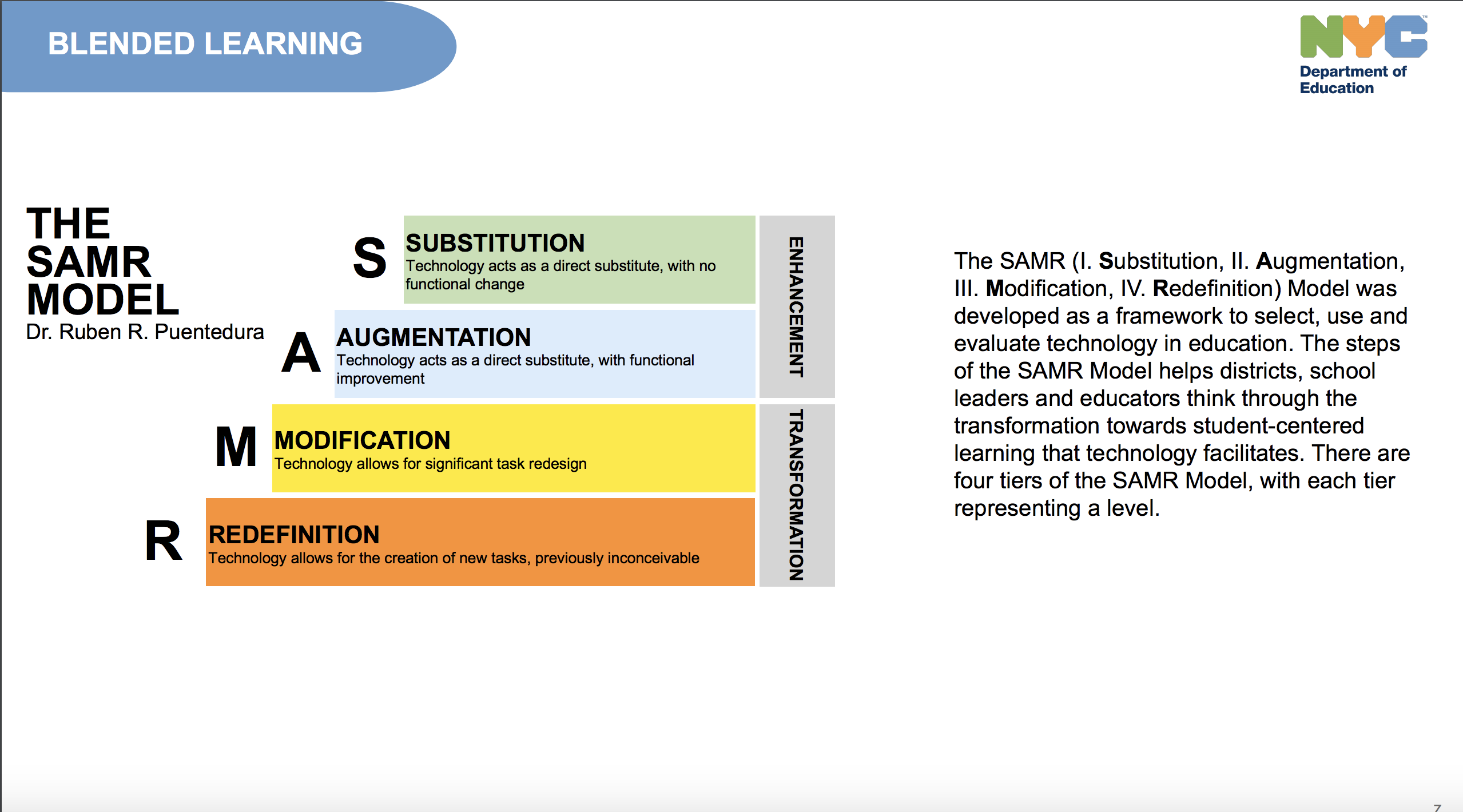
Did you read this? How does this help anyone?

This is a sketch, not a plan:
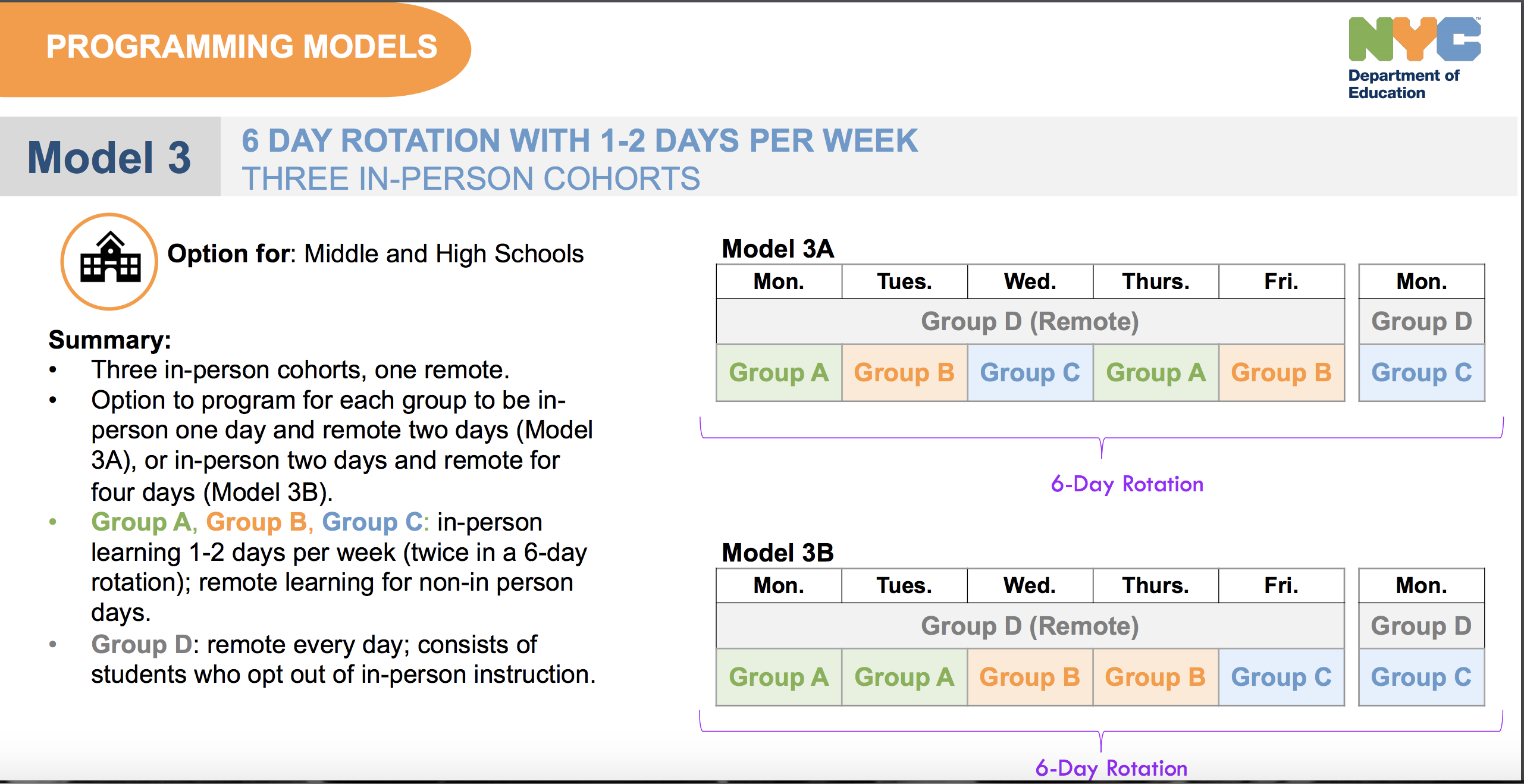
What to look for in the new NYC School Schedule Models
New York City’s first attempt to make plans for September did not stand up to scrutiny. Is there a chance that today’s “Schedule Models” will contain better news?
On June 9 the Department of Education released a planning document, “SCHOOL BUILDING RE-OPENING PRELIMINARY PLANNING OVERVIEW.” It was not good. Here’s the powerpoint. Here’s my take.
I explained in a separate post why the DoE’s schedule suggestion the first time, an AB model, was non-serious. Read here.
It did not account for rooms, teachers, class size, remote learning, special services, lunch, PE… It was the sort of “plan” I might get from a group of lazy high school sophomore boys: there’s a chart, but it doesn’t make much sense, because not much work went into it.
Let’s hope they are more sophisticated this time. What to look for (the order is arbitrary):
Variety of levels – are there plans that are suitable for elementary? plans for middle schools/jhs/intermediate schools? plans for high school? Plans for D75? Their first run seems to have been designed for elementary only (and still unworkable). Look not just for multiple models, but for multiple models at each level.
Details – Do the models contain details, or are they bits of suggestions, sprinkled with aphorisms? If there is no sense of worked out details, then the models are not the beginnings of plans. Having details is no guarantee that the thing will work, but lack of details would be a tell that these will not work.
Useable “out of the box” – in schools where the capacity to plan is minimal – and that is going to be many of our schools – an out of the box model will be needed. (Our principals were NOT trained to do this sort of work. Our programmers generally deal with one or two new ideas at a time, not a brand new schedule. Somewhere between one-third and two-thirds of our schools fall in this category (my guesstimate, having looked at master schedules and spoken to teachers from across the city). So we should see an option at each level that can be used with virtually no modification. If there is not, we may have a recipe for chaos in September.
Physical Education – no matter how good or how bad a schedule model is, I cannot start programming until I know what to do with PE. Is it remote? Is it live? What are the space requirements? If the models fail to address PE, that’s a very bad sign.
Lunch – no matter how good or how bad a schedule model is, I cannot start programming until I know what to do with lunch. This is huge. Lunch is normally a time that creates breaks in teacher schedules. If lunch is kept in the classrooms, who supervises? This is not a small part of the schedule. If the models fail to address lunch, it probably cannot work.
Some students fully remote – I’ve been able to create a workable (but not very good) model that brings in 9th grade, but leaves other grades remote. I might try for 9 and 10, or 9 and 12. Not sure if they will fly. Other programmers have been very generous in finding holes – leaving me pretty iffy about this. However, I needed to leave 50 or 75% of my school remote to even make it plausible. I expect that good models will include leaving some grades or particular groups of kids behind. (On the other hand, if 20% of my school, unevenly, but across the board, opts to stay home, that does not reduce the complexity of the schedule, but leaves me less room to maneuver. That does not solve any problems.) If the DoE models leave groups of kids (not just volunteers) remote, that’s a sign that they are thinking seriously about this.
Some classes fully remote – Leaving entire subjects remote might help make a hybrid schedule possible. I hear schools thinking about only bringing in their core subjects. Mulgrew suggested (and I agree) that some schools might have better luck keeping core classes remote, and making the others live or hybrid. In any case, if the DoE models suggest leaving whole classes/subjects remote, that’s a sign that they have done some actual thinking.
Social-Emotional Learning – This is like dealing with massive trauma. The need for SEL is huge. The DoE will mention it. But if they attempt to roll SEL into the schedule models, in a specific way, that would be a good sign.
Note: It is possible that the only “hybrid” model that works is one that brings in children for activities and services that support SEL, and leaves all or almost all academics remote. We should talk more about this possibility.
Worked out examples – If there is a fully worked out example for ANY model, that would be a good sign that they are starting to engage in the necessary work. If there is a fully worked out example for ALL models, that would mean that they are doing what they are supposed to do.
No simple division – If we take the student population, add the staff, and divide by the socially distanced capacity of the building, and round up – that can lead us to a number of “cohorts.” For example, my school, they would get 3.4, round up to 4, and say “hey, Jonathan, divide the kids into four groups, A, B, C, D, and have them come in every fourth day (or fourth week). That’s a “plan” that satisfies only the space requirement – there will be enough room for everybody who arrives each day. That does not satisfy anything else – remote teaching – movement – special services – special classes. I argued a bit with Sterling Roberson and Michael Mulgrew about this – Sterling thought I was being too categorical when I called this approach “impossible” – though he did not argue that it was a good approach. When I claimed that no school could be scheduled this way, Mulgrew retorted that there actually was one – but then added that they had defined “cohort” differently – in other words, were not bringing all the kids in. If their model tells us how to calculate the number of cohorts, and stops there – that won’t work – that’s not a model that will make it possible for school to open in September.
Coordination between schools – some models under discussion (by programmers, not necessarily by the New York City Department of Education) would require coordination between schools. For example, and this could make sense, a model where K-8 goes live, and 9-12 stays remote, would require coordination in the allocation of space in high schools to elementary and middle schools. The central aspect of this planning would be hard. If Central includes models in which it takes on responsibility for coordination between schools, that would be a good sign that they are attempting to engage in actual planning.
Who does what remote teaching – This could be a logistical nightmare. In any given school, there will be teachers who receive accommodations. There will be kids who choose to stay remote. But it is highly unlikely that the needs will match. If there is SOME (not all) remote teaching there needs to be an actual plan for how to make this work. If they do not address this centrally, remote teaching in a hybrid environment will be impossible to schedule in most schools.
Is a remote component necessary? – Another way to look at a hybrid model is that some students get live instruction, the rest are on break until their turn. It’s worked elsewhere. If the DoE considered this, it would be a sign that they are taking the complexity of the problem seriously.
Staffing – almost any hybrid plan, including many that leave some students and some classes remote, will require additional staff. If they pretend that we can do any of this without addressing staffing, that is a very, very bad sign for September.
Central staff with teaching licenses – For obvious reasons. We are way understaffed (over-crowded schools) in regular times. Going hybrid or live in September will create serious shortages. If the models do not invoke the licenses of those in the system who do not currently teach, they are just not serious.
Delays – The Chancellor announced a timeline last Thursday, July 2 on a conference call for principals. The timeline released DoE schedule models (and school budgets) on Tuesday, July 7. Neither one of those happened. Instead, we now expect models today, July 8 (and budgets today or tomorrow). One day? Does it matter? Wait. The timeline also demanded that schools choose a model by July 23. One day out of sixteen does matter. If there are further delays, that would probably indicate the process is in shambles.
NYC School Schedule Models – What was Wrong with the DoE’s First Try
New York City’s first attempt to make plans for September did not stand up to scrutiny. Is there a chance that today’s “Schedule Models” will contain better news? Should we be glad they were delayed a day – or should that worry us?
On June 9 the Department of Education released a planning document, “SCHOOL BUILDING RE-OPENING PRELIMINARY PLANNING OVERVIEW.” It was laughably bad, except laughing was the wrong reaction, since they were going to use it for September, with us, the teachers, and our students trying to survive it. Here’s the powerpoint. Here’s my take.
The key part to any plan is the school schedule. The powerpoint included a list of options: daily A/B, weekly A/B, or 2/3 A/B (with some remote). These options were followed by “Increase space among students during in-person instruction by moving some classes outside, re-arranging desks, diving classes into smaller groups, requiring students to remain seated during class; institute classroom stays where students stay in one classroom all day and teachers rotate; and/or close common areas and high-mix classes/activities.”
I would characterize these as hopeful suggestions rather than anything resembling as planning guide. And while hopeful, they were not good. Planning is hard work. It involves putting some flesh on ideas, and getting a feeling for whether the ideas would lead to something useful. Tossing out a handful of ideas, without doing any planning work, it’s not planning. It’s what friends do at a bar late at night. An actual planner will realize almost immediately the product of such a drinking session. It reminds me of an old xkcd comic:
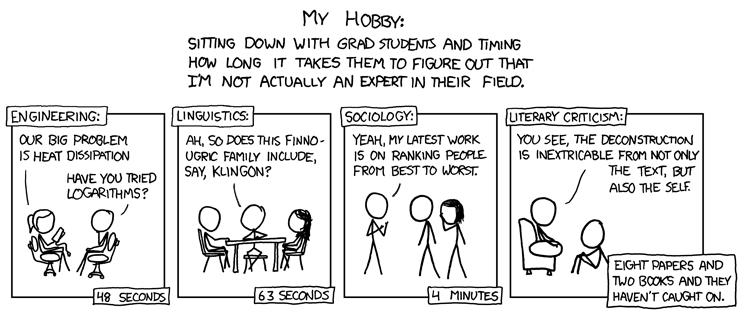
While the DoE people and their expensive consultants might be conversant in critical theory, I doubt there are any linguists, and certainly not an engineer.
Let’s look more closely. The heart of their suggestion (I’m choosing the easiest to follow) is to divide the student body in a given school into two groups, A and B. The A group would come to school during A weeks. During A weeks, the B group stays home and receives remote instruction. During B weeks it reverses. Group B comes in for classes; Group A stays home for remote instruction.
A school schedule is not like a jigsaw puzzle. It is like a multi-dimensional, rotating jigsaw. We schedule students, of course. But we schedule rooms, we schedule teachers, we schedule classes, we schedule services, we schedule special classes, we schedule lunch.
The DoE’s proposal did not look at any of that. When programmers (school schedulers) took a look the result, they just shrugged “no.” Let me explain why.
Space – They clearly miscalculated the space in schools. They seem to have forgotten that each room needs at least one adult. They used odd estimates. They engaged in massive wishful thinking.
Class size – When we divide a high school into A and B, do we get 10 kids in each room? Nooo. High schools have up to 34, junior high schools 33, elementary 32. A room that can hold 10 people, we can get classes of 9. Each of those classes, at each level, if they are at capacity, would need to be divided into 4 groups. Whoever wrote the document must not have realized that NYC Public Schools have classes bigger than 20.
Teachers – Let’s pretend that we are looking at a fourth grade. 200 students. 25 per class, that’s 8 classes. Distancing guidelines bring us down to 10 students in a class. Ok, 20 classes, 10 A classes, 10 B classes, and do the alternate week thing. Why not? Because now we need 10 teachers, but we only have 8. So what, two teachers? Multiply this by 1800 schools. We have a problem.
Remote Teachers – Let’s look at that fourth grade again. This time, the DoE has given us two extra teachers. All set? Group A comes in, 100 kids, 10 classes, 10 teachers – we are all set? Who is doing the remote teaching? Seriously, how did no one think of this?
High school – We have a high school that is starting with small classes – just for the sake of argument – 20 in each class. Maybe we can use an AB schedule with them? We carefully take half of each first period class and label them A, and the other half become Bs. Send the Bs home. We have 10 As in every class. Bell rings. Second period. What happened?!? High school kids get personalized classes. There are electives, Advanced Placement, make ups, different levels. When students go to their next class, they do not travel in a group. Those 10 classes with 10 kids each? Now they are 10 classes with 15, 4, 12, 10, 11, 6, 8, 18, 9 and 7. Social distancing? We could avoid this by finding groups of 10 (or 8, or 11, depends on the room) who have the same courses. Maybe this could work freshman year, but by senior year it would be a mess.
Push-ins/ Services – There is no provision for ESL services, special ed services, therapy, speech, push-ins, etc. There was no adjustment of ICT teachers (two teachers in a room mean one fewer student. In a room that accommodates 10, that’s 8 students instead of 9, a significant error).
Lunch – for a scheduler, lunch is ordinarily a break. A large number of students can be supervised by a small number of adults, most of whom need not be teachers. The cafeteria is a large space. So here’s a place in the day where ordinarily we have the room, and we can put in students, practically without limit, without scheduling a teacher. But in the DoE’s ABWorld, lunch would be in the room. That adds one period for each classroom that needs supervision – and with one adult in the room, the supervisor needs to be a pedagogue (for our purposes, that’s a teacher). In most schools that would be about a 15% increase in hours needed. In other words, more teachers. By not addressing lunch, the DoE actually created a mandate, but made no attempt to cover the increased need. There are also safety issues with lunch, but that’s beyond the scope of this post.
PE – for a high school or junior high school scheduler PE is not as big a break as lunch, but it’s a break. PE classes can go up to 50, taught by one adult. See “Lunch” above for why this matters. We also are confused by what to do with PE with social distancing. Our 65 square feet assumes people more or less stay in one place. What will PE look like? Remote? As many as fit in a gym? I don’t know that I could evaluate a possible plan until I knew how PE might be handled. The DoE AB plan does not mention PE.
AB Weeks? – this is not a schedule. This is not an idea that a real planner can use to produce a schedule. This was not worth the money the DoE paid its consultant. I have heard $3 million. I have heard $1.2 million. Maybe somewhere in between? In any case, money poorly spent.
Let’s go one step further: ABC, or ABCD? They would answer some of the problems, but cause others. (Think about who is doing the remote teaching, and how much more remote teaching there would be. Think about the high school scheduling problem). This is not simply a matter of choosing the right number of rotations.
Later today we will see the DoE’s next try. Let’s hope, for all of our sakes, that they did better this time.
27 Blank Pages
The Department of Education’s new PowerPoint for principals around reopening in September is little better than 27 blank pages. Really. I’ll go page by page later, but just an overview now.
Actually, there are some things in this powerpoint. But either we already knew them, or they are problems. If you are looking for actual content, beyond these notes, try pages 13, 14, 16 and 24. Or wait. I’ll try to write more in the coming days.
I downloaded the new power point: school-buildings-reopening_principal-meeting_07022020. And here’s a link on the UFT site. Same file.
p1 Title page. Nothing.
p2 Warm up. “NEXT YEAR WILL LOOK DIFFERENT. Every school district in the country is trying something different. Up to this point, we have literally made the road by walking. I’m excited. I’m also anxious. Just like you.”
p3 Blank page to set the tone: “CHANGE IS HARD. We can’t predict the future. We don’t have all the answers. We won’t have all the answers all at once. There is high potential that our answers may change. The only constant is change.”
p4 Empty promise, in preparation for shifting blame for onto principals and schools “WE NEED YOU. We can only do this together. Principals: I need you to lead. Now more than ever. We will navigate this uncertainty together. I commit to giving you as much information and support from central as I can as quickly as I can. We must be partners.”
p5 Agenda (5 points):
- Summary Survey Results – Family & Student Survey
- Health and Safety
- Budget Update
- Guiding Principles
- Call to Action: Next Steps
p6 Heading: SUMMARY SURVEY RESULTS
I’m going to interrupt, to point out that 6 pages in, no content.
p7,8,9 These slides have some summary data from family surveys, about preference about program model, precautions.
- It is interesting what family preferences are, if there were actual choices. But we don’t know what will actually be possible. How can this data guide our choices? How does this aid decision-making?
- Turns out, that’s not the intent: “Along with other information, these results should inform your future communications to your school community.” Also: “The results for your school will be made available to you next week.”
- So schools should mold their message, not their policy, based on parent/student preferences. <sarc> That’s a relief </sarc> And it also explains why I’m not chancellor.
- But, when I look more closely, I will pull apart the numbers from this section. They seem to have done some creative accounting.
p10 Heading; HEALTH AND SAFETY
p11 overview page – includes things such as Programming and PPE and Movement that are actually omitted below, or barely mentioned
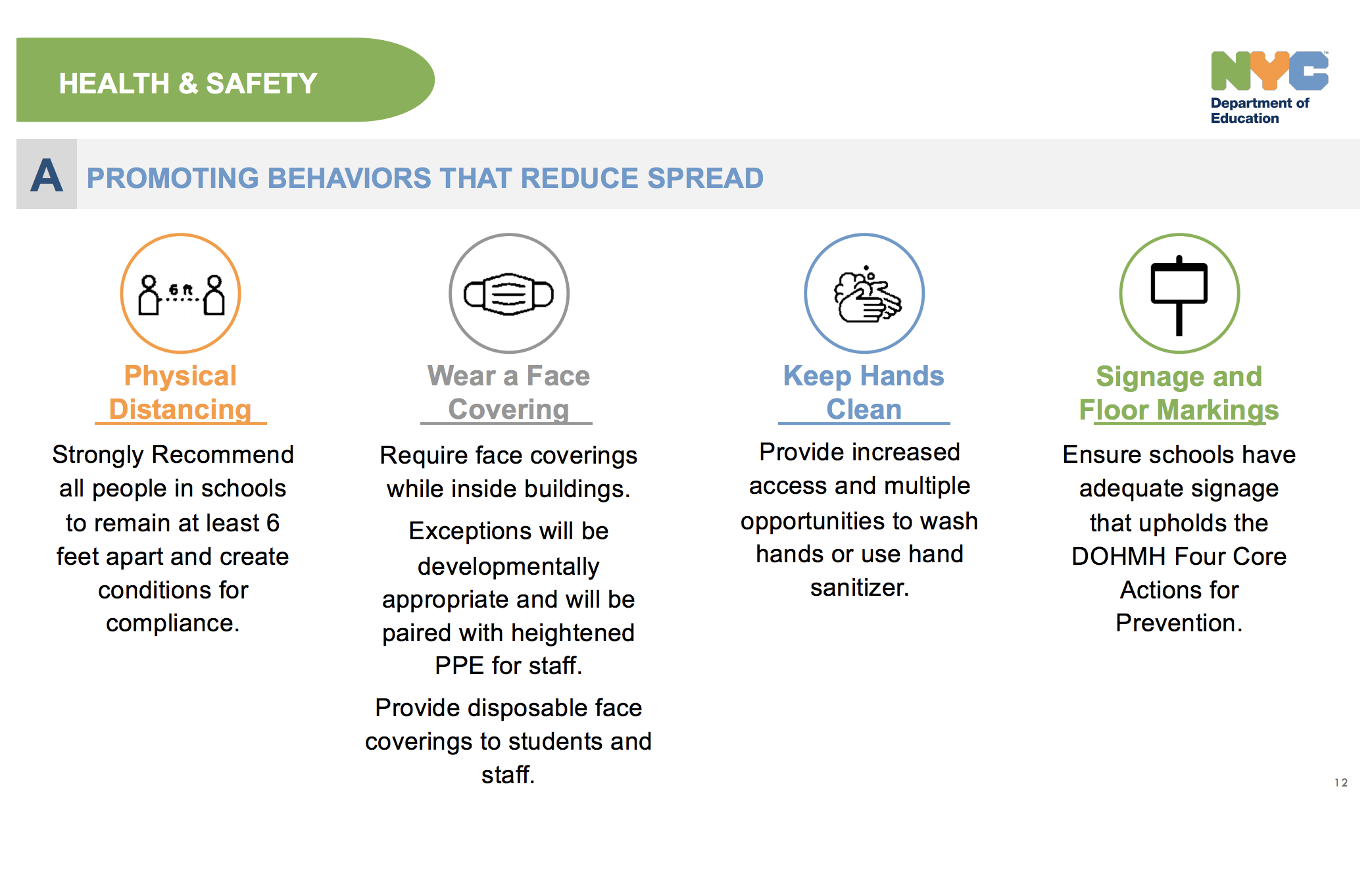
p12 “A PROMOTING BEHAVIORS THAT REDUCE SPREAD” We have mostly seen these:
- “Physical Distancing” 6 feet is a “strong recommend”
- “Wear a Face Covering” unlike Connecticut there is no exception for teachers while teaching. “Provide disposable face coverings to students and staff.” Not clear who is responsible here (see budget, below).
- “Keep Hands Clean”
- “Signage and Floor Markings”
p13 B MAINTAINING HEALTHY ENVIRONMENTS – mostly vague, very little content
- Changes to School Building: • Modify or configure spaces to ensure compliance with physical distancing rules. • Ensure all schools have a designated Isolation Room, as well as staff to supervise the space. • Utilize School Based Health Centers (SBHC) to provide supplemental care, if this is a viable option.
- Cleaning and Disinfection: • Ensure schools have adequate cleaning and disinfection supplies. • Ensure deep cleanings are completed on a nightly basis, including with the use of electrostatic sprayers. • HVAC improvements to ensure proper ventilation. • Implement improved cleaning in classrooms, bathrooms, and for high touch areas such as doorknobs and shared equipment such as laptops. • Providing cleaning supplies for classroom teachers if requested.
- Food Services: • Consider holding lunch in classrooms to minimize interaction between groups of students. We will be soliciting feedback on how to best structure lunch planning. • If the cafeteria must be used, consider personal dividers or assigned seating
I don’t know what an isolation room is, or how we will find staff to supervise it, especially when we are likely to be short-staffed.
I’ll come back to this. But just a fer instance: “If the cafeteria must be used…” Where is the guidance on that decision-making? If you are going to make it up to each principal, based on? I don’t know, their personal judgment, I know some of your principals… you are announcing that there will be plans that compromise the safety of students and staff.
p14 C MAINTAINING HEALTHY OPERATIONS (1/2) This should be crucial, but is vague enough to be meaningless.
- Testing: • Testing guidance continues to evolve. DOE will provide additional policy guidance.
- Screening and Entry/Dismissal Protocols: • Guidance on symptom checks continue to evolve. We will be asking for feedback from principals and monitoring best practices for entry/exit protocols. • Consider systemwide implementation of a health screening tool and explore options for electronic data capturing of health screenings. • Screen staff, students, and visitors daily on arrival for symptoms. • Create guidelines for health screenings of staff who report to work outside of morning arrival. • Recommend that student drop off and pick up is done outside the building to minimize the number of external visitors. • Recommend that nonessential visitors do not enter school building. Limit frequency and duration of other visitors.
- Movement Protocols: • Redesign movement protocols within a building to minimize congestion and designate one-way direction stairwells and single file routes.
Actual guidance? Nothing here. I’ll get a small bit of pleasure in noting someone gets paid a quarter million and is ok with “one-way direction” – although the pleasure fades as I realize that people who can’t get a phrase right are going to try to make decisions that may endanger me, my colleagues, and my students.
p15 C MAINTAINING HEALTHY OPERATIONS (2/2) I took nothing from this slide, except:
- I noticed the staff mandates come with no guidance “DOE’s goal is to have a nurse or health professional in every building” “Have adequate staff available to support with daily enhanced health protocols.” and
- I do not think this means anything “Ensure systems and structures for prioritizing social-emotional and mental wellness across all DOE schools including, but not limited to, Health Education, Physical Education and Social-Emotional Learning programs.” Anyone?
p16 D PREPARING FOR WHEN SOMEONE GETS SICK
- Stay Home When Sick:
- • Staff members and students should stay home when sick.
- Responses to Symptoms or Positive Cases:
- • Provide the necessary protocols, personnel, space, and DOE record keeping systems for schools to support students and staff who present COVID-19 symptoms.
- • Design a clear process that has checks and balances to monitor COVID-19 illness in a school building aligned with state guidance.
- Contact Tracing:
- • Partner with NYC Health + Hospitals regarding contact tracing and follow up.
- • You will hear directly from the Test + Trace and DOHMH team about how this will work in schools.
I have provided the full slide, so that you can plainly see, there is no language about closing a school if there is a positive case. If this is not addressed, I believe we will see job actions, authorized or wildcat, come September.
p17 Heading: BUDGET UPDATE
p18 Further cuts may come if there is no more federal aid. Cuts could happen during the school year.
p19 Budgets will be released (maybe) July 8. Central claims they are picking up the tab for cleaning supplies. No mention of who pays for PPE.
p20 Hiring freeze (transfers only). Open market has not been extended. All excessing goes through a review process.
p21 Heading: GUIDING PRINCIPLES
p22 Now the opening of this slide is interesting: “The New York City Department of Education (NYCDOE) will adhere to the following guiding principles as they plan, prepare and open schools for the 2020-2021 academic year.”
- Did you catch that? “as they plan” Pretty shady, shifting responsibility, hoping no one would notice.
- The principles are fine principles. Most have been written down many times before, and are not specific to the pandemic. I actually do want to take some time on these (future post). For now, here they are:
Physical and mental health of our students, teachers, staff, and families • Greater equity among students with respect to the education they receive and the learning environment in which they receive it—whether virtual or in-person • Academic achievement for students through high-quality instruction, tailored enrichment, and culturally responsive educational practices that allow students to see themselves reflected in the materials and lessons of their education • Social-emotional and trauma-informed support for all students • Community and continuity all year among students, and between students and teachers/staff • Priority for in-person learning for students and families who have trouble accessing and engaging in remote learning • Deeper empowerment of our families as essential partners in their children’s education • Frequent, consistent, and transparent communication with families, schools, and partners • Clear guidance for schools in balance with the necessary flexibility to meet the needs of their particular school community • Commitment to continuous improvement
(The Department has failed dramatically to provide clear guidance to schools over the course of the crisis. The Department has failed dramatically to provide clear guidance to schools for September. I believe that the failure is not correctable. I do not know if the problem is just leadership, or leadership in combination with personnel, structure, or with both. Decisions can be made and will be made, but in a vacuum of leadership. I am genuinely afraid.)
p23 Heading: NEXT STEPS
p24 “CALL TO ACTION *DATES TENTATIVE — SUBJECT TO CHANGE*” This is a timeline. Things for schools to do, based on things the authors of this powerpoint have not yet done. And frankly, based on things the authors of this powerpoint may not have the competence to do. Let me show you, and save discussion for later:

We will see July 7 when they release their super-secret schedule models. Prediction? They will not be workable models.
p25 Heading: APPENDIX
p26 “WHERE WE ARE” “NYC Department of Education (NYCDOE) has already began efforts to open schools buildings post-COVID-19. This effort is being completed along the following steps:”
- This slide actually has content. It is mostly false. The word false is insufficient. They are claiming things happened in April and May which did not. They claimed planning happened in May and June, which did not.
- I will pull this apart later, but for now, here is their claim for May – June: Key “Design Areas:
- 1. Enhanced Health Measures
- 2. Trauma-Informed Transition Back to School
- 3. Blended Learning
- 4. School Start Date (both academic year, 12-month programs)
- 5. Rolling/Phased Starts
- 6. Social Distancing and Split Schedules
- 7. Building Operations
- 8. School Support Services”
- This is dishonest. This did not happen. I will write more.
p27 NYC DOHMH GUIDANCE I think this is an old slide: Stay Home if Sick / Keep Physical Distance / Keep Hands Clean / Wear a Face Covering
– – — — —– ——– ————- ——– —– — — – –
The takeaway? They are only compounding a few bad decisions here. Mostly this is a place-holder. This is sixteen weeks of work, and they are nowhere. Yet they will hold schools responsible for implementing something in a very short time. I am very concerned about the implications for the safety of our students and our staff. I am concerned about these people creating chaos in September. I wish we had real planners in charge.
Big deals:
- There is no guidance on programming whatsoever. They promise “models” for July 7. I don’t think they have workable models.
- Six feet is “strongly recommended” That’s worrying.
- Mask on while teaching? Probably just an oversight.
- Cleaning – lots of mandates without any road to implementation
- PPE – not clear who is responsible for providing it
- Staffing mandates – while staff will be short. Every school should have a nurse – but how?
- Building closures – completely unmentioned. This almost led to a wildcat job action in March. Are they really preparing to provoke one in September?
I cannot begin to tell you how little respect I have for ability of this Department of Education to lead in a crisis. Or how much fear I feel.
Budget Crisis in the NYC Department of Education and Top Salaries
I promised to ask, so I will.
Carranza makes almost three times top teacher salary.
Many of his deputies make two times top teacher salary.
Top teacher salary is $124,909 a year. It’s more than double starting teacher salary, $59,291.
So why do the people at the top make so much? Especially, when you think about it, in an organization dedicated to teaching children, these are precisely the people who do not educate children?
Well, they do need to make enough to survive in NYC. The DoE pays paraprofessionals between $27 and $43 thousand. I guess the DoE thinks you can survive on $27k a year in NYC.
And, by the way, paraprofessionals perform important work, every day. (and if you want to complain about a paraprofessional you once knew who did not work very hard, I’ll trot out a dozen stories about paras who work their asses off doing work you would not want to do – and if you have a second story, I have a dozen more. Don’t go there). But if you ask me, ‘if Carranza couldn’t come to work for three weeks, which student would be lost without him?’ – is there a shrug emoticon? Because a para being absent is a big deal. A teacher being absent is a big deal. But if Carranza and his deputies took two weeks off, we would not notice.
But look, I can be reasonable. I’ve made an argument to fire the lot of them, but I’m not going to push in that direction.
Instead, in recognition of the severe budget crisis we are entering, with further cuts from the state possible, let’s look at reducing the pay of non-school-based personnel not working directly with children to say, 25% more than the top teacher salary. That’s $156k, rounded off. Still, a whole lot of money, almost 6 times a starting paraprofessional.
What would that save? Three million dollars? It’s just 1/10 of 1% of the budget. But the message would be clear. And not doing it? That message is clear, too.
What do you think? Should this be a petition today? Or would it divert us from greater struggles? I am galled that three mil is being thrown away like this. But we have a lot of fights.
Should there be a petition to cap NYCDoE executives at 25% over top teacher pay?
A Hybrid (Remote + Live Instruction) Model that Works
A teacher described her niece and nephew’s school. A and B weeks. (not high school). Everyone knew the schedule, followed it. Worked. Everyone wore masks. And kids had the option of staying remote, but they did not, and they will go back live in September.
BS fantasy?
No.
NYC?
No. NYC probably cannot successfully do blended learning. Oh, we are still working on it. But most schools are waiting and seeing. The only progress I’ve heard of so far involves keeping over 50% of classes fully remote, or keeping over 50% of students fully remote (and everything’s worse in high schools). We will find something, and it will be too expensive. Or too limited. And despite demands from politicians, A/B weeks for everyone? I don’t think so.
Not NYC. Read more:
I have family in Germany. today is their last day…they feel comfortable with everything that has been put in place.. One week in building and the next virtual. No parents allowed inside. Teachers and students wear mask, they have been very good at social distancing and washing hands. There is 10 children in the room plus the teacher and an aide. Majority of the parents have let their children return even with the option of straight virtual learning. My Cousin said she will let them do building again in September (ages 5 and 9).
I asked about numbers, and the answer:
only 10 all depends on the room size and she said the lowest she heard was 8…. with one teacher. she did mention a lot of furniture was taken our the rooms just desk. temperature checks for everyone and PPE equipment was supplied and well stocked
This is not “German punctuality” or neatness. This works because on a regular day there are 16 – 20 kids in those German classes.
This is not a post about COVID and hybrid learning.
It is a post about class size, and class, and race.
It is about schools that serve Black and Brown and Immigrant and poor students not being able to do what other schools do.
It did not have to be this way. The United States did not have to have a piecemeal approach to education, with public urban schools, parochial schools, public suburban schools, public rural schools, and private schools offering substantially different educational experiences in substantially different conditions.
But that is what we have. Northern urban schools were for the poor, the immigrants. Then for Black children. Everybody’s looking to carve out exceptions. Progressive schools. Special schools. My school. But at their heart, our urban school systems pack in poor kids. Used to churn them out without graduating. Now churn them out with a test-prepped diploma that does not always mean what we want it to mean.
And part of this system? Doesn’t matter how many kids we squeeze in a room. I mean, NYC does have limits. 32 elementary, 33 middle school, 34 high school. Numbers that would cause outrage elsewhere.
Want smaller classes?
Move. Plenty of places would never put 30 children in a class. But don’t move to another northern city. Move to Germany? That’s a lot to ask. Maybe a fancy suburb. Maybe a rural area. Or pay. Could you imagine the inside of a private school? With space.
But I’m not writing about individual solutions. It is way past time for this. We cannot continue to think of as “normal” 34 students in a high school class.
This is systemic. This is providing separate, unequal education to our urban students, mostly poor, mostly Black or brown or immigrant. This needs to end. Black Lives Matter! But it’s ok if Black educations are a matter for another day?
How much would it cost to get class sizes down somewhere near reasonable?
Reasonable? 20 kids in an elementary class? 25 in a high school class? Split the difference in between?
Cost? Cost to dramatically improving the education of one point one million New York City children? We all talk about cost. I do. And it’s disgusting. It’s racist, and classist. These are our children. Not potholes. Not tax abatements.
We need to hire many more teachers and paraprofessionals. Maybe 20,000 teachers. That’s a wild guess. I don’t know how many paras, can’t even guess.
We need more classrooms. We need to build schools. I don’t know the math for this one. There are 1800 public schools in NYC, but that’s not the correct number of buildings, which is less. I am certain that 100 new buildings is not enough. 300? I’ll throw out 300, but I could be way off.
So wait? Thousands of teaching and paraprofessional jobs? A massive multi-year construction project, spread across the five boroughs? And better education for one point one million NYC children, mostly poor, many Black, many LatinX, many immigrant, mainly poor? Win. Win. Win. Win. And not little wins. All of these make New York City better, help our people, help our children.
The money? We will need a lot. Borrow it. Weren’t we able to borrow after 9/11? Defund the police? We saw the smoke and mirrors in the City budget passed yesterday. They nibbled. Not at the edges but at the edges of the edges. How about we replace the police, and eliminate their repressive functions. Let’s see what Minneapolis does, and – we are New York – do it better. Reduce the size the replacement agencies. Sell off the military equipment. Recoup a lot of money. Tax the rich. Seriously. No need to be timid. We can’t make them work for the common good. But you know what they have a lot of? Money.
And you know what? If we did these things a decade ago, this would be a better city. And we would have a whole lot more flexibility with our schools today.
Whose fault is it that we did not? And that we do not?
Is it too late to hire the teachers and build the schools to make hybrid work in September? Unfortunately, yes.
Is it too late to join the fight against institutional racism by building more schools and lowering class sizes for New York City’s children? Absolutely not. Get on board.
Thank You Teachers and School Staff
I often put qualifiers or reservations on UFT stuff. Not this time. Enjoy.
Meeting with Mulgrew about Reopening Schools
Last Tuesday afternoon I attended a curious Zoom Meeting about reopening schools in September. Michael Schirtzer (teacher, Leon Goldstein HS, and UFT Executive Board Member, High School Division) organized it. He wanted to bring some hard questions to the UFT leadership.
There were six classroom teachers: Mike; me; the two co-programmers from Michael Schirtzer’s school, Gary and Marty; Emily James, teacher at a Brooklyn high school, recognized author of columns on teaching today, and advocate, most famously for paid parental leave; and Arthur Goldstein (Chapter Leader, Francis Lewis HS, and also a UFT Executive Board member).
And from UFT Central: VP at large for Academic High Schools Janella Hinds, Special Rep Anthony Klug, VP at large for Career and Technical High Schools Sterling Roberson, and President Michael Mulgrew.
Everyone looked kind of relaxed. From UFT Central Sterling was there on time, and we were chatting. I wondered if the others would make it. They all did. And stayed for a pretty full conversation.
Schirtzer moderated, to some extent. It mostly became a conversation. We all had different angles. But what we had in common is that we were thoughtful, and critical, and concerned first of all with the safety of our members.
My angle? You can guess it. I can program a school for “live instruction.” I can reprogram a school for “remote instruction.” But I know I cannot reprogram for hybrid instruction with the model from the DoE PowerPoint.
They proposed dividing schools in 2 and having A and B days or A and B weeks. No way to maintain social distancing with those numbers. Mulgrew at the Town Hall June 18 and Delegate Assembly June 17 had shown awareness of the complexities. First of all, you’d need A/B/C or A/B/C/D – and even then it might not work. There are issues with enough teachers (these models require more staff). And there are lots of little issues, many of which, when we begin to program, are actual road blocks. So I wasn’t happy when the UFT school survey seemed to ask Chapter Leaders to pick A/B, A/B/C, A/B/C/D or A/B/C/D/E.
Everyone else did raise important issues. No one recorded us. I was not taking minutes. So no slight intended to the others when I focus on what I tried to raise at the meeting, and the responses I got.
I tried to say multiple times that I thought Mulgrew’s presentations of the facts at the Town Hall and the Delegate Assembly were correct. Because I knew I would be critical, I wanted it clear that there was at least some agreement at the starting point.
Mulgrew underlined again and again, “safety first.” I think that is crucial.
Mulgrew at the Town Hall talked about a 4th grade – 200 kids, 8 classes. Remote it would be two cohorts (though he thinks two is unlikely) of 100, so 10 kids in 10 rooms – but where’s the extra two teachers? And who’s teaching the remote kids? (his solution: we need to hire more teachers)
I like that, because it is simple, and clear. Fix that problem, and we are not done. But how do you fix that one? It’s a biggie.
I like my example for high school: Imagine first period in your school. You’ve broken into 4 cohorts, so all those classes? They now have 8-9 kids each. They are perfectly programmed. And social distanced. Now let the bell ring – we move to second period. How are you going to keep one room from having 3 and another from having 14? This is high school. Mix and Match.
Simple and clear. Fix that problem, and we are not done. But first you have to fix that problem. (My solution: you can’t bring all the kids in for all the classes. Some classes or kids, probably most, have to stay remote)
I think that a “cohort” idea, breaking up a school into N pieces on an N-day or N-week rotation will not work in most schools. I am certain that it will not work in high schools.
Sterling responded (well, a lot) but the crux was that there were people who disagreed with me. I am pretty sure they are not programmers, and confident they have not created a program that works. Mulgrew said that there is one school that has programmed using this sort of cohort model.
I said I preferred live, but until we can go live, fully remote. But I understand that there may be incredible political, social, and economic pressure to go back. So we should be working hard to make a “least bad” hybrid model, because we certainly don’t want self-confident, incompetent principals imposing models on us – models that no one will know are horrible – not until September – when they lead to an inability to maintain social distancing, or just to plain chaos.
Therefore I am going to work on, and encourage schools to work on, hybrid models that might really work. For that reason I was going to ignore the DoE Power Point. And I would encourage other programmers and Chapter Leaders to do the same. I don’t think there was grumbling in response in the meeting (except for one teacher, who favors fully remote, and thought the hybrid work was a waste of time).
I talked about the Facebook NYC Programmers group, and Janella, I think, mentioned my participation in the UFT Programmers Focus Group.
What might work – that was the conversation that was most interesting.
I mentioned that I was building a dummy master for 9th grade hybrid / all other grades remote, and thought it might work (but that there were staff needs). One of the officers immediately retorted “9th and 10th“ – it was clear to me that this had already been the subject of conversation.
We talked about limiting live instead to certain subjects. Mulgrew suggested we look at keeping the core subjects fully remote, and bringing kids in for some of the others (that’s a longer discussion, but I believe that this could be an important strategy in some schools).
We talked about support services, or check-ins.
There’s an idea floating out there to open K-8, but not high schools, and use those buildings for the younger kids.
I know I talked about the particular complexities of high schools, where there are special classes and programs and lots of levels, especially juniors and seniors. But I think all the teachers in the room discussed the same issues.
Mulgrew wanted to know what we thought of getting waivers from the state to allow seniors to be programmed for what they need for graduation (and not necessarily a full day). Everyone though that was a good idea.
On the cohorts, Mulgrew suggested that breaking into cohorts might not mean bringing all the cohorts into the building (I was surprised, but pleased. I wonder if the school he mentioned that programmed with cohorts did this).
All of them emphasized that we should be creative, come up with the sorts of ideas that we were talking about, and communicate back what works.
I said that it was great that the people in the meeting heard it, but all programmers and chapter leaders should hear too.
Mike said that I could tell them.
I said that me saying “Mulgrew said…” is not as effective as Mulgrew actually saying it. He didn’t reply.
I’m skipping lots of stuff. I’ve focused only on the conversations I was directly involved in. But there was much more.
As we wrapped, Schirtzer asked if they would be willing to do this again. Mulgrew agreed. Janella reminded us that we can bring ideas to her and Sterling as well.
There is no easy calculation for September
At Wednesday’s United Federation of Teachers Delegate Assembly and again at Thursday’s UFT Town Hall, President Michael Mulgrew made the point clearly:
“Socially Distanced Capacity” divided by “# of Teachers” ≠ “Number of ‘cohorts'”
If you listened in, you heard him explain. Say you have a fourth grade with 200 kids. 8 teachers. Given your capacity, you can fit 100 kids into 10 rooms. But where do the extra two teachers come from? And who is teaching the 100 kids remotely?
He made it simple. Honestly, that was enough for the DA. But the situation on the ground will be far more complex. Push-ins change student capacity. We are not talking about lunch. Which, I assume, is a time masks come off? How much time will teachers stay in rooms without breaks? How will bathroom flow (pardon the choice of words) be managed?
It’s wonderful to say “oh yes, entrance can be staggered” – but I know the people saying it have not tried to do it. Nor managed distancing in hallways that are half-full. Nor stairwells. Nor elevators.
But we don’t have to go there. Mulgrew made it really clear.
And he had to. The DoE had put out an absurdly dumb powerpoint that facilely made it sound like all schools could be divided in two. Wednesday Mulgrew said it – most schools would need three, or four, and that still might not work. And then he described that imaginary school’s fourth grade.
I felt better. The initial UFT response – if I called it “unclear” that would be very generous. It actually sounded like they were accepting the powerpoint. So hearing Mulgrew Wednesday and Thursday – good thing. I already knew things sounded much better at the High School meeting last Monday.
So what’s left? We do a capacity survey in each school, chapter leader and principal. Report our findings to the UFT. And then scratch our heads and start thinking. This work is complex. Me, I have been part of a UFT programmers focus group. I also co-founded a Facebook NYC Programmers Group for wrestling through this stuff. We haven’t actually done anything yet – the group is 3 days old, has 80 members, 55 or so of them programmers. I figure we will need over 100 programmers (180 – 200 members) to have the critical mass to do this sort of work. End of the week should do it.
So everything was going right. Mulgrew corrected the UFT misstep. Programmers group started. Now the walk-throughs.
I blew a gasket when I saw the UFT survey. They recycled the
“Socially Distanced Capacity” divided by “# of Teachers” = “Number of ‘cohorts'”
nonsense. It doesn’t work. It’s misleading. It creates false expectations. It also creates the expectation that armed with the right number of cohorts, a principal could program a school. And look – that’s exactly what might happen. And in that school – and let’s face it – there are many with principals who are self-confident, arrogant, and dumb – the resulting chaos and lack of social distancing would put our members at risk. Kids too. So much for “safety first”
Now I am stuck. I cannot complete the walkthrough survey until the UFT corrects the survey.
I have to recommend that you not fill it out either. Wait. Or tell your Chapter Leader to wait. The UFT can fix this, can put safety first where it belongs. I am giving them a chance.
NYC Programming Group
Hey – this is like an advertisement.
I am a programmer (scheduler) and chapter leader. This summer we may have crazy programming issues coming up, and I’ve been kind of vocal about that. The DoE cannot program from the top. We need people in the schools who know their schools, who know how details work. If there are plans that will work in September, we are probably the ones who will find them. If there is a proposal that looks iffy, we are in the best position to evaluate whether or not it has a chance of success.
Gregory Levine, Program Chair at Long Island City High School agreed. We talked. He suggested making a group on facebook, so we did. Here’s the link, but I don’t know if you can get there directly with it.
Whether or not this group is productive depends in part on getting lots of good programmers together. Today we have 50 people, maybe 30 – 40 programmers. That’s not critical mass.
So the advertisement is this. If you are a programmer in NYC, join. If you are a teacher in a NYC school, ask your programmer to join. If you are a retiree, find the programmer you knew (if they are not retired), etc.
Thank you.
Sanity Through Math
This has been a tumultuous three months. I have been overwhelmed, frightened, angry, excited.
The world has been horrible. My employer has been heartless. My union has been too often passive. My friends are distant.
And my work has been exhausting. The grading – absurdly slow. Lessons? Maybe I’ve figured something reasonable out. I’m not certain, not about that. It’s taken me twelve weeks.
But math can be centering. Almost twenty years ago I registered for a too-hard-for-me math class at the Graduate Center (and one not-too-hard-for-me which I loved). This was the fall of 2001, and events in New York City interrupted class for a few weeks. Then we came back, and at the first session, Roman Kossak, the professor, said a few words about what had happened and then “sometimes when the world is falling apart around us, the best thing to do is some math.” Maybe he was right.
This morning I shared some enrichment work (mostly for my juniors, but optional for my seniors) and I included this cartoon (xkcd, by Randall Munroe):
Certainty
Now, if you hover your mouse over it, you’ll get a bonus, some alt-text: I didn’t share all of it with my students.
But I do think there is something comforting about considering problems with right and wrong answers.
And at 1PM today I finished my mini-elective in Axiomatic Arithmetic. Super-hard work. One lunch-time session per week, for 17 or 18 weeks, we studied arithmetic. We learned some history about the push to axiomatize systems other than geometry. We relearned arithmetic (I channeled my professor, David Rothschild, as we learned to count, add, subtract, multiply, divide, including after the “point” using the symbols /, ∆, ☐, O as the four symbols for base four.) I taught them standard high-school level mathematical induction. And then we read 10 pages of this text I found on-line: http://www.fen.bilkent.edu.tr/~franz/lect/ncp.pdf.
Now, you may say, 10 pages? The heart of a course was 10 pages? Well yes. And the pages are small. It was 1/4 of a credit, maybe it should have been worth more. We read pretty much every word. We discussed almost every word. They submitted proofs. Strong induction. Slowly we developed a little bit of a comfort level. We proved everything. When we finally got to proving addition was commutative – wow! Can you imagine defining multiplication? Proving distribution works? (twice, once from the left, once from the right. There you go, Randall Munroe).
And today? The hardest proof of the course. We spent almost an hour of an extended session. (Feel free to skip ahead)
Theorem 1.21. Every nonempty subset S ∈ N has a smallest element.
Proof. Let S ⊆ N be non-empty, and define R = {x ∈ N : x ≤ y for all y ∈ S}.
Then 0 ∈ R since 0 ≤ y for all y ∈ N, in particular for all y ∈ S.
Since S is non-empty, there is a y ∈ S; this implies y + 1 ∉ R: otherwise we would have y + 1 ≤ y, which does not hold (we have y ≤ y + 1 by (1.7), so y + 1 ≤ y would imply y + 1 = y, hence 1 = 0 and s(0) = 0 in contradiction with N3).
Thus R contains 0 but R ≠ N; the induction axiom then implies that there must exist an x ∈ R such that x + 1 = s(x) ∉ R. We claim that x is a smallest element of S.
First, x ∈ R implies x ≤ y for all y ∈ S, so we only need to show that x ∈ S. Assume x ∉ S; then x ≤ y for all y ∈ S implies x < y (because we can’t have equality), hence x+ 1 = s(x) ≤ y for all y ∈ S, which by definition of R shows that x + 1 ∈ R in contradiction to the construction of x.
All 10 students understood some of this by the end. Most understood most of it. Some of the 10 understood all of it. In a crazy, crazy world, we had done something sane, correct, and difficult. As a teacher, I usually consider the greatest accomplishment to be getting someone who knows very little to learn a tiny bit more. That is super hard. I usually don’t count teaching bright kids as particularly challenging – although it can contain challenges. But this, this course, today’s work, breaks my rule. It felt like an accomplishment.
They are mostly seniors, and I kept them after, to say how much they – and the course – have meant to me. They were my students freshman year, and they did Algebra II (a full year in one term) with me. Some did other electives. I had a lot to say. And now, during the pandemic, we focused on deeply challenging math, week after week. I think they learned a lot. And this class in particular gave me some balance.
And so, for four years’ association, and for being part of a class that was important to me, I wanted to send them on their way with some words of wisdom, but wasn’t prepared, and the words wouldn’t come. Maybe we should have just done one more proof. It would have been easier than saying goodbye.
Who Wrote That Useless Powerpoint?
I have variously heard that the school reopening powerpoint cost $1.2M, $1.5M, or $3M. Whatever, that’s a lot of money for a report that did not attempt to detail out a single school program.
Here’s the powerpoint: DOE Planning Overview for Principal Meetings.
They suggest A/B days or A/B weeks. Our capacity numbers say that most schools will need A/B/C/D. And because of the actual mechanics of being in an actual school, even that will not work.
There is not a template in that powerpoint that will open 1800 schools, or even a significant fraction. There is not a rough idea that can be turned into a successful program, not for any schools I can imagine.
Who stole a million or two from New York City, when our budgets are under incredible pressure?
McKinsey? That’s what I heard. Is that right?
McKinsey who sold us the Common Core? Where David Coleman used to consult? Why would any responsible agency contract with them? This is an outrage. Where is the accountability?
I was wrong. It is Accenture. Not tainted with Common Core. But they produced a horrible result in their own right.
Did the DoE really tell principals they are on their own? Yes
How should principals schedule for the fall? After a powerpoint, a letter, and a list of “guiding questions” the best the DoE has is “As we develop guidance on how to create your school’s schedule for the fall, updated resources will be posted”
Keep reading.
This is the letter that the principals received. I’ve un-linked all links. Sorry.
The attached capacity estimates were often wrong. In some cases, every room was wrong. In most cases the number of usable administrative rooms was wrong; their capacities were pretty universally wrong. Many of the registers were wrong.
But what’s worst, there is no guidance. There was no workable guidance in the DOE Planning Overview for Principal Meetings (the powerpoint).
There is a list of Guiding Questions for Principals. I’ve posted it at the end. They provide no guidance. In fact, they look like some idiots around a table batted around ideas, and every time they hit something way too hard for them to answer, they said, “That’s too hard for us. Let’s ask the principals.”
There are promises that the “guidance” will be updated. I do not believe that they will update, or if they update, in the same spirit as what they have already provided, it will not be useful.
Look, what they are trying to do is hard. They must have tried, realized they couldn’t pull it off, and sent a detail-free document to the principals, saying get it done. The failure will be on the principals and the schools. And the cost, compromised safety, chaos, will be on students, families, and teachers.
I do not care how smart the author of this letter is – she was willing to put her name to this document. She should face consequences for such gross irresponsibility.
Dear Principals,
As you heard from Chancellor Carranza, the DOE is considering a variety of options for opening schools in the fall with modifications for social distancing. Our priority is and will remain the safety of our students and staff. As such, a key question that underlies all subsequent decisions is: How many students and staff can we accommodate in our schools under social distancing constraints, with the goal of ensuring that we safely serve our students and staff?
The Division of School Planning and Development is developing new school-level student and staff capacities factoring in social-distancing requirements. Using guidelines from the Centers for Disease Control and Prevention, New York State Department of Health, and New York City Department of Health and Mental Hygiene; data from the Principal Annual Space Survey (PASS); enrollment data; and prior capacity and utilization data, these capacity calculations aim to ensure that at least six feet of space can be maintained around each person in a classroom, and that there remains room for teachers and students to circulate.
Attached you will find preliminary capacity information for your school, as well as further detail about underlying assumptions at the end of this email. Capacity is based on room allocations per the PASS data (available under “Facilities” in the “Reports” section of your school’s profile at https://www.nycenet.edu/schoolsearch) and currently planned 2020-2021 allocations; these calculations and allocations are both subject to change. In particular, we want to acknowledge the rapidly changing need for District 75 capacity as a result of the impact that COVID-19 has had on the provision of services for these students, and we appreciate your support in ensuring the needs of these students can be met.
As you develop an understanding of how many students you can accommodate in your space under social distancing, we recognize that programming amidst the current uncertainty will be a challenge. There are aspects of fall programming, such as organizing classes or course requests and making tentative teacher assignments, that you have underway. We also ask that you think through how different scheduling options could be implemented (see the School Building Re-Opening Preliminary Planning Overview PowerPoint [removed link]) and consider which scheduling option will be the most adaptive for possible changing circumstances in the fall. DOE will follow up with additional guidance on scheduling options in the coming weeks. Please also keep in mind that any classrooms that serve students six years old and younger must be inspected for lead and cleared for use for this age group.
We greatly appreciate your collaboration as we move this work forward together amid so much uncertainty. Your leadership is critical in our ability to meet our students’ educational and social-emotional needs in a safe and supportive way. Also attached to this email is a set of guiding questions to prompt your thinking about how to approach this planning for your school and community. To help us refine our system-wide thinking, please complete [removed link] to share your feedback and input on the space assumptions and programming options under consideration no later than Friday, June 26th.
You may submit specific space or facilities related inquiries at [removed link]. Information and answers to your questions will be posted on a rolling basis at [removed link].
As we develop guidance on how to create your school’s schedule for the fall, updated resources will be posted on our Academic Policy resources page at: [removed link].
Additionally, if you need access to your school building for an extended period of time, please submit a request for building access through [removed link] that will be sent directly to your Borough Safety Director (BSD). Your BSD will ensure that a School Safety Agent is available during the time of your visit.
Sincerely,
Karin Goldmark
Deputy Chancellor, Division of School Planning and Development
Social Distancing Capacity Assumptions:
§ Capacity ranges assume approximately 65 square feet per person.
§ The student capacity of each room assumes one adult, with the exception of 3-K and pre-K classes (where we assume two adults) and District 75 (where we assume 3 adults); classes requiring additional staff would result in a smaller student capacity for that room.
§ Full-size rooms are at least 500 square feet; half-size rooms are 240-499 square feet.
§ Instructional spaces include any rooms currently used for instruction or students support services.
§ Administrative spaces include all offices, as well as teachers’ and parents’ rooms; it excludes storage and building support rooms, as well as quarter-size rooms (<240 square feet).
§ Estimated total school-level capacity calculations assume that 100% of full-size instructional rooms will be used for instruction, and that 50% of full-size administrative space could be repurposed for instruction.
§ These preliminary total capacity calculations do not assume use of half-size rooms for regular instruction, with the exception of District 75.
§ School-level capacity does not include public assembly space at this stage. However, these spaces may be able to be repurposed for instruction as necessary. More guidance on this is forthcoming.
Guiding Questions were provided in a separate document:
Guiding Questions for Principals
As you review your school’s capacity information, consider the following questions:
▪ What adjustments to the capacity assumptions are needed for your school community? Why are these adjustments needed? Please keep in mind that the capacity assumptions are based on the currently planned allocations for the 2020-2021 school year.
▪ Can you use non-instructional spaces to serve more students? Why or why not? If yes, which spaces?
▪ How might you use smaller, half-size rooms (240-499 sq. ft., typically used for special classes, students support services, or administrative needs) to serve students or to accommodate other needs, such as dedicated health care spaces?
▪ Are there particular spaces you believe cannot be used for instruction under the circumstances? If so, which spaces?
▪ What do you consider to be the best use of public assembly spaces (auditorium, gym, cafeteria)? If not instructional, why is this use of the space better than using the space for additional instructional space? How will you ensure social distancing in public assembly spaces?
▪ What supports would be helpful in implementing these changes to your space?
The following questions aim to prompt your thinking about the various considerations for programming and scheduling under these circumstances:
- How would you approach programming your school schedule under social distancing constraints either on alternate days or alternate week schedules? Which decisions would you make first?
- How would you decide which students were grouped together on alternate schedules?
- Which instructional experiences would you prioritize for in-person instruction?
- Are there groups of students you would recommend attend every day? Why do you think it is important we prioritize these students? How would you prioritize these group of students given space constraints?
- What questions would you have about program services for students with disabilities and English language learners?
- How would you arrange for the provision of in-person related services?
- If your school serves 3-K and/or Pre-K, how will you ensure that you can continue to support these students in your building? What considerations are top of mind as you consider supporting this population in your building?
- How would you adjust your school’s bell schedule/period lengths/length of school day?
- How would you adjust plans for entry and dismissal, including working with other schools on the campus as applicable?
- How would you approach providing instruction for students who are learning remotely on any given day?
- What considerations will be necessary to create a schedule that can be modified over the year as public health guidelines are updated (for example, if we are able to serve more students at once)?
- What questions and concerns do you think families would have? How can you incorporate family preference in your scheduling?
- For classrooms that will be used to serve students that are six years old or younger, have those classrooms been inspected for lead in past cycles?
- What additional information would you need to create your master schedule?
I’m Not UFT President but this is what I would have said:
I did not send out a letter to the membership. I’m not the president. But it would have been far better than the letter that did get sent (copied at the bottom of this post. It is an embarrassment.) Excuse my mediocre writing. But I think the ideas are solid:
Dear UFT members,
With this school year drawing to a close, we remain focused on finishing things out. We have two more weeks of classes, grading, and reports. I believe you have done an exceptional job in the face of nearly impossible circumstances. The mayor and governor don’t call you essential workers, but you are. Two more weeks. And while I am still trying to get you compensated for the Mayor taking your Spring break, he can’t touch your summer. Enjoy it. You’ve earned it. You’ve more than earned it.
September
Some of us, though, need to focus on September. We need to plan for next year. Chapter Leaders, Programmers, and other UFT members who are leaders and planners in your school, we need your help.
Safety First
My highest priority is keeping UFT members safe. I will not compromise on that. We are also desperate to return to some form of live class. Society at large wants this. But I will not agree to return to buildings unless we are certain our members will be kept safe.
The Department of Education held discussions with the UFT and others. They are proposing reopening school buildings in September. They don’t think we can fully open – neither do I. They think we can follow the social-distancing guidelines established by the U.S. Centers for Disease Control by using a hybrid model of learning.
The Department of Education does not currently have a Workable Plan
Armed with just the rudiments of this idea, not a plan, the Department of Education is attempting to move forward. They created a powerpoint for principals, and sent them a letter directing them to start planning (powerpoint and letter attached). But there is not enough in those documents to say that we have a clear framework. The ideas in the DoE’s powerpoint – I do not think they amount to a workable plan. I doubt as written they could be used to create a workable plan in most schools.
We have a Fallback
Our fallback position – and we do not want this to happen – but our fallback position is that any school without a detailed, workable plan should open in September providing remote instruction.
How can we avoid this fallback? That’s where you come in. We need our best minds on the job. Chapter Leaders and Programmers, work with your Principals and Administrators. Consider all options that occur to you. Do not feel limited by the powerpoint. Dig into the details. See what parts work and what parts don’t.
This is a full-court press. Expect that the work will be hard, and drag through the summer. You will hit dead ends, and keep going. We are trying to do something that has not been done before – have on the job teacher leaders and planners rethink how and when students enter schools, and how and when teachers teach them, for a system the size of the entire state of Rhode Island. We are creating a Manhattan Project for scheduling schools in a pandemic.
The UFT Will Coordinate Distributed Planning
I want you to share your findings, both what might work, what is promising, and where obstacles occur with X. X will be the UFT point person for planning for September. X will take an idea that has promise in one school and share it with other schools. Likewise, as we encounter surprising difficulties, X will share those out. X will link our best planning minds across the city, making sure that insights and progress are shared, and that we are not reinventing the wheel 1800 times.
As we begin to create plans that work, I want you to pull them apart, look for every weakness. We need you to use your unique knowledge of your school to find things that an outsider would not notice. Before we put our members in a building, we want to have considered as many angles as possible.
If in the next weeks, or more likely over the summer, your school does believe that it has found a plan that works, there will still be more to do. The UFT’s safety department will review the plan, and we will ask a public health expert to perform the same work in parallel. We will not allow UFT members to work under a plan that has not been approved by both the UFT’s Safety department and an outside public health expert.
Current Ideas
The Department of Education proposes keeping the number of people in each school building significantly lower and establishing practices and policies in schools that keep the intermingling of large groups of people to a minimum. These seem like necessary conditions.
A hybrid model of learning might have students in schools for part of the time and continue learning remotely for the rest. A team approach is possible, with one set of staff members assigned to work with each cohort of students. The number of cohorts at each school might be determined by how many people your school building can safely accommodate combined with decisions regarding the use of nontraditional space for instruction.
Current Challenges
With social distancing restrictions in place, an A/B rotation is unlikely to work in many schools. Morning entry will be a logistical challenge. Lunch and bathroom use will be challenges. Stairways and elevators must be addressed. We believe the state will give us waivers on seat time, but that needs to be confirmed. Teachers will need time and space for remote instruction. The list of challenges is extensive, and in the coming days we will flesh it out further.
You might consider which services can most easily be provided remotely, or which are hardest to provide remotely. You might consider leaving some grades or subjects remote. If you conceive of a schedule that is non-traditional, but respects the spirit of the contract, let us know – maybe we could make it work.
What Else?
We are asking Chapter Leaders to compile a list of personnel who work on planning and programming for each school, with contact information. Your principal just received a capacity estimate for each room in your building. The DoE asked the principal to confirm or correct those numbers. Please review this with your principal, and participate with him or her in correcting the estimate.
The DOE, in consultation with the UFT, is establishing citywide testing and tracing infrastructure and resources, entry screening, the provision of personal protective equipment including masks for all staff and students, stepped-up daily school cleaning, myriad social-distancing measures and clear protocols for the communication and notification of new virus cases in schools. The UFT has recommended that all students and staff be tested for the coronavirus before the first day of school in September. The UFT will monitor the DoE’s performance closely. Teachers and students will not enter buildings where protocols are not being followed.
You have done phenomenal work this school year in the toughest of circumstances. Thank you for your tremendous work and dedication to your students.
Stay safe and healthy.
Wish the president had written this.
Instead:
|
|||||
|
|

Birthday Hits / It’s not only brutality
Over on Facebook I’ve been interrupting my frustrations and struggles with the pandemic, and my poorly run school system, and the great sense of hope rising out of the revolt in the aftermath of yet another murder of yet another Black man, I’ve been interrupting those rollercoaster emotions once each day, by posting a song. I am choosing, in sequence, the top 20 from when I was born, then the top 20 from my first birthday, etc. I was born in the 60s – most of the music has been pretty good.
But last night I broke my pattern. I should have posted #19 from my second birthday (A Well Respected Man – love it) but instead I wrote:
When I turned two this song had not been thought of.
A few months after my birthday a bar in a small city in New Jersey got robbed and someone got shot, killed. White police arrested two black guys, white witnesses lied, prosecutor knew, and proceeded. All-white jury convicted them on murder 1, and the white judge gave them life sentences.
This was the United States, and framing and jailing black men was unremarkable in any way, except that one of them was a middleweight boxer.
A decade later a campaign for their release helped get them a new trial. This song is from that campaign.
That’s not the end. New Jersey prosecuted them again, convicted them again. It took another decade to get a federal court to step in. And New Jersey considered putting them back on trial again! Except their lying witness and racist case would not have played as easily in the 80s as they had in the 60s.
Rubin Carter and John Artis spent over 20 years in prison.
Our attention, the world’s attention, has been focused of late on protests that arose from cops killing a black man, a script that has been used thousands of times in this country.
But from vagrancy laws to drug laws to mandatory sentences and modern mass-incarceration, the United States has stolen freedom from — I don’t know — hundreds of thousands? of Black men.
Yes, we need to remove funding from the police. We should be replacing them. But we also need to work towards ending mass incarceration, offering real rehabilitation (drug, and other), and abolishing the prison system.

 JD2718