What a mighty fall
COVID rates, by state, mapped, mid-month and end of the month, from Thanksgiving to today.
Numbers are from CDC, as presented here, on the heat map, by NPR. Maps, including mistakes, are mine.
Colors: The reds are very bad, tans and yellows less bad. At some point I introduced light greens for rates that were above containment levels, but not necessarily indicative of community spread. That’s where most of the country is today.
Are we done? No. Needs to get below that. But this summer will be a great opportunity, as long as we don’t create hotspots and start spreading it rapidly again.
That’s a separate post, probably more. The opponents of public health – concentrations of Trump voters and NY Times readers – are anxious to put us back at risk. Another discussion.


Rectangle Puzzle: Area = Perimeter
Every square has a perimeter, and an area. If the perimeter is 12, the area is 9 (check that).
But one special square has its area equal to its perimeter. (Answer is in a few lines).
You could just guess at it, and get it. You could do some algebra:



And yeah, the area of a square with side 4 is 16, and so is the perimeter.
Rectangles (here’s the puzzle)
Now, rectangles come in more varieties than squares. That can make them more interesting, or more complicated.
Can a rectangle have its area equal its perimeter? Yes, 4×4 works (remember, a square is a special rectangle). But there is at least one more.
Can you find another rectangle with its area equal its perimeter?
Can you find all of them?
How do you know when you have them all?
A Little Cryptography
I’m teaching a Number Theory elective this Spring, and trying to have some fun.
I chose a text, and I knew we would finish it in April, which we did.
And I gave students some choices of what to explore next. While they were choosing, I started a unit on old encryption systems, biding time, figuring they would pick a new direction.
But the direction most picked was to learn a bit of math that underpins modern cryptosystems, so learning a bit more about old systems made sense. Plus, they were having some fun. It’s one thing for me to claim that a code is easy to break, it’s another for me to post gibberish, and for my students figure out what it says.
They don’t own Captain Midnight Decoder Rings, but if they did, the rings would have been perfect for the first few lessons.
I told them to dial the rings to G and to decode the text I gave them. Wow! they all got it. Then I told them to encode a text (sounds bad, but just 250 characters). Not a problem.
Then they looked at encrypted stuff without knowing the key, but the one-letter words gave the key away.
Then we took away the spaces. Who needs them? And they make it too easy to break the code. But letter frequency gives it away. English has lots of As and Es and Ns and Ts, and not so many Qs or Zs.
Once students learned to break codes by letter frequency, even with the spaces gone, we decided it was a good thing we didn’t invest in Decoder Rings.
Next we looked at Napoleonic systems, that involved FOUR (4) or MORE (more) Captain Midnight Decoder Rings. That takes us historically up to the US Civil War (the slaveholders used this outdated cipher, some surprise), and in today’s time, up to today. I can show students how to break this system, and why it is eminently breakable, but breaking it is still hard, and only a few will even attempt it on their own. That’s ok. This has been fun. And next i’ll show them some of the mechanics of Enigma, and some of the basics behind modern stuff (Enigma shouldn’t count as modern).
But that’s all background.
Credit
Any part of that I got right, I owe to Dr. Kent Boklan of Queens College who taught a massively enjoyable class on Cryptography when I was on sabbatical. My group (we did group work) got some cipher text encrypted with Enigma, and we broke it. (Yay!).
And any part of the above I got wrong, I owe to not paying close enough attention in class.
That’s also background.
Choice of Text
I have to choose things to encrypt. And then ask a question. I could ask “first three sentences” “blah blah” “name of author” etc etc. Or I could ask things like, “Who wrote this, and why is he so angry?” Which I did ask (George Wallace on the passage of the Civil Rights Act of 1964)
I have picked some righteous words. Frederick Douglas, on Caribbean emancipation. Mohammad Ali, on why he would not fight in Viet Nam, Leonard Peltier: “America, when will you live up to your own principles?”
There was a boring abstract from the World Health Organization. It was so loaded down with Cs and Vs (Covid vaccines and variants) that it made the frequencies challenging.
There are classics. Edgar Allen Poe’s The Bells (letter frequencies go off in poetry), the prologue to the Canterbury Tales (some English looks funny, and has skewed frequencies).
Songs. Mail Myself to You (really cute, if you’ve never listened, you should). The Guns of Brixton. This Land is Your Land (lots of As, not so many Es in that one). My Rambling Boy was yesterday.
There was an unfair one (I think I got the key, but it doesn’t look like English). They were correct, it was the first few of the 95 theses. I don’t think anyone broke that one.
Another time they couldn’t get the key. But there were only 12 letters, which was a clue. And a few of them checked, and that sounded like something Polynesian. One guessed, correctly, Hawaiian. And then decrypted the Lords Prayer. Pretty impressive.
Choice of Text
I have also assigned students to encrypt texts of their choice. That’s fun, too.
I get popular songs.
I got “I Have a Dream”
I got a Sponge Bob song.
I got an excerpt from the Hobbit.
I have gotten philosophers. And poets.
An excerpt from the Communist Manifesto.
And a bicycle repair manual.
Last week I got a guide to answering questions on the AP English Language exam.
And a reading from an economics class.
More Fun Than Teaching Logarithms
It’s true.
Probably No Early Retirement Incentive This Year
Today’s email from Mulgrew held out the smallest glimmer of hope, “We will continue to fight until the final hour.” But the final hour is just about here.
When the NY State legislature included in the state budget a provision that would allow the City to negotiate with unions for an early retirement incentive, some teachers got excited.
But the negotiations bogged down. The City made ridiculous proposals (for some teacher licenses, but not others) that they knew the UFT would never agree to. It does not look like the City is serious. They will probably just run out the clock.
What happened? Here’s my guess.
An incentive would save the City money today, but increase overall pension liability. And, with the COVID economy and scary budget this fall, the City was thinking about the incentive more seriously than in any recent year (An incentive gets raised every single year, but usually dies a quiet death. One assemblyman gets to score points at home for introducing it).
Bureaucracy moves slowly, and the City’s interest in the fall turned into serious legislative moves over the winter, and the adoption of the incentive with the State budget last month.
Bureaucracy moves slowly, but the world doesn’t.
While an incentive was working its way through votes and negotiations and back-room deals, the feds sent money – a huge infusion. But at least some of it is only one-year money. So now the City’s immediate situation was much brighter, but with questions about the future.
The City might have gone for the incentive if they were short money today, but were good a couple years down the line. Now they saw their situation as the opposite: today’s money is good, but after that?
The City lost its incentive to pursue the incentive.
But there was already a bill. The City had already committed to negotiate with unions.
The City got what it asked for in November, but no longer wants it in May
So that’s where we are now. The City got what it asked for in November, but no longer wants it in May. Thus the fake negotiating. The demands they know are impossible. The City has every reason to run out the clock. Which, I believe, they are doing.
A year and a day
Yesterday people wrote meaningful remembrances.
Today I am asking: What’s changed?
One conviction. Almost a thousand more people killed by cops. Police still lying about deaths in custody.
After a few months of outrage and protest – what’s changed?
Why are armed, uniformed police still in charge of traffic stops?
Why are armed, uniformed police still in charge of dealing with the mentally ill?
Why has there been no discernible change in policing?
There is certainly more awareness today, among white people, that police treat Black people differently.
But after that horrible video (and how many other videos?), after those massive protests, after those demands for real change – shouldn’t we have done more than raise awareness?
Oh, that change is still needed, desperately.
I’m glad to see Trump gone from the White House, but that’s not the change I’m talking about. And that change, having a new president, is that going to change policing? Of course, of course, I know lots of people who say “of course” but let’s see that change before we are so sure it’s coming.
Where is that change?
Why do police have military weaponry? Why are traffic stops done by men with guns and tasers? Why do those men go to domestic disputes? Get called to deal with disturbed individuals?
Why haven’t we thought about other ways to keep ourselves safe?
“Modern” police forces have only been around 150 years or so. How else could we keep communities safe? Without killing young men. Black young men.
Armed. Uniformed. Military command structure. Not from the communities they serve/occupy (which one depends on the community, right?)
Magnets for racists. Sadists. Brutes.
There’s got to be better than “modern” police forces. What is it? Why aren’t the papers and commentators talking about it?
Where is the rich discussion? The debate? Where is the progress?
This is urgent, but a year has passed.
Something has to change.
And “soon” is a tired answer.
UFT Makes Endorsements in May that it Rejected in April
In April the United Federation of Teachers Delegate Assembly rejected a package of endorsements, including Comptroller, Brooklyn Borough President, and some City Council Members, 55% – 45%. It was a highly unusual occurrence – the DA, while occasionally noisy, is a fairly reliable rubber stamp for the leadership. Since I’ve been attending (2000), I do not recall a leadership resolution being rejected.
In May the United Federation of Teachers Delegate Assembly ratified the same endorsements, this time presented singly or in small groups. The votes ranged from 82% – 18% to 88% – 12%. All passed, all had a bit of opposition, but really not much. (at this DA 6% voted no on everything – so 94% would have been as close to unanimous as we would have gotten).
In April there were two speakers against the endorsement package:
- Dave Pecoraro, a retired teacher and former chapter leader, objected to Corey Johnson for Comptroller and preferred Dave Weprin. He urged a No vote on the package, because it was not possible to separate out one race for separate consideration
Johnson, current City Council Speaker, is, in the context of NYC, a mainstream liberal. He is ambitious. He is willing to make deals. He has no special background or knowledge that makes him stand out as a Comptroller candidate. The UFT leadership is very comfortable with him.
Weprin is the son of a New York State politician, and has been a politician (city council, NY State Assembly) for a long time. Pecoraro talked about Weprin’s financial background. I think the demographic (white ethnic, outer borough, not conservative) better explains whatever appeal he has. I believe some of our delegates, especially older white delegates from Queens, are familiar and comfortable with Weprin’s name (they are probably more likely to remember his father, Saul, or have passing acquaintance with his brother, Mark).
(no one mentioned Brad Lander, the clear progressive in the race).
- Tom McDonough, current chapter leader, mentioned his objections to Johnson, and to the Brooklyn Borough President endorsement not going to Antonio Reynoso (running as a progressive). But then Tom turned on the process. It is not right that the leadership does not present the candidates individually. Delegates should be able to discuss each race.
Tom’s argument probably swung the vote.
Outside of the pandemic, the UFT leadership brings a package of endorsements to the Delegate Assembly, but allows delegates to separate out controversial endorsements. Those are then debated separately, before a vote is taken.
During the pandemic the UFT leadership instituted different rules, including limitations on motions, amendments, and points of order. They are enjoying much higher Delegate Assembly attendance, which they want, and less discussion and debate, which they are happy to avoid.
Gjonaj Endorsed Without Debate
The first batch of endorsements that came up in January, Mulgrew asked for debate. I got in line – I was going to speak against Mark Gjonaj, a real estate lobby shill in the east Bronx who the UFT has shamefully supported in the past. But I did not get in line to make a motion, or to make an amendment. I was going to talk about who Gjonaj is, and why we shouldn’t endorse him. But Mulgrew asked if I wanted to separate him out. Sure. And then LeRoy Barr suggested that under the current rules this wasn’t allowed without a vote to suspend the rules. My mike was cut off without me having said a word about why I had asked to speak. Mulgrew made a motion to suspend the rules, which failed, 41% – 59%.
Mulgrew and Barr must have been slapping each other on the back, having so deftly avoided discussion. Of course, the proper sequence of events would have been Mulgrew asking “Jonathan, do you want to make a motion to suspend the rules?” to which I would have replied, “No, I will speak against the entire package” – but my mike was cut off, I had no way to object to the abuse.
Made You Look
But they should have paid attention. Their abuse of debate was flagrant, and someone, more than just some ONE, noticed. 41% voted to suspend the rules. That’s a lot of people. How many delegates know who Mark Gjonaj is? Maybe 5%? Maybe 10? In any case, rather than being so pleased with themselves, Mulgrew and Barr should have been concerned about so many delegates voting yes on such a small procedural resolution. At subsequent DA’s versions and variations of the same thing happened. One motion to suspend the rules actually passed.
Two fourth graders playing “Made you look” can play for hours and think they are amazingly clever, and not notice that no one around them is entertained.
This year active participation at DAs is way down. Conversation has become non-existent. Processes are less democratic. But attendance is up, way up. We dial in, instead of taking the train to Wall Street. And, sadly, we have time. Maybe attendance has more than doubled? Lots of regular teachers are tuning in on the phone conference, listening to reports, voting, listening to questions, and listening to debate, as minimal as it may be, for the first time. And regular delegates are hearing Michael Mulgrew, as clever as he thinks he is, playing “made you look.”
I don’t think 55% wanted David Weprin. I don’t think 55% wanted an all-progressive slate. I think most of that 55% agreed that the candidates should be presented and discussed individually, and further, that Mulgrew’s juvenile procedural shenanigans should stop.
Theory Confirmed – May DA
In May Pecoraro tried to get a Weprin endorsement on the agenda. It failed, 25% – 75%. Then Unity put up their Johnson endorsement. It passed 82% – 18%. Also, there were at least 6% voting no on every single vote. Look at 25 minus 6 is 19 and 18 minus 6 is 12. The support for Weprin was somewhere between 12% and 19%. Call it 15%.
In April, 55% voted down the Unity leadership’s endorsements. Around 5% vote no on everything. 15% or so wanted to support Weprin. That puts around 35% voting no because they objected to Mulgrew’s procedure. This “don’t be a jerk” vote is a breath of fresh air.
I have heard speculation that some Unity delegates must have voted no. I’m not so sure about that. I certainly have not heard from any. But I did notice Pecoraro openly breaking discipline. That’s unusual. But he won’t be a Unity delegate any more. As LeRoy once explained to me, their delegates need to vote in “lock step.”
Grumbles
I did hear grumbling about how long it took to get through all the endorsements. Starting with Mulgrew himself, several times during the process. And I heard more after the DA. The Assembly went until – I think 6:25 – we are usually done at 6.
But the extra time was not the delegates’ fault. Mulgrew’s over-long report can be shorter. What did he take, almost a full hour? And how much rambling and talking in circles was there? Better-prepared and better-disciplined he could have gotten us the same information in considerably less time.
But put the report aside. Assume the delegates like his style (I don’t know about that, but for the sake of this comment, let’s accept it). There was no need to make four or five separate endorsement resolutions (each with a too-long motivation, followed by 1. a Unity speaker using a prepared text, 2. another Unity speaker with a prepared text, Mulgrew asking for a speaker against, and getting 3. one speaker against, followed by 4. a final Unity speaker with a prepared text/summation.)
Instead, change the standing pandemic rules to allow any delegate to separate out any individual candidate – just like we did pre-pandemic. One resolution. A couple candidates would have been separated out for debate. Probably the same result.
UFT Delegate Assembly – Who will talk about health care and Stringer?
Scott Stringer, collecting endorsements, including the UFT’s, ran into a sexual harassment allegation. What will the UFT do?
Retiree health care, stable for years, the Chief broke a story that the Municipal Labor Coalition, including the UFT, are negotiating with the City to move to Medicare Advantage. There is much worry and concern, and the UFT leadership has been attempting to put out the fires.
Delegates Unlikely to be Allowed to Debate Medicare, Stringer
So here we are, UFT Delegate Assembly, two huge issues in front of us, and what will the delegates do?
My prediction: Nothing.
Not because that is what delegates necessarily want, but the UFT’s Unity leadership is unlikely to allow any discussion.
Mulgrew will discuss (and spin) both in his report. It will be a long report (it always is) and he will play down both issues.
Delegates might ASK about either issue in the Question Period – but that’s not discussion – and Mulgrew’s answers will be far, far longer than any question.
New Motions Period – Unity Obstructs the Process
And in the New Motions period? Those ten minutes are the only real time that a delegate can introduce an item for discussion? Nope. Apparently Unity rigged the system.
There is a system. A UFT email goes out on Sunday. And delegates can respond by submitting a reso. First come, first served? Hmm. The first two resolutions up for discussion were introduced by Unity members. If they were submitted first, that had to have been done with coordination by the leadership. And there is real question about when things were actually submitted. At least two of the resolutions on the agenda are listed out of the order in which they were submitted (according to the submitters, and the return receipt timestamps from the UFT).
Here’s the list:
- Motion No. 1 — Resolution to celebrate Provider Appreciation Day (submitted by Tammie
Miller) - Motion No. 2 — Resolution in support of School Nurse Appreciation Day (submitted by
Cynthia Bennett) - Motion No. 3 — Motion to endorse David Weprin for New York City comptroller (submitted
by David Pecoraro) - Motion No. 4 — Motion to move the resolution on Medicare Advantage to the top of the
agenda (submitted by Peter Allen-Lamphere) - Motion No. 5 — Resolution calling for the UFT to rescind its endorsement of Scott Stringer
(submitted by Ariela Rothstein) - Motion No. 6 — Resolution to increase union participation and build a stronger union
through hybrid in-person or virtual participation and voting options (submitted by Daniel
Alicea) - Motion No. 7 — Resolution for transparency in health care negotiations with New York City
(submitted independently by David Price, William Russell, Caroline Sykora and Alex Reich on
behalf of Retiree Advocates/UFT) - Motion No. 8 — Resolution in support of school libraries at summer school sites (Submitted
by Roy Whitford)
Order of Submission was Manipulated
Since the email went out at 12 noon, and the rescind Stringer reso was submitted at 12:03, something is going on funny. #4, #5, #6, and #7 are all topics that Mulgrew does not want delegates to debate. And Mulgrew, almost certainly, will slow down #1 and #2 so that they come up. I don’t know if he will let #3 come up.
Timing can be rigged; Timing has been rigged in the past
Does Mulgrew really rig the timing to keep motions from being introduced? Absolutely. Just this past November, I had a resolution up, it was #2 on the list. Mulgrew did not want it to come up (It was a call to end blended learning, which would have been a big shift since no one pushed blended more than the UFT leadership). #1 ended. Three minutes left. Mulgrew just talked. Filled the time. Filibustered. Ran out the clock. Yes, he rigs the timi
“Stuffing” the Agenda
To avoid the filibuster, Unity submitted “filler” resolutions to eat up agenda time. Tammie Miller belongs to the UFT Executive Board, and can submit resolutions there. They are, I think, very short meetings. Lots of time. I don’t know if Cynthia Bennett belongs to the Executive Board, but she certainly attended them back when I was a member. Why go through New Motions at the DA where there are only ten minutes available, and not do it at the Exec Board where time is unlimited?
Stringer?
Should the endorsement be rescinded? It should be discussed.
Mulgrew will announce that he referred it back to the committee that made the recommendation. The propriety of such a move is dubious. The committee made a recommendation to the Delegate Assembly. It is the DA that should decide whether to refer an issue to that committee. But the goal here seems to be to keep the debate away from the delegates.
Health Care?
I have more to say about this. This is a huge topic. Healthcare for members is coming up next, healthcare for retirees now. Big stuff. The proposed changes are in some ways not that serious. But they are also horrendous. This is a huge topic, and needs serious discussion and debate.
But for now, should this process stop while delegates discuss this? Absolutely. Will that happen? Absolutely not. Mulgrew is reporting right now. There may be a question – which Mulgrew will give a long answer to. And that, as Unity wishes, will be it.
Why?
Unity never likes discussion that it does not control. But after the April DA, when the delegates rejected Unity’s political endorsements, they must be terrified.
Long report. Half an hour of questions (which is a Good Thing). But delegates do not debate hot issues. The leadership does not want that to happen.
Health Care Savings
October 19, 2019, I experienced abdominal pain. Maybe a touch of food poisoning – it’ll pass. But no, it only got worse. I was breaking into cold sweat. The pain was getting worse. Some sort of blockage? Appendicitis? Worse? I considered the emergency room, thought about it, delayed, but with another burst of pain, I went.
The pain must have hit 9. I almost passed out. The doctor quickly diagnosed a kidney stone. An IV drip was amazing. The blood work showed a really high white blood count. Sign of an infection. They were getting ready for emergency surgery. After a scan they hesitated. They did more blood work – the wbc came down – it must have been elevated by the pain. The next morning they sent me home.
I called this piece “Health Care Savings” – but where’s the savings?
- For me? No savings.
- For the hospital? No savings.
- For the City? So, that’s interesting. It’s not really the City. I’ll get back to that.
But whoever pays the bills had two chances at savings, and cashed in on one of them.
First Savings – I Paid Extra
The obvious savings was my copay. I paid a $150 copay. Before the previous round of negotiations, it had been a $50 copay. So that’s a $100 LOSS for me, and a $100 SAVINGS for – for who exactly? Good question.
Because the union leadership and the City agreed that too much was being spent on healthcare, they agreed to work together to hold down costs. My copay absolutely did not go to the union – but the union absolutely got credit with the city for all of the additional copay money. The union meets its “cost savings” obligation by members paying for what the city used to pay for.
Second Savings – (didn’t happen) –
I paused before I went to the emergency room. That copay, $150, is significant. The “savings” (to the city, with credit to the union for meeting its obligation to lower costs) would have occurred if I had not gone to the ER. UFT leadership was quite open with us, people were using the ER when they didn’t need to – and the stiff copay was meant to decrease ER visits.
But I really had to go. That pain was intense – I almost passed out from it. And abdominal pain? A blockage, given my family history, would have been an emergency. Appendicitis would have been an emergency. The kidney stone might have been an emergency (I am glad they controlled the pain and waited and looked again – and realized it was not an emergency – all the same, I still underwent a procedure in January to have it removed). And there was no way I could know which of these it was, or none of them at all. Teledoc? Without a doctor feeling my belly, without bloodwork, without a CAT scan, and without appropriate (non-opiate) pain-killers? Urgent Care? That’s now a fifty dollar copay, for someone who would have sent me to the emergency room.
Nobody stopped me from using the medically necessary services. They just made me pause. They almost discouraged me from doing what I had to do.
When Someone Says “Savings”:
- Ask, who is saving?
- What are they saving?
- Who is it costing?
In my case, the City, with the UFT leadership’s help, saved money by taking it out of my pocked. In my case, the City, with the UFT leadership’s help, tried to save by discouraging me from using medically necessary services. They did not succeed.
Member pays more. Member gets less service. Whoever is saving, it’s not the member.

A year and a half ago I closed like this:
I only thought for one second about the copay. How about a beginning teacher, with debt? Is the copay high enough to discourage someone at the bottom of our pay scale from making a medically necessary trip to the Emergency Room?
How about we stop calling health care concessions “cost saving changes” and start calling them “life threatening changes”? And then how about we stop making them.
– Triple Digit Copays
The next questions should be: why does the union leadership participate in reducing the benefit to members – and are there alternatives.
A NYC Teacher Blogger Fell, 1 Year Ago Today
Eric “Chaz” Chasanoff was one of the best-known New York City teacher bloggers. He was an exceptional advocate for teachers, and a opponent of arbitrary and unfair policies.

Eric wrote regularly for well over a decade. He started in 2006. And he didn’t stop, until COVID stopped him.
During the pandemic he was writing every two or three days. On April 26 he wrote about reducing administrative costs, and not school budgets. And then… Silence. On May 2 I wrote to him. He was already sick, and did not respond. I didn’t know. I wrote to other bloggers, to his UFT borough office. And then we learned.
Eric was a weatherman – on TV – before he was a teacher. He became an earth science teacher. Earth Science Eric. Read here as James Eterno, his UFT Chapter Leader at Jamaica HS, talks about Eric.
Eric wrote about teacher issues. He wrote about teacher financial issues – pension, TDA. He wrote about problem schools, and problem administrators. He wrote about good work the UFT did, and he wrote about serious problems with the UFT.
Eric was independent, and fiercely so. He belonged to no caucus. Every election he endorsed people from each caucus, including some from Unity. I am proud that each time I ran, he endorsed me.
Eric was not a leftist, as some critics of the UFT leadership are. His views tended to be a bit left of center, but they varied, issue to issue. In the last presidential election he lived through, he did not vote for Donald Trump or for Hillary Clinton. I believe, had he lived, he would not have voted in 2020 for Trump or for Biden.
Eric’s most consistent “politics” were those of fairness. He advocated for fair treatment, again and again, for teachers who the system abused. The system abused Eric, too. Read here as NYC Educator Arthur Goldstein stands up for Eric against twisted charges (this is from 2012).
After that, the NYCDoE put Eric, a highly qualified teacher, in excess. They made him what is often called an “ATR” -forcing him to wander from school to school. But for Eric, that gave him more experience to write about, and more people being victimized by bad administrators or by the system to support.
And that’s what he did. He taught. He advocated. He wrote. He wrote after he retired. And he wrote until one week before his death.
He was missed, immediately. Many bloggers wrote of his passing. I did. Twice. Eric’s memorial page on the “UFT Honors” site is full of tribute.
I will close this post with what I shared on that page:
Eric wrote on his blog Chaz’s School Daze almost two thousand times. Most of his readers, and he had many, did not know his name. He was not writing for recognition, or promotion. He wrote because he cared deeply. He cared about students and schools. He cared about teachers, especially about teachers. And most of all, Eric cared deeply about right and wrong.
I was trying to think of one example that really stood out. And I looked at Eric’s early writings, about politics and teaching and the value of experience – but the one that caught my eye – in his first month on-line – was about a girl’s basketball game. One team’s coach had run up the score badly on a weaker opponent, 137 – 24. Eric, who had coached, was horrified:
- * Don’t run up the score on an inferior opponent.
- * Keep your best players out once it is a blowout.
- * Never embarrass another team.
- * Show class and be a role model for your players.
It was that same sense of right and wrong that motivated his defense of teachers. And it is that sense of class, and that dedication to fairness that I will remember.
Rest in peace
A year ago – a mathematical giant fell to COVID-19
John Horton Conway died of COVID-19 on April 11, 2020.
This is two and a half weeks late. I have been looking for something profound to say. I will not find it.
I met Conway in the fall of 2013. I was on sabbatical, trying to take interesting math classes at Queens College. I was happy I found a class in Combinatorics. Logic made sense for me (it turned out to be both challenging and rewarding.) And I needed one more. Someone, probably Kirsten, let me know: “There’s still seats in Number Theory – you have to take Conway” – and I did.
Conway had retired, but I think Kent Boklan brought him out of retirement to teach at Queens College. They were part of the same mathematical genealogy, going back to Davenport and Littlewood. That was good fortune for me, for all of us. Conway’s stroke interfered with his mobility, not his mind, and he clearly enjoyed engaging with students.
Conway was the most famous living mathematician. Maybe. Probably. The Number Theory was fun. But the stories were wonderful. He knew. personally, the guys (almost all men) that we read about. He told us about their work. He did not hide who he liked, who he disliked, who he felt was a genius, and who he felt was not. He talked about people skills (and lack thereof) and questionable politics. I was an idiot for taking notes on quadratic reciprocity, but not on who insulted whom at a cocktail party during a conference in which city.
Conway may well have been the most famous living mathematician. But he was certainly keeping an eye on – it seemed – all the others.
He liked attention, but most students ran off after class. At some point I learned to follow him. In that way I got personal lessons in Doomsday and other stuff. But I remember Doomsday. His lessons sounded a lot like these, except they were in an office, not a bar. And they were a few months before the YouTubes were recorded.
When he died I told my students. I shared the Game of Life. I shared the Randall Munroe tribute. I told a senior with mathematical promise about the Conway knot and its recent solution (turned out, she already knew).

This year I encouraged a student to do a brief project on the Game of Life. And instead of my regular elective, I decided to teach an Intro to Number Theory. I taught my students to appreciate mathematical genealogy, and to recognize some royal lineages, including Conway’s. When we looked at Fermat’s Last Theorem, I gave them a video about Andrew Wiles, wherein Conway was one of the talking heads.
And just now, needing a nice application of congruences, we turned to Doomsday, as Conway conceived of it, as Conway himself described it. My students watched the videos that are posted just above. And I shared with them how John showed off his speed, which was well known. When I was in the office he also showed off his intricate knowledge of the dates of adoption of the Gregorian Calendar, which is a bit more than one might think, since in the place of today’s Germany were maybe 50 or 100 individual states – some of which adopted, switched back, and adopted again.
I wish I could have found something profound to say here. But in the almost three weeks I have been stalling, I have shared with my students bits of the playfulness with which John Horton Conway approached mathematics. Maybe that’s a better tribute than the words I could not find.
Progress on Early Retirement Incentive
Yesterday, in Albany, Andrew Cuomo signed the budget bill containing the incentive. Now it is up to the NYC Mayor and the City Council and the municipal unions to work something out.
A few points, before I share the UFT email I received today:
- It is up to the mayor, city council, and unions to work things out – including which titles are covered. I think the bill says “non-uniformed.” No one is included until/unless there is a deal, and there is no guarantee a particular group will be included (if there is a deal at all)
- The UFT, if there is a deal, will send out a lot of specific information. There are many, many questions, and until there is a deal in hand and a pension fact sheet (or better, specialist) in front of you, they will remain questions.
- Yes, there may be other unions involved.
One very specific point – I have read the relevant section of the bill – I don’t see any provision that wavies the penalty for retiring before 55. I’m not a pension specialist, and better information will come out… but I think 53 comes with a penalty, whether or not there is an incentive. Certainly you should wait for definitive information to come out, but….
And a curious point about the UFT email. Look who they do not mention – New York State Governor Andrew Cuomo. The UFT’s Unity leadership has a track record of not criticizing Cuomo. Last April he took away our Spring Break (5 days), and Mulgrew sent out an email saying this was a Good and Thoughtful Decision. (And then de Blasio took away Passover and Good Friday (2 days) and Mulgrew went ballistic.) So why does Mulgrew mention de Blasio, the City Council, and the State Legislature, but skip over randy Andy? If you have a guess, I’d be curious to hear it.
Here’s the UFT email (I lost the formatting in the cut and paste. WordPress has a new editor, and I don’t know it yet)
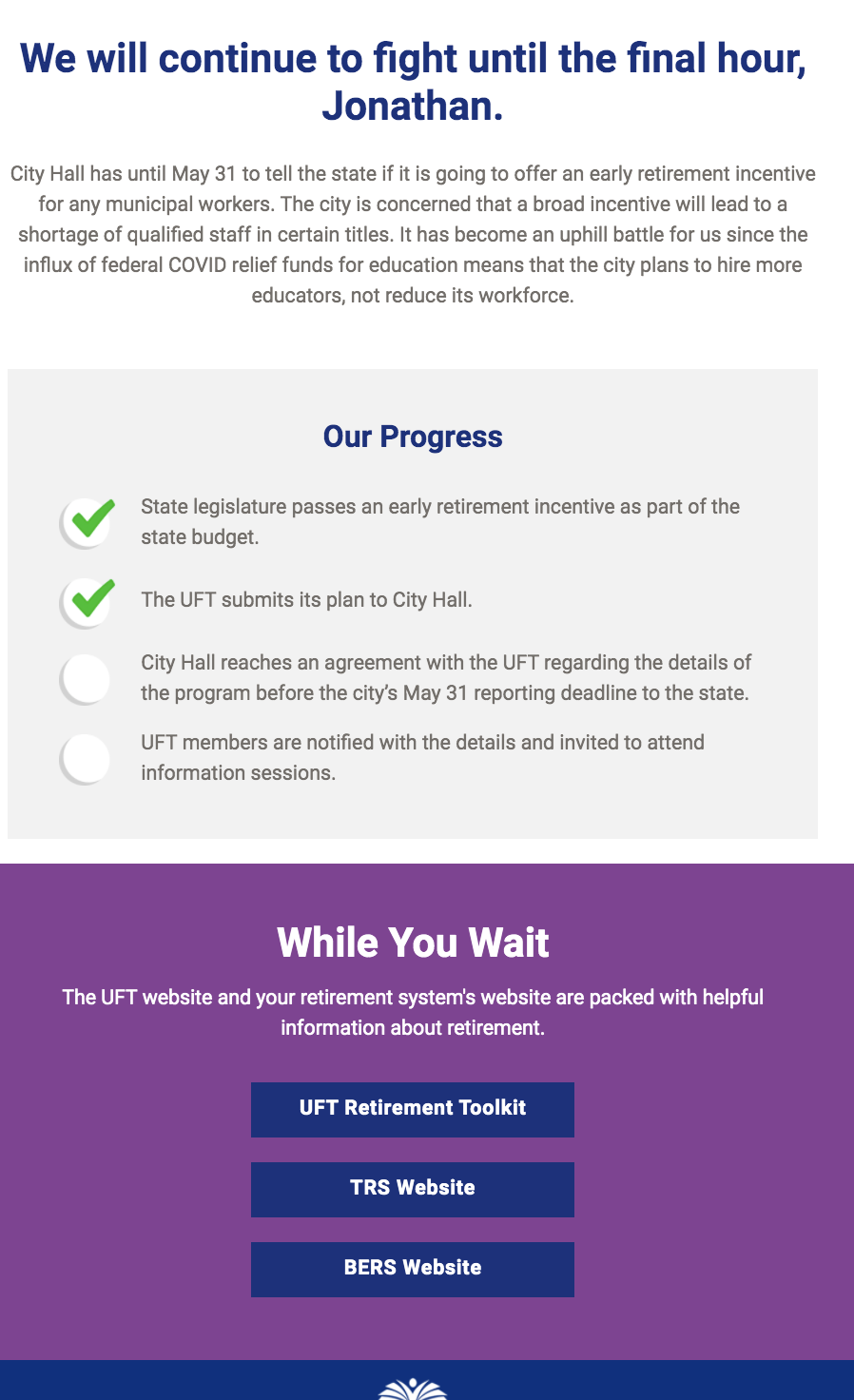
| Jonathan, we are one step closer to an early retirement incentive. The state Legislature included an early retirement incentive in the final budget, which the governor signed on Monday. It puts us one step closer to securing the benefit before the summer. But there is still one more hurdle: reaching an agreement with the mayor and the City Council. We hope we can reach an agreement that provides this well-deserved opportunity for many of our members. We will work hard to negotiate these crucial details as quickly as possible.Please be patient. We will share the details with you as soon as we reach an agreement with City Hall. |
 The UFT convinces state legislature to include early retirement incentive in state budget The UFT convinces state legislature to include early retirement incentive in state budget The UFT negotiates program details with mayor and city councilMembers will be notified with details and invited to attend information sessions The UFT negotiates program details with mayor and city councilMembers will be notified with details and invited to attend information sessions |
| While You Wait The UFT website and your retirement system’s website are packed with helpful information about retirement. Once an agreement is reached, we will provide you with all the information you need to make an informed decision. UFT Retirement Toolkit. TRS Website . BERS Website |

UFT Endorsement Process
The United Federation of Teachers just picked a candidate to endorse for Mayor (Scott Stringer – he received 90% of the up or down vote).
Better Process
This has been a better process than previous campaigns – by far. Apparently the leadership took everyone who volunteered. That’s a change from the past. The Town Halls were like infomercials – but slick and well-run, and informative.
I did not participate (other than watching the final town hall – which Mulgrew ran nicely). I did not realize that the process was changed to allow all of us to participate (last time I had checked, members of other caucuses had a hard time getting in the door). But more than that, with ten serious candidates and many more not as serious candidates, this was going to be an enormous time sink. I chose to put my time into my chapter and my teaching.
This was very different from eight years ago. In 2013 I went to meetings with Mulgrew and the candidates – but we weren’t really participating – and there wasn’t much attempt to get input from us. But 2013 was already an improvement over what had come before.
Low Bar
But doing a better job than in the past is a pretty low bar.
Everyone knows the UFT’s track record with picking mayoral winners for the past couple of decades has been, ahem.
I guess I would say that making a bad pick while standing up for our values, our members, our profession – that would be completely understandable. But, hmm hmm…
What Pay? What Play? Hevesi 2001
We never learned what conversation between Randi Weingarten and Alan Hevesi led to the bizarre UFT 2001 endorsement. We do know that Hevesi was later found to have engaged in quite a bit of pay for play. I wish I knew what was in their conversation. In any case, Hevesi finished four out of four. The UFT went on to endorse in the runoff (finished second out of two), and then in the general (finished second out of two). One election, three last place endorsements.
2009 Cowardice in the Face of a Bully
We know what happened in 2009. I know, because I was there. Bloomberg rigged the works to run for a third term. He had done amazing damage to the school system in his first two terms. Did anyone know he would do his worst damage in his third term?
Bill Thompson was trailing in the polls, but at 8 points and closing. There were signs that this was going to be a closer election than in 2001, or 2005. So we stand up to Bloomberg, and if we don’t win, at least we go down swinging, fighting for education, fighting for the membership, fighting for what is right? Nope. The UFT leadership was quiet. It became clear they planned to sit out the election, as if not offending Bloomberg might do us some good. I got up at the October 2009 Delegate Assembly to move an endorsement of Bloomberg’s opponent – Bill Thompson. Mulgrew argued that by staying out of the election we would get a contract from Bloomberg. LeRoy Barr and Paul Egan got up to procedurally quash my motion, and to argue that Thompson was not viable.
Bloomberg won the election, but by his smallest margin, just over 4 points. Would a UFT endorsement have made a difference? Absolutely, yes. Enough? We don’t know. But that was a completely unnecessary mistake. Oh, and that contract Mulgrew told us we were safeguarding by not endorsing? H-hmm.
Moving Forward
I’m glad that the UFT leadership has seen the need to improve the endorsement process. It looks like they have taken some significant steps in the right direction.
But we should be talking about what went wrong in the past, so that we can learn from it. And so that we don’t repeat it. Open, honest discussion makes us stronger.
It is certainly the right thing, what the leadership has done, involving many more members in the process. But there is information that is not being shared.
Our internal polls – perhaps the fine details, the crosstabs – perhaps there is much that we don’t want to publish. But post-town hall – who impressed you? There are certainly topline numbers that members should have seen.
And the criteria being used to select candidates – what were they – and how were they selected? I know, I know, I heard the talking point – “we want a candidate who is good for education and good for our members” – but that’s general, and there was a specific list. How did that list get made, how do we arrive at specific issues? I personally was delighted that we made class size a huge issue. I wish that it had always been an issue. So something has changed, become better. But how did that happen?
The strength, at least in theory, of the union, of any union, is in members taking collective action. That works best when we take collective decisions. And that means discussion – not just members reporting what they think to leadership, and listening to what leadership decides. It means members speaking with members. Honestly, it means active chapters. It means open discussion and debate. It means decision-making involving members, with the direct participation of members and their delegates, rather than in secret.
The town hall process, the broad involvement of members, is a step in the right direction. There is a long way to go.
A year ago, another
Actually, a year and three days. Jonathan Leventon, New Action supporter and Exec Board member, died from COVID-19 on April 15, 2020.
Jon had retired from teaching some years earlier. He continued for some time to be involved directly in UFT activity, serving on the UFT Organizing Committee in Queens.
Jon was a direct victim of Andrew Cuomo – at the time of his death he was living in a nursing home on Long Island.
A year ago today, another loss
A UFT Executive Board Meeting is wrapping. I’m not sure when. Not in the last two years. I’d disagreed with Mulgrew. Or Weingarten. Or Michael Mendel (I miss Michael). Or maybe a DR meeting, and I had spoken sharply.
Whatever. The meeting is over, and a slight figure, smiling, comes over, to explain that I spoke well, but that there really was no disagreement. Well-intentioned. So well-intentioned that it was tempting to overlook that he was wrong about the disagreement. Winston Slivera.
Winston was warm and friendly. He thought people should get along. I never saw him cross or angry or even annoyed. I often saw him at citywide meetings and Bronx meetings. Always smiling. I think the last I spoke to him he was saying it was a shame that I was no longer on the Executive Board (this from a member of Unity Caucus).
Winston had been a science teacher at Truman High School in the Bronx, a chapter leader, and in retirement a staffer in the Bronx office. Here’s more about him.
A year ago today Winston died of COVID-19.

Please, just tell us the truth
On Thursday the New York City Department of Education got rid of the “two cases” rule – a holdover from September. If there were two unlinked cases in a school, that school would be closed. The UFT had fought to maintain that rule. This may have been viewed as a loss. In place of “two cases” are new protocols, not as strong, but that may protect members.
On Thursday Michael Mulgrew wrote to members: “A new protocol for school closures.” (full text at the bottom of this post). He outlined the new closure protocols. But he did not say that the “two case” rule had been eliminated. The biggest part of the news, he just skipped it.
This was not a media release. Sometimes we need to spin for the media. I get that. This was a letter to the members. We deserve the truth. Just tell us the truth.
Today the New York City Department of Education got its way, and will move to a 3 foot rule, instead of the 6 foot rule we had been working with. The New York State Department of Health issued new guidance. The UFT had fought to maintain the 6 foot rule. This will be viewed as a loss. There are a host of places where 6 will remain the rule, but our members, especially in elementary school, will feel this loss directly.
(as an aside – really belongs in a separate post – school lunch will be especially problematic).
Today Michael Mulgrew wrote to members: “Update on CDC’s 3-foot rule.” (full text at the bottom of this post). He minimizes the effect of the new ruling, and fails to identify serious challenges it causes.
This was not a media release. Sometimes we need to spin for the media. I get that. This was a letter to the members. We deserve the truth. Just tell us the truth.
Text of Thursday, April 8 e-mail, Michael Mulgrew to members, in which he fails to mention that we lost the two-case rule:
| Dear Jonathan, Since September, our stringent safety policies have proven successful — keeping the percentage who test positive within our schools low throughout the year. Thankfully, as school staff get more access to the vaccine, the number of adults accounting for new positive cases in our schools is decreasing. But our children don’t have access to the vaccine yet, and we need to keep monitoring them inside schools to keep them safe. While the mayor has been fixated on removing the two-case rule for some time, we knew we must follow the science and the advice of our independent medical experts during any change in policy. Our independent medical experts have advised us to shift our attention from unlinked cases within schools to the cases within schools that can be traced to a common source. Our focus should shift to even greater monitoring inside the schools. We need to maintain a strong pulse on what’s happening in our schools to avoid spread. We understand that as circumstances and science evolve, policies should shift to keep up. We have negotiated with City Hall to create a new protocol for closing classrooms and schools that will take effect on Monday, April 12. The goal of these negotiations was to preserve our current level of safety, mitigating spread within schools, while reducing classroom disruptions for our members, students and families. Here are the details of the new protocol for classroom and school closures:We will continue our very strong classroom closure rule. If there is a positive case found within a classroom, that classroom must move to remote learning for 10 days.If any school has two or more positive cases in different classrooms within seven days, in addition to moving those classrooms to remote learning for 10 days, testing will be increased to 40 percent for that school building for the next weekly testing cycle.If four or more cases are found in different classrooms within one school in a seven-day period, and those cases can be traced to a common exposure within the school, the entire school will move to remote learning for 10 days.Co-located schools within buildings will be considered separate from each other, as long as the schools can prove that there is no physical interaction with the other schools.It’s been a long road, but as a city, we are making progress against this virus. We have undergone so many changes this year, and I know how flexible you have been to provide as much stability as possible for the students you serve. These new safety protocols will take us through June and give us more consistency while continuing to keep us all safe. |
Sincerely, Michael Mulgrew Michael MulgrewUFT President |
Text of Saturday, April 10 e-mail, Michael Mulgrew to members, in which he minimizes the change, and oddly blames a judge instead of the New York State Department of Health (compare, for example, this article from Politico):
| Dear Jonathan, There have been many conversations over the last few weeks about the CDC’s recent recommendation to reduce social distancing between students to three feet in classrooms. Now, in the middle of these discussions, an upstate judge has ordered the state Department of Health to issue guidance on the new rules. Local school districts, including New York City, must plan how to implement the new guidelines by working together with all stakeholders. Your safety remains the top priority, along with the safety of your families, your students, and their families. After all that we have been through since the start of this pandemic, it was our hope that there would be no further changes. But this is the unfair world we are all living and working in. We know that many times those in charge make decisions without realizing that we are the ones who have to do the hard work of implementing these changes. Under the new state guidelines, school staff must still maintain six feet from other adults and from students. The guidance also says students must maintain six feet apart in any public area, such as gyms, hallways and lunchrooms. Students and teachers must be in distinct cohorts throughout the day. With the wide availability of vaccines and our other safety protocols still in place, we are in a good position. But we need to remain vigilant. In the coming days, we will be taking all steps to make sure that any school that moves to the three-foot guidance can do so safely. The immediate impact of this change will be limited to predominantly elementary schools where space limitations mean some students now attend fewer than five days a week. As we near the final stretch of this difficult school year, your patience and perseverance are appreciated. We will be in touch with more information as soon as it’s available. |
| Sincerely,Michael Mulgrew UFT President |
A Year Ago – remembering
By April 6, 2020 my world was on its head. COVID was in NYC. I had decamped to near Lake Champlain. I was teaching, or trying to teach, via a computer. It was hard. And it was exhausting. And the news was relentless. Trump was horrible, but de Blasio and Cuomo were behaving like clowns – but clowns whose decisions affect millions of lives. It was too much. I’d lost a second cousin to the pandemic, but I didn’t know yet. And a colleague had passed in an auto accident a week earlier – maybe the trip was somehow connected. An alumni’s father died on the 4th. A peace officer at my school died on the 4th.
My school was started in 2002. I was there from the first. it is a specialized high school. But in those first years the student body was fairly integrated. A few years later we saw a shift, slow at first, and then not slow. We became one of the whitest NYC public high schools outside of Staten Island. There is a story there, a long one, about getting the faculty then our school community on board to address this, and the progress we have – and importantly – have not made. But that’s for another time.
I mention the segregation issue to mention one initiative in particular: our Local Outreach Tutoring Program (LOT). We started LOT four years ago. Me and some students did outreach to local middle schools, more or less walking distance from my school. Kids come after school, we do some activity, then some math enrichment and ELA enrichment. Sometimes there’s SHSAT test prep. And when I say “we” I mean our juniors and seniors. They organize, plan, and teach/tutor.
When I heard a Bronx AP had died from COVID-19 on on April 6, 2020, I checked to see the name and the school. It was my LOT contact from 95. I did not know her well. We met once, when I visited their school. We corresponded occasionally. But an educator. With a family. About my age.
I was fortunate to be near woods. I went outside, and walked, and breathed. Deep breaths. Empty shelves of toilet paper were strange. People dying was frightening, overwhelming. I was glad to be far away. I told myself I was safe. But I was alone.
An Early Retirement Incentive Exists! But, what does it say?
Seriously, can you read this?
Please tell us what it says.
This is from the New York State budget, just passed, or in the process of passing. Here’s the source.
9 Section 1. This act enacts into law components of legislation that
10 would enable the city of New York and the board of education of the city
11 of New York to offer a temporary retirement incentive to their employ-
12 ees, as well as to provide an age 55/25 years temporary incentive for
13 certain public employees. Each component is wholly contained within a
14 Subpart identified as Subparts A and B. The effective date for each
15 particular provision contained within such Subpart is set forth in the
16 last section of such Subpart. Any provision in any section contained
17 within a Subpart, including the effective date of the Subpart, which
18 makes reference to a section "of this act", when used in connection with
19 that particular component, shall be deemed to mean and refer to the
20 corresponding section of the Subpart in which it is found, unless noted
21 otherwise. Section three of this act contains a severability clause for
22 all provisions contained in each Subpart of this Part. Section four of
23 this act sets forth the general effective date of this Part.
24 § 2. Legislative findings. The legislature finds and declares that the
25 retirement benefits provided for in this act are designed to achieve
26 cost-savings for public employers and to avoid layoffs of public employ-
27 ees in this time of fiscal need. Therefore, the retirement incentive
28 benefit provided for in Subpart A of this act and the age 55/25 years
29 retirement benefit provided for in Subpart B of this act are intended
30 only to be temporary in nature for employees who are eligible to receive
31 and qualify for the applicable benefit during the applicable time peri-
32 ods specified within each Subpart. Further, nothing in this act shall be
33 construed to create an expectation of a future or continuing retirement
34 benefit for any public employee who is not eligible to receive and qual-
35 ify for the retirement benefits in this act during the applicable time
36 periods.
37 SUBPART A
38 Section 1. Definitions. As used in this act, unless the context clear-
39 ly requires otherwise:
40 a. "Retirement system" means the New York city teachers' retirement
41 system, the New York city board of education retirement system or the
42 New York city employees' retirement system, exclusive of the retirement
43 plans established pursuant to sections 13-156 and 13-157 of the adminis-
44 trative code of the city of New York.
45 b. "Teachers' retirement system" means the New York city teachers'
46 retirement system.
47 c. (a) "Participating employer" means the city of New York or the
48 board of education of the city of New York.
49 (b) "Educational employer" means a participating employer which is the
50 board of education of the city of New York.
51 d. "Eligible employee" means a person who is a member of a retirement
52 system who is an employee of the city of New York or the board of educa-
S. 2509--C 184 A. 3009--C
1 tion of the city of New York, but such term shall not include the
2 following persons:
3 (a) elected officials, judges or justices appointed to or serving in a
4 court of record;
5 (b) chief administrative officers of employers which participate in a
6 teachers' retirement system; and
7 (c) appointed members of boards or commissions any of whose members
8 are appointed by the governor or by another public officer or body;
9 e. "Eligible title" means any title where a certain number of posi-
10 tions in that title, as identified by agency, department, work location
11 or appointing authority, as the case may be, would otherwise be identi-
12 fied for layoff but for this act because of economy, consolidation or
13 abolition of functions, curtailment of activities or otherwise. However,
14 an eligible title can also include a title as identified by an agency,
15 department, work location or appointing authority in which positions
16 would not be eliminated but into which employees in titles affected by
17 layoff can be transferred or reassigned pursuant to the civil service
18 law, rule or regulation. The determination of eligible titles shall be
19 made by the chief executive officer of the city of New York or other
20 comparable official of a participating employer.
21 f. "Active service" means service while being paid on the payroll,
22 provided that (a) a leave of absence with pay shall be deemed active
23 service; (b) other approved leave without pay not to exceed twelve weeks
24 prior to the commencement of the designated open period; and (c) the
25 period of time subsequent to a June school term and on or before August
26 31 of the year for which an open period is designated for a teacher (or
27 other employee employed on a school-year basis) who is otherwise in
28 active service on the effective date of this act shall be deemed active
29 service.
30 g. "Open period" means the period beginning with the commencement date
31 as defined in subdivision h of this section and shall not be more than
32 ninety days nor less than thirty days in length, as specified by the
33 participating employer; provided however that any such period shall not
34 extend beyond October 31, 2021 for participating employers, and not
35 beyond August 31, 2021 for educational employers. For the purposes of
36 retirement pursuant to this act, a service retirement application must
37 be filed with the appropriate retirement system not less than fourteen
38 days prior to the effective date of retirement to become effective,
39 unless a shorter period of time is permitted under law.
40 h. "Commencement date" means the first day the retirement incentive
41 authorized by this act shall be made available, which shall mean a date
42 or dates on or after the effective date of this act to be determined by
43 a participating employer. The chief executive officer or other compara-
44 ble official of a participating employer shall notify the heads of the
45 appropriate retirement systems of the dates of each open period prior to
46 the commencement dates of such periods.
47 § 2. The determination of whether a title shall be considered eligible
48 shall consider whether the reduction of a specific number of positions
49 within a title would unacceptably:
50 a. Directly result in a reduction of the level of service required or
51 mandated to protect and care for clients of a participating employer or
52 to assure public health and safety;
53 b. Endanger the health or safety of employees of a participating
54 employer; or
55 c. Clearly result in a loss of significant revenue to a participating
56 employer or result in substantially increased overtime or contractual
S. 2509--C 185 A. 3009--C
1 costs. However, any title may be determined eligible if the vacancies
2 created can be controlled by the use of transfer or reassignment
3 provisions of the civil service law, rules or regulations or other
4 deployment of employees.
5 § 3. a. Eligibility for inclusion in the retirement incentive provided
6 by section six of this act shall be determined by seniority for employ-
7 ees of a participating employer; seniority shall mean the date of
8 original permanent appointment in the civil service of the city adjusted
9 to include veteran's credits for those entitled to receive such credits
10 pursuant to sections 80, 80-a and 85, if applicable, of the civil
11 service law, as established in the official records of the New York city
12 department of citywide administrative services, regardless of the juris-
13 dictional classification of the position or the status of the incumbent.
14 b. All eligible employees serving in eligible titles desiring to avail
15 themselves of the retirement incentive provided by section six of this
16 act shall provide written notice to his or her employer on or before the
17 twenty-first day preceding the end of the open period. Failure to
18 provide such written notice shall render the employee ineligible for the
19 retirement incentive provided by this act.
20 § 4. a. On or before June 30, 2021, a participating employer may elect
21 to provide its employees the retirement incentive authorized by this act
22 by (a) the enactment of a local law, or (b) in the case of a participat-
23 ing employer which is not so empowered to act by local law, by the
24 resolution of its governing body; provided however, no local law or
25 resolution enacted pursuant to this section shall in any manner super-
26 sede any local charter, provided further that, for an educational
27 employer such election must be made by May 31, 2021. The local law or
28 resolution shall specify the commencement date of the program and the
29 length of the open period or periods. A copy of such law or resolution
30 shall be filed with the appropriate retirement system or systems, and,
31 if applicable, on forms provided by such system. The local law or resol-
32 ution shall be accompanied by the affidavit of the chief executive offi-
33 cer or other comparable official certifying to the information contained
34 in subdivision c of this section.
35 b. The commencement date of an open period for eligible employees of a
36 retirement system of the city of New York who elect retirement benefits
37 pursuant to this section may be up to one hundred eighty days after the
38 end of the open period for other eligible employees, if requested by
39 such system.
40 c. Notwithstanding any other provision of law, the benefits provided
41 by this act shall not be made available to any person who (a) has
42 received any retirement incentive authorized by any provision of state
43 law, or (b) who receives, has received or is eligible to receive a
44 payment in a lump sum or in another form from a retirement incentive
45 pursuant to the provisions of a collective bargaining agreement or by
46 other arrangement with his or her employer, unless such person files a
47 written statement with his or her employer, a copy of which shall be
48 forwarded to the appropriate retirement system, that he or she agrees to
49 waive any right to such payment. If a participating employer has offered
50 a retirement incentive pursuant to the provisions of a collective
51 bargaining agreement or by other arrangement, such employer shall
52 prepare, and file with each retirement system, a list containing the
53 names and social security numbers of all persons described in this
54 subdivision. The employer is authorized, however, to exempt persons in
55 its employ from the provisions of paragraph (b) of this subdivision.
S. 2509--C 186 A. 3009--C
1 Such exemption shall be made part of the election made pursuant to this
2 section.
3 § 5. Notwithstanding any other provision of law, any eligible employee
4 serving in an eligible title who:
5 a. has been continuously in the active service of a participating
6 employer prior to the commencement date of the applicable open period;
7 b. files an application for service retirement that is effective
8 during the open period; and
9 c. is otherwise eligible for a service retirement as of the effective
10 date of the application for retirement shall be entitled to the retire-
11 ment incentive provided in section six of this act. If not otherwise
12 eligible for a service retirement, the following person shall be deemed
13 to satisfy the eligibility condition of this section: a person who is at
14 least age fifty with ten or more years service as of the effective date
15 of retirement (other than a member of a retirement plan which provides
16 for half-pay pension upon completion of twenty-five years or less
17 service without regard to age); or a member of a retirement plan which
18 provides for half-pay pension upon completion of twenty-five years of
19 service without regard to age who has not accrued, excluding additional
20 credit granted pursuant to this act, the minimum number of years of
21 service required to retire with an allowance equal to fifty percent of
22 final average salary under such plan, but has, with the inclusion of the
23 additional credit provided under this act, accrued such number of years
24 of credit.
25 § 6. Notwithstanding any other provision of law, an eligible employee
26 serving in an eligible title who is a member of a retirement system and
27 who is entitled to a retirement incentive pursuant to section five of
28 this act shall receive a retirement incentive of one-twelfth of a year
29 of additional retirement credit for each year of pension service credit-
30 ed as of the date of retirement, up to a maximum of three years of
31 retirement service credit at the time of retirement, provided, however,
32 that service credit provided under the provisions of sections 902 and
33 911 of the retirement and social security law shall not be included when
34 calculating the additional retirement credit awarded pursuant to this
35 act. For the New York city teachers' retirement system, the New York
36 city employees' retirement system and the New York city board of educa-
37 tion retirement system such incentive shall be available for all
38 purposes, including fulfilling the qualifying service requirements of
39 plan A and C, if applicable.
40 An eligible employee who is covered by the provisions of article 15 of
41 the retirement and social security law shall retire under the provisions
42 of article 15 of the retirement and social security law. The amount of
43 such benefit for an eligible employee who is covered by article 15 of
44 the retirement and social security law and retires under the provisions
45 of this section (other than a member with thirty or more years of
46 service in the New York city employees' retirement system, the New York
47 city teachers' retirement system, or the New York city board of educa-
48 tion retirement system) shall be reduced by six percent for each of the
49 first two years by which retirement precedes age sixty-two, plus a
50 further reduction of three percent for each year by which retirement
51 precedes age sixty. Such reduction shall be prorated for partial years.
52 The amount of such benefit for an eligible employee with thirty or more
53 years of service who is a member of the New York city employees' retire-
54 ment system, the New York city teachers' retirement system, or the New
55 York city board of education retirement system, or an eligible employee
56 who is a participant in the optional twenty-five year early retirement
S. 2509--C 187 A. 3009--C
1 program for certain New York city members governed by section 604-c of
2 the retirement and social security law, as added by chapter 96 of the
3 laws of 1995 or a twenty-five year participant in the age fifty-five
4 retirement program governed by section 604-i of the retirement and
5 social security law, with twenty-five or more years of service and who
6 is covered by article 15 of the retirement and social security law shall
7 be reduced by five percent for each year by which retirement pursuant to
8 this section precedes age fifty-five. The amount of such benefit for an
9 eligible New York city employee with five or more years of service and
10 who is a participant in the age fifty-seven retirement program governed
11 by section 604-d of the retirement and social security law shall be
12 reduced by one-thirtieth for the first two years by which retirement
13 precedes age fifty-seven plus a further reduction of one-twentieth for
14 each year by which retirement precedes age fifty-five. Such reduction
15 shall be prorated for partial years. There shall be no reduction for an
16 eligible New York city employee in a physically taxing position with
17 twenty-five or more years of service and who is a participant (i) in the
18 optional twenty-five year early retirement program for certain members
19 governed by section 604-c of the retirement and social security law, as
20 added by chapter 96 of the laws of 1995, or (ii) in the age fifty-seven
21 retirement program governed by section 604-d of the retirement and
22 social security law.
23 An eligible employee serving in an eligible title who is covered by
24 article 11 of the retirement and social security law shall retire under
25 the provisions of such article. There shall be no reduction in retire-
26 ment benefit provided that such employee retires with thirty or more
27 years of service at age fifty-five or older. The amount of such benefit
28 for an eligible employee covered by article 11 of the retirement and
29 social security law other than a member of a teachers' retirement system
30 with thirty or more years of service, a participant in the optional age
31 fifty-five improved benefit retirement program for certain New York city
32 employees governed by section 445-d of the retirement and social securi-
33 ty law, as added by chapter 96 of the laws of 1995, with twenty-five or
34 more years of service, or a participant in the optional age fifty-five
35 retirement program for New York city teachers and certain other members
36 governed by section 445-i of the retirement and social security law,
37 with twenty-five or more years of service, shall be reduced by six
38 percent for each of the first two years by which retirement pursuant to
39 this section precedes age sixty-two, plus a further reduction of three
40 percent for each year by which retirement pursuant to this section
41 precedes age sixty, provided, however, the foregoing reduction shall not
42 apply in any case where an eligible employee can retire pursuant to a
43 plan which permits retirement for service with immediate payability,
44 exclusive of this act, prior to the age of fifty-five. Such reduction
45 shall be prorated for partial years. The amount of such benefit for an
46 eligible employee who is a member of a teachers' retirement system with
47 thirty or more years of service, a participant in the optional age
48 fifty-five improved benefit retirement program for certain New York city
49 employees governed by section 445-d of the retirement and social securi-
50 ty law, as added by chapter 96 of the laws of 1995, with twenty-five or
51 more years of service, or a participant in the optional age fifty-five
52 retirement program for New York city teachers and certain other members
53 governed by section 445-i of the retirement and social security law,
54 with twenty-five or more years of service and who is covered by article
55 11 of the retirement and social security law shall be reduced by five
56 percent for each year by which retirement pursuant to this section
S. 2509--C 188 A. 3009--C
1 precedes age fifty-five. Such reduction shall be prorated for partial
2 years. There shall be no reduction for an eligible New York city employ-
3 ee in a physically taxing position and who is a participant in the
4 optional age fifty-five improved benefit retirement program for certain
5 New York city employees governed by section 445-d of the retirement and
6 social security law, as added by chapter 96 of the laws of 1995, with
7 twenty-five or more years of service.
8 An eligible employee serving in an eligible title who is not covered
9 by article 11 or 15 of the retirement and social security law shall
10 retire under the provisions of the plan by which he or she is covered.
11 The amount of such benefit shall be reduced by five percent for each
12 year by which retirement pursuant to this section precedes age fifty-
13 five, provided, however, the foregoing reduction shall not apply in any
14 case where an eligible employee can retire pursuant to a plan which
15 permits retirement for service with immediate payability, exclusive of
16 this act, prior to the age of fifty-five. Such reduction shall be
17 prorated for partial years.
18 An eligible employee serving in an eligible title who participates in
19 a retirement plan which provides for a retirement allowance equal to
20 fifty percent of final average salary upon the completion of twenty-five
21 years of service without regard to age and who is otherwise eligible to
22 retire shall retire under the provisions of such plan. Such employee
23 shall, at the time of retirement, be credited with one-twelfth of a year
24 of additional retirement service credit for each year of service credit-
25 ed under such plan as of the date of retirement, up to a maximum of
26 three years of retirement service credit. If such employee has not
27 accrued, excluding additional credit granted pursuant to this act, the
28 minimum number of years of service required to retire with an allowance
29 equal to fifty percent of final average salary under such plan, but has,
30 with the inclusion of the additional credit provided under this act,
31 accrued such number of years of credit, the benefit payable shall be the
32 percentage of final average salary that would ordinarily be applicable
33 to such individual upon retirement with such amount of credit (including
34 incentive credit), reduced by five per centum per year for each year by
35 which the number of years of service otherwise required to retire with
36 an allowance equal to fifty percent of final average salary under such
37 plan exceeds the amount of service credited to such employee under such
38 plan at retirement (excluding the additional retirement incentive
39 service credit provided pursuant to this act). Such reduction shall be
40 prorated for partial years.
41 § 7. a. Notwithstanding any other provision of law, any termination
42 pay or leave arising from accrued sick leave or accrued annual leave for
43 an eligible employee who has elected the retirement incentive provided
44 by this act and who is a member of the New York city teachers' retire-
45 ment system employed by the board of education of the city of New York
46 shall be paid in three equal installments during a twenty-four month
47 period commencing on such eligible employee's effective date of retire-
48 ment.
49 b. An employee of the city of New York who retires under the retire-
50 ment incentive provided by this act, who is eligible for terminal leave
51 pursuant to an applicable collective bargaining agreement or a personnel
52 policy or rule or retirement leave pursuant to section 3107 of the
53 education law or who has an accrued annual leave balance on the effec-
54 tive date of retirement shall be paid in three equal installments two
55 months, fourteen months and twenty-four months following such eligible
56 employee's effective date of retirement.
S. 2509--C 189 A. 3009--C
1 § 8. a. A participating employer, if it elects the retirement incen-
2 tive provided by this act shall be required to demonstrate the savings
3 of their election by either eliminating positions vacated as a result of
4 an eligible employee in an eligible title receiving the incentive
5 provided by section six of this act or demonstrating a compensation
6 savings such that the total amount of base salary paid for the two-year
7 period subsequent to the effective date of retirement for such eligible
8 employees in eligible titles to new hires, if any, who otherwise would
9 not have been hired by such employer after the effective date of this
10 act but for the retirement incentive provided herein shall be no more
11 than one-half of the total amount of base salary that would have been
12 paid to such eligible employees from their date of retirement for such
13 two-year period. A participating employer may also demonstrate savings,
14 however, by identifying a vacant position into which another employee
15 can be appointed, transferred, or reassigned pursuant to the civil
16 service law, rules or regulations, in which case the former position of
17 the employee so appointed, transferred, or reassigned shall be elimi-
18 nated. A participating employer shall make available its plans for
19 achieving the savings described herein.
20 b. The New York city department of citywide administrative services
21 shall prepare a report designating the title, grade level, salary, and
22 classification, according to appointing authority, (i) of each position
23 which is eliminated pursuant to subdivision a of this section, (ii) of
24 each position into which another employee was appointed, transferred, or
25 reassigned and the former position of such employee, and (iii) of each
26 position which is eliminated as a result of an appointment, transfer or
27 reassignment referred to in paragraph (ii) of this subdivision. Such
28 report shall be available no later than ninety days after the last date
29 of the open period related to such positions.
30 § 9. Nothing in this act shall be used to provide benefits that shall
31 exceed the limits contained in section 415 of the internal revenue code.
32 Provided, however, any service retirement benefit which has been reduced
33 because of section 415 of the internal revenue code shall be increased
34 when (and consistent with) the dollar limits in section 415 of the
35 internal revenue code are adjusted by the internal revenue service for
36 cost of living increases. Such increases shall not increase the benefit
37 in excess of the service retirement benefit otherwise payable.
38 § 10. Any eligible employee who retires pursuant to the provisions of
39 this act and enters or reenters public service as defined in subdivision
40 e of section 210 of the retirement and social security law and joins or
41 rejoins any public retirement system of the state shall if the addi-
42 tional benefit was provided pursuant to: (a) section six of this act,
43 forfeit the additional benefit authorized by this act at the time of his
44 or her subsequent retirement; or (b) repay to the participating employer
45 such additional contribution together with the appropriate interest as
46 determined by the appropriate retirement system.
47 § 11. Notwithstanding any other provision of law, if the service
48 retirement benefit of a member of a retirement system is subject to a
49 maximum retirement benefit, the additional benefit authorized by this
50 act will be computed by multiplying the final average salary times the
51 number of years of service credit granted by section six of this act
52 times the benefit fraction of the plan under which such member retires.
53 § 12. The provisions of section 430 of the retirement and social secu-
54 rity law shall not apply to any benefit or benefit improvement provided
55 by this act.
S. 2509--C 190 A. 3009--C
1 § 13. The pension benefit costs of section six of this act shall be
2 paid by participating employers as provided by applicable law for each
3 retirement system covered by this act over a period not to exceed five
4 years commencing in the fiscal year following the fiscal year in which
5 this act shall have become a law.
6 § 14. Where an employee is eligible to receive the benefit authorized
7 under section six and the retirement benefit provided for under section
8 five of subpart B of this act, such employee may elect a section under
9 which he or she will participate. In no event shall the benefits
10 provided for in section six of this act be received by any employee in
11 conjunction with the benefits of section five of subpart B of this act.
12 § 15. This act shall take effect immediately.
13 SUBPART B
14 Section 1. Definitions. As used in this act, unless the context clear-
15 ly requires otherwise:
16 a. "Retirement system" means the New York city teachers' retirement
17 system, the New York city board of education retirement system or the
18 New York city employees' retirement system, exclusive of the retirement
19 plans established pursuant to sections 13-156 and 13-157 of the adminis-
20 trative code of the city of New York.
21 b. "Teachers' retirement system" means the New York city teachers'
22 retirement system.
23 c. (a) "Participating employer" means the city of New York or the
24 board of education of the city of New York.
25 (b) "Educational employer" means a participating employer which is the
26 board of education of the city of New York.
27 d. "Eligible employee" means a person who is a member of a retirement
28 system of the city of New York and who is an employee of the city of New
29 York or the board of education of the city of New York who has attained
30 age fifty-five and has at least twenty-five years of creditable service
31 in a retirement system, but such term shall not include the following
32 persons:
33 (a) elected officials, judges or justices appointed to or serving in
34 court of record;
35 (b) chief administrative officers of employers which participate in a
36 teachers' retirement system; and
37 (c) appointed members of boards or commissions any of whose members
38 are appointed by the governor or by another public officer or body.
39 e. "Active service" means service while being paid on the payroll,
40 provided that (a) a leave of absence with pay shall be deemed active
41 service; (b) other approved leave without pay not to exceed twelve weeks
42 prior to the commencement of the designated open period; and (c) the
43 period of time subsequent to a June school term and on or before August
44 31 of the year for which an open period is designated for a teacher (or
45 other employee employed on a school-year basis) who is otherwise in
46 active service on the effective date of this act shall be deemed active
47 service.
48 f. "Open period" means the period beginning with the commencement date
49 as defined in subdivision g of this section and shall be ninety days in
50 length; provided however that there shall be only one such open period
51 and any such period shall not extend beyond October 31, 2021 for partic-
52 ipating employers. For educational employers who make election after
53 April 1, 2021, the open period shall begin immediately after such
54 election, and shall not extend beyond August 31, 2021. For the purposes
S. 2509--C 191 A. 3009--C
1 of retirement pursuant to this act, a service retirement application
2 must be filed with the appropriate retirement system not less than four-
3 teen days prior to the effective date of retirement to become effective,
4 unless a shorter period of time is permitted under law.
5 g. "Commencement date" means the first day the retirement benefit
6 mandated by this act shall be made available, which shall mean a date or
7 dates on or after the effective date of this act for participating
8 employers. The chief executive officer or other comparable official of
9 a participating employer shall notify the head of the appropriate
10 retirement system of the date of the open periods prior to the commence-
11 ment dates of such periods.
12 § 2. A participating employer, if it elects to participate pursuant to
13 section three of this act shall establish a commencement date for the
14 retirement benefit established under section five of this act in the
15 following manner: (a) for participating employers that are not the city
16 of New York, its governing body shall adopt a resolution establishing a
17 commencement date; and (b) for the city of New York the chief executive
18 officer shall issue an executive order establishing such commencement
19 date, provided, however, no executive order shall in any manner super-
20 sede any local charter. A copy of any such executive order or resolution
21 establishing a commencement date shall be filed with the appropriate
22 retirement system or systems, and, if applicable, on forms provided by
23 such system. The executive order or resolution shall be accompanied by
24 the affidavit of the chief executive officer or other comparable offi-
25 cial of a participating employer certifying the commencement date.
26 § 3. a. On or before June 30, 2021, a participating employer may elect
27 to provide its employees the retirement incentive authorized by this act
28 by the enactment of a local law or adoption of a resolution provided
29 however, no local law or resolution enacted or adopted pursuant to this
30 section shall in any manner supersede any local charter, provided
31 further that, for an educational employer such election must be made by
32 May 31, 2021. A copy of such law or resolution shall be filed with the
33 appropriate retirement system or systems, and, if applicable, on forms
34 provided by such system. The local law shall be accompanied by the affi-
35 davit of the chief executive officer or other comparable official of a
36 participating employer certifying the validity of such law.
37 b. The commencement date of an open period for eligible employees of a
38 retirement system of the city of New York who elect retirement benefits
39 pursuant to this section may be up to one hundred eighty days after the
40 end of the open period for other eligible employees, if requested by
41 such system.
42 § 4. Notwithstanding any other provision of law, any eligible employee
43 who (a) has been continuously in the active service of a participating
44 employer prior to the commencement date of the applicable open period,
45 (b) files an application for service retirement that is effective during
46 the open period, and (c) is otherwise eligible for a service retirement
47 as of the effective date of the application for retirement shall be
48 entitled to the retirement benefit provided in section five of this act.
49 § 5. a. Notwithstanding any other provision of law, an eligible
50 employee who is: (a) a member of a retirement system and (b) who is
51 entitled to a retirement benefit pursuant to section four of this act
52 may retire during the open period without the reduction of his or her
53 retirement benefit that would otherwise be imposed by article 11 or 15
54 of the retirement and social security law if he or she has attained the
55 age of fifty-five and has completed at least twenty-five or more years
56 of creditable service. An eligible employee who is covered by the
S. 2509--C 192 A. 3009--C
1 provisions of articles 11 and 15 of the retirement and social security
2 law shall retire under the provisions of articles 11 and 15 of the
3 retirement and social security law.
4 b. A participating employer may deny participation in the retirement
5 benefit provided by subdivision a of this section if such employer makes
6 a determination that the employee holds a position that is deemed crit-
7 ical to the maintenance of public health and safety.
8 c. Where an employee is eligible for the retirement benefit under this
9 section and the retirement incentive authorized pursuant to section six
10 of subpart A of this act, such employee shall elect a section under
11 which he or she will participate. The benefits provided by subdivision a
12 of this section shall not be conditioned upon a participating employer
13 making the benefits of section six of subpart A of this act available to
14 employees in their employ. Further, the benefits provided by subdivision
15 a of this section shall not be available in conjunction with the bene-
16 fits of section six of subpart A of this act.
17 d. The action of a participating employer in denying the retirement
18 benefit provided for in subdivision a of this section to any individual
19 shall be subject to review in the manner provided for in article 78 of
20 the civil practice law and rules. Such action for review pursuant to
21 article 78 of the civil practice law and rules shall only be commenced
22 by the individual that was denied the retirement benefit provided by
23 subdivision a of this section.
24 e. After making any such determination under subdivision b of this
25 section the participating employer shall notify the appropriate retire-
26 ment system or teachers' retirement system of its determination.
27 § 6. The pension benefit costs of section five of this act shall be
28 paid by participating employers as provided by applicable law for each
29 retirement system covered by this act over a period not to exceed five
30 years commencing in the fiscal year following the fiscal year in which
31 this act shall have become a law.
32 § 7. This act shall take effect immediately.
33 § 3. Severability clause. If any clause, sentence, paragraph, subdivi-
34 sion, section or part of this act shall be adjudged by any court of
35 competent jurisdiction to be invalid, such judgment shall not affect,
36 impair, or invalidate the remainder thereof, but shall be confined in
37 its operation to the clause, sentence, paragraph, subdivision, section
38 or part thereof directly involved in the controversy in which such judg-
39 ment shall have been rendered. It is hereby declared to be the intent of
40 the legislature that this act would have been enacted even if such
41 invalid provisions had not been included herein.
42 § 4. This act shall take effect immediately; provided, however, that
43 the applicable effective date of Subparts A and B of this act shall be
44 as specifically set forth in the last section of such Subparts.
FISCAL NOTE.--Pursuant to Legislative Law, Section 50:
SUMMARY OF BILL: This proposed legislation, as it relates to the New
York City Retirement Systems and Pension Funds (NYCRS), would provide
for a temporary Early Retirement Incentive Program (ERI Program) to
allow certain members of the New York City Employees' Retirement System
(NYCERS), the New York City Teachers' Retirement System (TRS), and the
New York City Board of Education Retirement System (BERS), who are
employees of the City of New York (City) or the New York City Department
of Education (DOE) and meet enumerated criteria, to elect immediate
retirement with enhanced benefits.
The ERI Program consists of two parts and is contingent upon the
employer's election to participate in the Program. Part A would provide
S. 2509--C 193 A. 3009--C
to eligible members, determined by title, seniority, and enumerated
policy considerations, an additional service credit. Part B would remove
the application of early retirement reduction factors for qualifying
members. The benefits of the respective Parts cannot be combined.
Eligible NYCRS members would have anywhere from 30 to 90 days in an
open period to elect and retire under Part A or within a 90-day open
period following the commencement date to retire under Part B of the ERI
Program. Multiple open periods, not to exceed 180 days from the end of
an open period for other employees, may be requested by NYCRS. Should
the City or the DOE elect to participate in the ERI Program provided by
this Act, it would be required to demonstrate the savings related to the
election.
A member is eligible to participate in Part A of the ERI Program if he
or she:
* Is otherwise eligible for service retirement;
* Is at least age 50 with 10 or more years of service and is not in
a plan which permits retirement at half-pay with 25 or fewer years of
service without regard to age; or
* Is in a plan that permits retirement at half-pay at 25 years of
service without regard to age and would reach 25 years of service
considering the additional service credit provided in Part A.
A member is eligible to participate in Part B of the ERI Program if he
or she is age 55 or older and has at least 25 years of service.
In addition to the eligibility conditions above, members must also:
* Be in continuous active service preceding the commencement date of
the open period;
* For Part A - provide timely written notice of the intent to avail
himself or herself of the ERI and file for service retirement that is
effective within the open period;
* For Part B - file for service retirement that is effective within
the open period and otherwise be eligible to retire for service as of
the effective date of retirement.
Effective Date: Upon enactment and as determined by the respective
open periods contained in Parts A and B.
IMPACT ON BENEFITS: Part A would provide one-twelfth of a year of
additional retirement service credit for each year of pension service,
up to a maximum of three years of additional retirement service credit.
Some benefits provided under Part A could be subject to Early Retirement
Factors (ERF) as specified in the proposed legislation.
Part B would allow members to retire with an unreduced benefit if they
are at least age 55 with 25 or more years of service.
FINANCIAL IMPACT - OVERVIEW: There is no credible data available to
estimate the number of members who will retire under the current ERI
Program and potentially benefit from this proposed legislation. There-
fore, the estimated financial impact has been calculated on a per event
basis equal to the average increase in the Present Value of future
employer contributions and in the annual employer contributions for
members who would benefit from the proposed legislation.
The Present Value of future employer contributions is the net result
of the increase in the Present Value of Future Benefits (PVFB) and the
decrease in the Present Value of member contributions.
For the purposes of this Fiscal Note, the increase in Present Value of
future employer contributions was amortized over a five-year period
(four payments under the One-Year Lag Methodology (OYLM)) using level
dollar payments, the maximum allowable period under the proposed legis-
S. 2509--C 194 A. 3009--C
lation. This amortized value is the estimated increase in annual employ-
er contributions.
There will also be future savings in Employer Contributions assuming
that these members are not replaced. This additional savings is not
included here.
With respect to an individual member, the additional cost of this
proposed legislation could vary greatly depending on the member's length
of service, age, and salary history.
FINANCIAL IMPACT - SUMMARY: Based on the census data and the actuarial
assumptions and methods described herein, the enactment of this proposed
legislation would result in an increase in the Present Value of Employer
Contributions and annual employer contributions. The estimated pension
financial impact has been calculated as the average increase per person.
A breakdown of the financial impact by NYCRS is shown in the table
below:
Additional
Present Value of Estimated
NYCRS Future Employer Annual Employer
Contributions Contributions
($ Per Person) ($ Per Person)
Part A Only
NYCERS $80,700 $24,600
TRS 84,800 25,900
BERS 37,900 11,600
Average $77,900 $23,800
Part B Only
NYCERS $113,600 $34,700
TRS 68,000 20,800
BERS 98,400 30,100
Average $109,200 $33,300
Both A & B
NYCERS $96,500 $29,500
TRS 85,000 26,000
BERS 43,700 13,400
Average $87,700 $26,800
CONTRIBUTION TIMING: For the purposes of this Fiscal Note, it is
assumed that the changes in the Present Value of future employer
contributions and annual employer contributions would be reflected for
the first time in the Final June 30, 2020 actuarial valuations of
NYCERS, TRS, and BERS. In accordance with the OYLM used to determine
employer contributions, the increase in employer contributions would
first be reflected in Fiscal Year 2022.
CENSUS DATA: For purposes of this Fiscal Note, it was assumed that the
census data had the same age, gender, and service characteristics as the
census data used in the Preliminary June 30, 2019 (Lag) actuarial valu-
ations of NYCERS, TRS, and BERS to determine the Preliminary Fiscal Year
2021 employer contributions. Active members' salaries have been adjusted
to reflect estimated salary increases from June 30, 2019 to June 30,
2020.
The table below contains the census data for members who meet the
eligibility requirements and would be impacted by the proposed legis-
S. 2509--C 195 A. 3009--C
lation (Potential Elections), and for a subset of those members who
would benefit actuarially (Assumed to Elect).
NYCRS Potential Elections
Part A Only Count Avg Age Avg Svc Avg Salary
NYCERS 34,147 58.5 22.3 $83,900
TRS 31,727 57.7 21.2 101,300
BERS 9,736 60.2 15.8 49,900
Total 75,610 58.4 21.0 $86,800
Part B Only Count Avg Age Avg Svc Avg Salary
NYCERS 5,990 58.2 30.2 $88,600
TRS 569 58.0 26.9 110,100
BERS 430 58.6 29.5 72,700
Total 6,989 58.2 29.9 $89,400
Both A & B Count Avg Age Avg Svc Avg Salary
NYCERS 34,147 58.5 22.3 $83,900
TRS 31,727 57.7 21.2 101,300
BERS 9,736 60.2 15.8 49,900
Total 75,610 58.4 21.0 $86,800
NYCRS Assumed to Elect
Part A Only Count Avg Age Avg Svc Avg Salary
NYCERS 19,259 60.4 26.3 $87,600
TRS 11,436 61.3 27.0 109,000
BERS 3,318 63.6 21.6 51,600
Total 34,013 61.0 26.1 $91,300
Part B Only Count Avg Age Avg Svc Avg Salary
NYCERS 5,941 58.2 30.2 $88,400
TRS 530 57.9 26.9 109,900
BERS 423 58.6 29.5 71,500
Total 6,894 58.2 29.9 $89,000
BOTH A & B Count Avg Age Avg Svc Avg Salary
NYCERS 20,204 60.2 26.4 $88,000
TRS 11,588 61.2 27.0 109,000
BERS 3,331 63.6 21.6 51,900
Total 35,123 60.9 26.2 $91,500
ACTUARIAL ASSUMPTIONS AND METHODS: The changes in the Present Value of
future employer contributions and annual employer contributions
presented herein have been calculated based on the actuarial assumptions
and methods in effect for the June 30, 2019 (Lag) actuarial valuations
used to determine the Preliminary Fiscal Year 2021 employer contrib-
utions of NYCERS, TRS, and BERS.
S. 2509--C 196 A. 3009--C
The Actuary is proposing a set of changes for use in the June 30, 2019
(Lag) actuarial valuations of NYCRS to determine the Final Fiscal Year
2021 Employer Contributions (2021 A&M). If the 2021 A&M is enacted it is
estimated that it would produce increases in the Present Value of
Employer Contributions and annual employer contributions that are
approximately 1% larger than the results shown above.
To determine the impact of the elective nature of the proposed legis-
lation, a subgroup based on who could potentially benefit actuarially
was used. The Present Value of future employer costs (i.e. the PVFB less
the Present Value of future member contributions) of each member's bene-
fit was determined under their current plan and as if retiring imme-
diately under the ERI Program. If the Present Value of future employer
cost under the ERI Program was greater than or equal to the Present
Value of future employer cost under the member's current plan, then the
member was deemed to benefit actuarially.
Based on this analysis, the costs presented in this Fiscal Note are
borne only from current NYCERS, TRS, and BERS members who are employed
by the City and assumed to benefit from, and thus opt to retire under,
the ERI Program.
RISK AND UNCERTAINTY: The costs presented in this Fiscal Note depend
highly on the realization of the actuarial assumptions used, as well as
certain demographic characteristics of NYCERS, TRS, and BERS, and other
exogenous factors such as investment, contribution, and other risks. If
actual experience deviates from actuarial assumptions, the actual costs
could differ from those presented herein. Costs are also dependent on
the actuarial methods used, and therefore different actuarial methods
could produce different results. Quantifying these risks is beyond the
scope of this Fiscal Note.
Not measured in this Fiscal Note are the following:
* The offsetting reduction in salary due to retirements earlier than
expected.
* The impact of potential new hires replacing members who retire due
to the ERI Program.
* The initial, additional administrative costs to implement the
proposed legislation.
* The impact of this proposed legislation on Other Postemployment
Benefit (OPEB) costs.
STATEMENT OF ACTUARIAL OPINION: I, Sherry S. Chan, am the Chief Actu-
ary for, and independent of, the New York City Retirement Systems and
Pension Funds. I am a Fellow of the Society of Actuaries, an Enrolled
Actuary under the Employee Retirement Income and Security Act of 1974, a
Member of the American Academy of Actuaries, and a Fellow of the Confer-
ence of Consulting Actuaries. I meet the Qualification Standards of the
American Academy of Actuaries to render the actuarial opinion contained
herein. To the best of my knowledge, the results contained herein have
been prepared in accordance with generally accepted actuarial principles
and procedures and with the Actuarial Standards of Practice issued by
the Actuarial Standards Board.
FISCAL NOTE IDENTIFICATION: This Fiscal Note 2021-19 dated April 5,
2021 was prepared by the Chief Actuary for the New York City Employees'
Retirement System, the New York City Teachers' Retirement System, and
the New York City Board of Education Retirement System. This estimate
is intended for use only during the 2021 Legislative Session.
A Year Ago, Today
I didn’t learn about Tom Waters’ death until almost a week after the date, April 4, 2020.
Tom’s son was my student. He was more of a humanities kid, but did fine in two courses. His final project for an elective, Combinatorics, was a nicely presented bijection between parenthesization and Dyck Paths (Catalan). He was also a standout in the Drama Club, but my role there as “advisor” was less than minimal. Carmen (and Lillie) were really in charge.
But there were parent-teacher conferences. I met Tom and Hillary several times. I knew they were progressives, some sort of activists, but not much more.
When I heard of his passing, I looked him up. I was stunned. Tom was a housing activist, whose work affected many. I will not summarize – instead I implore you to read this memorial/obituary. Take a moment to look at how young he was. But please read – Tom strove to make a difference for renters in New York City – and he sometimes succeeded.
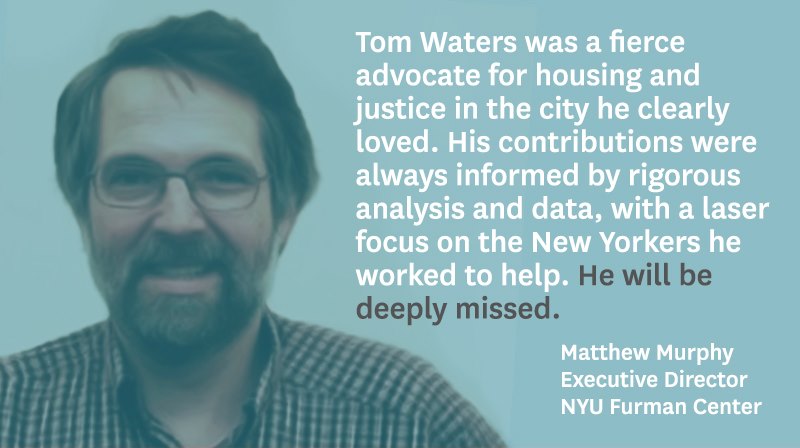
Reading this article a year ago (the tab is still open. Bad habit, I know, but I have periodically returned to read more) I was amazed that I had met such an activist, but had not thought to ask him about his work. It was the wrong feeling, I know, but I felt sorry for myself, for not having learned from him.
I tweeted – and got an unexpected reply:
Lazar was referring to the work I have been involved in, trying to increase representation/diversity at my high school. We first met when Lazar visited the UFT Specialized High School Task Force (I was cochair), and stayed in contact after that work stalled, as I fashioned proposals specific for my school.
So here I was, taken aback by the great work Tom Waters had done, stunned by the death of someone my age.
But there was more. I had decamped to Essex County, New York. I had run away. I was desperately trying to teach. I was worried by my union’s tepid response to a serious matter. I was enraged by Cuomo and de Blasio’s recklessness. I was exhausted. I was trying to function as chapter leader. Every day I was learning new technology. The news was frightening, and relentless. I had already lost a faculty member (car accident) and another member of our small staff. I was overwhelmed. I had not had time to process this, any of it.
And so there I was taken aback by the great work Tom Waters had done, stunned by the death of someone my age. And I read Lazar’s words. And couldn’t believe that this guy who I was regretting not talking to had actually thought highly of me. And for the first time since the pandemic hit, I cried.
A Year Ago Today – COVID hit close
April 4, 2020. I had already lost a cousin to the pandemic, but I didn’t know that. And I didn’t know that cousin well. But on April 4 last year – it was a Friday – Ulises Castro died.
Castro was a Lehman College Peace Officer. He was assigned to our school – the High School of American Studies at Lehman College, for most terms over the last 16 years.
I spent hours talking talking to Castro when I stayed late -which was often. That was his shift. We were both strongly pro-union – he was a teamster, and that colored the conversations. But I recall him often digging not into who was right and who was wrong, but into the psychology behind people’s decisions. Castro often had an interesting angle.
My walks take me by campus, almost every day. And almost every day I am reminded of our loss. I glance up, foolishly, at the booth at Gate 8. But he is not there. And I know he is not in the high school…
Here’s what I wrote a year ago: https://jd2718.org/2020/04/07/in-memory/
Here’s the CUNY memorial page. Here’s the Teamster memorial page (I’d never seen such a young and trim photo!).
Here’s the smiling officer I remember:
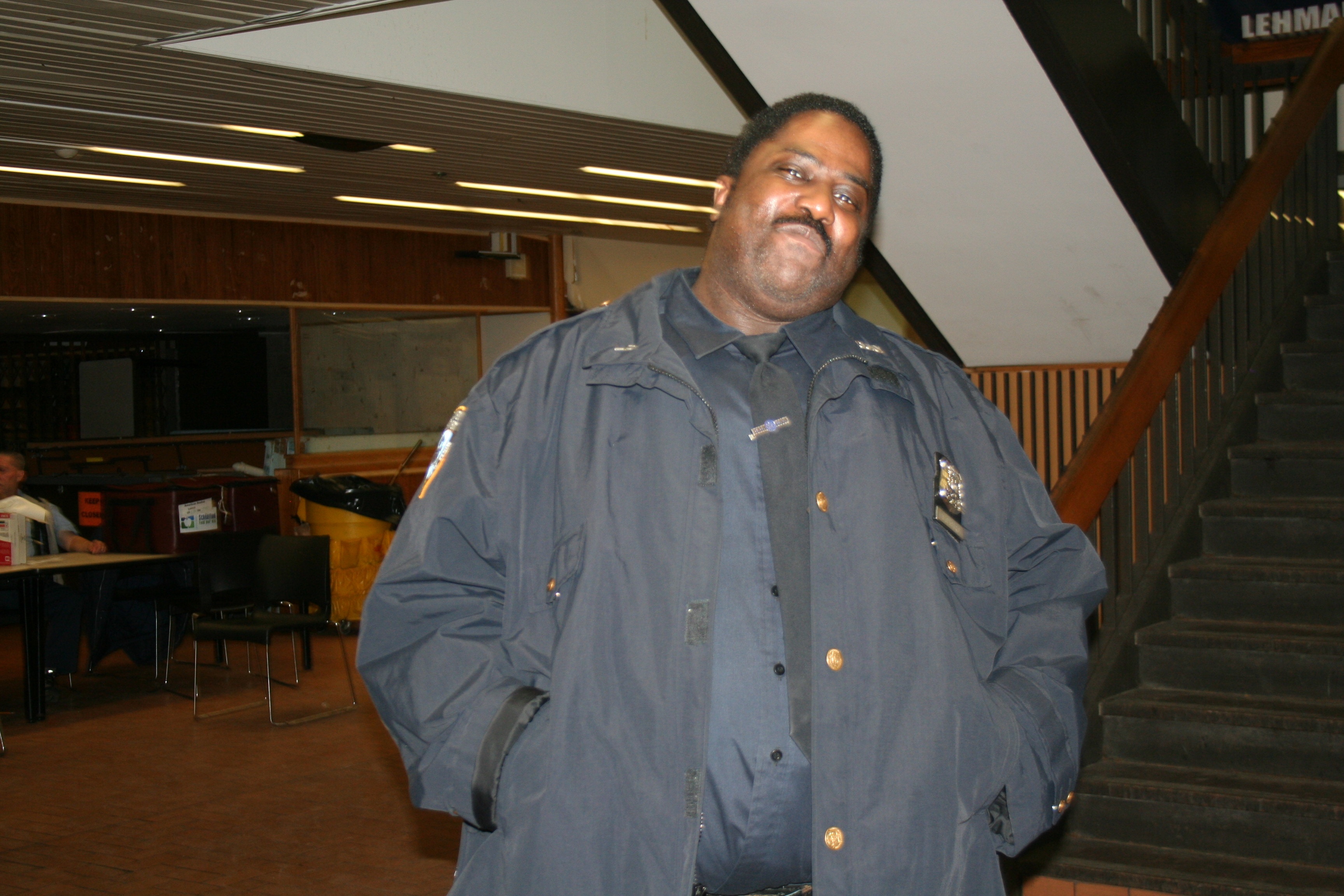
The Global View – 3 Maps
The first map is the number of COVID cases since we started counting in early 2020 or late 2019. These are cumulative totals (as a proportion of the population)
What jumps out? Asia? Africa? the Pacific? It looks like practically no cases in 2/3rds of the world.
But didn’t China have a lot of cases? Early on, yes. But they controlled the pandemic, which governments in Europe and the Americas did not. As of today China has had 90,000 cases, mostly in the first quarter of 2020. The US has had 31,000,000 cases, half of them in the last four months. Yesterday there were 68,000 new cases in the US, and 11 new cases in China.
What about South Asia? West Africa? Is this just underreporting? There is underreporting. But the March 1, 2021 New Yorker had a fascinating piece, Why Does the Pandemic Seem to Be Hitting Some Countries Harder Than Others? By Siddhartha Mukherjee that dissected what is going on. Underreporting? Certainly. But that hardly explains the bulk of the difference. Younger populations? Yes, but again it only explains a bit of the difference. Government response? That explains Vietnam and New Zealand, but not most of the rest. Could exposure to other corona viruses impart partial immunity? That is a fascinating idea that needs to be further explored.
So this is a funny picture. We have a worldwide pandemic, with the bulk of the cases in the Americas, especially the United States, and in most of Europe.

The next map is the number of COVID-19 deaths since we started counting.
It looks like the previous map. A lot. So where are the differences?
- Mexico and most of South America show worse on the mortality map than they did on the number of cases map.
- Most of Europe shows up worse on the number of cases map than on the mortality map
- New York shows up much worse on the mortality map than on the number of cases map.
In fact, New York shows up the worst in the world on the mortality map. This represents one decision, by one man. Over 14,000 people died in New York nursing homes. That is, 1 out of every 200 people who succumbed to COVID worldwide was in a nursing home subject to Andrew Cuomo’s executive order.

The third map is the current new case rate. Look at problem areas:
- France
- to a lesser extent Italy, Netherlands, Belgium, Denmark, Norway
- central Europe (except Germany)
- southeastern Europe
- Turkey
- Brazil and Uruguay
- to a lesser extent, the southern cone of South America
- the northeast United States, especially New York and New Jersey. Also Michigan
Inconsistent government response is a common denominator. Opening up too soon and allowing the virus to roar back, creating fertile ground for imported variants, or new mutations. In NY, allowing extensive local travel is clearly a factor.
it is worrying for the US, Brazil and Europe that new cases are mostly occurring in those places – it is as if there is no possibility of local mitigation. These leaders will keep opening things up and letting people get sick and die, with the promise that one day enough people will be vaccinated.
In the meantime… it’s as if the meantime doesn’t matter to Cuomo.

Why do these COVID maps look different?
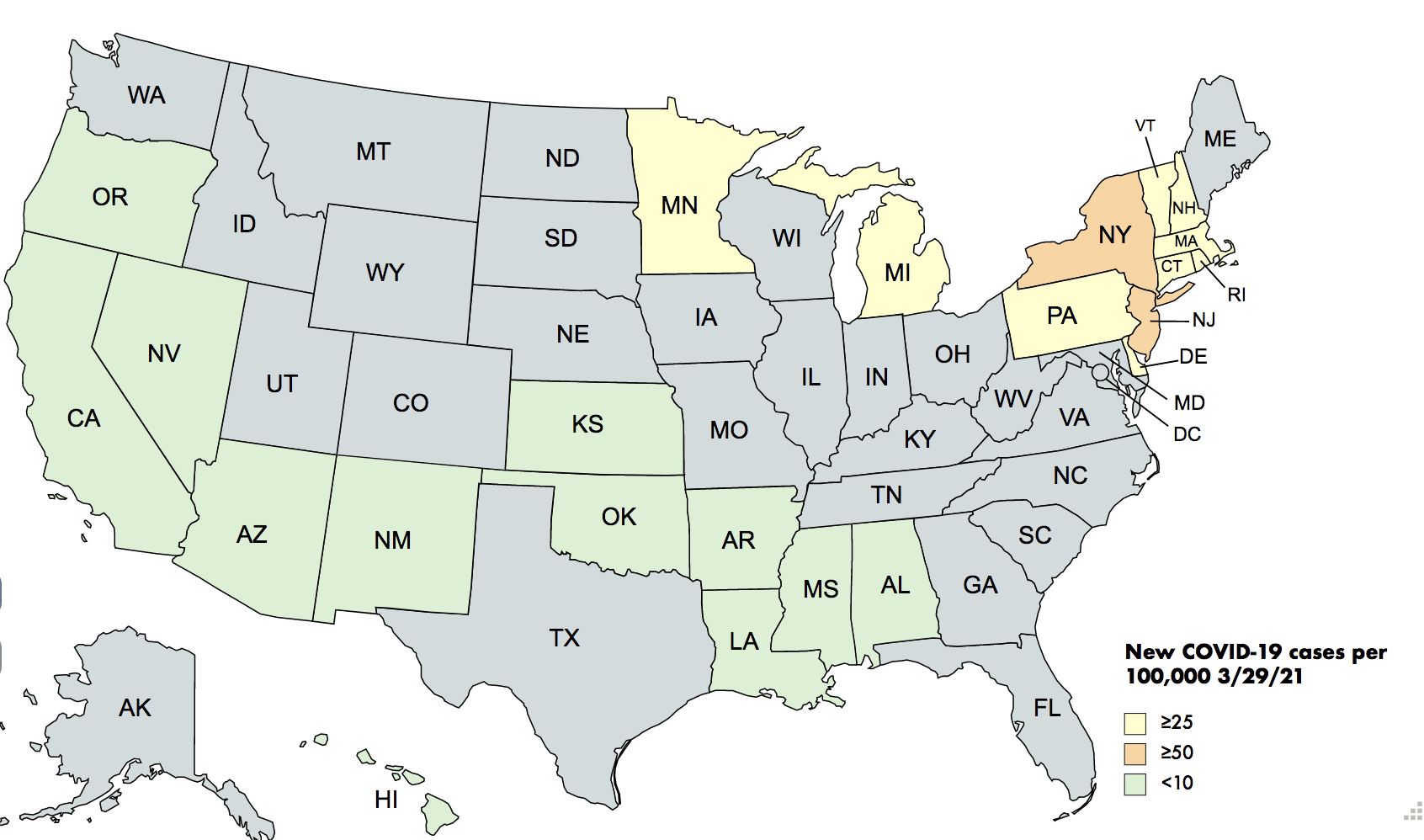
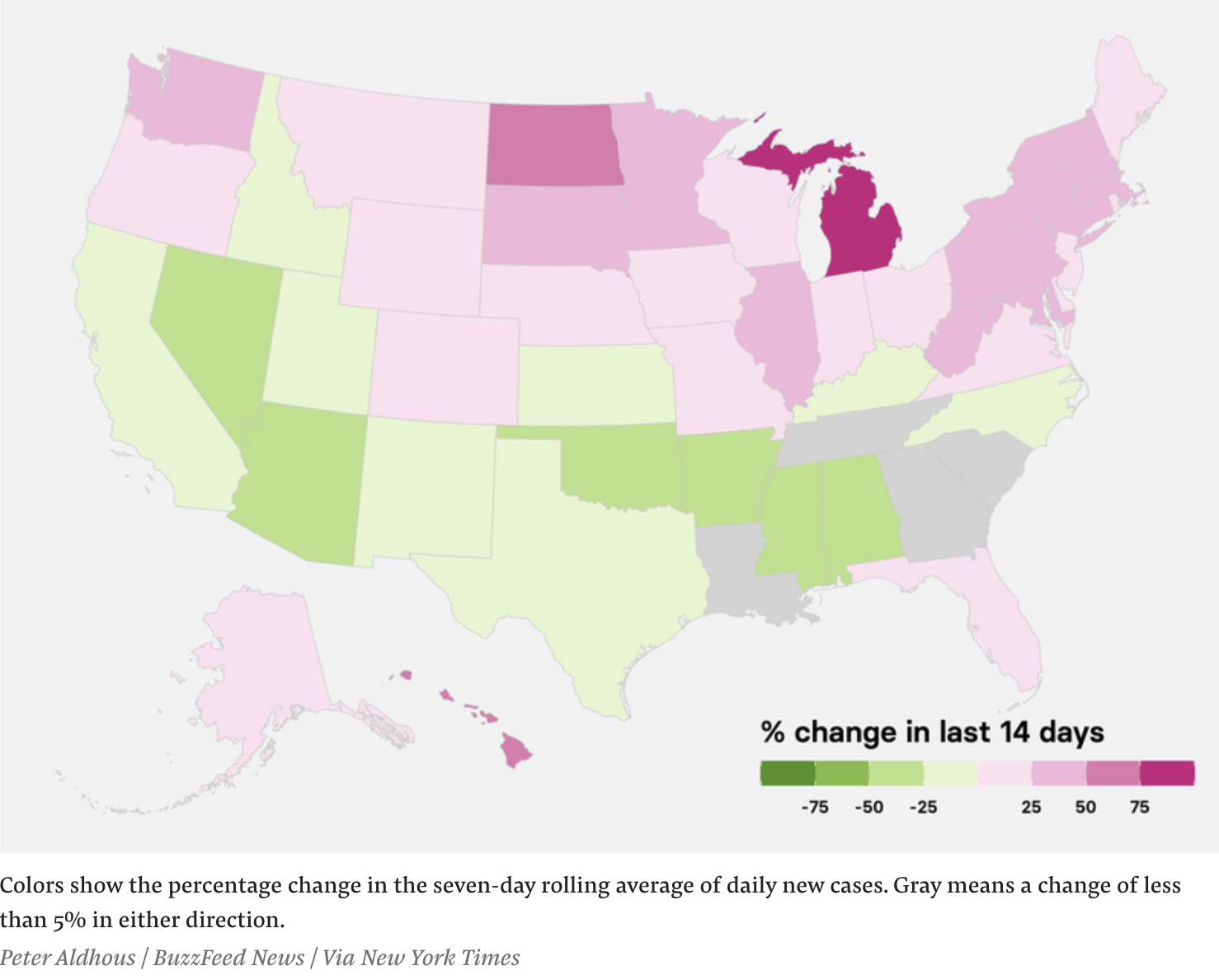
The first map I created, using NPR’s spread-tracking webpage. They, in turn, take their data from Johns Hopkins. The second map I found on the buzzfeed version of the widely-reported story about the CDC’s Rochelle Walensky‘s very candid comments yesterday. The map itself seems to have originated at The New York Times.
The maps look different because they are reporting different things. My map indicates if the current rate is high or low. The Times’ indicates if the rate is going up or down.
Look at Hawaii. Hawaii currently is experiencing 7 new cases daily for every 100,000 people who live there. In the US today, that’s almost the lowest rate. On my map Hawaii shows up green – my low category. But a few days ago Hawaii’s number was 4. From 4 to 7 – that’s huge increase by percentage, and the Times shows Hawaii pretty red.
Look at Idaho. Idaho’s current rate is 16 per 100,000, higher than Washington (12), Oregon (8), Nevada (9), Utah (13), Wyoming (11), and Montana (14) – all of its neighbors. But because Idaho’s numbers are still falling, it shows up green on the Times map. In fact, all of these states have significantly lower current numbers than New England and the mid-Atlantic.
Look at New Jersey. The Times shows it light red, not as bad as its neighbors. But Jersey’s numbers started higher than all of its neighbors, except New York. Even with a slower growth rate, the new case rate is 50 for every 100,000 – the second highest in the country. After New York.
Overall, the maps look similar. For those of you who like saying it this way, my map is the current proportion, the Times is the first derivative with respect to time. They do not look very different. But where there are differences, you probably want to go with me, not the other guys, especially when you consider how the other guys have covered the pandemic.
It started for me a year ago
I didn’t even know it.
COVID was all around us, dominated the news. Schools had closed, and were now reopening remotely. I was reeling, not only from the “big picture,” but having just lost a colleague of 18 years. It was a car accident, but somehow it felt related to the pandemic. He was visiting a home-bound friend in New Jersey.
My father, 82, is the youngest son of a youngest son – and my grandfather had kids late. All my father’s cousins are older than him. Most are gone, but the rabbi in Queens, Moishe Kwalbrun, must have been mid to late 80s. I don’t think we would have recognized each other in the street. But his mother and my grandfather were sister and brother, who arrived together, with their mother, in December 1923. I used to hear about Moishe from my uncle, with whom he regularly talked philosophy and politics and probably much more.
I learned in May that Moishe died of COVID-19 at the end of March, 2020.
US Covid numbers moving in 2 directions
New infections rates have dropped under 10 cases per 100,000 population (less than 1% of 1%) in a dozen states from Alabama to Oregon. That’s getting pretty low.
But in New York and New Jersey and some neighbors the number has stayed above 25, and is holding steady or rising. New Jersey, at 49 cases per 100,000 and rising, and New York, at 50 lead the country.
When I wrote that something was wrong with New York’s numbers back in December, it seemed strange. Almost no one else was noticing. The major media were oblivious, or worse (New York Times) saw the data and ignored it because it did not fit their narrative. But the shape of the curve in New York did not match the shape in the rest of country. Same wave, different impact. There must have been different facts on the ground.
Today we know that the British variant and a homegrown New York variant are big parts of the answer. I suspect that local travel patterns (lots of drivable vacation spots. Lots of second “country” homes) are also a part of the answer. And staying with class – I wonder if the service economy is just different here, with massive demand from safe/at-home office professionals for service work (delivery workers, retail workers, food delivery workers, food service workers). But the variants are the clearest part of the answer.
And all the media now knows about it. I heard about it today on NPR, and read about it in the Post. And they are questioning reopening at this moment. Fauci is warning that some states are reopening too quickly, that this is a dangerous moment.
And New York and New Jersey’s numbers are rising during a huge vaccination campaign. What would we be facing if the vaccine rollout had been slower? Were we inches from disaster? Thankfully we will never know.
And at the same time, a swath of the West, Southwest, and South is watching numbers drop well below September numbers.
Recap:
- huge spike in October/November in South Dakota and neighboring states.
- 3rd wave begins in lead up to Thanksgiving. Post Thanksgiving surge, followed by a dip (except NY) and then another, higher surge post-Christmas and New Years.
- 3rd wave recedes in February, but with numbers left at elevated November levels (higher in NY). NY and NJ actually plateau and stop falling.
- Now, numbers continue to recede in most of the country – but begin to rise again in NY, NJ and their neighbors.
Look at the maps from today, mid-March, start of March, mid-Februrary, start of Februrary, mid-January, and New Years (I am showing low rates, below 10 new cases per 100,000, in green)
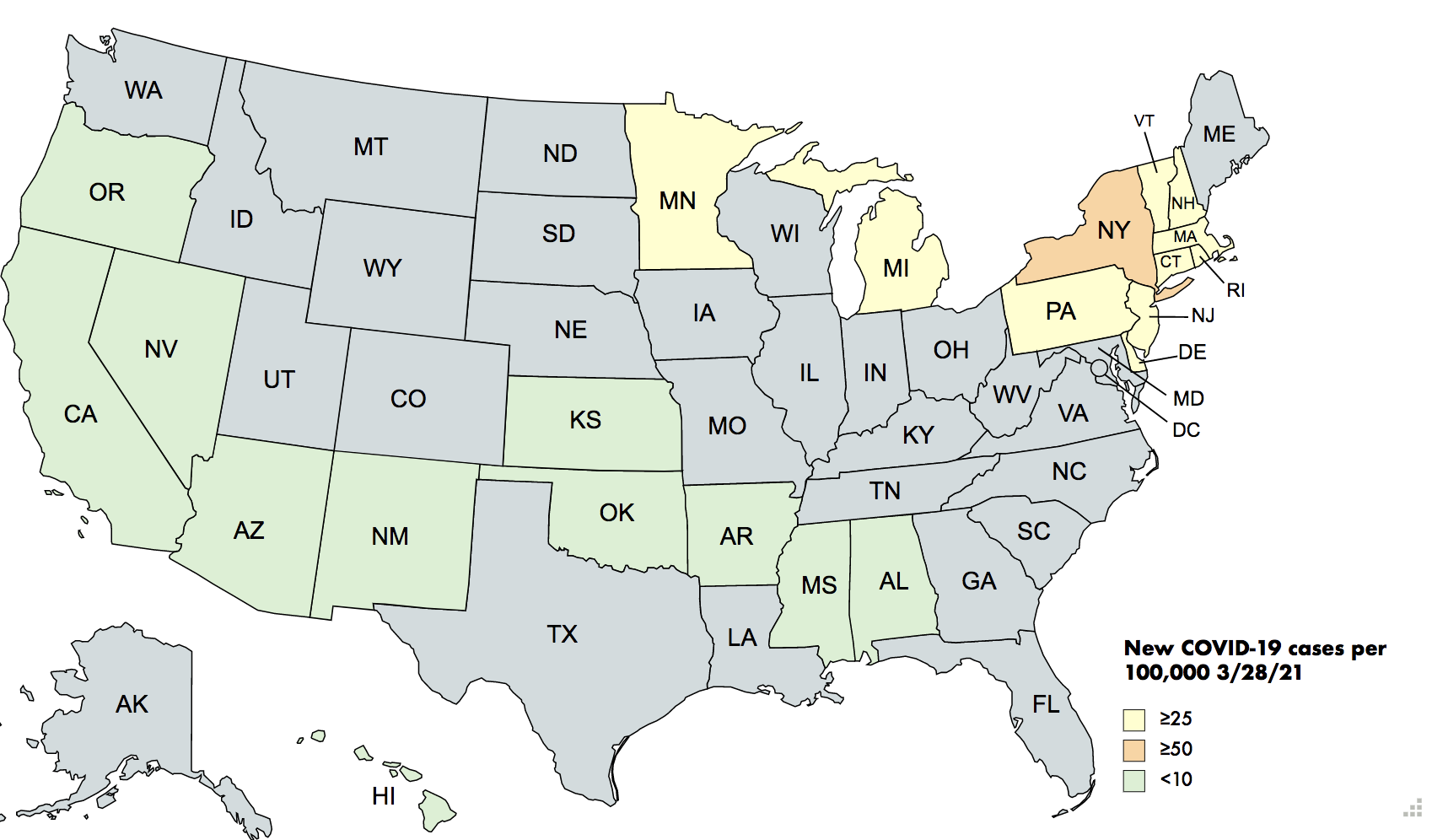


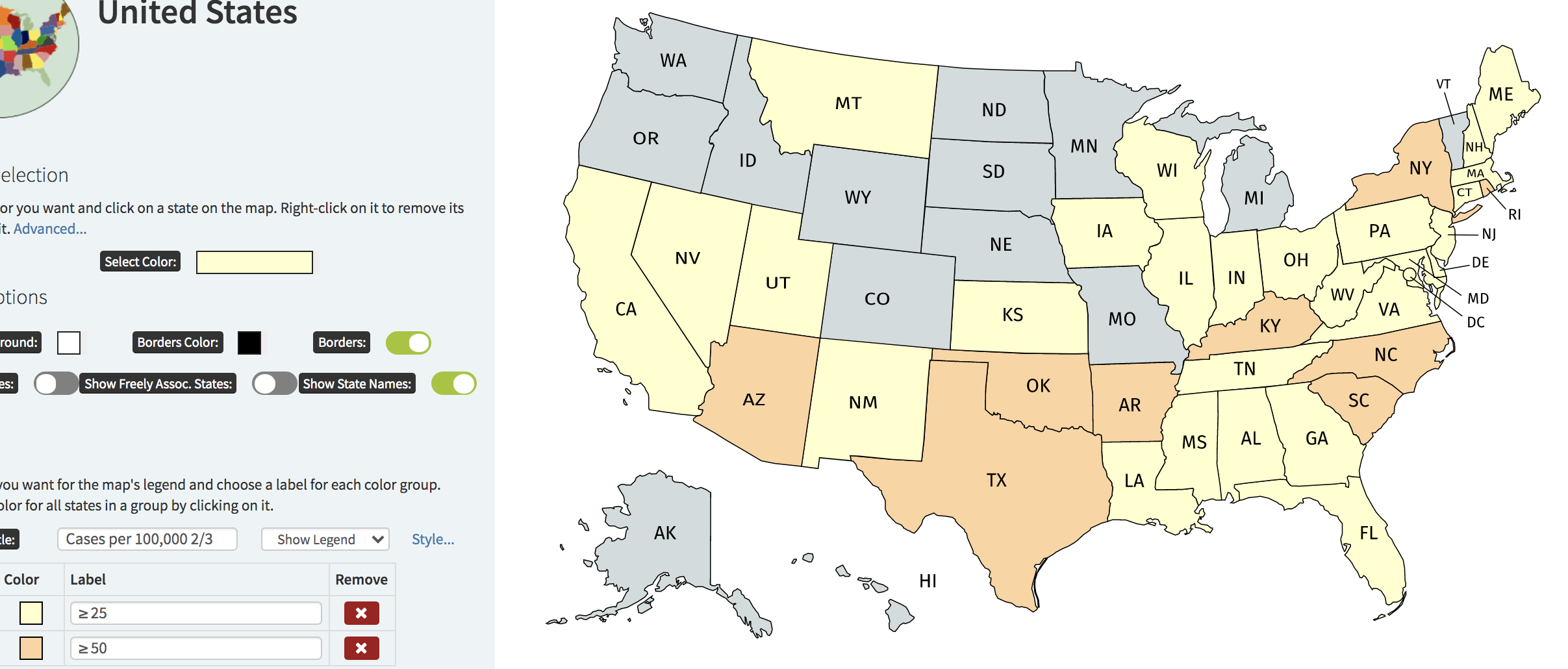


High School Classes Continue. High School Buildings Open.
Tomorrow is the day. High schools finally …..
Reopen? Bullshit.
High schools have been open since September. Even then, the bulk of our teaching was via zoom and other remote platforms. Tomorrow, the bulk of our teaching will be via zoom and other remote platforms.
In fact today more students will be fully remote than back in September.
Because they chose to be remote.
Something ridiculously high in high schools – what, 70%? More?
In fact high schools are reporting additional families switched to remote instruction since the de Blasio/Porter announcement.
So what’s happening?
Tomorrow all high school buildings are opening, and some minimal version of “blended learning” will engage 10-20% of high school students. Over 90% of classes will remain on-line.
All buildings will open. With 15% of students. With less than 10% of classes. de Blasio will be talking about buildings, not students or classes.
Tomorrow de Blasio is making a great show out of opening the buildings. That’s all. It is a show. Instruction will continue for most students and most teachers on line. It is a political show. He wants to say he has opened schools. It is a political boast. He likes saying “New York City was the only large school district to reopen for in-person learning in September.” Actually, that last one is Mulgrew. Also a political boast. But whichever of these two is boasting obscures the fact that despite open buildings, despite some “in-person learning” New York City has been a largely remote-instruction city for schools, and an overwhelmingly remote-instruction city for high schools for these last seven months.
Both the DoE and UFT know that tomorrow’s change will have little practical direct impact on instruction. The Department of Education was most brazen. They know this is show. Read this from them:
- Taking into consideration the complexity of high school scheduling, schools can come up with creative and flexible programming solutions to have students in buildings as much as possible, including having students engage in remote learning while reporting to school buildings in-person.
Do you see that last phrase? “including having students engage in remote learning while reporting to school buildings in-person” Do you know what that means? The DoE wants the kid, instead of sitting at her desk in her apartment, opening her laptop and joining her classes, to sit at a desk in school, open her laptop and join her classes.
The UFT’s email to high school members 2 weeks ago, signed by Mulgrew, Janella Hinds, and Sterling Roberson, discusses testing and vaccination, and safety protocols, but nothing about instruction, or work rules related to in-person instruction. That is not an oversight. You can open this and zoom to read it:
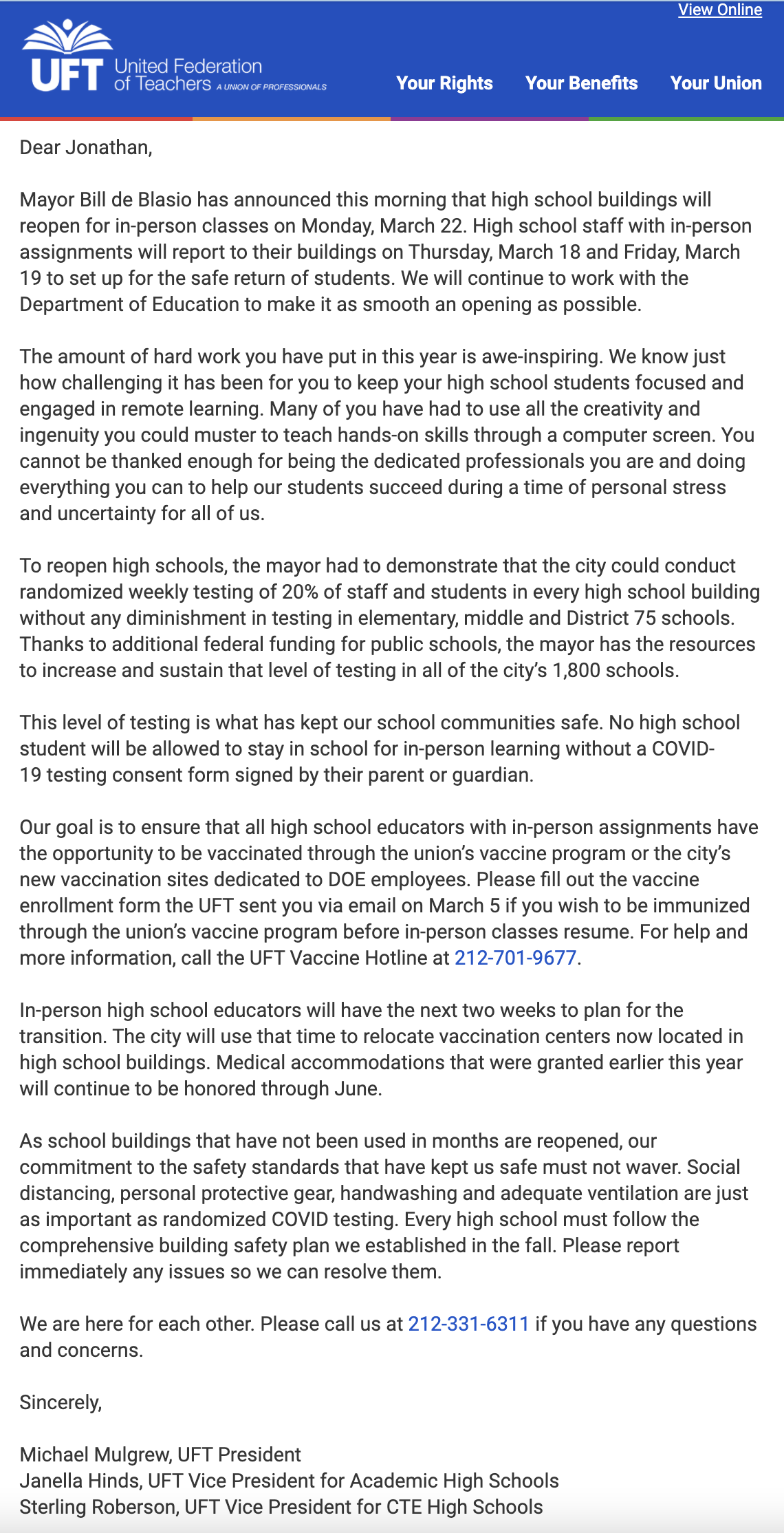
There have been some questions since, but most I have heard were about whether teachers who teach on-line need to come to the building? (may depend on whether they teach in-person as well?)
Why should we care?
We should care because de Blasio is perpetuating a fraud. And we know. And remaining silent would be remaining complicit.
We should care because every high school administrator should have just had their actual work, which might be related to kids’ wellbeing and kids’ learning, disrupted for two weeks, to make this little show work.
We should care because even with safety protocols in place, the additional risk to staff and students is not worth having kids in a classroom, headphones on, joining classes on their laptops.
We should care because people are getting sick in NYC every day. Instead of our numbers going down, they are going up. This is a bad time to throw a few thousand more into public transport.
Mercifully, the number will not be very large – but those who end up getting sick will get little comfort from that.
Mulgrew and Porter statements seem contradictory
How can they both be right?
I think that Mulgrew’s words have to be read very carefully. They have lawyers and others at 52 Broadway, I am guessing, who carefully help craft lawyerly ways of saying things. Everything written since last March has to be carefully parsed, not read at face value. Did he say something would not happen, or that he did not expect it? Did he say that something was wrong, or that the UFT would actually fight it? You can’t go by a first read. But in this case, he states details of the CDC guidance that are correct, and says it would be complicated, and that the DoE would have a lot to figure out. He does not say that the UFT would fight it. (I didn’t expect that). He does not say the UFT would fight the DoE if they violated state guidelines. (Too bad, I thought he might).
Read it yourself, see if you agree.


Meisha Porter is a new entity – and in her first meaningful act – sounds like Bill de Blasio is speaking. I’m not shocked to be disappointed, although I had hopes otherwise. And I’m a little surprised to be disappointed so swiftly. I think she is ignoring the State, and ignoring that there is no actual plan. I’m also not wild the way she addresses teachers. Lots of people make us feel like pawns, but sometimes it takes more than a week.
Read for yourself, see if you agree:
|
|
Dear Colleagues,
Happy Friday! I hope you are well today.
As you may have heard, the Centers for Disease Control (CDC) today announced that it is updating its recommendations for physical distancing in schools, decreasing from six feet to three feet for most students in most cases.
This is welcome news with respect to in-person learning, allowing us to bring more students back into buildings. In response, we now plan to open another opt-in window beginning next week for all families. Our 3K, Pre-K, Elementary, and District 75 Elementary students who opt-in will begin returning to buildings in April; details to come on middle and high school student start dates.
While this is exciting news that allows us to continue to both best serve our children and lead the nation in in-person learning, it is also a complex undertaking, and I know many of you will have questions about what this means for you. Please trust that we are actively working with our partners at the NYC Department of Health and Mental Hygiene to evaluate the CDC guidance and provide detailed answers as soon as possible. But in the meantime, here’s what I can tell you for now:
· For our principals, I know you want to give your students the best chance for success. I know this will be hard work, but the reward will be on the faces of our kids when they return to buildings. Being a principal for ten years, I understand that any changes now pose major challenges, but we stand ready to support you, troubleshoot, and help any student who wants to be back in the physical classroom get there.
· For teachers, paraprofessionals and other in person classroom staff, we are going to consider health and safety in every single decision we make. I also understand that each school community is different, and we will be flexible and take into account the specific needs of each school as we work closely with our labor partners every step of the way.
· For school support and all other staff, our hard-working custodial workers, food service employees, school aides, parent coordinators — thank you. From my 20 years in the DOE, I know you all are the ones who keep it all together. This has been a year unlike any other.
One thing this year has taught us is that any time in the physical classroom is valuable. And because we still have a third of the school year left, the DOE is going to do what we have always done during the pandemic: act in the best interest of our school communities, keeping health and safety front and center.
On a personal note, let me say that my first week as Chancellor has certainly been memorable, eventful, and uplifting! As we look forward to the reopening of our high school buildings on Monday and the opt-in opportunities going forward, I hope you will take a couple of minutes to watch this video of me describing why I am so proud to lead you and what lies ahead for us. Thank you so much, and have a wonderful weekend!
Sincerely,
Meisha
Meisha Porter
Chancellor, New York City Public Schools
she/her/hers
New York City Department of Education
52 Chambers Street | New York, NY 10007
Postscript – the UFT responded:

 JD2718