Sabbatical – last 48 hours of freedom
Summer Vacation 2013. Then a study sabbatical 2013-14. Then Summer Vacation 2014. And now, after 14 months out of school with very few exceptions, there’s one more hour until I’m going back.
The last 48 hours:
Sunday, 8AM Answer e-mails, read news, light breakfast in room, stretch, pack.
Sunday, noon. Check out. Check bag. Walk down University towards the Rogers Centre.
Sunday, 12:30. Front Street by the Rogers Centre and the Metro Toronto Convention Center are adjacent. Yankees fans, Jays fans, and Fan Expo Canada all mixed together, dressed like their favorite character, be they the Riddler, Jeter, or Lind. Who looks silliest?
Sunday, 1PM. Jeter Ceremony. They gave him a trip to Banff.
Sunday, 3:30. Quick game. Yankees lose 4-3.
Sunday, 4:30. Pho Orchid for a bowl of soup. (rare beef). Then cafe sua da, or whatever it’s called. Vietnamese iced coffee. Sweet. I spent myself down to about C$4.
Sunday, 5:30. Express bus to the airport.
Sunday, 6:45. Arrive Pearson.
 Sunday, 7PM. I learned that that nifty passport card, good for Canada and Mexico, is only valid for LAND and SEA, not AIR travel. I get a confused agent at pre-security. Then an explanation at Passport Control, and a folder to carry, which they take at Customs and send me into an office, where I get a “talking to” and they stamp my entry stamp on my boarding pass. Then a confused flight attendant looks at my passport card. But I’m good.
Sunday, 10PM. On curb, LaGuardia. Wait half an hour for the M60. Not reasonable at that hour. Bus is packed. Woman blocks access to the center aisle with an empty stroller. Driver announces last stop is Steinway. Then repeats herself, “last stop in Queens…”
Sunday, 11:30. Home. I binge watch House (Season 6, 3 episodes) and go to sleep.
Monday, 9:30. Katie arrives. Pack a little. We drive to a deli, get trail snacks, and a sandwich for me. Pick up Adil and Meryem.
Monday, 11:30. Storm King. Beautiful weather, skies clear for us, storms must be to our south.
Monday, 4:30. Home. We did a shorter loop.
Monday, 6PM. Walk to Garden Gourmet (about 2 miles). Shop. Walk home.
Monday, 7:30. Phone calls.
Monday, 8:30. Binge watch House. Season 6, three episodes.
Monday, 11:30PM, last sleep before work.
Tuesday, 5:30AM… you know… but without an alarm
Tuesday, 7, coffee in hand, write blog post.
Tuesday, 7:15 (right now). Finish post, shower. And the first walk to work…
Unjust, unfair firing of probationary teachers – give them a second chance.
NEWS RELEASE Contact: Greg Distefano August 28, 2014 Phone: 718 757 4552
Unjust, unfair firing of probationary teachers – give them a second chance.
Press conference
Tuesday, September 2, 4:30 PM
in front of the Department of Education (Tweed), 52 Chambers Street.
Stephanie (Barchitta) Casertano PS3 Staten Island and
Dana Parisi PS253 Brooklyn,
both discontinued, will speak briefly, will deliver their appeals to Carmen Fariña, and will be available for interview.
Others may join them.
Under the Bloomberg / Klein administration, many principals were hired based on management, not educational/pedagogical skill. While some grew to be fine principals, hundreds remained incompetent and became abusive. And as probationers can be fired without cause, hundreds of probationary teachers were unjustly discontinued and prohibited from working anywhere in the NYC Department of Education.
The teachers here today could work elsewhere in the system – other principals want them. They spent many years of college preparation, and were fired without being given proper support. But they are unfairly barred. They are asking the Chancellor to review their discontinuances. And we urge the Chancellor to review all the discontinuances of incompetent principals.
New Action is a caucus within the United Federation of Teachers.
Frustrating Endorsements
State Senate
11 – UFT ally, John Liu, against Tony Avella who once challenged Bloomberg, but more recently joined the IDC to help Klein and the Republicans steal back the senate that they’d lost
31 – long time friend of public education and the UFT Robert Jackson, against Adriano Espaillat. Espaillat was not supposed to be in this race, but his primary challenge to Charlie Rangel failed
34 – Jeff Klein, head of the IDC, is finally facing a primary
Oliver Koppell vs Jeff Klein (NY State Senate 34. Klein led the IDC)
NYSUT – Klein
AFL/CIO – Klein
de Blasio – Klein
WFP – none
John Liu vs Tony Avella (NY State Senate 11, Avella joined the IDC)
NYSUT – no endorsement
AFL/CIO – Liu
de Blasio – Avella
WFP – none
Robert Jackson vs Adriano Espaillat (NY State Senate 31, Espaillat ran because he lost to Rangel in the primary)
NYSUT – Espaillat
AFL/CIO – no endorsement
de Blasio – not sure – probably no endorsement
WFP – Espaillat
Cuomo vs Teachout
NYSUT – no endorsement
AFL/CIO – no endorsement
de Blasio – Cuomo
WFP – Cuomo
Links:
NYSUT
NYS AFL-CIO
WFP
March for Justice on Staten Island
My union and my caucus have called for participation in the march on Staten Island. Saturday, August 23, noon, Bay St and Victory Blvd, near the ferry terminal.
There’s been a flurry of opposition, partly on social media, partly fueled by the New York Post and the like.
Perhaps as a result, the UFT webpage notice is weaker than the UFT action alert (which we received August 14, over the signatures of LeRoy Barr and Ellie Engler). We should not be afraid of the opposition we are seeing. On the contrary, it should strengthen our resolve.
The UFT Action Alert (with flyer – cannot locate it at uft.org) (8/14):
Join the UFT at the March for Justice for Victims of Police Brutality
Please join Rev. Al Sharpton and the family of Eric Garner at a march to demand justice for victims of police brutality.
Date: Saturday, Aug. 23
Time: 11 a.m.
Place: Intersection of Victory Blvd. and Bay St., Staten Island (site where Eric Garner was killed) Directions »
Complimentary transportation will be available from the Brooklyn end of the Verrazano-Narrows Bridge at 10 a.m. The march will begin at noon and proceed to the intersection of Hamilton Avenue and Richmond Terrace (site of the Staten Island Police Department), where a rally will take place until
3 p.m.
The UFT webpage notice (8/20?):
March for Unity and Justice
Members of the UFT will be joining the NAACP, Local 1199 and others on Staten Island for a march for unity and justice. We can come together as a community by respecting each other and listening to all voices. The march begins at 12 p.m. at Victory Blvd. & Bay St. and proceeds to Hamilton Ave. & Richmond Terrace for a rally. The march organizers are providing free transportation from the Brooklyn end of the Verrazano-Narrows Bridge at 10 a.m.
Sabbatical – Teaching Math? – Math Circles
I took a sabbatical 2013-14, to study. But I did other stuff, too. Including learning more about teaching. It wasn’t required (Just the graduate math classes were required). I did it for me.
Even before Labor Day, even before the first day of staff meetings that I did not have to attend, I was using my sabbatical. It was early July when me and a friend hopped in his car, and after sampling our way through one brewery in New York (meh) and one brewery in Ohio (nice), and one brewery in Michigan (very nice), landed in South Bend, for a Math Circle Summer Institute.
Math Circles are… well it can be tricky to generalize. They are extra-curricular. They are sometimes led by non-teachers. Some are free, some cost money. Some are geared towards contest preparation. In this country, they are far more often geared towards curiosity and enrichment.
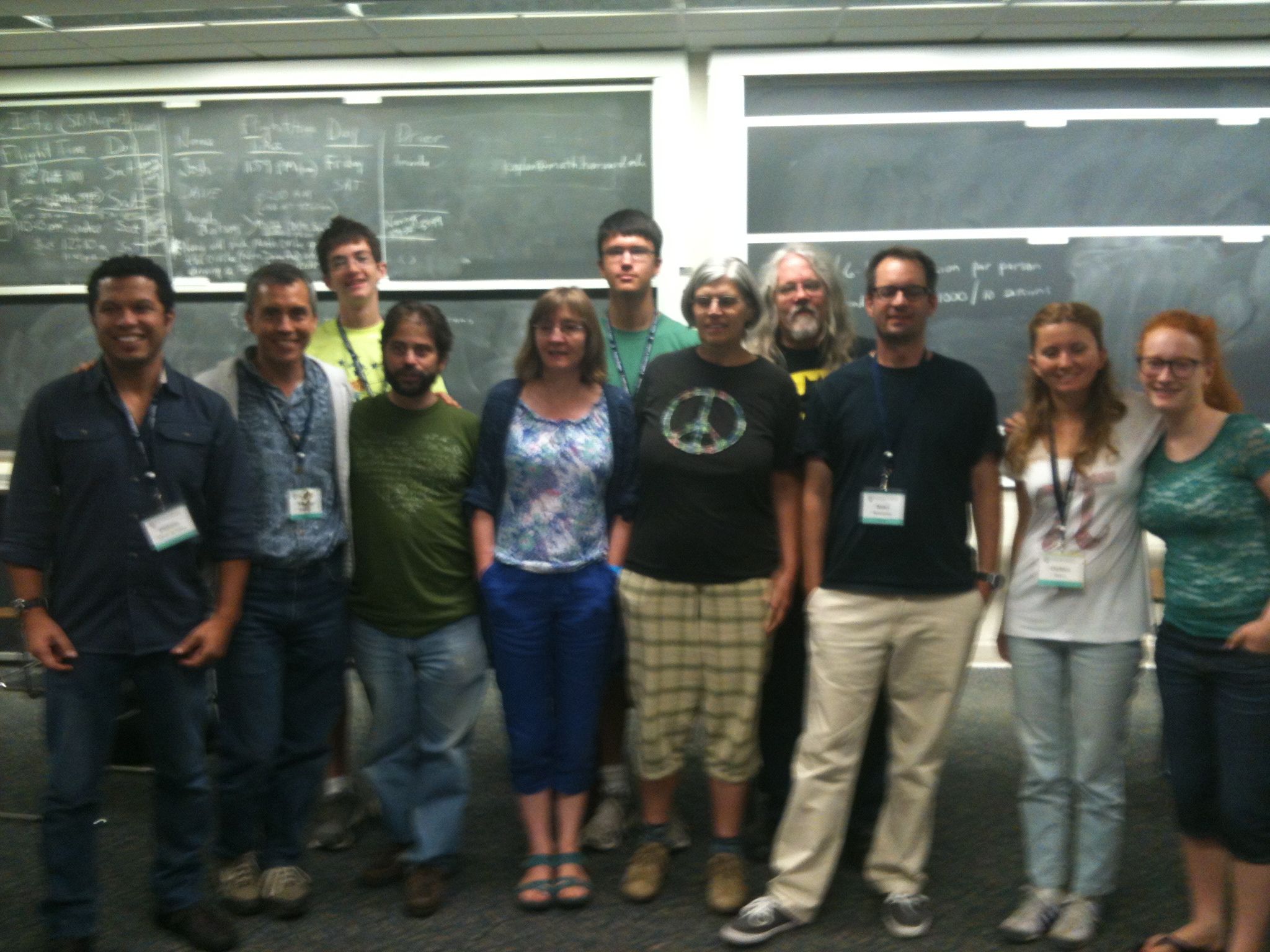
The summer institute drew teachers and non-teachers. The founders/leaders/patriarchs, Bob and Ellen Kaplan, couldn’t make it. A math circle/math community in South Bend organizes the event, and brings kids to play with the participants, and to participate in little circles. I knew in advance myself, my friend, Sue, and Owen. The rest were new to me.
Each day began with a math circle type problem for the adults. The instructor modeled posing the question, but not giving too much information, and letting the teachers and kids play with the problem, ask questions, explore. We worked individually, together, and as a whole room (there must have been 25? altogether. It’s a year ago, I’m a bit fuzzy).
In the afternoons we broke up by level (high school, middle school, upper elementary, lower elementary). There were kids at each level. And we ran daily “math circles” with each participant getting a turn to lead or co-lead.
How was it?
We were playing math all day. You can guess, but I’ll tell you. I had a ball. One of the interesting bits was how few actual teachers there were. I mean, motivated parents who run or want to run circles and university types who want to run or facilitate circles, or people who might become teachers – they were there in larger numbers. That meant there was a sort of freshness and newness to some of the conversation. The mix meant there were people to engage in math with at all levels. But it also meant that there were people trying to rediscover or discover stuff that you figure out pretty quickly in the classroom. It was… interesting. And it was … different. And it was … engaging in a new sort of way. Plus, I made a math-y friend, which was nice for me.


Return to NY – Any impact?
The way back involved more stopping. Bell’s again. One famous (bit disappointing), one fun stop in Michigan. And a tiny stop in Horseheads, NY.
And since? I’ve kept thinking about how the Math Circles organized time, and allowed kids to explore, and to bang their heads against hard problems, without rushing to the answer. I already do some of that, would like to incorporate more of the “feel” into some of what I do.
My friend kept thinking about how fun the circles were. He played with ways to set one up. And he ended up spending time at the NYC Math Circle, hanging around with instructors, volunteering for the summer.
How do you sign up? Should you?
So it’s fun. And you’ll learn stuff. And meet interesting people. And exchange ways of thinking. And get to try stuff out. But it costs money. I paid, but most people… I’d recommend it more for people who can get at least partial funding by their district.
But if you are going to go ahead, it’s a week in July, e-mail Bob Kaplan at kaplan@math.harvard.edu and get more info directly from him.
Sabbatical – First trip? Pittsburgh!
I took a sabbatical 2013-14, to study. But I did other stuff, too. Especially travel.
With my classes only on Tuesday and Thursday, I thought I would be out of town just about every other weekend. All of those weekends, by the way, four days long. Didn’t happen. I traveled a lot, and loved it, but cost and reality held down the number of long weekends by quite a bit.
Anyhow, I didn’t know this when I more or less threw a dart at a map, and decided to go to Pittsburgh in September (this is last Fall). With a long weekend a peaceful ride on Amtrak was possible. I used PriceLine to get a downtown hotel for a pretty good price. But I hit a snag. The uptown IND was really out of service Friday morning, September 13 (you can look it up, something bad, just don’t remember what) and despite my creative efforts, I missed the train. Got the next one, but it cost me. And the connection in DC was late… The good news? This was the Cardinal, one of the most scenic trains in the east. My seat mate was a young woman with a minor political job in DC, who loved trains. I had great company right up to her stop,
The rest was a two day blur. I picked out a hotel on Trip Advisor without knowing what one it was. Good deal. Turned out to be the Marriott. And now it is so long ago, that I am having trouble putting my “sights” in order:
- PNC Park. The Pirates lost, but I had a very good seat in a truly great stadium, sitting with intense, yet friendly to out-of-towner, fans.
- The Warhol Museum. Pretty cool.
- Bridges. I think I crossed the Allegheny on two, the Monongahela on one.
- Inclines. Up the Monongahela. Down the Duquesne. With a drink on a terrace at the top, looking over the city.
- Point Park. Lovely. And the Ft Pitt Museum. Too fast.
- Wandered the Strip, the old dock district, and took a distillery tour.
- A walk along part of the Three Rivers Heritage Trail System






And then a return Amtrak train, daytime, lucked out and had nice company again, and a helluva view around “Horseshoe Curve” in Altoona.
It was not as much as I meant to do, and done a little too fast. But what I did, I enjoyed. And if I had thought carefully, I might have wondered if this was going to be a common pattern during my sabbatical year.
“Retired” abusive administrator reappears
It’s usually enough for a bad administrator to leave the system – we are rid of them and their behavior – though for the sheer numbers of abusive and/or incompetent principals and assistant principals in New York City today, one at a time seems hardly enough.
And if they reappear, but elsewhere, as the disgraced former principal of Bronx Science recently has, we might like to point it out, but it does not become our immediate problem.
However, we know that issues of abuse, incompetence, and less than forthcoming statements often accompany each other. And when we can document statements that seem in hindsight to veer from the facts…
Last year, a scandal over hazing of younger athletes by older athletes broke at Bronx Science. There were allegations that administrators, up to the top, were aware. And in the midst of the investigation, the principal announced her retirement.
Now, it wasn’t as if that was the first controversy she’d encountered. Under her stewardship, the atmosphere for teachers at the elite school at deteriorated. Faculty turnover was far higher than at any other specialized high school in NYC. Teachers, bristling under her arbitrary and authoritarian leadership, and noticing that she used an honorary degree to start adding “Doctor” to the front of her name, ran a quack campaign – with ducks, that was then repeated in several versions as student pranks. A special complaint of harassment was brought against the principal and one of her assistants – and an arbitrator found for the teachers. She weathered those storms, though it seemed that she continued to stay out of spite for her subordinates.
In any event, you have a chance to compare what she says today, as she takes a new job, with her reasons for leaving, which she claimed had nothing to do with controversy or an investigation:
Now:
“This July I was appointed as principal of Maria Regina High School. I am honored to accept … after spending thirty-five years at the Bronx High School of Science where I was the principal for twelve years, an assistant principal of science for three years and a science teacher for twenty years … As an educator, my goal has always been to excite students about learning and support them as they work to attain their educational goals. As an administrator, I know that I cannot and do not work toward this end alone. I, as principal, am a member of a community. It is only with the work of gifted teachers, involved parents and motivated students that success can be achieved … What I have learned through my years as an administrator is that leadership is a humbling experience…
Then (Bx Sci alumni bulletin) (NY Times) (same article):
The principal, Valerie J. Reidy, who took over in 2001 after 23 years of teaching and managing at the school, said she was under no pressure from city education officials and was “not under investigation” in connection with the arrests of three track team members, all juniors, in March.
“Was I happy about the track debacle? No,” Ms. Reidy said in a telephone interview on Thursday. “But is there ever going to be a perfect time?”
Ms. Reidy cited her age — she will turn 65 on Nov. 28 — and financial and family concerns for her decision. Her husband, James, retired two years ago from the federal Environmental Protection Agency, and one of her sons is set to wed in September. She wants to sell her house in Westchester County and travel more….
When the tests are powerful and wrong
A great math teacher deals with dicey math, because it is on the test
“I’m providing Test Prep for students who have to confront this type of language regardless of its mathematical validity!”
One of the trickiest topics in K-12 mathematics is probability. It’s tricky for a number of reasons:
- It’s not a traditional topic. There are not decades of practices to use, improve, or rail against.
- Probability relies heavily on fractions, the gateway between arithmetic and algebra, the single aspect of grade school mathematics that we screw up (in this country) the most
- The subset of probability we teach, simple combinatorial probability, is not a standard part of college probability courses – we don’t have the usual crowd of post-secondary math people poking around and complaining about mistakes.
- Most people teaching probability learned their probability k-12, or from math ed classes that were based in k-12 curriculum. In other words, what we do poorly, we pass down not only to students, but to the next generation of teachers.
So this twitter exchange is with a great math teacher, retired. As department chair he took some of the most advanced classes (everyone does that) and some of the least advanced classes, full of kids who struggle (no one does that). Currently he is doing SAT prep. He prepares SAT-type questions, and I think he solicits the occasional comment.
Great Teacher: A pt is chosen randomly inside larger of 2 concentric circles. If the prob the pt is outside smaller circle is 84%, larger rad:smaller rad=?
JD: Is “random” smooshy here? If I randomly choose an 0 < angle < 360 and a radius 0 < radius < BIG Radius, is that not random?
3rd Party: Good point – ‘random’ doesn’t necessarily mean ‘uniformly random’
GT: Excellent pt re random. The language I used is common on stand’zed tests where “uniform” is implied. Pls reword it in <=140 char!
JD: Why use “random”? Why make it a probability q? 2 conc circ, Large and small. 84% of area of L is not in s. Radius(L) / Radius(s) ?
GT: Agreed but I’m providing Test Prep for students who have to confront this type of language regardless of its mathematical validity!
Sabbatical – a Real First Logic Course
I took a sabbatical 2013-14, to study. I mean I did other stuff too, but studying came first. And the first class I walked into was Mathematical Logic.
I teach “Logic” – but it’s a high school course, based on the first logic course that might show up at the 100 or 200 level in a philosophy department. Hurley is my text. My content barely touches the beginnings of what we were about to study.
I was at Queens College, and this was a 600 level course – it was designed as a first real course – and it was. In college I’d only done a philosophy department logic, similar to what I teach. This was new.
I want to describe the course and the people and what I did and didn’t do, briefly. The text was Enderton “A Mathematical Introduction to Logic.” Professor showed an earnestness, an excitement about the subject. Looked vaguely like a cross between Dr. James Wilson and Lt. Reginald Barkley. There were a few complaints that he was unclear, or explained poorly – but they were off-base. The subject was very hard – the professor spoke clearly, used vocabulary carefully, introduced ideas well, offered great board notes, provided illustrative examples – but the subject was just that hard.
There was one auditor for the first two or three weeks who seemed to be a retiree – but he got bored and disappeared, leaving me probably the oldest in the room. We lost about a quarter of the class before the mid-term. Maybe more. And we were down to about half by the end.
The text for this class was divided into four chapters. We covered the first two, and part of the third.
I made it through “Sentential Logic” relatively unscathed, running an A, and while I felt shaken a bit by the level of difficulty, more or less stayed on top of everything. Professor was really good with office hours, available, and wanting to help. We used induction, but differently than I had encountered it before. It took real getting used to. The concepts were fairly familiar, or I picked them up. Or struggled through them. I had to study, which is something I did precious little of when I was younger.
The second unit, First-Order Logic tripped me up. I lost my way with “substitutability” and never fully recovered. What’s a language? What’s a Theory? What’s a model? What does it mean to “satisfy”? What does it mean to be “definable”? I have answers for all of these, but I’m not 100% sure when I answer. And sometimes I know what to say, and I’m not sure what my words mean.
We touched incompleteness and undecidability at the end. I certainly did not follow all of what we were doing there.
My final exam was weaker, and I ended up with a B+. Which doesn’t sound great. In fact, I think there were only 3 or so A’s in the class; my grade’s no embarrassment. And I learned enough that I would love to do this class again (or read something, but I doubt I could do it without a smart, clear professor, like this guy). It’s a situation where I know something between half and three-quarters, and where I am well-positioned to to boost that to 90+%.
It may have untangled some vocabulary issues for my teaching, but hardly. It was good to struggle against hard material. And it was fun to study with much younger students (I worked with a teacher, two grad students, and an advanced undergrad), some of whom ran academic rings around me.
Side-note. While I was taking this class, this blog got linked by a guy who shares my initials and probably teaches the exact same class at a different campus in the same university.
Today’s MLB standings (with math): the extreme AL West
I don’t follow baseball as closely as I once did. I go to Yankees games, and have to ask the names of some of the players – back in the day that’d never happen.
But I still enjoy the game, and do get to games, and every once in a while check box scores or standings.
That, by the way, is a remarkable admission from someone who used to buy one or two daily newspapers during my 20s, and would turn to the box scores first. I gained much facility with arithmetic, back before I was ten, as I saved the Sunday paper, and updated the leaders during the week, adding in ABs and Hs from the box scores, and dividing to get the new averages. I studied pitchers’ ERAs and tried to find the match-ups that would lead to the shortest games. And at a certain point, I would look at an average, and find possible AB and H combos that would have led to that average (rounded to the third decimal place), or would look at an ERA and a number of innings to calculate the number of earned runs, and recalculate the ERA with the new box score (websites give you all of this instantly today, but it used to take a week before new stats were published).
Anyway, I’m looking at the standings today, and it turns out that the two best records in baseball, and the two worst records in baseball, they are not extremely good or extremely bad, and all live in one division of one league: the American League West.
First, the lack of extremes is interesting. Over half the teams are between .450 and .550. But only two are over .600, and only one is over .400.
But the AL West looks different. The Oakland As are 25 games over 500, the California Anaheim Angels are 22 games over, the Houston Astros are 20 games under, and the Texas Rangers are 22 games under. See that California vs Texas thing? Cool.
Is anyone else close? On the high end, no. In fact, they are the only two teams are above .560, the Tigers, Orioles and Dodgers are 12 games over, each. On the low end its closer. Rockies are 19 under, Cubs are 18 under, and the Diamondbacks and Phillies are both 14 below 500.
But the two best, and the two worst, in one division of only five teams. If this was independent, it would be weird. But here’s my question: how much is this due to the Angels pounding the Rangers and the Athletics pummeling the Astros? I could ask someone, or I could look it up:
Astros |
Rangers |
+/- |
|
As |
5 – 2 |
7 – 5 |
+ 5 |
Angels |
10 – 3 |
8 – 2 |
+13 |
+/- |
-10 |
– 8 |
Interesting, without the two doormats, the Angels would be just 10 games over .500, and nothing special. Without losing to the top two teams in baseball, who the are forced to play frequently (currently about a fifth of their games), the Astros and Rangers would be ten and fourteen games under, or pretty much mediocre. In other words, the high quality of the competition in the division hurts the two from Texas, while the (weaker) divisional opponents boosts the Angels’ record.
But the As are 12 – 7, .632 against the Astros and Rangers, 53 – 33, .612 against everyone else. They are just really good.
It’s a book. Read it.
José Vilson wrote a book. That you should read. And, maybe get others to read. He called it “This is Not a Test”
I don’t do book reviews. But this is different. It’s José.
Vilson is a blogger, and a poet, and a teacher. The author part wouldn’t matter if he wasn’t a teacher. He wrote a book about teaching. Some about his teachers. And some more about him, the teacher. All here in New York City. Manhattan.
So look. I’m not doing a long write up of what I liked about the book. He tells a good story. Some of the anecdotes are like a slap in the face, others as sweet as a first kiss. He’s got his influences, his growing up on the Lower East Side. He’s got the time his answer was wrong, until it was repeated by a white kid. He’s got rejection, cockiness, becoming a teacher, screwing up, and getting stuff right.
I liked the first part, about him growing up. And the second part, about him being a teacher. But I didn’t really get the third, shorter part. Felt like an add-on.
I mean, other people, smarter, more important, have written glowing reviews. Diane Ravitch big enough for you? They describe his style and his voice and his getting-it-ness better than I can. Even better, Karen Lewis – that Karen Lewis – wrote the forward. With all those big shots, why should I bother? Because it’s Jose, I need to do this.
There are other books about teaching in NYC. They are probably fine books, written by people who really taught. And they may contain interesting stories and insights. But some taught briefly. Others were in awe of NYC, not having grown up here. Others – poor word choice, I know – can’t get past their first experience working with so many people who weren’t white. These books can be interesting, but they are not the same thing. And then there are the books about teaching by people who’ve never taught, and don’t know anything about how schools or teaching work. Those books are not interesting.
“This is Not a Test” is a real book, about a real NYC kid, both Haitian and Dominican, but not really either. He’s smart. He teaches math, but he uses words – blogger, poet, author. He can write. He became a teacher recently enough that he remembers how bad starting sucks, but he’s been doing it long enough, and well enough, that he gets a chunk of the big picture. And he has stories. And trust me. You should read this.
Look what I did with my extra copy:
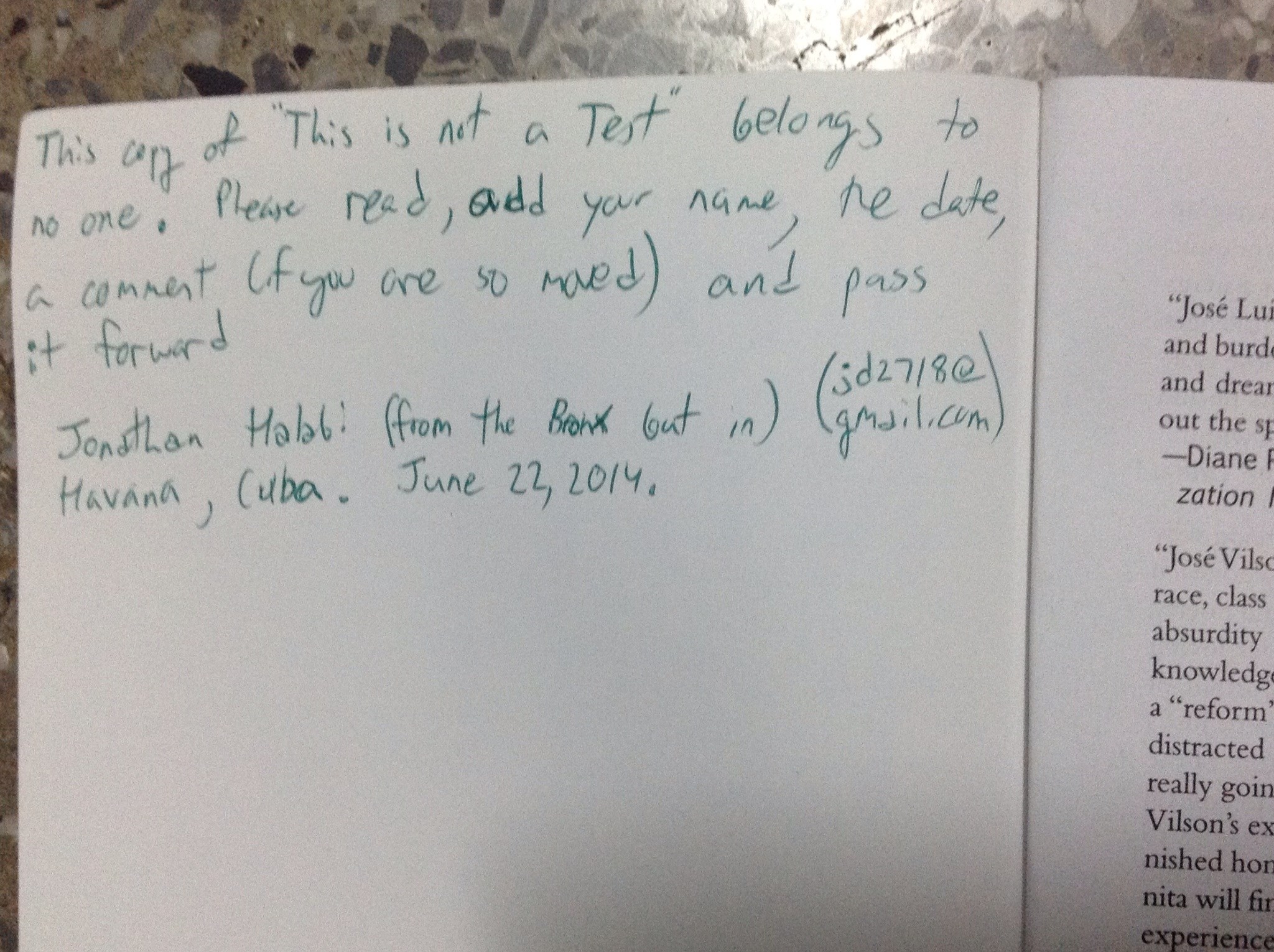
I think I’m supposed to mention that the publisher is Haymarket Books, and that they are cool and you should check them out.
Why the fuss over retroactive pay?
Teachers and paras are suing the UFT for retroactive pay? The principals’ union is calling the mayor “outrageous” for refusing to pay retro to principals? What gives?
The contract as written does not include retroactive payments. Instead, there are lump sums equivalent to what a member would have earned from 2009-11, payable only to retirees and in-service members. The principals are right to be pissed, but they do not have standing to complain. The members who left service have a right to be super-pissed – they were intentionally left out of this agreement.
But they are wrong on two counts – 1. despite the UFT frequently using the word “retroactive” in the campaign to get this contract passed, there is nothing in the contract that says “retroactive” and 2. suing the union is something that should make all of us uncomfortable.
Maximizing “the package”
So what happened? In short, the UFT leadership wanted members to vote yes. They wanted to claim “full retroactivity.” They wanted to show as big a raise as they could. So they worked with the DoE to maximize the payments members would get, by excluding some people from the payments. And they never really said they were doing this. They emphasized “full retro” and scrunched the raise per cents together to make them seem as large as possible. In fact, when one high-ranking UFTer read the negotiating committee the size of each year’s raise, when he came to the 0 year, he just skipped it, leaving people confused as to how many years the contract ran for.
Creating Winners – and losers
Who was left out? The biggest group – anyone who quit before today. That includes people who left on disability (one such para is a party to the lawsuit), people who were discontinued, including unfairly by incompetent or abusive principals, people who left vested, planning to retire a few years down the road….. The NY Daily News thinks there are 9000 people in these groups. I suspect the number is a bit higher. Now, that means no pay for a group of people who don’t vote, and more for everyone else. No, not fair. But I see the cynical logic.
And, apparently, anyone who moved to a non-UFT title. We just heard about teachers who moved to principals. There may be other such groups.
In addition, everyone here today will start getting their payments on schedule (1/8 Oct 1 ’15, 1/8 Oct 1 ’17, 1/4 Oct 1 ’18, 1/4 Oct 1 ’19, 1/4 Oct 1 ’20). However, anyone who should quit, resign, get discontinued – or perhaps even die – they will not get future payments. And it seems that any teacher taking a principal job in the next 6 years will suffer a pretty sharp financial hit as a consequence. Figure the DoE and UFT had actuaries and accountants actually calculate how much money would get freed up in that way.
Retroactive in Print, and Not
The New York City Department of Education – United Federation of Teachers contracts that were just ratified, cover 2009 – 2018. Other City unions had previously settled for 2009- 2011, getting 4% and 4%. There was an expectation that UFT members would get those same raises, retroactively. That’s almost, but not quite, what happened.
The UFT Leadership boasted that they had gotten us “full retro pay.” Everyone who heard Mulgrew speak would have sworn that he said we were all getting full retroactive money. But in print, they were lawyerly. What follows are from e-mails to the membership, signed by Michael Mulgrew.
May 1: Over the life of this nine-year pact, which runs through October 2018, UFT members will receive an 18 percent raise, full retroactivity as well as a $1,000 signing bonus upon ratification.
May 4: We were able to negotiate the wage increases in this package — including the two 4 percent increases that the previous administration had insisted that the city could never afford — through stretching out how the retroactive raises are being paid. Be assured that all members will receive every penny that they have earned since Nov. 1, 2009 as long as they are in-service, have retired since that date or are planning to retire in the future.
May 5: The phase-in of the retroactive raises has no bearing on the final amount of retro payments you’ll receive. All in-service and retired members will receive 100 percent of the money they are entitled to, compounded back to Nov. 1, 2009, by 2020.
May 9: The vast majority of questions we are receiving are about the salary increases and the retro package. If this contract is ratified, all in-service and retired members will receive 100 percent of the money they are entitled to, back to Nov. 1, 2009, by 2020.
Notice how “full retroactivity” on May 1 got a caveat added on May 4: “as long as they are in-service, have retired since that date or are planning to retire in the future”. By May 9 the raises have become a “package.”
On May 1 there was no qualification of who was getting the back pay. On May 4 it was limited to in-service, retired, and those planning to retire.
And then the Memorandum of Agreement came out, and the word “retroactive” did not appear at all. Read it for yourself (3. Wages, sections B and E)
Sabbatical – one rule
But one decision, one rule, I kept. Almost. I decided not to go into my school.
When my sabbatical was approved, May of 2013, I had to make some decisions about the school year that just passed.
I chose an institution to take courses, and then I changed, and then I partially changed again. And I changed classes along the way. They were still, mostly, graduate level math classes. Just not the ones I had originally planned on, nor at the institution I had thought was perfect.
I decided to travel every other weekend. And while I did travel, and a lot, it wasn’t close to every other weekend.
I decided to visit schools and watch math classes. I figured I would get to 2 or 3 dozen. The visits were harder to arrange than I thought, and I ended up visiting fewer than 20 schools.
But one decision, one rule, I kept. Almost. I decided not to go into my school. Not to drop by. Not to say hi. Not to speak to a chapter meeting. Not to discuss administrative items with my principal. Never.
I cleaned out my personal items on June 26, 2013, so I wouldn’t have an excuse to “just drop by” for something.
There was excitement (not in the positive sense of the word) over the new evaluation system. Teachers wanted my input. They got it via e-mail. Or in person in bars or restaurants. I wasn’t going in.
The principal occasionally wrote to me, apologetically asking a question. He knew I was really disconnecting. He did not ask me to come in.
This winter a student was making a documentary film for class about specialized high school admissions (my school is a specialized high school.) Several of the teachers in my school worked on a UFT committee (organized by VP Janella Hinds) examining ways to improve specialized high school admissions – and I co-chaired the committee. And he wanted to interview me, and I wanted to grant the interview. But I arranged it in a college library, close to our school. I wasn’t going in.
My principal received papers, important to my sabbatical (eventually) and offered them to me if I dropped by. I asked him to hold on to them. I wasn’t going in.
I was really, really good.
And then the new contract proposal hit in May. And one of the co-acting-chapter leaders asked me to come in. I declined. And then another chapter member. And then another. And when I had my fifth request, from a chapter of just 25, I broke down. May 23, I came in and ran two Chapter meetings. And then I met with my designee and the principal about possible schedule options, assuming the contract went through. June 2 I came back, ran an after school chapter meeting to discuss schedule options. And while I’ve been in touch, at a distance, I did stop by twice after school ended – once to follow up on some questions, and once to collect copies of sabbatical-related material (I’m turning in my sabbatical papers today).
I guess this rule, not going in, this one rule was a really good one, as long as I kept it. Once I broke it once, it kind of broke down.
There are ATRs in New Haven?
Not exactly, but something like it.
Because of “Turnaround” – adopted in a 2010 Weingarten/reform contract – there is a group of “displaced teachers” every year – who will have a job, but have to find the placement themselves. And because “turnaround” comes with stigma (it’s schools in poor areas that have it done to them, but they are labeled as failing), teachers leaving those schools tend to be shunned.
The story comes from the New Haven Independent.
It also quotes union leader Dave Cicarella, on an interesting, different, note. New Haven adopted a five stage teacher evaluation system in 2010, before NYC’s H, E, D, I system. People I know there said that the dramatic change was not in the number of people scoring the lowest, and in danger of losing their jobs, but that principals had discretion over the difference between a 3 and a 2, and being able to punitively push teachers who spoke up into a “teacher improvement plan” which is apparently a miserable experience.
Before then, Cicarella said, “we had a ridiculous evaluation system” that involved nothing more than “a couple of drive-by” observations of teachers. As in most of the country at that time, teachers were rated on a binary system, either effective or ineffective.
New Haven was one of the first districts nationwide to start grading teachers on student performance—a trend that has now spread nationwide, prompted by federal pressure from the Obama Administration’s competitive grant programs and No Child Left Behind Act waivers. The initiative is based on the premise that the most important factor in a kid’s education is the quality of the teacher—and that that quality can be measured.
His response to principals: “Why don’t you tell your colleagues to do their job?”
If principals are using the teacher evaluation system properly, he argued, they should be working hard to help low-performing teachers improve—and firing them if they don’t. The teachers contract allows a principal to fire a tenured teacher after one year if he or she scores on the bottom of the five-point evaluation scale, and after three years if he or she fails to improve to “effective,” a three out of five. The system requires schools to give teachers plenty of notice: They have to warn teachers in November if they are on track to score on the bottom, or top, of the evaluation scale.
So here we have a new five point scale, and the reformers complain that not enough teachers get fired and blame the union. Sounds like the same complaints we’ve heard in the past about the S and U system, and about tenure. In fact, the problem is the complaint itself, and it would be nice if more AFT locals stood up and said so, rather than trying to mollify the reformers.
And, as Cicarella inadvertently points out, HEDI, 54321, S and U, all rely on good administrators. And the lack of good administrators is something we should be looking much closer at.
Sabbatical? Take one if you can
My sabbatical is winding down. A full year of classes, travel, visiting schools, and no teaching.
I turned 50, hiked to Machu Pichhu, studied cryptography.
I am relaxed and healthier.
Over the next month and a half I will tell some sabbatical stories in this space.
But for now, I’m worried about one particular story: yours.
If you are eligible, you should do this. The time is amazing. The stress on the job is too great. The opportunity to learn is wonderful. And the time to do other things is too.
What are you waiting for? You need to be in your fourteenth year when you apply.
The DoE memo comes up in February. They leave you a window of about two weeks to get the application in. It’s not enough time… so start way before February. There are UFT workshops afterschool in each borough in the fall. Attend. Figure out where you are going to take courses. Use last year’s memo as a template. Figure out some likely courses. They need to be rigorous and job related. And the majority (you’ll need a total of 16 credits) have to be at times that you would otherwise be teaching.
Money? You still get 70% of your pay. After taxes, that’s a lot less of a cut than most people expect. If even that is too much, you can cut TDA for a year (but I don’t like the sound of that). Plus the year still counts towards pension. Find a way to tighten the belt a little, if you have to. But no excuses.
Many UFTers think that sabbaticals no longer exist. Wrong. Think that most applications get rejected. Wrong. Think they can’t afford one. Wrong.
So stop making excuses – get ready for the February application. You won’r regret it.
Saying hello and goodbye to Tucson in one breath
I arrived in Tucson, and I am leaving.
I spent last weekend in Los Angeles, at the American Federation of Teachers Convention. Instead of heading straight home, I detoured east by southeast into the Gadsden Purchase.
With my luck, the flight in Monday was delayed. And the great rate I got from Thrifty? It didn’t come with an actual car.
I got to my hotel (nice spot, Lodge on the Desert, big room, fireplace – well, fake, but I think it’s one of those gas jobs – balcony, comfy, clean… it’s a bunch of two-story buildings around a restaurant, bar, and pool) I got to my hotel around midnight, and slept in Tuesday.
More luck, Tuesday there was a morning storm, and it continued. Lightening, and on and off bursts of rain. But the natives seemed to like it, and told me it would be fine to visit the Arizona-Sonora Desert Museum, and it was. Dips in the road were filling with water, and I’d been warned twice to be very careful. I’d also been advised of the “Stupid Motorist Law” which says that if I drive into a puddle that turns out to be much bigger than that, and need to be rescued – I pay the cost.
The Museum was like a massive nature center / botanical garden. They had an amazing variety of cacti, and the creosote plants (not creosote) scented the drizzly air, and the steel grey sky provided an awesome backdrop. There were animal exhibits, plant exhibits. There was a walk-in aviary, and a walk-in aviary for hummingbirds. I must have stepped in the wrong spot, because one buzzed my head a few times. There was geology, and paleontology. And it got hot when the sun finally came out, but I had already spent hours there. It was absorbing, and entrancing, though perhaps not amazing.


The road took me over a little hill with an overlook back east over the City, and another on the other side, west. On the return trip, as I made it down the east side, I saw a cop with flashers. I slowed. A lot. He was guarding a boulder that had fallen in the road – the shape of a huge wheel of cheese, maybe two-and-a-half feet high, with about a six foot diameter. Another trap for stupid motorists.
In the evening I ate at the Tucson Tamale Company, which was ok. The young woman who helped me let me taste everything, and then even came over to the table to unwrap a tamale for me, and told me I looked way better (she should have said younger) than her mother. One Sonora, one vegan blue.
And then I found the house where my father lived his first few years. Pretty sure the building is not old enough, probably newer construction on the same site. The West University neighborhood was interesting.

Then a few laps in the pool.
And today? Breakfast. The Pima Air and Space Museum. Connection to Phoenix. And an exit row from Phoenix to JFK.
AFT 2014 Convention – Monday
1. Enough Press
This is (barring some odd tangent) my last AFT Convention post. Here’s the others: Friday – Saturday – Sunday.
And yesterday was another busy “tweeting” day, well morning. If you are curious, here’s the handle once again: @jd2718x . My twitter account saw more action this weekend than in the previous three months. One Unity delegate (and full-timer) joked as I passed him on the way to the bathroom that I needed to get back up front and get back to work. Others noticed that I looked a bit tired (it really was a bit draining). And a Unity retiree who I know slightly, seeing the fatigue on my face, offered to make me her guest in two years. (I know I can register myself as a visitor, but it was a really nice gesture).
2. Ukraine
I’d been waiting for this. The AFT is famous for pro-war resolutions, and despite their protestations, their draft Ukraine resolution was another example. I heard, and this was at least a little heartening, that it had only squeaked out of committee by two votes. And I expected, despite the odds, a fierce debate.
“the AFT has a long, ugly pro-war history (they were Kerryishly for the Viet Nam war before they were against it, a dozen years ago my local passed a blood-curdling “let’s invade Afghanistan, because we need to invade someone” resolution, and just four years ago the AFT passed a blueprint for justification of a war they clearly were hoping the US would launch against Iran). This time? Pro-war resolution on Ukraine. Look for it to pass, but in a hot debate.”
But a funny thing happened. There was some sort of agreement, and the Cold War reso was replaced by a substitute, introduced and strongly motivated by a math teacher, PSC-CUNY delegate Glenn Kissack. The substitute dropped support to the current Ukrainian government. It added opposition to IMF-imposed austerity. It added support for labor rights for Ukrainian teachers. The Whereas’s (preamble) in the substitute, among other things, pointed harsh fingers at the nationalist right wing parties, Right Sector and Svoboda. That was too much, Shanker Institute Administrator Leo Casey rose to swallow the new resolution, but asked to blank the entire preamble, and PSC-CUNY President Barbara Bowen generously agreed.
This was one of two places in the Convention where something better than what the leadership proposed was passed, and clearly the more important. (The other was getting a symbolic anti-Duncan resolution). The Ukraine resolution is not a resolution the State Department would be comfortable with. Excellent.
3. Speakers
Two speakers stood out on Monday – the NEA’s new president Lily Eskelsen García and the AFT’s new Executive Vice President, Mary Cathryn Ricker.
Lily Eskelsen García spoke plainly, and well. She struck good teacher chords, good labor chords, and was genuinely funny.
Best: “When I die, I would like to die in a faculty meeting. The transition between life and death would be so subtle.”
But she hammered reformers, and testing, and sounded as militant as anyone who’d addressed the assembly.
I wasn’t taking notes when Mary Cathryn Ricker spoke. I had moved to the back, bag over my shoulder, watching my phone, waiting for my ride to call. But as I caught some of her words, my focus was pulled back to the stage (or the screens, I guess). She is from Minnesota, and had been involved with the St. Paul local’s militancy, and so it should have not been a surprise that it was a real labor speech, and kind of tough, and I know it doesn’t necessarily mean anything, but it was a good last note to AFT14.
4. Election Results
The Progressive Caucus (which binds many major locals to UFT/Unity, and loosely ties some others, prominently CTU and PSC-CUNY) won an overwhelming majority – on the order of 97-98% over perennial opposition BAMN. Of some interest, Mary Cathryn Ricker received the highest number of votes. More interestingly, while the vast majority of votes are slate votes, there are enough votes for individual vice presidents to see a difference – and indeed CTU and PSC-CUNY presidents Lewis and Bowen received more votes than any of the other vice presidents, outpolling the last VP by about twenty thousand weighted votes each.
5. And then? I visited the La Brea Tar Pits and the Page Museum, had lunch in Little Ethiopa, and flew to Tucson for a day and a half of sightseeing – which I need to get started on!
AFT 2014 Convention – Sunday
1. More Press
I spent another day front row, listening, writing, tweeting. I’m “Press” here because I blog. But then it turns out I tweet… another 40 yesterday, even though I missed a bit. Maybe a little more intense during the two big discussions. If you are curious, here’s the handle again: @jd2718x
2. Common Core
The second resolution of the morning supported the Common Core, but criticized implementation, testing, etc. It called on teachers to rewrite the standards. This was the most contentious resolution, probably of the entire convention.
Randi Weingarten opened by asking to suspend the rules, so that the question could not be called for the first 15 minutes, and to allow the suspension to be extended 15 more minutes (guarantees debate). In the event, the debate went on about 40 minutes, and included a range of points from each side.
At first it looked like UFT against CTU, but as other delegates joined in, it looked like Chicago and some rank and filers on one side, against AFT Vice Presidents on the other – an unfortunate blunder on the part of the common core supporters.
Almost none of the debate addressed the actual content of the CCLS. Which is unfortunate. The math has some plusses, but the demerits are overwhelming. The high school component is a disaster. And no one seems to care what’s actually in them. One Chicago delegate did address reading: Kids naturally learn to read between ages 4 and 8, and not on schedule. One special ed teacher talked about how inappropriate the standards were for “her babies” (phrase made me cringe), another (unconvincingly) described how the standards would help (hmm, she described things that she’s not currently doing? I was confused, probably for good reason).
The Vice Presidents spoke, some in favor of the Common Core, some in favor of reclaiming the Common Core. A woman from Rhode Island was quite clear about not liking them the way they are, others seemed to endorse them as written.
One rank and filer from Minneapolis, dynamic speaker, distinguished between corporate standards and educational standards, rebutted the idea that kids would be on the same page in different states, and pointed out that we could never “reclaim” standards that are copyrighted.
The vote was about 70 – 30.
3. Duncan
Can we make Duncan resign? No.
Can we say we are pissed? Yes.
And that’s the unstated motivation for the amendment to an unrelated resolution calling on him to resign.
Only another delegate comes up with a snarky “Improvement Plan” for Duncan. Cute? Yup. Motivated? With precise, sharp criticism of things he’s already done to harm us. But it kind of distracts from the “We’re pissed, resign” message. So Mulgrew gets up and speaks for it. And the house, still edgy from the Common Core debate, divides along similar lines – Resign vs Improvement Plan. In the end, the Improvement Plan passes overwhelmingly, and it’s only a slightly weaker way of publicly venting.
4. Other stuff
Argentina’s defense was amazing, but they could not score against Germany. I watched with a delegate whom I’d met in June, in Cuba.
Donna Brazile spoke on the Democrats for Public Education. I was outside the hall, eating.
A resolution to create physical infrastructure in the US closed the session. A delegate rose to amend, to add a pro-environment line, and an anti-Keystone line. Randi separated the two, but the question was called right away (delegates were in a rush to end the session). Keystone went down overwhelmingly, but Randi was horrified to see the environment also fail, about 2-1. She called for a revote, and enough of a signal went out that the new result was close enough to a tie that she could conclude that the amendment passed. And who would object? Those were mostly her votes that were still going the wrong way.
5. Maybe I would like LA, if I gave it a chance.
6. On deck: International Resolutions. The AFT has a long, ugly pro-war history (they were Kerryishly for the Viet Nam war before they were against it, a dozen years ago my local passed a blood-curdling “let’s invade Afghanistan, because we need to invade someone” resolution, and just four years ago the AFT passed a blueprint for justification of a war they clearly were hoping the US would launch against Iran). This time? Pro-war resolution on Ukraine. Look for it to pass, but in a hot debate.
I Love LA
Did I really say I didn’t like LA? Almost. Look at #5: “I do not love this city” And Fred Klonsky forgave me (Even if Jonathan doesn’t like LA. He’s a New Yorker and can be forgiven), but I vowed to do some repair work.
I guess mostly it was just a NY prejudgement. An idea that the Bay Area was good for transportation, and southern California was good for traffic. All kinds of movie stereotypes. Have you ever seen Annie Hall?
But how can I have an informed opinion after visiting for 4 days (stayed in Culver City) once in the late 80s, and 3 days (all AFT convention) this week? Well, I can’t.
And there’s already some good stuff I can mention. Two of my favorite movies are set in LA. Chinatown, but I haven’t visited Chinatown. Chinatown holds up after over 40 years, as if it were made yesterday.
Better than that, Double Indemnity. You know, Fred MacMurray, from My Three Sons? An insurance salesman, lured into crime by a seductive Barbara Stanwyck? And betraying his close relationship with his boss, claims adjuster Edward G. Robinson? (doesn’t he usually play gangsters?) “Know why you couldn’t figure this one, Keyes? I’ll tell ya. ‘Cause the guy you were looking for was too close. Right across the desk from ya.” “Closer than that, Walter”
So we found a livestream of Double Indemnity, and my cousin, who’s been in LA for a year and change, loved it. Because she leaves in the direction of Glendale (not there, just in the direction) and she recognized every corner, every address. Plus it’s, ya know, a good movie.
And then there’s Dodgers Stadium. We saw a game yesterday. Great game. Pitchers’ duel. 0-0 into the 9th, bases loaded, one out, sac fly to left to win it in the bottom of the inning. Love those games. And the shtick between innings was more middle America honky tonk than big city. Loved it. Running to second and back to first. Unpiling cups faster than Jose Uribe. Good wholesome shtick. And the views, and the moon. Yeah, it’s old and falling down a little. But it was no National League cookie cutter. Good sight lines, comfortable feel. Someone should tell the Dodgers fans not to come late and leave early (a couple in front of us left 0-0, bottom in the 9th, one on, no one out), but other than that, good place to watch baseball.
And there’s the ethnic food, which I haven’t figured out yet. And I’m about to leave. Maybe next time. Korean tacos? Really?
And then there’s Uber. An App to call special cabs. You can see how close they are, and get an ETA. And they bill your credit card without swiping anything or opening your wallet. And they are cheaper than regular cabs. Cool.
The only sightseeing I’ll get in is tomorrow, on the way to the airport, La Brea Tar Pits. And what’s Hammer?
So, honestly, I don’t love LA. At least not yet. But I’ll come back, and give it a real chance.
AFT 2014 Convention – Saturday
1. Meet the Press
I spent yesterday mostly in my seat, front row, listening, writing, tweeting. Odd experience. I tried to find out how to come to the AFT Convention as a non-delegate, a guest, an observer – and I ended up being a “Press” because I blog. But then it turns out I tweet… More yesterday in fact (40ish times) then in any previous month. There’s no depth to tweets, but some instant info. If you are curious: @jd2718x
The press area is two rows in front. There seemed to be more blogger-types than major publication reporters. And there were folks on the edge. In the morning I sat between 2 major reporter/blogger/writers – at least major in my world. Stephen Sawchuk (I should ask if he’s related to Terry) writes for EdWeek. And Jeff Bryant writes for the Education Opportunity Network (looked them up, seems like good guys).
I’m a little surprised by how few “Press” are sitting up front. Maybe there are more hiding in the hall?
2. Visitors
The convention was addressed by a bunch of outsiders. There were three California politicians (not as big as Friday’s Jerry Brown, but…) Tom Torlakson, Congressman Mark Takano, and LA Mayor Eric Garcetti. Takano said he was a Democrat for Public Education. That’s a new group, counter to the anti-public education Democrats for Education Reform, but it’s the first time I’ve heard a politician say he was part of it. Later today Donna Brazile will address the convention specifically on DPE. Garcetti was an iffy speaker – he has a mixed record on education. At one point he flubbed as he tried to blur the lines in the war to preserve public education “We’re all reformers in the room, aren’t we?” he asked, followed by an awkward pause, and then a smattering of weak applause from one section in the hall.
We also had Christine Marinoni, new special advisor for the NYCDoE, and her wife, Cynthia Nixon. That’s the second time I’d seen Nixon live – first time was at Wit a year and half ago. In fact, Nixon read powerfully from a piece by Margaret Edson, Pulitzer Prize winner, and Wit’s playwright.
And then there was Asean Johnson. OK, the kid is photogenic. And a dynamic speaker. And he snuck in an anti-Common Core line. What’s not to like? Here’s a link to a youtube of his talk.
There is a program to “Reconnect McDowell” a poor county in West Virginia, near Logan and Mingo. It’s a hybrid economic/school program. And the AFT is quite involved. But the first outside speaker they brought was a lawyer – not a teacher, not from the county – another lawyer. That’s always a disappointment.
Zakiyah Ansari is always a strong speaker – nothing new here, since I’ve heard her numerous times in New York.
3. Resolutions
No great surprises in this department. A few interesting amendments. Steve Conn from Detroit amended the Immigration Reform reso to include a call to stop deporting children, and to adopt a national Dream Act. An attempt to add controls on handguns failed. And Susan Di Raimo, PSC-CUNY, and a friendly face at Lehman, amended the Reso to end the reliance on adjuncts, to include ending the exploitation of adjuncts. Good point.
I felt proud to have once been a PSC delegate 4 years ago, based on once again a strong intervention. At least 6 PSC speakers raised issues such as the legacy of slavery, the attacks on K-12 being paralleled in post-secondary education, and not accepting simple and wrong anti-worker explanations for the economic crisis. And the Chicago delegation also made its presence felt, even if dynamic President Karen Lewis was limited to a brief set of introductory remarks from the podium. She had a great line “There are thousands of Asean Johnson’s in the Chicago School System, and we are privileged to teach them.” Other CTU speakers were also strong (including on the dramatic decline in the number of Black educators).
Mulgrew spoke about the UFT contract. I’ve already written extensively on that. Here’s one link, but there must be a dozen.
4. Special Orders of Business
There was some action here.
- Calling on Duncan to resign. On the agenda for today. I expect this to be sharply debated, and pass.
- Support for striking British Columbia teachers. On the agenda for today.
- A “Create Economic Opportunity, Reclaim the Promise of America” resolution, that was debated, amended, and passed as the last business item of Saturday.
- And a “Fighting Back and Fighting Forward” reso for today, about developing a concerted national electoral and activist response, in alliance with others, against the continued anti-worker, anti-union onslaught.
5. Los Angeles
I said I don’t like the city, which wasn’t really fair, because I didn’t give it a much of a chance. And Fred Klonsky mentioned it, and ‘forgave’ me, but I’ll fix this so no forgiveness is necessary. More later….
6. Shifted home base from a northeast neighborhood to a shared hotel room near the conventions center. And saw a great Dodgers game.
7. The hot stuff – Common Core, Duncan – that’s today. Stay tuned.
AFT 2014 Convention – Friday
So this is notes, not everything, because I didn’t see everything, not close.
1. The morning was a series of greetings, including The Rev. Dr. William Barber II (president of the North Carolina NAACP, and of Moral Monday fame), and California governor, Jerry Brown. Brown had an entertaining tangent – he misspoke two words on immigration, and then did a two minute clarification on what needs to be done – I’m assuming it was planned – but a bit funny for the audience.
2. Weingarten spoke long (not a surprise).Her writers had an organized message (we’ve been keeping the promises, we need to keep keeping them, and add a new one). She acknowledged opposition to Common Core, while continuing to support it (but criticizing testing, implementation, etc). She completely appropriated the term “badass” to the point that, when she asked Badass Teachers to stand up, only a small numbers of those present did. I’m assuming embarrassment kept others in their seats.
Weingarten’s writers have a voice problem. Her natural Rockland – big words, not all of them bungled, many of them used correctly – it’s not what you want for a long speech. But what to do? As she moved section to section, the voice, the register, they changed and shifted. A good speaker might pull it off, maybe to great effect. Here, many of us focused on the words, since the delivery jumped rapidly from awkward, to natural, and back again. Even the attempts at self-deprecation often seemed forced. And the audience seemed to cringe collectively at her “homey” moment.
3. Committee Meetings and Caucus Meetings. I am not a delegate, so am not assigned a committee. I am not a member of the Progressive Caucus (joining the UFT’s Unity with others), and do not attend their closed meetings. Which is to say, I missed much of the action.
A. There’s not a “Duncan Resign” resolution coming from the leadership to the floor. On the other hand, what will the AFT tops and UFT do if someone else brings one to the floor? Earlier this year NYSUT (New York State United Teachers) replaced most of their top leadership – largely because the previous year that leadership, confronted with a “John King Resign” resolution, animated by anger and frustration, said no. The UFT stepped aside, and the President and all but one VP were replaced. And the UFT walked away unscathed. So now it’s national, the AFT, and the anger is aimed at Duncan, not King, and if there is a “Dump Duncan” reso from the floor, maybe that’s a big if, but if there’s one, wouldn’t the UFT do the same thing, step aside and let the anger be directed towards passing a resolution that really doesn’t mean much anyway? Duncan has two years left. And the AFT’s voice would be a late addition to a fairly loud chorus.
B. The AFT’s has a long history of taking pro-war positions, and only later modifying some of them (eg Viet Nam). When I was a delegate in 2010 in Seattle, the AFT pushed an Iran resolution that was clearly meant to encourage the hawks in DC. And this time? A Ukraine resolution. No real news, except that it barely squeaked out of committee – just a two vote margin.
C. Common Core. The Chicago Teachers Union resolution “Oppose the Common Core Standards” was defeated in committee. The AFT tops / UFT resolution “The Role of Standards in Public Education” was passed. These are counterposed.
The official resolution continues bad AFT policy from the past. In a section at the top, they laud the standards, in seven bullet points creating a slide show that looks like pure promotion (it would be interesting if this turns out to have been lifted). In another section at the top of the resolution, they say “some AFT members oppose and distrust…” Notice the weak argument, based on “some people.” But then in seven bullet points, they dwell on testing and implementation. This echoes a June 20 e-mail many of us received from Mulgrew: “Everyone recognizes that the Common Core, while the right direction for education, had a terrible rollout.” No. Not everyone.
“The AFT” it reads “will continue to support the promise of CCSS…” That’s the bottom line. And will support a shift away from “excessive testing” begging the question of which tests those are, and exactly how much high stakes testing and standardized testing the AFT is happy with.
There will be debate on the floor, but the UFT delegation votes in lockstep, regardless of how the individual members think, and thus the result is foregone.
Oh, that committee also rejected a resolution (California Federation of Teachers) to reject any more Bill Gates money. It’s hard to fathom how Ed Reform $$$ do not buy influence. In the Bronx, we know that Gates money broke up our schools, created a mess, and then disappeared. We live the aftermath every day.
4. AFT Peace and Justice Caucus had a fairly well-attended panel discussion in the evening (scheduled against a caucus meeting) on corporate school reform.
5. I’ve been staying with my cousin, and navigating LA with great difficulty. I do not love this city.
A Big Year
For me, at least.
Turned 50.
Was on a full year sabbatical. Took courses. Math and Computer Science. Some were amazing. Also visited schools and classrooms (not part of what I promised to do, but something I wanted to do).
Traveled. Pittsburgh. Chattanooga. Boston. Buffalo. Morocco. Tallahassee. Tampa. Cuzco/Macchu Pichu/Lima. Cuba. Boca. And now LA. And soon Tucson. And maybe a little more before September.
Still managed to do a little union work. Attended DAs and High School Cttee meetings. Advised my chapter acting co-leaders. And co-chaired (with Kerry Dowling) the UFT Cttee on addressing Specialized HS admissions (organized by Academic HS VP Janella Hinds)
And about to finish my 30th year in New York. Almost a New Yorker. I should throw a party.
I didn’t write much about this during the course of the year, but now I’m ready.
I’ll start in the next few days with where I am now. LA. The AFT Convention.
Chancellor Fariña: Problems scurrying around Tweed
One of the easiest ills to fix is all over Tweed: lawyers who serve no good purpose.
I have been writing for months that things would improve under Fariña: “Things under de Blasio/Fariña will get better for the schools, students, and teachers of NYC. They might get a whole lot better. They certainly won’t get worse.” (here, and here, and again here).
But so far, very little improvement has filtered down to the schools.
It’s becoming frustrating.
Certainly our leaders downtown tell us that the new people at the top are completely different. They can work with them. But in the schools? What has changed? And what Bloomberg evil has been undone? We are bracing ourselves for reports on tenure and extensions of tenure. Maybe that is getting better? But that’s just being hopeful; I’ve heard no such thing.
Last week New Action, my caucus, introduced a resolution to undo the mess Bloomberg made out of school parking – in part we chose a lower priority item specifically because it would have immediate impact (well, September) IN THE SCHOOLS. And it something that the new administration can agree to outside of contract negotiations.
But one of the easiest problems to fix is all over Tweed: lawyers who serve no useful purpose. There are hundreds of them. Like court-packing was intended, Bloomberg (and Klein/Black/Walcott) lawyer-packed Tweed to help overwhelm educators. Decisions got made, policy decided in an atmosphere that was dense with non-eduators, heavily anti-union and anti-public education. Their culture oozed all over the system, but especially in the dark corners of CFNs and 52 Chambers. Principals learned “to call legal” to decline teacher requests. Legal was associated with unfair discipline, unfair ratings, unfair hearings, etc, etc. Legal is enmeshed in school closings, in evaluation, in clogging arbitration. The lawyers are a reservoir of the evil that Bloomberg brought to the system.
Were all of them hired under Bloomberg? The vast majority, if not all. We did not need that number before, and we do not need them now. I don’t care if they are fired, if their positions are eliminated, or if the entire departments they run are shut down. The Accountability Office needs two people, not two hundred.
Francesco Portelos is calling a rally for today (June 10, 2014), 4:30, in front of Tweed, for a “house cleaning.” A house cleaning is the right idea.
Fariña and de Blasio move slowly. I am not happy about that, but I get it. But by September it would be gravely disappointing if the number of J.D.s (not me!) at Tweed wasn’t seriously reduced. Two hundred heads and twelve hundred legs are way too many.
Prediction – UFT Contract Vote
With the announcement just an hour and a quarter away – I’m sticking with last week’s prediction. “But if I had to guess I’d say this contract passes with an unenthusiastic 70% or so”
I’ve heard about even more schools swinging “No” in the last few days. However, the relatively high turnout, which is a good thing for our union (over 72,000 votes cast, 72% of eligible), means more members who casually follow union news were involved. The “No” vote was concentrated in the more highly engaged members, who would have turned out no matter what.
We will know soon.
And if somehow this thing is rejected, we will need to start talking, fast, about what we want our negotiators to change. “Everything” is an easy answer, and won’t get a hearing. Last week I proposed two areas to be renegotiated:
- Take our health care off the table
- Leave out the language that treats ATRs differently than other teachers
and two ways to change how the vote was approached:
- Don’t rush us. Give us the agreement in writing, and time to discuss it in our chapters.
- Don’t sell it. Tell us what is good, and what is bad. We don’t want to buy a pig in a poke.
And if there is a yes vote (more likely), we will need to start identifying areas that members and chapter leaders need to be careful. An easy place to begin is with abusive administrators who insist that they can still call faculty conferences – and that members must attend.
Preserving NYC transit history through words
A little off-beat. I found an interesting bit of transit history in a funny place.
First, when New Yorkers say “car fare” – they mean subway fare or bus fare. Why? The “car” is left over from “street car” or trolley. Brooklyn’s trolleys, the whole city’s trolleys are long gone, but they have left a linguistic trace.
Next, when the Grand Boulevard and Concourse was constructed in the Bronx, it ran from 161st Street north to Mosholu Parkway. It was opened in 1909, completed in 1914. OK, so? There is a subway station at 149th Street and the Grand Concourse, opened in 1904. And on the lower platform (2 and 5 trains), the station wall gives up a little history – where an enamel sign is missing, the wall tiles spell out Mott Ave, the original name of the street. The name “Grand Concourse” – but not the broad boulevard with service roads – was extended south over the former extent of Mott Avenue.
So we have words in a phrase, and words on a wall, preserving bits of history. What did I find?
A bus ticket.

More specifically, a receipt for the Bx41 Select Bus Service. Pay in a machine on the street (I used my metro card), and out pops a paper ticket. You get on the bus, off the bus, without bothering with the driver or the farebox. You’ve already paid. (Every once in a while an inspector gets on and asks for your ticket. I assume the fine is pretty big for fare-cheating. This system is more common in Europe.)
Anyhow, what does the ticket say that interests me? It says “Direction: S/W”
Why is that curious? Because the Bx41 is a north-south route. Up Melrose and Webster. Down Webster and Melrose. Why didn’t my ticket say “south”?
Tickets say N/E and S/W because the old paper transfers used to be divided that way. And why were there only two kinds of transfers? Why not four: north, west, south, and east? Because they were color-coded, blue or orange, and the TA kept things simple by only using two colors (faded blue transfer, N/E, below). When metro cards came in, and two fare zones were eliminated, paper transfers were phased out. I don’t know what year they completely disappeared, but it was a while ago. Probably between 1997 and 2003.

(Actually, there was a third color, pink, used for General Orders. The token clerks called those “block transfers” and so did we. Was it because they let you walk around the block? or because they were issued when the line was blocked? And was the Franklin Shuttle paper transfer a different color? I wish I’d saved some of those.)
And couldn’t they drop the S/W and N/E business, now that they are just printing the letters on a slip of white paper?
Car fare’s car fare, who cares how they print it.

 JD2718