Our Chancellor
If you were reading the newspapers this spring, you read a lot of horrible things about our chancellor, RIchard Carranza. It was a constant drumbeat. He hired friends. He demoted white women. He flip-flopped on math. He is responsible for schools doing poorly. He is anti-white. And there are teachers joining the chorus. Amazing, Joel Klein was never treated so harshly.
What’s going on? This is a reaction to Carranza’s proposals on diversity, and the introduction of implicit bias training. This is about race.
I didn’t love the implicit bias training, but it was ok. It certainly was not the horrible anti-white caricature portrayed on the blogs.
The diversity initiatives? Man, there are guys who teach “separate but equal is inherently unequal” about the South, but are cool with segregated schools up here. Not cool. Don’t like the Chancellor’s plans (and some of them aren’t the Chancellor’s)? Where’s yours?
Instead of attacking Brown v Board, the critics attack the chancellor’s mistakes – and many of them are real mistakes. But it’s in the context of going after him on race.
Let me end this note with something I put on a listserve this spring:
I have no interest in defending this Chancellor in general. However, there are two specific exceptions:1. when Bloomberg supporters criticize him, especially for problems that were caused or exacerbated by Bloomberg/Klein – in those cases the critics need to be called out for hypocrisy, and I do call them out2. Criticism of implicit bias training. This is strange place for me – I’m not a big fan of this training, but I recognize that the current public critique, clearly from the Post and more politely from others, is hostile to public education and even more so to integration, and I feel a strong need to differentiate myself from those critiques, especially when I criticize the chancellor..The loudest critics of the chancellor today are those attacking implicit bias training. I do not stand with them. When I criticize him (as I have done over the last year for Regent’s grading policies, class size, keeping too many lawyers, poor communication with schools, empowering lousy principals, etc, etc) I make clear that I am not adding my voice to those who criticized him on race.
Life without Alarms
Thursday morning. Friday morning. Saturday morning. Scores of thousands of New York City teachers have enjoyed them, waking and opening their eyes, without being jolted awake by an alarm.
The only sour note? Knowing that, come September, sleep will again daily crash to a halt with the jarring ring, clang, chirp or loud nuisance song that we set for our alarms.
But does it have to?
(Worst alarm ever? A very loud mosquito buzz.)
Five years ago, on sabbatical, my early class was 10 AM. There was no need for an alarm. Peace!
(you are generally eligible for a full-year sabbatical in the New York City Department of Education after 14 years of service. They are absolutely wonderful. If you are getting close, start looking into it.)
So I stopped setting an alarm. And something interesting happened. I liked getting up at 6:30. Solving the morning Kenkens. Making coffee. Reading a bit. And know what? Every morning I got up between 6:10 and 6:40. No alarm. My body did just did it.
Sometimes I needed to wake earlier (for a meeting, or an event, or a morning meet-up for a hike). I experimented. My body got me up at the right time.
Did I make exceptions? A couple of times, for flights. I might have set 5 alarms all year. And, by the way, I usually woke up before the alarm sounded, and successfully disarmed it.
All good things come to an end, as did my sabbatical. September came, but the alarm stayed off. I was fine.
Now, I can be late places, but that is because I dawdle. I don’t oversleep.
Would this work for you? Maybe, maybe not. I have some advantage (man, of a certain age, I do wake up more frequently than you do). But how can you know for sure, unless you try?
Set yourself a wake-up time. Remind yourself of it before you go to sleep. Don’t set an alarm. And see what happens. Repeat. And repeat. And repeat. Until you trust yourself.
I haven’t routinely set an alarm since June 2013. I can’t tell you how amazing that is.
Problem Solving: Last school day – jury service?

Solution! – I requested a postponement to December 23.
UFT Elections – Retirees
I might follow this post with a little analysis.
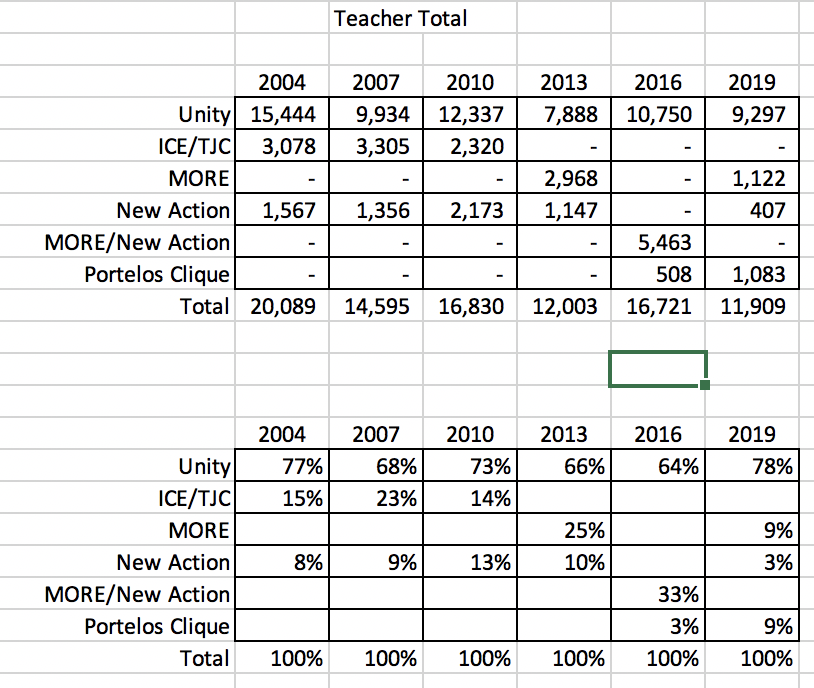
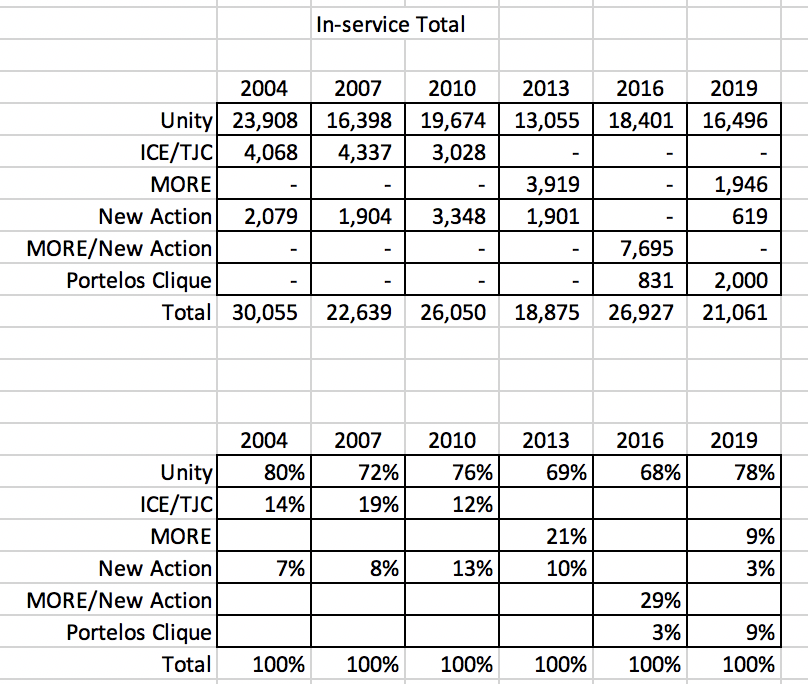
I’ve delayed reporting the retiree numbers, because I have problems with the historic numbers. Retiree votes are constitutionally capped. The cap used to be 18,000. Now it’s more. My variety of sources include:
- Capped numbers (official and unofficial)
- Raw numbers (official and unofficial)
- Back-calculated numbers
The totals I am reporting are inconsistently calculated. I don’t know if there’s any sense using them to compare year to year, except as percentages between caucuses. If anyone can help me puzzle this out, I would work with you.
Anyway, imperfect as they are, here are my numbers.

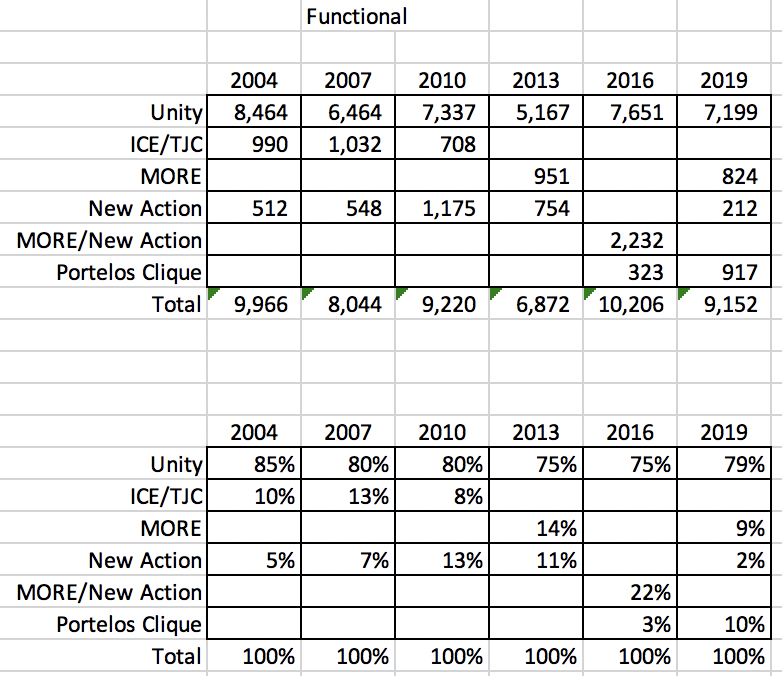
UFT Elections – Functionals
“Functional” as a division requires some explanation. I’ll get some of it right, but I find it complicated. Functional Chapters are organized across schools, by members’ function – or job. Guidance Counselors, Paraprofessionals, Secretaries, Speech Therapists, Occupational Therapists, Nurses, etc.
Are non-DoE chapters “functional chapters”? I don’t know. I do know that when I say “our contract” I am excluding functional chapters – there are separate contracts for other titles.
In any case, since “functional” actually covers a range of titles and locations, lumped together, the votes there are more of a composite, giving guesswork a larger role in analysis.
These numbers look different from the teacher divisions. The total number of votes has not consistently declined. Unity’s totals have not consistently declined. There’s a significant unexplained blip from 2007 to 2010 in raw opposition vote.
UFT Elections – Middle Schools and Elementary Schools
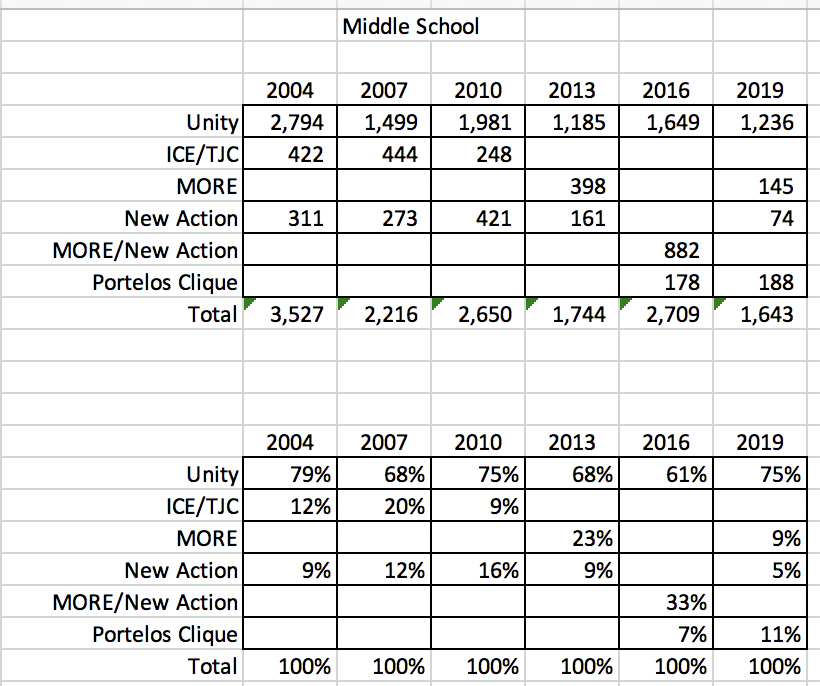
New Action for over a decade won the High School Division in UFT elections. Since 2000 that has changed, with ICE/TJC winning once, New Action winning in coalition with Unity, then in coalition with MORE, and this election Unity winning the seats outright (though running with two independents).
No other division has been in play – except for the Middle Schools. New Action won them once, long ago. But after the last election some thought it might be possible to put the Middle Schools into play.
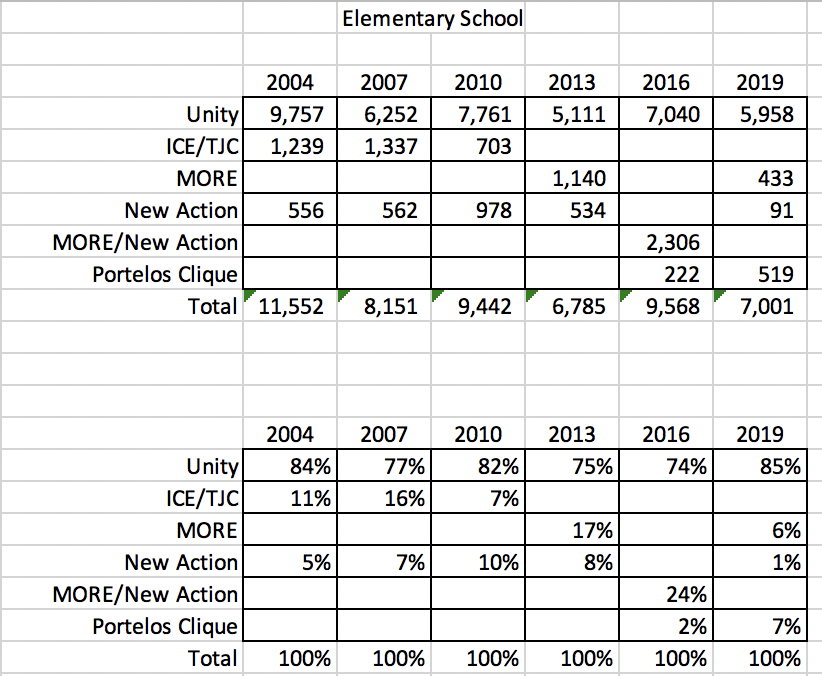
Elementary schools have been a Unity stronghold. No one expected anything different this time.
I don’t have actual results, but backed into the numbers by looking at minimum vote by caucus by division in Exec Board At Large voting, In other words, I am confident that the following numbers are at least partially wrong, but definitely close. With that caveat, the results in these two divisions:
UFT Elections – Totals
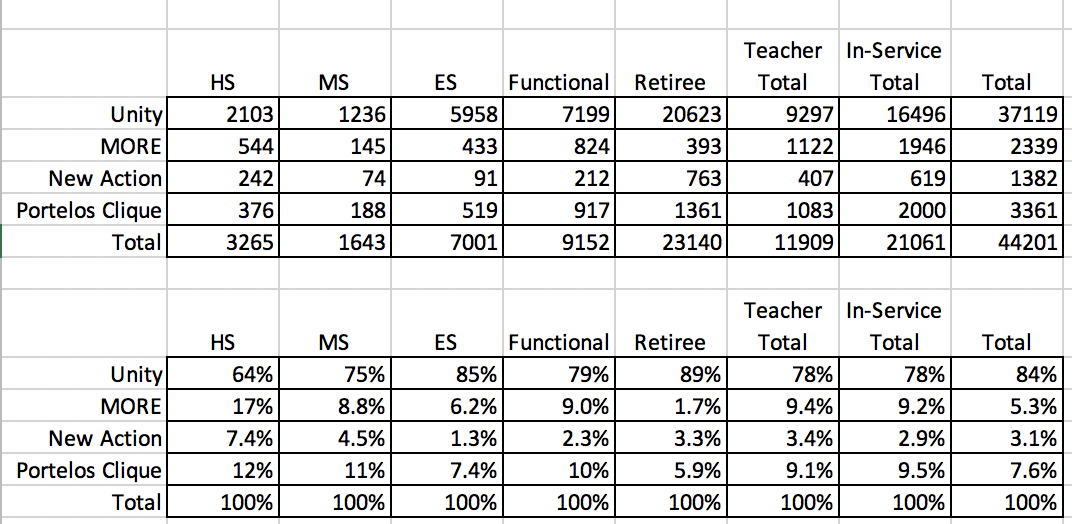
It was a bad election for the UFT. Vote totals were down across the board. My caucus, New Action, did particularly poorly
Unity did sweep the seats. But the group that has a monopoly on power has a growing inability to turn out votes, even after turning a popular chapter leader of a huge school, and a prominent Bernie Sanders supporter, with following.
Anyway, here’s the numbers for this time (back-estimated based on minimum vote on Exec Board At-Large, by Division by Slate) and the numbers for the previous five elections.
I’m holding historic retiree numbers until I have a better way of handling the weighting/non-weighting/change in weighting.
UFT Elections – High Schools
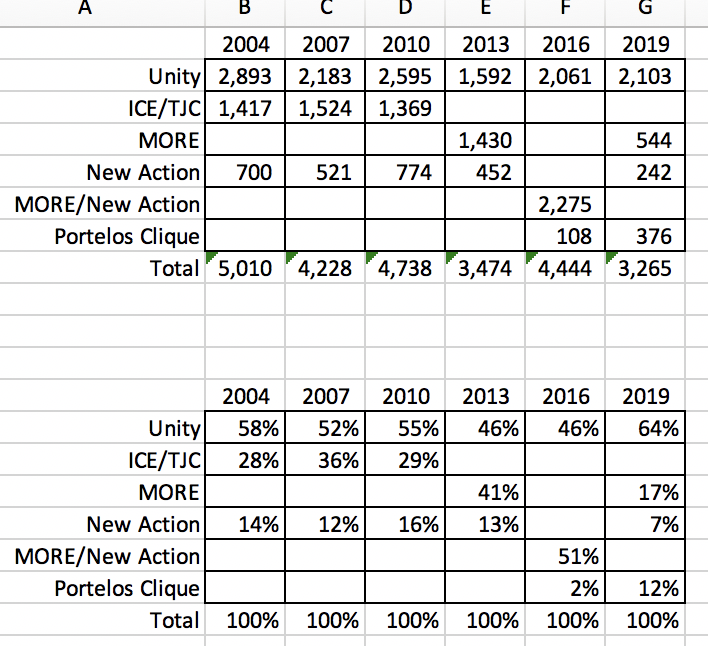
It was a bad election for my caucus, New Action. And in the high schools, it was a bad election for the UFT. Vote totals were down across the board.
Unity can claim a victory – they took an absolute majority of the high school votes for the first time since I’ve been a teacher… but with their second lowest vote total in years, perhaps ever.
I’ve seen speculation about who came in second overall. These results make me think Unity came in second – and those with an interest in promoting distance between the members and the union – our enemies – came in first.
And who’s next? High schools are the only (for now) winnable division, and no one was remotely close.
Anyways, here’s the numbers (I used the minimum candidate vote in the division for each slate as the slate vote. I could be off by a dozen or so)
Accountability
Should every school district be measured with the same ruler? Should they be measured at all? Should the measuring be done by state governments and the US government, none of which (except, I guess, the DoD) actually teach kids?
Monticello, in Sullivan County, has a small school district. Bronxville, in Westchester, has a similarly-sized district. But the circumstances of those living in those districts is dissimilar. Education, which in the abstract might equalize, instead is used to threaten one district, while leaving the other alone. (median family income in Bronxville is almost 10 times greater than in Monticello. The Black and Hispanic population makes up over 40% of Monticello, and about 4% of Bronxville.)
Is each district doing a good job educating its children, given its resources and situation? What is the state doing to improve resources in Monticello? That’s a question that deserves a QUALITATIVE answer, followed by a challenge to Cuomo. You know what those questions don’t do? They don’t threaten the people who are educating kids, especially those doing so under difficult circumstances.
In the late 90’s, under the cover of developing state “accountability” systems, the Bronx superintendent moved struggling kids into schools he, Gates, and other conspirators had slated for closure. Graduation numbers, test scores, measures of safety – all plummeted, and THOSE SCHOOLS were held accountable for decisions made by THE SUPERINTENDENT. The schools have been closed; the superintendent continued to work as a consultant.
Fifteen years ago the Department of Education started sending our vocational high schools students who were not interested in the careers those schools prepared young people for. The vocational schools were held accountable – and were broken up or shut down – often replaced by schools with no CTE status.
Today the Office of Student Enrollment sends some high schools too many students, or too few, or students without interest in the school’s “special programs.” Who is held accountable? The schools.
We need a real discussion of special education in high schools, where many schools are too small to realistically provide a full range of services, but OSEPO sends them kids who need a wide range of services, and the DoE staff advise them to alter IEPs to match what services they have available. The petty bureaucrats who are cheating the kids, I pity and abhor them – they are trying to cope with an impossible situation. Hang them all, and what would that accomplish? The accountability system still nails the school, the schools large enough to provide the full range of services still don’t get put back together, and those in charge still walk scot free. More on this another day.
At a minimum, those who supervise a group of schools should be held responsible (I refuse to say “accountable”, see above) for their schools. Schools should not be held “accountable” for intentional mismanagement or plain incompetence of their office-based supervisors. We need a way to ask the question “Is this school doing a good job, in its specific circumstances, with its specific resources, and with its actual population?” that does not generate “accountability reports.”
We need real educators in charge. We need to remove the data people and their punitive tests from our system. Asking, “Is this school doing a good job?” should not carry an implicit threat.
Time to resume blogging
I used to blog a lot.
In 2009 the Department of Education subpoenaed me to testify in a special complaint. When I finally appeared in 2010, the union gave me a strong warning that my blogging might not be protected by the First Amendment.
I thought I ignored the warning, but I became cautious. Too cautious. I wrote less and less. And got used to not writing.
It’s time to get back to business.
jd
My best photo – Part 1 of 4
My mom came home 3 weeks ago – and so did this photo:

In the course of 54 weeks in hospitals, a nursing home, and an assisted living facility there were various family photos with her at different times. But this one never left her side.
– – — — —– ——– ————- ——– —– — — – –
My mom was, among other things, a rank and file activist.
She worked in a non-union hospital, helped form an organizing committee, met for years, and finally got the union to come in and try to organize (that one didn’t end so well. After getting fired for organizing activity, she won her NLRB case, but lost, on appeal, an unfortunately common outcome).
She worked at Yale, clerical, when clericals and technicals organized. She was an active part of that drive. And they won.
And she came to Harvard after the clerical union was recognized, but before the first contract. Harvard administration was trying to sell the load of bull that a contract would make things worse for the workers. My mom spoke to one department after another, explaining how having the contract had made a difference at Yale. A lot of people worked hard on that vote, and they won. My mom stayed a rank and file activist for the rest of her career, playing a leading role in solidarity campaigns with other unions.
It makes sense that she chose to keep this photo with her during her recovery. It’s a photo of me, speaking about solidarity, at a United Federation of Teachers Delegate Assembly a decade ago.
345 – 328
I beat my mother in Scrabble last night. Game was okay. She took an early lead (opened with JIBES for 46), but a few turns in I played UNAWARES for 61, and a little later FRAT for 34 put me in the lead for good.
When I visit my mom, we play. A quick stop is a game or two. A long weekend could be 4, 5, 7. I win more than I lose, but they are good games.
But we have not played. Not since my visit last September, over a year ago, my last visit before surgery. The surgery went well, but it was followed by a stroke.
Sometime last November I noticed a statin on her meds list. I spoke with the doctor – years ago she took herself off statins. She claimed they made her thinking fuzzy. I told the doctor about Scrabble. I am good for 3 out of 5 or even 3 out of 4 when I’m on a roll. But while she was on statins, I won better than 9 out of 10. And she played super-slowly and made mistakes. He removed them.
In December we were talking about recovery. I had questions about mobility, about memory, about the ability to socialize. And about Scrabble. He was hopeful that she will play scrabble with me, but may not be able to compete. We will see evolution over the next 12-18 months.
But over the next few months, it was not at all clear that the doctor’s assessment would be correct. I cursed that conversation and its false hope.
But turns out, it wasn’t false. I’m sure I’ll win more than I lose. And the margins may be more than 17 points. But I’m thankful we have our Scrabble back.

Experimental Sweetened Yams
I don’t publish recipes because:
- I don’t cook much and
- I don’t use recipes
I mean, I have a sense of what foods / herbs / spices / flavors / textures might work together. It’s not nearly as tricky as picking a good math problem, or as incomprehensible as knowing whether or not clothes match.
Anyway, I don’t do sweetened yams, but Wednesday I planned a root vegetable mash that went sideways. So here goes:
Yams – 4 huge ones.
Carrots – or Other Things that go with yams. I chose carrots. Big old loose ones. 3 or 4 of them. Probably the equivalent of a full cello package. Is that a pound? I think parsnips (justalittle) might have worked, but not sure about the sharpness. Celery root would have been a waste. Squash would have been good. But too much work. Pumpkin would have been perfect.* Might have skipped the yams altogether. But Garden Gourmet’s not selling pumpkins this year. Bastards. So yams it is. Yams they are?
Sweeteners.
Bosc pears. Very ripe. Big ones. 4 of them.
Apples. I think these were Cortlandts. Big.
Honey. That was last minute. I was going to grab maple syrup, but the bottle was old and looked icky. And I have the bottom of a jar of honey that I got gifted a year ago (I use it slowly) by the Actual Beekeeper.
Some milk.
Spices? I was going to skip them. But when the maple syrup didn’t look like a good idea, vanilla.
I guess you could do “pumpkin spices” – cloves, allspice, cinnamon, nutmeg.
Boil the yams for a while, until they are almost soft. Then throw in the carrots for a few minutes to soften them, but not as much. Pull out carrots and yams. Peel the yams. Throw them in the pot. Slice the carrots into slices or chunks (depending on diameter). In the pot.
Core the apples, and peel them. Slice them. Peel (carefully here) the pears, then cut out the bottom little pyramid with the core/seeds. In the pot.
Stir up the stuff in the pot. This was work. let them yams mush as you go. Keep mixing, mushing. Pour in some milk. Pour in some vanilla, if you are going that route. Keep mushing/mixing. I wasn’t sure about sweetness, so I grabbed a super ripe banana and mushed that in, too. Mush mush mush.
I put it in the oven. 350 seemed too high for this one. I tried 320.
After half an hour I looked. It had started to have a nice smell. I pulled it out. Tasted. Mushed mixed a little. The carrots were the firmest thing in there, plus some of the apples. But the apples would cook down. A carrot in yam matrix tasted good, and some of the fruit sweet was in the bite, but not much. I tried another spoon from a different corner of the pot. Same verdict. That’s when I went for the honey and vanilla. I poured a little vanilla. But the honey was my only measured quantity
2 tablespoons of honey
I know that because I poured in one tablespoon. Then I looked, and decided to add another.
Mix mix mush mush. Back in the oven. Maybe another hour. Or a little more.
It was good. The carrots (less sweet) were “floating” in a yam matrix with unidentifiable fruit flavors (apple/pear/banana) and while there was sweetness, it was dinner sweetness, less sweet than the cranberry sauce (but no acid), and far less sweet than the abominable yams with marshmallows on top that my sister asked for (what, no marshmallows?) before declaring mine perfectly good.
*Pumpkin is a good ingredient because the fresh stuff does not show up year round, and it has an interesting texture, and because, if you buy a small to medium sized one it’s pretty easy to get the guts ready for cooking. Take a small-medium pumpkin. It should fit on a plate. Saw it in half along the equator. Yank/scrape out the seeds. Fill the plate with water. put the pumpkin face down in the water. Microwave on high. 5 minutes. Probably not enough. Take it out of the microwave. Is the flesh ready to fall out? Nope? Try another 5 minutes. You might need a third 5 minutes, but that’s the longest it’s ever taken me. And then you can just cook with it.
Does Trump’s Rhetoric make the Atmosphere Toxic?
I apologize in advance for asking such an obvious question; my union’s leaders seem to be getting it wrong.
Last Monday, the day before the midterms, they introduced a “Resolution to Unite with Organizations against the Toxic Political Atmosphere.” at the United Federation of Teachers Executive Board. (I’ve pasted it at the bottom of this post.)
Good and fine, except what they left out – nothing about the hate-mongering coming from the White House. You might think, “minor omission” – except they have a history. They have a history of being afraid of naming Trump.
Right after 2016 election (see the parallel?) they amended a resolution. See if you can guess where Trump’s name had been removed:
WHEREAS, the presidential election targeted communities on the basis of race, ethnicity, sexual orientation, gender identity and religion, and displayed abusive behavior toward women, has threatened the nation’s promise that all people are worthy of respect; and
WHEREAS, the presidential election has outlined an education agenda overtly hostile to public schools and teachers, promising to prioritize vouchers and charter schools at the expense of public schools ; and
They are afraid of naming Trump? Maybe not. Maybe November 2016 they were in a strange panic (many people were). So I raise my hand, and offered to insert the phrase “the provocative rhetoric of President Trump.” We all agree, vote, and go home, right? Not so fast.
The UFT leadership would ultimately vote, in unison, against naming Trump. But they needed to speak against. Normally one of them would rise to explain why they thought this language was a bad idea. But this time? No. They cued a speaker, not an officer, to go up. I was stunned by his words, and did not take notes. But someone did.
“Not the first time these things have happened” – 11 people killed in a synagogue in the United States? Yes, yes it is the first time.
“We don’t want to give him attention” – WTF? He’s got all the attention. He needs to stand accused of fomenting these attacks.
“Happened before and after Trump” – racist hate crimes are on the rise. Willfully ignoring this is offensive.
“People have spread this talk before” – but not from the White House? That makes a difference. A big difference.
And then they voted, and every officer, members of Unity Caucus all, voted not to mention Trump’s hateful rhetoric. This was a party-line vote, even if one or two broke ranks, and a few more party members remained silent in deep embarrassment
Trump’s incendiary attacks on rivals have created fertile ground for those inclined toward extremism. Why are United Federation of Teachers’ leaders afraid of stating this obvious truth? And they needed to use an intermediary? Why are they afraid of speaking themselves about Trump?
Resolution to Unite with Organizations against the Toxic Political Atmosphere
WHEREAS, three acts of hate-filled violence erupted in the United States in October 2018; and
WHEREAS, mail bombs were sent to more than a dozen public figures critical of President Trump; and
WHEREAS, a man with a history of violence murdered two African-Americans at a Kentucky supermarket following a failed attempt to forcibly enter a black church; and
WHEREAS, a man shouting anti-Semitic slurs killed 11 people in a Pittsburgh synagogue; therefore, be it
RESOLVED, the UFT stands with organizations from across the political, religious and social spectrum – from the AFT, the American Civil Liberties Union, the Southern Baptist Convention and the Archdiocese of New York, to the Council on American-Islamic Relations, the Southern Poverty Law Center and Black Lives Matter – in repudiating the rhetoric of hate. The UFT stands with organizations speaking against the toxic political atmosphere that helped give rise to these abhorrent acts. We extend our deepest sympathy to the families who suffered catastrophic loss in these dire events.
Occupational Therapists/Physical Therapists Reject Contract
I have not been actively following the “No” side of the contract ratification vote – I thought this one was worth a yes.
But there are over a dozen actual contracts – I often focus solely on the teachers’ contract – but there are contracts for counselors, paraprofessionals, secretaries, and a bunch more.
Voting down a contract is pretty serious business, especially when the therapists knew that the other units were likely to vote Yes.
It is our obligation, all of us, to stand in solidarity with the OTs and PTs. They will need our support.
It is our obligation to understand the issues that led to such a different result than the other units (teachers voted yes over 80% – lower than I anticipated, but still a large margin. All of the units taken together voted Yes by 87%).
Essentially, OTs and PTs are not paid in line with school workers with comparable professional training. By a lot. They are massively underpaid. And at negotiations de Blasio’s people essentially said “we don’t care; we won’t negotiate a correction to this inequity.” The DoE’s position is utterly unacceptable. The OTs and PTs perform critical work in our schools, often under horrible conditions, often without adequate space. They need to be treated fairly.
We must find a way to engage all of the UFT, including those who just approved a contract for their unit, in solidarity with the OTs and PTs so that they can get a swift and fair settlement.
What for All?
There is an initiative called “AP for All” – it’s packaged as a “leveling the playing field” program. But there’s some issues.
Not every student is ready for an AP-level course. Or perhaps a student is ready, but not for the interesting selection of 2, or 3, or 4 courses offered in their school. Especially in the proliferation of mini-schools in Black and Brown neighborhoods in New York City, required AP with minimal selection can be a problem.
And then there’s the AP itself. Advanced Placement. A course that one day was billed as “college level” – but today is linked to a test. A test owned by The College Board, a kingpin in the US testing industry. The College Board distorts education, forces “teaching to the test,” lives and dies on manipulating students to take one, two, three, many high-stakes, high-cost tests, while picking up none of the cost for the educational and psychological damage they are doing. AP for All? Meh. I’d rather support someone other than a corporate vulture.
I’d rather support, say, math teachers.
What about “Four Years of Math for All Who Want It”? In too many city high schools, kids run out of math. By, say, passing trig. There’s nothing else. What about requiring schools to offer four years to everyone? I don’t care if the “extra” course is calculus, statistics, solid geometry, personal finance, business math, or number theory. No one should “run out of math” in a city high school. (I was thinking about this while listening to a podcast called “Miseducation” put together by NYC high school students. Some of the voices they interview ran out of math, even though they wanted to take more.)
Four Years of Math for All Who Want It would be a better program. It would benefit all kids. And instead of lining the College Board’s silk pockets, we’d be helping a group that’s actually deserving.
Tentative Contract Agreement: Vote Yes, But Keep Talking…
The Tentative Contract Agreement (TCA) has some very important gains. This is a contract we need to vote yes on. And it deals with some issues, but incompletely. And it does not deal with some important issues. There are provisions that we should not care about. And it introduces a major problem. The way it was negotiated is an improvement on previous contracts, but there is still a long way to go.
Note: I am a co-ordinator of the New Action Caucus / UFT – but I am writing here for myself, not my caucus.
First, the very good.
Due process for paras. Before this contract, paraprofessionals could be suspended without pay based on a single allegation. This contract establishes elements of due process for paraprofessionals (pp 10 – 12 of the memorandum of agreement (moa)).
Easy grievances to file. The TCA creates categories of complaints that can be brought to consultation, and if not resolved within five days, go to the district level. This creates five new classes of complaints (along with paperwork) that are functionally grievances, but do not require members to file an individual grievance. The categories are: Paperwork, Workspace, Workload, Basic Instructional Supplies, Professional Development, and Curriculum. (pp 4 – 6 moa)
More Arbitration Days. We get for our purposes more arbitration days by agreeing to use existing days better. 1. Class size grievances will be heard earlier, and resolved more quickly. In practical terms, arbitrators will handle 6 in a day (instead of 1). (moa pp 12 – 16). 2. Salary, LODI, and religious observance arbitrations will be scheduled 5 per day, instead of one per day. (moa p55) The Grievance Department estimates that we will get an additional 140 days that we can use to arbitrate matters that are critical to us.
Process for forcing the DoE to move on stalled arbitrations. Needs no explanation. (moa pp 53-54)
Next, the Incomplete:
Two observations: For most teachers (with an HE, or two consecutive Es) only two observations per year. (16 – 18). Our ability to challenge bad observations is blocked by the state law (which Mulgrew boasts he helped write). And students’ test scores still factor into our observations. We still have a long way to go
No Harassment. Language prohibiting retaliation, with a process that leads to arbitration. Hey, enforcing it will not be easy – but this is the first time we will have such language:
“The Board (“Department” or “DOE”) shall maintain an environment that promotes an open and respectful exchange of ideas and is free of harassment, intimidation, retaliation and discrimination. All employees are permitted to promptly raise any concerns about any situation that may violate the collective bargaining agreement, rule/law/regulation, or Department policy or that relates to their professional responsibilities or the best interests of their students. The harassment, intimidation, retaliation and discrimination of any kind because an employee in good faith raises a concern or reports a violation or suspected violation of any DOE policy, rule/law or regulation, or contractual provision or participates or cooperates with an investigation of such concerns is prohibited.” (p 19).
This does not come close to solving the problem of the abusive administrator, but it is a step in the right direction. We’ve got all these new arbitration days – we have to press Unity to use them to push back on abusive administrators.
ATRs – Placed in vacancies Day 1 (instead of several weeks in.) Salaries won’t count against the school. Mulgrew says we need to keep the pool under 500. I think that’s 500 too many, but these provisions are small positive steps. (38 – 40)
Next, Missed Issues
Abusive Administrator. This is touched on through the anti-harassment language, and implicitly by the increased number of arbitration days. But we need to keep pressing the union to respond to members in schools with abusive admins.
Class Size. Expedited procedures are one thing, but reducing class sizes should be the goal. We need to end the false dichotomy between raises and reducing class size. We need a campaign not based on contract, but on the common good, for reducing class sizes. We should target lower grades, and we should target higher needs districts.
I don’t care deeply about:
There’s a pilot for remote learning. Two classrooms in the Bronx will be videoconferenced with a third, so that AP Physics can be taught in three schools. There will be a pedagogue in each room, and class size is fixed below the normal level. And the experiment will probably fail and not be renewed. (33)
The Bronx Plan, which is for schools in other boroughs, too. This replaces the “renewal” program with one that requires UFT/principal cooperation before a school can join. There is shared decision making, and there may be extra money for some titles. (24 – 32)
Prose Plus is for existing Prose schools. They get to take an annual vote of no confidence in their principal. (32-33)
A+ credits will likely be Teacher Center credits for people trying to get their 30 above. At least 18, for new employees, will need to be these A+ credits. I don’t love the TC making money off our members, but it will be easier to get the 30 above. (19 – 22)
There will be join professional development (teachers + administrators) on how the observations should go. Unity seemed excited about this. For most of us, it’s another PD we don’t want or need. (18)
Chapter Leaders now get incident reports and the safety plan. I thought we already got that. (6-9)
The 13% appealable ratings now include people covered by the S/U system. (18)
There are now more “teacher leadership roles” – I don’t think many will get filled. (22 – 24)
Problems
The pattern was set by DC37, and the money is not great (2%, 2.5%, 3% over 3½ years). This is sub-inflationary – not by a lot, but it doesn’t keep up. For lower paid titles there was across the board money as well, so that some of them do keep up with inflation.
But the pattern is discussed in the Municipal Labor Coalition before the first union negotiates. The membership should have been involved in the discussion, BEFORE DC37’s contract. Agreements at the MLC that bind us later on, during negotiations, should be brought to the UFT membership first.
Health includes unspecified savings totaling $1Billion over 3 years for all the municipal unions. (not sure what the UFT’s share is) (p3, moa). Again, this was bargained at the MLC, with UFT participation. It should have come to our members. One specific provision we know of is that the right to choose your own health plan will not start until your second year of employment (everyone will get HIP during their first year). We must guard against future incursions on our health care, and block proposals that push the second tier further.
The issue of Unity making deals with the City and the other unions, and presenting them to us done deals (and not taking responsibility) is very serious. We must work to expose this to the membership, and attempt to end this anti-democratic practice.
The Negotiating Committee actually did some of the negotiating this time – that’s a step ahead, although it falls far short of having meaningful engagement at the chapters. A sub-group of regular members did sit across the table from the DoE negotiators – but the real bargaining remained behind closed doors. The contract survey was better written, and Unity acceded to at least one member concern: Unity Bigwigs (including Amy Arundell) had wanted as many observations as possible – but the members wanted the numbers cut. And we did get the number of observations reduced.
People like the idea of an early contract. But if it is early, there should be no rush. The deal was done on Thursday, and delegates were summoned on Friday to a DA, without the MOA being published. The MOA was e-mailed during the meeting, where Mulgrew summarized the TCA. Delegates were asked to vote on a document they could not have possibly read. Unity distrusts the delegates, and some of the delegates, many of whom were at their first DA, felt it, and may have distrusted Mulgrew right back. The No vote at the DA was double on Friday what it would have been on Wednesday, had they given people time to read through the agreement and talk with their chapters first.
Conclusion
This tentative contract has good new provisions, especially due process for paras, reduced observations, and some repairs to our grievance machinery. It also has disappointing salaries, and a dangerous change in our health care. There are issues (class size, abusive administrators) that we need to continue to deal with outside of the contract. And we must challenge Unity’s practice of making deals at the MLC without membership oversight.
Overall, the good far outweighs these reservations. We should urge a yes vote.
A Quick Fraction Puzzle
This problem is not original, but pushing the solution in this way is fun. Watch, or play along. See if you can figure out what a nice ending might be.
Find a number that is 1 more than its reciprocal
Make sure the audience knows what a reciprocal is: It’s what you multiply a number by to get 1 as the product, or colloquially, the “flip” of a number. For example the reciprocal of 9 is 


I usually allow kids to explore in any direction, but for today’s purposes I don’t want that to happen. I’m going to control the investigation.
Get the kids to make some naïve guesses: 1 is too small since the reciprocal of 1 is 1. 2 is too big since the reciprocal of 2 is 

So let’s start more serious guessing. 


If you comment, mention the age of the children you imagine working with. I’ve been speaking with a few teachers, and we are trying versions of this with 10 year olds, 17 year olds, and everything in between….
I haven’t posted a mathematics puzzle or problem (for kids or adults) in quite some time. I hope there’s someone out there who still likes this.
Remind me: Who did the UFT not Endorse?
The United Federation of Teachers (UFT) did not endorse Andrew Cuomo. For all his progressive rhetoric, and despite some progressive (or progressive-sounding) legislation, union members know that there was much more that could be done, that he’s responsible for blocking much progress, and that if it suits his needs, he can turn on us, and viciously. He is a self-serving, principle-free politician, and we do not trust him, most of us do not like him, to the point that our leaders did not endorse him. Good. Here’s the list. No Cuomo.
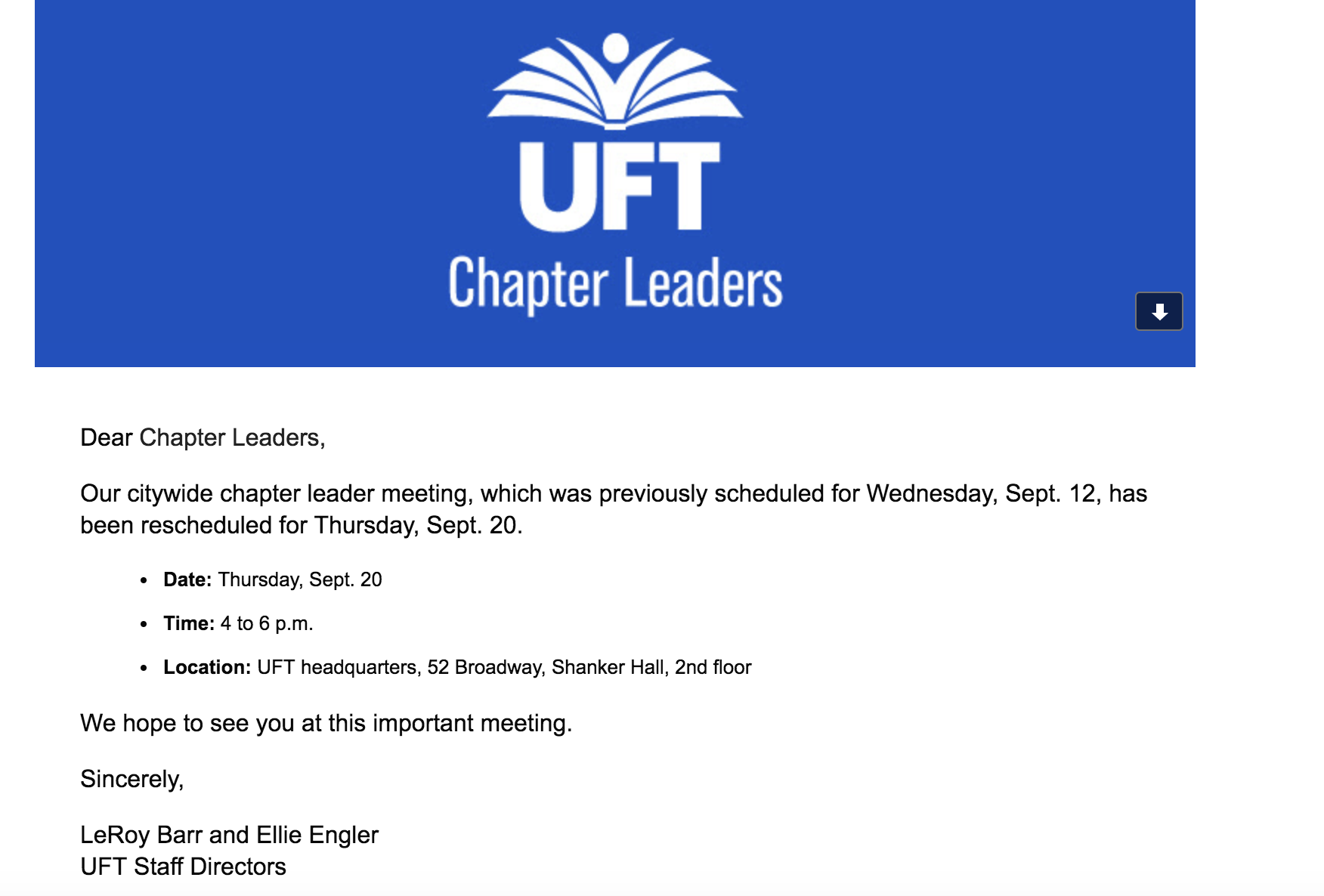
Today we had scheduled a Citywide Chapter Leader meeting. This is a big deal. We do it once a year. Some of us write it, in ink, in our calendars.
Seven days ago we got notice: postponed.
Has this happened before? Not in my 17 years as chapter leader.
Explanation: none. (See below).
What do these things have to do with each other? Maybe nothing. But yesterday we got summoned to a rally “to support Letitia James” (James is running for Attorney General, with NYSUT – that’s the UFT’s statewide federation – endorsement).
Is it a rally for Tish? Nope. It’s a “Get Out the Vote” for Cuomo, Hochul, and James. Mulgrew wants us to show up at a Cuomo rally because we like #3 on the list?
Date: 9-12-18
Event: Bronx GOTV Rally for Cuomo, Hochul, Tish
Time: 6:00 p.m.
Location: Xxxx Xxxxx Xxxxx, Brooklyn xxxxx
So much for not endorsing Cuomo.
Welcome to Another Year
New York City Public Schools open tomorrow (except some PROSE, and I said public, not charter, no idea when they open) – anyway, our schools open tomorrow for teachers, with kids on Wednesday.
Welcome back.
This is our first school opening post-Janus. Will it make a difference? I hope not in a negative way, although we are sure to lose at least a few members. On the other hand, perhaps we will find the Unity leadership more responsive?
Where should we look for responsiveness? That’s easy: how much will Unity stand up for members in schools with out of control administrators? They’ve got to do better.
We don’t have a new contract yet, but I expect to have one at some point this year. I don’t expect great changes.
But welcome back. Forget that other stuff, just for a moment. You are educating kids – that’s a great and valuable thing you do, and no matter what the year brings, remember that – your work is important. It matters.
Specialized High Schools – some comments should not matter
At the time of the proposal of the thirteenth amendment abolishing slavery*, the former senators from the southern states were not consulted. And that was correct.
Today, as people with differing opinions discuss future admissions policies for the Specialized High Schools, those “reprentatives” of the schools who have been heretofore silent on segregation should likewise not be consulted.
The current admissions system is based on a single test, on one day. That’s the way it’s been, for a long, long time. But in 1970 or 1971, someone decided to study the admissions policy for the schools (at that time the Bronx High School of Science, Brooklyn Technical High School, and Stuyvesant High School). The New York State legislature responded by passing the Hecht-Calandra Act, enshrining the existing test in law, and limiting an already limited alternate route (Discovery).
The Hecht Calandra Act was passed to stop a study, to preclude discussion.
And today we have de Blasio’s proposal to radically change the admissions process. Now, lots of people want to talk about THAT.
There are people with a direct personal interest in the school: faculty, administration, current students and parents, aspiring students and families.
For the past fifteen years, and more so in the past five-ten, the numbers of Black and Hispanic students at these schools (now eight schools: the three named in the law and five newer schools) has plummeted. In some of these schools, there are faculty and administrators who worked to reverse or slow this process of segregation. But most did nothing.
We have people who no longer have a personal stake in the school, who are advocating that the law be respected. These alumni are not stakeholders. They are advocating that we bow down to a law passed to prevent discussion. They have forfeited their right to be heard. We are correct to ignore them. (Even if in the 13th hour they are advocating systemic change – while insisting the law is unchallengeable.)
I have one guy, always silent on the issue, who now twists every conversation about specialized high schools to advocate that the mayor drop the five new schools, and respect the law by leaving the original three (including his alma mater) alone. I ignore him. Good people should too.
Some specialized high school administrators have been silent in the face of this obvious accelerating segregation. Their right to be heard should be contingent on their not defending the “SHSAT-must-never-be-examined” Hecht-Calandra Act.
That still leaves many of us. Their are current students and parents – both for and against the changes the mayor proposed. They should be heard. There are communities where young students have been preparing for the test. There are alumni who HAVE been speaking about the horrible segregation and have been working for change. They all have a right – perhaps even an obligation – to engage in the conversation.
And there are faculty members who have been trying to address this issue. I served on a UFT task force with several of them, from all eight schools. And there are school communities, including administrators, who have been looking to modify admissions. In my school, the entire faculty and principal agreed to a bold proposal that we presented to the DoE a couple of years ago, only to have the DoE and their lawyers shoot us down. The principal and I were in the process of renewing our proposal (since we have a new chancellor) when de Blasio’s plan was announced.
But for those who ignored a law that told people that they couldn’t even talk about specialized high school admissions, for those who ignored obvious and deep segregation, and especially for those who are no longer connected to these schools – why should your opinion matter?
Speed
Sometimes I write my own math problems:
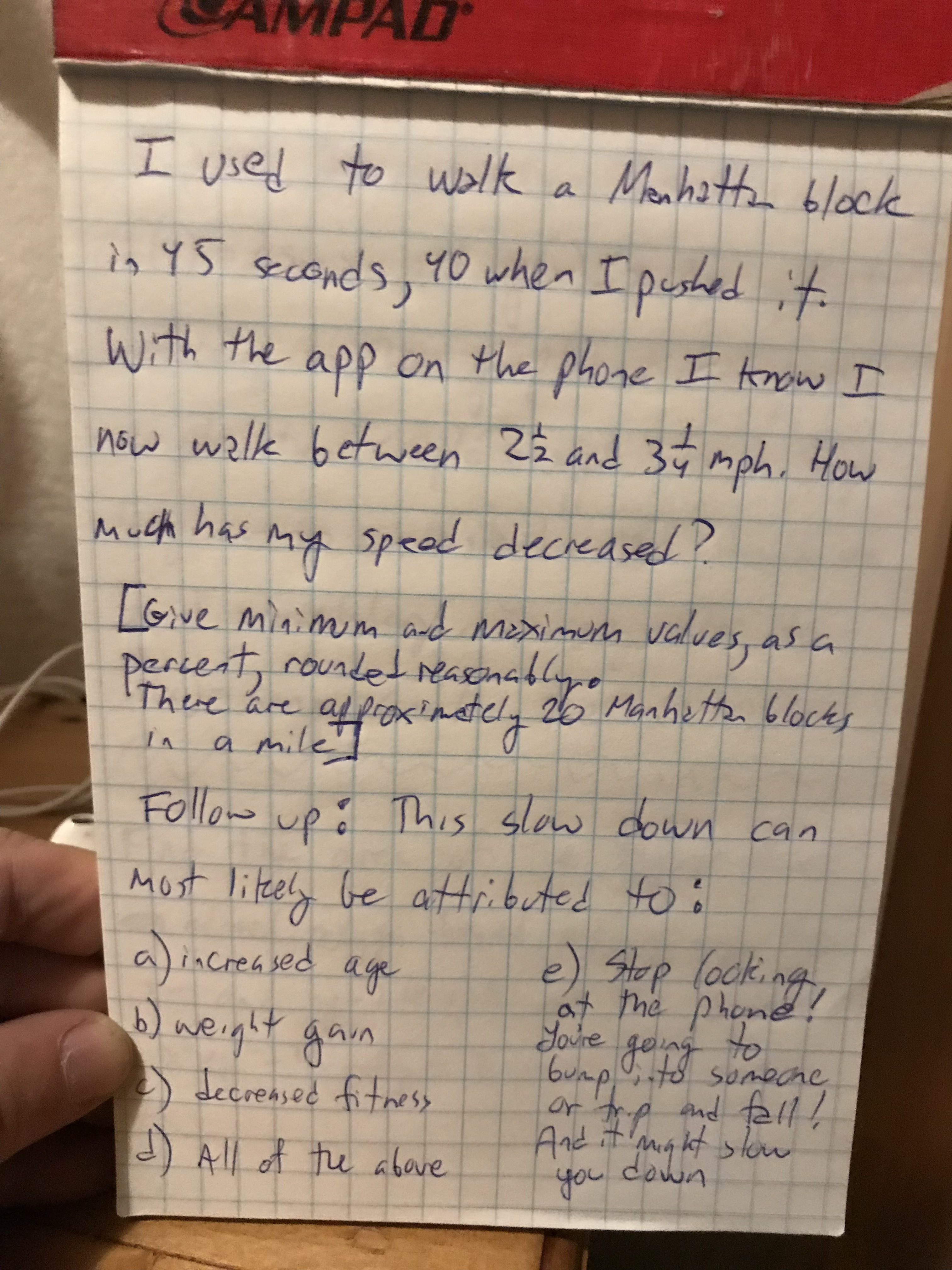
But I think this is the first time I over a decade that I’ve written a multiple choice question.
Specialized High Schools – I support public schools
As I start rambling on about specialized high schools, I need a starting point. And here it is: I am a strong supporter of public education. I support equity. I am anti-racist. I have a sense of fairness that is always on. But none of this is simple.
Public education in the United States – well, it doesn’t begin at the beginning. I mean publicly funded, publicly run, secular, unsegregated schools, roughly K-12 (though I’m not sure how we got to exactly those 13 years), with compulsory attendance. I don’t think we’ve ever had exactly that in this country. There’s not some “golden age” we can point to… we think of the one-room schoolhouse, but that was protestant, not secular. And, AFAIK, the New England schoolhouse was spread to the midwest and then partially imposed on the south in the early, mid, and then late 19th century, unevenly and incompletely. (There’s a book called “Pillars of the Republic” by a guy named Kaestle that does a good job on this). There were also little private tutoring schools (“Dame Schools”?) going back to the 18th century. And then with the rise of the big cities, charity schools, which give rise to our large urban schools. And these are sort of merged into an almost universal system. But golden age? With segregation? With the vestiges of their religious origins?
And then there’s been a parallel system of religious (used to be mostly Catholic, but there’s quite a range now) and private (or “independent”) schools. So this has never been universal. And over the last two decades there has been the growth of the privately run “charter” schools.
All of this is to say that my support of “public education” is of an ideal, not of the way schooling takes place in the US today, certainly not in NYC today, and there’s not some golden model I can point to at some date in the past.
I think I’ll talk about equity and equality next.
New York City’s Specialized High Schools and Admissions
New York City’s Specialized high schools are in the news; Chancellor Carranza, Mayor de Blasio, and State Assemblyman Barron have proposed changing how students gain admission to these schools. That proposal is stalled until January, which gives us time to discuss and reflect.
Most students who get placement in these schools do so by scoring high on the Specialized High School Admissions Test (SHSAT). In recent years the number of Black and Hispanic students admitted has dwindled . The “diversity” issue has generated occasional arguments and proposals over the last few years. But this proposal comes from the Mayor, and has been headline news…
There are eight schools that would be affected. I teach at one of them. In fact, 16 years ago, I was the founding math teacher at one of them. And the chapter leader for these 16 years…
I certainly have some thoughts on specialized high schools and admissions. And over the next few days I will be sharing them.
A maximizing area question
I gave this question to students as a challenge at the end of a trig unit.
A quadrilateral has perimeter = 60 and a 30º angle. What is the maximum possible area?
I think this is cute. The kids had to make some assumptions, test them, and use trigonometry along the way. It’s not “open-ended” but it does involve some investigation, and it is not just a direct application of what I’ve taught them.
What’s your answer?
Do you like the question?
And do you know why “What is the minimum possible area?” is not a good question?

 JD2718