Running for UFT High School VP – how I got started
I am running for United Federation of Teachers High School Vice President, with the United for Change coalition.
Who am I?
Jonathan Halabi. I teach mathematics at the High School of American Studies at Lehman College. I am a twenty-five year high school mathematics teacher. I am a twenty-year UFT chapter leader. I’ll tell more, but let me start by going back.
– – — — —– ——– ————- ——————— ————- ——– —– — — – –
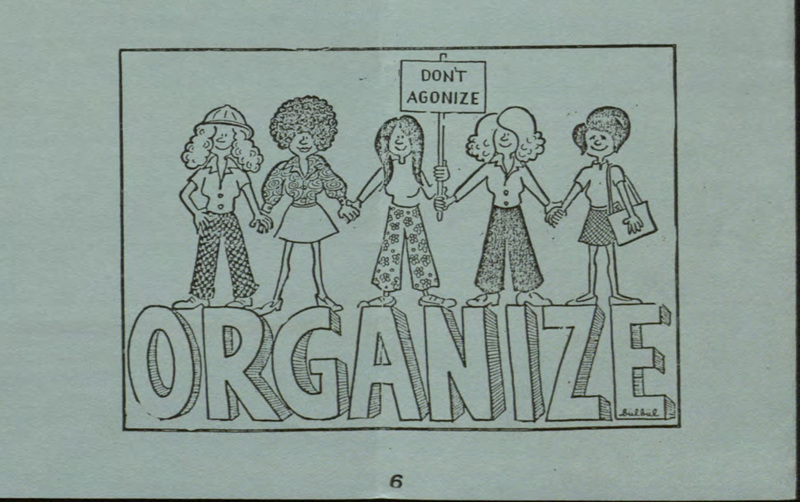
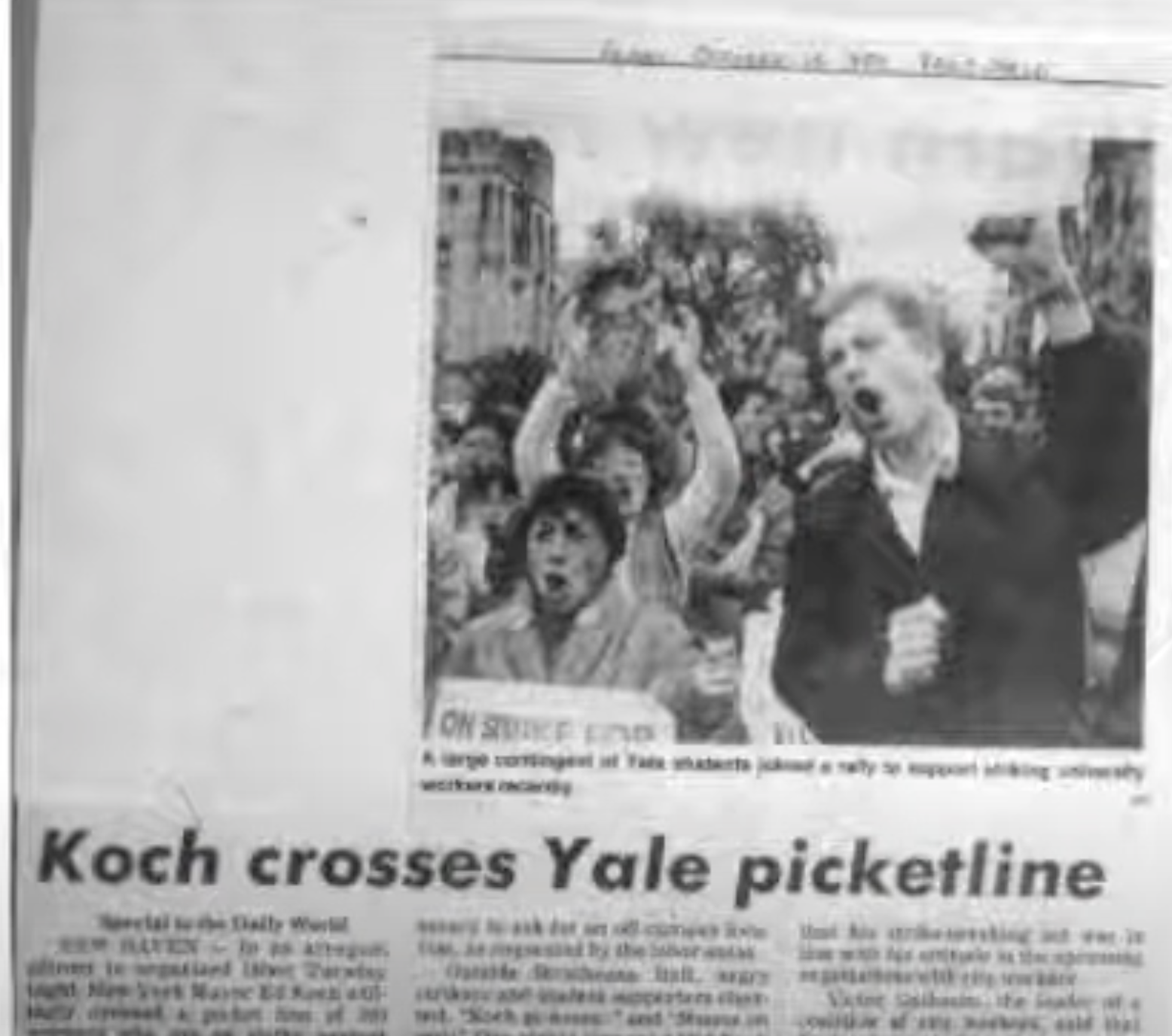
When I was a kid my mother was part of an organizing drive at the hospital where she worked. Actually, that drive wasn’t easy to get started. The hospital workers union did not want to get involved unless there was a real chance to win. So, when I was a kid, my mother hosted meetings in our living room, with workers from different departments, figuring out how to get more people interested. And they did. It took a couple of years. But 1199 came in, and ran a drive. There was a real organizing headquarters in a storefront around the corner. But our kitchen got busy too. And then there was the vote, and the workers lost 45 – 55, and the administration retaliated against my mom. She won a victory against them for harassment at the NLRB, only to lose on appeal. In any case, she ended up working at Yale, and was part of the historic clerical and technical organizing drive there. And when she moved north, and got a job as an administrative assistant at Harvard, the newly formed union there made good use of her experience, and had her explain what it was like to gain their first contract at Yale. In any case, I wasn’t around for that campaign – having left for college. But the hospital drive, and the campaign at Yale, I remember those clearly. And it’s how I think of my mom back then – out for hikes, and over dinner, and organizing.
So I came to New York, eventually got a City job (Department of Transportation), quit that, finished the college degree I’d never finished, and didn’t really have any prospects. My uncle, who’d just retired from a long (maybe 35+ years) teaching career, including the last two decades at Murrow, said “teach.” “I don’t want to teach.” “Do you have any other prospects?” I didn’t have an answer. So February 1997 I started subbing, and pretty soon one school, Christopher Columbus High School, started calling me every morning, and then told me to come in whether they called me or not. I got hired for September, teaching three sections of MP1 for freshmen, one section of MQ1 for freshmen, and one section of MP1 for repeaters…
I signed a union card right away, volunteered to sign up for COPE, and thought that would be the extent of my commitment. I knew how consuming union work can be, and this teaching was HARD. I would be a good, quiet UFT member. But after a couple years the chapter leader approached me. In short order I got pulled onto the consultation committee, and elected Delegate. At Delegate Assemblies, at Fashion Industries, I always sat with my District Rep, David Shulman, in the raised seats, back right.
One Election Day PD (back then, all the high school math teachers in the Bronx would go to one school, and run PD for each other. It was some of the best PD I’ve ever had) – but one election day PD the Bronx Superintendent ranted at us and insulted us and declared we did not know how to teach, but that he was going to fix that by bringing in a new math program, Math Connections. We were not delighted, although I think I was the only one in the CCHS breakout room who gave the sentiment clear voice. (Very clear voice. I can’t write it here, but ask me, if you like, and I’ll tell you). A few months later I got dragged to a meet the president event (Randi Weingarten) and the old-timers in my department told me to go talk to some other people, and by the end of the event I was part of a borough-wide committee. Article 24. Professional Conciliation. We won. (and some of the friendships formed then endure today…)
The Bronx high schools were having a hard time of it in the late 1990s. New York State had already closed Monroe. Then Morris. And after I started came Theodore Roosevelt, and Taft. Low graduation rates, mostly. So they closed the schools and opened mini-schools in their place. Why, if the kids stayed the same, and the teachers were the same, would mini-schools do anything? Maybe changing a principal might, but even that… So here’s what they did. They capped the size of the mini-schools. All the extra kids (and the Bronx had lots of extra kids) were shunted to the other Bronx High Schools (three were exempted). Most of those reaching Columbus needed additional academic support. The school, nervous about State review, was shunting money into the wrong places to handle a flood of new students with such needs. And students who were placed into classes with work they could not handle became frustrated, and acted out. The school felt like a mess. I had helped a friend, McRib, get a job teaching math with me during my third year at CCHS, but by the next year I was helping him find another place to teach.
Then we learned. Columbus was under pressure. From the superintendent, from the State, we knew that. But we were attacked from a direction we did not expect. Columbus’ numbers were good enough to avoid closure. But the Gates Foundation was funding a project, breaking up big schools into small ones, and was offering bucketloads of money if districts would agree. Our district agreed – I guess that’s the chancellor. But who expected our union, the UFT, would agree? No one I knew. But that’s what happened. Randi Weingarten agreed. David Shulman always maintained that she’d promised things that were never in writing and never happened. But worse than that, the chapter leaders were not consulted. The members were not consulted. (Years later, Gates admitted it was a bad idea. But damage done, he walked away.)
There’s much more of that story, but here I am, in my fifth year at Columbus. I’ve finally gotten kind of ok at teaching. But the school feels like it is veering off the rails, and we just got this announcement that not only are we being closed, but that our UFT leadership made the deal closing us. Do I stay and fight? Or do I move on? In retrospect, my career path would have been different if I’d stayed. But I would have helped fight, and the same things would have played out. Columbus fought closure longer than the other schools that were on the block that day, but it was indeed finally closed. My presence would not have changed that story. In fact, I started applying to schools, got some interviews, and got an offer from a brand new specialized high school located on the Lehman College campus, near my house. In fact, the job offer came a few hours after my interview.
– – — — —– ——– ————- ——————— ————- ——– —– — — – –
In twenty-five years I have learned from teachers at many different kinds of high schools. I have met teachers from miserable cookie-cutter mini-schools with a fake theme and an untrainable principal. I have also met teachers who work in well-run mini-schools with strong themes, developing strong culture.
Some of the things they used to about big impersonal schools were true about SOME schools. But many of the big schools really had communities within them, with embedded support. Most older NYC high school teachers I know have fond memories of their academic comprehensive schools.
During the math war I met some amazing folks from the vocational schools. Imagine taking anyone interested in your trade, with no screen. These were “schools of choice” in a very honest sense.
Transfer schools take a special kid of teacher, with a different outlook. I have met some super-dedicated folks in these schools.
There are consortium schools, and international schools, there are specialized high schools (like mine).
In my years teaching and doing union work and professional math work, I have had the opportunity to speak to teachers from a wide variety of schools. I have also met with teachers from out of the city, other districts, out of state. I have been to some of our other NYC high schools. I even once visited a Brooklyn charter high school.
– – — — —– ——– ————- ——————— ————- ——– —– — — – –
The high schools in NYC have an amazing history of union strength, of activism. High school TEACHERS have included some amazing activists (I wrote about one, from long ago). Dave Widom, Chapter Leader once upon a time at Erasmus Hall, tells the story: There was asbestos at Erasmus Hall. He held the membership out of the school. Chancellor later praised him for doing the right thing. Can you imagine if we had chapters with such strength September 2020? March 2020?
The high schools have a long history of challenging authority. The high schools were the only division to ever choose their own VP, not one chosen by Shanker or Feldman or Weingarten or Mulgrew. Michael Shulman (not the Dave Shulman I mentioned above) beat George Altomare. What did the Unity leadership do? They changed the rules so that High School teachers do not pick their own VP any more.
High schools were so independent that Shanker created the HS District Rep job to keep tabs on HS Chapter Leaders. That wasn’t enough control for Weingarten, who changed DR from an elected position to one that she appoints. Ironically, I applied several times for the Bronx HS DR job…
Why did Weingarten agree to break up the Bronx high schools? She may have been dazzled by the size of Gates’ offer. Or she may have been dazzled by his flattery of her. She was certainly susceptible to flattery. Us old timers remember how Bloomberg used flattery to sell her a raw deal in 2005…
But there is another theory, one worth at least considering. Breaking up the high schools meant breaking up clusters of independent-minded UFT members, activists. Breaking up the high schools meant breaking up opposition strongholds.
– – — — —– ——– ————- ——————— ————- ——– —– — — – –
I haven’t written much about the 2022 election here. I am running with United for Change – for multiple reasons.
Making high school chapters more active, more involved, more central, and ultimately more powerful has to be a high priority.
I am committed to ending the kind of backroom deals that tore apart my school, other high schools in the Bronx, and others in Brooklyn, Manhattan and Queens.
And I have to mention health care, including protecting Medicare from Mulgrew, and pivoting our political action (the UFT leadership is opposing single payer. I want to turn that to supporting single payer).
This list could get long, should get long, but not right here and right now. Just one last, multi-parter:
- Members’ should have their voices heard. We need to guarantee that information is flowing.
- This includes shifting focus from consultation minutes alone, to consultation minutes AND chapter meeting agendas. Consultation minutes alone make our members passive recipients of information. The engagement comes at the chapter meetings.
- Chapters elect Chapter Leaders. Good. But Chapter Leaders should elect District Reps. And we all should elect the Exec Board and the AFT and NYSUT delegates. Changes to elections should be one of the first things United for Change should work on.
- But there’s another aspect of member voice that matters, and needs to be recognized. When members are in schools where their administration does not respect them, abuses them, scares them, what do those members do? Stand up! Fight back! is the answer we all want to hear. But what about places where members are brave enough to call their District Rep, but are not ready to organize? When those members make their voices heard, it must be up to the apparatus of the union, the leadership and reps, to speak for members who are not ready to speak, to stand up for members who cannot stand up for themselves. And when that happens, that will be a big change from the Unity-controlled UFT.
– – — — —– ——– ————- ——————— ————- ——– —– — — – –
My opponent is Janella Hinds, the incumbent HS VP. Janella has a strong sense of justice, and right and wrong. She is very smart, and an effective communicator. I have worked with her. I have great respect for her. If there were no caucuses or parties, I would probably support her.
But we do have caucuses, and being a member of Unity caucus means at crucial moments (including votes) Janella functions as a caucus member, and not as the brilliant individual who she is. I don’t know what role Janella had in the Medicare Advantage Plan, which was hashed out by the Municipal Labor Coalition, where she represents the UFT.
And so I am running against Janella not out of animus or disrespect, but in spite of liking her, and regarding her highly. We do need a change in the leadership caucus. But I still wish Janella well.
– – — — —– ——– ————- ——————— ————- ——– —– — — – –
This is a big election. I guess they all are – right – when does someone tell you an election is not a big deal?
But this is a big one. One party rule is at stake. Healthcare is at stake. A different, inclusive vision of member involvement is possible.
And as the events unfold, we may have an opportunity to reinvigorate our union in the high schools.
– – — — —– ——– ————- ——————— ————- ——– —– — — – –
Ballots are going to be mailed later today. Look for them in the coming days.
When you get your ballot, open it and vote. You can vote for me, and the entire United for Change slate by checking the box on the left.
The answer is “Mulgrew, Medicare, Pandemic”
Question: What are three biggest problems for Unity in the April 2022 UFT elections?
I have been involved, one way or another, in 6 UFT elections, pretty deeply in 5 of them, kind of near the center of campaign planning for 3 or 4. And I have never seen such a competitive campaign. Unity, the United Federation of Teachers’ ruling caucus for more than my lifetime, looks worried.
Broad Coalition
United for Change, the opposition coalition, is bigger and broader than anything we’ve seen in these last two decades. Maybe the coalitions is Unity’s biggest problem? You could make that argument. But I don’t think so. We had a pretty big coalition in 2016, and did win the high school division, but it wasn’t scary for Unity the way today is.
Pandemic
Ask a dozen teachers, you’ll hear a dozen different answers about what they are angry with our leadership for over the pandemic.
- Elementary teachers who were forced back to work first, in the fall of 2020, pre-vaccine, with sketchy safety
- Everyone, over “instructional lunch” that apparently was proposed not by the DoE but by the UFT leadership
- Politically savvy members, who couldn’t believe Mulgrew’s email supporting Cuomo‘s decision to make us work through Spring break 2020
- Financially savvy members, who knew we got robbed on the Spring Break arbitration (vacation days are good, but we were owed cash, right?)
- (I do not support the anti-vaxxers – but they are angry about not being supported. Though, frankly, many of them are just angry in general, about the world and the 2020 election, and the gaps in the wall and the 13th amendment…)
- Everyone who read the papers about the “toilet paper test” to pretend that rooms with dead air were actually ventilated
- Everyone in non-ventilated and semi-ventilated rooms who had to keep windows open with frigid temps outside
- Lots of people, about all the secretly negotiated safety protocols
- Lots of people, about the bizarrely and secretly negotiated protocols for remote work
- Techies, when they realized our HEPA filters are not HEPA, and the DoE just lied, and the UFT leaders stayed silent
- Me, and a handful of programmers, over the ludicrous “hybrid learning” that was unworkable, and that we know came from the UFT leadership.
If the pandemic ended 6 months ago, maybe short-attention span members/voters would have forgotten. But the pandemic has not ended, not yet, though we hope we are close. And the wounds of the last two years are fresh on members’ minds. Some blame UFT leadership for doing things badly. Most blame UFT leadership for not doing enough. There may be enough anger that members who have never bothered voting before, some will actually vote this time. And not for Unity.
Medicare
We get it. Healthcare costs are going up.
But who covers the extra cost?
I think WE should NOT. Bargaining with the City to get them to pay is a steep hill to climb, but we may have to. The best option does not solve our problem immediately, but does in the long run: fight hard for single payer. The UFT needs to drop its opposition to single payer.
But the UFT leadership, they think WE should pay, but they are hoping we do not notice it much. That is why their medicare advantage is designed to cover most of the same “things” as retirees’ current coverage. But it will not cover them as completely. It will not provide as much care, just the same type. Mulgrew just negotiated with the MLC, to reduce how much care we get (or will get when we retire and are ready to go on Medicare). Most procedures will be approved. Some will not. I know, I know – your procedure is probably fine. But just because you are ok, try talking to someone who faces a denial. And services denied = less service = cost savings (for the fund) = less medical care (for some retirees).
Our retirees did not fall for this, and opted out in large numbers.
A mistaken policy is one thing. A mistaken policy on retirees’ healthcare? This is healthcare. This is wrong as bad policy. But it is also strategically a potential disaster. It has the potential to upend decades’ old voting patterns (retirees have gone for Unity with about 80-85% in recent years). They made a small version of this mistake 6 years ago with co-pays. But nothing like trying to penalize retirees for sticking with Medicare. $2300 a year Unity was going to charge, to avoid Mulgrewcare.
But there’s also how they played it. The back-room wheeling and dealing, which when it broke Unity’s first response was to say it should have stayed secret, but it was not really secret. And then they shifted their story every time they spoke with retirees. Mulgrew – well, I’ll save him for the third answer. But the answers shifted, and seemed shifty. And retirees are by and large fairly savvy. They were not having this being misled stuff.
And just about everyone knows that retirees would not have signed onto Mulgrewcare voluntarily. That’s why Unity withdrew it. They had no way to get seniors to sign up, except by 1) making it “opt out” instead of “opt in” and 2) penalizing anyone who tried to opt out.
And everyone knows that Unity will try to revive it after the election – unless there’s a huge backlash in the vote. Little motivation there, for people who care about healthcare to return their ballots.
Mulgrew
The broad coalition may trouble Unity. I’m not really including UFC as one of Unity’s problem issues. They did not come out of the Pandemic smelling good. That’s a problem. Attacking retirees’ health care was a huge blunder. But they would probably survive all of these, pretty easily (except in the high schools) if it weren’t for their biggest problem: Michael Mulgrew.
There has not been a less popular president in the history of the UFT. For these last 25 months members have been paying more attention than ever before. And they are not pleased.
It’s policy:
- He gets hammered for Mulgrewcare.
- He gets hammered for the handling of the pandemic
- Some members remember that three ring circus endorsement process that settled on Stringer, couldn’t move off, and then switched to Adams in the general (who is now offering us 0% 0% 1%)
It’s politics, internal and external:
- He supported every move Andrew Cuomo made, even when they were bad for us.
- He never gave the full denunciation of Trump that other union leaders did (and avoided even saying his name)
- The rumors and innuendo about his conservative Staten Island background keep floating out there (although they are not nearly enough to convince real Trumpers to vote for him. Lose/lose.)
- Within the UFT leadership he takes no counsel
- He has surrounded himself with hired non-educators, outsiders.
It’s personality:
- He is rude at the DA’s
- He got caught talking down to retirees
- He sounded like he was lying to retirees
- He’s just not – and I know this sounds shallow – very likable
This has gotten so bad that everyone knows. Everyone in Unity knows. At United for Change we constantly have to pass up the easy cheap shots – we are not just running against Mulgrew – we remind ourselves – we are running against Unity, his caucus.
Unity has taken to hiding Mulgrew. They will not let him debate Camille Eterno. They tell him to eat up all the time at the Delegate Assemblies so there is no danger of issues being discussed. They left him off their mass mailing leaflets, and hide him (small photo, lower center left) on their general leaflet. They try not to use his name. Last newspaper article I saw on UFC vs Unity, Unity wouldn’t let Mulgrew speak, and sent a vice president instead.
Interesting Election
For people who follow elections, UFT elections are usually a snore. 12 officers, 95 executive board seats, 750 delegates, none of these are a contest. There is usually a tussle over the last 7 executive board seats. The high school seats. I held one of them for 11 years.
But this year? At least those 7 seats in play, with a realistic chance for more, and an outside chance for the whole ball of wax. Observers and players alike are speculating about the margin. If Unity somehow loses votes from 2019 (83%), but stays at their 2016 level (76%), that will look like a huge victory for them. But I don’t think that is likely.
Will Unity lose some votes, or will they lose a lot of votes?
Will they take a small hit but still sail in with 72%? If that happens, there’s no mandate for change. UFT members who want something different will be disappointed. Some Unity members among them.
Of course UFC might win, and we should talk about that, a different day.
But if the votes come out and Unity wins, but takes a big hit on the numbers – and that’s what I think will happen, will that send a clear message? Will Unity adjust some of its policies? Will they find a new leader?
Stay tuned – observers. And remember to vote – members!

Shady Unity Health Care Changes – from 2014
In the 2014 Contract – the current story goes – we voted for health care savings (generally cuts) to pay for raises. Many stories have a lot of truth, mixed with some story-telling. This one is not an exception.
In the Spring of 2014 I sat on the Negotiating Committee. A contract proposal came to us May 1. It included a mix of slightly good, kind of bad, and overall unimpressive changes. But health care? There was a line about a huge (in the $billions) savings, but no details.
May 5 the UFT Executive Board met. We had a huge question and answer session. But there was no Memorandum of Agreement. They claimed that it was 50 pages long and they were checking it for grammatical errors. And none of the details about where the health care savings were coming from were forthcoming. And then the Exec Board (minus New Action) voted to send the agreement to the Delegate Assembly.
I’ve written this before. I’ll write it again, I’m afraid. But we should have time to read something before we vote to approve it. When Unity rushes us to approve without reading, that’s a warning. And when they claim they can’t share the agreement because they are searching for grammatical errors…
They did issue a document. It included info about pay, and about educational issues. Know what they left out? Health care.
They called a special contract ratification Delegate Assembly. For March 7. They were in a special sort of rush.
It was a lousy Delegate Assembly. Because members had not had time to read the agreement, there were not good questions. And there were only a few minutes of them. There were still no real answers on healthcare, except for Mulgrew and Artie Pepper vowing up and down that members would not pay, that savings would be found administratively. And debate was brief – Unity loyalists argued for a yes vote.
In a hint of things to come, the vote was to “send and recommend” the contract to the membership. “Send and recommend” means that the union would allow the members to discuss the contract (send) but would push for them to vote yes (recommend). But at the DA Mulgrew kept saying “send” “send” “send” so that delegates would think they were giving members a choice, not a bum’s rush.
When they ask Delegates to vote, and it is not clear what they are voting on, and no one has read the agreement, just listened to a one hour infomercial followed by some shouting… When you see Unity rushing people to vote without thinking, reading, discussing… You know what that means….
Below I have links to all my posts from that month. (Reverse chronological order – if you read them, start at the bottom)
But what’s missing? There’s no discussion of retirees. There’s nothing in my writing, nothing in what Mulgrew claimed, that made me think about the effect on retirees. And while I was considering the balance of give backs and improvements, I never thought “health care cuts (savings) are being used to fund our raises”…
The truth of what Unity was doing to us, and to our future selves, was hidden in plain sight. Or would have been, if they had printed it.
What does Unity do when they see a Problem?
When real leaders see a problem they deal with the problem, they try to fix the problem.
But Unity caucus holds for now the leadership of the United Federation of Teachers. I have often accused Unity leadership of hiding problems, rather than addressing them.
When a school is full of untenured teachers, terrified of an abusive administrator, you’d think the DR would march in, with back up, and begin to set things straight. Sadly, the more common response is to say nothing, to hide the problem, to pretend it’s not there. Without opposition on the UFT Executive Board, there are no reports of abusive administrators. Instead instances of bad principals get swept under the rug.
(There was a celebratory report recently on a school that had defeated such a principal – but the pattern is clear – if they had not won, the leadership would have said nothing. And a school in that situation getting help is the exception)
When there was opposition on the Executive Board, we used to call them on it. Teachers from such schools would come in, and appeal for help. But the Unity leadership would point out that the teachers in those situations have often not begun to organize themselves. This is the wrong answer. As union leaders we are supposed to fight for people who cannot fight for themselves.
But today, bizarrely, we have a clearer example of how Unity deals with problems.
In the 2022 United Federation of Teachers elections, the reigning caucus, Unity, is stuck with the most unpopular president in UFT history – Michael Mulgrew. He got a lot of exposure during the pandemic (Town Halls did not help) and a surprisingly large number of members think he’s a jerk. He’s identified with the union’s slow, indecisive pandemic policies and inadequate protections for members. Mulgrew’s tied by his unwavering support to Andrew Cuomo. And Mulgrew is the front man for the Medicare Advantage flim flam. Unity has themselves a turkey.
Unity has a problem. Michael Mulgrew.
What does Unity do when it faces a problem? They hide it.
Last week they mailed – I don’t know – 70,000? 100,000? 150,000? 200,000? pieces of campaign literature to members’ houses. Lots of pictures on those mailers. Know who they left off? Mulgrew.
The high school piece included a list of their candidates who work or worked in a high school. Some have been out of the classroom for almost two decades. One for four decades. One never worked in high school. But you know who worked in a high school? Michael Mulgrew. Except they left his name off the list.
Now they have new literature, with all the officers’ photos. I’ve seen it. Mulgrew is running for an officer position (President). They couldn’t leave him off – but they made him the same size as everyone else (actually, a bit smaller. Richie Mantell is leaning in, smiling at the camera. Mulgrew is glaring from afar.) And where is? Lower row, 3rd from the left.

I didn’t get this in the mail. I went to the Unity Facebook page (like jumping in icy water, or eating a roach – simultaneous tempting and frightening or gross) to see it. I also noticed something interesting; his name is absent from the page.

Michael Mulgrew is a problem for Unity. So they are hiding them.
And that says a lot of what you need to know about how they run this union. When they see a problem, they bury it, or run from it, or hide it.
We need better leadership than that.
Campaign Strategy: hide Mulgrew
Unity has a new campaign strategy. They just sent out 60,000 flyers to teachers. I bet they sent another 70,000 to functional members. Who knows what they sent to retirees.
So 60, or 130 or 200 thousand glossy flyers to United Federation of Teachers members. And you know who’s mug was missing? Mulgrew’s. His name’s not on there, at least on the teacher ones.
I mean, it’s not a surprise they won’t let him debate. If he had a huge lead a debate costs nothing, makes you look open, confident. But this election they are shaky, and not confident in his performance when he doesn’t control the chair.
But leaving his grin off tens of thousands of leaflets?
There’s some professionalism to Unity’s campaign this time. They branded (“we do the work” they say. That’s worth a deeper dive, because much of the work Unity members do is because they have jobs they got in return for being loyal Unity members – jobs that are not open to others). But back to the campaign, they branded. They improved their graphics (somewhat).
And they are adjusting.
They pivoted. They bury the Medicare Advantage issue, hoping “out of sight, out of mind” and that somehow they will hold onto more retiree votes than most of us think they will.
And they have pivoted again. They may have even done some internal polling. They would have discovered what every teacher knows: Michael Mulgrew is not very popular. He’s taking the blame for Unity mishandling the pandemic, sending teachers into unsafe conditions, not backing us enough, or soon enough, inventing “instructional lunch.” He’s taking the blame for sucking up to Andrew Cuomo, looking like a dishrag instead of a union leader. He’s taking the blame for the UFT getting pummeled in the Spring 21 primaries – and Adams – one of the two guys we wanted to stop, becoming Mayor. And he’s taking the blame, despite Unity trying to keep it out of the news, for Unity and the MLC trying to privatize retirees’ Medicare.
In any case, they are hiding him.
Maybe they read what I wrote: Do the Right Thing?
You should read it. I said, for the good of the union, they should remove him. Put in someone else. Almost anyone. This would be bad for me politically – United for Change has a chance (albeit small) against Mulgrew – but we really would not have much of a chance against anyone else. But people are so angry at him, some of that anger gets turned into anger at the UFT, which is bad for all of us. So, even though it would not help me, I suggested they remove him for the good of the union.
But if they read what I wrote – THAT’S NOT WHAT I MEANT. I meant replace him because he generates anti-union sentiment among our members. I didn’t mean keep him at the top of the ticket, but hide him from view. Your consultants care more about winning than about the health of this union.

March 22, 2020
Those days are both clear, and a blur.
The last regular day of school was Friday, March 13. Opposition people in the union had been screaming for the schools to shut for several days. MORE was actually organizing for a Monday sickout. People in schools with COVID-19 cases were shouting that their schools needed to be closed. But they were not being closed.

Unity and Mulgrew claimed months later that they were trying to close the schools in advance – but there was no indication of any such effort until Mulgrew’s statement on March 13. And no subsequent evidence has emerged. In fact, I still do not understand why UFT officials did not stand in front of those schools with cases and refuse to let members enter. During the asbestos crisis that is exactly what strong high school chapter leaders did.
The UFT’s Mulgrew leadership, while late to the game, did get on board on Friday, March 13.
MORE’s petition was to Cuomo. Once Unity was on board they started Mulgrew’s almost-as-successful petition, which was to de Blasio. Both of those political clowns dithered and argued with each other and refused to close schools. Until Sunday afternoon, March 15. de Blasio announced schools would be closed Monday, and then open Tuesday, Wednesday and Thursday for faculty only. Close Friday. And reopen remotely, temporarily, the following Monday, March 23.
March 17 was a fairly useless pd day in my school. Who could teach us how to teach remotely? I understand the experience in many schools was similar. Many teachers across the city did not report. I did not come back March 18 and March 19. The benefit (none that I could discern) was not worth the risk (rapidly advancing public health emergency without known limits). Side note: I am grieving, with some of my members, the return of days to our CAR. We are waiting to be denied at Step 2.

When our safety was at stake, they were playing things politically, and safe (for them, not us).
There has to be some accounting, not here, for why there was practically no real support for remote teaching – not from any quarter. Schools were left to their own devices. We made it up as we went along. There was no support, no help.
Anyhow, pd ended for me March 17. It was the last time I saw Ulises Castro, one of our peace officers, and Denis Murphy, one of our teachers (and one of our founding teachers). PD ended for others on March 19.
Those parts are clear. What happened next, for me, is less clear.
I think I left Thursday evening, made arrangements, came back Friday, packed, and left left on Sunday. In any case, by Sunday March 22 I had relocated far north in New York State, to a county that had not yet had a single COVID-19 case. I got a deal on a spot, and the wifi was good enough. I might even get some hiking in.
Spring 2020 was the longest stretch of time I spent out of NYC since 1984. There were things I enjoyed – the outdoors, time with my hosts and their kids and grandkids. I liked walks in the woods. I liked time at the barn. I liked checking my cameras.
The on-line teaching, with no real training, would have been miserable anywhere. But I made the best of it. I was not the worst on-line teacher. But nor was I the best. School year 2020-21 would be considerably more successful in that regard (my school was fully remote, and we organized a schedule that worked for teachers, students, and families – at least as well as any other remote schedule, and better than most).
In any case, the teachers in my school mostly wanted to start teaching later in the day – after kids were up (not a bad guess that many students would make sleeping in a daily habit). So what did I do? I posted on-line lessons. I rewrote lessons into short texts (not phone texts, but like mini-chapters from books) designed for student learners to read and learn from directly. And I set up 8 – 10 office hours (I called the time “coffee”) every day, and required regular attendance at some office hours each week.
I felt, at times cowardly. I had run away from New York City, my 36-year adopted home. I missed cheering the hospital workers. I wonder what it felt like to be here. But I was glad to be safe, to have clean air, not to worry every day. I don’t know if I made the right decision – but I live with it – it was the decision I made.
I came back once to get a different computer. I was in and out in an hour or two. Early April? I came for a few hours one day in May. But I didn’t come back for good until the summer, the end of June. The apartment building was eerie. My apartment was somehow strange – everything was where it should be, but I had time-traveled 3 months ahead. I remember the second day back, my first day outside, avoiding people, avoiding touching surfaces, not knowing what to expect. Walking to Van Cortlandt was easy, and it was not so hard to avoid people. The grocery store though? I remember my first time inside, and how strange and foreign the whole experience seemed. But that’s another story.
There are tens of thousands of stories like this – teachers individually doing our best to rationally plan for our work, for our students’ learning, and for our safety – while our political leaders grandstanded, stalled, postured – and provided no useful guidance.
Saving Medicare: Why is Unity anti-Optout today?
Last Spring, Summer, and Fall
Retirees opted out of Medicare Advantage Plus (aka MAP, aka Mulgrewcare). Not all. But many. Many of the city’s retirees. They opted to keep Medicare with the current reimbursements. And pay the Mulgrew-penalty ($191/month) rather than find out how bad the preapproval process would be, and how many doctors were really not going to accept the new privatized plan.
Back last spring, and over the summer, and into the fall, while Mulgrew was trying to sell Medicare Advantage, I understand why he might have pleaded, bullied, and tried to trick retirees into not opting out. And man, did he try.
He had probably promised Emblem or Anthem or the Alliance or whatever that company is called (you know, the insurance company, the one making the big bucks even though they never take your temperature or test your blood or perform surgery) – he probably promised them that he would keep some high number of retirees in MAP. The more retirees who opted out, the more he freaked out.
But today?
Almost three weeks ago a judge said the City and MLC and UFT could not penalize retirees with a penalty for not choosing their preferred plan: Medicare Advantage Plus. Mulgrew wanted to fine members who kept their traditional Medicare – judge said no. There’s huge holes in that decision. But now the City is appealing and Mulgrew says, for now, MAP is not going to start.
So why is the RTC in Florida circulating information telling retirees not to opt out? What difference would it make if Mulgrewcare is DoA?
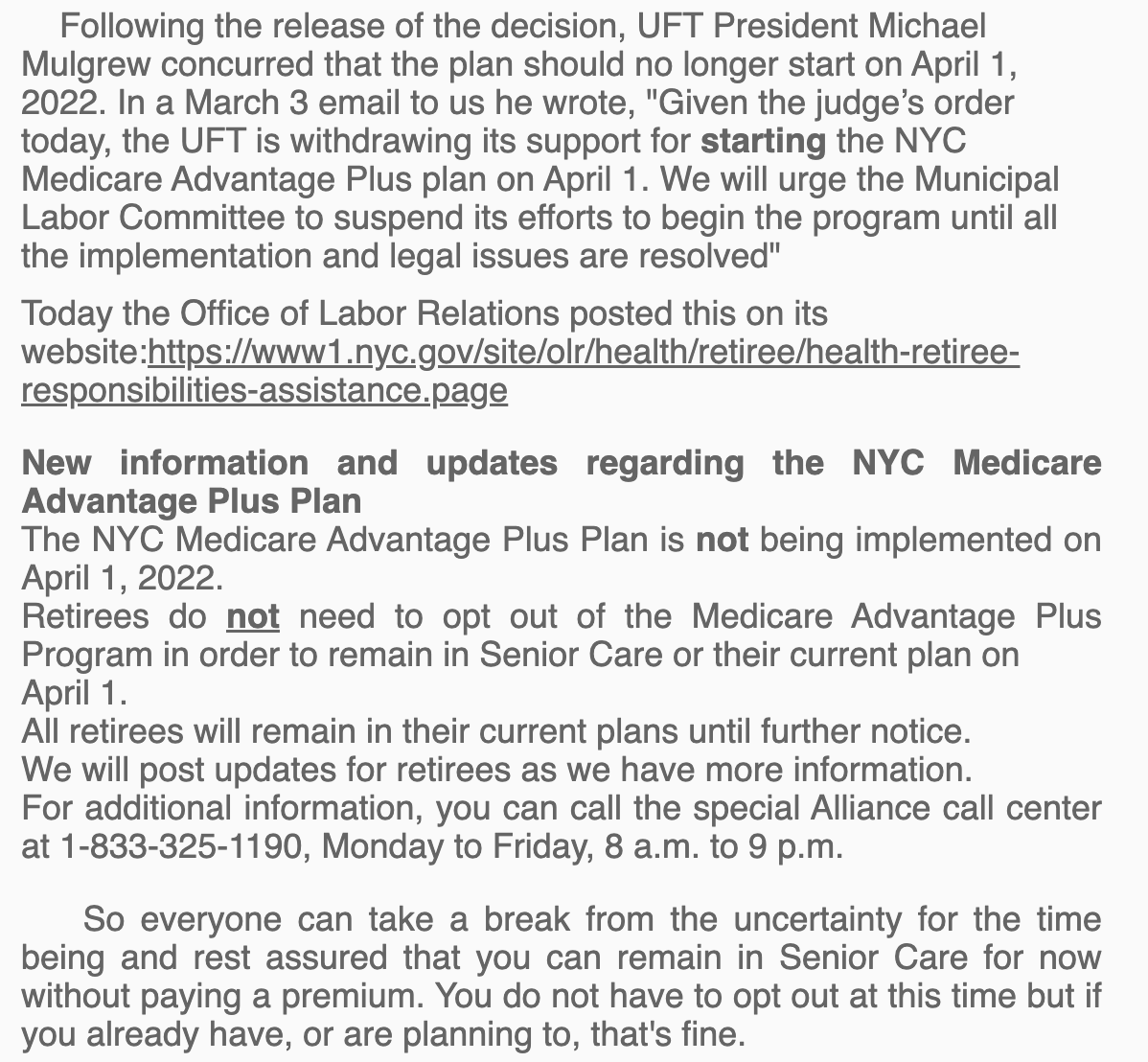
New information and updates regarding the NYC Medicare Advantage Plus Plan
The NYC Medicare Advantage Plus Plan is not being implemented on April 1, 2022.
Retirees do not need to opt out of the Medicare Advantage Plus Program in order to remain in Senior Care or their current plan on
April 1.All retirees will remain in their current plans until further notice.
We will post updates for retirees as we have more information.
For additional information, you can call the special Alliance call center at 1-833-325-1190, Monday to Friday, 8 a.m. to 9 p.m.
Well, there’s a rub. What if they are planning to wait until after the election, and then revive their assault on traditional Medicare? Then it would make sense for them to continue to campaign against opting out. And that, I am sorry to say, is what I think they are doing.
Why else does Mulgrew say “the UFT is withdrawing its support for starting [MAP] on April 1”? What date does he really have in mind?
And, if he is planning to bring this monstrosity back, shouldn’t retirees who were planning on opting out go ahead and opt out, just to be safe?
Mulgrew on Medicare?
I wanted to share the audio with you.
It wasn’t secret. Mulgrew posted it here.
You can click the link. But it says “This track was not found. Maybe it has been removed.” Indeed. I wonder why.
He was proud of that tape. Apparently. Until he wasn’t.
He sounded so smug. As if he knew more than anyone else on that call.
You could have heard him sounding like an overconfident used car salesman.
You could have heard how condescendingly he spoke to our retirees.
You could have heard him boast how Medicare Advantage Plus (aka MAP, aka Mulgrewcare) was better than real Medicare.
You could have heard him brag that he was under no obligation to tell retirees that he was renegotiating their health care. You could have heard him ignore the significance of pulling so many people off of Medicare.
You might have heard him explain that once he was done forcing retirees off of Medicare, that he was going to completely revamp health care for in-service members. Shudder.
You could have heard him suggest that he might restrict new hires to HIP for their first 5 years.
I mentioned this to a Unity supporter. “Come now, you know it is politics. Everyone knows he doesn’t mean what he says to members.” Something to think about, right?
By the way, we all used to be able to choose our healthcare from when we were hired. But Unity’s last round of “cost savings” forced new hires onto HIP for their first year. And now he’s thinking about 5?
And “health care savings?” That is Unity’s way of saying “extra costs for members that save the Stabilization Fund some money.” For you and me “cost savings” means we pay more.
But I can’t share this with you. I can’t share the audio tape. It was an audio tape that Mulgrew had made – that he proudly posted – until Unity stopped being proud of it.
I mean, they could put it back up, and you could listen for yourself. Or you could trust me. But I don’t think you can trust people who hide evidence.

The audio tape that Unity deleted was from a May 4, 2021 retiree call with Michael Mulgrew.
Who should we keep secrets from?

My phone rang. My cell. I was in the program office at school. It was late September, 2009. I was busy.
Program changes had just finished. I was teaching 3 classes, but each one different. Algebra. Geometry. Combinatorics.
There was a mayoral election campaign in full swing. Eight years of Bloomberg was the legal limit, but with enough money, apparently, you can change the limit. He was running again. And he was in the lead. In an act of gross cowardice, Mulgrew and Unity were preparing to stay out of the election, to give Bloomberg a free pass. (In case you don’t remember, Bloomberg’s third term was his most destructive.)
The Call
But the phone call had nothing to do with the election. It had nothing to do with my classes. It had nothing to do with programming.
Hello? It was a NY Daily News reporter. She was calling to ask me about contract negotiations. (Well, maybe it was related to the elections, that’s one theory.) The reporter asked me about a contract demand – was it true that the UFT was going to ask the city as part of contract negotiations to return to “unit costing”? And she read me some language. It was precisely the language the UFT was using.
“I am in favor of a return to unit costing. As far as negotiations, the UFT is developing many demands, but I am unable to comment on any of them at this time.”
The reporter knew I was in favor of a return to unit costing. I had written about it on this blog. And the rest, the negotiations, Mulgrew required us to sign “confidentiality agreements” that promised not to discuss negotiations with anyone. I signed, and abided, by that agreement.
Not So Secret
Those words the reporter read to me? They were mine. Not quite word for word. I suggested them at a meeting of the full (300 member) negotiating committee, and they were popular enough to include, but Mulgrew had a lawyer work them over. So it was weird not being able to confirm that the words she was reading me were actually words I had written and a team of lawyers had rewritten. Weird.
And what about the secrecy stuff? The current UFT leaders, Unity caucus, often repeat, like a mantra “we do not negotiate in public.” Except, sort of, it looked like they did. The reporter knew every word of a specific demand. She probably had every word of every demand. I got the call because, given what I’d written publicly, she figured she’d get a good quote. And to be clear, the 300 committee members did not get the text – we just discussed it. If she had something in writing, it came from the leadership.
And “unit costing”? I’ll take a look back at that, in a fuller post. But in short, it was the practice of giving schools a specific number of teachers. It was replaced by a new sort of costing, and a new sort of funding, and a new sort of transfer, a new sort of school governance, and a new policy about closing schools, that combined to make principals not want to hire more experienced teachers at the same moment that more experienced teachers were being forced to transfer. But more about that, and the culprits in a really nasty story, another day. For now it’s good enough to know that in 2009 the entire UFT, more or less, agreed with me that going back to unit costing would be a good thing.
Not So Secret Here, Either
Fast forward a week. I was on the “executive committee” of the Negotiating Committee. It was no longer 300 people. I was in a group of 30. And big day. Big day. We walked into a room. Filled the back and the sides. Table in the middle. Mulgrew waited. Through the other door some City or DoE people walked in.
James Hanley, the City’s chief negotiator, shook hands with Michael Mulgrew. They sat. Mulgrew began reading demands. Something about money. Hanley responded – don’t remember 13 years later exactly what – but I think more or less “there’s a package; we can tweak details.” Then a second demand. Then Mulgrew read my demand, quickly. And Hanley responded “not a subject of” and I think the phrase is “impact bargaining” but I’m not sure, but whatever it was, Hanley said it instantly, with no hesitation. He knew what to say, exactly what to say, upon hearing a fairly complex demand. Because… He already knew what Mulgrew was going to say. And Mulgrew knew what Hanley was going to say. No hesitation, no question, they just moved forward.
Did Everyone Know? No
“We don’t negotiate in public” apparently means – we leak our demands to the DoE and to reporters. Who do Unity leaders keep negotiations secret from? Not secret from the politicians. Not secret from the press. Mulgrew and Unity keep negotiations secret from our members.
It doesn’t have to be this way. Many unions involve their memberships in contract negotiations. Most make their list of demands public. While some unions keep some aspects of negotiations confidential, none that I know of go to the bizarro extremes that Unity and Mulgrew go to. And, frankly, we can’t point to wild success coming out of this policy. We’ve had more givebacks than gains in the 26 years since I started.
LA does things differently. Chicago does things very differently. I don’t know that they are doing any better than us. But their negotiations did not fail because they shared information with their memberships.
Hiding stuff from members is just bad policy. It should stop. “We don’t negotiate in public” is just Unity shorthand for “we limit information we share with our members.” An informed membership would be a stronger membership.
Keep the content of negotiations secret?
Or keep the fact that negotiations are happening secret?
That would have been a good close, except we are not quite done.
Last spring Mulgrew got busted. He was negotiating (really Unity, through the auspices of the Municipal Labor Coalition) with the City to force our retirees off of Medicare into Medicare Advantage (private medicare). And another union went public. Our retirees did not know. They heard about this from members of other unions.
This one also needs another post.
But get this – when Mulgrew got caught, he said, “we do not negotiate in public.” Really? Now he’s not talking about keeping the demands secret. No one knew he was negotiating. He hid the whole entire negotiation from our retirees.
This is even WORSE than Mulgrew swearing me to secrecy, then having his staff leak the demands to reporters and city officials. Back then, all of the UFT, teachers, secretaries, everyone, knew they were negotiating, just they weren’t sharing the details.
With Medicare Advantage, Unity managed to hide from our retiree even the fact that negotiations were going on at all. The nerve.
To end the policy of hiding information from members we will need change. United for Change.
Yes, UFT members can defeat Unity / Mulgrew
A small win in April 2021. A bigger one in November 2021. And now, today, a huge win on healthcare.
For years, when I urged a vote for this or that candidate, or on a particular resolution, people would say “I agree, but you are wasting your time. Unity always gets what it wants. They control the votes.”
Well, not so fast.
2016 Election
Way back in 2016 New Action (I was a member) and MORE ran together against Unity. We did not win the presidency – only took 21%. But we won the high schools. Me, Arthur Goldstein, Ashraya Gupta, and four others took seats and used them to ask Unity hard questions and to bring forward real needs and concerns of our members. But there were no wins in 2019. It’s been a while. Actually, there were bigger wins decades ago, but that’s decades ago. I’m only looking at recent years.
Two Recent Delegate Assemblies
Last spring, in April, the United Federation of Teachers Delegate Assembly rejected Mulgrew and Unity’s endorsements for a number of New York City races, including Brooklyn Borough President, and Comptroller. The DA wasn’t rejecting the policy – we accepted the same endorsements the following month. No, we were actually rejecting how Unity was running the Assembly, and especially Mulgrew’s dickish behavior towards elected delegates.
And then, just a few months ago, at the November DA, Nick Bacon almost placed an item on the agenda that all health care changes go to the Delegate Assembly before they go to the Municipal Labor Coalition. Lost 49 – 51 (Unity won – they don’t want members having a say in health care policy. It was actually HS VP Janella Hinds who rose to speak “We have never had votes on this, have never engaged in that kind of debate in past, asks for no vote”). But that same meeting Unity asked for support for legislation to reduce class size (fairly ineffective legislation at that) and resisted members who were trying to make reducing class size a priority for contract negotiations. And guess who won? The members. 61% – 39%. And then the members won another vote. In the entire history of the UFT I do not think there has ever been a Delegate Assembly where members outvoted Unity twice. And in November they did exactly that, and almost succeeded a third time.
And Today, Medicare Advantage Phhhpt
From: UFT Press Office <press@uft.org>
Sent: Thursday, March 3, 2022 2:53 PM
Subject: Mulgrew on NYC Medicare Advantage Plus Plan
Contact: UFT Press Office | press@uft.org
Dick Riley | C: 917.880.5728
Alison Gendar | C: 718.490.2964
Melissa Khan | C: 646-901-1501
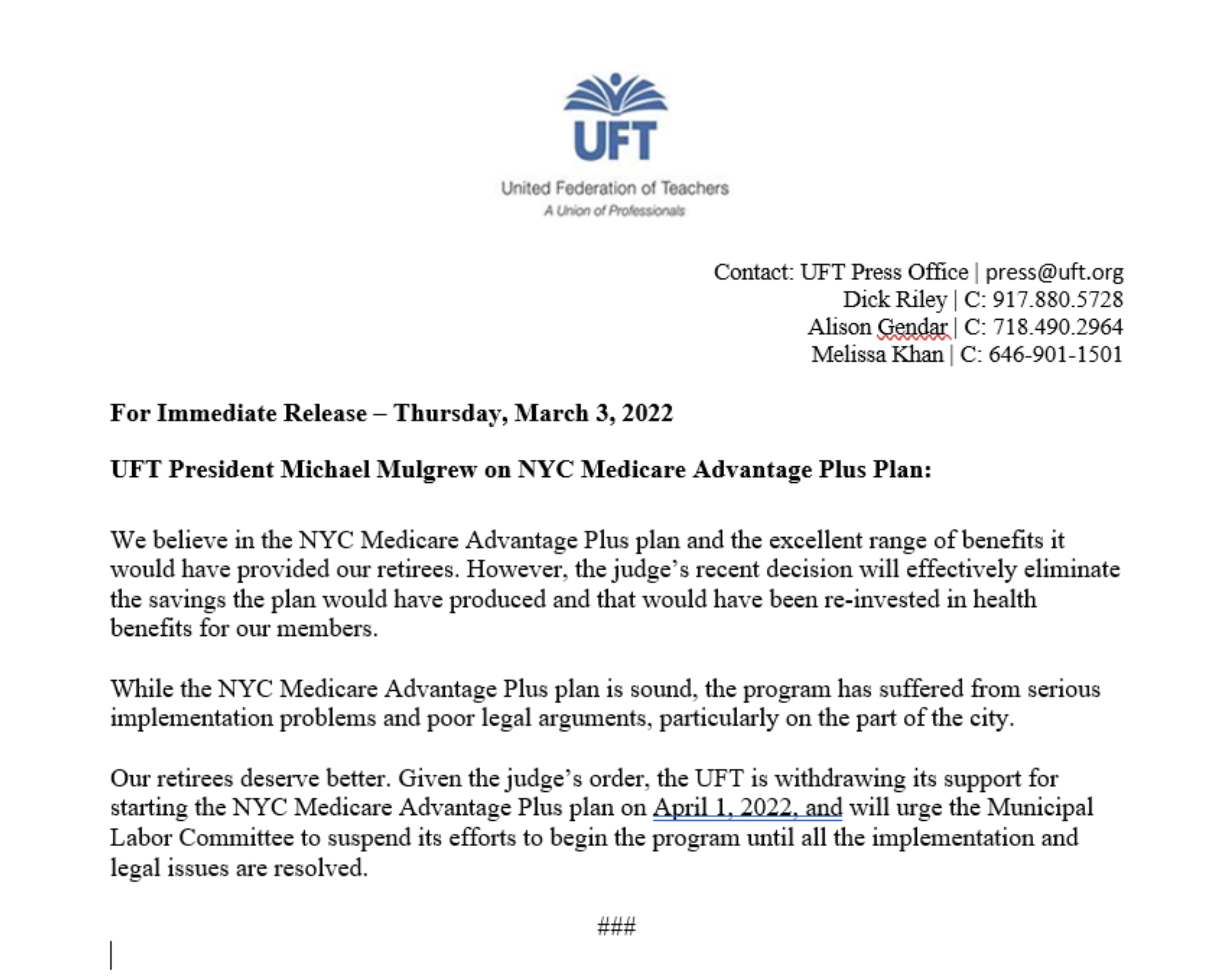
For Immediate Release – Thursday, March 3, 2022
UFT President Michael Mulgrew on NYC Medicare Advantage Plus Plan:
We believe in the NYC Medicare Advantage Plus plan and the excellent range of benefits it would have provided our retirees. However, the judge’s recent decision will effectively eliminate the savings the plan would have produced and that would have been re-invested in health benefits for our members.
While the NYC Medicare Advantage Plus plan is sound, the program has suffered from serious implementation problems and poor legal arguments, particularly on the part of the city.
Our retirees deserve better. Given the judge’s order, the UFT is withdrawing its support for starting the NYC Medicare Advantage Plus plan on April 1, 2022, and will urge the Municipal Labor Committee to suspend its efforts to begin the program until all the implementation and legal issues are resolved.
###
And a detail not to miss:
Mulgrew and Unity wrote a press release. They think that speaking to the press is more important than speaking to the members. This is not an occasional mistake. This is legit how they think. Sometimes they show they don’t know how to talk to members. Others they just ignore the members. And it’s been going on. And on.
Mulgrew and Unity wrote a press release. They forgot to tell retirees what they recommend. Not that, were I retiree, I would trust Mulgrew and Unity today. But they didn’t even bother pretending they had any advice to give…
Who Pays for Prior Authorizations?

Under Medicare Advantage Plus (MAP) there will be prior authorizations for lots of procedures that did not have prior authorizations under Medicare. The list I found is long, and likely incomplete. So there will be staff, probably dedicated staff, reviewing requests from doctors to do stuff that the doctors think needs to be done.
Background
Medicare Advantage Plus is Medicare Part C. It is privatized Medicare. It is the plan the Municipal Labor Coalition (MLC), including the United Federation of Teachers (UFT), pushed for, and negotiated with the City to contract for. The provider will be called “Anthem” – I think. Some members are calling the plan “Mulgrewcare” with pejorative intent – attaching Mulgrew’s name to something has become a cheap way to indicate disapproval.
It is the MLC (and UFT’s) intent to force as many Medicare-eligible retirees as possible off of Medicare and onto MAP (Mulgrewcare). They have a two-pronged approach:
- Charge retirees $191 each month to remain on Medicare
- Limit the times that retirees can switch off of MAP back to Medicare.
As there has been significant pushback from retirees, the UFT leadership’s stance has shifted – Mulgrew was trying to get everyone off Medicare as quickly as possible (last July? was his initial target) but now says the later date (it still hasn’t happened) was his idea. The promotional pitch has also shifted as pushback has changed – at first it was about the secret negotiations, then about the overall sneakiness, then about the lack of documentation, then about providers who might not accept the plan, etc.
What I see? A significant number of Medicare-eligible retirees are talking about opting out (a third? a quarter? of those eligible. I’d like to know the real number – but maybe we don’t know yet. Maybe we can’t know until there is an implementation date that arrives without a judge stopping it.) And it is those with higher pensions, with greater financial security, who are announcing that choice. It says a lot – for the most part those who are opting out are those who can afford to.
Prior Authorizations Question
I’m not wild about clerks making decisions about my doctor’s judgment. Maybe they will agree with my doctor. But if they disagree, will I miss a necessary procedure? Many of us have gotten preauthorizations – no problem – right? Except until there is a problem.
I have a genetic condition that lifts my lifetime risk of colon cancer from 4% (general population) to 50%. I need to get screenings more often than most of you do. And last summer I got a call – some clerk in Arizona let me know that I’d been preapproved. Made me wonder – who the clerk was (not a doctor, clearly), and how they decided, and what would happen if next time the clerk got it wrong. I think my doctor has a pretty good idea of what I need, and no one I know volunteers for extra colonoscopies – why was this clerk even involved?
Here’s why:
Cost savings
Not my cost. The insurance company’s cost. And the Stabilization Fund’s costs. That’s another post for another time. The MLC and the City and the UFT Leadership are more concerned with the health of this fund than they are with the health of our retirees.
- Cost savings for NYC ✔️
- Cost savings for Emblem / Anthem ✔️
- Cost savings for the Stabilization Fund ✔️
- Cost savings for you or me? ❌
It costs money to staff offices with people to process prior authorizations. Emblem or Anthem or Aetna do not spend money they don’t have to. In fact, the prior authorizations are designed to SAVE money. Just not our money.
How will prior authorizations save money? They have to save enough to cover the clerks’ pay – and then some. The only way prior authorizations save that money is by denying coverage.
Prior Authorizations? Prior Denials?
There are prior authorizations. It costs money to pay the clerks to authorize procedures. Anthem only gets that money back by denying procedures. Which procedures will be denied?
Ask Mulgrew – which procedures will be denied?
Remember, there is no savings to Anthem or the City or the Fund unless they are denying procedures that used to not require approval.
Ask Sorkin and Usatch from the Welfare Fund – which procedures that members currently get will be denied?
No insurance company will spend money that it is not getting back. Anthem is paying clerks to work on prior authorizations (and denials). Anthem already knows – probably – why the costs make sense to them. They already know what they are planning to deny.
And so does Mulgrew. Ask him. Ask Mulgrew which members are currently getting procedures that he wants to cut off.
Prior authorizations only work for a profit-making company if there are prior denials. And the UFT leadership would not enter into these agreements without knowing exactly what these prior were going to be.
They know. They should tell us. They will not tell us unless they feel like they have to.

No retiree wants to save Anthem money by having a necessary procedure denied. But that’s in the works. Only, we don’t know today which retirees, and which procedures.
But Mulgrew and the Welfare Fund know. Ask. Ask. Ask. Remind them, if they have information that we need, they need to share it.
Retirees need full information, not infomercials.
Successors – More Arithmetic
“What comes after seven?” “Eight”
“What comes after sixty-three?” “Sixty-four”
The Pitch
“What comes after one thousand twenty-six?” “One thousand twenty-seven.”
I’m not sure why the room full of freshmen was playing along with me. Maybe just because their teacher was letting them. Maybe it was a break from solving equations with polynomials over denominators. Maybe they were curious why the strange teacher was asking them such simple things.
“One thousand twenty-seven comes after one thousand twenty-six? Where did you learn that?”
“Kindergarten!” “First grade!” “Really, your first grade teacher taught you about a thousand twenty-six? My first grade teacher didn’t teach me about a thousand twenty-six.”
I addressed the rest of the class “Who here studied a thousand twenty-six in grade school?” “Well, not exactly…” “No, who studied precisely a thousand twenty-six?”
I paused for a beat. For another. “So how do you know what comes next?”
“There’s a rule.” “What rule?”
“Add one!” “Add one? You went to a school that taught you to add before they taught you to count? Who else went to a school where you learned to add before you could count?” The pause was shorter this time.
“Change the six to a seven” It was the first thing this student had said, quiet, maybe a little shaky. “OK,” I got quieter, too “now we are getting somewhere. What comes after three hundred ninety-one?” “Three hundred ninety-two. Change the one to a two.”
And the rules came pouring out. Until I got to five hundred thirty-nine.
And that was my recruitment pitch. Word spread to the other freshmen classes, and I got a few intrepid mathsters, signed up for a once a week arithmetic seminar.
The Seminar(s)
In the first post I explained what was coming. I would make arithmetic strange, and really think about it, and sneak some abstract concepts in. We would reexamine most of it with a new set of symbols: {}. I would teach them a bit of history – 19th century ideas about the axiomatization of arithmetic. I’d also get a discussion going of what the students learned about arithmetic, and how and when they learned it. That’s always fun. Maybe some reflection on pedagogy. I’ll add some history of Sputnik and New Math.
The more advanced group will review proof by contradiction, learn a little proof by induction. Then it is off to examine the Peano Postulates. And, for the older kids, use them to construct the natural numbers, proving every single step.
This work I have assembled from memory, from a wonderful class I took with David Rothchild a quarter of a century ago.
Successors
The first lesson in both seminars is “successors” – what number comes next.
Here’s my set of rules (I pulled it out of the students):
The first numbers succeed each other in this order: {1, 2, 3, 4, 5, 6, 7, 8, 9, 10}. After that, for numbers past 9 that end in 0, change the 0 to a 1. Numbers that end in 1, change the 1 to a 2. And so on. Numbers that end in 8, change the 8 to a 9. But numbers that end in 9 require two steps. Change the 9 to a 0, and then follow these rules for all the digits to the left of the (new) 0.
And then, in response to my blog post, a later student of Rothchild’s shared the actual handout – I handed seen it in years. I am not far off, but for numbers that end in 9, he treats the rest of the number as a string. It probably works better. He doesn’t have the language for our number system, but if he did it would look like:
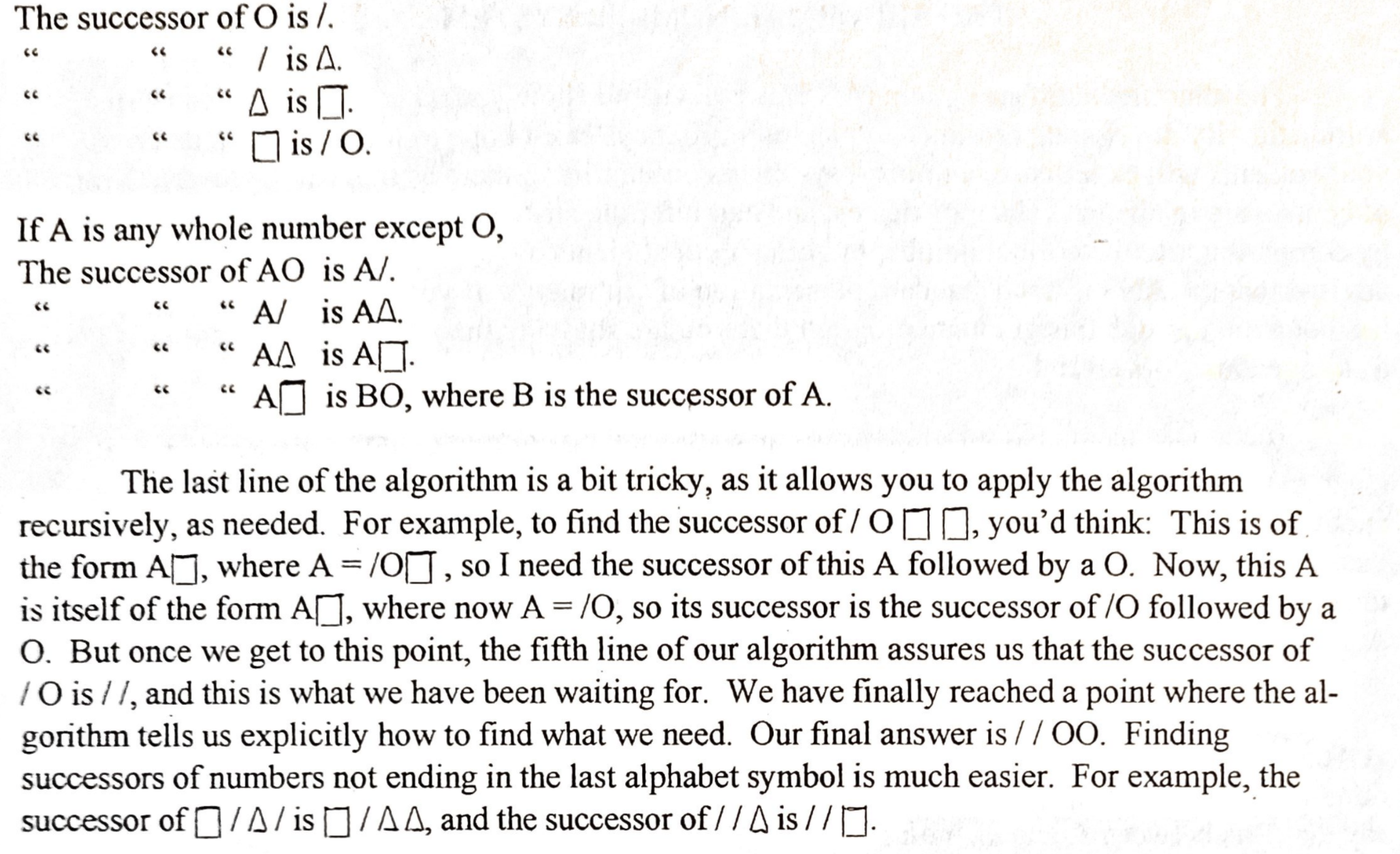
If A is any whole number except 0, the successor of A0 is A1, of A1 is A2,… of A8 is A9, and of A9 is B0, where B is the successor of A.
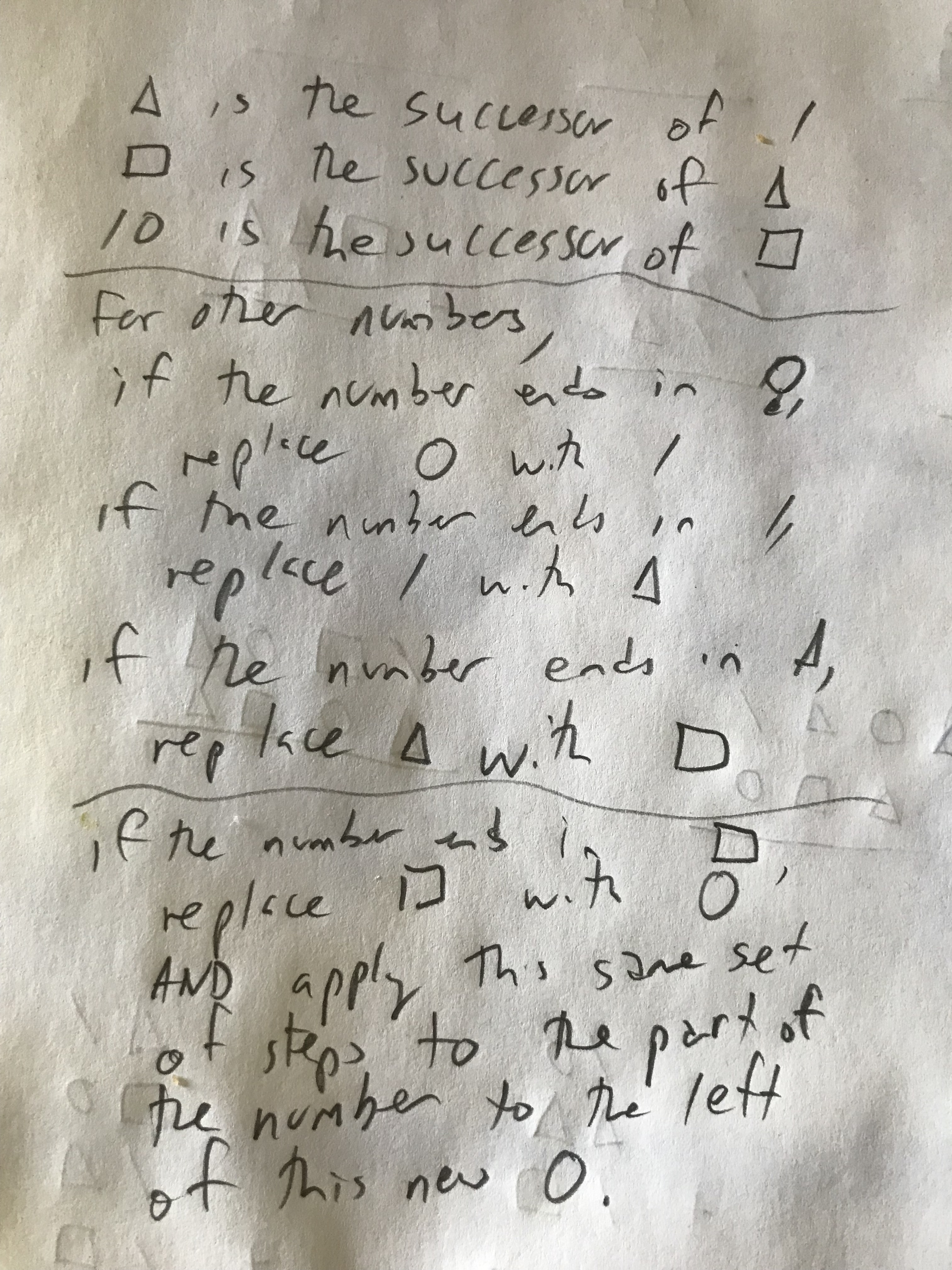
We both move next to the “Abnormal Number System.” As far as I was concerned, Rothchild invented this. David insists he learned it from someone else. Consider the numbers /, ∆, ☐, /❍, //, /∆, /☐, ∆❍, ∆/, ∆∆, ∆☐, ☐❍,…
Now, my version of the class asks students to come up with a “successor algorithm” for the abnormal number system. Here is what I found from Rothchild:
Here is my expected answer:
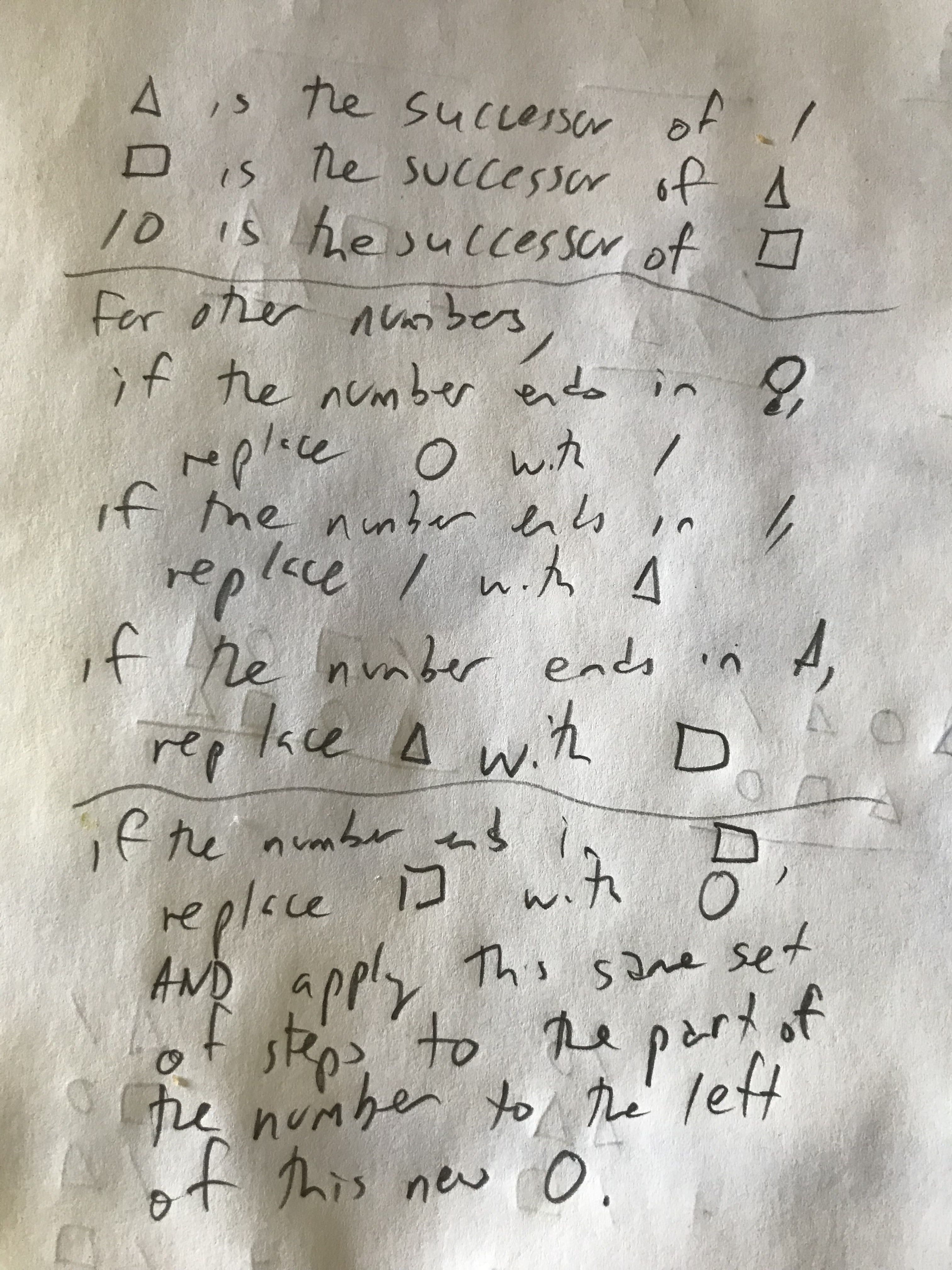
Notice his deft use of A and B. Also notice, he is treating ❍ as his first number. I start at /.
Where do we go next? Counting, predecessors, and addition (where I believe I diverge from my teacher). And we must talk about ❍ vs /. Stay tuned.
Arithmetic
I am teaching arithmetic this term.
It is not ordinary grade school arithmetic. Instead, my students are revisiting arithmetic with fresh eyes.
Here’s what we will do:
- Learn arithmetic again. Kind of regular arithmetic – except instead of 1, 2, 3, 4, 5, 6, 7, 8, 9, 10, 11,… we will use /, ∆, ☐, /❍, //, /∆, /☐, ∆❍, ∆/, ∆∆, ∆☐, ☐❍,… I will call this “the abnormal number system”
- Sneak in some new concepts and definitions. For example, we will dwell at length on the idea of “what comes next” and give it a name – each number has a “successor.” We will attempt to create formal definitions for addition and multiplication, and blend them with our work.
- Teach a basic outline of the 19th Century history of the axiomatization of arithmetic
Here the seminars will diverge. There are two seminars – one for 9th and 10th graders. The other is for 11th and 12th grades. It’s the latter that will forge ahead further, while the former might just get a taste.
- Review proof by contradiction (all of the juniors and seniors previously had a seminar in Set Theory or Logic with some substantial indirect proof. This is review).
- Learn some simple proof by induction. Do some standard high school level problems. Though I am not sure if ‘standard”\’ is the right word – it seems that very few high school students see any proof by induction at all.
- Construct the Natural Numbers, using a modified version of how it was done in the late 1800s. This is Very Hard. We will use the first chapter (10 pages) of this text, reading every line, doing every exercise, completing every proof*.
How was it done in the 1800s?
Warning – gross oversimplification coming: In the 19th Century some mathematicians wondered why Geometry has Postulates, and Undefined Terms, and Formal Definitions, and Theorems, and Corollaries, and Lemmas – but Arithmetic does not. And so they did the obvious – they created Postulates, and Undefined Terms, and Formal Definitions, and Theorems, and Corollaries, and Lemmas – all for Arithmetic. The postulates are called Peano Postulates, after Giuseppi Peano.

A couple more things:
The two seminars have fourteen kids each (just worked out that way). They meet once a week each (by design). I am requiring reading and some exercise outside of class, for preparation. I am not grading homework, and there are no tests or quizzes. We are meeting to discuss mathematics, to ask questions, to explore new terms and notation, new ways of looking at things that once seemed familiar, and to consider what it means to prove something.
An instructor defined proof as “that which convinces.” Maybe I heard that in 1996 or 1998. I am convinced (ha ha) that I have not encountered a better definition. Ever. I share it with my own students.
The instructor was David Rothchild. I say “instructor” because that is what he was. David was quick to correct anyone who called him “professor” or “doctor” – he did not have a PhD. I met him at Lehman College, where I finished my undergraduate studies, and began my graduate work.
In the mid and late 90s I sat with Rothchild for four math courses, courses for aspiring teachers of mathematics. In 601, I think it was, he taught us to view arithmetic with fresh eyes, through a system he called “abnormal arithmetic.” He used four symbols: a slash, a triangle, a square, and a circle. He snuck in concepts, such as “successor” that we would use later in the course – during those harder parts when he introduced Peano’s Postulates. Few courses have had a greater impact on my decades of teaching mathematics.
Two years ago I channelled Rothchild, and tried my own “Axiomatic Arithmetic” – based on my memory of his course from over 20 years earlier. It worked well. That seminar started in person in February of 2020. We suspended it for a few weeks when the pandemic hit, but moved to remote, and met every week for an hour of pure math, until late June. An alum, now a math major at a prestigious institution wrote “I was behind much of the class when it comes to content but I’m pretty far ahead when it comes to proofs. Axiomatic arithmetic was honestly the best way I possibly could have prepared…”
This year I am trying to do it a little better. We will be in person for the full seminar. That’s a plus. And there has been some hype about how challenging it might be, and what an accomplishment it will be to complete this. Eyes wide open. Very eager eyes. It helps.
I will write up synopses of some of the seminars. I will get to ‘successors’ later this week. Maybe ‘predecessors,’ too. The older kids have added. The younger will get their chance after break.
I’ll show you, as I we go. This is fun.
Do the right thing?
The UFT’s leadership has an opportunity to make the union stronger. Will they do the right thing?
My union is the United Federation Teachers (UFT). The leadership is completely controlled by a “caucus” or political party, whose politics generally align with centrist Democrats – but whose day to day politics are about maintaining power, and not much more than that. This caucus is called Unity. I think they should be replaced.
But today Unity controls the leadership of the UFT.
Over the course of the pandemic members of our union have seen our union leadership in different situations and different ways than before the pandemic. Policies affected us directly, in what were truly life and death situations. Members who never paid attention paid attention.
And now that members were paying attention, what did they see?
Policy, Pandemic, Conciliation
Policy letters, sent out by the UFT President, Michael Mulgrew, of Unity Caucus. Letters that endorsed bad decisions by Andrew Cuomo. Letters that put school opening ahead of our safety. Letters that promoted weirdly risky policies, such as instructional lunch, or weirdly bad planning, like the 2020-21 hybrid plans. Members who had not paid attention to union correspondence before were now reading the stuff, and concluding that we had a problem, a problem named Michael Mulgrew. He may not have written the stuff, but as we talked to friends, coworkers, teachers in other schools, the easy target was the man with his name at the bottom of the email.
Running Meetings Poorly, and Being Obnoxious About It
Delegate Assemblies are usually poorly attended affairs. But during the pandemic they went virtual, and many more people dialed in than used to attend at 52 Broadway or Fashion Industries. And what did they experience? Strange, long-winded, sometimes hard to follow reports – and then the chair of the meeting, UFT President Michael Mulgrew of Unity Caucus, being a jerk to chapters leaders and delegates he disagreed with or didn’t like. His behavior was so bad that last spring Unity lost a vote (they never lose votes, at least until now) based on member reaction to his juvenile behavior alone. That was bad.
There were also town halls, attended by huge numbers of members, who heard the same rambling, though there was far less of the jerky commentary. But between Delegate Assemblies and Town Halls many more members became familiar with the UFT leadership, and did not love what they saw. And they identified what they saw with the person of UFT President Michael Mulgrew of Unity Caucus.
Endorsements
Probably not too many people paid attention to the UFT’s endorsements in last spring’s primary elections. The endorsements are all about handing cash to candidates, not about GOTV (get out the vote) which the UFT can no longer reliably manage. But for those who paid attention they got to see the worst UFT election season. Ever. And not just the mayoral race. And as Mulgrew ran the endorsement events like an emcee, the massive screw ups that were the UFT’s eventual decisions were pretty tightly tied to him.
Medicare Advantage / Mulgrewcare
And the kicker happened this spring. Unity is committed to private health insurance, as their rep explained at the last DA. They are opposed to single payer. We all kind of knew this. What we didn’t know was that they were negotiating to protect the Stabilization Fund at the expense of our retirees. Mulgrew’s folks worked with the MLC to cut a deal to push our retirees out of Medicare into Medicare Part C (private care). They did it in secret. Not just the details in secret. Even the fact that they were negotiating was kept secret. When UFT retirees found out (another union told ITS members, and word spread) – when UFT retirees found out they were pissed and scared about losing medicare, but they were super-pissed about being deceived. Retirees were incensed. Many blamed Unity. But when UFT President Michael Mulgrew of Unity Caucus came personally to “explain” – they got even angrier. Unclear. Deceptive. Smug. Michael Mulgrew came to attract much of the blame personally.
In the Field
I hear members who never cared about the union, deriding the union. Some of the sentiment verges on anti-union sentiment. Our brand – “UFT” has suffered damage. And it is OUR brand – all of us – this is our union. When someone is pissed at Mulgrew and says they no longer trust the UFT – you see that? It hurts all of us.
Opposition / United for Change
A coalition formed to oppose Unity in this election, made up of individuals and caucuses, many of whom are working together for the first time. In the past the odds were massively stacked against oppositions in what were essentially winner take all elections (except for a handful of divisional seats). But this time, because of bad pandemic policy, and bad endorsements, and because many members have seen and not liked big UFT meetings, and because Unity decided to mess around with Medicare… and because the opposition is united… I’d rate us as a long shot, but with an actual chance. Maybe 1 in 50 or even 1 in 20 instead of 1 in 1000 from elections past? I don’t know – I’m making up the numbers based on instinct, but probably not that far off.
In any case. say we have a 3% or 4% chance instead of 0.1% or something like that. A lot of that difference is based on members’s anger directed not at the union as a whole, but at the person of UFT President Michael Mulgrew of Unity Caucus.
And, I have said “we” and “us” – I am running with United for Change. I also say “we” and “us” for the UFT – because while I do not support the reelection of this leadership, it is still OUR union. I am fiercely proud of our union. I want it stronger, better.
So?
So this.
So United for Change has a better (still slim) chance in the election because Michael Mulgrew is at the top of the Unity ticket.
But the UFT is weaker, has less support from members, with all the negative attention Michael Mulgrew has garnered. We all suffer with him in the lead.
We (United for Change) cannot do the right thing here. It has to be Unity. Make our union better. Shore up support from members whose confidence in the union has been shaken through the pandemic. Even though it hurts my election chances, I am asking, pleading with Unity, do the right thing. Remove Mulgrew. Replace him with someone, anyone. Promote him to some position where members don’t see him.
Because in the end, no matter who wins, we all lose if members are turned against our union, against the UFT.
Unity members, do the right thing.

Birthday, 2022
It was my birthday Friday. Not much of a day, and no real celebration. I was wrapping up scheduling, and preparing myself for the new term.
In my morning classes I recognized the day before I was born, Freedom Day, February 3 1964, when almost half a million students boycotted NYC schools to demand integration. Big win, right? Wrong. They got a study and maybe a promise of a commission and then nothing. The talking heads in the video below, actual participants in the boycott, discuss that NYC schools were more segregated in 1964 than ten years earlier when Brown v Board became the law of the land. Well, NYC schools are more segregated today than in 1964. Here’s the clip I showed:
https://www.facebook.com/watch/?v=1513593365492105
I remembered Freedom Day last year, too. I still am flabbergasted that this huge Civil Rights action in New York City is not a required subject/topic in our schools’ history courses. It is safe for New Yorkers to rail about segregation and voter suppression and slavery in the south. But the courage to cast a critical eye on our own history, especially when there are implications for policies today – nah, that courage is depressingly rare.
Walked into one class, African-American Studies, looking for volunteers to swap sections of another class. But the teacher knew what day it was, and asked the kids to sing happy birthday. They did. This version:
Cool music from my childhood. Reminded me of some other stuff. Thought about uptempo funk that I like…. So I wrote “falletinme” on the board and no one knew it, so the teacher googled it and played this:
And that was kind of it, besides calls from friends and family. And a gazillion facebook posts. Now, I know that facebook prompts you, and you just type in “happy birthday!” which holds down the meaningfulness, but I don’t care, I like them, and acknowledged all of them (Saturday) and answered many of them individually.
Saturday was a “signing party.” There is a coalition challenging for the leadership of the UFT – United for Change. To get on the ballot, petitions have to be signed. The current leadership (Mulgrew) handle it easily – but for our coalition the process forced us into tight spaces on a short timeline as omicron is still fading. They definitely were trying to put as at risk (and denied appeals for time, for waiving the requirement since they knew we could do it, for electronic signing, etc). Since their goal is winning, not the health of the union, and certainly not the health of their opponents, this is understandable. But still despicable.
Anyhow, Saturday was a signing party. And I did a bunch of the behind the scenes logistical work. One of the coalition partners, MORE, brought most of the people. And it was tremendous. And here is one of the main organizers singling me out for credit:
It was kind of cool to be treated as the sage veteran with wisdom and experience. I like that role.
Sunday McRib asked me to come out to Jersey. We hiked twice in January, and two weeks ago we faced some icy conditions. We discussed microspikes, and he went out and bought some. So when I got there, he asked if he should bring the spikes. Yup, why not, be safe, just in case. They were still in the envelope they were shipped in.
I picked a spot 25 minutes WNW of him, where we’d never been. Apshawa Preserve. And sure enough, we got there and asked two hikers a bit older than us if we would need spikes on some of the trails. “Everywhere” they told us. So we strapped the spikes on, and walked cautiously, getting used to the feel. Mixed ice and dirt/mud. And then nothing but ice. We gained confidence as we tested the traction. A mile in and we were stomping the ice, like kids stomping through puddles. I can’t remember the last time I saw McRib having so much fun.
And here’s me, with Butler Reservoir frozen behind me.

We walked out a bit on the reservoir. We saw what the ice fishermen had left behind. And then stomped back to the car.
A nice end to a fairly uneventful birthday weekend.
Lousy week, good story
Last week was lousy. Omicron was raging. I had issues to deal with. Not good. I didn’t write. Not at all.
The long weekend was welcome. And after three days, I’m feeling a little better. I don’t know exactly why, but I’ll make a list of four possibles.
1. Staying on top of a resolution. A book a week. I meant it. And I have been making it. I opened with A Game of Birds and Wolves about women in Britain who joined the naval auxiliary during WWII and worked on war-gaming the battle of the Atlantic. And this week I read Spider Silk: Evolution and 400 Million Years of Spinning, Waiting, Snagging, and Mating, clearly written, organized by evolutionary twists and turns, with nice illustrations. Fascinating. I met one of the authors four years ago, and upon hearing the book broadly described, declared that it reminded me of something one of my favorite authors, John McPhee, might have written, and “of course you have heard of him?” He had been the author’s advisor at Princeton. I can still taste my shoe.
2. I made winter soup. It’s not the right name. I don’t think it has a name. But It is a ponderously heavy concoction of bones and lentils, split peas and barley, with carrots, celery, onion and parsley. With salt and black pepper. On a cold day it warms me from my core, and reminds me of winters growing up…
3. Walks on Saturday and Sunday, one with a twist. Sunday was a nice stretch, a little longer, and quite needed. It was not bitter out. Saturday was bitter. Saturday we batted around ideas for where to go, and settled on a lake in north Jersey, in a park big enough to have trails move away from the (exposed) lake shore. The wind added some bite, and the temperature was low by the water. We passed some people ice fishing, and turned to head away from the water.
We must have missed a turn off and reached a small camping/parking area when we heard a pick up come up behind us. He parked and got out and it wasn’t a ranger. We said hello, and so did he, and we asked what he was doing. Checking his beaver traps. The beavers dam the streams and flood the park and the Parks people think they are a nuisance and this guy gets permits, and comes in and traps. He sells the pelt, and the meat. Beavers are vegetarians, he explained, they taste good. And we explained we were hiking, and he warned us about ice patches under the snow on the trail we were pointing to. It wasn’t snow everywhere, but there were patches, more in come places than in others, so it was a worthwhile warning.
So we move up the trail, a little slowly because of the snow patches, and in case of ice, and we are passing a frozen pond on our left, and we hear something. The trapper who had been fiddling with his equipment by the truck has now caught up with us. His traps, he motions, are on the pond. And my friend wants to follow him, and at first I’m nervous about walking on a frozen pond, but my curiosity got the best of me, and I’m stepping and sliding forward and avoiding weak spots.
We came past something that could have been beaver construction to his first “set.” He showed us the sticks and wires. But the trap was in the water. He pulled out a hatchet to chop through the ice. Now, I’ve never seen a beaver trap before, so I didn’t know what to expect. Those of you who know, it was a Conibear 330. As he chopped through the ice he talked. He was local. He learned to trap from his father who used to trap when he didn’t have work. He plucked out ice chunks, and tried to free the trap, but could not, not yet. This trap (as he continued to chop) had been his father’s – the trap was maybe 70 years old. You pass down your traps, he tells the two of us who have never trapped, with care, like you pass down your guns, he tells us, who own zero guns between the two of us.
And we were not about to see a beaver – he could see the trap had not been tripped. Did it look like jaws? That was my question. No, it’s not a snare. And a few minutes later he almost yanked it out – cleared more ice, and then showed us. It was like a big mouse trap without the base. We wished him luck.

4. Omicron has peaked in NYC. And I’m still negative.
I knew this last Monday or Tuesday, it’s true. The shape of the curve looked like the one from South Africa’s omicron surge, so the timing was about right. And the surge was slowing right before the weekend, so the little drop after was probably more than weekend cases being reported on the wrong day. And I read about the virus load in waste water in Boston (fascinating, look here or at these charts.)
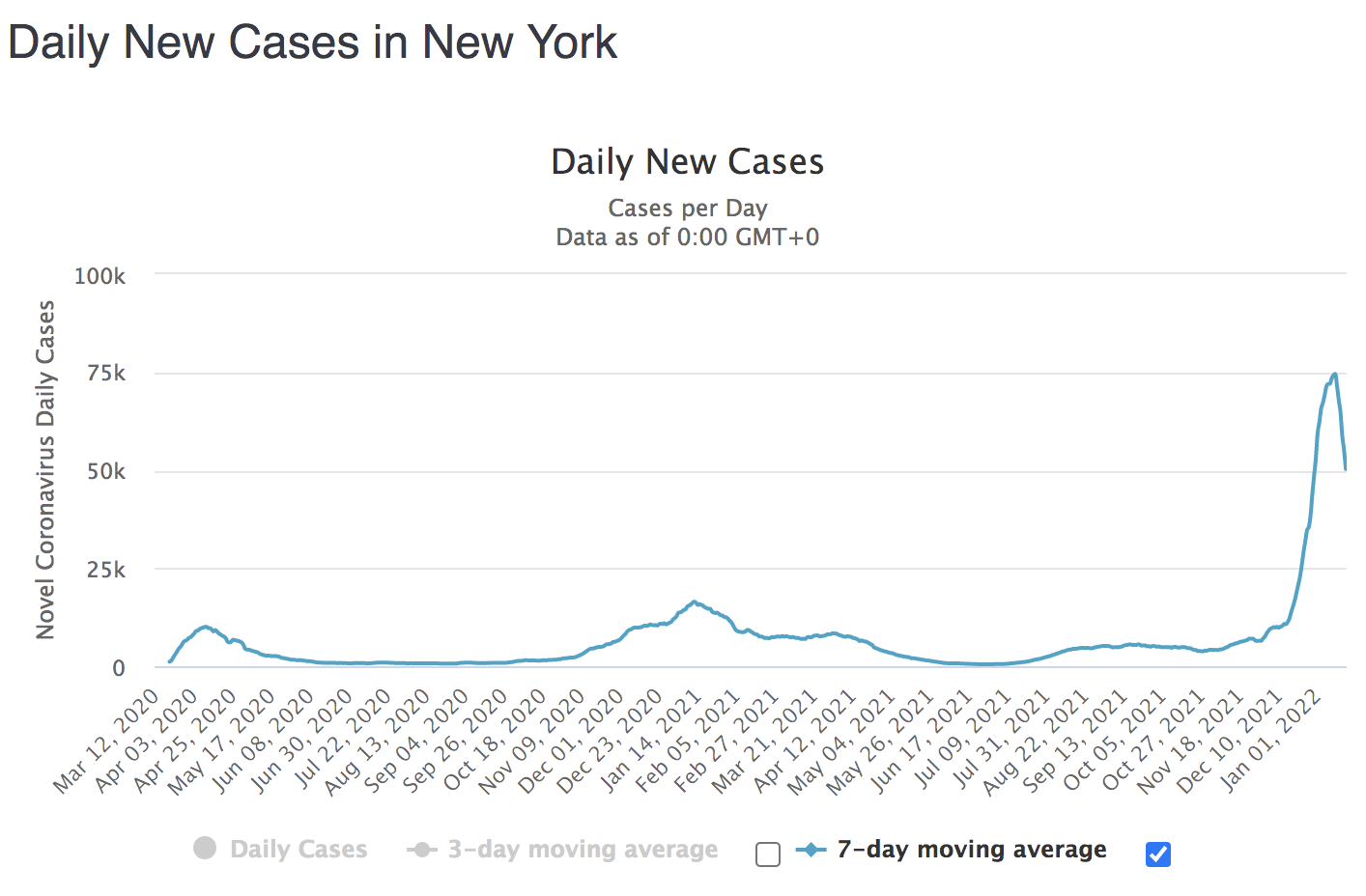
You can also see above the cases dropping (New York State, no City). But you can also see below, the number of people dying is as bad as last winter, which was pretty bad. Want to keep that in mind and be careful how we use the term “mild.”
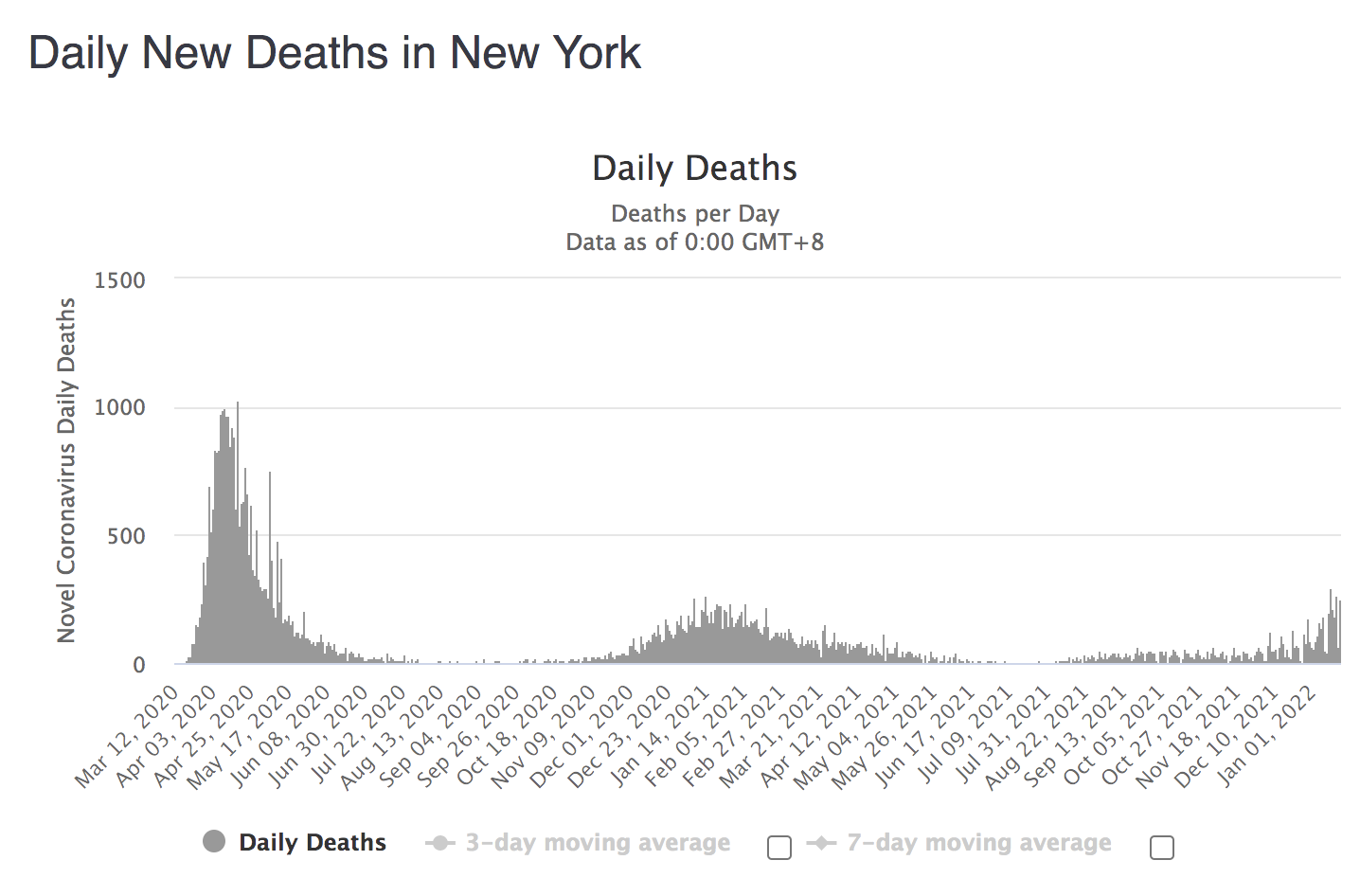
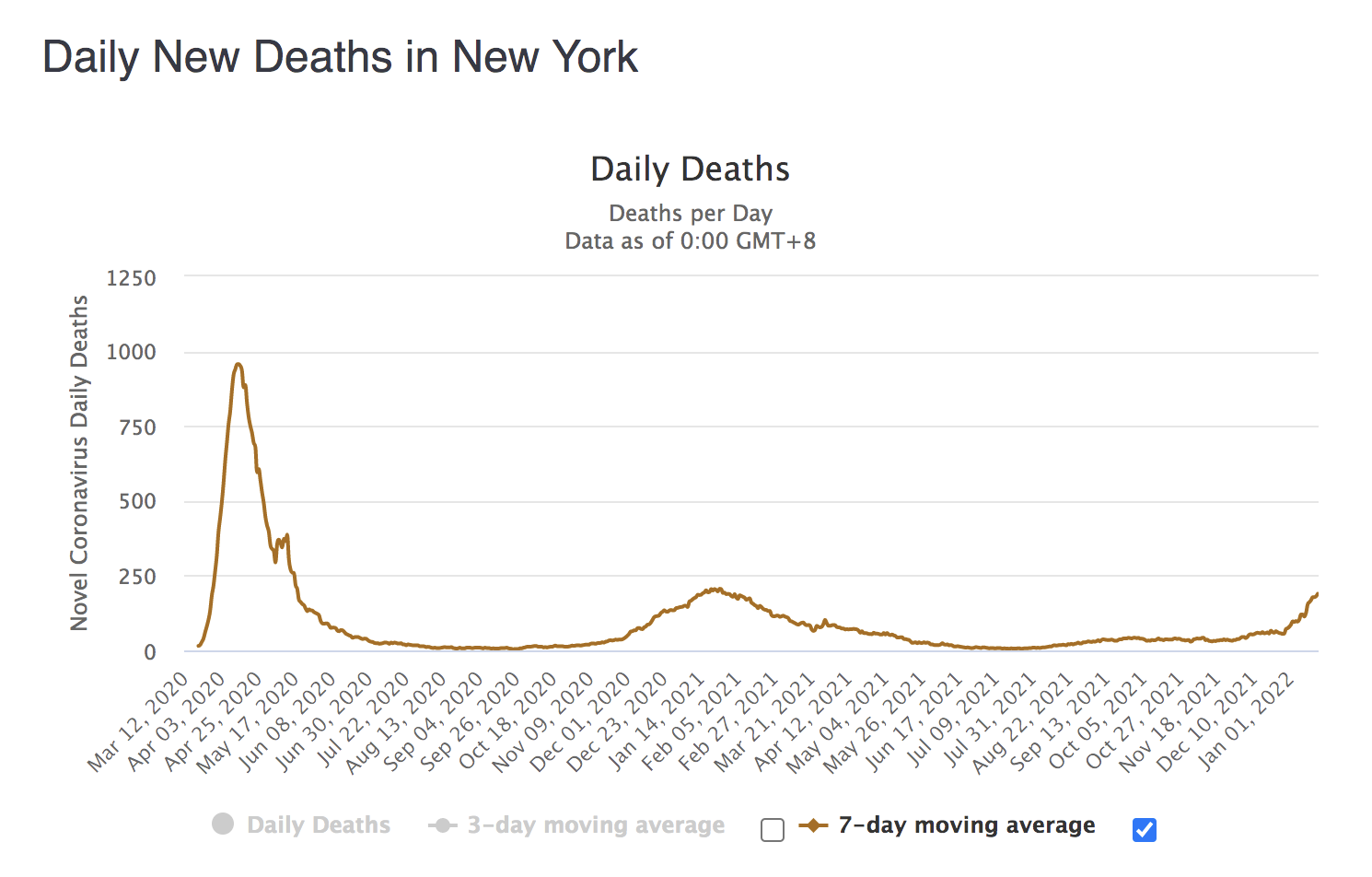
Stop Contracting Out / Against Privatization
These words have special meaning within the UFT, today.
It’s a good position in general. It can be a good slogan. But we can get specific.
In fact, “we” have. The United for Change coalition adopted this platform plank:
No Corporate Interests in Education and Healthcare: We will fight to remove private greed from our profession, our livelihood, and our schools.
- Reverse privatization of Medicare for NYC municipal retirees. No in-service healthcare givebacks. Support single payer public healthcare.
- Rescind mandatory HMO enrollment for new UFT members. Bring back choice.
- End high-stakes testing. Replace with fairer forms of student assessment.
- Fight the privatization of public education. Reverse the spread of charter schools in public education.
I’m going to write, just a little bit, about each of these four points. But not in order. And then I’m going to write about a fifth point that could have been included, about a major NYC organization that has contracted out work, while laying off workers.
Charters
The number one privatization scheme in local education in NYC today are charter schools. 90% anti-union. High turnover. Sucking public money into corporate pockets. We need a leadership that opposes their proliferation – that stands up for public education – that stops the give away of public school resources – AND PUBLIC SCHOOL BUILDINGS – to private interests. And not some of the time – all of the time. Enough backroom politics around raising or maintaining the cap, tying charters to other bills or deals. It’s going to be hard to make up all the ground we lost under Unity leadership – Weingarten and Mulgrew allowed almost 300 charter schools to open and siphon almost 15% of students out of the public school system. We need new leadership to stop and reverse this destruction of public education, to get these corporations and anti-union profiteers out of NYC.
Medicare
Hands off Medicare! I guess I’m shouting at my union leadership. Public health care for seniors – good idea, right? This year Mulgrew rolled out a privatized version – Medicare Advantage Plus. Seniors are now going to be forced to make hard decisions (and they should pick what works best for them). But the politics here are clear – move forward towards single payer, stay still, or move backwards to privatization. Mulgrew and what some are calling MulgrewCare are big steps backwards. There is a proposal for single payer in New York State, the New York Health Act. It needs work – work that the unions should be engaging in. Instead Mulgrew is bringing more private interests into our healthcare. And Mulgrew is working to kill single payer, the NYHA. New leadership is needed to fix the bill, and get corporate interests out of our health care. Who wants a clerk in Idaho deciding if your colonoscopy is covered? And has an insurance company ever delivered a baby, removed a growth, treated an infection? Let’s focus on not lining corporate pockets, but on getting our members and retirees the health care they deserve.

Mandatory HMO Enrollment?
Bet you didn’t know, new teachers, that back in the day, like a few years ago, new teachers could choose their health plan? Seriously, we didn’t all start in HIP.
Bet you didn’t know, senior teachers (those hired before 2019) that all new teachers have to join an HMO, HIP. They don’t get a choice of what plan to start in. The next year they can switch.
Bet you didn’t know, all teachers, that Mulgrew is flirting with the idea of making it so new hires have to start in HIP HMO, and have to stay there for FIVE years. Seriously – I was on a zoom with Florida retirees, and that’s exactly what he said.
So we could ask Mulgrew to change the policy. Or we could ask the members to change the president. Which do you think would work better?
High-Stakes Testing
I don’t want to write much about this now. There are so many problems with high stakes testing. Profits are just one small part of the problem. But they are real – the corporate profits (massive) from the tests themselves, from the test prep, from the curricular materials designed to meet the distorted curricula… Big money, that we should get out of education (not just for reason of de-privatization). Anyhow, here’s stuff I wrote about one profiteer that’s got to go.
One more
When talking about privatizing and corporate greed we’ve looked at medicare, and charters, the College Board, and an HMO. None of those are surprises.
But it turns out that the UFT’s hated “concierge” telephone service – the thing that stops me from reaching offices in a normal way, and that leaves my members on long holds – and that makes everybody answer Big Data questions before proceeding to someone who can answer a question – that union call center is not one. It’s not a union call center.
There’s also the issue of having to call a call center. It’s like calling the cable company, but worse. Members deserve better from their union.
Norm Scott uncovered the secret. Mulgrew fired the retired UFT members who were answering the phones, and contracted the work out. Those are no longer UFTers you are talking to, wasting your time. Go read his first piece, The Face of the UFT is Salesforce, and then his follow up, Workers Sue UFT over being replaced by Salesforce. It’s a real story.
And I’m going to ask UfC if we can add:
- Fight the privatization of UFT member services. Hire retired teachers.
to our platform.
Spring Break 2020 – Part II
Part I: Cuomo took away Spring break. Five days. Mulgrew backed him up. Then de Blasio took away the first day of Passover and Good Friday, and Mulgrew went ballistic. The DoE unilaterally gave us 4 sick days as compensation – we took the days but did not accept that they were compensation. Every Town Hall and Delegate Assembly since Mulgrew has been hounded with questions about Spring Break 2020. When arbitrations started again, the UFT leadership put this one in. And this week the ruling came…
So the ruling is here: spring-break-arbitration-decision. What did we get? What should we have got? What are the details?
The ruling introduces a new kind of day – a vacation day. A vacation day is different than a sick day because 1) it can be used without providing a reason, and 2) Vacation Days can be used at any time, with some school based approval/disapproval, and 3) left over days are paid out, at retirement, at full value (instead of 2:1 like CAR days).
Those 4 CAR days they already “gave us” will be converted to Vacation Days. And then we will get up to 3 more Vacation Days. The total each one of us will end up with will be equal to the number of days each of us worked.
People who separated from service will get a payout.
Comments
Some Days are Worth More than Others
The arbitrator, Scheinman got it wrong. Read more…
Spring Break Arbitration (searchable document)
The UFT posted a pdf that was not searchable. I converted it to a word document.
Here’s the document spring-break-arbitration-decision.
And here’s the text (with unfortunate spacing, but better than nothing):
AMERICAN ARBITRATION ASSOCIATION
X
In the Matter of the Arbitration
X
between
X NEW YORK CITY DEPARTMENT OF EDUCATION X
Re: Spring Recess
Case #A-079-C23132
“Department” X
-and- X
UNITED FEDERATION OF TEACHERS X
“Union” X
X
APPEARANCES
For the Department
Karen Solimando, Executive Director
For the Union
David Campbell, Director
BEFORE: Martin F. Scheinman, Esq., Arbitrator
BACKGROUND
In this Union initiated (“Uin) grievance, the Union protests the Department’s refusal to compensate its represented employees for seven (7) extra days of work resulting from the cancellation of Spring Recess 2020. The Union contends the Department• s decision in April 2020 to require schools remain in session during the previously scheduled Spring Recess resulted in seven (7) uncompensated school days and the lost opportunity for staff to take planned vacation time off and is in violation of Article(s) 3, 6 and 20 of the Collective Bargaining Agreement (“CBAn) and corresponding articles of the CBAs of all other impacted titles. It asks for a determination compensating the impacted represented employees for these seven (7) days insisting the four (4) Cumulative Absence Reserve (“CARn) days provided by the Department are insufficient compensation.
The basic facts are not in dispute. New York City (“NYCn or “Cityn) is now some twenty three (23) months into the COVID-19 pandemic. Throughout this period, the City and its municipal unions have worked collaboratively to provide needed services for the City’s 8.8 million residents and, as most relevant here, its more than one million public school students. While at times experiencing issues, some of which I was called upon to resolve, the Department and the Union have worked together to transition
from in-person to remote learning to hybrid learning and then back to full in-person instruction. Throughout this period, and despite great strain from the pandemic, educators and administrators at all levels strove to deliver the best experience possible under challenging circumstances.
Most relevant to this matter, prior to the pandemic, on April 29, 2019, after consultation with the Union, the Department issued its “2019-2020 School Year Calendar,” setting Spring Recess for Thursday, April 9t h through Friday, April 17t h , a total of seven
(7) weekdays. (UFT Hearing Documents, pp 18-22). A revised
calendar was issued on September 24, 2019, containing the same
scheduled Spring Recess dates for the coming year. Documents, pp 23-27).
(UFT Hearing
The weeks leading up to Spring Recess 2020 saw the Covid-19 pandemic in its initial surge. With cases rapidly rising, Mayor de Blasio, on March 12, 2020, issued Emergency Executive Order No. 98, declaring a state of emergency for the City. That Sunday, March 15, 2020, the Mayor and Chancellor Richard Carranza announced NYC public schools would be closed for all students from March 16- 20, 2020. During this week, all staff prepared to engage in remote
instruction/learning. March 23, 2020.
All schools commenced remote instruction
On March 27, 2020, Governor Cuomo issued Executive Order (“EO”) No. 202.11, which, inter alia, waived the one hundred eighty
(180) instructional days requirement for school districts and directed schools continue to “first use any vacation or snow days remaining.” (UFT Hearing Documents, pp 35-38).1 On March 30, 2020, the State Education Department (“SED”) issued a clarification “school districts must continue to provide remote instruction for students, meals for students, and childcare for essential workers every weekday between April 1, 2020, and April 14, 2020, even if the district is scheduled to be on spring break during that time” (UFT Hearing Documents, p 39).
On March 31, 2020, subsequent to SED’s clarification, UFT President Michael Mulgrew wrote to UFT members via email that while schools would be open remotely beginning Monday, April 13, 2020, schools would be closed on Thursday, April 9 and Friday, April 10,
1 The directive contained in Executive Order 202.4 indicated, relative to the closure of schools statewide, shall hereafter be modified to provide that all schools shall remain closed until April 15, 2020, at which time the continued closure shall be re evaluated. No school shall be subject to a diminution in school aid due to failure to meet the 180 day in session requirement as a result of the COVID-19 outbreak, provided their closure does not extend beyond the term set forth herein. School districts must continue plans for alternative instructional options, distribution and availability of meals and child care, with an emphasis on serving children of essential workers, and continue to first use any vacation or snow days remaining.
2020, for the religious holidays, as standard in the school calendar. (UFT Hearing Documents, pp 45-47).
However, in order to be in compliance with the Executive Orders and NYSED directive and to avoid losing critical and much needed state funding, all Department staff continued to work remotely and school-based staff provided an alternative instructional program during the 2020 Spring Recess. On April 3, 2020, the Chancellor emailed all staff announcing schools would remain open remotely on April 9 and 10, 2020, in addition to Monday through Friday of the following week. This resulted in Union represented school-based employees being required to work through religious holidays in addition to the full Spring Recess. This added seven (7) days to the work year and required those who sought to observe the religious holidays to utilize existing CAR days.
On April 4, 2020, to resolve the issue of the right of employees to observe religious days without loss of earned days, the Union, along with other unions representing school-based employees, reached a Memorandum of Understanding (“MOU”) with the Department that provided teachers and other school-based employees with four (4) additional CAR days that could be used for religious observance days or reserved to be used for sick days.2 The MOU
2 For twelve (12) months employees were to receive four (4) sick days or four (4) annually leave days, at the employee’s option.
also included provisions reserving the unions’ rights to pursue compensation for working during Spring Recess (Union Hearing Documents, pp 50-54: “Each Union expressly reserves its rights t.o seek additional compensation in order to make represented employees whole for time worked during the previously scheduled spring break”).
After discussions to resolve the matter proved unsuccessful, the UFT filed the instant grievance on July 1, 2021, seeking full compensation for all employees for work during Spring Recess, April 9-17, 2020, in violation of Articles 3, 6 and/or 20 of the Collective Bargaining Agreement. A Remote Conference was held at the DOE on September 28, 2021. By decision issued December 9, 2021, the Department denied the grievance. (UFT Hearing Documents, pp. 55-57.) The UFT promptly sought arbitration of the matter by demand dated December 14, 2021. (UFT Hearing Documents, p. 58.)
I held pre-hearing conferences on November 17, and 24, 2021, and a hearing on December 15, 2021. At those times, both parties were afforded full opportunity to introduce evidence and arguments in support of their respective positions. They did so.
During these conferences and formal hearing, I made a series of interim determinations including that some form of compensation
was due for the extra days worked. I directed the parties to consider draft language reflecting this ruling and also to provide
possible remedies. Even though I am familiar with the language of the current Collective Bargaining Agreement and related policies since I am a member of their permanent arbitration panel and have served as mediator and fact-finder during several rounds of bargaining, including most recently in connection with the implementation of a vaccine mandate, I concluded the parties are more familiar with Department policies and procedures and how leave and entitlements should be administered in tandem with prior agreements. As such, my determination reflects the parties’ proposed language in response to my rulings.
DISCUSSION AND FINDINGS
The Issues:
The basic issues to be decided are:
- Did the Department violate the parties’ various Collective Bargaining Agreements in the way in which it treated employees represented of the Union regarding the Spring Recess in the school year 2020- 2021?
- If so, what shall be the remedy?
Positions of the Parties
The Union asserts employees who work additional days performing their duties should receive monetary compensation for those days. While employees can, under appropriate circumstances,
be ordered to work additional days, they cannot be ordered to work those days without compensation, insists the Union. The Union cites prior Awards by Arbitrators Jay Siegel and Carol Wittenberg in support of this proposition. Nor, urges the Union, is it relevant what specific instruction occurred on those days, for student instruction and activities varies throughout the year with some days allowing for special activities and soine typical instruction. Whether directing enrichment or a math lesson, employees were required to perform their professional duties on those days and prevented from engaging in planned vacation activities, asserts the Union. Therefore, the Union insists additional compensation is appropriate.
The Union alleges a Spring Recess vacation is omnipresent on the school calendar and is incorporated into the Agreement pursuant to Article 20. Article 6 of the Agreement provides the Department set the number of school days and the dates of scheduled Vacation Days with the Union prior to the beginning of the school year. The school calendar, once finalized, establishes the workday schedule for that school year, maintains the Union. In its view, the only ability to deviate from the set calendar is in circumstances where snow days or school closure in response to other events require certain predetermined recess days (not beginning with Spring Recess) be converted to schooldays, where
there is a one (1) for one (1) exchange of a school closure day for a recess day. Additionally, Vacation Days may only be taken, in the agreed upon order of preference, to the extent needed to
“meet the statutory minimum,” Art. 6, C. minimum was suspended.
Here, the statutory
The Union further argues the cancellation of Spring Recess not only resulted in additional work without pay, it also forced some employees to use accrued days for their religious observance, for there were certain holidays which fell during the Spring Recess. It is for this reason, urges the Union, the parties in recognition of the magnitude of the disruption to employees of being required to work not just during a scheduled vacation, but also during religious holidays, entered into an MOU. That MOU addressed solely the re•ligious observance issue, granted each employee four (4) CAR days and explicitly recognized and reserved to the Union (and the other participating unions) the right to later bring claims for additional compensation such as this UI. As CAR days are limited use days, for employee illness and preapproved personal business, the Union contends CAR days do not provide equal value for the additional days worked and the loss of unencumbered paid Vacation Days. Accordingly, the Union seeks monetary compensation for the seven (7) days worked.
In the alternative, given my preliminary indication monetary compensation did not seem to be the only way to address the purported inequity suffered by the represented employees, I asked for other possible remedies to ensure employees receive equal value for the vacation time lost. In this regard, the Union believes an appropriate remedy is to provide credited paid Vacation Days to employees who worked during the Spring Recess. CAR days, as suggested during the hearings by the Department, would not provide equal value as they are limited use days that would not replace the lost unencumbered time to engage in self enriching, relaxing or family activities, insists the Union. The Union also notes CAR days would not provide equal value when paid out, should they not be utilized. Accordingly, the Union posits, a vacation pay remedy would provide for up to three (3) credited paid Vacation Days and up to four (4) CAR days converted to Vacation Days, for each day an employee worked during Spring Recess, if I declined to award the monetary remedy pressed by the Union.
While the Union understands a myriad of administrative factors go into properly staffing a school and providing instruction and services, to properly mirror the lost vacation time the scheduling of Vacation Days should be done with ample lead time for administrators, but with limited bases for denying the requested days. The Union asserts an appropriate balance can
be struck between administrative needs, fairness and transparency if employees are required to submit requests for the use of Vacation Days prior to commencement of each term and administrators were able to deny requests only if they exceeded an agreed upon cap. For example, the Union speculates if 10% of the employees in a school or program (or more than one (1) employee in a school or program with nine (9) or fewer employees) requested a Vacation Day this could be resolved by the existence of such a cap.
The Union also notes by providing a clear and streamlined process for use of the Vacation Days, employees will be encouraged to use the days, thereby reducing the cost of compensating employees for those days as the cost of substitute coverage is typically less than would be required to pay staff based upon a pro rata share of salary. Nonetheless, such Vacation Days should not expire and should be paid out on a one (1) for one (1) basis upon separation from service and to those who separated from service after Spring Recess but before determination of this grievance, urges the Union. In its view, this will also reduce the burden on the Department by spreading out payouts over several years.
Finally, the Union urges, employees whose circumstances resulted in their having used more than the four (4) CAR days allotted in the MOU during Spring Recess should not suffer a net
loss of CAR days because of the scheduling change. Accordingly, any CAR days beyond four (4) used during Spring Recess should be refunded to employee CAR accounts, lest an unfortunate employee who was out sick all of Spring Recess receive no Vacation Days and be out an additional three (3) CAR days beyond those allotted under the MOU.
The Union proposes any disputes under the program be directed on an expedited basis to Scheinman Arbitration and Mediation Services (SAMS).
The Department (“DOE”), on the other hand, submits the grievance should be denied on several bases. As an initial matter, the Department claims there is no contractual entitlement to Spring Recess. Article 6 of the Teachers’ CBA specifically defines the work year as:
- All teachers shall report to their schools to begin work on the Tuesday following Labor Day and will have a professional day on Brooklyn-Queens Day. The Tuesday following Labor Day may be an instructional Teachers shall be in attendance on duty thereafter on all days of the school year except for the last two weekdays of the month of June. The official school year calendar shall provide a one week February mid-winter recess which includes Washington’s Birthday, without reducing the number of instructional days for students. In no event, however, shall the number of days worked in any school year under this work calendar be fewer than the number of days teachers would have worked had they reported, as before, on the Friday after
Labor Day and worked through the last weekday in June.
- Emergency Closings
- The Board of Education (“DOE”) and UFT recognize that due to emergency conditions (including, but not limited to snow closings) there may be situations where the DOE may fall short of the minimum number of instructional days required annually by the Education
- Prior to opening of each school year, the DOE and UFT agree to jointly determine those Vacation Days during designated recess periods which shall be used in the event that there is a need to make up days in order to meet the statutory minimum and the order in which such days would be
- In no event shall the number of make-up days exceed the number needed to meet the minimum required by the Education
The Agreement specifically recognizes and guarantees a February mid-winter recess but is silent with respect to Spring Recess. Moreover, even if there is an entitlement to Spring Recess, the contract recognizes recess periods may be eliminated and used if “there is a need to make up days in order to meet the statutory minimum.” Here, based on the Executive Orders and NYSED directive, there was an “emergency” which required the Department to continue instruction during the 2020 Spring Recess to meet the statutory minimum instructional days and avoid losing state funding, insists the Department.
Second, the Department and Union entered an MOU which provided all staff who worked during 2020 Spring Recess would receive four
(4) days in their respective accrued leave banks. This additional time not required under the Agreement, maintains the Department, should satisfy any liability or obligation owed to Union members that worked during the 2020 Spring Recess. Although all staff were required to continue working remotely during the 2020 Spring Recess, the Department notes that work was different because a menu of options was provided.
The Department further contends if, however, additional compensation is due to the Union represented workforce for the lost vacation period, the days should be deemed CAR days and paid on a 1:2 basis upon separation from employment.
Moreover, with respect to the use of the days, the Union’s remedy request staff have an “automatic right,” without any supervisory oversight, to use any “make up” days (i.e., the CAR days previously provided by the Department and if any addition days are provided in the instant matter) should be rejected based on the impact on Department operations. While the Department recognizes the commitment and critical role all staff played in maintaining an instructional program during 2020 Spring Recess, an “automatic right” to a day off (or consecutive days) without supervisory oversight would negatively impact staffing and
services to students. The Department fully expects, absent compelling circumstances, staff should be able to easily utilize the accrued time off to care for themselves, others or to recharge. However, the Department maintains school supervisors should have authority to reject an absence request to ensure appropriate staffing for students’ instructional programs and school operations.
Opinion
After having carefully considered the record evidence, and having the parties present arguments and documentary evidence, as well as responding to my inquiries, I make the rulings set forth below. While some ‘of the language has been drafted, initially, by the parties in response to my rulings, in the end the language set forth, herein, is mine alone. I hereby issue the following Award:
There is no dispute employees worked seven (7) days which had been scheduled for vacation for the 2019-2020 school year. When employees perform additional work, they are entitled to additional compensation. This principle is well established even as among these parties. For example, in UI SESIS 1, Arbitrator Siegel ruled the implementation of the special education reporting system known as SESIS required employees to work beyond their regular workday. Accordingly, he found the workday provisions of the CBA were violated when a significant portion of SESIS users worked beyond
their workday. Siegel ordered those employees be compensated at a pro-rata rate for all time spent working on SESIS outside of their regular workday.
In UI C-175, Arbitrator Wittenberg found educators teaching classes for credit outside of the school day must be paid pro-rata rather than per session. In so holding, Wittenberg relied on Chancellor’s Regulation C-175, which describes per session work as “comprise[d of] any activity that is not part of, or an extension of, a pedagogic employee’s primary job responsibilities.” Regular classes held after school were an extension of the teacher’s primary job responsibility and compensable at a pro rata rate commensurate with their salary.
This case is analogous. Employees worked additional regular school days. They performed their typical and primary duties
during that time, albeit remotely.
This work was an extension of
their primary job responsibilities.
On a practical level, the
days were essentially paid Vacation Days during which employees were required to work. Indeed, the Agreement refers to them as “Vacation Days.” Article 6 C. The Department’s argument employees are not entitled to compensation for extra days worked because the Spring Recess was cancelled as a result of an order from the Governor (with clarification from SED) is unavailing. While employees may be ordered to work additional hours or days during
an emergency, they cannot be ordered to do so without compensation. Furthermore, the parties already indicated something additional was in order when it agreed to the MOU.
While additional CAR days might be a possible resolution of this grievance, I find them inadequate. CAR days are of a different nature than the Vacation Days that were lost. The use of CAR days is limited and does not serve the recognized need for time to disconnect, decompress and restore. Then Chancellor Carranza recognized in his original message to educators, and the Department acknowledged during the hearing, the need for the days off and the impact on educators for having lost them: “We recognize this may feel like a disappointment to many students and schools as we have all been working tirelessly in our transition to remote learning and very reasonably want a break. Many of our educators are parents themselves, and this has been an especially challenging time for them. We hear you and recognize the need…. We thank all of our educators for the sacrifices they’re making in advancing
the health, safety and we,llbeing of our city.” Documents, p 50.)
(UFT Hearing
Thus, appropriate compensation for the additional time worked requires either cash compensation or some restoration of the lost Vacation Days.
Having found compensation is due and additional CAR days would not provide equal value, I need to determine what form the compensation should take. The Union argued in the first instance the proper means of compensation is to pay employees who worked during the Spring Recess 1/200 of their annual salary at the time of payment for each additional day worked. The Department estimates this remedy will cost hundreds of millions of dollars. While I understand the rationale for this approach in light of the ongoing pandemic, the need to continuously respond to changing circumstances and consideration of the potential cost to the Department, I find. restoration of the lost, unencumbered paid Vacation Days is the more appropriate remedy for what the employees lost, namely, rest time.
Had I ordered direct compensation to make employees whole for the lost use of the schedule Vacation Days, as the Union contended, it would require the Department to pay all eligible employees for seven (7) full school days. It would also require that those who separated from service on or after April 10, 2020, be paid the same rate. This amounts to a substantial sum and would be burdensome to the system. Moreover, it would not equalize what the employee actually lost, namely, vacation time. At the same time, limiting the remedy to a few additional CAR days, as urged by the Department, would not provide employees with the full value
of what was lost. Arguments regarding what specific work was performed on those days miss the point; employees were required to perform the duties the Department asked of them as part of their jobs. Accordingly, crediting employees with paid Vacation Days that can be used in the future would both limit the cost to the Department (as the cost of substitute coverage is generally lower and any payments after separation would be spread out) and more accurately reflect the loss opportunity to spend time away from work in whatever manner the employee chose when Spring Recess was cancelled.
A paid Vacation Day benefit allowing staff to take off on days school is otherwise in session does not currently exist in the Agreement. Rather, teachers have “Vacation” days during periods of school recess, i.e. Spring Recess. Accordingly, certain procedures need be adopted in order to provide credited Vacation Days in a manner which will provide equivalent value to employees at issue. Further, while these employees already received four
- CAR days pursuant to the MOU, a CAR day is different from a Vacation Day. The use of CAR days is limited to self-treated or medically certified absences (illness) or pre-approved personal business, including the care of a sick family member, that cannot be conducted outside the school day. Employees cannot use CAR days to take a trip, go to the beach, run an errand, or otherwise
spend quality time with family. Unused CAR days are also cashed out at a two (2) for one (1) basis, rather than at the full value of the day.
Accordingly, the Department is ordered to provide paid “Vacation” days for each day a qualifying employee actually worked during the 2019-2020 Spring Recess. No employee shall receive more Vacation Days than they actually worked. For clarification purposes, the CAR days provided under the MOU shall be converted into Vacation Days together with three (3) additional Vacation Days, up to the total number of days actually worked during Spring Recess. Days already utilized as CAR days shall count against the seven (7) Vacation Days being granted.
Pursuant to the program outlined below, the credited days shall be available for use beginning February 1, 2022. Unused Vacation Days shall be paid out on a one (1) for one (1) basis as described, below. I find this program will provide employees with the full value of the lost days while balancing other issues raised by the Department regarding coverage and the ability to fully provide students the education and services they are entitled to receive.
- Scope and Entitlement:
- For purposes of the Vacation Day program, an eligible “Employee” shall refer to any Union represented employee who was directed to work during the previously scheduled 2020 Spring Recess and shall not include any employee who works in a title that normally works during the Spring
- Employees who were on payroll during the period of April 9, 2020, to April 17, 2020, shall receive one (1) Vacation Day for each day they worked during that period. No employee shall receive more than seven (7) Vacation Employees shall first receive a maximum of three (3) Vacation Days credited to their Vacation Bank and then shall have up to four (4) of their CAR days converted to Vacation Days, subtracting CAR days actually used which were provided pursuant to the MOU. There shall be no minimum CAR balance to allow for the conversion. For example, if an employee worked five (5) of the seven (7) days, the employee would receive three (3) credited Vacation Days and two (2) converted CAR days that would be deducted from their CAR Bank, for a total of five
- Vacation
- Employees shall be credited with Vacation Days effective February 1,
- Vacation Bank:
- The Department shall establish a Vacation Bank to which the credited Vacation Days shall be deposited. The Vacation Days/Banks shall be separate and distinct from CAR days/Banks, and Vacation Days shall not count toward maximum CAR
- Vacation Days shall not expire. Employees who separate from employment shall be paid for any unused Vacation Days on a one (1) for one (1) basis, at the rate of 1/200 of the annual salary for each unused Vacation Day at the time of
- There shall be no minimum service requirement for administrative employees who wish to, upon separation from the Department, receive payment for any unused Vacation
- Employees who separated from service on or after April 10, 2020, shall be paid out for unused Vacation Time without additional
- Vacation Days may be used as CAR days only after all CAR days have been exhausted and when the Employee explicitly requests a Vacation Day be used for this
- Vacation Day Use:
- Employees may take any unused Vacation Days individually, consecutively, and/or on any
- No Employee shall be subject to discipline for the use of Vacation
- Vacation Day Scheduling/Compelling Reason Denial: Employees shall provide notice of scheduling of Vacation Days as soon as possible but no later than ten (10) school days prior to the requested date. Vacation Day(s) requests ordinarily are to be However, if the Supervisor determines there is a compelling reason to deny the Vacation Day(s), the Supervisor shall notify the employee in writing, the Union and central Department no later than forty eight (48) hours after the employee request describing the compelling reason for the denial. Central DOE then shall consult with a Union designee within forty eight (48) hours of the compelling reason denial. If the Union does not agree a compelling reason exists, either the Vacation Day(s) shall be scheduled or the Union may submit the dispute to Scheinman
Arbitration resolution.
and Mediation Services (SAMS) for expedited SAMS shall convene a hearing as soon as possible
(which may be virtual), but no later than three (3) days after the
submission is received. SAMS shall issue a determination of the dispute within twenty four (24) hours. The parties shall share in
the costs of these services. Any other disputes arising under this program shall be determined by SAMS. These hearings may be virtual and the parties shall share the costs of these services.
To minimize the need for dispute resolution, I state the following:
- Should the compelling reason for not scheduling be the number of notifications that are made for a given day, a reasonable number of those employees will be scheduled, based on
- When there is a small number of employees in a given title or license, the lack of colleagues in that title or license shall not necessarily be considered a compelling reason for not scheduling. For example, if there is one (1) Physics teacher in a school, the lack of another Physics teacher in and of itself is not a compelling reason for not scheduling. However, the existence of a single teacher in that title or license may be relevant as to the timing of the Vacation Day(s) the employee seeks to
- The proximity of a Vacation Day to a holiday or recess that is already on the DOE Calendar ordinarily shall not be considered a compelling reason for
rejecting the vacation request. However, common sense dictates there cannot be an excessive number of employees seeking to extend a
January 5 , 2022.
Martin F. Scheinman, Esq. Arbitrator
STATE OF NEW YORK COUNTY OF NASSAU
ss.:
I, MARTIN F. SCHEINMAN, ESQ., do hereby affirm upon my oath as Arbitrator that I am the individual described herein and who executed this instrument, which is my Award.
January 5 , 2022.
Martin F. Scheinman, Esq. Arbitrator
DOE. UFI’. Spring R,.i::ess UI. awd
Spring Break 2020 – Part I
Cuomo and de Blasio had a feud. Mulgrew was on Cuomo’s side – for no reason that any UFT member who I talk to could understand. They kept bickering as the sleezeball’s state and the goofball’s city became ground zero for COVID worldwide.
When de Blasio issued a “shelter in place” Cuomo overrode him, and then issued his own, and called it something else. I’m not sure why we left them in charge so long, behaving like toddlers but in charge of our safety, though this January 2022 and with some luck we will have seen the last of both of them.
At the end of March teachers, students, schools, were a mess. We were just learning zoom, everything was overwhelming and exhausting, and at that moment Cuomo ordered schools to stay open through Spring Break. Here’s how Marty Scheinman tells it:
On March 27, 2020, Governor Cuomo issued Executive Order (“EO”) No. 202.11, which, inter alia, waived the one hundred eighty (180) instructional days requirement for school districts and directed schools continue to “first use any vacation or snow days remaining.” (UFT Hearing Documents, pp 35-38).1 On March 30, 2020, the State Education Department (“SED”) issued a clarification “school districts must continue to provide remote instruction for students, meals for students, and childcare for essential workers every weekday between April 1, 2020, and April 14, 2020, even if the district is scheduled to be on spring break during that time” (UFT Hearing Documents, p 39).
Martin Scheinman, Spring Break Arbitration Decision
Teachers were outraged, incredulous, furious. How did Mike Mulgrew respond? Well you can guess – The UFT was sucking up to Mulgrew, why change now?

You would think that Mulgrew represented Cuomo, not members.
Insult on top of injury, de Blasio followed up by cancelling the last two days. What does the UFT think about de Blasio? You know. Mulgrew blasted him:

Mulgrew was angry over de Blasio’s steal of 2 of our days, but supported Cuomo’s steal of 5?
They were kicking us when we were down. There is no time I can recall when a break was more needed. And yet Mulgrew was more interested in sucking up to Cuomo than in protecting members.
The DoE unilaterally gave us 4 CAR days (sick days) to make up for the theft, which we took, but did not accept as compensation. For almost two years most meetings with Mulgrew have included the question “what about our spring break pay?” And when it could, the UFT leadership filed for arbitration.
to be continued
One Way to Get Kids Enthused in Math Class: Make a Discovery
One problem with fully planned lessons is that it narrows the opportunities for the teacher to be surprised. This is a story about a lesson that was not fully planned.
I teach in a high school full of kids who passed a hard test. Even the students who are, for us, ‘lousy at math,’ are actually at least ok, and usually pretty good at it. But I teach a class of seniors, most of whom are not taking calculus. Self-selected. One trick we use to get some motivation is NOT to teach them the things they already have been taught, but just make it harder. Instead, I teach Matrices and Vectors – material is not too hard, but it’s all brand new, so that helps with the interest level. Plus, like I wrote, in my school they are not the ‘math stars’ but they are actually as a group pretty good at it, and some individuals are quite good.
I’m transitioning from vectors in the plane to vectors in space. That’s where I was when the Wednesday/Thursday before break was disrupted. And we are about a day and a half ahead of the other section. Yesterday we reviewed coordinates in 3 space, set up coordinates in the room, discussed midpoint, developed the extension of the “distance formula” – but we also discussed why slope was tricky, and what a vector perpendicular to a plane might look like. We were previewing work that would come later, and reviewing work that came before, but with almost half the class out, that was all we did.
I came today ready to improvise – I had a few directions to move in. What made sense depended on who came. Attendance was up enough, almost, for regular class. But almost. And we were still ahead of the other section. So I would do a little new, and review a topic from October: determinants of matrices.
More specifically, determinants of 3×3 matrices, which we had played with, but the students had not passed a quiz on that topic (we use mastery quizzes). We will need this skill next week to find cross products of vectors (and do some work with planes).
I remind the kids about the notation for determinants: absolute value bars, or double bars, or “det” + parenthesis, ie |M| or ||M|| or det(M). They calculated a couple of determinants of 2×2 matrices. And then I choose for a first 3×3 example one with variables in the first row. That’s what it will look like when they calculate cross products. Plus, less arithmetic. Make the first example easy.
I wrote in a then b then c for the first row. For the second, avoiding 1s and 0s, I wrote 2 then 3. I chose 5 next to avoid creating an arithmetic progression, but instantly saw that I had numbers from the Fibonacci Sequence.

So I continued:

And listened as a kid told me the determinant was -2a – 2b + 2c. Hey, that’s weird. I ran the work step by step, to keep everyone on board:

And yes, for those of you jumping up and down, those are all plus signs. Not an error. I always begin the minors below and to the right of the entry I am multiplying by.
Then I tried an “easier” one:

And when I heard that the determinant was 2a + 2b – 2c I was pretty sure we had stumbled onto something at least a little interesting. That’s when I was pretty much ditched the rest of the plan. I told them that that was weird, and that I had not intended it. We talked a bit about Fibonacci numbers, how to calculate them, a couple of problems that modeled them. We calculated a few. I wrote a recursive formula, wrong, without dwelling on it (too many terms before the general term). And now the room was highly engaged. We filled in some more runs of 6 Fibonacci numbers, and sure enough, the determinant when filled starting with 
This surprised me a little, and was new to me. But it made sense that there was something going on with Fibonacci. And I told them. Maybe it was a discovery. And then I got the most interesting questions: how would I know if it had already been discovered? Where would I check? What work would I do? Who would I ask? And if it was new, what would I do? Who would I tell? And some of the questions were coming from kids who ask fewer questions. I answered them. I took pictures of the board. And I promised I would report back.
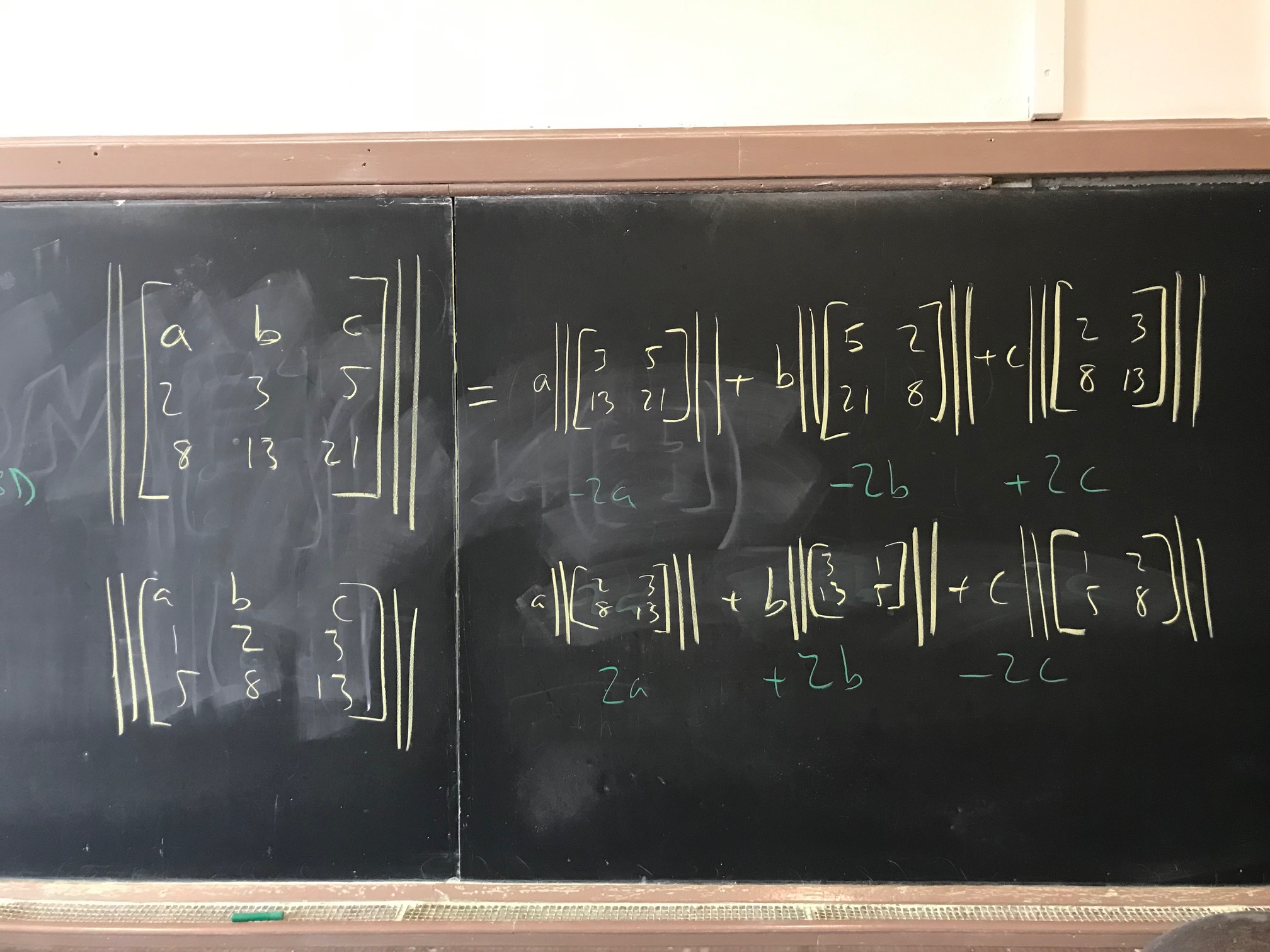
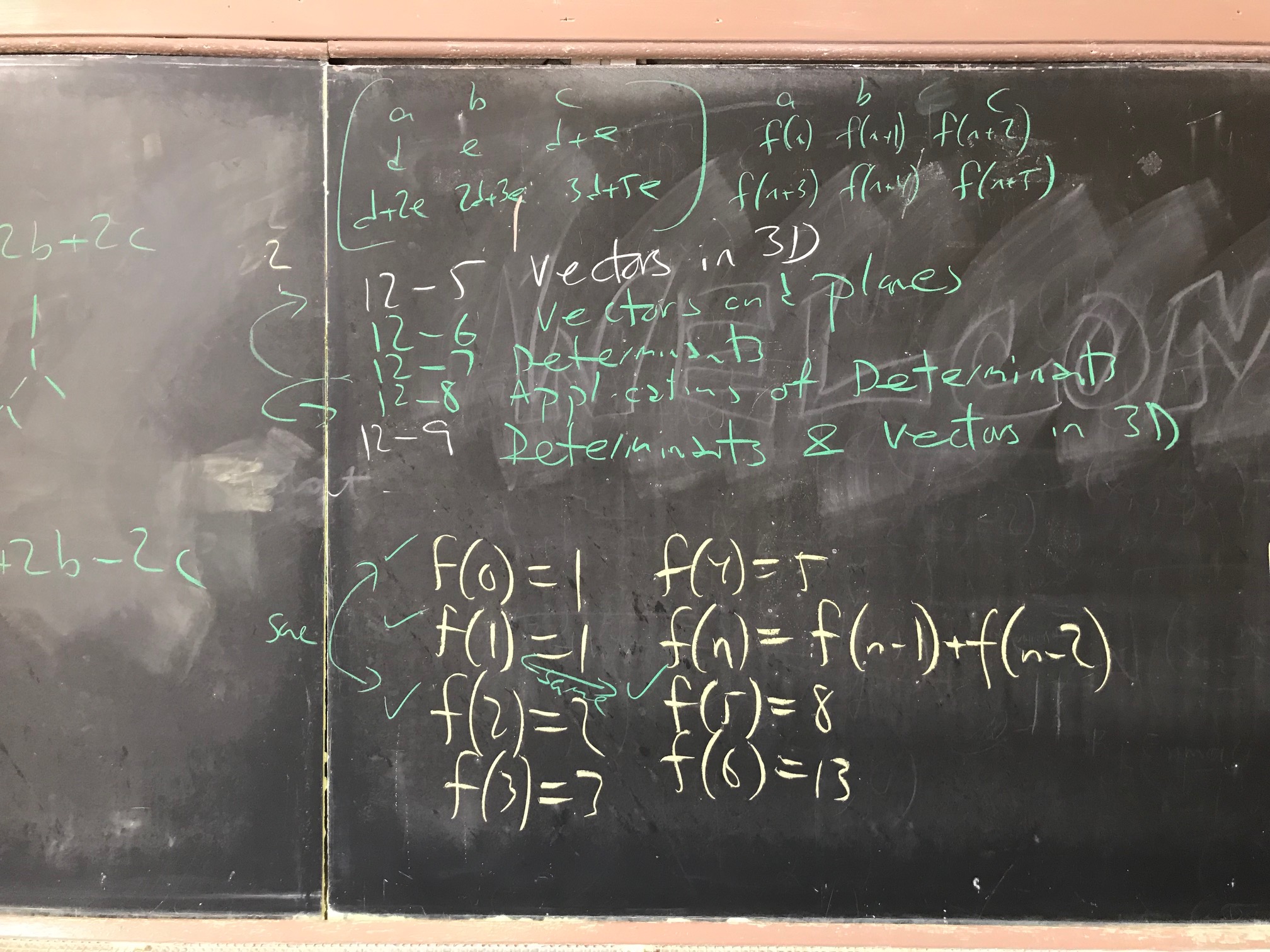
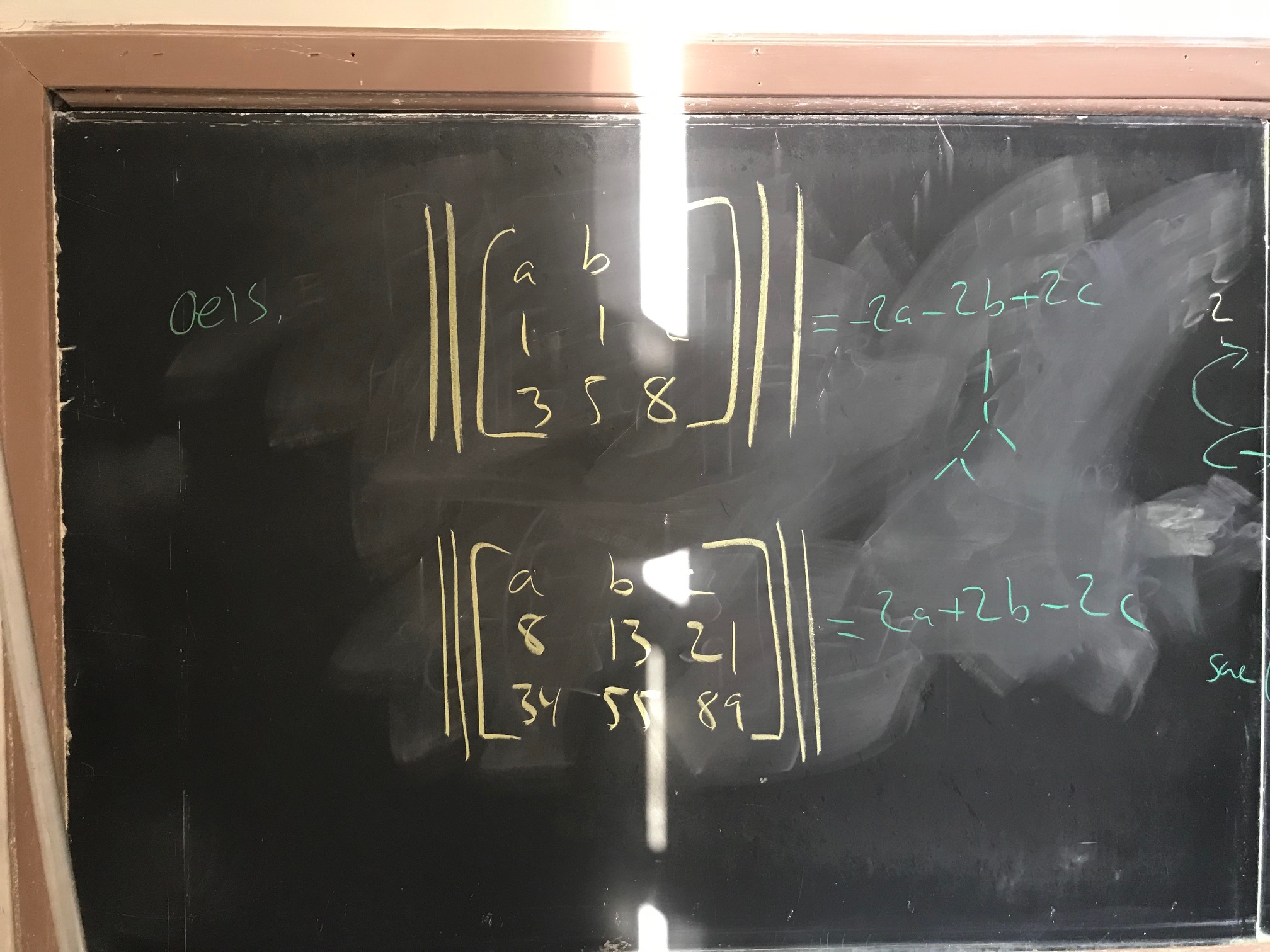
And an hour later one of the students, one with a bit less than average enthusiasm, stopped me in the hall to ask if I’d determined if the result was original.
I had not.
But I have started. I went straight for Proofs that Really Count by Arthur Benjamin. And I found straight off several identities that will help. I think I can make our result fall out of them. And then I played around. And then I googled a paper on a related problem (with answers -1 and 1 instead of -2 and 2. Cool!)
I may try to write something up. I’m not sure there is enough meat here to be worth more than a note. But I will have a class full of fans egging me on.
New Year, Problems: old, new, tricky
The problems are actually
- Real world, we’ve seen before
- Real world, math
- tricky math question from a kid
The first, how do we keep ourselves safe when the people who run the schools don’t? I don’t have the answer. I dutifully checked for masks and test kits, like a good UFT chapter leader. The principal was already handing out test kits. Clarified the mask situation (each teacher gets one KN95 each week).

But that’s not enough. There are too many people in school, and too much virus hanging around. We are going to get each other sick. The Department of Education is going to get people sick. It almost certainly already has. And the associated stress!
A new problem: I have often criticized the Regents for creating problems with lousy artificial context. Easy to criticize. Have I ever created a real world problem without that issue? Today I did:
If the positivity rate is among those who get tested… and those tested are in lines to get tested… and the positivity rate in a neighborhood is 44.4% What’s the chance the person in front of you AND behind you in the PCR line will be positive?
https://twitter.com/Jd2718x/status/1477975444511207425?s=20
Before you jump in to say what a great problem, but those numbers are not real world, let me point out that my testing center is at 42%, my school is at 45%, and my apartment is at 43% (adjacent zip codes) – so 44% is a fair stab at an average. On the other, I should point out that the “Math Teacher Blog O Sphere” #MTBOS already has a polite attack on the appropriateness of the question. Also, in case you didn’t notice, I used the same problem yesterday, but with lower numbers. So goes omicron.
Tricky problem. We were talking about (I was leading a discussion) of some basics in (x,y,z) coordinates. Nice ideas about adding dimensions. And then I set up a standard imaginary coordinate system in the room, with the head of the kid sitting under the projector the origin (0,0,0) and units 1 foot. We found a few points, and then I wrote y = 0 on the board, and with some prodding the students (70% of whom were in class) visualized and described the graph, with words and gestures. They got easier: z=0, z=-3, then harder, x+y=0. And we developed a 3D distance calculation. But before all that, the origin asked if a line could be perpendicular to a 3D object, and I was stumped. I don’t THINK so – but is anyone more certain?
Zero Positive
The positivity rate in my apartment is 0. That’s pretty good. As long as I don’t go out, I can keep it there. Unfortunately, my school is open tomorrow.
I should qualify that. Not the school part, it’s true and it’s horrifying. The zero percent part. I did a rapid test on the evening of Monday December 27. It was negative. I did a PCR on Sunday December 26. It came back negative on the 27th.
In the interim I went for a hike Wednesday. With one person. Who tested negative before and after. Not during, we didn’t do that. I visited a friend Friday. For maybe 10 minutes. She was sick, thought she had Covid. But after 3 negative rapids and 2 negative PCRs she admitted that it might be a nasty cold. I brought her dark chocolate, with oat milk, vegan. She took my photo. And then there was a store clerk Saturday. I might have shopped Tuesday?
And I took my second rapid just now. The results are not in, but I saw the second line darken. In ten minutes I’ll still be negative. Apartment of jd2718? Positivity Zero.
Unfortunately, outside my apartment, the positivity rate is not zero. I know this from people on the internet. Also, from this website, by Gothamist. The positivity rate if I open my door is currently 41%. I’ve been trying not to open my door.
I was thinking of walking up to my favorite testing site, one zip code and a 17 minute walk away. They may have teacher priority. They may not. But it’s where I would go first. Except they do not have positivity zero. Nope. They have positivity 41%, too. But while mine is 41.46%, theirs is 41.08% which is a difference. But not enough.
Think of it this way. I could walk there, be safe and masked and distanced and outside the whole way, but when I get there I will be in line, and with a 41% or 41.08% positivity rate, and me probably negative, there would be a good chance of having the person in front of me and the person behind me both positive (some math person might say that’s only a 1 in 6 chance, but try explaining that to non-math people), creating a viral sandwich, which, even if the CDC renames it a viral open-faced sandwich, compares unfavorably to the zero per cent in my apartment.
So here I am sitting, negative, in my zero percent positive cocoon, and reading the craziest… They have schools open tomorrow. My school is one zip code away. Positivity 44.62%. Not only does that beat my living room, it beats the street outside my building. It’s also going to be cold tomorrow, which is another matter, but a matter all the same.
If I had symptoms, I would stay home. But I don’t. If there were some other excuse… If my union led a mass protest, a strike – I would join in. If that strike were illegal – I would still join in. If a significant number of union members across the city… alas.
I polled my members. Some had good breaks. Others, well… But none of the answers supplied me with an excuse to stay home.
So there you have it. My rapid just finished. Negative. Tomorrow around 7 in the morning I will put on a scarf, a hat, a maroon winter coat, and the warmest two masks I can find. Unless a new and exciting excuse emerges in the next 8 hours, I’ll be heading from 0 to 44.

2022 / jd2718
I wish 2021 were a speck in the rearview. Soon. We hope. But not yet. Here are some wishes, some thoughts, and a few resolutions.
COVID
There’s an immediate goal. I have not been infected. I would like to avoid infection. But omicron is making that tough. 43,000 NYC residents tested positive Thursday – that’s about one out of every 200 of us. Wednesday was 44,000. Tuesday was almost 40,000. Monday was less than 30,000. I’d like to stay relatively isolated for another few days. I’ll do my best.
And then mid-term goals – for 2022. I don’t mind keeping precautions in place, but if subsequent waves are smaller, and the proportion of serious cases falls, I would be ok with that.
Culture
I’ve started reading (again). For years I have let the internet/screen steal my eyes, keep them out of books. I made progress this year. I know that numerical resolutions are a bad idea, but this will not be my first bad idea – start and complete at least one book each week of 2022.
I’ve systematically been listening to popular music from when I was a kid. It’s fun! I will keep doing that. My 1973 top 100 got to be a little much, but I will keep exploring. There’s a sense of nostalgia attached to some of those, but I am listening to old artists who are new to me, exploring genres, sounds, times. I will continue to explore older music (50s/60s/70s). I will look for good music that has politics attached. And (actual resolution) I will pick up a turntable so I can hear the vinyl that I have been dragging around with me for decades.
I haven’t been inside a movie theater since before the pandemic – I’m trying to remember, but probably since 2019. Instead, I’ve been bingeing Netflix, much of it not very good. I’m going to cut down on the bingeing – and I hope that COVID gets to be less of a threat, and that I get braver – I miss the big screen, and would dearly like to return at some point this year.
Broadway? Live theater? That’s asking too much.
Travel
I certainly want to visit friends and family – and those nearby, not a problem. But traveling further? I’d like to venture out for at least one longer car trip – that’s usually not my thing, but it feels safer. But where? I’m stuck on the Cumberland Gap. But there are other choices.
I am definitely heading north more than once. I will visit Essex County, NY. I have found some nice land, in between Lake Champlain and the Adirondacks. That’s happening.
I have tentatively planned my first big trip. Probably my first plane trip. McRib is turning 60 in July – the plan is to splurge on a northern Norway midnight sun extended drive tour, maybe with a stop over in Iceland on the way back. I wanted an Arctic cruise – but he wasn’t wild about being trapped on a boat, and, well, COVID…
And then as much more travel, train, plane, or boat, as I am able.
Recreation
Hiking doesn’t count as travel, but it takes me away from home. And I love it. And given how little I hiked in 2021, it will be easy to hike more in 2022. I see no reason not to commit to at least two walks in the woods every month, more in warmer weather.
And I’d like to clean up my bicycle, pump up the tires, and take it out – for the first time in a long, long time. At least one bicycle ride this year (on the premise that it will lead to another).
Work
Hey, I want to survive. But I’m interested in really enjoying teaching.
The biggest challenge will be revamping Axiomatic Arithmetic, a once a week completely voluntary elective. It’s potentially the most fun teaching possible. I’ve built up some anticipation for this – I think there is a good core who is looking forward to joining the class. So here’s what we will do: 1) Relearn arithmetic, but base 4, and using strange symbols {0,1,∆,☐} instead of the digits {0,1,2,3}. Sneak in the vocab associated with Peano’s postulates. Sounds like not much, but wait for long division… 2) Teach proof by induction. Maybe 3 sessions. Nothing too wild, just practice. Review proof by contradiction, but some of the students will have just done some indirect proof in logic – and the rest will have just done a bunch in set theory. And 3) Working from Peano’s Postulates, construct the natural numbers (with addition, commutativity, multiplication, distribution…) Proving every item that we encounter. Hey, I’m pretty excited about this. I will have to write more, full posts, once it gets going.
I also have some regular challenges – like continuing not to test students – and continuing to provide alternative feedback. I’ve also trimmed the quantity of content in my courses – and that has been good – ratchet it back a notch, and get more kids to master more of the material. I am looking to continue it.
Probably the biggest thing about work is deciding whether or not to continue. I am eligible to retire. June 30? I’ll tell you then.
Union
There’s my UFT chapter. We’ve been very busy. I’d like to keep us focused and active. There are building issues that we have to stay on top of. We have an expanded consultative committee. I’d like a new chapter leader to come from that committee. I’m near the end of my tenure.
And there are union elections.
This pandemic has changed the landscape. Many more teachers than ever before have participated in Town Halls and Virtual Assemblies (remote option was a game changer) and a huge number were shocked about how Unity operates. The pandemic response has also angered members. The political action? They blew almost all the endorsements in the primaries, and kept sucking up to Andrew Cuomo until almost the day he resigned. And Mulgrew got caught plotting to force retirees into Medicare Advantage Plus. Some retirees will go with the privatized health care, but he gave the impression he was trying to deceive retirees, and messing around with health care, which makes this an election issue.
All of that adds up. The ground under our feet has shifted. And this will be the most competitive election ever. United for Change, a coalition, is challenging Unity. I will actively work with UfC in this election.
Mathematics
I mentioned above getting to teach an excitingly challenging course to a handful of highly motivated students. That’s cool.
I also have a commitment, once he’s done with a paper for grad school (why???) to start reading mathematics together with my friend (see Norway, above). He’s asked to start with a basic Number Theory text. I’m cool with that. And if that goes well, what comes next?
And beyond that? I’m looking at some of the combinatorics I have worked on – lots of interesting starts, and no finishes. Maybe bring some of that work further?
And if I do retire, that opens up lots of possibilities. I loved studying during my sabbatical year, (logic, combinatorics, number theory, cryptography, algebra) and would almost certainly find a way to return to my studies. Mathematics? The history of mathematics? The history of the teaching of mathematics? Or something brand new? Probably just math. It calls to me.
2021 / school / union / jd2718
The year began with COVID, and is ending with COVID. The pandemic dominated life the way no other event has dominated a year – certainly not for me. One off events have cast long shadows – but nothing has infiltrated every corner, every fiber as this virus from 2019.
My grandmother was one of eight children. The last sibling (great uncle or aunt) died the summer before the pandemic. But there were two spouses still living. COVID took one this past January. The funeral was live-streamed.
I was vaccinated in March. Moderna. Sore arm for the first shot. Really sore. Then real flu symptoms, 48 hours, for the second.
We ran through variants in 2021. Alpha was in the spring. Delta was later.
I was boosted in November. Sick for a day. But side effects are better than the main event. So far, no COVID for me. I will keep it that way, if I can.
But just after boosting, after it felt like things were easing up, we got hit by omicron. Lots of people got sick, and are getting sick. There is some hope that this will not cause people to get AS sick, but the jury is out.
Travel? No real trips in 2021. A couple visits to Massachusetts or Connecticut to visit family. Two rides way upstate. Celebrated my mom’s 80th in her backyard.
Hikes? I’ve been on a few. Local stuff. Harriman. Rockefeller. Pound Ridge. Van Cortland Park. But three separate foot issues limited my adventures.
Movies? I haven’t been in a theater since January 2020.
Did watch a lot of tv. Binged watched a few good shows. And quite a few others. Started reading books again. That’s good. Finishing “A Game of Birds and Wolves” just now.
And teaching.
In the spring all my teaching was online. It was exhausting and horrible. Zoom zoom zoom. I showed movie clips – I don’t do that in regular teaching. But I survived, and I tried to teach less, and some students learned a lot. And I never want to do that again.
In the summer I planned for the fall. I make the schedules, that takes a long time.
And now, in the fall and winter I am back in school. The classroom is great – best part of the day. The hallways, the crowds, the worst. Every day is stress-inducing.
A classroom bonus? I teach four once a week seminars. Logic for younger students, logic for older students, game theory, and set theory. Especially in set theory I have fun; I get to engage with kids who want math to be deeper than finding x.
I brought in a typewriter, and that was fun for some students. When I took it home (it’s mine) I purchased another one so they could keep playing. That’s a highlight.
And the union stuff.
That’s been infuriating. I never supported the caucus that runs the UFT, Unity. And in 2021 they did the normal bad stuff (lousy endorsement, not protecting teachers from abusive principals, etc)
But through this pandemic they have been worse than ever. Apparently they (or just Mulgrew? but I figure it’s a group of them) cut a deal to keep schools open, no matter what, and they spent all of 2021 (and a chunk of 2020) putting that pledge ahead of their obligation to represent the membership.
Through the first of 2021 (and all of 2020) they were embarrassing Andrew Cuomo fanboys. When he disagreed with de Blasio, they always took his side. When he made decisions that were bad for teachers, Mulgrew told us that they were good. They only stopped worshipping Randy Andy when he resigned in disgrace.
Also, they got caught working to privatize Medicare, and when caught, Mulgrew sounded to most retirees like he had just got caught.
And this year they did it all in front of an audience. With virtual DAs and Town Halls in the Spring, and with hybrid DAs now, many, many more UFTers – leaders in their schools, have seen Mulgrew’s behavior. And they have been disappointed, saddened, horrified, or some combination.
One thing I will be doing (this really belongs in tomorrow’s post) is working this coming spring with United for Change to unseat Unity.
Low Bar
When I think about some of my favorite years: 1969, 1972, 1983, 1992, 2014, hmm, there’s more. But 2021 is not on that list. In fact, 2021 might be at the top, of that other list.
So when I begin considering 2022, tomorrow, it’s a good bet that I’ll expect improvement. And indeed, 2021 has set an extremely low bar.
Happy New Year to all of you. I’m not waiting for the ball to drop. And good night. – jd (Jonathan)

 JD2718