Road trip! Ideas?
I’ve never taken a real road trip before. August will be my first.
Denver to Salt Lake City. Via all or most of: Wounded Knee, Mount Rushmore, Crazy Horse Memorial, Glacier National Park, the Salmon River, Lava Hot Springs, ID.
Cool, huh?
So what should we miss? What shouldn’t we miss? Towns? Museums? Parks?
What’s worth spending extra time in? What should be a quick stop?
Any recommendations on specific places to stay? to eat?
On types of places to stay, to eat?
This should be fun!
No Surprise Except the Timing: AFT Endorses Hillary Clinton for President
It’s no surprise that the AFT endorsed Hillary Clinton. The close alliance between AFT President Randi Weingarten and Clinton is well-known.
It’s a bit of surprise that it happened today, six months before the first primary, sixteen months before the general election. The AFT Press Release claims that members were engaged in the decision process. That comes as news to me. Unions are organized in locals and chapters… certainly I did not see engagement at that level. But the AFT (and UFT’s) political action wings treat us not as a membership organization, but as a PAC. So I do not doubt that they did an in house poll and some sort of unscientific website survey.
In any case, the question is not about the eventual result – this union’s leadership is clearly pro-Hillary – and not even about the lack of process (though it would be nice to at least make a gesture towards asking members).
No, the question is about the timing. So early??? The answer probably has a lot to do with Bernie Sanders’ recent surge in the polls, especially in early Iowa and New Hampshire.
As pundits have pointed out, even if Sanders somehow slips ahead in those two states, they are outliers, he has only the slightest chance at the nomination. But cautious Clinton is taking no chances, especially after 2008.
From this seat, it was nice that Bernie was pushing the race to the left, raising issues of banking and foreign policy and economic policy. It would have been nice to let the campaign develop before an AFT endorsement. Anyone for an AFTers for Bernie?
CC Algebra – conclusion – Why fewer strong scores?
I wasn’t teaching last year. Sabbatical. And that was the year that Common Core Algebra arrived. I was spared figuring out the exam from scratch. I consulted with teachers from across the City and New York State, debriefed. I looked at the exam. I looked at the State-supplied modules.
This year I had a number of students sit for Common Core, a number for the old Integrated Algebra regents, and a number for both. But I chose to teach as if they would all sit for Common Core. I made very few adjustments to what I usually do in algebra (mostly 1. changing a couple of “function” lessons into a full, rich, challenging unit – starting the discussions with graphs, then moving to applications, 2. tacking on a new stats unit at the end, and 3. leaving an extra few days for regents review.)
I have been doing this high school math teaching thing for a while. I have a pretty good idea of what my students know, and what they don’t. I can tell the difference between short-term memorization, and understanding. I see how they perform on a written test versus during classwork or question and answer sessions. And I had a fairly good idea of the content they would be looking at. And something weird happened. Two things, actually.
Kids who looked like high 80s kids, they got high 70s on the Common Core. I had heard similar reports from around the State, about high performers.
And kids who sat for both exams got virtually identical raw scores (points), but vastly different reported scores. And I heard anecdotally that something similar happened across all of New York City.
Anti-public education reformers (Cuomo, Gates, TFA, Rhee, Pearson, Coleman) claim that common core standards are higher, or that the content is more rigorous. But they are ignorant, lying, or both. Raw scores stayed the same, but reported scores showed large differences. The problem was in the conversion chart. Take a look.
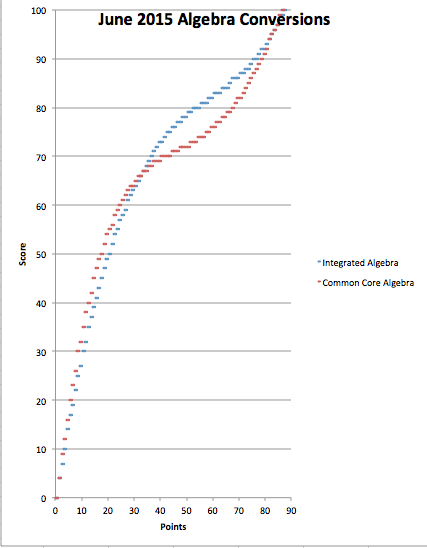
It looks like someone has intentionally depressed scores between 70 and 90, most dramatically between 80 and 85! And it looks that way, because that is exactly what they did. That 5 to 10 point drop? Here it is. Not in the exam. Not in harder content. Not in higher standards. That drop can be found in a new conversion chart.
The exact mechanism is fairly uninteresting, but assuming that you have just read through four pages of this stuff, it would not be right to omit it.
All of New York State uses four performance levels. That’s the way scores on the Elementary School and Middle School tests are reported – 1, 2, 3, or 4. And for high school? We paid no attention to the levels, because we had actual scores, but Level 1 was failing, Level 2 was 55, Level 3 was 65 (passing) and Level 4 was 85 (mastery).
With the Common Core exams, the State amended these levels to cause a drop in scores. They added a Level 5. They set it at 85. And they took the old Level 4, and let the cubic regression set it. It seems to be sitting around a 73. This means a child who was ready to score an 85 on the old test, but who was well-taught for the new test instead, will score a 73. This is not this year’s child knowing less or being able to do less than last year’s child. This is instead New York State directly lowering scores.
Here is how they define the new performance levels:
- NYS Level 5 Students performing at this level exceed Common Core expectations.
- NYS Level 4 Students performing at this level meet Common Core expectations.
- NYS Level 3 Students performing at this level partially meet Common Core expectations (required for current Regents Diploma purposes).
- NYS Level 2 (Safety Net) Students performing at this level partially meet Common Core expectations (required for Local Diploma purposes).
- NYS Level 1 Students performing at this level do not demonstrate the knowledge and skills required for NYS Level 2.
By the way, performance levels are absolutely arbitrary.
I asked about this on the AMTNYS listserve, and received the following response from a professor who was involved in the process:
Jonathan,YES, the state has changed how it sets the scale. I can speak to this as I was a (small) part of the process.Level 4 now means “Proficient in CC”, and this was set by the Commissioner after a recommendation by a group of educators who argued loud and long about what a proficient student should and should not be able to do.Level 5 now means “Exceeding CC expectations”, and this was set in a similar way.The old Level 4 is gone, and it is replaced with these two new levels. The cubic is also gone, and I don’t know everything about the function that fits the rest of the scores. I do know, however, that educators took a hard look at the CC standards and at actual test items to determine which ones should be answered well by proficient students.The new exams are harder and the new standards are higher. We know that the State is closely monitoring the Algebra results because the Class of 2022 is coming soon, and they will need to pass at Level 4.Teachers should be looking at the number of points necessary to hit those cut scores and not at what percent corresponded to what score. The only four scores that really matter are the ones that set Level 2,3,4,5. The fact that a student got an 88 doesn’t mean he knew 88 percent of the material; it means he exceeded CC expectations. The fact that a student got a 62 means nothing except that he is eligible for the safety net.Best wishes to you as the school year winds down.
Looking at performance levels instead of looking at scores is foreign to us. Just telling teachers to do so isn’t fair, not without looking more deeply.We distrust the state. Sounds like I’m being tough on the State, but it was the State, not the teachers, who changed the state exams, and renamed the state exams, and tweeked the state exams, and changed the state standards again and again and again over the last 15 years. It was the State that has produced at least one bad question out of every three exams published for a decade. The State has earned our distrust.Teachers face kids and parents, regular folks, who know 88, but who don’t know that 4 is the highest, (unless 5 is highest).Teachers also face parents and kids in some districts who score highly and want Regents Diplomas with Honors. http://www.p12.nysed.gov/part100/pages/1005.html#diplomaHonorsA district can “award a student a Regents diploma with honors or a Regents diploma with advanced designation with honors to a student who achieves an average of 90 percent in all Regents examinations required for the diploma.”Notice that, it’s not an average performance level of 4.5, it’s an average score of 90. And that just got tougher.
And that, patient readers, is that. The State wanted to make Common Core look tough, so they took the old scores between 85 and 100, and stretched them so they are now between 73 and 100. Top kids have lower scores, by design.
Who’s responsible? Andrew Cuomo? Merryl Tisch? Candace Shyer? Steve Katz? Idk.
– – — — —– ——– ————- ——– —– — — – –
In Part I we saw how, when Common Core Algebra replaced Integrated Algebra, teachers tried to figure out how to adjust to the change. But even with adjustments, scores for top kids fell. I adjusted, as I had for exams in the past, but kids who seemed prepared for scores in the mid-80s saw scores in the mid- to high 70s instead. Similar reports came from across New York State.
In Part II we saw how kids no longer earn their scores directly. In the 1990s and before, score 85 points, and your score is 85. Since 1999 though, points and scores were untethered. The number of points was reduced to a number between 80 and 90. And for each exam administration a new “conversion chart” is created, that seemingly magically translates points into a score. Importantly, the conversion chart changes every time the exam is given. The number of points needed to passvaries each time the exam is given. The number of points needed to get an 85 varies each time the exam is given.
In Part III we looked at how the Conversion Charts are created.
CC Algebra – Fewer Strong Scores – Part III – How the Conversion Scale is Created
Set a pass score, set a mastery score, and perform a cubic regression. That’s the short hard-to-understand answer. Definitely needs explanation.
In Part I we saw how, when Common Core Algebra replaced Integrated Algebra, teachers tried to figure out how to adjust to the change. But even with adjustments, scores for top kids fell. I adjusted, as I had for exams in the past, but kids who seemed prepared for scores in the mid-80s saw scores in the mid- to high 70s instead. Similar reports came from across New York State.
In Part II we saw how kids no longer earn their scores directly. In the 1990s and before, score 85 points, and your score is 85. Since 1999 though, points and scores were untethered. The number of points was reduced to a number between 80 and 90. And for each exam administration a new “conversion chart” is created, that seemingly magically translates points into a score. Importantly, the conversion chart changes every time the exam is given. The number of points needed to passvaries each time the exam is given. The number of points needed to get an 85 varies each time the exam is given.
But how are these conversion charts created? The crucial element is something that New York State calls “performance levels” – and we have already created mystery for what should be an open process – but let’s go on. New York State numbers students as 1, 2, 3, or 4, and those numbers have names that go with them. In high school we don’t pay too much attention – those are mostly elementary and middle school numbers (I got a 2 on the ELA, but a 4 on the Math!). We think 3 means grade level.
For the first administration of an exam only, the cowardly agents of the State gather educators from around New York, and sit them in a room. They look over the questions, and guess what a level 1 kid would get right, a level 2 kid, level 3, level 4. They assign difficulty levels to each question. The State (or a contractor) examines the results, looks over the real tests, and combines them into a range of possible points that could equate to a 65 (passing) and an 85 (mastery). Then they bring those results to another room, where the cowardly agents of the State have gathered a mix of educators and administrators from around New York, and in that room they look at the percentage of kids who would fail under each scenario, and choose one.
(Cowardly? The data, as presented, leave very few choices. The process is predetermined. The educators in the room do not produce a result different from what the State produces. They are involved only so that the State has someone else to blame. Cowards.)
In any case, they walk out of the room knowing that 0 points = 0 score, X points = 65, Y points = 85, and all the points = 100.
For each subsequent test administration, a single room of educators determines X and Y (passing and mastery), consistent with the cuts that were set on previous exams.
So how do all the in-between scores get converted?
One method would be to ignore the committee work, and just use percentages. That’s what our gut tells us to do. So 72/87 = 84% (after rounding).
Another method would be to take the committee’s points, and use linear interpolation to fill in the values between. For example, in June 2013 it took 30 points to get a 65, and 68 points to earn an 85. (Ignore that 30 is 34% of 87, and 68 is 78% of 87 – we are no longer looking at percents). So 72 raw points would 4/19 of the way from 68 to 87, and would earn a score of 88.
But the method the State uses is different. They take the committee’s points, and they find a curve that fits the points. This process of curve fitting (they probably use a cubic regression) has absolutely no science, no math, no research to support it. It creates a conversion chart, so they use it. Without reason.
My students have studied this, and are appalled. I use it to do some statistics, and later to talk about abuse of mathematics.
Anyway, here’s the June 2012 data. Notice the small differences between linear interpolation and cubic regression? They are completely meaningless and arbitrary – not really what you want to hear about when you are looking at grades going on kids’ transcripts.

Conclusion: Why did high scores drop when they shifted to Common Core? (posted here)
CC Algebra – Fewer Strong Scores – Part II – Untethering
A: When you are in New York State.
Q: When is your score not your score?
There’s something that anyone working with New York State Regents Examinations knows, that no one outside of education would assume. There are not 100 points on the tests. Common Core Algebra has 86 possible points. A complicated “conversion chart” changes this “raw score” (actual score) into the “scaled score” (reported score).
It used to be different. When we had Course I, Course II and Course III Regents, and at all times before, you earned points, and those points made your score. There were 100 points available. Earn 65 points? Your score was 65. Earn 85 points? Your score was 85. People understood this.
The first of a series of disruptive innovations in mathematics in New York State freed the test from the content (they called this “standards based testing” but we no longer knew what questions they would be asking), and freed the score from the points. Really.
Here’s old Course I exams. See, no conversion scale. But each question has a point value. As a kid worked this exam, they had an idea of how they were doing.
And starting in 2002, there were Math A exams. 85 points. And the last page in the answer key included a conversion scale. Teachers were not happy. Some of the exam was impossibly wordy, and hard on weaker readers, but the scale made it up by making 51 points (60% of the points) equivalent to a score of 65. The State was using scaling to fuzz over the fact that they could no longer write an appropriate test. And a kid taking the exam? They had no idea how they were doing, even if they attempted to keep track of points.
Oh, that 60% is passing? That went out the window quickly. In June 2003 the State gave a Math A exam that tons of suburban kids failed (it really was a poorly constructed test), and “fixed” the problem by jiggering the exam. They did not remove the inappropriate wordiness, the false contexts, or the over-penalization for rounding. They “fixed” the problem by dropping the passing score. By August 2004, 36 out of 84 (they changed the length) was now passing. 43%. They got kids to pass, but in the process convinced more teachers and administrators that they were incompetent.
Each new test had a slightly different chart. But the big changes were:
- Math A introduced (June 1999) (notice the 1999 – 2002 Math A’s are hidden in a “pre-1998” link at the bottom of this page)
- Math A rejiggered after the June 2003 fiasco (that the state has never accepted responsibility for)
- Integrated Algebra, (June 2008) and now
- Common Core Algebra (from June 2014)
We now have a full generation that works with exams out of 82 or 87 or 84 points. Do they accept that using an odd-ball conversion chart makes sense? Most of us, no. Does the public get it? No. Is it fair to kids that they don’t know how they are being graded? No.
I’ll provide more details on how the conversion charts are created in the next post in this series, the third.
But that system of conversions is key to answering the question: “Why did the top scores decline during the shift from Integrated Algebra to Common Core Algebra?”
That’ll be in the fourth and final post.
CC Algebra – Fewer Strong Scores – Part I
When New York State changes exams, schools hold their collective breaths, trying to figure them out. We are not sure about content, about context, about difficulty, and most of all, we are not sure about scores.
Why New York State has been changing exams so frequently over the last 15 years (disruptive innovation) should be the subject of another post.
But my bread and butter exam has been Course I. Then Math A. Then Math A (adjusted). Then Integrated Algebra. Now Common Core Algebra.
What you do with these exams depends on who you are, and where you are. At Columbus I taught a course that took kids who had already failed Course I multiple times. Me and Bill Gerold taught it. And we figured out ways to get a kid who tried hard to break that 65. It was kind of amazing. And given our success, and it was success keeping the school off the SINI list or whatever it was called then for a year, the administration refused to offer the course again. At my school today I teach a fairly old-fashioned algebra course, with fairly heavy emphasis on mathematical understanding, challenging problems, lots of fractions, rich discussion of process, but not much emphasis on real-world connections. And then I build in the supplements for the exam. Obviously this means different supplements every time they change the exam.
It works fine. Kids get scores in the 80s or 90s. Once I had a kid with 100, but that was not my fault. The kids, the school, the parents, they all care about the scores. More than they should. Since my kids already know some math (they can all add fractions) when they arrive, and they all can take a standardized test (they get into the school by passing a test), the pressure is not on passing, but on getting scores that look good. And on getting the average for all of their regents exams to be at least 90, which qualifies them for an “honors designation” on their diplomas. It’s a sticker, and I give out nicer stickers, some more colorful, some scratch and sniff, some glittery, but the kids want this sticker in particular.
So the new Algebra regents (common core) hits last June, 2014, and I was on sabbatical. But I heard from around the state, from the AMTNYS listserve, and from talking to people, and from my school, that scores for strong kids were down 5 – 10 points.
So we set about scrambling to see why the scores were down, and what we could do to bring them back up. I went to the AMTNYS conference in Syracuse in October. I talked to people. Teachers, professors. Consensus was that those who used the “modules” ran out of time, those who taught the old curriculum watched the grades fall a full 10 points, or 10+ even, and those who used a reduced sampling from the “modules” did best. The modules are NY State supplied materials that probably would require a 300 day school year to teach completely (we have 180. There are 260 weekdays in a year).
There was my answer – adopt portions of modules. Of course I did nothing of the sort. I took an already rich function unit, and expanded it. I added a couple of stats topics, taught differently than I had in the past, emphasizing equally what the stuff means, and how to calculate it. I ended the year with a week and a half of intensive test prep. And my students did well. But the scores were 5 – 10 points lower than I would have expected. Mid 70s through mid 80s. Something was wrong.
I’ll give you important background in the next post, some technical information in the 3rd post, and tell you what went wrong in the fourth and final post in this series.
Teaser: NY State lowered top scores intentionally.
UFT “Endorsements” – a frustrating year – Part II
In the first part of this post, I wrote a bit about the governor’s race. The UFT helped Cuomo secure the Working Families Party line, then refused to support his opponent in the primary (and the AFT President made calls on behalf of Cuomo’s running mate), and watched Cuomo take the general election. And as a reward for not interfering with his election, we got nothing but problems from the guy.
But were there other problems with UFT endorsements this year?
In the fall:
Charlie Rangel. They endorsed Adriano Espaillat against Rangel in the primary, and tried to sneak it through the exec board without mentioning who Espaillat’s opponent was. Espaillat lost.
Robert Jackson. This guy has been a champion for public education, instrumental in winning the CFE case, our friend, our ally, John Dewey award winner. We endorsed Espaillat against him, and Espaillat won, 50% to 43%. But which one of these guys is still out there working for public education?
John Liu. Our friend. Damaged in a financial scandal that looks like it was intentionally dragged out to hurt him. Running for state senate against Tony Avella, one-time progressive who joined the semi-Republican IDC to keep the state senate in Republican hands. We have a clear side in this race, right? Wrong, the UFT sat it out. Avella won, 6,813 votes to Liu’s 6,245.
Jeff Klein, turncoat democrat who leads the IDC and keeps the Senate republican. He got primaried, about time. The UFT supported him anyway.
Tea Party backed, about-to-be-indicted congressman Michael Grimm from Staten Island was challenged in the general election. The UFT sat out the race.
In the spring:
When Karim Camara took a job with Cuomo, his assembly seat opened up. The UFT pushed an endorsement for Shirley Patterson, running democratic and independence parties (which should have been a sign). The endorsement pitch did not mention her Independence Party connection, her connections to landlord groups, or that her chief opponent, Diana Richardson was running with tenant organization support on the Working Families Party line. Richardson won, the first assemblyperson who won on the WFP but not Democratic Party line, and without UFT support at that.
Grimm’s seat opened up, due to Grimm being indicted, and once again the UFT sat out the race (they would not have even mentioned it had we not asked).
UFT “Endorsements” – a frustrating year – Part I
At the June 2014 United Federation of Teachers Delegate Assembly, thirteen months ago, I asked a question.
Paul Egan had moved the contingency endorsement resolution (any endorsement questions that come up in the summer get referred to the Executive Board), MORE delegate Megan Moskop rose in opposition, saying that a special DA could be called, or that electronic voting could be used, and objecting to back room deals (the phrase “back room” drew hoots from the audience and a comment from Mulgrew).
We’ve had the contingency resolutions in the past, they are generally non-controversial. But we had the governor’s race sitting in front of us.
I rose to ask if a Cuomo endorsement could happen under the contingency resolution. And Mulgrew said no. For something that big, he said, we would not do it without the Delegate Assembly. Satisfied, I voted yes.
And then, over the summer, there was no official UFT or NYSUT Cuomo endorsement. Case closed?
Hardly. My question was two weeks too late. The UFT had already “watched” the Working Families Party deliver their line to Cuomo – ensuring that the best route for a strong challenge had been blocked off. One report said that the UFT (must mean an officer or top official) threatened to destroy the WFP if it didn’t endorse Cuomo.
Our role in the governor’s race did not improve. In September Regina Gori’s motion to endorse Zephyr Teachout over Cuomo in the primary was defeated by the UFT leadership’s caucus. And on the eve of the primary Randi Weingarten, AFT President, made phone calls, not as AFT President, to support Cuomo’s running mate. The UFT officially remained neutral in the general election. But not working against a powerful governor is not very different from working for him.
The rest is history. The WFP/Cuomo deal? Every promise Cuomo made, he broke. Cuomo and the teachers? We don’t need to ask.
If we had fought Cuomo, could we have stopped him? Wrong question. We didn’t get beaten. We lay down, and got kicked repeatedly in the teeth.
A bunny problem, or a bunny challenge
Depends on you.
This spring a student (her real name is not Nancy) posed a problem for herself: Starting with one newborn pair of bunnies, after one month the pair matures, after the next month the pair produces a new pair, and continues doing so every subsequent month, until after six months the pair dies. Describe the number of living bunnies after n months.
Problem
If you are not sure how this is going to work, the problem is for you. See if you can figure out how many bunnies will be around for the first few months, and then see if you can describe the relationship mathematically.
Challenge
If this set up is not a problem for you (if you can write the recurrence relation directly from the problem set-up), then I have a challenge for you: what interesting new problem can you create out of Nancy’s problem that would take someone who can already write the recurrence relation and make them think?
Extending Fibonacci with Death
I had a student this year play with Fibonacci, then modify the problem, and give a partial solution to the modified problem. The modified problem is well-known and completely solved. You can try your own hand at it, (see next post). but here’s the student’s story:
Late in the fall of this past year (November 2014) I assigned freshmen the task of taking a problem that we had solved and discussed in class, and proposing a new problem as a modification or extension of the original. Some found it fun, and at least one remembered it later. (I’m sure it was more than this one.)
This February I started a special one-day-a-week class for freshmen (number theory and arithmetic, special topics of their choice, I did this once before).
Nancy (not her real name) worked in a team on Euclid’s algorithm. They did a very nice, very clear presentation, most of the students in the room were able to follow and perform the steps and work out a simple example. And then the team broke up.
Nancy decided to play with Fibonacci on her own. I was a little worried about real-world examples, but she stuck to the traditional “a pair of bunnies is born. In its first month it matures. In each month after that it produces a new pair. And she played it out and let the recursion and the problem statement match up fully. (My Ghost the Bunny is just word play)
And then she got bored, and played what-if. Nancy modified the problem – her bunnies would now have 6 month life spans. She carefully worked out what this would mean: 1, 1, 2, 3, 5, 8 all stay the same, but 13 – 1 = 12, and it gets interesting from there. Nancy identified the quantities that needed to be added (the two previous) and subtracted (six back) but had not written up a recursive formula when the class ended (we only met one lunch period per week, ate before we worked, and homework was not allowed).
But see why I’m excited? She played with a problem, then posed her own problem? Because she was curious. Ninth grader. Cool, huh?
“Looking Back ” by Extending Problems
I like posing and solving problems on-line. Is this reflected in my classroom? Not enough, but yes.
In the fall term of algebra classes I carve out a day here or there, or maybe a few half-periods, to work on extended problem solving. It is generally not on-topic. On-topic would allow the kids to know before they start HOW they should solve the problem, and that would spoil the joy. I usually choose problems with multiple paths to success. And I certainly do not choose problems that have an accessible formula – that would spoil the challenge.
This fall I did different problems with different classes – but all did the checkerboard, and some did Ghost the Bunny too.
I use an Understand / Plan / Carry out the Plan / Look Back approach with the kiddies, but too often “looking back” for them just means “check.” Over the years I have pushed “find another approach” or “find the relationship between two successful approaches” or “generalize a solution.” But this year I pushed in a new direction.
“Use your work and solution to think of a new, interesting problem.” The idea is not to simply make the problem bigger, or generalize it, but to come up with something related, but new, probably closely related and more complicated, but not necessarily so. And it was quite possible for the new problem posed to be easier than they realized or harder, to yield to a similar approach as the original problem did, or not to yield at all. After all, if they knew there would be a solution of appropriate difficulty, it would mean that there was not original problem posing going on. And after practicing generating ideas on earlier problems, we hit the checkerboard, and I assigned them to extend the problem, gave them time in class and at home, and required them to write up a problem solving “experience”:
- Understand the Checkerboard
- Devise a Plan
- Carry out the Plan
- Look Back (include posing a new problem)
- Devise a Plan
- Carry out the Plan
- Look Back (since many new problems were not solved, this included commentary on obstacles. Where problems were partially solved, we got suggestions for the next team to pick the problem up. Where problems were solved, we got ‘normal’ generalizations, but also suggestions for future work. From 9th graders. )
So, post-checkerboard, what problems got posed? Here’s a few that I recall:
- Solve for an abnormal 8 x 9 checkerboard. Generalize to squares on an m x n checkerboard.
- Solve for a checkerboard with the four corners missing. Try again with the four 2 x 2 corners missing. 3 x 3. Generalize to an n x n checkerboard with four m x m corners missing
- Variation (different group). Solve for a checkerboard with one corner missing. Then a 2 x 2 corner…. Generalize to an n x n checkerboard with a single m x m missing.
- Variation (there was a lot of removing squares going on). Solve for a checkerboard with a 2 x 2 hole in the center. 4 x 4. 6 x 6. Generalize to an n x n board with an m x m hole in the center.
- Solve for an 8 x 4 checkerboard. Account for the difference between two 8 x 4 boards and one 8 x 8 boards (the write up for this was beautiful)
- Solve for rectangles on a checkerboard.
- Leaving the board out of it, count trimonos, tetrominos, pentominos, hexominos. (I think this group got side-tracked into some fascinating but for the moment fruitless discussions of symmetry and handedness. Product? Nah. Discussion – excellent.
So, when you get an answer, are you at the end? For most of the kids the response is still “check, and that’s enough, unless the teacher makes you go on” – but for a substantial minority I think they got used to the idea that mucking around further is a good idea, and potentially fun or interesting.
The Day After The Year After
Yesterday was the day after the year after sabbatical. A group of us took out a friend, first day of retirement. And I breathed, really free, for the first time in a while.
I fell down on blogging badly. Let’s see if I can’t recap the past year, over the next 20 days.
There’s my school, and teaching, and plans for next year.
There’s union stuff, a lot of it. There was some good stuff that happened last year, but lots of troubling stuff, too. And now after de Blasio / Fariña have completed 3 of 8 terms, there’s not nearly to show for it.
There’s education stuff outside of my union. Common Core and Opt Out, and vicious battles in other states and cities.
There’s politics, education and otherwise. In that respect, the year ends on a high note, with marriage equality the law of the land.
And there’s always math. State exams, national exams, new courses, old courses. And puzzles. I’ll start tomorrow with puzzles.
The Community School Farce
New York City is getting community schools. Mayor de Blasio likes them. The UFT likes them.
They have “wrap-around” services – which can mean a lot. They have drop-out prevention programs. They have medical and dental care. They have mental health services. They have expanded guidance services. And each school is supposed to develop further services to meet the needs of its community.
But for high schools, there is no community.
It is a farce to call them community schools.
Mayor de Blasio says: “Every Community School is different and reflects the strengths and needs of its students, families, and local community. ”
The report the UFT posts says “Community in this model is defined in the broadest sense possible, including not only non-profits, but also private-sector businesses, hospitals, universities and communities of faith. ”
But under Bloomberg’s DoE, most communities do not have their own high schools. Students are assigned to a school by OSEPO, after going through an insane process of listing 12 choices, and sometimes getting none of those. Students are often drawn from across their borough, or beyond. There is no neighborhood. And how do we call it a community without a neighborhood?
When a kid does not apply to attend a special school, or a school with a special program, where is the neighborhood school that is his or her default? Under Bloomberg, such defaults were eliminated or destroyed.
Carmen Fariña and Bill de Blasio have been running the show for a year and a half now. Every neighborhood or group of nieghborhoods should have their own neighborhood high school. They should be good choices, with good programs, good extracurriculars, good course and elective options. And yeah, it would be very cool if they could provide the wrap-around services in the Community School model.
But until then, please don’t tell me about community schools that have no community.
Another bad math question from NY State
How can New York State test kids in math when it can no longer consistently write appropriate questions? This gaffe is almost two years old, but it looks like no one noticed the problem, until it showed up on the Association of Mathematics Teachers of New York State (AMTNYS) listserve this week.
On the August 2013 geometry regents, students were asked to find the slant height of a cone, given the lateral area.
It’s easier than it sounds. There is a formula sheet in the back that gives
L = πrl,
where L = lateral area and l = slant height and r = radius.
Heres’s the question:
Since radius is half the diameter, r = 12 and plugging in: 120π = π(12)l, or l = 10, choice 3.
But wait. The height of the cone (like a flagpole from the base to the highest point), the radius (like a stripe from the base of the flagpole to the edge of the cone), and the “slant height” form a right triangle, with the slant height being the hypotenuse. So how is the hypotenuse (10) shorter than the base (12)? Can’t happen in the real world… but in New York State?
Here is an insightful comment from the listserve:
This is another example of the type of error that has been occurring on Regents exams since the early 1990s when the math bureau of NYSED was downsized from 7 very experienced and talented people (a bureau chief + 6 math specialists) to an inexperienced few. It is also a product of contracting out the writing of exams to rich companies that had no experience in this area.The errors often occur from the creation of questions that require substitution into formulas without looking at a drawing to see if the numbers are possible.
Did the UFT change its position on testing?
Probably not. But we should not gloss over the formal shift.
In this week’s NY Teacher there is a brief report on the April 15 UFT Delegate Assembly:
The first resolution, introduced by Vice President for Academic High Schools Janella Hinds, articulated the union’s view on the role of testing in public education. The resolution voiced the UFT’s support for the right of parents to opt their child out of state tests, called on the state to break Pearson’s monopoly on testing and condemned Gov. Andrew Cuomo’s proposal to increase the weight of standardized tests in teacher evaluation, among other things. (Resolutions: Delegates approve resolution on proper use of assessments)
The full text of the resolution, as passed, is here on the UFT website.
But there’s something missing.
As originally written, the resolution said that tests were good for rating teachers and schools.
RESOLVED, that the UFT affirms its support of standards and its support of multiple measures to assess student progress, evaluate teachers and gauge the success of schools;
The resolution was introduced at the March 7 UFT Executive Board. New Action moved to strike “evaluate teachers” and Unity sent up several speakers to argue against the amendment, and defeated it. (It would be easy to add “overwhelmingly” since Unity controls all but ten of the 102 votes, but there were clearly some who quietly chose not to vote).
But at the Delegate Assembly a few weeks later, I moved to strike “evaluate teachers and gauge the success of schools.” There was another proposed amendment (changing “standardized assessments” to “state-mandated assessments,” shifting both meaning and tone). I saw LeRoy Barr move from the podium to the floor of the meeting hall – usually a sign that he would take the mike to speak against. A Unity loyalist whispered to me that it was a good amendment, but that it would be voted down. But after some discussion, I saw that LeRoy returned to the podium. They changed their minds? Sure enough, the amendment went through, either unanimously or close to it.
What happened? Mulgrew was touting the new Federal Legislation that would stop mandating sanctions for schools with low test scores, and stop forcing states to rate teachers based on student test scores. It would be hard to favor such changes, if the union maintained its traditional stance that said that test scores should be part of rating teachers and schools. In fact, a delegate asked if the amendment was just echoing the federal change. Also, Unity has been taking heat for helping bring in the lousy evaluation system. And the DA was during state testing, and Unity was taking heat for opposing MORE’s opt out resolution. They stepped aside.
It’s not a small thing. The largest teachers’ local in the country dropped its official support for using tests to rate teachers. The Delegate Assembly said that we do not support using “multiple measures” to”evaluate teachers and gauge the success of schools.”
The DA coverage in the New York Teacher omits that the Delegates don’t want multiple measures used to rate teachers and schools. It is easier (not easy) to delete language from a resolution. It’s another thing to change policy, on the ground. We have not seen any change in practice.
More Fallible Friends
While I search for a copy of an old puzzle, I’ll post a new one of the same type:
So I asked five friends about a number they had seen, and each one told me two things about the number. Unfortunately, my friends are infallibly inconsistent – if they say two things, one is guaranteed to be right, one is guaranteed to be wrong, and it’s hard to tell which is which. Can you help find the secret number?
Abigail: It is a multiple of 3. And it is a prime.
Bernard: It has a 2 in it. And it is the product of two distinct primes.
Cassandra: It is a three-digit number. And it is even.
Declan: It does not have a 0 in it. And it does not have a 6 in it.
Ernestine: It is the product of three distinct primes. And it is a two digit number.
Have they told you enough? Do you know the number?
– – — — —– ——– ————- ——– —– — — – –
I am producing more of these because one class is eating them up. There’s some number sense. There’s some reasoning. And at 5 minutes, and in exchange for enthusiasm the rest of the period, it’s an easy choice.
Notice that Declan is a more directly useful than some of the others. His statements can be combined into “has a 0 or a 6 but not both.” If I were working with younger kids, I would use more of those sorts of pairs, for example “It is even and it is a multiple of 6” which narrows things quickly or “It is two digits and it is less than 50” which places an even tighter restriction.
Next most directly useful might be the combination of Cassandra and Ernestine. Notice how there are not 4 T/F choices, but only 2.
– – — — —– ——– ————- ——– —– — — – –
I’m interested in feedback from anyone who has tried these (and enjoyed or not enjoyed them) or even more so, from anyone who has tried these with kids.
Sue published me!
That’s Sue Van Hattum. And she published a great big book called “Playing with Math.” And not just me. Rather, lots of people contributed. My “play” is two tiny puzzles. But still, it’s a real book. See the real cover (at the bottom of this post)?
In celebration, I took one of my puzzles, and let a class do it. I hadn’t done fallible friends yet this year, and I thought the kids might appreciate it more since it was now “published” and not just a worksheet their teacher made. (We did the easier one that Sue published, but you might like to try this harder one.) One class loved it, and begged for more. The others? A bit mixed. But that’s ok.
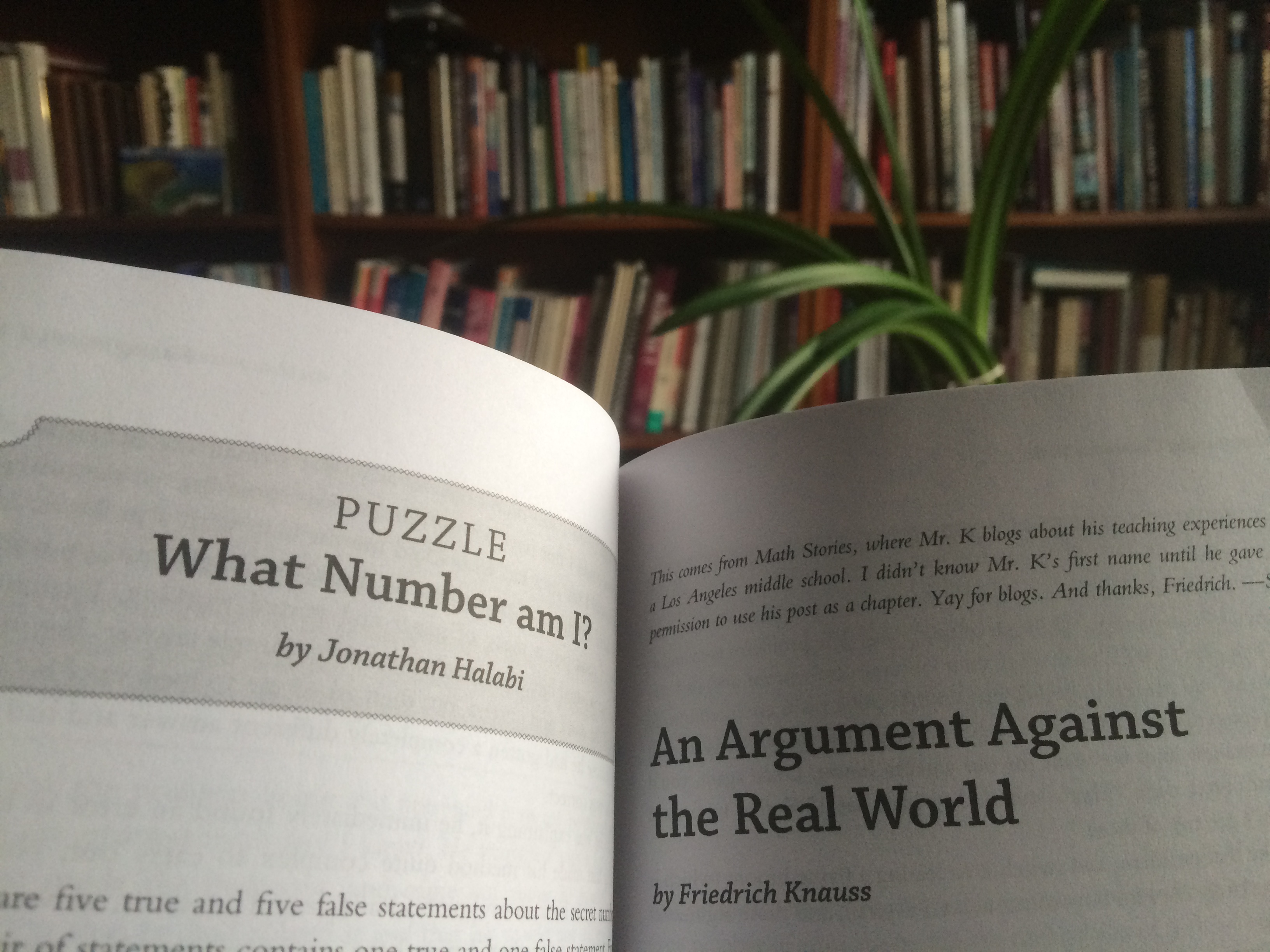
I actually got a pdf of Playing with Math earlier, but a book with a cover is special. You can leaf through it. Which I did. And I’ve already discovered a dozen other ways to play with math. And I am not nearly through. I would have wanted this book, even if I wasn’t part of it. Cool.
You can order Playing with Math here.

Getting push polled by my union?
My union e-mails me surveys. The right way to get member sentiment is to let chapter discussions happen, filter up from Chapter Leader to District Rep to the leadership on the 14th Floor of 52 Broadway.
Unfortunately, that chain is weak or broken. There are schools without Chapter leaders, chapter leaders who do not meet with their chapters or meet without discussion, chapter leaders who do not pass on information to their District Reps, DRs who do not solicit member thoughts from CLs, DRs who ignore schools where they do not get info, DRs who are afraid to share negative information with the 14th Floor, and times when 14 does not hear what some DRs are saying.
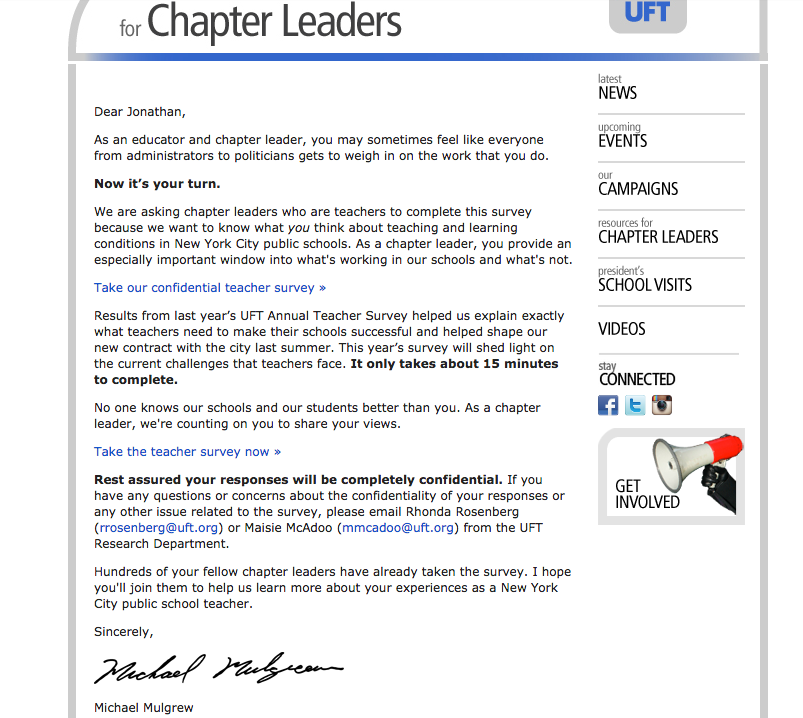
But even though it’s not the right way for a union to listen to members, certainly not to listen to chapter leaders, I fill them in. Last week I got a letter from Michael Mulgrew (well, signed by him, not actually from him, see below) asking me to fill in a survey that would just take 15 minutes (it took me more).
I was tooling along, answering what borough I was in and what I taught last year (I filled in for the year before, because of sabbatical), when I got to THE QUESTION.
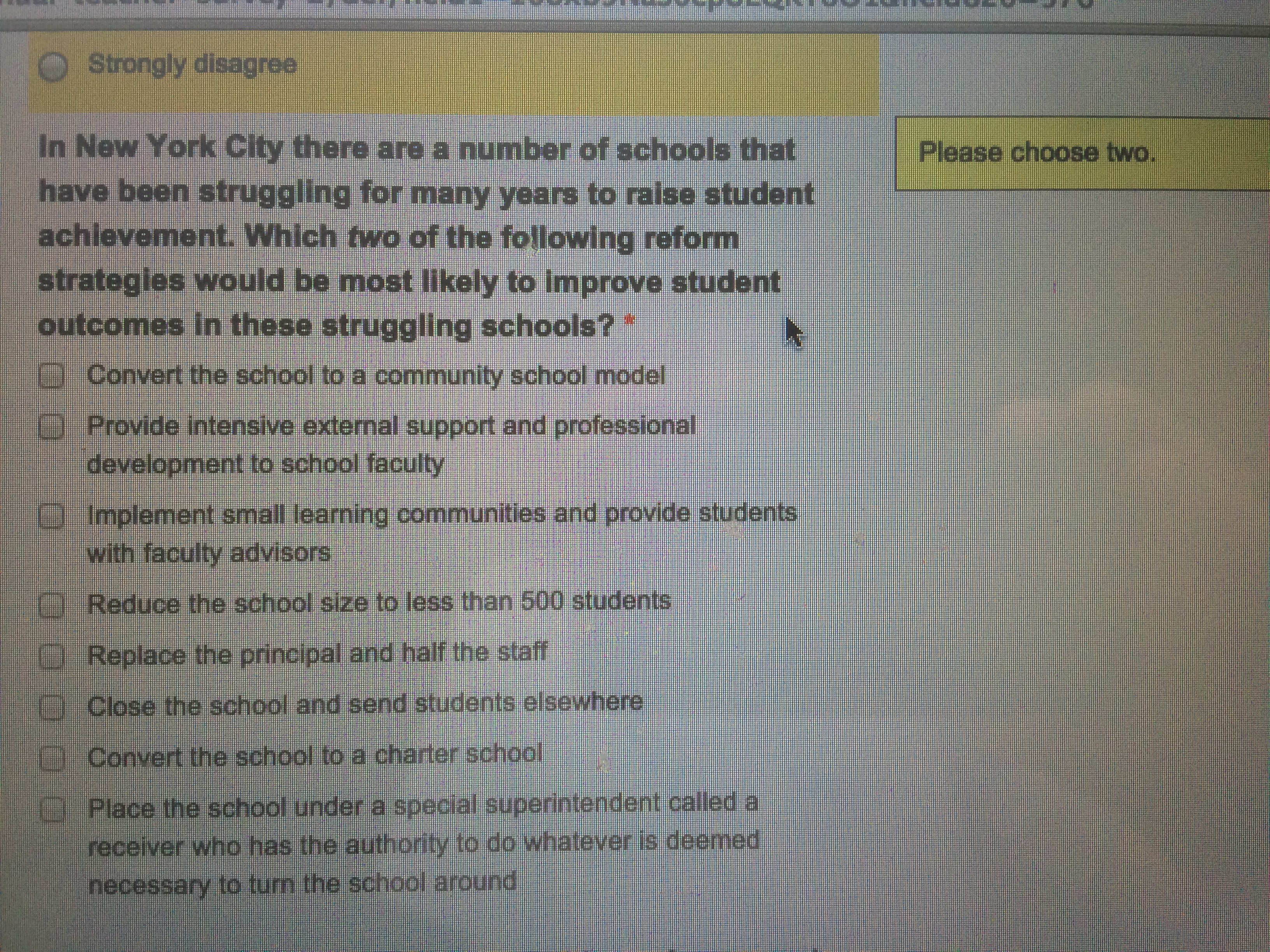
So I could check Community School, since some of the ideas of providing services make sense, but I really don’t know full details. The others are just plain unacceptable.
Plus, what do they mean by:
“…there are a number of schools that have been struggling for many years to raise student achievement….”?
We know that there are schools in poor neighborhoods where kids don’t do as well. And we would like to help more kids succeed. But “student achievement”? That’s what Cuomo, Rhee, Gates, Duncan etc call test scores. Do we really want our union to use “Klein-speak”? And do we really want our union to focus on test scores? This sort of language is embarrassing.
In fact, the whole question accepts the premise that if a school’s scores are low, the school must be bad. Didn’t the delegate assembly reject exactly that premise just two weeks ago? Isn’t the battle against that very premise part of the battle to preserve public education?
I decide to skip the question.
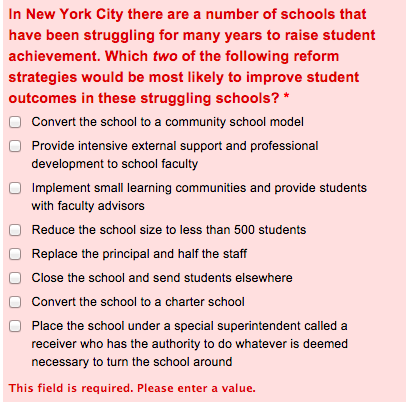
Nope. They won’t let me leave it blank.
I try to check off “Community School”
Now we have another problem. They are serious about choosing two. I know what they want. They want me to push “more PD” – but teachers used to hate PD. And most NYC teachers still do. And I don’t think PD fixes schools. The best PD is voluntary, and out of the building. NYCDoE Professional Development is top down, and supervised. In some schools it’s gotten better, but it’s still neither what most teachers want, nor what most teachers need. And what is that “external support”? And why are they asking teachers who are not in those schools about what teachers in those schools should have to go through?
Finally, I try clicking “proceed” with just “community school” checked off, and despite the warning it lets me move on.
But what is the union going to report? That most teachers want community schools and PD? Or, more honestly, given this limited list of options…
Where are the other options?
Where is “smaller class sizes?” Where is “more funding for after school activities and sports and clubs?” Where is “remove problem administrators?” Where is “more help, less rating?” Where is “repair our buildings?” Where is “build more schools?” Where is “allow principals to hire the best teachers without being penalized for preferring experience?” Where is “Other?” Where is “None of the above?”
Push polling doesn’t really fit with respecting teachers’ voices.
UFT Leadership digs in against Opt Out
At last night’s (4/13/15) UFT Executive Board, President Mulgrew and another officer tested their newly aggressive stance against the opt out movement.
Some background:
When Andrew Cuomo finished ramming his new budget deal through the NY State Assembly and Senate, Mike Mulgrew wrote to UFT members (3/29/15):
Our hard work has paid dividends
Dear Jonathan,
In a rebuke to the anti-public-school agenda of hedge-fund billionaires, the state Legislature tonight reached agreement on a new budget and a package of education proposals that will immediately increase aid to public schools, ensure that teacher evaluations do not hinge on state test scores and ensure local oversight of struggling schools.
Just two months ago, Gov. Cuomo proposed a series of education proposals that amounted to a declaration of war on public schools. His plan was to use the incredible leverage he holds in the state budget process to ram through his plan.
…
And now all of our hard work is paying dividends. The governor’s Draconian agenda has, in large part, been turned back. We want to thank the Assembly and the Senate for standing up for our schools and school communities.
The membership was not buying. There was anger about almost every aspect of the deal. And then there was the testing. There is a growing “opt out” movement across the state. While largely concentrated in suburbs, a number of anti-testing organizations have been making inroads in New York City. Several city schools already have high opt out rates, and there will be more.
NYSUT president Magee issued a statement encouraging opt out. There must have been a ton of e-mails and calls to UFT headquarters. On April 1, just three days later,
What the state budget contains
Dear Jonathan,
Three months ago, Gov. Cuomo declared war on teachers and public education, resurrecting the battle we fought for 12 years with our previous mayor. Both have the same Wall Street allies determined to privatize education and eliminate teachers unions.
…
Given the immense power that the governor wields in the budget process, we knew we had our work cut out for us. We did not negotiate this budget agreement, but we supported Assembly Democrats in pushing back as many of his bad ideas as possible.
We took hits in this first battle but so did he, thanks to the extraordinary movement of public school parents, educators and community members that has emerged over the past few months.
The tone had certainly shifted. But would they move on testing and opt out?
No.
At last night’s Executive Board Regina Gori (New Action), Chapter Leader of the Brooklyn New School (with a 90% opt out rate) asked how the union was planning to help teachers of conscience who did not administer state tests. The response was sharp.
- Refusing a direct instruction from your supervisor is insubordinate
- If we test less than 95% of our students, we could lose Title 1, Title 2, and Title 3 funding, which would cost jobs.
- Our allies in the Civil Rights Movement want annual testing. It has helped us learn where the system has problems.
When he arrived fifteen minutes later, Mulgrew used the second and third points in a long and slightly repetitive talk. (Those same points were raised by Al Sharpton in a NY Post interview a few days ago). Mulgrew additionally raised the specter of ten thousand lay-offs.
He went on to explain how the federal law could be rewritten to drop that 95%. He explained that we were different from other parts of the state.
The strategy he laid out had a few parts: engage with the Regents, negotiate a new evaluation immediately, wait for some federal change.
With the Regents, there will be a series of public hearings in NYC, and we should engage with them without shouting. I think he had in mind Merryl Tisch, who wrote most of Cuomo’s proposals, but who we are now looking to negotiate with. Unity leadership was quite defensive about Tisch through the winter and spring, even as it was clear that she was working at Cuomo’s side. I couldn’t figure out what they like about her. When we had three dozen schools on the block a few years ago, she did personally intervene to save Grady. Grady was Mulgrew’s old school.
Thank you, thank you, thank you
I was glad to be at Saturday’s rally. It was the first larger UFT event I’d been to in some time. And I liked challenging Cuomo, though I wish we’d done it during the election.
About 15% of my chapter’s members turned out (it’s a small school, there were four of us). I talked to teachers from other schools, to parents, to a principal from a D2 elementary school. I saw union activists I know, and total strangers. United against the governor, against absurd evaluations. Most of us, except for a handful of union leaders, were also united against high stakes tests.
I left a little early. It was cold and snowy. And I missed my Saturday morning whitefish, and was cranky. As we passed the stage heading north, I saw a familiar face on the corner. At twenty yards I shouted “thank you” to Zephyr Teachout, and I waved. She looked up, waved back, and smiled. Teachout challenged Cuomo for governor last year, and our union leadership snubbed her. But here she was, speaking forcefully at a UFT rally. She didn’t have to come, didn’t have to stand side by side with those who had taken the Working Families Party endorsement that was rightfully hers, and handed it to Cuomo, but she knew what was right. She spoke loud and true. AFT president Randi Weingarten made telephone calls during the campaign for Cuomo’s running mate, some woman named Hochul, but she didn’t come, Zephyr did. Thank you.
As I got to the southeast corner of 42nd and 3rd I saw a small cluster around an old guy. Robert Jackson. Hero of Public Education. Dewey Award Winner (UFT). Lion for the Children of NY. This is the guy who made the Campaign for Fiscal Equity lawsuit happen. And this fall, running for State Senate, the UFT leaders endorsed his opponent. Actually, NYSUT did. But that was with UFT support. So what does Robert Jackson do? He keeps fighting for public schools. He keeps fighting for the children of New York. And he keeps fighting shoulder to shoulder with the UFT, who abandoned him. His opponent, who the UFT endorsed? He was a no show. But Robert Jackson does what’s right. “Thank you” I smiled at him on the corner, and he smiled back and waved.
Finally we got to Grand Central, and coming out as we were coming in I saw Audrey. Audrey’s a freshman at Brooklyn College. Back when she was my student, I knew she was into environmental issues, but I had no idea she was going to be an activist. But here she was, with a large hand-made sign, ready to stand with teachers and parents and give it to the governor. “Thank you!”
No one took their attendance. No one forced them to come out. It was cold and snowy. No one would have blamed them for staying away. But they stood in solidarity. They spoke. Everyone who came out deserves a thank you. But I chose to thank these three.
Thank you.
Thank you.
Thank you.
2015-2016 Sabbatical Applications on-line – due 3/17
Did you know the New York City Department of Education still grants study sabbaticals? Well, they do. I took one last year. I know two people on them this year. And the application for next year has been posted, and is due in just a few weeks.
Here’s the DoE’s sabbatical page (very little explanation): Sabbaticals (note, the page has a link, but it currently goes to the the wrong memo. See below for next year’s)
Here’s the Sabbatical memo for next year: Sabbatical_Memo_2015-2016_SOLAS_4_Feb_12_2015_(2)_Final_Version
And here’s the on-line application: Self Service On-line Leave Application (SOLAS) (Sabbaticals are included)
What do you do on sabbatical? Take courses (16 credits) or do a project. But I got a lot of advice that said the coursework gets approved more easily.
How much pay do you get? For a full-year sabbatical you get 70% of your pay.
Can you afford that? Maybe. A 30% pay cut is substantial, but taxes fall more than in proportion. And, you can drop TDA contributions to a lower level. And we are in the process of seeing raises – 3% this May, 3% next may. And we get our first “retroactive” payment next October. I think mine will be just over $5000, minus taxes. But there is also an extra expense to consider: courses cost money. Mine were about $7000. (CUNY)
What courses do you take? They should be “rigorous,” “job-related,” and the majority should meet during regular school hours. Nothing on-line, or weekends…
They want a list of courses now, but the class schedules are not out! Not a problem. Use last year’s schedules – likely your courses will be quite similar. Many courses are offered in the same time slot every year. If not, you’ll complete a change of course request. Not a big deal. I did three changes, all approved.
The application is completely on-line. When I submitted mine, I included a cover letter that explained how my stuff was relevant to work I do in my school. Not sure if you can do that on-line, but if you can, it’s a good idea to point out to the superintendent the relevance and rigor of the courses.
Are you eligible? If you have 14 years of service, including this year, including up to three years as a PPT. (less for a one term sabbatical)
Is it worth it? Wow. Courses can be fun. Destressing is great. Having some real time to reflect on your teaching is great. Long weekends are great. College breaks (6 weeks in Dec/Jan, Spring break, summer from mid-May to Labor Day) are great.
Some people get bored. I don’t understand them, but I know they exist. If that’s you, then no, a sabbatical would be bad. Some people can’t take any drop in pay. Family, mortgage, kids in school ($$$), debt. Not you either. But for most of us who’ve put in a decade in a half, tighten the belt a notch, get working on that application now, and prepare to leave, learn, and breathe free.
For more information, contact your UFT borough office.
Saturday’s Demonstration #BlackLivesMatter Was Really Something
Nothing profound to say here. I was feeling fluish, but would have been embarrassed not to at least take a peek, seeing as I was already downtown for an AM movie. Had a bowl of mushroom dumpling soup on Second Avenue, and wandered over to Washington Square a little before 2, expecting to see a fun but ragtag group scattering in. Nope. The park was packed.
I forged into the thick of it, and then out along the edge, and back in, hoping to run into a familiar face. But the crowd was already in the thousands, and luck wasn’t with me. It started to move. Waves of chants flowed. Signs were everywhere – homemade, and distributed on the spot.


We shuffled forward, unevenly. Marching was out of the question. But the voices were powerful. Here and there small groups fell back, or surged forward, all being carried in the broad Fifth Avenue river.

As we slowly advanced, I checked my phone. Twitter wasn’t accepting posts, and my connection was bad for Facebook. I noticed others glancing into their palms as well. Video cameras darted around us. On corners, at lightpoles, boys and girls took pictures from their perches. I thought about finding a pole of my own. But I let the crowd carry me forward.

I tried to see ahead of me. I don’t know if I could have seen the front, even if I were taller. I tried to look back. That was more difficult. I was surrounded by a flowing stream of Black and white, mostly young, but some old, some chanting “Hands Up, Don’t Shoot,” others with their hands up. The energy and power were intense. I thought it might carry me to the end.
At Herald Square we turned, and I saw the Manhattan Mall. Bathroom. Across the street I saw Duane Reade. Sudafed. And back across the street I saw the D train. Home.
I’m a fan
…. of my students.
Yesterday, the fourth day of a dress up week, was “Spirit Day.” (Pajama Day, School Spirit Day, and Twin Day were earlier)
Students were asked to wear clothing to support their favorite team (Yankees, Rangers, even Red Sox…)
But many of my students wore a piece of paper over their tops, like a runner’s number. The papers looked like this:

Of course they were not all the same. Some of my students are not fans of chokeholds, or people being targeted for their race.
But there were a lot of protesters, more than half of some of my classes. And they were clever, and got their message across, and I’m a fan.
Getting Back in the Swing (Sabbatical’s really over)
Six weeks in, and I’m back in the swing.
I could write “it feels like I never left” but that wouldn’t be true. I’m calmer, feel better. Leave aside that I’ve studied a lot and seen a lot, been to a lot of cool places, made new friends… And I have continued life without an alarm clock. I hope to never use one again.
But the first couple of weeks – and I’m not asking for sympathy, since I deserve none – I was tired each evening by 7, sometimes earlier. I can write a lesson, and manage a classroom, all that good stuff, but physically I was a first year teacher all over again.
But here I am, finishing up my first “interim reports,” giving my second round of tests (in the courses where I test, more about that another time), collecting my first rounds of projects… Back in the swing.
This week three classes solved “How many three digit numbers are there?” (one class found six ways to count them) and “In a 73 player single elimination tournament, how many matches are played?” and wrote up their process.
Another class, that’s been getting a quickly paced diet of algebra review (trinomial factoring with two and three digit coefficients, adding, subtracting, multiplying, and dividing algebraic fractions, polynomial long division) oohed and aahed when they learned that for 
And my seniors, they completed a four equations, four unknowns project, and turned in mostly clean, well-annotated work, and then had what I thought was a really good talk about keeping the stress level down during the next few months of college applications.
The only thing missing now is blogging…
Teachout for Governor, Robert Jackson for State Senate
In the first UFT Executive Board of the year, New Action moved the endorsement of Zephyr Teachout for Governor. The motion was debated (2 speakers for, 3 against) and overwhelmingly defeated. Yet it was important that the issue came forward, and that opposition to Cuomo was acknowledged.
I spoke about Robert Jackson during the question period. Given the NYSUT endorsement of the other guy, a motion seemed besides the point. But what does Jackson have to do – Hero of Public Education, Dewey Award Winner (UFT), Lion for the Children of NY – to earn the UFT’s support?

 JD2718