No Quarantine – What are these people thinking?
I’ll play out a few scenarios – both for the No Quarantine Policy, and also the No Mandatory Negative Before Returning to School Policy.
And by “these people” I specifically mean Bill de Blasio / Eric Adams. I’ll say “de Blasio” most of the way, but I’ll mean “de Blasio today and Adams tomorrow.”
To play along, you need to set aside what you think is best for the system, for the students, for the staff. This game guesses what de Blasio’s objectives are, and then sees if the policy would be a logical policy based on THOSE objectives. Remember, his objectives may be misguided, or worse – but we are trying to discover them.
Scenario I
de Blasio seeks to keep the number of infections as low as possible.
This scenario immediately fails. Quarantine lets fewer people get infected than No Quarantine.
Scenario II
de Blasio seeks to keep the schools open, and seeks to minimize infection. He uses the rapid tests to quickly identify sick students and staff.
This first part of the scenario passes. It keeps the schools open. But rapid testing on the first day will catch no infections. And rapid testing on the fifth day WILL catch infections, but after the victims had already spent time, contagious, in school.
This scenario fails.
Scenario III
de Blasio seeks to keep the schools open, and seeks to control infection rates. The rapid tests will help control infection rates, at least a bit.
This first part of this scenario passes. It keeps the schools open. But same problem as scenario II with the second part. This scenario fails.
Scenario IV
Maybe the rapid tests are a decoy: de Blasio seeks to keep the schools open. He is deploying the rapid tests for a reason other than controlling infection.
This first part of this scenario passes. It keeps the schools open. But it leaves two questions: why deploy the rapids? and, is he doing nothing to control infection?
Scenario IVa
de Blasio seeks to keep the schools open. He is deploying the rapid tests for some other reason. And he is doing nothing to control infection.
This first part of this scenario passes. The second part is incomplete. Why deploy the rapids? And his people know the virus is spreading. The third part, do nothing to control infection, kind of guarantees serious outbreaks that will blow back on him. This fails.
Scenario IVb
de Blasio seeks to keep the schools open. He is deploying the rapid tests for some other reason. And he is doing something else to control infection.
This first part of this scenario passes. The second part is incomplete. Why deploy the rapids? And his people know the virus is spreading. The third part, begs the question, what is he doing (not rapid testing) to control infection?
At this point, IVb is the best. But those questions need some sort of guesses: Why use the rapids if they are not keeping us safe? And how does he think he will keep big outbreak from happening?
Why use rapids?
- They are cheap.
- They address parent and staff demands for “testing” (but not effective testing)
Let’s try this,
Scenario IVb1
de Blasio seeks to keep the schools open. He is deploying the rapid tests because they are a cheap way to convince the public that testing is happening. And he is doing something else to control infection.
The first part of this scenario passes. The second part is intriguing. The story line is “more testing.” And aren’t rapids being funded by the state and the feds? I can’t find a source for that, but would be grateful is someone could point it out to me. It looks like they are being dumped. And a rapid on the first day is essentially a test in the trash – which makes no sense from an epidemiological point of view, but the perception that more tests are being given will be real. The second part of this scenario fits. But what about the third part?
So IVb1 is looking best. But the third part of that scenario needs filling in: How is he hoping to control infection?
- Rapid tests?
- Morning screeners?
- Count on omicron being mild?
- Count of infectiousness and symptoms arriving simultaneously.
Before looking at those possibilities, let me return to a previous assumption: I do not believe that de Blasio intends to get lots of people sick. There’s all the usual reasons – looks bad, inhumane, stain on his record – but a big outbreak would close schools, and I’ve assumed that his top priority is keeping schools open, which works with most of these scenarios.
And with that in mind, that de Blasio really doesn’t want big outbreak, which of these four possible reasons won’t work? Just the rapid tests – because they are being given too early to catch anything, and then to late to prevent spread. The morning screeners could help. Some parents will send in symptomatic kids, but some will not. Omicron does look “milder” than previous variants. Scare quotes on “milder” because it still can pack a wallop. And the “mildness” may relate to previous infection or vaccine status. And it is true, infectiousness and symptoms arrive after infection (I’m not sure how close together), which makes me believe that the first day after infection there are not likely to be symptoms, or spread.
So, let’s try this:
Scenario IVb2
de Blasio seeks to keep the schools open. He is deploying the rapid tests, not to control outbreaks, but because they are a cheap way to convince the public that testing is happening. And he thinks he will control outbreaks because 1) omicron is milder than previous strains, 2) parents will keep symptomatic kids home, or the kid will fail the screener and 3) before the symptoms arrive the kid won’t be very contagious.
The first part of this scenario is consistent with what de Blasio has said, and his actions. The second part fits what is happening, including public concerns about spread, and cost. But what about the third part? Will mild omicron, parents keeping kids home, and a window before a kid is infectious hold down infections?
Maybe. But these are people’s lives. Those are awfully high stakes for “maybe.” A bean-counter, a bureaucrat, might be okay with that sort of gamble, but not you or me. But who do you think worked on de Blasio’s plan?
One last detail gnaws at me. What about the first serious illness? Or death? That, on reflection, is not a big problem. Just claim that the kid got infected at home. There is a lot of omicron in circulation, after all.
A different problem
Second problem, quicker solution. Why is de Blasio opposed to mandatory testing before January 3? Or delaying opening a few days to allow time for mandatory testing?
Look at the answer to the previous problem. de Blasio is opposed to closing schools. So a delayed opening violates that objective. And mandatory testing will show many many infected children. Enough that it might lead to closing schools or classrooms. And de Blasio is opposed to closing schools.
But won’t that allow lots of sick people into schools to spread omicron? Look at the answer above. Omicron is milder, parents will keep symptomatic kids home, and asymptomatic kids are less likely to spread it.
Cruelty vs Deceit
Part I – Cruelty
Tuesday Bill de Blasio announced that quarantines in New York City schools were mostly a thing of the past. He said a bunch of other stuff – he was talking about COVID and safety. But his big new flash – no more school closings.
Up to now, when someone was positive for COVID, their “close contacts” needed to stay home, until we knew that they were not sick. It’s the approach we generally use for maintaining public health. Under the new plan, all contacts are assumed to NOT have COVID and stay in school, at least until a remote test 5 days after the fact catches them. That’s not the way we generally approach public health, but there is a lot of frustration with this pandemic.
How do I know that ending quarantines, ending classroom closures, and not sending kids home was the centerpiece of his press conference? After all, he spoke for two hours. I know it, and you can know it, because he said so.


Is this cruel? A rapid test on the day of exposure will come back negative. A kid who picks up the virus that day will get a negative rapid, and come to school. For five more days, before the next rapid.
Has the mayor’s staff run estimates of how many people will get sick that way? (probably, “many”) of how many cases will be worse than “mild” (they are hoping for “few”) and how many children and adults will die (they probably calculated “0 to very few” but they’ve probably also gamed out how easy it will be to claim they picked it up outside of school).
The mayor and his staff are gambling with our health, and the health of children. They are taking bets that they hope will work out, but it’s called gambling for a reason…
Part II – Deceit
Michael Mulgrew followed the press conference by issuing a press release. Three hours later he wrote to UFT members. That order reflects who he thinks is more important, but that’s another discussion.
How does he discuss the quarantine change?

Read that paragraph as many times as you like (it’s from the letter to members). He doesn’t discuss the quarantine change.
Perhaps I cut out the relevant part. Look at his list of changes:

That’s also from his email to members. And nope, nothing there about the change in quarantine.
Here’s the whole email:

Not a word about quarantine. de Blasio (and Adams) are practically eliminating quarantining, and Mulgrew doesn’t mention it. But he does support “the changes” – he just fails to mention that eliminating quarantining is one of those changes.
Maybe the press release was clearer?

Nope. Not a word about the biggest change, quarantining.
Although, there he goes again with the “we got this” messaging that just pisses all of us off.
By leaving out any mention of a change in quarantine policy, Mulgrew is trying to deceive teachers. But we are smarter than that. Which you’d think a good union president might know.
Mulgrew still staying on message
Yesterday de Blasio and Adams announced an end to quarantining, and Mulgrew’s email to members omits any mention of quarantining.
Made me think about this piece from September 20, 2021.
See what you think:
“We’ve got this” “we will figure out/ we figured out remote” “we will lead the way back to in person” “schools/teachers/NYC/NY State will lead the way” “We are reopening NYC” The “we”? New York City public school teachers. Me. Probably you. Other public school workers. The authors? The United Federation of Teachers “communication shop.” Reporters. Media people. And they have done an excellent job staying on message. Versions of the message came out even as schools were closing March 2020. They kept running through the spring and summer, and into last school year.
“We got this” “We are reopening NYC” represents a UFT officer’s marketing campaign that does not speak to teachers, and is frankly, alienating.Here’s the thing. Some teachers don’t love this message. It wasn’t, I don’t think, designed for us. It is a media play, a press strategy, a public relations campaign. Since Wednesday I have opened almost every conversation with a teacher the same way. “I love being in the classroom. Zoom? Never. I won’t go back. But being in school, in the hallway, around so many people, with so many safety questions – I am stressed and exhausted like never before” And the responses – teachers are relieved that I get it, that I am articulating it, that someone understands what they are experiencing. They open up. They appreciate the empathy. Which is what is missing from the UFT statements.
Today’s e-mail
Today de Blasio increased testing from 10%, only of unvaxxed, and only if they agree, from once every other week, to once a week. A little better. But still inadequate. There needs to be a lot more, and more frequent. de Blasio also dropped quarantining requirements further. Most students who may have been exposed to COVID in school will remain in school. A small win and a big loss. What did teachers talk about? The loss of quarantining. What did UFT Communications do? They put out an email “Mayor agrees to weekly COVID testing in schools” They stayed on message. They are talking to the public (or whoever they think the public is). They are not addressing teachers.The New York Teacher
In the latest “The New York Teacher” there is an article entitled “Bridging the post-pandemic learning gap“. It is not clear to me where the problems with this article originate. It is a Teacher Center piece, and Teacher Center values often align more closely with DoE values than teacher values. Or was this Mulgrew’s media folks? In either case “learning loss” is fictional stick that anti-public (school reform) advocates use to push their agenda and club teachers over the head with. And “Post-pandemic?” Is that where my union thinks we are? With masking and testing and quarantining. Well, maybe quarantining. Can you imagine your reaction if someone walked up to you tomorrow and asked how you liked teaching post-pandemic? Thanks to James Eterno for finding and publicizing that one.Balloons and Confetti and Smiles
I just got another email today, that was addressed to me, but not really addressed to me. It was from Meisha Ross Porter. She was celebrating “Homecoming” and even mentioned a pom pom rally. These things happened and are happening – that is true. But a little flash doesn’t cover up the anxiety and stress we are feeling; the nervousness about safety, concerns about teaching through a mask; general angst about this very iffy year. Arthur calls this “toxic positivity” as he points his finger at the DoE’s deaf ear. But read his blog a few days earlier, and what do you read? UFT Exec Board, and UFT Officers expressing a similar positivity. Keep to the message? Or speak directly to teacher needs, hopes, fears? Which was it? They kept to the message.On Message, Not Talking to Us, a Year and a Half
After 18 months of this, people are getting used to it. And it really is 18 months. Here’s the first piece I wrote about an insulting Mulgrew email. Check the date – April 1, 2020. Schools had been out for less than three weeks. And they continued, and continued. DoE, de Blasio, Cuomo directives were all shared with the members, mostly with fanfare, over Mulgrew’s signature. Many were followed by clarifying emails that walked back the tone, if not the content. There’s a price to all this – maybe not a price to Mulgrew – but a price to you and me. The level of cynicism about the union (and most members see the leadership as the union. That’s not right, we, in the schools, are the union, or at least we should be. But that’s often the perception) – the level of cynicism about the union has never been this high. I hear distrust coming from people who’d never paid attention in the past. When something goes wrong, a significant number of our members now blame the UFT as their first assumption. I am very worried about the damage that’s being done.Questions
Each one of these deserves in depth examination. How did we end up with the “We got this.” “We are leading the way to reopen as quickly as possible” message? It was never put up for a vote, in any body AFAIK. How much is the failure to empathize with teachers a problem of Unity Caucus? And how much does it belong to this current Communications Team, and their boss? And how is this team different from previous teams? To change the message entirely, or to drop it, that would probably require a change in leadership – and even if you think that the leadership should be changed – you probably know that that cannot happen until the end of the year, and that is unlikely to happen even then. But what about modifying the message? Can the leadership elevate the concerns of members over the media/marketing messaging? Today’s email – how hard would have been to give it an appropriate title, and to put the issue that MEMBERS are worried about before the issue that the OFFICERS have focused on? Am I wrong about this? Was there another time when the UFT’s President (and they were all Unity Caucus) failed to connect with members to this extent?The End – For Now
So that’s it. This last bit is for people who won’t read this, but I need to say it anyhow. Tone down, or eliminate the marketing strategy. It is alienating members. Write the emails TO members, not for public consumption. Your primary audience should be US, teachers and other school workers. Teachers are nervous and even scared. We never were trained for remote work, and survived a year with very little support, and we know it – and now we may have to do remote again. We are worried about safety. We are worried about lack of quarantines. We know that social distancing is not at the 3-foot level, and that worries us. Crowded hallways stress us. We do not trust the DoE to tell us when we are at risk. Learn this for yourselves, if you don’t know it, and begin each conversation by acknowledging it. Show us some empathy.de Blasio’s Plan to Keep Schools Open
There was plenty of outrage today, over de Blasio barely pretending to keep us safe. What did he say? Here’s some highlights:
- de Blasio is encouraging families to test
- de Blasio is encouraging families to give consent to be tested
- If a kid is positive, those exposed take a rapid home test that day. If it is negative, they stay in school (no quarantine). They test again five days later.
- They are doubling staffing at the situation room
- They are doubling the number of in-school PCR tests they are giving (for students and staff) – and allowing staff to use as many tests as are left over after the students are tested
- They are going to include vaccinated and unvaccinated in in-school testing
I’m going to look at this, point by point.
de Blasio is encouraging families to test: In Boston they are testing everyone before they return to school. de Blasio claimed this is not feasible in NYC. I guess, why not? OK, here’s a guess. The City’s testing network is a patchwork mess. It is easy to proclaim “tests are available” – de Blasio has done it several times – when it was at least partially untrue. it would be quite another level of challenge to process and collate a million test results. Maybe de Blasio was almost telling the truth. Maybe testing all of our students and staff before January 3 is not feasible in NYC, because it requires planning and competence that exceed what is available in de Blasio’s administration.
de Blasio is encouraging families to give consent to be tested: NYC is an outlier – requiring families to opt in for testing. Most places assume everyone can be tested, but allow families to opt out. This bizarro pattern may sound a little familiar. Remember in 2020-2021 when we couldn’t get a handle on how many families wanted to be remote? How it came as a result of de Blasio engineering an opt-out of hybrid learning, when an opt-in would have made sense? We know what happened then. de Blasio and some of his numbers people tried to rig the system to get more kids to attend in person. It didn’t work. But the abuse of opt-in vs opt-out is now signature de Blasio. It’s a ham-fisted attempt to alter the narrative, and now it’s not only lousy propaganda, it’s an impediment to safety.
If a kid is positive, those exposed take a rapid home test that day. If it is negative, they stay in school (no quarantine). They test again five days later: This is the one that has teachers screaming. It is essentially an end to preventative quarantines. Only sick, symptomatic, positive children will stay home.
Watch this: Johnny comes to school Monday, 3rd grade, was exposed the previous week, shows symptoms Monday, goes home, tests, positive, stays home. Now the kids who were with Johnny in class on Monday, they take a rapid test Monday night. Of course, after a few hours exposure, they all test negative. But in fact, two of them picked up omicron from Johnny on Monday. They all keep coming to class, and over the weekend they take their second rapid tests, and look, after a week of exposure…
But try again: Isabella comes to high school Monday, was exposed the previous week. Feels off, but isn’t sure that these are symptoms until the end of the day. While Johnny was with one class, and his classmates stayed together all week, Isabella has been in 7 classrooms with 7 groups of kids. Plus lunch. That’s, idk, 100, 200 rapid tests that night. None of the tests pick up anything. Too soon. But even if a few kids caught omicron from Isabella, by the end of the week large numbers of students and faculty will be potentially exposed.
This “no quarantine policy” is not good health policy. The first rapid test is too early, and is a waste of resources (especially in NYC, where we have had trouble getting tests for people who need them). Coming to school for a week immediately after exposure is risky for everyone else.
A secondary issue is about the reliability of at-home tests – not because of the tests are lousy – I think they are good – but because we know there are parents who send sick children to school. Especially with de Blasio and Adams and Hochul downplaying the risk to children, accepting home results looks like a practice that is designed to fail, at least at some schools, for some age kids.
And, minor side-note, the use of rapid tests leaves a question mark for teachers. How do we avoid getting docked pay if we do not have a PCR (with documentation)?
But this “no quarantine” policy will just about completely halt classroom closures, as it was certainly designed to do.
They are doubling staffing at the situation room: OK, that can’t hurt. But will it help? For the last two weeks the Situation Room broke down. Principals left messages – could not speak to a live person. Test and Trace seemed to have disappeared. Schools, with no specialized training, were attempting to make decisions about how to categorize illness, whom to contact, etc. Will increased staffing at the Situation Room fix this and prevent it from happening again? To answer that, we would have had to know what went wrong. And we can guess in a general way (not enough people, o-verwhelmed by o-micron, organizational problems), but we cannot get more specific. Worse, de Blasio denies that anything went wrong. How do we know he is addressing the problem, if he claims there was no problem? That is worrying. It’s also insulting to our intelligence.
They are doubling the number of in-school PCR tests they are giving (for students and staff): Again, sounds better. But if the baseline was low enough, doubling it will still leave us with a low number. And the previous number, 10%, was way too low. And by making it 10% of unvaccinated students who had given consent, the actual numbers tested were often tiny. One parent reported that 0 kids were tested in her daughter’s school last Monday. I think there were just two in my school (plus four adults) the same day. This policy was designed to keep the numbers tested low, so that the reports about COVID in schools would say that the number was small. Minimize testing, minimize the number. So today when asked, de Blasio claimed “We’ve never had a problem getting the number of kids and adults tested that we’ve needed to” (from Jen Jennings twitter feed. She listened to the entire event). The number he is talking about is a compliance number. He fulfilled an agreement, like a contract. He is not describing testing large numbers of kids – an outcome the agreement was designed to prevent.
They are going to include vaccinated and unvaccinated in in-school testing: Good change. It was needed as soon as breakthrough cases began. Which would have been September. Excluding fully (and partially) vaccinated students was just a way to “juke the numbers” as my friend Arthur says. Even when de Blasio is moving from doing the Wrong Thing to doing the Right Thing, he does it in a way that reminds us how astonishingly untrustworthy he really is.
– – — — —– ——– ————- ——————— ————- ——– —– — — – –
If de Blasio brought his brightest education people, health people and numbers crunchers into a room, and he asked them: “Come up with a system that will keep teachers and students safe, and will not unnecessarily send kids home, close classrooms, or close schools” and they came up with this system, he would need to fire all of them.
- At home testing has an element of unreliability because some families will want their children in school, sick or not.
- Sending exposed children back into the classroom for five days will lead to avoidable cases.
- Adding staff to the Situation Room without assessing what went wrong is, well, dumb.
- Not restarting January with a baseline negative from everyone seems like a strangely lost opportunity.
- Keeping consent as an “opt-in” rather than an “opt-out” is another lost opportunity.
No, if a room of smart people missed this, then they are not so smart, and should not be drawing a check from the City.
But that is unlikely what happened.
“Come up with a system that will completely stop closing schools and classrooms, and that will minimize time that students are kept out of school, that will reduce staff complaints, and, if possible, avoid major outbreaks”
If de Blasio brought his brightest education people, health people and numbers crunchers into a room, and he asked them: “Come up with a system that will completely stop closing schools and classrooms, and that will minimize time that students are kept out of school, that will reduce staff complaints, and, if possible, avoid major outbreaks” then they might have thought like this:
- Avoid testing large numbers, but do not make it so obvious. Double the previous numbers, that’s still low. Keep the “opt-in” in place, it holds numbers down. Allow faculty to take tests in school – they test themselves out of school anyway, and watching testers leave, with tests, but without testing faculty just pisses teachers off needlessly
- Under no circumstances demand PCRs before January 3, since we know that 10-20% will test positive and some schools will not be able to open.
- End quarantines for close contacts. This ends classroom closures and school closures, and keeps the minimum number of kids out of school.
- Count on parents to hold their kids out of school if symptoms are bad. (the DoE has already gotten away with the self-reported health screening – which is kind of a scam).
- Use at-home rapid tests to move accountability away from the DoE. Make a show of giving lots of at-home tests.
- Ask for the at-home tests to be administered too early to detect infection.
This is what de Blasio got. And that gives us a pretty good idea of what he asked for.
Erika and Sterling
New technology is cool for kids. Even when it’s not new.
Just before the pandemic I found myself reading about old machines: typewriters.
I used them when I was a kid. Mostly electric, occasionally a manual. I took a typing class in 9th grade.
Over the last few years, on my travels, I noticed that many historical or technical museums in other countries included them in exhibits – either as examples of technology (saw one like that in Quito) or as the possession of a famous man (saw one like that in Beograd).
Before that I admired how Ed Darrell included typewriters of historical figures and authors in his blog, Timpanogos (aka Millard Fillmore’s Bathtub).
Not that many years ago a huge hit film had a typewriter as a major plot element. In fact, several typewriters show up in Das Leben der Anderen (Other People’s Lives), but it is a very slim Groma Kolibri (hummingbird) that is carefully stored under loose floorboards. By the way, the closing line of the closing scene is tremendous. Wiesler opens the book on display, and sees it is dedicated to him (or rather, his code name, which is no longer secret), and takes it to the clerk. “Shall I gift wrap it?” “Nein, das ist für mich” provides a layer of truth for the clerk (Wiesler is going to keep the copy) and a much deeper layer for Wiesler himself (this work of art is for him). Perfectly underplayed, over a score that adds, never detracts, from the film. Fifteen years later, and it holds up beautifully.
Back to typewriters. I dug a little. There were a handful of US manufacturers who dominated the market. Smith Corona. Royal. Underwood. Remington. A coworker’s wife collects Royals (originally from Brooklyn). These are easy to find. But I dug further. There are some great European typewriter manufacturers. Hermes – Swiss, finely machined. Olympia – German, solid. Olivetti – Italian, beautifully balanced and light. And some of the best engineering went into the portables.
And I thought of Das Leben der Anderen and read about the Groma. Turns out, the quality of this East German machine was quite high. Digging deeper, Olympia wasn’t really Olympia – it was a new West German company that took over the name. The original, rebranded Optima, continued to be produced in the DDR. And then I happened on it – Erika. A typewriter called Erika. The company has a name, Seidel & Naumann but they left it unobtrusive. Erika was the name of the typewriter. After the war the name of the company was eventually changed, more than once, but the typewriter remained Erika. Precision. Quality. Beauty. And I bought one. From 1958. Here:
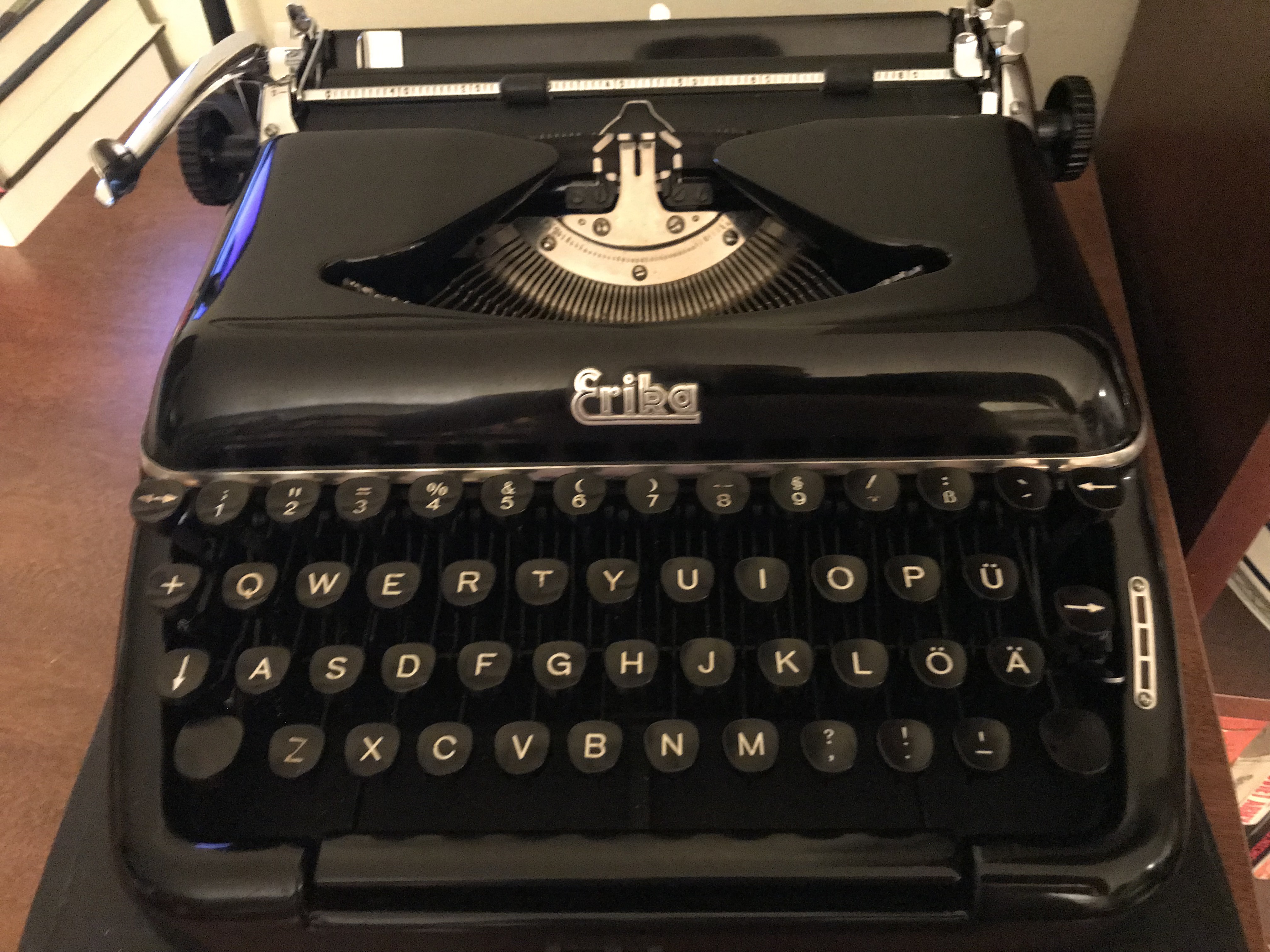
The package arrived when I was out, and the postman left it at the post office instead of my apartment, which is how I ended up with it in my car, and brought it into work. Also, the case needs a new handle, so I was going to bring it with me to someone I would visit in a few days who might be able to make the handle. So I brought it into work, planning to leave it there a few days.
I showed colleagues, showing it off (it’s tempting to say “her” since the name is feminine, but it is, after all, a machine). Some kids saw, and were curious. I encouraged them to try it. It was so funny! They were hesitant. They didn’t know how to load paper, or advance a line, or bring the carriage to the start of a line. Typing was slow. For a few days a trickle of kids touched their first typewriter keys. A junior came to me, announcing it did not work. It turns out there is a difference between pressing a key and striking a key, which is not intuitive, but is easy to explain.
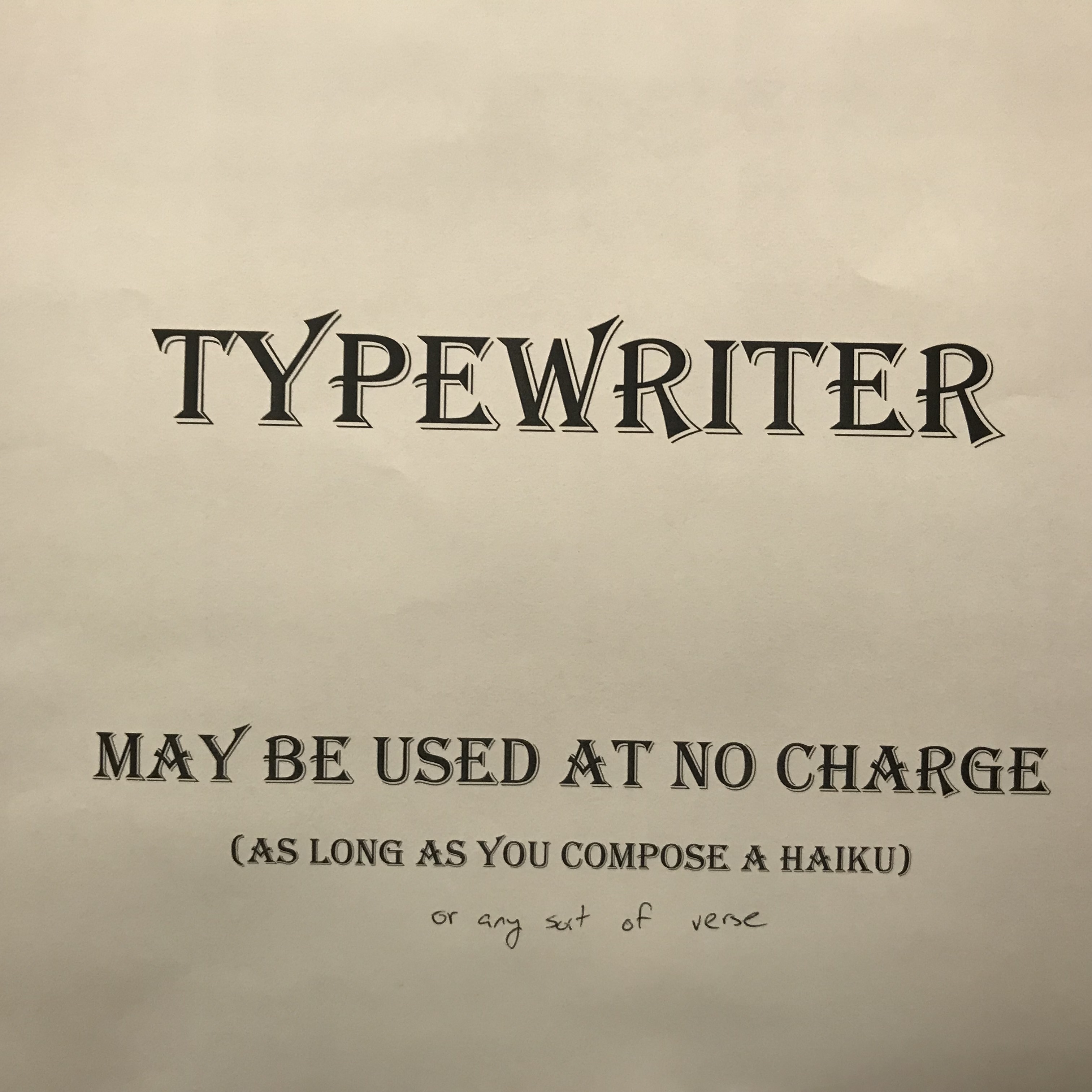
I put up a sign, announcing that there would be no charge if a student created a haiku or other verse. Of course there would be no charge in any case, but the sign had an instant effect, and I began to find haikus on pages left on the roller. Different kids were typing on the same sheet. The traffic got, not heavy, but consistent. I started posting some of their work on the office door.
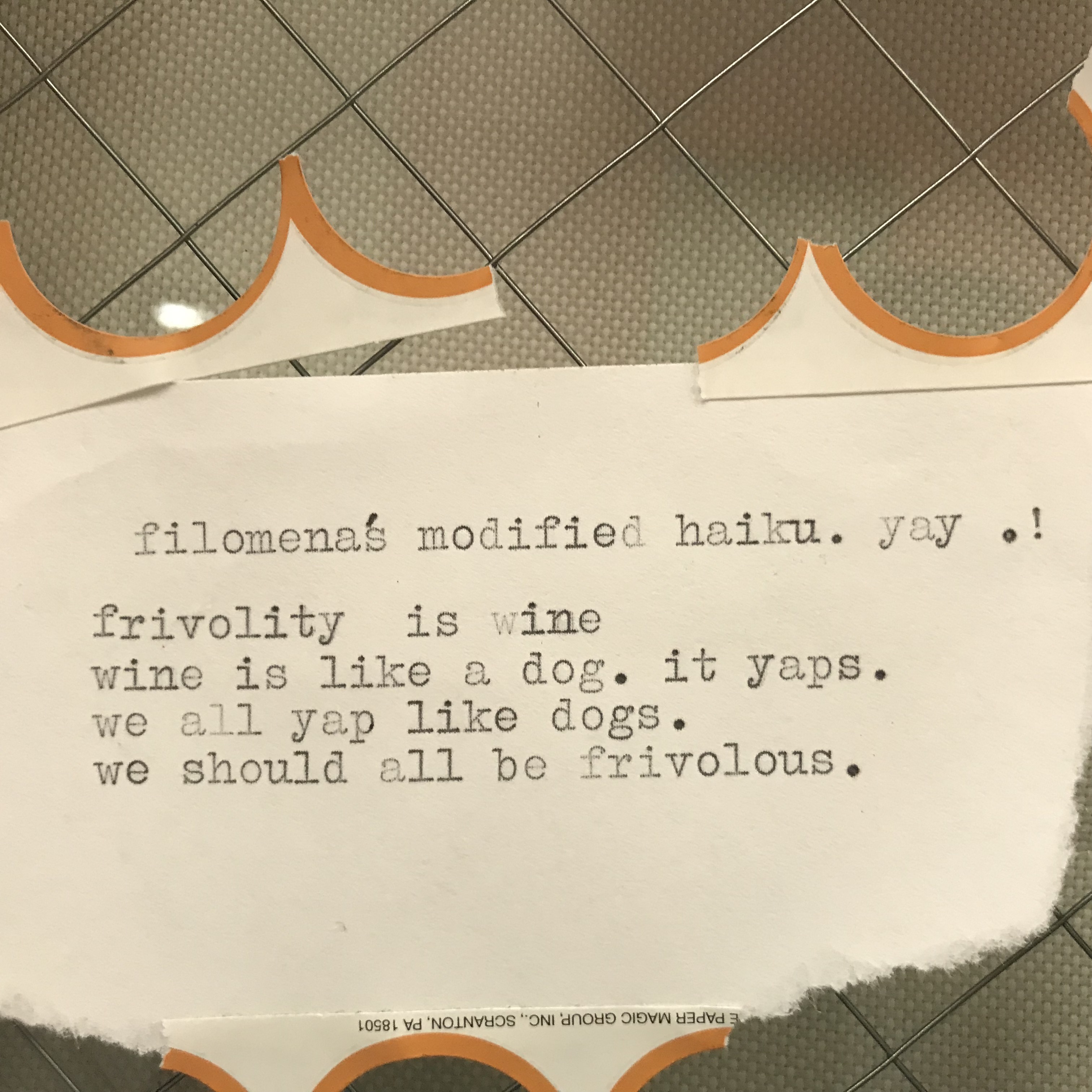
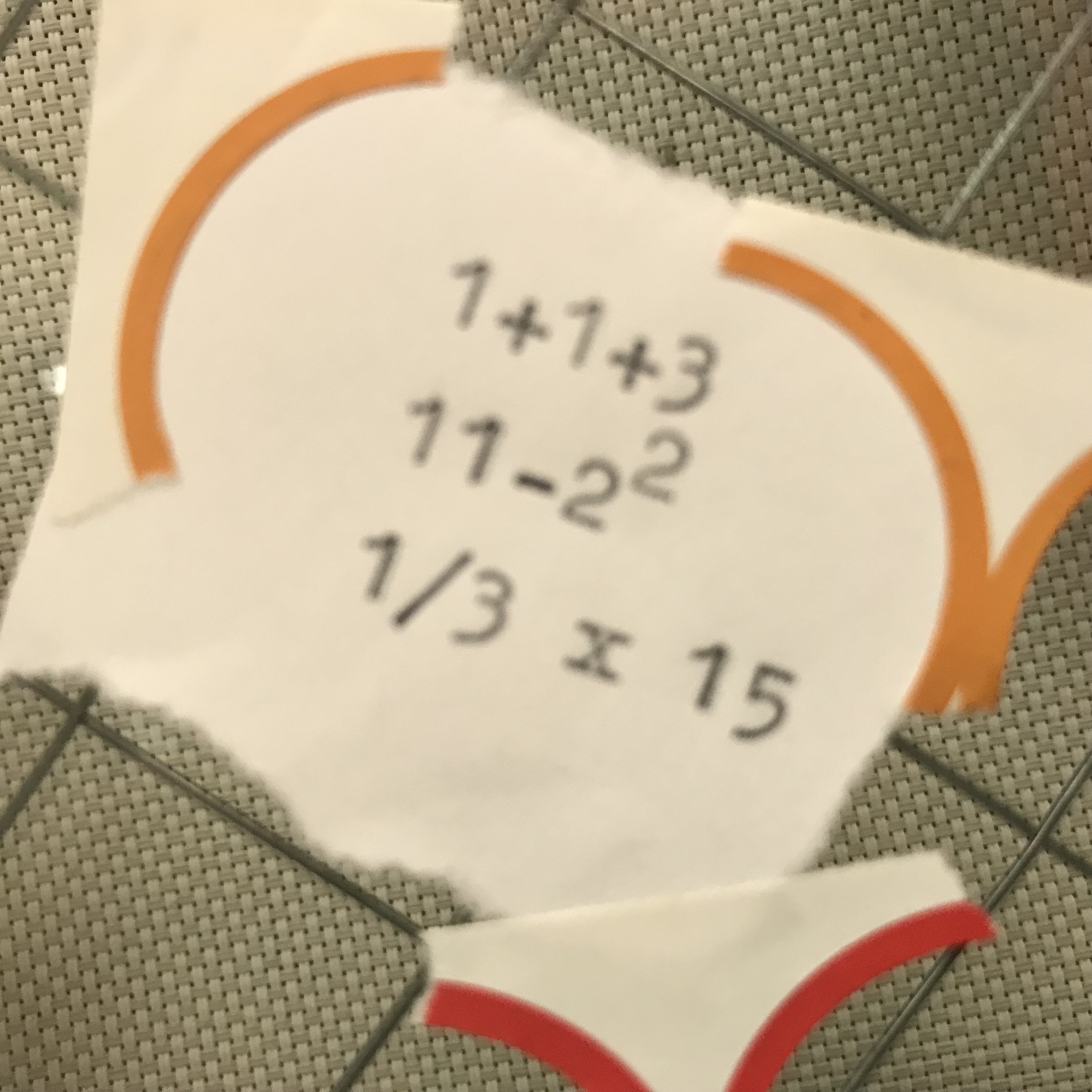
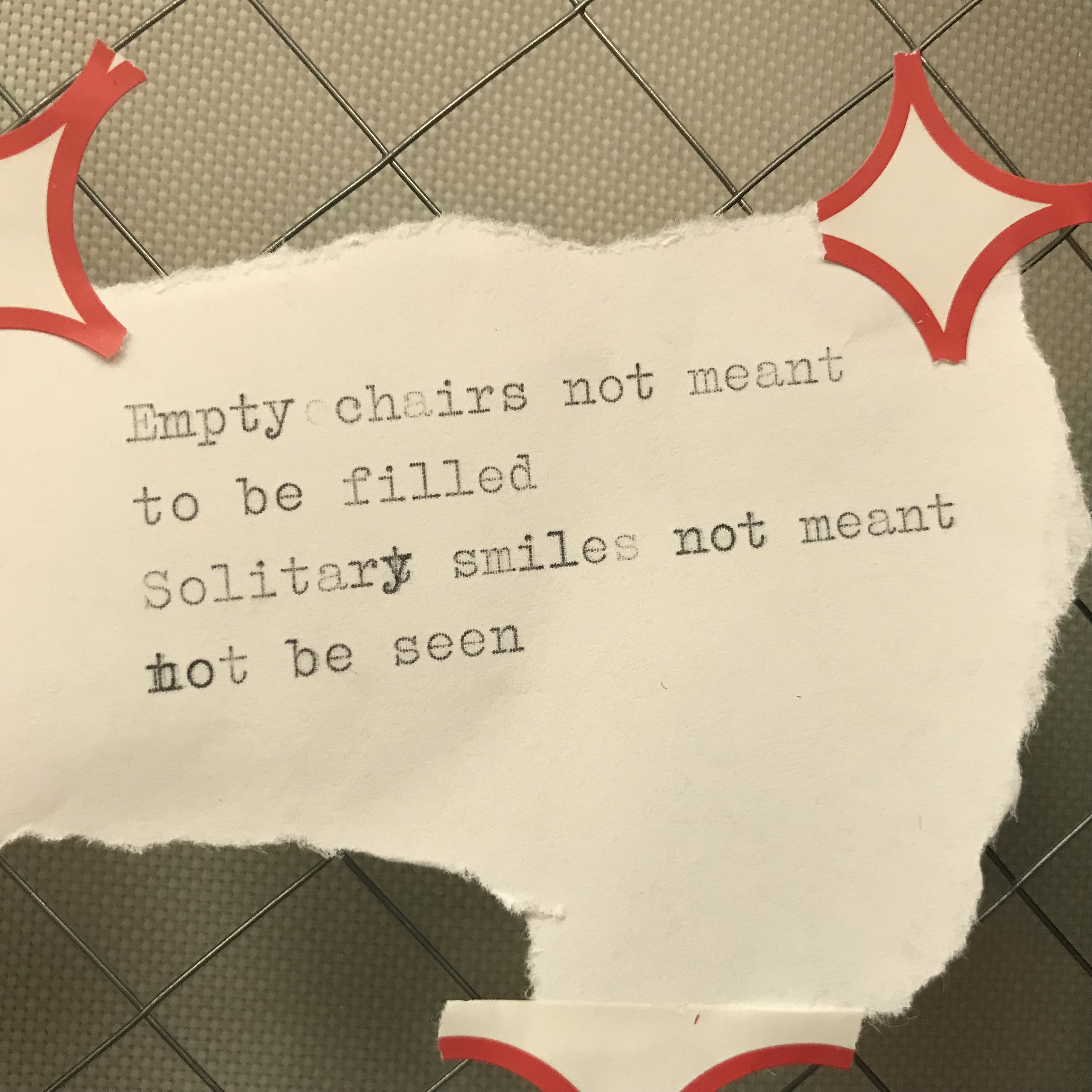
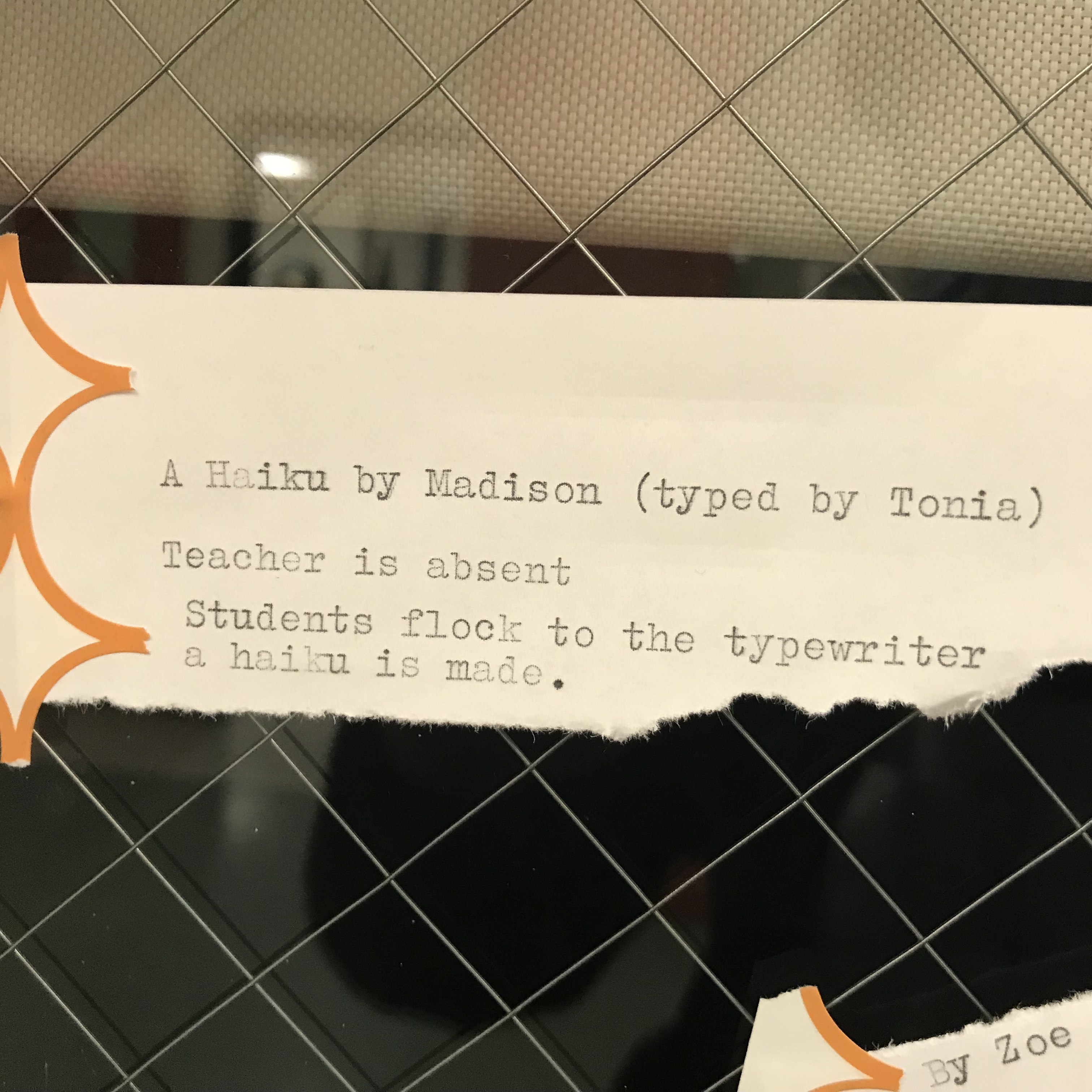
And then the day arrived when I was taking the typewriter away, and I felt a little bad.
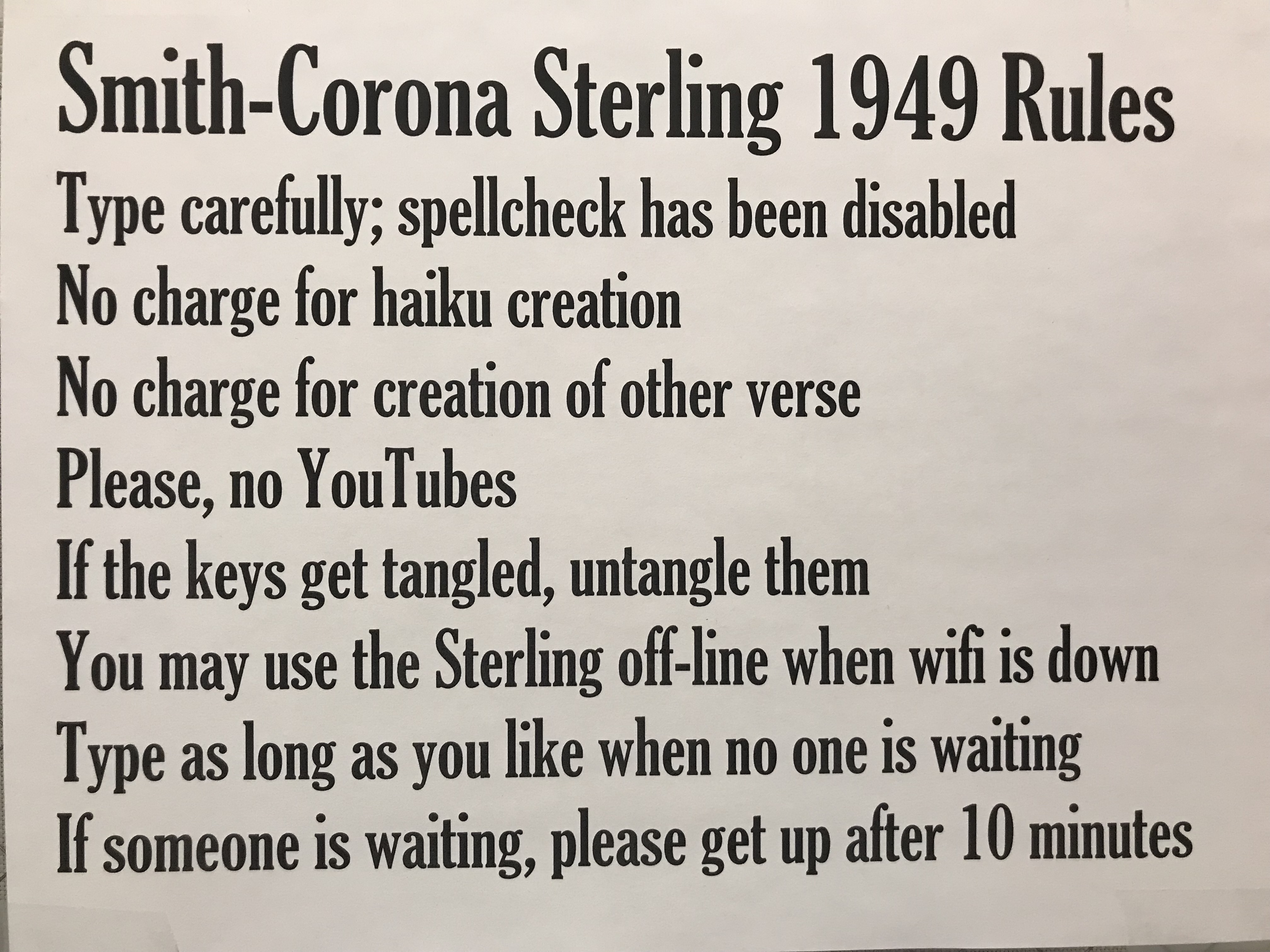
So here’s what I did. I went to a facebook typewriter collector’s and sellers group, told them my story, said no way was I leaving my gorgeous Erika in school, but did anyone have a more downmarket American typewriter. And I got a few responses, one was just across the GW, and I picked up a Smith Corona Sterling. The Sterling is simple, not elegant. But for the kids it is magical new percussive technology. I put up new rules:
Every day I find things that students type. I often enter the office to a clickety-clack, and smile. Most students work alone. Often I find them with a partner. Some like a fuller audience. It’s mostly seniors – they know me. But one lunch I was at my desk and heard a rustle, and I saw the tip of a head disappearing behind the door-frame. It was a freshmen, who wanted to know if she could try it. I don’t think she did.
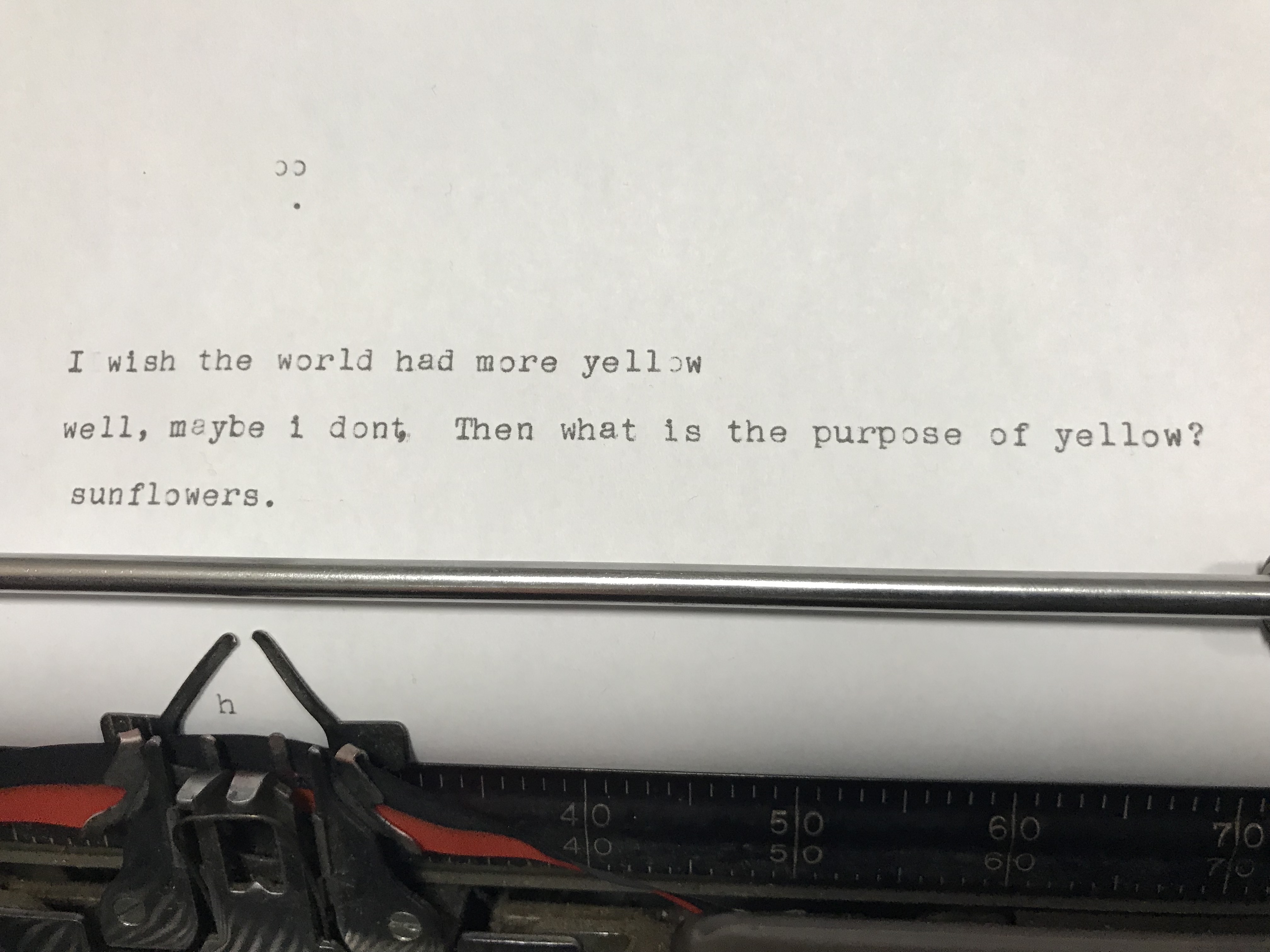
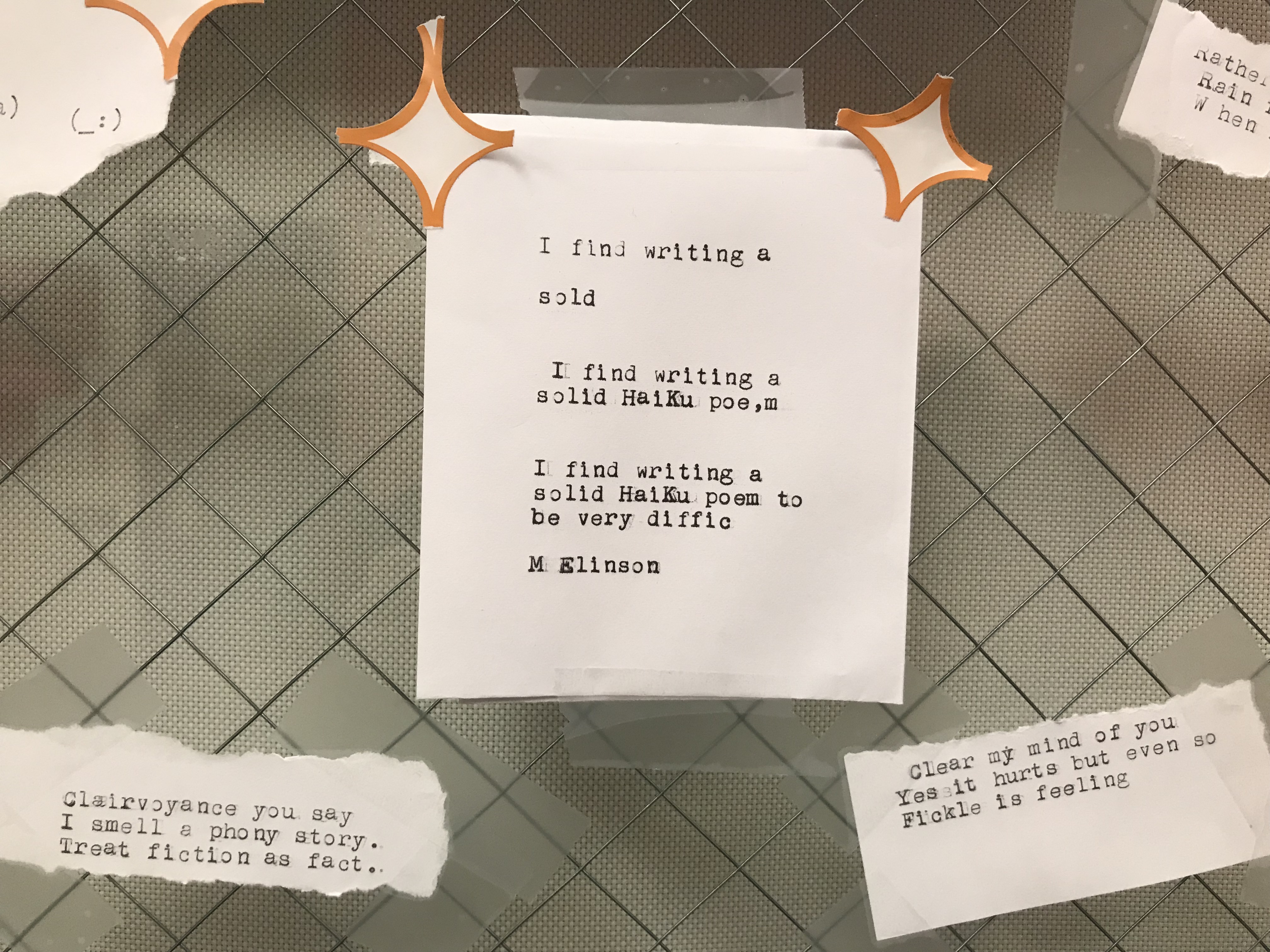
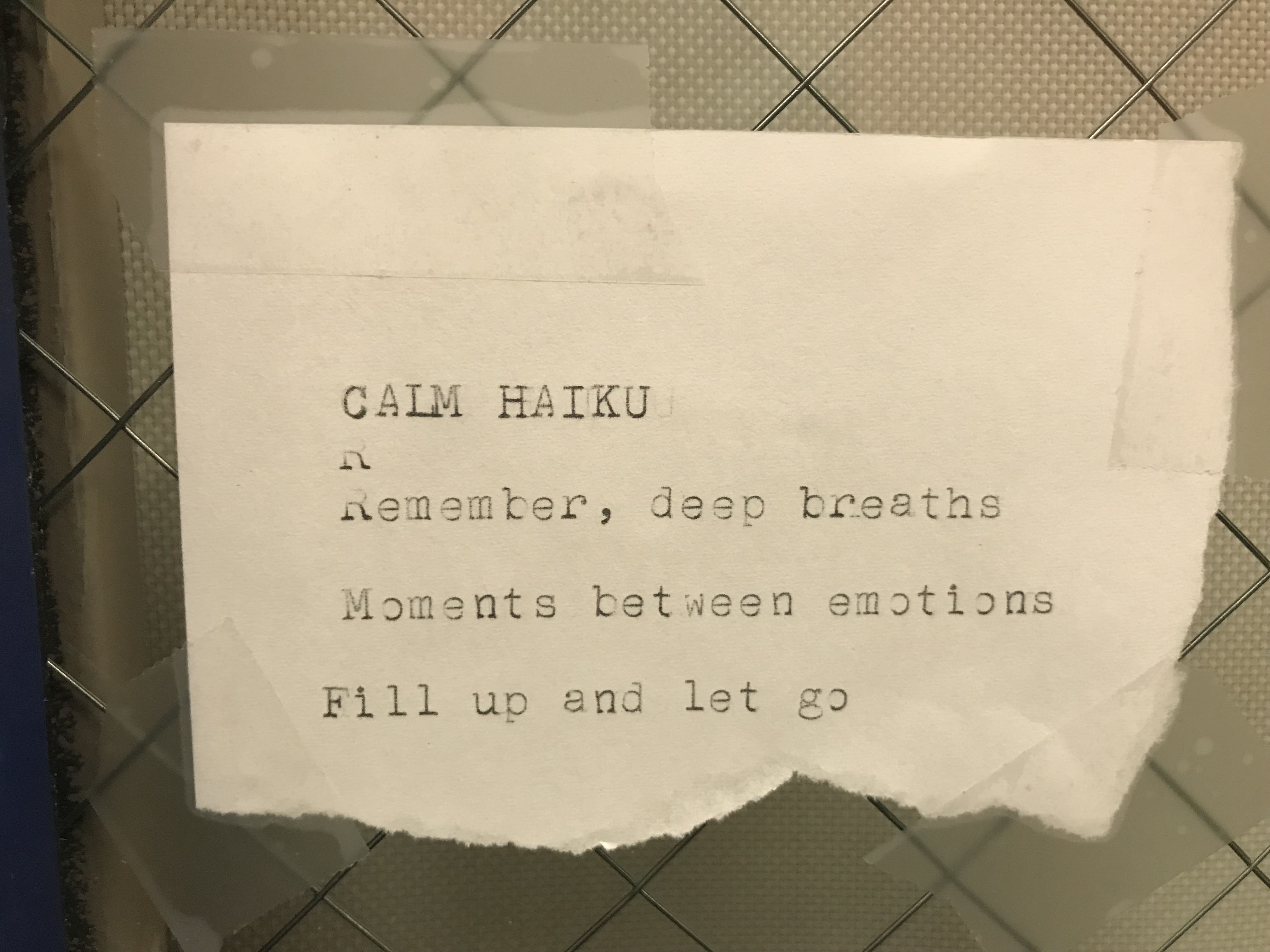
Over time the rhythms seem to be getting steadier. One senior has written letters to friends and family. Each letter, I have noticed, eats up exactly one page. One day I found a few paragraphs, explaining why the author’s choice of best quote in Lear was better than the teacher’s choice. Sometimes there are brief philosophical tracts – navel-gazing with short attention spans. But mostly, there are haikus.
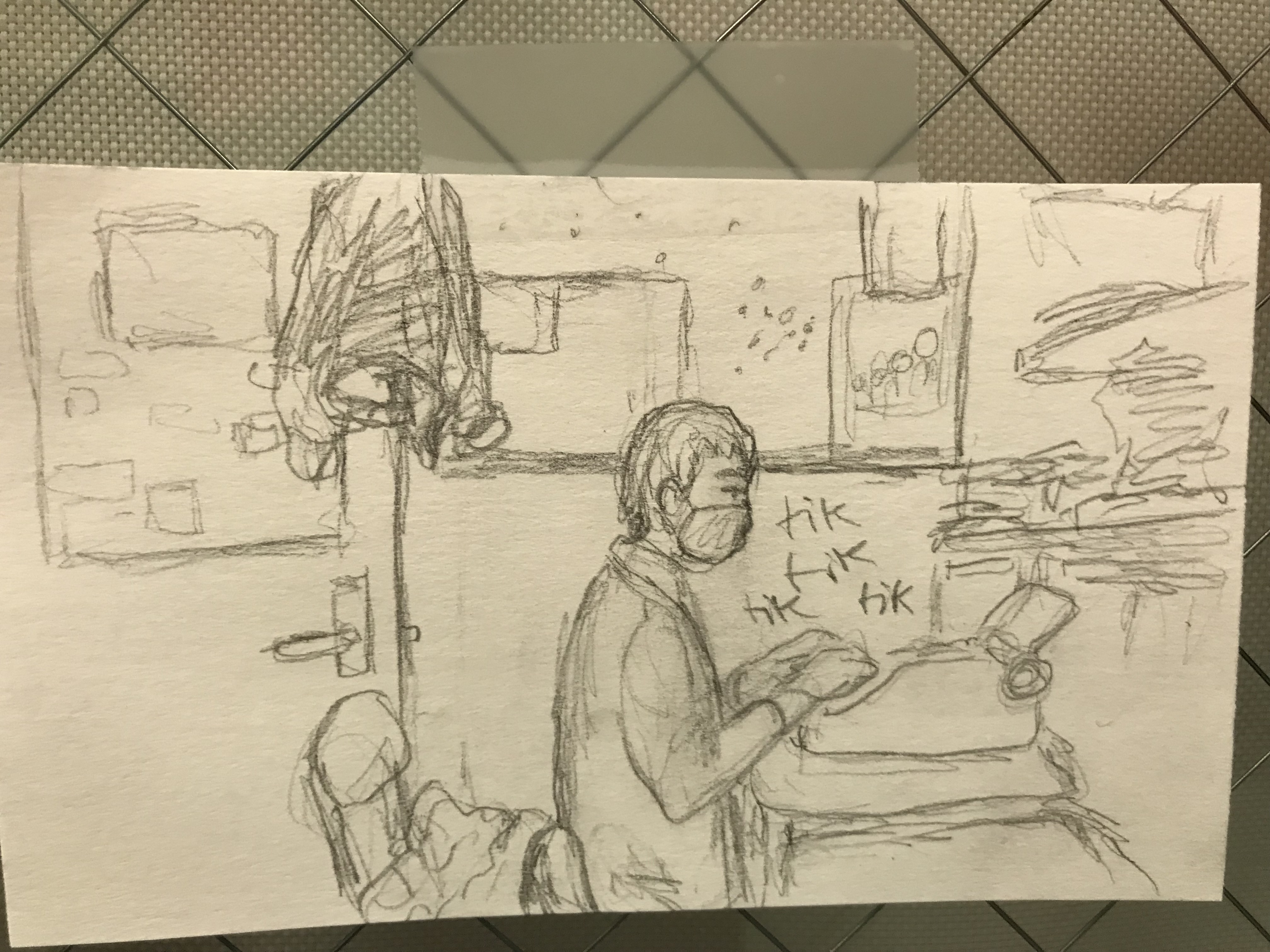
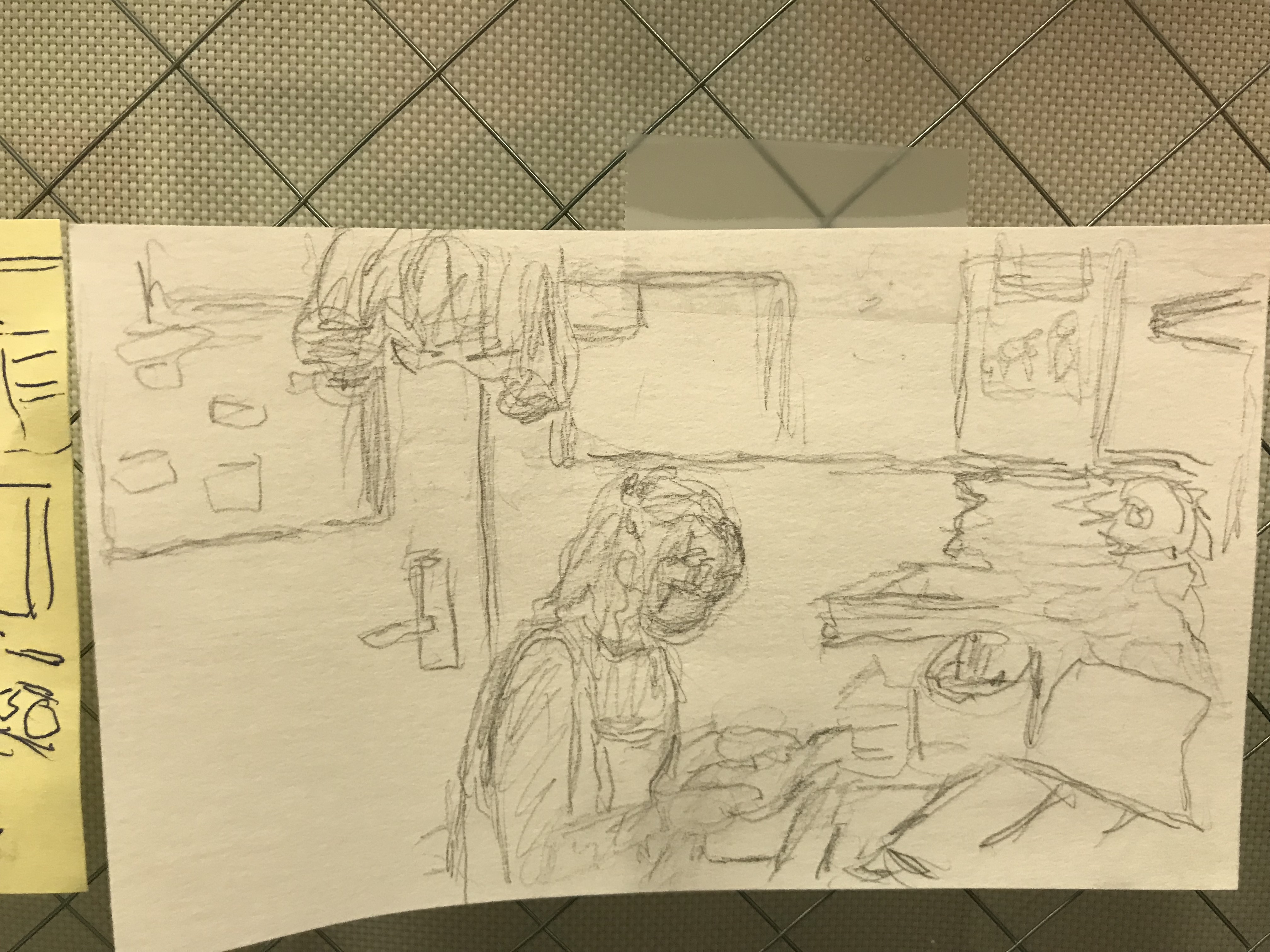
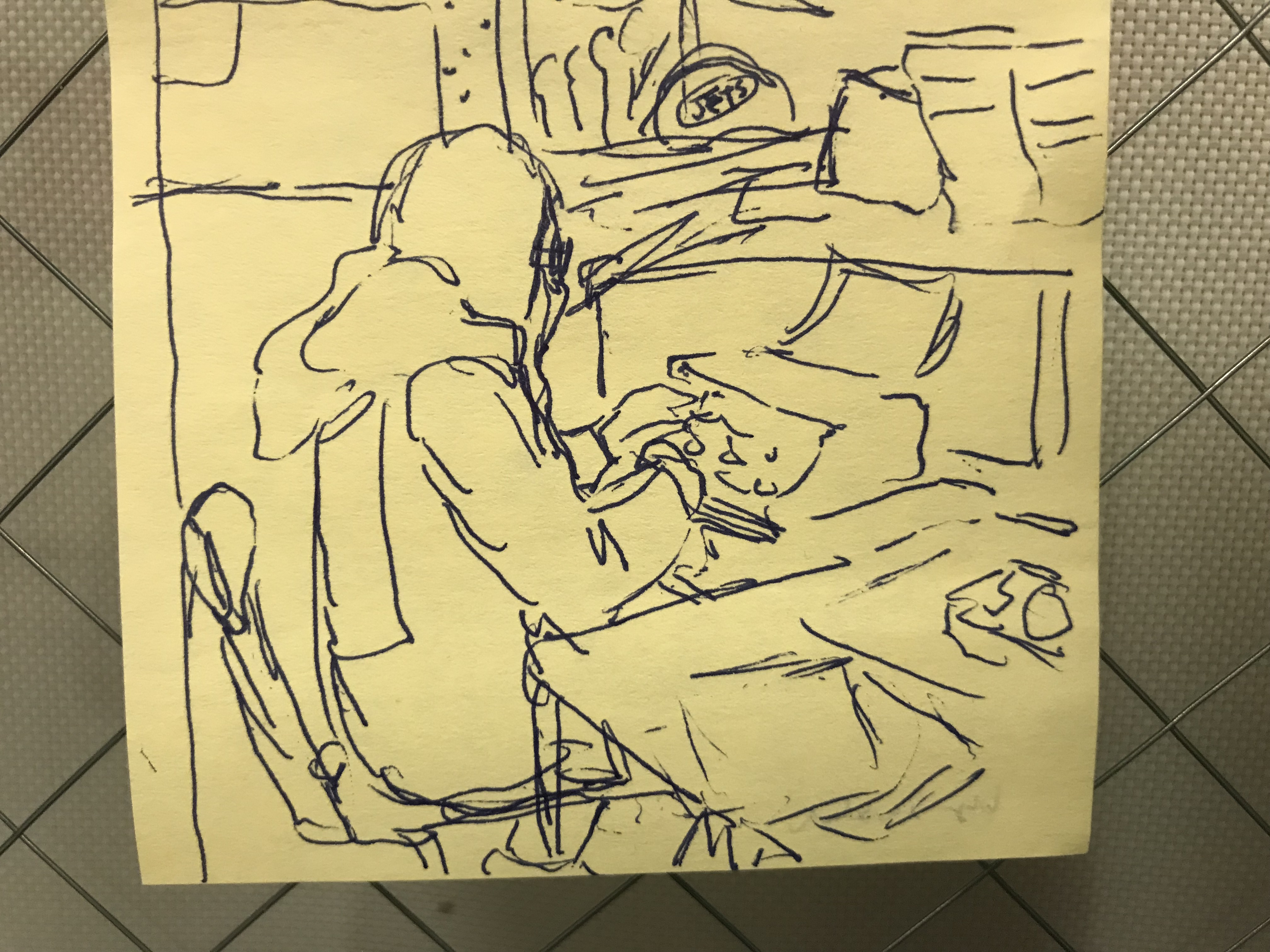
I have also recovered three sketches of students typing. I think I’ll keep the Smith Corona in the office for a while.
Omicron: Testing My Patience
I made it through last week. I thought.
Friday morning, trying to start to breathe, I opened an email from a colleague…”I am so so sorry…” They had tested positive on a rapid Friday morning.
My school was pretty good this fall – few cases – at least as far as I knew. We were careful, most of the kids, almost all of the adults. The teacher who sent the email had been especially cautious. And I was up there. But with omicron the usual precautions may not have been enough. If a kid was a little sloppy, if a few kids were, this omicron might have started moving from kid to kid, kid to teacher.
So when I got the email I wasn’t so worried about having caught omicron from the teacher – we had been in the teacher’s room together, but not so close. I was concerned that omicron had been circulating in the school, and that I could have picked it up from anyone – student or teacher – I encountered.
I had a negative PCR on Monday (I was one of the lucky staff members, the 10%), and I did not socialize last week. So I put my risky days between Monday and Thursday. Instead of waiting 4 days, like with all the other COVIDs, omicron is detectable a bit more quickly. Which made Sunday, today, the perfect day for a PCR. Somewhere between 3 and 6 days from possible exposure.
After I got the email I went online, and found that the closest public hospital, North Central Bronx, had plenty of appointments on Sunday. I picked 9AM.

And then I waited. Stayed home Friday. Missed a gathering Saturday – but I was not the only no-show – it’s omicron time, and we all understand.
Sunday, today, came. North Central is a walk from my house. I cut it a bit close. I was a block from home when I realized I had put on my mask, but forgotten my glasses. Oh well. At 20/25 I can survive, though I wouldn’t want to teach that way. I walked the best route, cutting through two chunks of park, zigging through the warren of little streets.
As I came up Kossuth I saw the line of test-takers stretched to the corner (which had been bad news last Friday). But when I got to 210, I saw the line turned the corner and went 50 feet up the block and slightly uphill. Now, I had an appointment, but I knew better. I just jumped on the end of the line. I looked at my phone. 9:00, to the minute.
We slowly shuffled forward, and a few came on line behind me. I counted sidewalk blocks – 13 in front of me, 2 behind. I slid forward, and caught a warm sunbeam. It felt good. Progress was slow. 20 minutes passed, and we had hardly moved.
Then all of a sudden the line broke and moved and reformed all the way at the corner. Staff were offering free rapid take-home tests to anyone who would leave and go home. Progress! But the corner had no sunbeams. And a wind picked up, and gusted. It was cold. Really cold. 20 people or so to the front steps. We moved about halfway. Still the cold, and no sun.
We moved again. Officers were counting 10 people inside. My group would be next. A family – or two friends with their kids – in any case a group of 5 – were in front of me. Then me. Two guys who seem to have met in line. A woman in an 1199 knit cap. And an older couple. It was 10:10. I’d been 70 minutes in line.
Based on the previous motion I estimated 10 – 20 minutes to get inside. It was still cold, but the porch we were on had partial walls, so there was some protection from the wind. I did some toe raises. One of the women in front of me was in a little dance. It felt necessary to try to keep warm. Time passed. It was more than 20 minutes. Every once in a while they brought out rapid tests and sent more people home.
We peeked in the glass doors. Those inside were in line – and had not moved forward. It was more than a half hour. We started chatting, frustrated. People showed up with appointments – they got sent to the back of the line. Appointments were not being honored. A staffer came out to move some people out of the vestibule. I asked if something was wrong. As she answered, we got motioned inside. It was 11:30. I had been waiting outside for two and a half hours.
We stood in the inside line, going nowhere. It was a bit surreal. At least it was warm. They asked us to take out IDs, and then didn’t ask for them. They asked who had been to this hospital before. Half of our hands went up. And nothing. A woman argued about needing a test because her previous test was mislabeled.
Finally, after about 20 minutes, they took IDs. I took a seat, and took out my phone to read email, play with twitter, play mindless games. Stuff my fingers would not let me do when we were out in the cold. I heard them announce they were cutting off the line. Wow. The site was scheduled to stay open until 2PM. But it was just after noon. The woman with the mislabeled test from last week resumed her argument.
At 12:15 my name was called. I was directed to a line in the middle of the room that went nowhere. But it felt like my status had risen. The guy called after me, one of the two men from outside, his name was Jonathan, too. We chatted.
I could see both sitting areas now, and the front desk, and the door. Where they had been tough about controlling entry, now there were people pushing through the vestibule into the lobby. It’s hard to keep people in the cold that long. When we’d entered the lobby it was pretty quiet. But now there were babies screaming. Someone was playing some inspirational music – just briefly – but quite annoying. I heard discussions about flights. Apparently, if you could prove you were flying in the next __ hours (did they say 36? 24? I wasn’t fully listening) you could get some sort of priority status or priority test. Words between the two staff members and the people who wanted to get tested seemed to be getting a bit tense. An explosion would not have been completely unexpected.
The pieces were in place. I am surprised there was not a blow up when they cut off the line. But while I was standing with Jonathan they announced to people who could not get a PCR – but who could take home a rapid test – that the rapid tests had run out. That did it. A woman would not accept this, and demanded the name of the staffer, and asked for a supervisor. No supervisor came. The woman refused to leave without the name. People took out cells and started filming. No one in the conversation had the ability or the interest to deescalate. Officers arrived (hospital, not precinct). I’m not sure how, but this defused.
The staffers, and officer, and someone else in hospital uniform discussed clearing the lobby. And then two men came in. They made the same appointment as me – but for 1PM. The hospital was not going to honor their appointment. They were loud, and fairly angry. Again this could have been the spark, but was not. And then a woman walked in with a 1PM. That did not look as confrontational. My name was called.
I went to the hallway past registration, and before the testing area. Each time a person went for testing, the rest of us moved down one chair. Jonathan was right after me. He had been hanging out with some friends, who then tested positive, and he wasn’t feeling so great. It was 1:15.
Fifteen more minutes, and then I got called into the testing room. A nurse took my information. She was distracted and slow. She took my info once before, in September – but how many tens of thousands of tests ago was that? She walked away, with me sitting there. Then I heard “Sir, sir” and she was calling me. She sent me to another curtain where a nurse swabbed me and sent me on my way. I got to the lobby, but the door was blocked with sawhorses. They sent me out through the ER. I got to the ER, and asked the officer where the exit was. Right in front of me. I was disoriented. But I pushed the door open, walked through the automatic door into the garage, and stepped towards the sunlight. I reached the sidewalk. It was 1:45.

That was wrong. Very wrong.
For one, I should not have spent four hours and forty-five minutes getting a PCR.
I had a 9AM appointment. Why was Health and Hospitals making appointments, but not keeping them? I think that goes to allowing de Blasio to say to the public and the press “appointments are available.” He should get credit for the act, if it happens, not the words, which are empty, or worse, lies.
I know staff is short, but they clearly needed more.
And I know that staff is short, but uniformed hospital employees are important. At least one of the staffers was working under a contract – does not inspire confidence.
No one knew what traffic flow was supposed to look like in the lobby. They made it up, I think, as they went along. Which gave the impression, at times, that nothing was happening.
This was a Sunday, and a bad shift (super busy day after Christmas). But that demands a strong on-site supervisor. It took a few minutes for me to find two bottle-necks – registration of new patients needed an extra person – and the nurse doing intake (right before the test) needed to be freed of other tasks. The nurses doing the tests seemed to have significant down-time.
But even if the site could have been more efficient, there were too many people seeking tests.
Health and Hospitals knew the staffing levels. The people at the top. de Blasio’s people. They knew how many appointments had been made. They had numbers from the previous days. They knew they were going to have more people seeking tests at Bronx North Central than the site would be able to accommodate. And they did nothing. On Christmas Day Bill de Blasio knew there would be a problem today, and he did nothing.
This is malignant indifference on the part of Bill de Blasio.
There should have been more staff. But if there was not more staff, there should have been a plan.
Find a way to accommodate people with appointments – or alert them in advance.
Let people know when they got in line that capacity had been reached. That’s horrible, right? But it was far worse what happened – turning away people who had been waiting in line in the cold.
Have enough rapid tests on hand. Replenish them when they run low. Look, running out of tests a week ago, when omicron was first hitting New York City hard, understandable. But when you know what the demand will be?
Finally, I heard that a public hospital in Queens was fine today. Thank you, Mayor de Blasio, for reminding us that you think the Bronx is special.
Omicron Details, Omicron and New York City
Omicron is a new variant of COVID-19.
Omicron was first identified in Botswana and South Africa. It may have originated elsewhere.
Omicron is more different from previous variants than other previous variants had been.
When Omicron was first sequenced, it was already more different than previous variants, which may indicate that it was developing for a while, which may make its ultimate origin not Botswana or South Africa.
There are several competing theories about how this could have happened:
- It could have developed and mutated as a long-term infection in an immuno-suppressed person – that would have given it time to become very different, while not being detected.
- It could have passed from person to animal, and back to person.
- It could have happened when a person was infected with two variants, and those variants recombined, swapping parts, creating a brand new variant.
- It could have been around for a long time, and we were just not looking for it.
I think the top of the list is more likely than the bottom.
Omicron is definitely more transmissible, by a lot, than other variants of COVID-19.
Omicron can infect vaccinated and even boosted people.
Is Omicron less severe than other variants? That’s an important question. And the answer? Maybe. We are seeing infections that are in general less severe – but is that intrinsically omicron, or is that because so many omicron cases are reinfections, cases in people who already have partial immunity? In South Africa omicron found a population where vaccination rates are only 25%, but where many people had already been infected – so it is not clear if the cases were less severe because that’s how omicron is, or if the already-infected and the vaccinated just have milder cases. I’m hoping omicron is just less severe, but we should be watching closely.
How fast does Omicron spread? It was fast in South Africa. In Britain it started out doubling every 2½ days or so, but sped up. I’ll show you the numbers from New York City – it’s hard to figure out while we are looking at super-steep increases with daily variation, but every three days seems about right.

Notice the pretty clear change in shape right around December 13 – 14. Four weeks later (potential start of the end of the surge) would be January 10. Two weeks later (potential end of surge) would be January 24.

The second graph is cases per 10,000 population – so new case rates instead of raw numbers. Notice how Staten Island is double the other boroughs while Delta was dominant. (Trumpies not vaccinating). But also notice how, when omicron arrives, Manhattan takes off. Why? Are more people there sick? How does that happen? Or are more people there being tested? How does THAT happen?
So what could happen?
Biggish (few hundred thousand cases) surge.
Huge (over a million cases) surge.
Some people are out sick or quarantining (non-health care) but with no real impact.
Enough people are out sick or quarantining (non-health care) that services are impacted – fire, sanitation slow downs, longer lines at supermarkets, schools combine classes due to teacher absence.
So many people are out sick or quarantining (non-health care) that there are some stores, supermarkets, schools, etc that are unable to operate.
Some people are out sick or quarantining (health care) but with no real impact.
Enough people are out sick or quarantining (health care) that services are impacted – some elective procedure are delayed. Lines get longer in doctors’ offices and hospitals.
So many people are out sick or quarantining (health care) that there are breakdowns in service.
A proportion of those sick require hospitalization, but the rate is so low that even with the biggish or huge surge, there is no problem with hospital beds.
A proportion of those sick require hospitalization, and beds start getting tight.
A proportion of those sick require hospitalization, and the rate is low, but the biggish or huge surge is so large that hospitals begin to get overwhelmed. Elective stuff is canceled. Staffing issues cause cancelation of things that should not be canceled.
Omicron is as mild as de Blasio hopes it is.
Omicron turns out to be not quite as mild as we hoped. Go back and recalculate the answers to all the previous questions.
The surge will last 4 weeks. (omicron reached New York City around December 7)
The surge will last 6 weeks.
The surge will last 8 weeks.
Options?
Hope that the less serious complications hit us. Brace for them. But let life continue as it has been going. Reduce quarantining requirements, so as to not let omicron disrupt us. This is the de Blasio plan.
Limited measures. Step up pressure on masks. Temporarily limit gatherings. Close schools where there is spread. Add vaccine mandates, and enforce the ones we have. Encourage vaccination of the unvaccinated, including children.
Aggressive mask, vaccine, distancing requirements. School closures while the wave passes over us.
And?
And we will see. I think the wave will be huge, not just big. I think that some services will be partially overwhelmed, and that only limited disruptions to health care will occur. I’d like a better handle on how bad the infections are before making more policy – but vaccine mandates for students, yes. And closing schools for a short while really would depend on the shape of the curve – it could be the right move – but I think we are short information just yet. If extending closure through January 10 would appreciably limit the spread, then I think we would want to go for it.
December 23 2021 was not March 13 2020
The shock is wearing off. Over twenty-four hours after school ended.
Yesterday had an ominous feel. We were teaching in a crisis. My school has high attendance, but yesterday many classes had too few students to accomplish anything. Our hallways were eerily uncramped. Students removed Christmas decorations – something about streamers not staying up – but it felt like undecorating. Rumors floated about a possible shutdown, but consensus was that de Blasio and Adams would be committed to keeping schools open, no matter what. Still, there was more conversation about COVID than about holiday plans. I finished the day by taking a goodbye selfie – December 23, 2021, just like March 13, 2021.


Back then was a Friday. This was a Thursday. But the differences run much deeper.
First, a couple more words about yesterday. I taught students new games. I put “find all rectangles whose area = perimeter (disregarding units)” on the board in someone else’s “class” – and a few students tried it. I told another class my version of how omicron got its name. And the best answer I could muster to “will we shut down” went something like this: “the politicians are committed, for reasons that have nothing to do with safety, to keeping our schools open. I heard de Blasio on the radio urging caution and caution and more caution, except in City office buildings and in NYC schools. But it is possible that things go way beyond what the politicians want to happen, and they may end up closing schools – but that will mean the situation has become horrible – something nobody wants.”
March 13, 2020 vs December 23, 2021
Yes, that was Friday. This was Thursday.
Back then we did not know much about COVID. There was a mix of terror and disbelief – and an amazing amount of naïvety. Masks. Door handles. Today we know a lot about COVID. We don’t know how this will end, but we understand a bunch more about transmission.
On March 13, 2020, there had been no publicly confirmed deaths from COVID in all of New York State. There were about 2000 confirmed cases across the entire United States. On December 23, 2021 we found ourselves on the leading edge of a fourth wave, with roughly 53 million cases over the last 21 months in the US. We have lost almost 60 thousand New Yorkers to the disease, a quarter of whom were victims of Andrew Cuomo’s lethal nursing home policies.
What kind of shutdown?
In March 2020 we were fighting with de Blasio and Cuomo and to some extent with Mulgrew – we were demanding that schools be closed. Two week shutdown. Three week shutdown. We were going to extinguish this thing. The goal was to stop COVID in its tracks.
Today the discussion is different.
There are families who desperately want a remote option, independent of the omicron wave. They should have it (run centrally – not by each school)
But there are concerns about omicron spreading in schools – as it is clearly doing. There is some push for closures in the face of clear in-school transmission. And there are huge question marks about how slow de Blasio has been to allow the evidence of in school transmission to be collected and evaluated. He has undertested. He has understaffed the situation room. He has undermined test and trace. It is hard to believe that this is not intentional.
There have been some pretty strong statements, including this press release from United for Change / UFT, and Friday’s MORE statement. And they are not outliers. Most teachers think the DoE and de Blasio were trying NOT to find cases, and trying not to close schools. And most teachers think that when COVID is spreading in individual classrooms or whole schools, that those sites should be closed. That sentiment is broad enough that Mulgrew was forced to put out a statement: “Our school buildings should not open in January if we don’t have a plan in place to keep each school community safe.” It’s non-specific, as you could have guessed in advance, because he does not really mean it, but that’s the effect of pressure from the membership, that he even put something out. (I’ll write more about the recent UFT reaction to omicron in the next few days).
So there are some calls for schools to stay closed until some specific condition is met (I have heard negative PCR test for everyone – adults and children. I have also heard about an ask for a change in policy, to mandate vaccines for eligible children). The assumption here is that schools might need a couple of extra days in January, a week at most, to meet the first of these conditions.
There’s a more nuanced position – that closings should be aggressive for the duration of the omicron wave (this position usually comes with the assumption that the wave will be huge, but of brief duration) to avoid overloading hospitals – but also any other institution that will not function properly without adequate staffing.
One position I do not hear today is that of March 2020 – no one I know of has promoted the idea that schools should be closed until COVID goes away. That’s not happening.
Political Obstacles
March 13, 2020 Andrew Cuomo and Bill de Blasio were bickering over, well, everything. de Blasio called for a shelter in place. Cuomo said no. Then Cuomo called for a shelter in place, but called it something else. On the schools they fought and fought and fought – while the actual problem – this brand new virus was arriving – and we had no idea what was going to happen – and we had no immunity – while the actual problem was going unaddressed. At the same time we had an idiot in the White House who not only was doing nothing worthwhile, but was actually using the impending catastrophe to whip up racism.
And instead of yelling at Cuomo and de Blasio for bickering, our union’s leadership watched. (Over the next months the union’s Unity leadership consistently sided with Cuomo over de Blasio, time and time again – but that should be the subject of another post). And instead of condemning Trump’s buffonery in the face of a pandemic, the union’s Unity leadership continued its cowardly policy of avoiding using Trump’s name.
But on school closures de Blasio, Mulgrew, and Cuomo got there – just a little later than they should have – and with major pressure from teachers and parents – and with some real fear of the unknown pandemic we were facing.
Today the politics are different. de Blasio has a few days left. Cuomo left four months ago, in disgrace. Mulgrew seems to have promised the politicians that he would keep schools open, and is trying to find a way to calm member anger without breaking his closed-door promise.
Masks and Ventilation and Vaccines
There were no vaccines in March 2020. There was contradictory information on masks. Today masks are understood to be useful at controlling the spread, despite a substantial (political) anti-mask movement. We have much better understanding of how ventilation can provide a degree of protection, even though many classrooms are not properly ventilated, and even though de Blasio and Karin Goldmark bought substandard air purifiers for every school in NYC. But the biggest difference is vaccination. At this point every adult working in NYC schools is required to be vaccinated – and a good chunk, maybe a very good chunk, have been boosted.
Infection and Mortality
That leads to one of the biggest differences. On March 13 2020, none of us had died, but, sadly, quite a few were about to. Compared to the time after, very few had become infected.
Today, with our knowledge of masking, of how transmission occurs, and with some ideas about ventilation, but with the virus all over the place, and with “breakthrough” infections, people, even careful people, are getting sick. I’ve been careful, but I may have been exposed Thursday, and will be testing in a day. For the moment, the vaccines and boosters are carrying the day, and mortality is far lower than in March/April 2020. But COVID is not just a cold. Long COVID remains an issue. And the disease is still new enough that we probably do not yet have a full sense of what the long-term problems will be.
Anything Else?
We are tired of this. We are tired of the pandemic. We are tired of COVID. We are tired of masks. We were way tired of Zoom teaching, and we are tired of teaching with COVID restrictions (even if some of them, such as air purifiers, ventilation in some schools, and social distancing are more or less fiction.) We want to get back to how things were.
Cases now are not so serious – most of them – as they were 20 months ago. Vaccines work. Boosters work. Breakthrough cases are mostly on the mild side. Omicron cases may be on the mild side as well (not clear if this is a feature of omicron, or if this is because omicron is infecting people who already have some immunity).
At the same time we are scared. COVID killed tens of thousands in NYC. Most of us lost someone we knew, maybe someone close. A positive test brings uncertainty – it might be mild – but we won’t know. Each new variant does something different – remember when it seemed that kids would never get this? Or do we worry that the next variant may evade the vaccines? We are already facing hyper-transmissible omicron.
There are fatalists, and impatient people. With the vaccine they are pretty sure COVID won’t kill them, and they want to discard the masks and the mandates and the precautions yesterday. COVID, they rationalize, is like a cold; everyone will get it sooner or later. I understand where they are coming from. But they are wrong.
The trick is to find the safeguards that are adequate for the moment, and to exceed them, even if only slightly. But that is very hard with politicians in charge. Will Hochul, Adams and Mulgrew handle things better than Cuomo, de Blasio, and Mulgrew?
All good questions. None of which we could have asked on March 13, 2020.
Regents Cancelled, Again. How about forever?
I wanted to write two things about yesterday’s cancellation of the January 2022 Regents. If you didn’t see it, Betty Rosa wrote that due to hardship around the pandemic the exams were being cancelled. Kids who were passing the class, and needed the exam, would get waivers. You can click the link above to get more details.
So there were two responses I had.
The first Arthur already wrote about. It is hard, sitting in a New York City school, to imagine that cancelling Regents increases safety. Many of our schools have for months essentially had no precautions, except masking. Social distancing? Three-foot social distancing is meaningless, and the DoE was fine with violating even that where not possible. Contact tracing? In high schools the city was ruling that almost no one counted as a contact. Testing? Tiny numbers, and huge exclusions. It was designed to be able to say “we are testing” – not to keep us safe. So how will cancelling exams keep us safe, when basic measures are not in place?
The second is important. The Regents exams have become lousy exams. Maybe they always were, but now they definitely are.
Regents exams measure the knowledge learned in a course. Or they measure readiness to graduate from high school. Or both. Or neither. I don’t know. No one does. We give them because we always gave them, and we don’t worry about why.


Regents exams guarantee that teachers do a good job preparing students. Well, no. Regents Exams squeeze the curriculum in many places. Teachers are pressured to teach to the test. And avoid teaching interesting things that the State will not test. Much of the best stuff I teach I can only teach by avoiding Regents material (a luxury many teachers do not have), or by teaching non-Regents classes.
Even if Regents force teachers to teach to the test, at least they force them to teach to a good test. Well, no. Regents exams are lousy. Not uniformly. Math exams I have written extensively about = they started a rapidly downward spiral two decades ago, and have not improved. ELA, History, Science exams – all are bad in their own way. But I remember teachers when I started in 1997 talking about NY State Regents exams as some sort of national gold standard. They were exaggerating, at best. But no one would make that claim today, not without being met by snickers.
These are pointless exams, with content that doesn’t make sense to be tested, with bad questions, with weird scoring. They are important to rating teachers (in a clearly wrong way) and to stressing kids. Most colleges don’t care. And teachers, given the choice, would be better able to assess their students by themselves.
Losing another Regents administration is good (we lost June 2020, August 2020, January 2021, June 2021 – did we lost August 2021? – and now January 2022. Our current high school freshmen, sophomores, and juniors have been spared them so far. Why would anyone want them back? OK, there are a few possible answers. But what good reason does anyone have for bringing them back? They have long outlived any value they may have once had.
I am glad January Regents are cancelled. We should be advocating permanently eliminating New York State Regents Exams.
Why Omicron?
Not “why are we faced with such a contagious variant?” – though that is an excellent question. Rather, why is this variant named “omicron”?
The easy answer is that omicron was the next letter in the Greek alphabet. That’s not correct, although there is a good idea there.
The variants are being labeled with Greek letter names, alphabetically. Alpha, beta, gamma, delta – ouch delta! Epsilon, zeta, eta, theta – (“yay!” say all the math teachers – “theta!” We name angles “theta” all the time. θ.) Iota, kappa, lambda, mu – remember how scary was mu was going to be?
And then we skipped two letters.
Nu. It was going to sound like “new” and confuse people. If we are talking about the “new variant” it is whatever is new at the time, but the “nu variant” would only be new for a short while. No to nu.
Xi. Hard to pronounce? Not a problem for the World Health Organization. Same spelling as the Chinese president’s name? Might be an issue. Probably the big issue. But the WHO just said that Xi was a common surname. Good enough. There was reason to skip Xi. And Nu.
Which brings us to omicron, which is the next letter in the Greek alphabet. End of story.
End of story? Not quite.
Omicron. That’s a mouthful. Three syllables. Why is the name so long and awkward? What sound does the letter make?
Think about it. The only letter in English with a multi-syllable name is W, which is, in all honesty, a pretty weird name. Most letters sound like their sound. Why not call W “wee” or “woo”? Or if we are going to go after the shape, whey not “double V”? That shape is definitely not two Us. But I’ll take W as a clear indication that a letter with a long name probably has a story attached.
That’s Omicron.
Omicron is really two words put together. O. Like a good name for a letter. And micron. Greek for small. Like microscope. Here it is in Greek: Όμικρον. Little O. So cute. And cuddly. And transmissible.
But if there is a little O, what is that in contrast to? Well, Greek also has a big O. Omega. O – mega. Like mega-mart. Here it is in Greek: Ωμέγα. But since omega is at the end of the Greek alphabet, we use it to denote the very last. Alpha is first, omega is last. The alpha and the omega. The beginning and the end. But that ignores the Little O / Big O thing. We don’t talk about that so much in English. But with omicron making headlines…
Little O. Big O. Question answered, right? Right. But that raises another question. Why? Why two different Os? They make, as far as I know, roughly the same sound. So this will take some digging.
Sounds change over time. When Shakespeare wrote he rhymed “move” and “love.” They no longer rhyme. When Puritans landed in Boston and New Haven, the Boston Puritans did not say “pahk” while the New Haven Puritans said “park” – there weren’t even cars. The sounds shifted. When the Beatles sang “Komm gib mir deine Hand” they were singing in German, of course. Different language, different words. But four of those five words are identifiable to an English speaker – but with the sounds shifted “Come give me your hand.” (not sure how we got “your” and they got “deine”) Sounds change in language. Sounds change as dialects develop. Sounds change between languages.
So what happens when different sounds become the same?
In the Latin spoken in most places there were distinct B and V sounds. But, people who learned Latin in parts the Iberian Peninsula merged the bilabial voiced stop and the bilabial voiced fricative (what we think of as B and V) into a single sound, giving rise to the letters B and V being pronounced the same in Spanish – even today. Now, the spelling never got reformed. So some knowledge of etymology might help speakers of the language spell, but memorization plays a huge role. And how, when a Spanish speakers mentions B and V, are they distinguished, if they sound like B and B? The speaker might say b grande y b chiquita, big B and little B (meaning B and V, respectively).
In Russian something a bit similar happened. They lost the letter yat: ѣ. Yat originally was a vowel a bit different sounding than a short E, but over time in most accents and dialects the sounds converged. There were exceptions. In Moscow differences were reported, and even today there are places that linguists say preserve distinctions between words that used to be spelled with ѣ from words that used to be spelled with e. But by 1800, in most regions, without a sound difference, spelling became frightfully difficult. The provisional government abolished the letter in 1917 – and old habits die hard – the Bolsheviks had to ban it again. Today it only appears in monarchist or intentionally olde fashioned documents. But the loss of spelling distinction means loss of some connections to the past – as this student, for example, found etymologies vexing without the support of the original spellings. Roots are obscured. Knowledge has been lost.
In English. Ooph. When English spelling became standardized everyone was spelling sort of alike, but not, with lots of regional accents supplying spellings to different words. Sounds have separated and merged, separately in different places. I guess I have heard about how useless the C is, because it makes either the same sound as a K or an S. But think about accent, chimera, matriarch… I think C is tied in with both pronunciations and history in a way that makes it hard to extricate. Plus, if we moved English to spellings that match how WE say things WE would have to decide which WE meant – as English words are pronounced in different ways in different places.
So back to Greek. The Greek situation is more akin to that in modern Spanish. Greek has two modern letters that make an o sound, omicron and omega, little O and big O, Ό and Ω. Small letters o and ω. But once upon a time, the omicron made more of an “oh” sound and the omega made more of an “aw” sound. It was only later, when the sounds merged, that the “little O” and “big O” names became necessary.
And that is why we have the letter omicron.

The COVID Surge and Calls for Action
December 19, 2021 
This is a crisis week in the COVID pandemic. NYC is exploding with cases. This week alone cases have tripled in our city. Theater, sports, music venues, and colleges are shutting down, or taking a pause, just as they did in March 2020. And just as the city and mayor lagged behind in 2020, the DOE and UFT leadership is lagging behind in its response now while putting students, teachers and whole communities at significant risk.
Listen to what the data is telling us! Expert epidemiologist, Michael Osterholm, the director of the Center for Infectious Disease Research at the University of Minnesota, in reference to our city’s data stated, “I think we’re really just about to experience a viral blizzard.” The CDC is expecting critical spikes in hospitalizations and projects that over 15,000 Amercians will lose their lives to COVID in the week of January 8, 2022. Here in New York, over 21k cases were reported on Friday alone – a record number of cases during the pandemic.
Meanwhile, the DOE situation room is falling apart. Testing and tracing at schools is overwhelmed and dysfunctional. Data reporting is inadequate, opaque, and skewed. Now is the time for the UFT to step up to the plate to protect its members and school communities with strong demands for action during this chaotic mayoral transition. It’s not enough to make tepid and vague suggestions for the incoming administration in January. We are in a crisis now and we need action now. Mulgrew’s email of December 17th offers nothing but the same acquiescence to mayoral/DOE policy that exposed so many of us last time. If the DOE is incapable of keeping schools safe we, as educators, must act on behalf of our school communities.
Actions by Teachers and School Communities For This Week and Beyond
We can act now by utilizing the resources, rights and opportunities we already have available to us:
- Follow existing guidance on getting tested when sick or exposed immediately. See the DOE personnel memo here.
- Stay home if you’re sick: Be honest on the health screening. If you have COVID symptoms, or symptoms of any illness this week, stay home. Did you know that the CDC includes other symptoms such as a headache or runny nose as COVID symptoms?
-
- You shouldn’t have to use any CAR days if you correctly follow the guidelines and procedures. Remember you are allotted 3 CAR-free days from onset of symptoms to seek a COVID test. The same goes if you actually test positive for COVID (even without symptoms).
- Testing: Rapid tests are great, but rely on a lab-confirmed PCR test also; stay home until you get both results (submit the PCR to your principal as proof of testing).
- Insist on being tested at your school after students are tested. Don’t take ‘no’ for an answer from testing and administrators. Testing is our way to maintain safe school communities.
- Reach out to families to let them know the severity of the crisis and what they may want to do to keep their children safe.
- Consider making arrangements with families who feel unsafe this week to post assignments for those keeping their students home. If possible, coordinate posting work with the existing quarantines at the school.
- Be mindful of the social emotional needs of our students and keep their workloads reasonable and manageable. Keep your per session opportunities in mind while posting work for classroom quarantines.
- Consider organizing informational picketing before and after school to highlight our safety needs during this crisis, along with families and allies.
Demands for Safety from DOE
Safety must be the overriding concern during this pandemic. City teachers unions like United Teachers Los Angeles have successfully demanded much more in terms of safeguards than the Unity-led UFT. United for Change demands the following from the DOE:
Classroom/School/City Closures
- There is no current threshold for classroom, school or city closures. We need more definitive thresholds for closures based on the science and specific criteria.
- Since breakthrough cases are now the norm, we should quarantine vaccinated students, teachers, and staff who are exposed – not just unvaccinated students.
- Provide KN95 or fitted N95 masks to all students/staff. Demand that principals actually enforce that they are worn in school settings.
- Strengthen classroom and school closure protocols at least to their maximum 2020-2021 levels. The current standards appear linked more to the question of ‘are there enough teachers or subs to keep the building open’ than what is healthy/safe for our staff, students, and families.
- Fully staff the situation room and ensure notifications and decisions are made in a timely manner. We propose a watchdog group of UFT & parents as oversight in the Situation Room.
Testing
- All students and employees must be given baseline testing. We call for students and teachers to return on January 3rd (through the 5th, if need be) with a negative PCR test.
- Increased access to weekly testing–regardless of vaccination status. Provide all in our school community with free at-home tests, regularly. Robust testing for all staff and students from grades 3K, Pre-K and beyond must be available in our city schools without impediments.
- Return testing at least to maximum 2020-2021 levels, and do so for both vaccinated and unvaccinated persons. Provide those students who don’t consent with a remote learning option.
- Ensure randomized testing so that the same students and staff are not tested over & again.
- Increase access to testing by making neighborhood schools testing sites.
Ventilation
- With temperatures now too low to keep windows open in many schools that rely on them almost entirely for ventilation, we must improve indoor ventilation, heating, or relocate overcrowded classrooms to safer environments.
- Add real HEPA filters to classrooms.
- We need access to all CO2 readings in classrooms and common spaces. Readings should be happening regularly in all buildings and all classrooms.
Other
- Expand UFT-staffed remote options for students with personal or family health issues.
- Given the health risks teachers face and the realities of long COVID, we must increase access to out-of-network healthcare options for first year teachers. And no more healthcare givebacks affecting in-service members and retirees in our upcoming contract.
- End teacher observations for this year, as Los Angeles has done for most teachers. There are reports of teachers being pressured to seat students at an unsafe distance to facilitate pre-pandemic ‘collaborative learning strategies’ in schools with high community spread. Teachers shouldn’t have to choose between their students’ and families’ health and their own professional livelihood.
- Expand CAR-free sick days for teachers who have COVID symptoms or have children of their own who are exhibiting COVID symptoms.
A Better Union, A Responsive Plan
The pandemic is here for the foreseeable future, but our current disconnected UFT leadership doesn’t have to be. United For Change candidates running in the spring 2022 UFT elections offer a better alternative and real, responsive solutions. Here is what they say about the current crisis:
Camille Eterno (ICE), our candidate for UFT President, running against Michael Mulgrew, says, “The current UFT President cannot wait for the new mayor to take office to act. The time to demand a safe teaching and learning environment and inform members of their rights is NOW! Mulgrew is fiddling, just like he did in March of 2020, while COVID is again spreading like wildfire in NYC. We must do better.”
Annie Tan (MORE), for UFT Secretary, states, “Lack of leadership, from Mayor de Blasio and our own union, has led to thousands of cases among students and staff that never needed to happen. Our schools are left with major staff shortages and COVID spread at school, preventable with baseline COVID testing, universal weekly testing and other common-sense safety measures. Educators, students and families deserve leadership that acts decisively on what is happening at schools, including remote learning options; ‘normal’ was never good enough.”
Luli Rodriguez (ICE/Solidarity), candidate for UFT Treasurer: “At The Heritage High School, there are only 11 classrooms for 350 students. Certain classrooms are over-capacity. Current UFT leadership dropped the ball by not successfully pressuring the mayor to lower class sizes. We cannot wait any longer for real enforceable safety measures to be implemented.”
Lydia Howrilka (Solidarity), a candidate for UFT Executive Board, representing high school teachers, adds: “I urge caution and a return to remote instruction for the week of December 19 and 1 week after the New Year. We can’t control what people do. But we can take preventative measures.”
Alex Jallot (MORE), a candidate for UFT Executive Board, representing high school teachers: “We are once again finding ourselves in a position where our students, colleagues, and families are at high risk. Cases have been increasing rapidly over the past week and the data suggests those numbers will only go up. We demand that schools be able to go remote for this upcoming week to keep everyone safe. Furthermore, we demand that everyone produce a negative test upon our return after the holiday break. We were told to prepare our classrooms for a remote possibility, and now is the time to utilize that. It is imperative that we act immediately in order to save lives.”
Edward Calamia (New Action) a candidate for UFT Executive Board, representing high school teachers: “The policies coming from Washington, Albany, and DOE Central must be judged based on the experience of the workers and students who enter school buildings every day. We who are on the front lines need something better, we who are on the front lines have accepted the challenge to create something better.”
Nick Bacon (New Action), a candidate for UFT Executive Board, representing high school teachers: “We know all too well the consequences of our union leadership’s failure to act in March 2020. Michael Mulgrew’s current pandemic strategy isn’t working. Enough with the empty gestures. The time is now to proactively ensure the safety of teachers, students, and families.”
Daniel Alicea (EONYC), a candidate for UFT Executive Board, representing middle school teachers: “As a dad and educator, we must do right by our families and our kids – keep them safe. Our students from ages 5-11 are not fully vaxxed. Neither are children in 3K and pre-K. We aren’t testing kids in 3K or pre-K and that’s unacceptable. We may need a pause for in-person instruction to avert a catastrophic outbreak. A pause will provide relief to our healthcare workers who are overwhelmed, our school staff shortages and it may, ultimately, save lives.”
What happened to testing in NYC?
I got shut out of two free testing sites yesterday. I may not have been alone.
I arrived at the end of the line at North Central Bronx Hospital at 3:45. I’ve walked over there a bunch of times. This was the longest I’d seen the line – out the door and all the way to the corner. But it was 3:45, and they close at 4:30. So I was safe. Not. A woman came out to say that the line was closed, that the guy in front of me was last. “Just one more?” “No.” Another guy walked up, same story. I thought maybe numbers would help “just the two of us, can you ask?” “No.” and the other guy walked away, wasn’t going to join me – and I was wrong – I didn’t like being shut out, but it was not the woman’s call.
I played with my phone, wanting to see what Health and Hospitals said about North Central, but – score! – I found a mobile site in St James Park (just below Kingsbridge) – both PCR and rapid tests (I like PCR) and open until 7! So I walked over. (as an aside, my feet have been hurting, various ailments, but yesterday they felt fine). Half an hour later I got on the end of a longish line. It was still daylight, and yesterday was mild. The line moved, slowly, maybe 3 – 5 people forward, then pause. We slowly advanced towards the van. Half an hour passed, an hour. The conversations near me were about 2/3 Spanish, 1/3 English. Daylight faded. I heard that they were only giving rapids. Fine. I was too far in to complain. The van was closing after every few people tested so they could “work.” A woman came out and said something to people further back. The line cleared a bit. There were maybe 12 people in front of me. It was getting cold. I zipped all the way up, flipped my collar. We needed to register – there was a QR code I should have scanned, on the sign by the van. I walked up and tried to scan, but my shadow was in the way. “N’importa” – I was glad I recognized the word. The line advanced – just three people in front of me, and the door shut again. Now I was eavesdropping out of boredom, and to practice my comprehension. The guy was first, and he did not know the two women behind them, but they were chatting. He worked on the ramp at JFK and LGA for a major airline, and was telling them that they were hiring, and some details of the job. It was just after 6PM. The van opened. “Listen carefully, we only have one test left.” What? What? “We thought we had another box of tests. We do not. We reopen at 8AM.” “There is an open site at 149th Street and _________” (I wasn’t paying attention). I stood there, stunned. But the guy advanced to use that last test, and the rest of the crowd/line just melted away. I didn’t move, wondering what would happen next, when I should have known the answer: Nothing. I said in the general direction of the woman still standing behind me, my neighbor for the previous hour and a half, with whom I had not exchanged a single word (though we saved each other’s places in line) – I said in her general direction “how did this happen? This isn’t right” at which point she burst into tears and showed me her phone – an Uber to the other site would cost her $30. What could she do? I tried to imagine the backstory – she desperately needed the result for Saturday – for a trip or a visit or an interview – and she didn’t have cash to buy one from a drug store, or could not find one. I nodded my head sadly. I should have tried to help her call down there, to make sure they had not run out as well.
We are in a health emergency, and tests should be widely available. Running out of capacity at one site and supplies at another represent small breakdowns – but repeated breakdowns make a pattern – a scary one.
We know from the schools that the City has been limiting testing as much as possible. Breakthroughs happen among the vaccinated, but testing does not. Adults have extra hoops to get through before they can get a test – and even then very few adults are tested in school. Most students get skipped.
The City, de Blasio, doesn’t like testing because it hurts the stats on sick people. But testing is needed to limit (not stop, unfortunately) the spread. Lots of testing is needed.
The City needs to make widely available testing a priority. And it has clearly not done so so far.
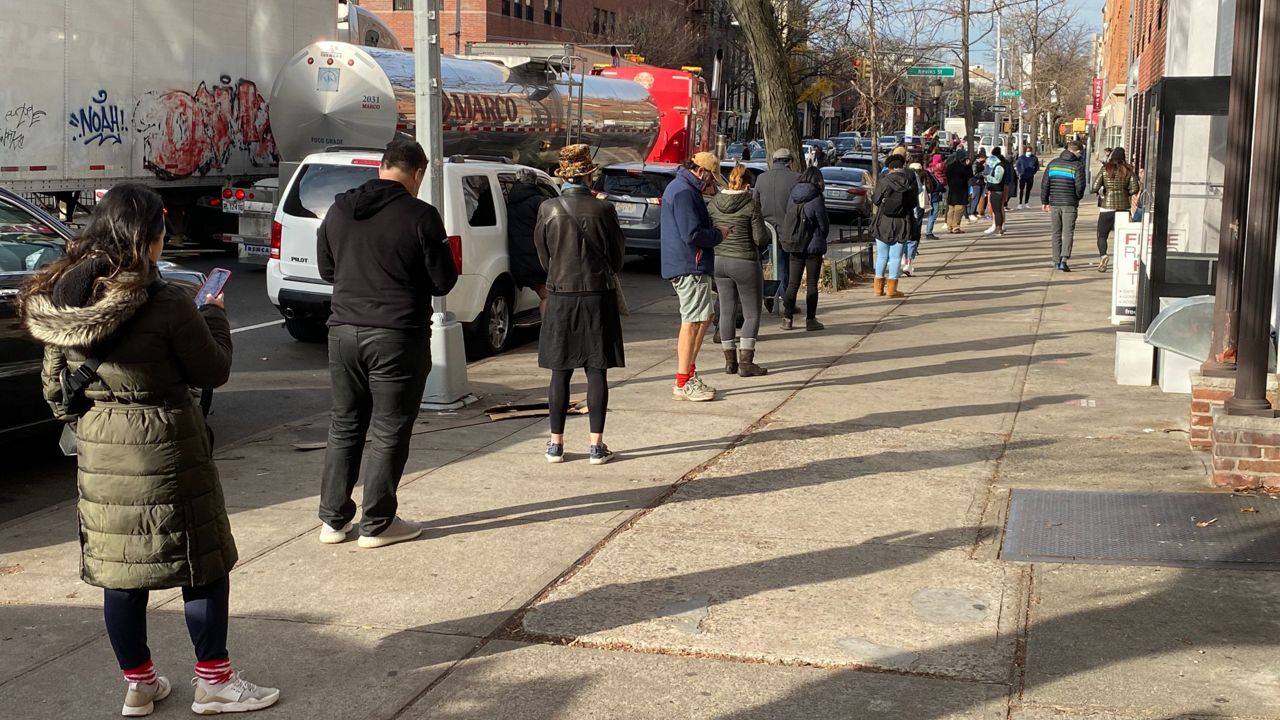

Mulgrew Avoids Losing Votes / By Not Holding Any
The highest decision making body of the United Federation of Teachers is the Delegate Assembly. But what happens when it makes no decisions?
Wednesday the Delegate Assembly met. Mulgrew gave an extended report. A Welfare Fund representative gave a fairly substantial report in favor of Medicare Advantage Plus. There was a question period with five questions and a point of personal privilege. I believe that two of the questions and the procedural point were arranged by the leadership in advance. And then two points were added to the agenda. And then Mulgrew adjourned, before the business part of the Delegate Assembly began.
This stands in sharp contrast to November, when a motion to add an agenda item Mulgrew opposed (about the Medicare Advantage Plus program – asking for some member say in the negotiations) almost got on the agenda (49% in favor), and during new business Mulgrew lost two votes (I think Mulgrew and Weingarten combined had lost a total of one vote in the previous 20 years – two in a night was startling).
The Delegate Assembly routinely does not have enough time to conduct its business. It used to start at 4PM, with an automatic adjournment at 6PM. Some years ago (anyone remember exactly when?) it moved to a 4:15 start. The president’s report is not time-limited, but the question period (15 minutes) and the period for motions directed to the agenda (10 minutes) both are. And new business runs up against the 6PM automatic adjournment.
What ends up happening? The president’s report is usually long, and time is pressed for the rest. There are delegates who want to ask questions who never get called on. Lots of them. And there are delegates who want to add something to the agenda who never get called on. And then the new business usually goes uncompleted, unless Mulgrew really wants to get to something, and then he gets the meeting extended past 6.
Question Period
Delegates have questions. Pre-pandemic I tried to extend the question period quite a few times. It’s not a factional move – it’s just that delegates really want to know stuff. Sometimes they ask questions that have already been answered in an email, or at a previous DA, or even that day. Still, they are delegates with questions, and should get answers. During the fully remote DAs they extended the question period – it usually was interesting. Because there were also questions that no one had asked yet – and that likely other delegates had the same questions.
The period is partially undermined by the leadership planting questions – those questions eat up valuable time – and if the leadership wanted that information to get out, it could have asked Mulgrew to include it in the report. It was not just the December DA where that happened – it is every month. In past years (and maybe it still happens) there was an invitation-only club run by an officer, a member of Unity Caucus, that would create and assign these planted questions.
If the time were longer, or better, not limited, then those planted questions would not be a problem. And the question period really needs to be longer. It’s a Delegate Assembly after all. Certainly 15 minutes is not enough time.
New Motion Period
This is where items are added to the agenda by delegates. An item is proposed, then voted on. (It takes 50% + 1 to get it on next month’s agenda. It takes 2/3rds to get it on the current agenda).
The Executive Board sends items to the Delegate Assembly, and they are placed on the agenda. Since one caucus, Mulgrew’s Unity Caucus, controls all but three Exec Board seats, this means that the only way for someone who thinks differently to add an item to the DA agenda is through the new motion period. Thus there are delegates highly motivated to be recognized during the New Motion Period.
At just 10 minutes, and with each item taking a few minutes and needing a vote, it is usual for only 2 or 3 items to come up – even when we are aware that there are 4 or 6 or even 10 delegates who wish to introduce something.
Worse, when the leadership does not like what may be coming up, they ask their loyal delegates to introduce items through the new motion period, even though those items could have easily been introduced through the Executive Board. This takes time from the New Motion period away from those without access to the Executive Board (opposition). On Wednesday, the leadership did just that, introducing two agenda items that everyone would agree to, that could have come from the Executive Board, but that fully ate up the New Motion period.
Even worse, when that is not enough, Mulgrew can drag out an item to prevent the next motion from coming up. He did that to me last November, dragging a nothing motion out for 7 minutes, and then filibustering for 3 more minutes, just to prevent me from raising questions about the hybrid learning that Mulgrew and Unity Caucus supported. Here, read about that.
President’s Report
The president’s report ran long on Wednesday. It is always long. Yesterday’s was padded with a substantial Mulgrew-Care infomercial (less polemically, a presentation by Joe Usatch, Deputy Director (?) of the UFT Welfare Fund, on the Medicare Advantage Plus plan that the Municipal Labor Coalition negotiated with “The Alliance”(?). I think the pitch was substantially similar to the one that our retirees have been getting since late last spring).
In any case the president’s report ran longer than usual, but usual is already long. Instead of squishing the rest of our time, yesterday’s report left no time for new business. Given how poorly Mulgrew did last month, that must seem like victory. He can’t lose any votes if none come up. But that means that the Delegate Assembly was completely prevented from performing its nominal mandate – running the union.
But the president’s reports are always long.
Is he intentionally eating up time to frustrate delegates? Perhaps. He’s definitely done that sometimes. He should stop. Or there could be a time limit, like for every other agenda item, and like they do at the Professional Staff Congress for president’s reports – but I don’t really think that’s a great idea. Just take the time you need, and don’t filibuster to prevent questions and motions from coming up.
Does he just have a lot to say? OK, then the Delegate Assembly needs to be longer. No one wants long meetings. But a 6:15 adjournment would make up for the time we lost years ago, bring the DA back to a full two hours. That, as a minimum, would be the right thing to do. And a 6:30 adjournment might meet the needs of delegates who have something to ask, or something to add to the agenda.
This is a Delegate Assembly, after all. Delegate questions and issues should take priority.

Sum of Squares
What if showing your work IS your work?
I teach an elective, counting things, Combinatorics, really some nice enumeration, with a lot of problem solving approach.
I used to give tests, but they got in the way of learning, and wasted class time, and caused needless stress. So I have small homework assignments, and I have bigger assignments. The bigger assignments I call “write-ups” – they are sort of mathematical lab reports, documenting something that was learned in the course of a full period or so, by way of collaborating in a group…
I also give final projects. Big poster, like from a science fair. And a presentation – something between three and five minutes. No matter how complicated or simple the project, the goal for the presentation is that it can be digested by the student’s classmates. Over the years I have done better at assigning the final project, and the quality of the projects has gone up. Some have been quite good.
In the fall of 2018 a then junior, Z, chose a slightly simpler topic – the sum of the squares – and did an absolutely superior job explaining and extending the problem. She knew it. We all did. Everyone understood what they were watching/hearing as the presentation unfolded.
A year and change later, during the pandemic (and without my knowledge – there was no reason for me to know – just mentioning that I wasn’t part of it) she repackaged the project as a video, attempting to channel Vi Hart, and submitted the product to the Museum of Mathematics and won a communication first prize.
I am proud of her. Also a little intimidated – this is the first student who is so quickly advancing to mathematical knowledge beyond mine – she is currently a college sophomore, math major, doing tough work. And also a little personally proud to have given her a push in this direction. Plus, I can see a bit of my style how she clears the fractions in fractions.
So this here is me, sharing Z’s video. It’s just 2 ½ minutes. Please watch it and say nice things

Consent
This week the testers came to my school. I saw them, and I could use a test. I asked for one. Nope – I had not given consent. Well look, when I say “please test me” that is consent. When I say “I consent to be tested” that is consent.
But that’s not what the Department of Education means. For them, there are two objectives – limiting the number of positive tests, and limiting the number of tests, period. They completely canceled testing of staff, then relented. But when they relented, they required “C*NS3NT” – some bastardized from of “consent.” Department of Education C*NS3NT is not designed to see whether or not staff give consent – it is designed to be a bureaucratic obstacle. It is designed to stop staff who want to be tested from being tested.
In their drive to keep schools open (which is not yet seriously threatened, and may not be seriously threatened, let’s see how o-micron hits) the Department of Education treats testing as a problem. Canceling tests for teachers was too much? So they allow testing, but put teachers through hoops.
This began long ago. Testing for COVID in our schools was political from day 1. Testing was expensive and organizing it was tricky way back in August 2020. So testing proponents (Mulgrew) asked experts to come up with a number that workable. The DoE immediately pushed back – not 20%, but 10%.
If someone didn’t want to be tested, they didn’t have to be. No random sampling. They intentionally sampled a population that believed it was not sick, and got predictably low numbers. And they compared those low numbers to samples of people out of schools who got tested because they thought they WERE sick. The results – more people who thought they were sick really turned out to be sick than students who thought they were not sick – were predictable.
Then vaccines came, and the DoE said, we do not test vaccinated students. Then breakthrough infections happened, and the DoE did not test, by policy, those susceptible to breakthroughs. This fall the DoE stopped testing students with one dose – incompletely vaccinated.
Testing in schools has been used for a year and a half to push a political agenda. Keep schools open, test healthy students to keep positivity rates low, not test those susceptible to breakthroughs. And now, to make it difficult for people who just want to be tested to actually get a test.
Incomplete?
New York City does not allow grades of “Incomplete.” But what other grade would we give our departing schools Chancellor? Should we make an exception?
An Incomplete might be appropriate if there were just not enough time. But the issue behind Meisha Ross Porter’s scanty record is not lack of time. Nope, no incomplete.
When Richard Carranza left last winter, de Blasio was appointing a 10 month chancellor. Ten months was all Porter ever had. And de Blasio made clear (in part through his behavior with Carranza), that he, not the Chancellor, would be calling the shots. Porter, when she took this job, was agreeing to a short tenure, with her name in lights, but little real control.
Her expectation was to get little done, and she succeeded.
de Blasio had a priority, reopening schools in September. That’s his record, although she allowed her name to go on it. No remote option? Part of de Blasio’s plan. Too little testing? That’s how de Blasio was keeping schools from going into partial closures. de Blasio. Testing the wrong kids? Same thing. Mandates for adults to get vaccinated? That’s de Blasio, too
So the biggest stuff Meisha Ross Porter did – open schools in September and find ways to keep them open and full and staffed, that was really just following orders – or de Blasio directly
One big question I have, since we were going back to school in September 2021, no matter what, is how would the school system help kids who had a rough 2020-2021. I heard that there would be a “screener” – that we would be identifying kids who needed help and support. Good idea. But the system chosen, DESSA, is horrible. Rumor has it that the decision to use DESSA was not Porter’s, that it came from City Hall. Nonetheless, here’s somewhere she could have made a difference, somewhere she probably knew she could make a difference, but she stuck with the idea that she does not call the shot except as de Blasio asks for them.
Porter came in to a short-term job, knowing full well that most big decisions were going to have her name on them, but be made by the Mayor. And even where she might have made a difference, there is no evidence that she tried. Her effort may have been incomplete, but there’s more than enough to grade. It’s not the circumstances, it’s her choices that we should be thinking about.
Operation of the New York City school system through the pandemic has ranged from a D to a C. I’m putting Porter’s grade right there, halfway in between, C- / D+.
Do these sound alike?
With streaming services I can – and I do – watch one show at a time. I blew through all the Nordic Noir I could find in English, and even some subtitled stuff. Happy Valley, Broadchurch, Y Gwyll, The Fall, Shetland, and more. Some hardboiled procedural things. Recently Bosch. And more police procedural stuff, and more.
And one day, well last Monday, I think, I start a new one. WPC 56 about a young woman police constable, first female officer in a precinct in a small English Midlands city Birmingham in the 1950s, and I thought, “That music is familiar.” And I thought some more, and there’s this show that’s kind of similar, but in a modern setting, but also a young woman Garda in a town near Dublin, but with some thematic overlap. “Red Rock.”
Similar themes. But what do you think? Similar theme music?
United for Change / UFT
FOR IMMEDIATE RELEASE
November 17, 2021
Press Contacts:United For Change: info@unitedforchange.vote Annie Tan, teacher: annietan127@gmail.com Bennett Fischer, retired teacher: 646.591.7598
RANK-AND-FILE MEMBERS OF THE UFT FORM UMBRELLA SLATE TO CHALLENGE THE CURRENT RULING LEADERS OF THE UNION IN SPRING 2022 UFT ELECTIONS
New York, New York: Throughout 2020 and 2021, UFT members have watched as their union failed to keep unsafe schools closed, failed to listen to its members, and failed to secure fair pay, benefits, and protections. Late night emails from UFT President Michael Mulgrew with empty rhetoric are commonplace, but classrooms are overcrowded and poorly ventilated, counseling departments are grossly understaffed, schools reopened with the same poor infrastructure, and the healthcare of retirees and new members has been sold to the highest bidder. The COVID-19 pandemic and shutdown has shown that educators need a responsive union leadership that is willing to mobilize members to improve working and learning conditions.
United for Change, a group of opposition caucuses, activist groups, and individual educators in the United Federation of Teachers is proud to announce a joint-slate coalition to challenge the 60-year reign of the UFT’s Unity caucus in the upcoming 2022 UFT elections. United for Change is composed of school workers who want to see a fundamental shift at the top of their union after entrenched, increasingly undemocratic and unaccountable, single-party control. Coalition organizations include the Movement of Rank-and-File Educators (MORE), UFT Solidarity, New Action-UFT, the Independent Community of Educators (ICE-UFT), Educators of NYC (EONYC), Retiree Advocate-UFT, and a broad swath of new and veteran union activists. The coalition’s platform includes calls for:
- Smaller class sizes with enforceable caps negotiated in the UFT contract
- More student support staff, including counselors, social workers, librarians, nurses & secretaries
- Fair pay and professional respect for all, including paraprofessionals, therapists, & untenured staff
- Safe working conditions & safe learning conditions
- More democracy within their union and more organizing support in chapters & districts
- A halt to the privatization of public education & healthcare
- Better healthcare for union members & their families
The joint slate will be announced at the UFT’s Delegate Assembly at 52 Broadway on November 17th at 4:30 PM. Coalition activists at the delegate hall will speak about the new coalition.
Movement of Rank-and-File Educators Caucus member Annie Tan said, “I am inspired by the examples of Chicago and Los Angeles that won many more protections than New York because they have unions that listen to their teachers and members. I’m fighting for a union that will actually listen to us and won’t back-door negotiate. As a former Chicago Teachers Union member, I know that we have power in numbers and that our voices matter. We are united for change for a better union that mobilizes our membership.”
Eric Severson, a member of the Solidarity Caucus said, “UFT Solidarity’s logo is ‘we have your back.’ We believe this new coalition does just this. We believe the union should spend more time listening to member concerns on contracts, working conditions, and job-related concerns, and less time lecturing the members that they serve by defending backroom deals.”
Bennett Fischer of Retiree Advocate spoke about the UFT’s role in switching city retirees to a privately administered Medicare Advantage Plan: “As a UFT retiree, I want a union that supports public education, public healthcare, and keeps retiree’s Medicare public. I want a better union.”
Micheal Shulman of the New Action caucus added that “Our union has failed us in the fight against COVID, failed to reduce class size, failed to fight to improve our unequal pensions, and failed against abusive administrators. We need a proactive union that fights to improve our working conditions and end our segregated school system.”
The Independent Community of Educators looks forward to working in the upcoming union election with all of our coalition partners: “We have been aiming for a united opposition to Unity’s mismanagement of our union since our founding in 2003.”
# # #
An Inauspicious Anniversary
For those of us who mark the passage of time not necessarily in days and weeks and months, but in school years, and vacations, and terms, last Friday was, indeed, a notable date. Notably inauspicious.
Friday was November 12, 2021. Really nothing special about that date for me. Friday morning was a school activity day for us. Friday afternoon were parent teacher conferences.
Three terms ago the Friday activity morning between the evening and the Friday afternoon parent teacher conferences was the last day of school for a long, long time. It was the last day before the mayor and governor finally closed New York City schools.
It was the day before the COVID-19 pandemic closed my school. It may not have been the day that COVID reached us. But it was the day we know that COVID spread within our walls. The activities included a karaoke room. And multiple participants in karaoke, adults and children, got sick.
I thought about this Wednesday, surprised that karaoke was back. I checked – it met DoE regulations, and those of our host campus.
Friday was November 12. That fateful Friday, three terms ago to the day, was March 13, 2020. Friday was three terms, to the day, from the last school day before pandemic closure, an inauspicious anniversary indeed.
At home on Thursday I struggled with what we were doing – the same things we’d always done. Something didn’t feel right. I thought about the anniversary. I thought about loss. I felt my heart race – I couldn’t get my head anywhere else. I guess I got my first first-hand experience with what “triggered” means.
There are many places that have never acknowledged the trauma that came with COVID. There are probably many schools that have not acknowledged what happened. But Thursday, then Friday, and now all weekend, my thoughts were not about the rest of them. My thoughts were about my school, about what a proper acknowledgement might look like.
But how did we get so far into the year without recognizing the loss, the trauma? There are many, students and adults, who just want to get back into a routine. Let’s move forward they think. Getting back to normal quickly is the best therapy. And for some I am sure it is.
But that is not true for everyone. The sense of loss is profoundly different, person by person. We were hit by the pandemic in different ways. Some of us got sick. Most lost people they knew. Some lost people close to them. Some suffered depression, anxiety. In my school, the last day many of us saw Peace Officer Ulises Castro was March 13, 2020.
When a society or a community goes through a great trauma or upheaval, there is a need for reckoning, of remembering, of repairing, before moving forward. I think of Truth and Reconciliation in South Africa, in Chile. Of remembrance, of memory, in many other places in the world. I think of counseling after Littleton, Parkland, Sandy Hook. Earlier this week a student from the Theodore Roosevelt campus was shot after school (he will be fine) – but the other students and teachers were freaked out, and they arranged counseling.
So where is my school in this? Where is the Department of Education? If there was one thing that de Blasio’s team might have got right… yeah, I know.
In my school I will ask. We have pretty thoughtful teachers. Administration listens. Students like being asked. I’m hopeful that good conversation may lead to strong positive suggestions. I will say:
“I do not know exactly what we should do. I know that some will want to continue to plow forward. And that is ok. But as a community we must find a way to collectively look back, to remember, to honor those we have lost, to process the tremendous and terrifying events that we have witnessed.”
But who is asking in our other schools? I am sure that some of them have figured it out (I wish I knew what they have done). But I am guessing that many of them have not. I am guessing that many have not even stopped to consider the need. Plow ahead, just like things were normal….
As a start, maybe, let’s acknowledge that this is necessary work, and that it involves all of us. And let’s remind those in charge that a screener does not take the place of healing.
In This Together: Why does NYSUT get the messaging?
And why does the UFT not?
I have some guesses. But no actual answers.
Why’d I ask the question? Because it should be asked. Why ask now? Because I got the NYSUT United insert in the mail, and was about to throw it out, but first I read the lame front page headline, but it wasn’t lame. Look here:
The UFT should have solid messaging like this. But it does not. Sometimes we get it, or come close. Like on the Social Emotional Screener.
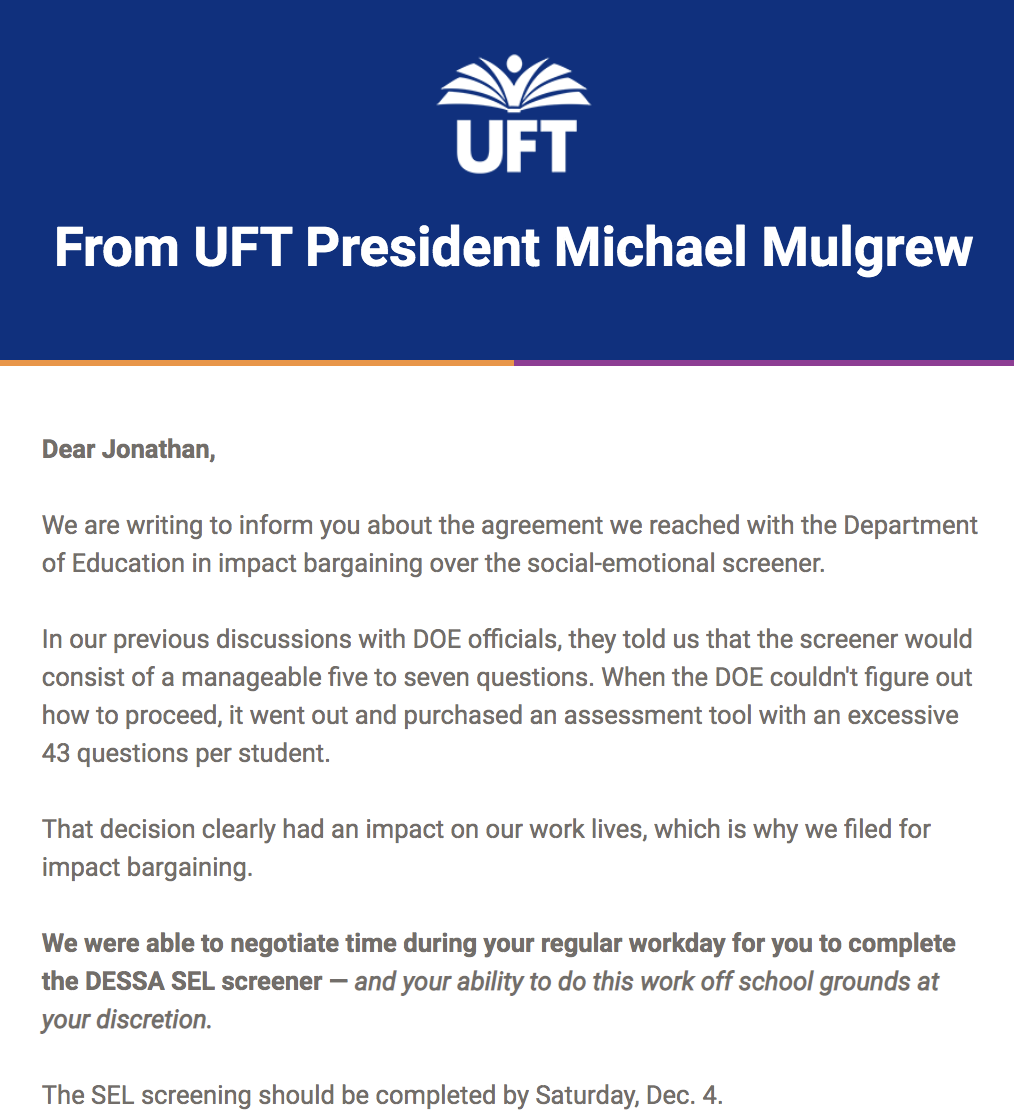
Close, right? But did you notice the ham-fisted attempt to make members thank Mulgrew? And to remind us who is in charge. Look at all WE do for YOU. The words “we” and “you” had no place in this message. Leave it to Mulgrew’s office to deliver something nice that people wanted, and find a way to add an off-note.
But over the course of the pandemic, “coming close” has been an exception. Mulgrew’s communications usually miss.
So what drives the difference? Why does NYSUT seemingly have an easy time not fucking up?
First, terminology. When Mulgrew says “UFT” he means himself and other top leaders. Sometimes he might mean his entire caucus. He says “the UFT is all of us” or “the union is all of us” when a delegate complains about something not happening, but he doesn’t mean it.
I am writing about messaging. I’m talking, in this post, about Mulgrew’s messaging, which is the union’s messaging, no matter how I phrase it. So when I write about UFT messaging, I am not writing about all of us (even though the union is in theory all of us, and decisions should represent our mutual interests). When I write about UFT messaging I am writing about Mulgrew, his direct staff, his communications and media people, and to a lesser extent, his caucus.
Oh, and bias? I don’t much like Mulgrew’s caucus. “Unity.” But I don’t like the related caucus that runs NYSUT, the state federation. I don’t like either one. But one knows how to package a solid message, and the other doesn’t. And I am asking why. And I don’t know the answer.
Guesses
Constituency –
- NYSUT serves locals. And that means local presidents and officers. There really is an expectation of service.
- The UFT (UFT top leadership) on the other hand gives members what the leadership decides to give. There are no local presidents, and chapter leaders are a usually bypassed afterthought. Mulgrew is not answerable the way Pallotta is.
Who runs schools? –
- For the UFT, the NYC DoE does. And the UFT leadership wants to be able to help. There’s lots looking for “a seat at the table.” Some of their messaging it to boast about how close their bureaucracies work together. You know how every time the DoE makes a decision the Mulgrew email sounded celebratory? Even when it should have been, like, “this is ok, but raises some issues, we will have to see”? Other times the messages are orders to chapter leaders to comply with a DoE directive that Unity helped shape.
- NYSUT? They work with New York State Education Department. And SED doesn’t run schools. It’s just different
Politics –
- The UFT leadership often think of themselves as a PAC, with the union stuff a side-gig. So when Cuomo was screwing schools and teachers during the pandemic, Mulgrew was making pronouncements to his members praising Cuomo. I don’t know if Unity were afraid of Cuomo, or were trying to curry favor – but neither of those have anything to do with the interests of our members. And the messages were all off, or just wrong. And then the attacks on incompetent Bill de Blasio were ferocious at every turn – and sometimes the members agreed – often in fact – but 1) the attacks were not always connected to our schools, which was weird, and 2) they stood in sharp contrast to the fawning over Cuomo.
- NYSUT pushes teacher issues in the legislature, but politics is clearly a part of the work, not the biggest part. And while NYSUT sucks up to politicians, it is not central to their messaging. It’s just not what they do.
Personnel –
- Mulgrew is responsible for his people. He’s got a communications chief who doesn’t seem to communicate much, a social media guy who is not too social when fighting with teachers, a media specialist who used to specialize in writing attack pieces on teachers facing charges. Related, he hired a political director (our first ever who was not a teacher) who took the UFT’s miserable performance in past elections – as low a bar as you could set – and failed to meet it. And I think you have to ask, is the problem the personnel, or is the problem the person who is choosing them? Or the person who is leading them?
- NYSUT? I’m sure there’s plenty of cronyism there, too. But there’s some sense that you should be able to do the job you have.
I don’t know. None of these arguments are super-convincing. But NYSUT reminded me today that good messaging by a union during the pandemic is possible. And Mulgrew reminds me every week that there is no guarantee.
What do you think? Do any of these make sense to you? Do you have a better theory? Please share in the comments.
Another Comment about the Medicare Advantage Preliminary Injunction
Mulgrew sent out:
“A state judge on Oct. 21 ordered an extension … to give you and medical providers more time to learn about this unique health care plan..”
Michael Mulgrew, email to UFT retirees.
The judge wrote:
“…the Court feels that the method of implementation of this plan at present has been irrational, and thus arbitrary and capricious. … retirees have been given a deadline of October 31 … It is simply irrational for retirees to have to make this decision as circumstances currently stand.
Honorable Lyle E Frank
what Mulgrew says the judge wrote is different from the judge’s actual words


Judge Frank wrote what he wrote. We can read it for ourselves. And this time Mulgrew’s claims can be directly evaluated. Does Frank say that he is giving retirees more time to learn about Medicare Advantage Plus?
No, he says the implementation plan is irrational. He further states “if [retirees] are required to opt-in or out of a medical program by the October 31, 2021 deadline there would certainly be irreparable harm.” And he orders the Municipal Labor Coalition (including the UFT) and the City not to give retirees more time to think it over. He orders them to:
“… cure deficiencies with the implementation of the proposed new Medicare Advantage Plan… “
Honorable Lyle E Frank

The last time I saw Unity selling something so hard, so irrationally – it was the 2005 contract. I recoiled with mistrust at the hard sell. As any thinking person might do now.
One Comment about the Medicare Advantage Preliminary Injunction
Mulgrew sent out:
“Can I go to my current doctors and hospitals? Yes. The NYC Medicare Advantage Plus Plan is a Group Medicare PPO, which does not restrict access to providers.”
Municipal Labor Committee “Frequently Asked Questions (FAQs) About the NYC Medicare Advantage Plus Plan” (updated 8/11/21, on City of New York letterhead, with Emblem and Empire logos.)
The judge wrote:
“there is little clarity as to which health care providers will be accepting this new Medicare Advantage Plan” and “it is undisputed that much of the program terms are still unsettled and unclear.”
Honorable Lyle E Frank
It is hard to reconcile those two statements.
But before we believe that either is lying, remember that the judge is a lawyer, and Mulgrew doesn’t speak to members on big issues without talking to a lawyer first. And if lawyers wrote both of these things, then perhaps these things do not mean exactly what we think they do.
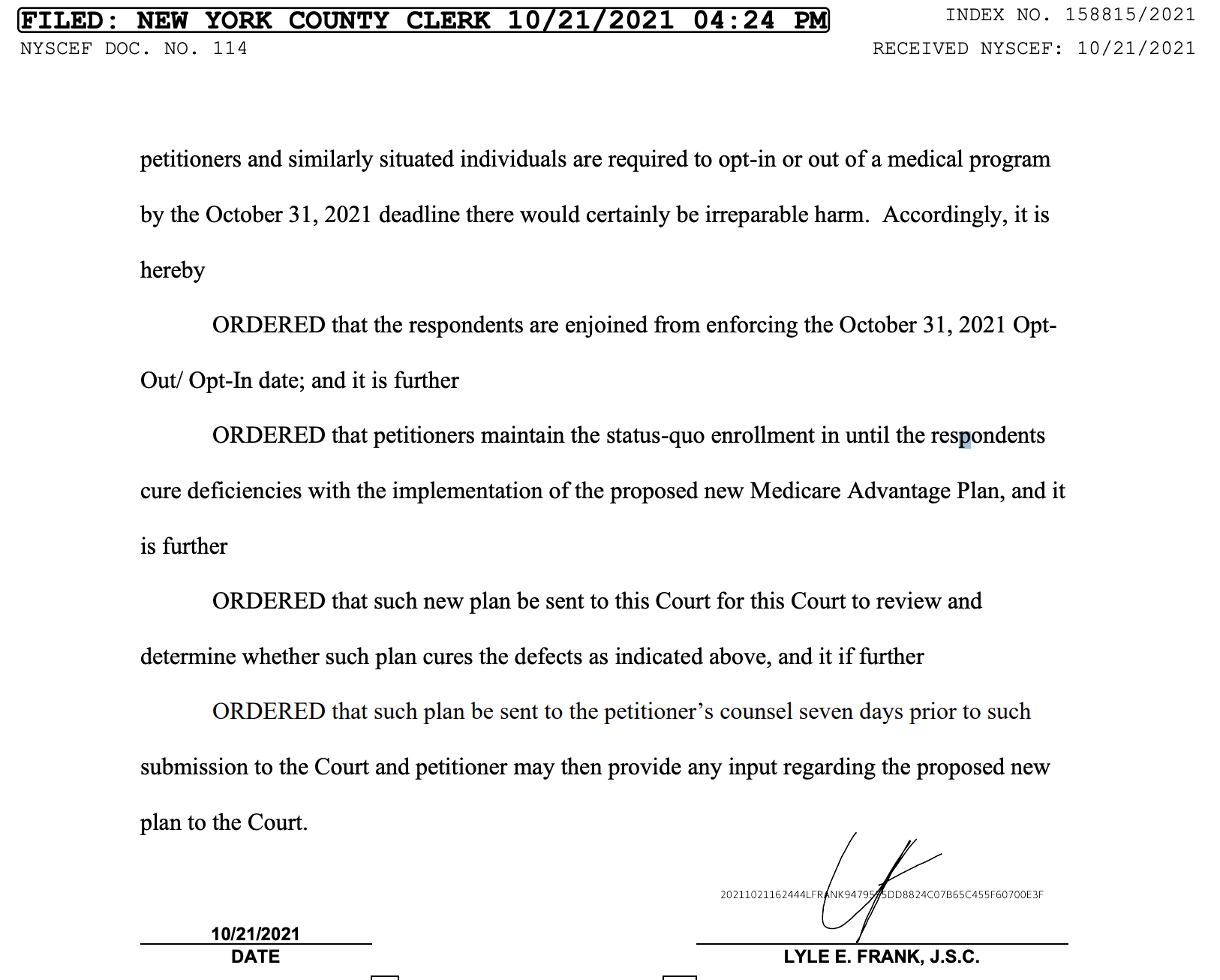
As an aside, I need to write about healthcare, the New York Health Act, the UFT leadership, and privatizing Medicare (Medicare Advantage). That writing is overdue. I apologize.
As another aside, it would be nice to have a UFT President who didn’t need to speak to a lawyer before speaking to members and chapter leaders.
Teaching for fun: Set Theory
Part of my schedule this term is an Intro to Set Theory. Just once a week, lunch time for the kids. I have a nice paper, An Introduction to Elementary Set Theory (Mathematics Association of America). We are reading the document, every line, and doing every exercise. It is reading/seminar style.
I like that the authors spend time connecting Set Theory to its history, and to Cantor and Dedekind. I added in some additional historical background – what was happening in math in the 19th century. I’d like to read more of the history. I get the feeling that the reexamination of Euclid and the development of set theory and the axiomatization of arithmetic and the development of logic are all part of a movement – but I don’t really know that, and I would like to learn more.

It is a great opportunity to introduce notation, to dwell on correct language. It is also their first heavy dose of proof by contradiction (indirect proof). And that is useful.
Today we were looking at subsets, and of 6 exercises, 4 were best answered with a proof by contradiction. A kid asked, a bit sadly, if they were ever going to be allowed to do direct proofs again.
It’s just 10 kids. At least 6 of them are there so that they can study Arithmetic with me in the spring (“Axiomatic Arithmetic”) – which I will describe some other time – but I insist that they do at least one proof-based course first. In the spring there will be a heavy dose of induction. I can imagine a kid asking, sadly, if they will ever be allowed to do proof by contradiction again…
In any case, today we were playing with subsets, and proving some basics. 

Here’s the talk. One set is a subset of a second set if everything in the first set is also in the second. But we like stating this backwards. The first set is NOT a subset of the second if there is something in the first that is not in the second.
- A = {p, q, r, s}
- B = {q, r, s}
- C = {q, r, s}
- D = {s, t}
- E = {}
OK, so B is a subset of A. Everything in B is also in A. Or, there is nothing in B that is not in A.
B is a subset of C. Everything in B is also in C. Or there is nothing in B that is not in C.
D is NOT a subset of A. Why? Because t is in D, but not in A. (see how that works?)
Now, is E a subset of A? Is everything in E also in A? Hmm, that might cause an argument. Let’s look at it the other way. Is there something in E that is not in A? Nope. Then E is a subset of A
One part of this that’s fun and annoying is that while the concepts can seem slippery, we are doing them with all new notation.
t is in D?

t is not in A?

B is a subset of C?

A is a subset of B is equivalent to saying that everything in A is also in B?

A is not a subset of B is equivalent to saying that there is something in A that’s not in B?

The kids seem kind of into the notation, and the notions. One that caught their attention today was the distinction between a subset, and a proper subset. See how the subset symbol looks a little like “less than or equals”? Like ≤? Well, if we take the line away, then it means a “proper” subset, and it must strictly be smaller than the set, or be missing something that is in the set.
Looking at the examples above, B is a proper subset of A (there’s nothing in B that’s not in A, AND there is something in A that’s not in B), but C is not a proper subset of B. It’s true, C is a subset of B, but there is nothing in B that is not in C, so C is not a PROPER subset of B.
In symbols, B is a proper subset of A,

C is not a proper subset of B,

At this stage, if students start to “get it” they are prone to argue almost philosophically.
Today was no exception. I sent them to lunch as they debated whether the empty set is a subset of itself AND a proper subset of itself.
This is teaching for fun. Every student is here voluntarily. They have chosen to suffer. We sit and read, and talk and debate, and I jump out of the circle to run to the board. One by one the kids are getting tough ideas or tricky language.
I’m assigning homework, and taking attendance. But the homework is for class discussion. I am not checking it. I am not grading it. I am not giving tests or quizzes. I will grade my students on the quality of their discussion, which has been uniformly high.
Hanging out and talking about math with kids who want to talk about math. This is teaching for fun.
Groveling gets you nowhere
On Wednesday the United Federation of Teachers (UFT) endorsed Eric Adams for mayor, after vigorously opposing him in the primary. Of course our union was going to need to work with him, but the leadership’s insistence on an endorsement was a mistake.
Unity stage-managed the process, making certain that Marv Reiskin gave the clinching argument. Marv thundered, or as close to thundering as his voice could get, but the content was lacking. “Adams took a civil service exam!” he kind of roared. I took a civil service exam, too, and so did most of my neighbors. But good for Marv, for trying. It didn’t really matter, as Unity only allowed one voice in opposition.
But to what end? An endorsement wasn’t going to make Adams like the UFT. He doesn’t need it to win. He won’t need our phone banks. And if we offer him cash – did you know he is already turning down matching funds? Any cash the UFT leadership hands him will be surplus, that he will pocket, and could fund his reelection campaign, when, you know, we might not be supporting him. I’d say “pathetic” except it’s my money too. I’m not happy about this.
And since we can’t deliver any votes that Eric Adams needs, and the cash is for next time, this looks like nothing less than a feeble attempt to curry favor, even to bribe the man.
I warned:
A bribe is insulting. A tiny bribe is insulting. Thinking it will buy anything but contempt is naïve. Instead of treating us as formidable partners in education, Adams will likely regard us as weak, detestable mutts.
https://jd2718.org/2021/10/09/permission-to-bribe/
And then the UFT leadership got him endorsed anyhow, and he treated them like weak, detestable mutts. Here’s the story:
The UFT leadership has negotiated, as part of the Municipal Labor Coalition, a move from Medicare to a private plan for our retirees. It is an unpopular move. Retirees are upset. They are angry at Mulgrew in particular, because he seems to have kept the fact of negotiations secret. Mulgrew and Unity have spent months and months in damage control mode.
Me? I think privatizing health care is, big picture, wrong. I am against privatizing schools too. I am against privatizing social security, and the post office. I think the UFT leadership has badly lost its way on this one.
(I am not writing about what individual retirees should do. You have to make the decision that is best for you and your family, even if you don’t like the choices being forced on you – unless there is a way to change those choices – which I do not think there is at this point.)

Adams? He’s not against privatization. Ideologically he’s probably fine with what Mulgrew and his mob are doing to retirees. But Wednesday Mulgrew had us endorse him, even though we don’t like him. Mulgrew groveled. And Adams treated the UFT as if it were weak and detestable. He went after Mulgrew’s Medicare Advantage scheme, and kicked Mulgrew in the teeth:
“When you start talking about cuts in health care, they’re my cuts,” said Adams at a campaign event in the Bronx. “I know what people are going through, and so we’re going to take a close examination of this because it’s going to traumatize our retirees. Some of the stories I’m hearing about increases in payments, you’re on a fixed income — this is devastating.”
By staying in Advantage Plus, retirees wouldn’t have to pay a fee, but they’re concerned that under the new plan, they’d lose their doctors and be forced to get time-consuming pre-approvals for costly tests and procedures that might be needed on a tight time frame.
Union leaders like UFT President Michael Mulgrew and DC 37 honcho Henry Garrido have both assured retirees that they wouldn’t lose their current doctors under Advantage Plus, but when Oliveri asked his doctors about it, he said “they never heard of it.”
“You don’t become a civil servant to become a billionaire. You become a civil servant to have stable health care, a stable pension and a stable life, and we cannot destabilize it after they retire,” Adams said. “Right now, after serving your city, we should not do any type of bait and switch. When you retire, you retire with an understanding, and we need to make sure we live up to that agreement.”
Eric Adams calls Mayor de Blasio’s NYC retiree health care shift a ‘bait and switch’
Most of Adams fire, to be fair, was aimed, by name, at lame duck de Blasio – but the content was a slap at Mulgrew.
Does that mean Adams will undo the deal? Unlikely. He likes private stuff. The article closes:
But he admitted that, if he’s elected, he’s unsure how much power he’ll have to undo de Blasio’s proposal.
“We need to, at a minimum, extend the deadline so people can have a better chance and opportunity to understand the real impact of this,” he said of the Advantage Plus shift. “I have to really look at it and see what are my powers.”
Nope. Eric Adams took a cheap shot at Michael Mulgrew, undermining him, making him look bad, not to stop Medicare Advantage, not to help those who oppose privatizing healthcare, but as payment for Mulgrew’s groveling endorsement.


 JD2718