And the answer is…
October 29, 2007 am31 9:23 am

Can you come up with a question?
(JBL has me busy on those bitstring, er, run permutation questions…. it could be a bit before I can really concentrate on a post)
17 Comments
leave one →
Can you come up with a question?
(JBL has me busy on those bitstring, er, run permutation questions…. it could be a bit before I can really concentrate on a post)


 JD2718
What is the radius of a circle of area pi squared?
What is the factorial of 1/2?
No? Not really, is it. Here’s what Google says (plunk it in the search line, and if it looks math-y, Google evaluates it):
(1 / 2) ! = 0.886226925
It should be , which is sort-of equivalent to
  . (That’s the gamma function, for those who are interested.) Naturally,
Given a grid of lines spaced 1 unit apart, and a needle of length one unit, what is the square root of the average number of times the needle has to be dropped on the grid in order for it to touch or cross two lines.
There’s really such a thing as factorials for fractions? Who knew?
What is the side length of the square whose area is equal to that of a circle with radius 1?
What is the fourth root of the summation from k=one to k=infinity of (6/k^2) ?
“the cube root of 2”
and “the cosine of 10 degrees”,
cannot be constructed with
compass and straightedge–
this disposes of *two*
of the “three classic insoluble geometry
problems of antiquity” (as they’re commonly
known). name a constant
disposing of the third such problem.
this (of course) has more than one answer —
“pi” itself would do just as well, e.g. —
and is anyway just a trumped up version
of mathmom’s much more natural question.
just happens to be what i thought of
when i tried to work out an answer
*without* mentioning “circle” or “square”.
jd’s “gamma of one-half” is much my favorite
answer so far, but what should we expect?
— it was his question!
Integral from -Infinity to Infinity of exp(-t^2) dt
JBL: Sorry, yes, you’re right.
jbl’s correction of pseudo’s example, i mean.
why look it up when you can just cite sources
completely at random? anyway, clueless’s #10
is topping the chart (& is unlikely to be beaten).
Actually, by using symmetry and by using a substitution of x=t^2, the integral reduces to the definition of Gamma(1/2).
granted; still more elegant because
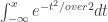
*much* more familiar … a vast army
of undergraduate students “learn” about
in statistics classes, whereas it’s possible
to get a math doctorate knowing little more
about gamma then gamma(n) = (n-1)!
(for n a natural #).
You are all winners with this one. Have to try it again sometime, it’s been fun.
Interestingly, if you write the equation as
Integral from -Infinity to Infinity of (exp(i^2x^2)) dx – sqrt(pi)=0,
you have an alternative to Euler’s equation that does not have unity, but does have infinity and the indefinite variable.
that is so funny – a student asked me that exact square root today!