Losing Time

Have you ever lost time?
Wednesday was a good morning – school visit – nice conversation – and I got home, and the day slowed down. I had a list of things to do. I sat down. Started. Got distracted. Left the house to take care of a big errand, had a nice walk. And sat down again, and time passed. I was aware that my mind was getting pulled in several directions – things I was going to take care of. I spent time thinking about what to do next, what steps. I got distracted by an email. Then a call. I kept replanning. I paused to play a game. Came back to the same spot, having made little progress. Fortunately I got a text around 6 – was I coming? And I was aware that I should have already left – it was a meeting I was happy to be invited to, just 20 minute’s walk away. But I thought thoughts about what else I had to do, and 20minutes later I had not stood up. Well, I did, and arrived late (and realized I had misunderstood what the meeting was – a story for another day – but nice people with good priorities – glad I made it)
I didn’t fall asleep. I certainly didn’t “black out.” I just thought, considered, got distracted, planned, thought… all the right things, except I didn’t do anything.
And then Thursday I worked and was not in a good mood (work these days makes me happy, so that was strange). I couldn’t let go of the frustration from the day. Plus I lost something, and hunted and hunted and hunted for it, retracing steps, almost compulsively (earbud – set it down at Wednesday’s meeting – I picked it up Friday). Thursday evening, of course, I was hunting, and running thoughts through my head, and getting nothing done.
Friday early in the morning I volunteer. My absence or presence is unimportant, I am part of a larger group, and who is there is there. I did not sleep well and decided to take the day to recover. But I was unable to finish anything. I made a list. I checked nothing off it. Same thing. I was aware that I was losing time, but I was losing time.
Saturday – I had weekend plans, but minor, and had undone them. Free day. I would break out. And take a nice walk. And I didn’t. Ten item “to do” list – knowing I would get to some, but not all. I didn’t take a walk. And I checked off exactly one item. And now here I am today, Sunday, and I am behind again, still behind. But feeling better (my thoughts), and ready to go for a walk. Let’s see. I should get some stuff done.
What happened?
I do fall behind on daily tasks, and on bigger work. That’s me. And I catch up. Also me. And this winter’s been ok for me. So nothing out of the ordinary. Not sure what broke on Wednesday. But clearly something did. I got some news that maybe was worse than I realized. I didn’t process it as sad, but maybe it was. And I had a conversation at some point (Friday?) about a relative who has some degree of “time blindness” – nothing like planting an idea. But I had already been barely treading water for two days.
Back on track?
I think so. I expect to come back here with an update in one day: Second half of Sunday was fine, and Monday was fine. We will see.
Ideas?
This is just weird. There’ve been times I didn’t do much – got lazy, got stuck on a project, or in a book. But to get frozen for a few days? Never. Just weird.
So first, want to make sure I’m out of “it” – whatever “it” was.
And second, I’m really curious what “it” was.
Postscript
Knocked off a few emails, some light cleaning, and got outside (Van Cortlandt Park). This’ll be ok. Still want to figure out what happened.
Some Buds


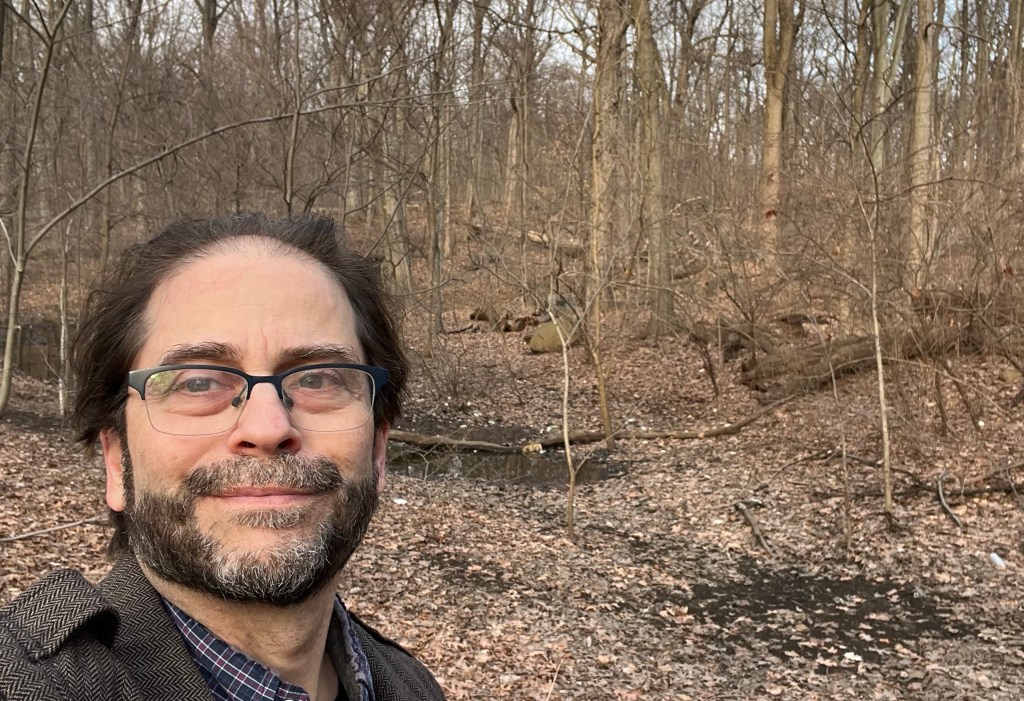





What does 62 get you?
It’s my uncle’s 70th coming up. That’s a big deal. He is my mother and aunt’s baby brother. 70. But he’s agonizing – his business is turning 43. He’s thinking of putting on their website:
What’s so Special About 43? Nothing!
… and then posting 43 of their best pieces of work.
I told him about the non-special number paradox: What’s the first number with nothing special about it? 1 is 1, it is first. 2 is the first number that is not 1. 3 is the first odd prime. 4 is the first perfect square. 5 is the first sum of two distinct primes. And so on. And at some point you get to a number, and you’ve run out of things to say that are special, so you call that the first non-special number. But of course, it is the first. And that’s special.
My uncle loved it, and wanted to work that into his website. I didn’t bother explaining – he will realize. Anyhow, he gets congratulations for 70, a milestone. And 43, some other kind of stone.
But me? I just turned 62. What do you get for 62?
I’m not cashing in social security. Not yet. I bet there are a bunch of discounts. But here’s where I started.
I was up in Cambridge with my mom. Came back President’s Day, but instead of coming straight home, stayed on the Mass Pike all the way, got to the highest point on I-90 east of South Dakota (there was a sign. That’s got to be one of my favorite highway signs, ever.) Crossed into New York State. Took the Taconic south, and then local roads to Hyde Park. I was headed to Vanderbilt Mansion.
In the Visitors Center at Vanderbilt Mansion I asked to buy a Senior Lifetime National Park Pass. $80. They asked for ID. And then the coup – I asked if I could use it for the next house tour. $80 out of pocket, but with an immediate $15 yield… smart, right? Starting at -$65 instead of -$80? Except it was Presidents Day, and the tours were free. So not only did I not make a dent in the $80 fee, I lost a chance to save $15, so I’ll need to save $95 to break even… Don’t worry. I’ve got this.


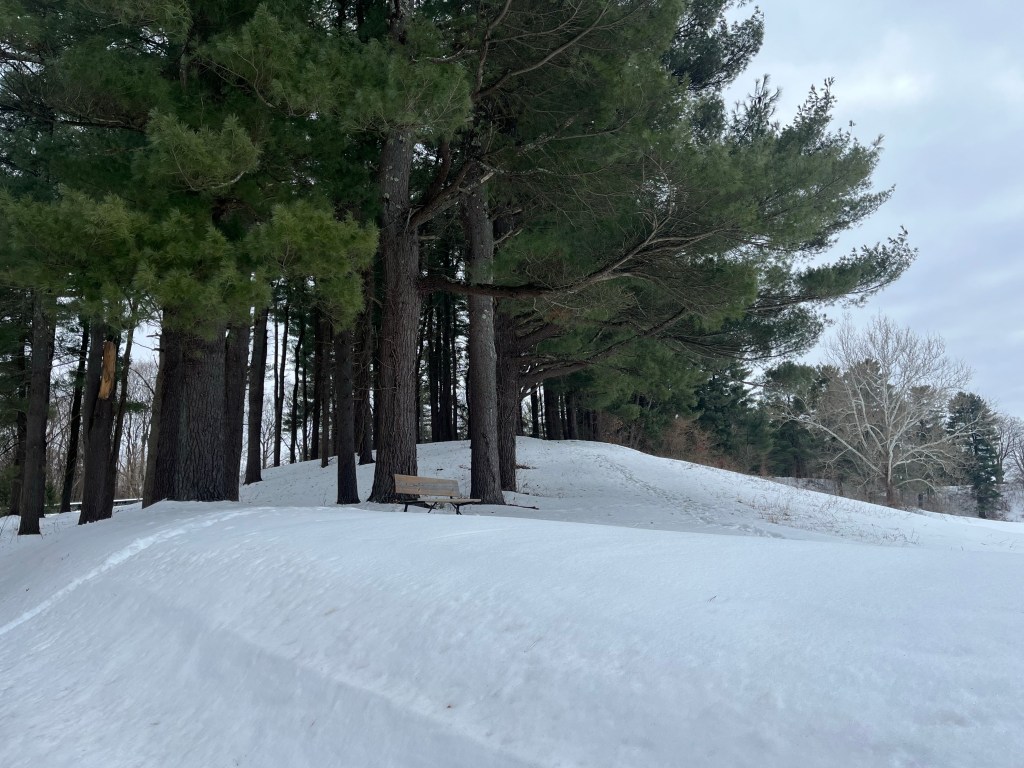
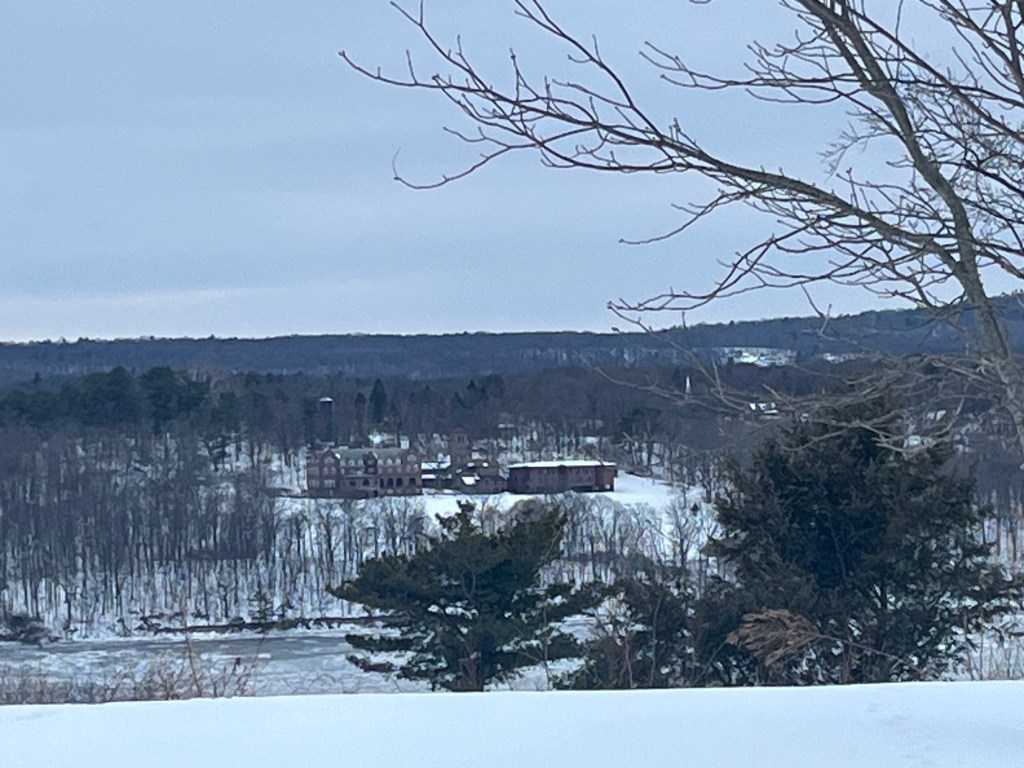
I also blew the timing, a tour had just left. So I walked down to the Hudson, to Bard Rock (is that an island?) The road was clear, but there was snow on the side, so I decided it would be fun to walk on the edge, until my second step. Ice on top, snow below, up to my knee. I stayed on the road.

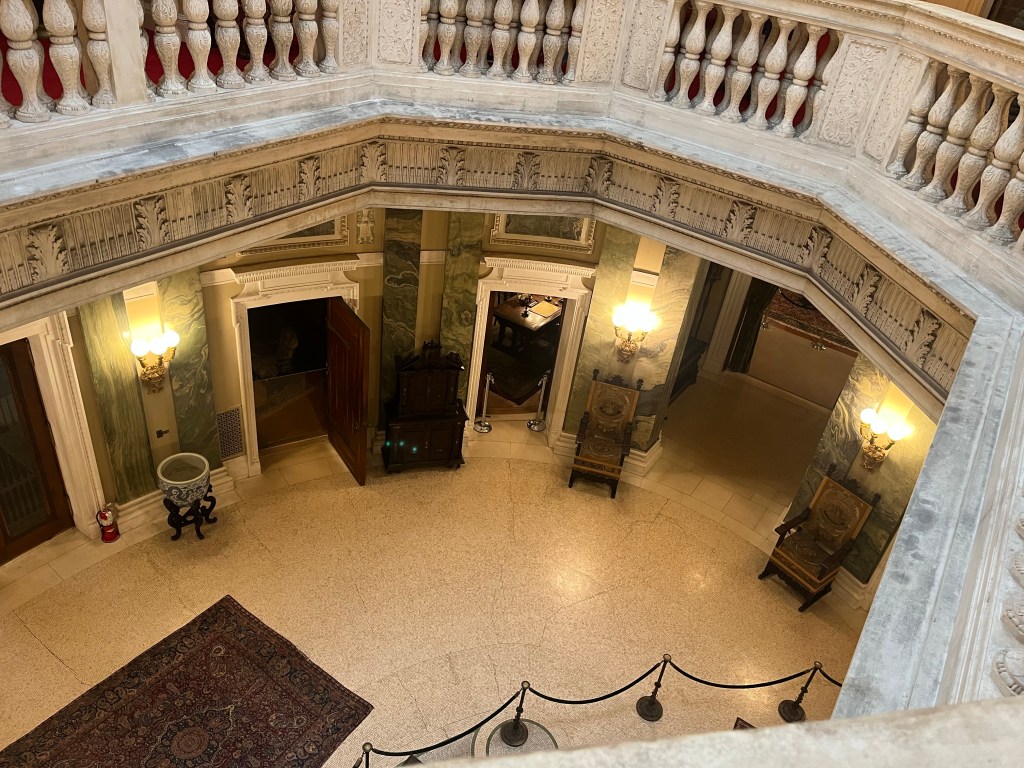

Mansion itself? I did find a nice octagon, but overall not my cup of tea. I’ll have to get to Acadia or the Grand Canyon or something…


Birthday Week Ripple
I went to bed Sunday before last with a couple of notes caught in my head, a melodic earworm. I know the sound and the rhythm, not the words. Started humming it. Over and over. I knew the artist – the Grateful Dead – but not the song. But it’s happy-sounding music, so I smiled as I hummed along. And that’s how I began my birthday week. Waking up Monday with that same tune.
It was a good birthday week. Monday morning I met The Jose Vilson for coffee. It had been too long. And we will have to talk more – politics AND pedagogy (and life). I walked out of the coffee shop smiling. And humming. Same tune.
I looked it up. Ripple. Very catchy. Mostly listened to music and let the words run by without grasping them. I’m having trouble writing even right now, the song’s on loop, and it’s hard not to bop along.
Tuesday was a nice day – met student teachers – nice group. I shared this puzzle with them. I used to be terrified of middle school – and now I work more with middle school than high school. What a long, strange… (ha ha)
Wednesday was the day. Fifty-twelve. Another cycle around the sun. Since Bella was going away, we had birthday Dosas in Jackson Heights. Kate and Shelby rounded out the company. I had rasam, and there were appetizers that I mostly skipped, but I had some rav masala dosa and some pondicherry dosa. Drove everyone back to Astoria, Then stuffed, happy, and humming returned to the Bronx. I think I spoke with someone from my old school.
Thursday was quiet. And I finally dug into my lyrics. I like this verse:
There is a road, no simple highway
Between the dawn and the dark of night
And if you go, no one may follow
That path is for your steps alone
So maybe it’s a road, not a cycle? I like the travel symbolism, and decided it fit with my birthday. Lifetime as a journey.
Audio is cleaner here, words are clearer (since now I was listening, and thinking):
Friday was my first official “celebration” day. Who showed up at the bar? Drifting in and out? Alumni who are teachers. Alumni who are not teachers. An alum’s mom. Retirees from my school. Retirees who I hang out with. A relative. A UFT full-timer. Folks from MORE. Some Unity folks (at the far end of the bar, but said hi, and hung out later). A couple of folks from New Action. Community activists. A few current teachers from my old school.
That’s the idea – lowkey – from various places. It’s still mostly teachers and students – that’s where I’ve spent a lot of time. But hanging out. Relaxed. Chatting. Catching up. That was a nice celebration.
The rest of the song – by Saturday it was fading from mind, a bit – but the lyrics are also interesting:
Ripple
If my words did glow with the gold of sunshine
And my tunes were played on the harp unstrung
Would you hear my voice come through the music?
Would you hold it near as it were your own?
It’s a hand-me-down, the thoughts are broken
Perhaps they’re better left unsung
I don’t know, don’t really care
Let there be songs to fill the air
Ripple in still water
When there is no pebble tossed
Nor wind to blow
Reach out your hand, if your cup be empty
If your cup is full, may it be again
Let it be known there is a fountain
That was not made by the hands of men
There is a road, no simple highway
Between the dawn and the dark of night
And if you go, no one may follow
That path is for your steps alone
Ripple in still water
When there is no pebble tossed
Nor wind to blow
You who choose to lead must follow
But if you fall you fall alone
If you should stand then who’s to guide you?
If I knew the way I would take you home
It’s not just a journey. And it’s not all upbeat, even if the melody and rhythm are. There’s religious images, but from a variety of religions. That “ripple in still water” business is decidedly philosophical.
Here’s a verse without instruments – changes the effect:
And I still like the melody and the rhythm, and tap my feet and bounce to the music. This is the soundtrack to my fifty twelfth birthday week. Celebratory, no matter what words they sing. Celebrating all these years, and this journey so far. A walk – but where’m’I headed?
Well, Sunday, that was not a question. Birthday walk. Started on Broadway. It was cold. And the paths through Van Cortlandt Park had a thick blanket of snow, with crust and ice. It was work moving forward. But we did. Five souls. We knew where we were heading – the weir, and back to the Tortoise and Hare. A loop. A cycle. And after I had the most delicious birthday pho with Carol.
Until next year. I wonder what song will join me then.
Mam endorses Mom?
No one I respect would prefer Andrew Cuomo over Kathy Hochul. I don’t say that as a reason to support Hochul. I am setting an outer limit on how bad a candidate the Democratic Party has picked for NY State Governor. “Hochul is better than two-time loser Cuomo” is meant as information, not an endorsement.
I did not endorse “One Tough Mother” Hochul. But Zohran Mamdani did.
I haven’t been writing, so I haven’t been writing about Zohran. I’m not starting there. Rather, I’m watching, reacting, and commenting on what others say about him. Forget the NY Post and the crazy right wing. Of course they hate him. Or The New York Times and the Cuomo democrats, leaning on him to abandon his principles one day and rooting for his failure the next. I am more curious about the people who supported Mamdani for Mayor (and I am in that group).
Zohran and Schools (so far)
I was actually worried early on that he was not paying much attention to schools. I proposed the slogan “Fast and Free Public Schools” – catchy, but meaningless, but it would have placed schools in his regular banter. There was no interest. And we saw what played out – as soon as he won, he dropped his opposition to Mayoral Control of our public schools. And he appointed a very nice status quo Schools Chancellor.
Why bring up education? Because of how his supporters reacted. And remember, I am around some of his supporters who have strong interest in what happens with the New York City Board of Education, or whatever it is called today. And some of them were livid. Outraged. Kamar Samuels was business as usual. And the reversal on Mayoral Control was a betrayal. ZM supporters wanted to denounce ZM? And some of his supporters not only forgave him, but made excuses. They dug a couple of small favorable things out of Samuels’ record and claimed he was a great choice (just, no). They made excuses for keeping Mayoral Control.
Me? I think ZM made a bad pick for Chancellor, but not terrible. Of those who had been trained in Bloomberg/Klein’s Department of Education, Samuels was one of the stronger possible picks. But he was trained in Bloomberg/Klein’s school reform, market-oriented, data-driven department. KS is not purely status quo. But he’s pretty close to it. And on Mayoral Control? That was a bad deal. He disappointed supporters. He was looking right in the face of making real systemic change, and he chose not to. Honestly, I don’t think he was ready to. Remember, no focus on education through his entire campaign. So here I am disagreeing with Zohran’s two biggest moves on education. I’m not pretending his mistakes are brilliant. But I am also not denouncing him for making bad decisions.
Zohran and Change
Zohran Mamdani will get some real change for us. This business with childcare? Huge. Absolutely huge. And there will be more. And he ran a brilliant campaign. But that does not make him a brilliant politician. He will get some big things right. He already has. But he will do things that are wrong. He already has.
One idea that’s worth considering, at each step of the way – comes from baseball stats – “Wins with Replacement” – how would the team have done with an average player instead of the one they’ve got – and specifically how many more or fewer wins would they have. In other words, not “is Volpe a good shortstop?” but “how many more games would the Yankees have won with a hypothetical MLB-average shortstop?” And the parallel question – for each move Mamdani makes, good or bad, what would that sad SAC – Sliwa, Adams, or Cuomo – have done? Put the Kamar Samuels choice in that context – and it should be clear why I criticize without condemning.
Part of Zohran’s presence, a benefit of having “Mayor Mamdani,” is the space he creates. No, he will not do everything I want him to, or that any activists want him to (I write “activist” but assume you know I mean “progressive activist”). But his presence makes it far easier for us to organize. Expectations are up, true. And while some will wait for Zohran to do it for us, more already know or will come to realize, we still need to act for ourselves – but today we get to do it with an ally, maybe a bit inconsistent here and there, but genuinely an ally, in City Hall. And when he is not there for us, he will make it easier for us to be there for us.
So what about the Hochul endorsement?
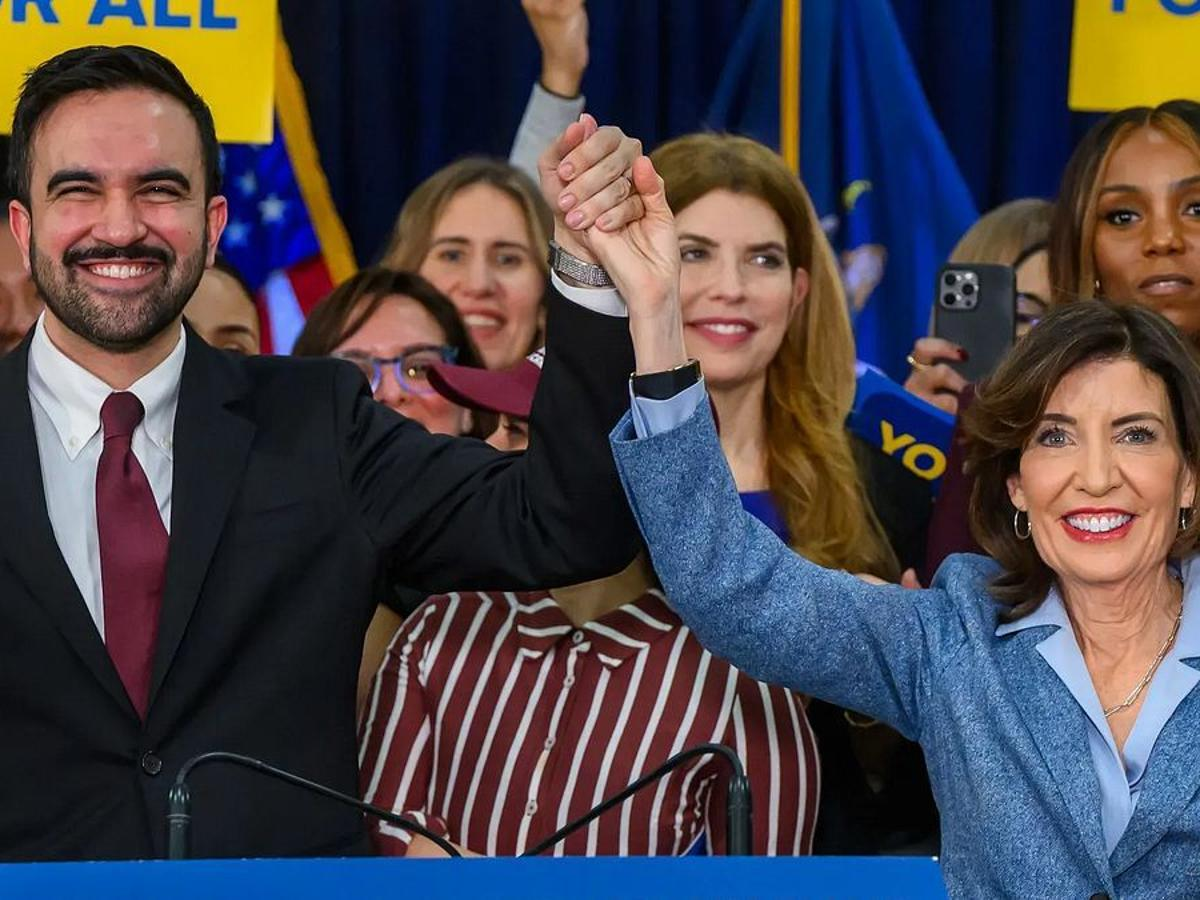
I already know, some people are furious. Others are disappointed. Hell, I bet some are pleased.
There are people who like Kathy Hochul, a lot. I’m not talking about them, not now.
There are people who like Antonio Delgado, a lot. I’m confused by them. Sure, Delgado says a lot of progressive stuff today. But that’s part of his campaign. Has he been an activist? No. Did he do anything special in Congress? No. He was best known for always voting “the right” way. And not speaking. When Zohran ran, he had a thin legislative record, too. Except the one thing he did, free buses, was signature. And the campaign he was part of, the hunger strike against medallion debt. Delgado got anything like either of those? Being loyal and quiet doesn’t count.
There are people who thought that the endorsement was brilliant, that now she owes him. I’ve got something to say about that, further down.
Look, Hochul was going to win. Doesn’t mean he has to endorse her. But he also needs Hochul to move on several of his major issues. Revenue is key. Tax the rich? Or get the money from somewhere else? Mamdani isn’t going to roll over Hochul, so he’ll need her to move on this, so he can move his agenda. And for anyone outraged over Mamdani endorsing Hochul, think about Mamdani’s agenda, and Hochul’s power, and relax.
I figured, way out, that as a practical matter, Hochul was the odds on favorite and Delgado was uninspiring. Only question, in my mind, first for the WFP, then after he became odds on favorite for mayor, for Zohran Mamdani, was what was the best deal they could trade for that endorsement. Hochul was the favorite, is the favorite, but even a favorite does not want the risk of a primary, the distraction of a primary, the cost of a primary. She knew that. Zohran knew that.
Now I worried a little. Zohran ran an impressive campaign. But he’s already been caught asleep by Julie Mennin, and lost track of education before he started. So the power part of politics? Would he know how to play hardball?
So that’s where I leave this. Zohran didn’t play hardball on this one. Not a good negotiation. He already had childcare promised. It was his chance to get more, and instead he got future consideration, which might be something, and might be nothing. I’m not a big fan of the endorsement because I’m not a big fan of Hochul. But it was sort of inevitable, and so I’m not terribly worked up about it either. I am not annoyed that Zohran endorsed Hochul. I’m annoyed that he didn’t get anything for it. For us.
Birthday Puzzles
I got a card in the mail with a math puzzle on it. I solve it while walking up the stairs (6 flights, but still…) Here goes:
If each letter represents a digit, what is the true equation?
MA × CA = WWW
There was something about this that made it quick work for me. Do you want to guess what that was?
Later, I shared the puzzle with a few people, and the most interested of them was having trouble seeing the digits as digits (with place value) – he hadn’t done this sort of puzzle before. And we couldn’t really talk. So I made him a puzzle where the idea of being a digit was clearer, and easier for him to figure without me explaining:
DAB
+DAD
ABCD
And the whole group had fun with this one.
New York City’s Hidden History – Freedom Day (reprint)
Forward: I’ve been writing about Freedom Day (February 3, 1964) on its anniversary for several years now. I am glad to see the anniversary getting marked a bit more widely this year: Alan Singer sent out something, I think this might be the first time. I see pages about it on more websites than a year ago. And an internet search shows more new hits in the last month. That said, my discussions in the last year brought me to someone who thinks integration was not the goal the Black community was after, but was in a sense a concession… I don’t know about that – but it deserves more careful research. Anyway, here’s my recycled post:
Huge civil rights protest, half a million, 60 years ago. And some of you might want to say, “but the March on Washington was sixty and a half years ago – and it was a quarter million” – which is correct. And it makes the point. A protest, twice the size, not in Washington DC but here in New York City, happened 60 years ago, and it is hidden.
The NY Daily news sent a note to subscribers – 60 years ago (Wednesday) a few hundred school kids skipped schools to greet the Beatles at JFK. A few hundred. None of the NY newspapers sent out notices about the 60th anniversary of half a million kids boycotting school earlier the same week.

Why hide the history? Few people know about “Freedom Day” – it is omitted from our history text books – around the country, and, worse, in New York State and New York City. Why do leaders and educators hide such a major event?
Let’s pause for a second, and just review what happened. February 3, 1964 was Freedom Day in New York City. 470,000 students boycotted school, and many engaged in additional protest and demonstration. They were demanding integration. They got empty promises, that were broken.
I don’t trust you anymore
https://www.youtube.com/watch?v=LJ25-U3jNWM
You keep on saying, “Go slow”
Go slow
But that’s just the trouble (too slow)
Desegregation (too slow)
Mass participation (too slow)
Other actions, strategies, and protests have occurred since. With the same results. Or less. New York City operates one of the most highly segregated big city school systems in the nation today.
From Time Magazine, September 2020:
(that’s an 8 minute video. There’s also a print story)
So Freedom Day was momentously huge. It did not bring about change. It set the pattern for promising discussions or studies down the road, and delivering nothing.
Is Freedom Day part of our history?
If a textbook in Colorado skipped over a huge protest in another part of the country that did not result in big change – I kind of get that. But half a million students is a lot. And the fact that the Civil Rights Movement produced the March on Washington that we think of as a turning point, but Freedom Day, twice as big, that did not change anything… probably worth mentioning.
But we are not in Colorado. We are in New York City. And when there are large national events or changes, we often include lessons on how they played out in our state. New York City during the Civil War (draft riots). New York City and immigration (Jacob Riis and Tenements). New York City and suburbanization (Levittown). But what about the struggle against segregation? That was across the country, including here. And a massive school boycott – that’s the biggest political action by students in New York City, well, ever. How do we leave our history out of our textbooks?
There is Black History in New York in our textbooks. I don’t have a DoE approved book at home – but Brittanica Kids has an article about riots in Harlem. But nothing about Freedom Day. Freedom Day was organized. It involved many, many more people. Why would Brittanica (and I assume other texts) privilege a story of chaotic response over an inspiring, bigger story of well-organized response?
Is Freedom Day “uncomfortable”?
If the March on Washington is history, but Freedom Day is not… If the Harlem riots are history… but Freedom Day is not… maybe the question is who is making that decision – and do they have an interest in including some stories and excluding others.
Yet, King highlighted the venality of more “polite” forms of racism and challenged Northern liberals to address racism at home — and not just in the South. Violence and hate-filled rhetoric were not the only methods by which White supremacy was maintained. King identified how people, including those who may have deplored Southern injustice, maintained the racial status quo. Moderates and liberals deployed “both-sidesism,” argued that time would solve the problems of racism, cast disruptive protest as unwise and unreasonable and embraced ideas like the “culture of poverty” to justify strong-arm policing and explain away inequities in their own cities.
https://www.aaihs.org/martin-luther-king-jr-s-challenge-to-his-liberal-allies/
Freedom Day challenged – and the fact that it occurred challenges – present tense – the racial status quo in New York City. The stories of the riots provide a rationale (false) for more and more aggressive policing – and that is “policing” which was, and continues to be, largely directed at people of color. And the story of the defeat of Freedom Day highlights the duplicity of those who counsel patience, going slow, “this is not the right time,” more study, etc.
More Links
I have been writing about Freedom Day for several years. This year I am four days late. Short post. Meandering story I told kids one year.
Chris Bonastia’s book covers much of the story of Freedom Day in detail. I recommend it.

Who decides what is history?
Freedom Day is uncomfortable. It is inconvenient. But it was a huge, huge event. It was defeated by double-talking politicians. And it continues to be mistreated, by being kept hidden from generations of students. Who has decided, up to now, that it is not taught in our schools? And who will decide to remedy that injustice?
Missing digits puzzle
Can you find the missing digits?
Could I have offered fewer digits (and still have one solution?) could I spread the digits better?
_ _
x _ _
________
496
1860
—————
—- —- —- —-
Tuesday’s Close Election: Proposal One
Zohran won six days ago. That was the election that everyone remembers. But there was more on the ballot. Proposals 2 – 6 were about New York City (2 – 5 passed, 6 failed). But Proposal One was a state Proposal. And it was one of the closest votes last Tuesday.
New York State has parks. The US Government has national parks. Other states have parks. But none of them, not even Yellowstone, are protected by a constitution. Except for two. Catskill Park and Adirondack Park are protected by the NY State Constitution. They are the best protected parks in the entire country. But are they?
Adirondack Park is huge. Six million acres. Bigger than all of New Jersey. About the size of New Hampshire, or Vermont, or North Macedonia. With different rules for how land is protected and used in the park. It’s a mix of public and private land. There are towns in the park. Over 100,000 people live inside its boundaries.
Here’s a cool map of land use in Adirondack Park.
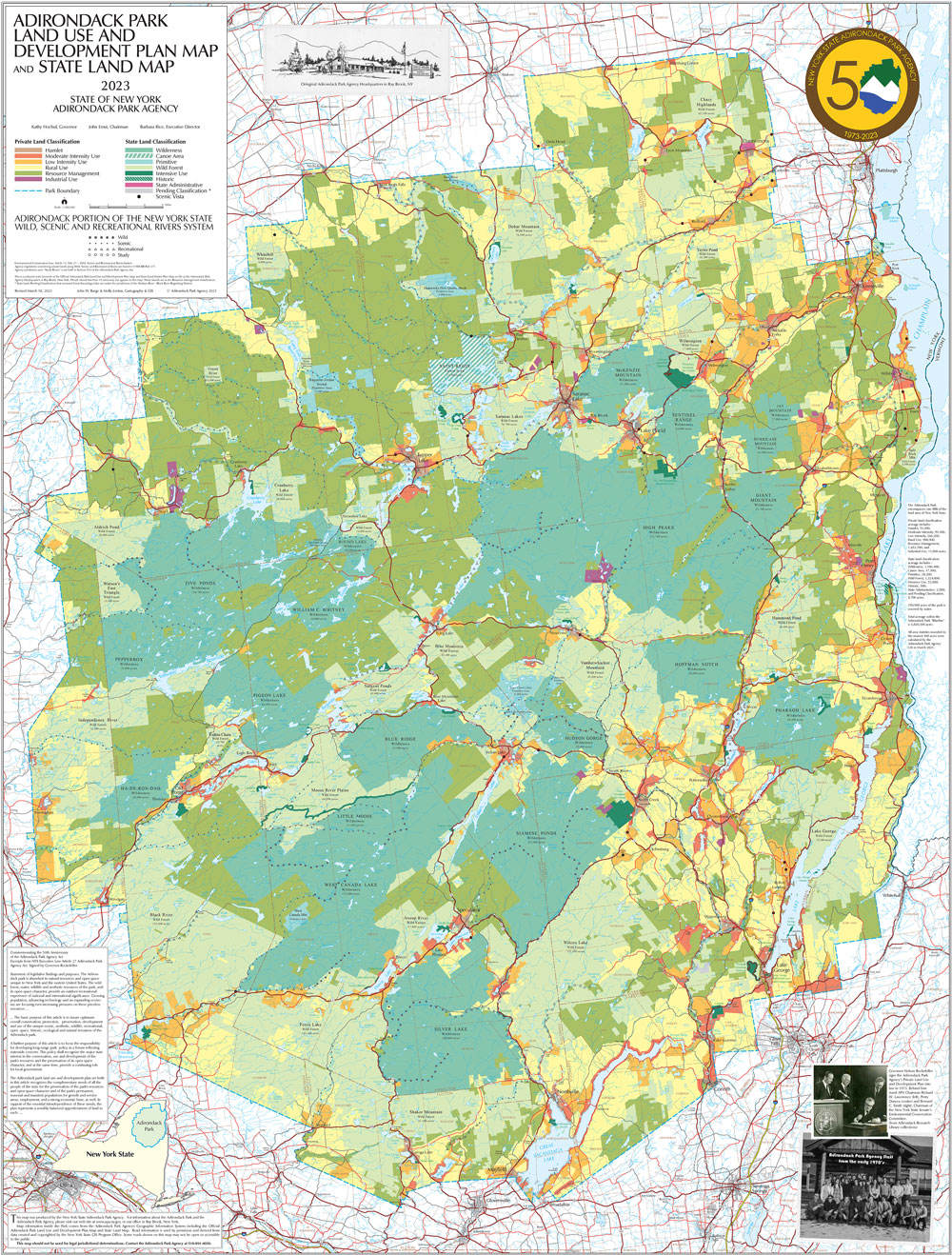
But I asked, is it really well-protected? (Now I’m forgetting about Catskills, just talking about Adirondack Park.) Well, sort of. There are restrictions and regulations on development, on clearing land, on building structures. But they are not always followed to a T. Some locals, understandably, bristle at some of the limitations – why are they restricted from certain activity on public land? On private land they own? But we are not talking about, mostly, major encroachments. Proposal One was about a major encroachment.
Lake Placid is in the northeast of the Park. Winter Olympics twice. Other major winter sports events. And five years ago the Olympic Regional Development Authority (ORDA) built some cross country or bobsled or somesuch trails – not where they should have been built, but by clearing some land in Adirondack Park that should not have been cleared. 343 acres out of 6,000,000 may seem small, but over 300 acres is a real violation. Here is a summary of the story on public radio up there. Here’s another summary on a local TV station.
So what to do? The approach of Proposal One was to carve the land out of the park (for as long as ORDA is using it, then return it) and add 2500 acres elsewhere to the park. And this could only be done by amending the NY State Constitution.
- Why is this good? Once done, there will be no related violations of the constitution in play. The park will have lost 400 acres and gained 2500 – a net win.
- Why is this bad? ORDA gets away with what it did, without penalty. They claim inadvertent – I’m suspicious.
- Why not another approach? Make them put it back? Seriously, might make us feel better, but doesn’t help.
- What’s not relevant? It does not open up the park for development (the amendment is only about this parcel). It does not set precedent.
And who supported this? All the environmentalists working to preserve Adirondack Park. That’s a big deal. And who opposed this?
Let’s go to election night. Huge turnout in NYC, swamped the rest of the state more than NYC usually swamps the rest of the state. And surprise – early on, Proposal One was going down statewide. Outside of NYC it was passing near 60%. But in NYC? Even votes in Manhattan and the Bronx. Big negative vote in Queens. And huge votes against in Brooklyn and Staten Island. Think about that – when do Brooklyn and Staten Island agree? Not on the choice of Mayor. Or President. Or much else. But they were #1 and #2 in all of NYS, and they almost succeeded in defeating Proposal One.
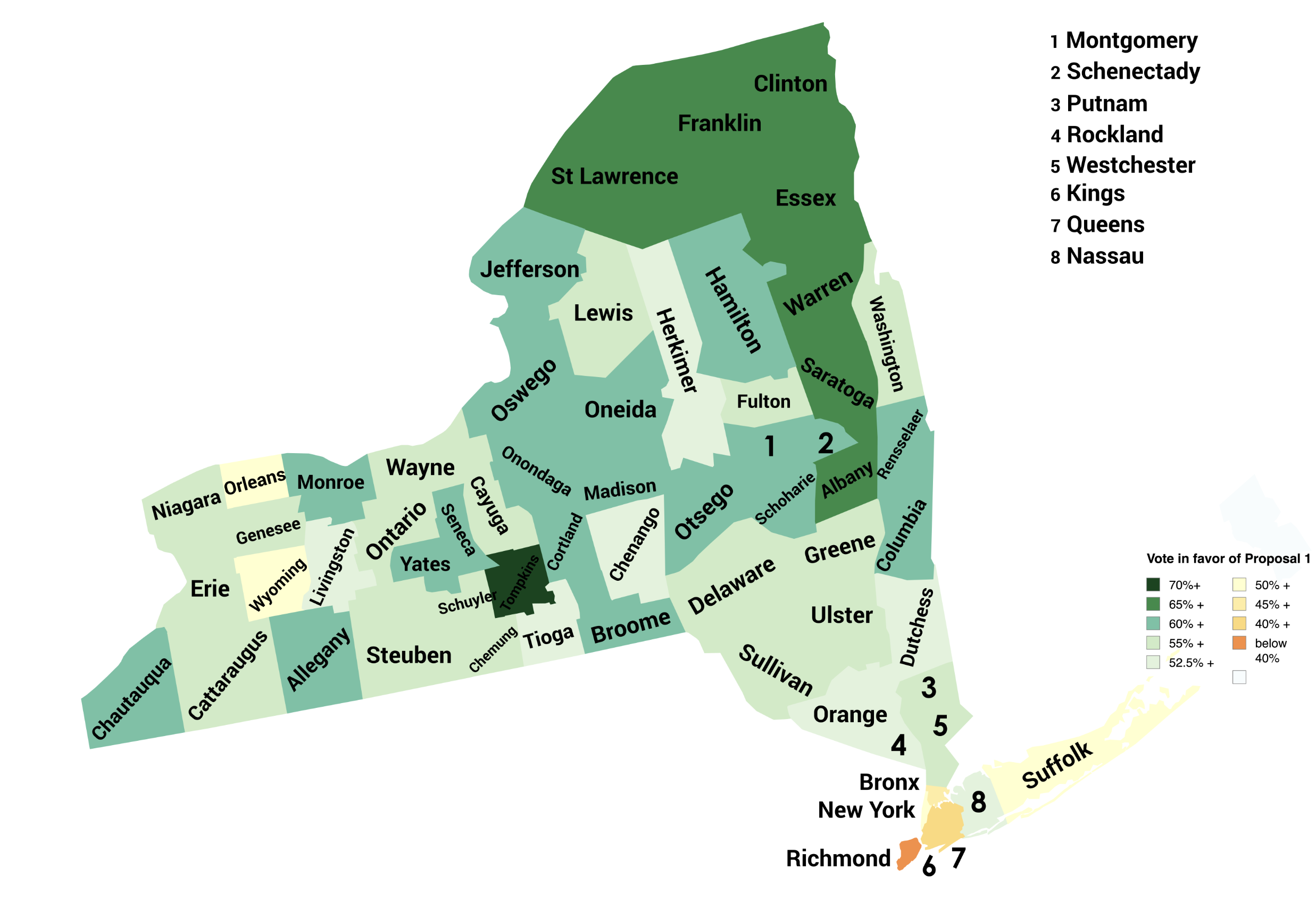
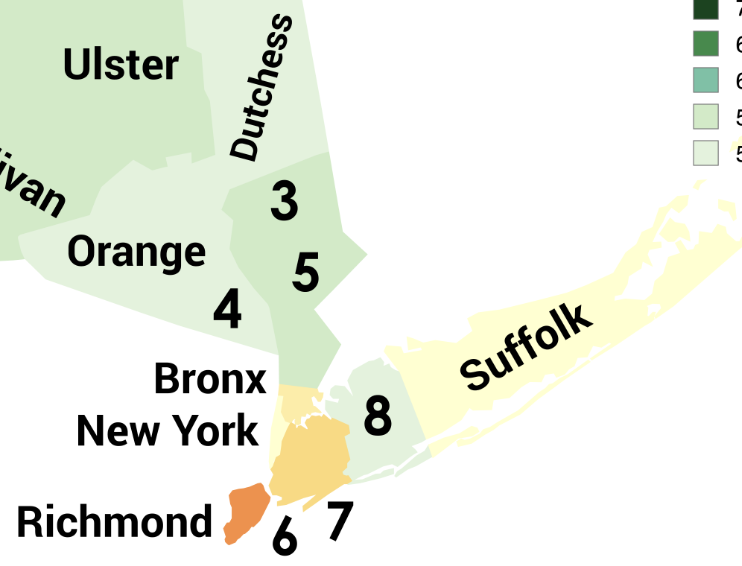
Late returns from Westchester County, and Rochester and Buffalo, and Niagara County turned Proposal One from a 50,000 vote loser to a win over 100,000 votes. NYC voted “no” by over 150,000 votes. The rest of New York voted yes by 300,000. This map is weird.
The land is in Essex County –
- and Essex and the surrounding North Country counties had most of the highest yes vote in the state.
- High environmental awareness drove yes votes especially in college towns – look especially at Tompkins County, the dark green square where Cornell and Ithaca are located – but also Broome (Binghamton), Saratoga, Albany, Schenectady, Rensselear…
- Pretty much the rest of New York State voted in the mid 50s to low 60s yes, including Syracuse, Rochester, Buffalo.
- The NYC suburbs were closer – Nassau and Suffolk in the low 50s, Westchester, Dutchess, Putnam, Rockland, Orange a little higher on average – but definitely a lower average than the rest of the state, except…
- New York City! Queens, Brooklyn, and Staten Island, what’s up? The original 718. What’s up with that? For some of those voters, a MAGA lean, including “I vote no on everything.” Upstate turnout was lower, there wasn’t a huge competitive mayor’s race. So NYC had many more low information voters – who might be more suspect of government. And who live very far from the affected area. And there was definitely a push (poorly informed) among some local progressive organizations (who are also very far from the affected area) to oppose the measure. Reading what was written, I am fairly certain the drivers of this campaign had neither read the amendment nor spoken to any activists on the ground.
But whatever, Staten MAGA Island and Progressive brownstone Brooklyn came together and almost killed this proposal.
Edit: It is clear that the supporters of this amendment did a poor job getting the word out about why they wanted this to pass. Certainly their thinking did not reach many NYC voters.
Here’s the amended (added) language, linked back to the full proposal:
It’s easy to know who not to trust – NYCE PPO (with update)
What follows is a repost of what I wrote on Substack Wednesday – with some additional info:
- The Professional Staff Congress (CUNY professors and others union) will be abstaining at the MLC. Somehow this has been misreported – please pay attention to how trustworthy your sources are (or aren’t).
- Retiree Advocate has a variety of views – and will not be taking a single position.
- I will try to write more, probably little bits, between now and Monday.
- I am, by the way, a pre-medicare retiree. I usually don’t write about personal impact, but in this case I should.
There’s a lot of discussion of the proposed new healthcare plan for in-service employees and pre-Medicare retirees. But not much of it is trustworthy.
On the one hand we have leadership loyalists, Unity supporters, who say yes when so instructed. They are not sharing information, but scripts. Even smart and pleasant people, when ordered to sell something – can end up sounding like salesmen. Why would anyone trust someone who was going to support this no matter what was inside?
On the other hand, we have people who are driven completely by their opposition to Unity. They knew they were voting no before any details were released. They search for reasons to oppose, and construct what might be wrong, based on a lack of information. They are loud, insistent, and driven by political considerations – not by the needs of our members. Why would anyone trust someone who was going to oppose this no matter what was inside?
When I left the Professional Staff Congress’ zoom last Wednesday, I did not know which way their Delegate Assembly would vote (ultimately they instructed, I believe, their reps to abstain at the MLC). I understood some strengths of the plan, and some concerns. And I was left with more questions. But I also trusted that I had gotten some real answers.
All of last Wednesday’s PSC information zoom:
The opening 20 minutes or so are presentation – James Davis, PSC President, Debbie Bell, PSC’s retired Executive Director, and Barbara Caress, a healthcare policy expert from the Zicklin School at Baruch College – the next almost 10 minutes are summary (Davis) – and the next hour and 15 minutes are Q&A.
I would suggest that James Davis’ summary is a good place to start, though perhaps it is easier to follow after listening to the opening. In any case, the summary runs from about 26:30 to 34:50
The Q&A is quite rich – PSCers have some of the same concerns, some different concerns, from us. There were at least two UFT/PSC members who asked questions. I think the Mamdani question is interesting. I notice that the PSC strongly supports self-insurance as a cost-savings measure.
Analyzing UFT election results – from 2022
JD2718 blog posts from May and June 2022.
Post-UFT election for the last two decades I have done some analysis of the numbers. I am getting ready to start pulling apart 2025. But first – I’ll repost all of what I wrote three years ago.
Three years ago a grab-bag coalition of many of the groups and caucuses opposed to the ruling Unity group came together under the name “United for Change” (UFC). UFC ended up taking 5700 votes among teachers (matching MORE/New Action from 2016) and over 8200 votes in-service. Unity had a particularly bad election and only got 7900 teachers and 13,200 in service (total).
The big take-aways from 2022 (but if you have the patience, you should read through)
- “Votes cast” tells the story far better than “percents”
- The elections shift as Unity voters decide to vote or not vote – or as non-Unity voters decide to vote or not vote. We are not (generally) competing for the same voters. That means everyone’s votes can go up (or down) in the same election.
- the “opposition” total votes cast from 2004 – 20022 were relatively stable (important for understanding what changed in 2025)
- Unity’s total votes cast among teachers and in-service steadily declined from 2004 – 2022.
- The Retiree vote does not follow the same patterns as the in-service vote.
- The Retiree vote AFTER Mulgrewcare shifted, and is still in flux (I’ll also discuss Retired Teachers Chapter elections, including 2024, 2021, and earlier.)
Now, I did write a lot three years ago. Thirteen blog posts? I don’t expect anyone to sit down and read this straight through. But it is a useful reference – perhaps for you – definitely for me, as I pull apart the 2025 numbers.
If you would prefer to read this as individual blog posts, I have added links to the original posts.
· What Would a Big Unity Win in the UFT Elections Look Like? (May 8, 2022)
· What Would a Big United for Change Win in the UFT Elections Look Like? (May 9, 2022)
· Even the incomplete results are incomplete (May 11, 2022)
· Unity scrapes out a win – United for Change takes high schools (May 11, 2022)
· More unofficial numbers (May 11, 2022)
· Good Luck (May 13, 2022)
· Analyzing UFT Election Results: My Data (May 14, 2022)
· UFT Election Turnout: Four Charts (May 15, 2022)
· UFT Election Turnout: Some Observations (May 15, 2022)
· UFT Elections: Voting Against Unity (May 21, 2022)
· UFT Elections: Voting For Unity? (May 22, 2022)
· Why do I look at total votes in UFT elections? (May 23, 2022)
· The Retiree Vote (June 20, 2022)
What Would a Big Unity Win in the UFT Elections Look Like?
We have a hot United Federation of Teachers election. Incumbent president Michael Mulgrew is the least popular UFT president, well, ever. The ruling Unity caucus, in power since the UFT was founded, looked weak and spineless during the pandemic. And our retirees, long a bulwark of Unity’s support, learned a year ago that Unity was forcing them off Medicare, into a private program. The retiree vote for Unity in an election as the news was breaking fell from 85% to 70%. These were danger signs.
The various opposition groups coalesced into one coalition: United for Change. (I am the High School Vice Presidential Candidate for UfC). They nominated a large number of delegates, and probably reached more members in more schools than any opposition campaign in memory.
The expectation, I am guessing, is that in this environment Unity’s vote total falls, a lot. They got 76% in 2016 (the larger oppo groups united) and lost 7 Exec Board seats (out of 102). In 2019 they won the seats back with 83% of the vote against a three-way divided opposition.
What Would Constitute a Big Unity Win?
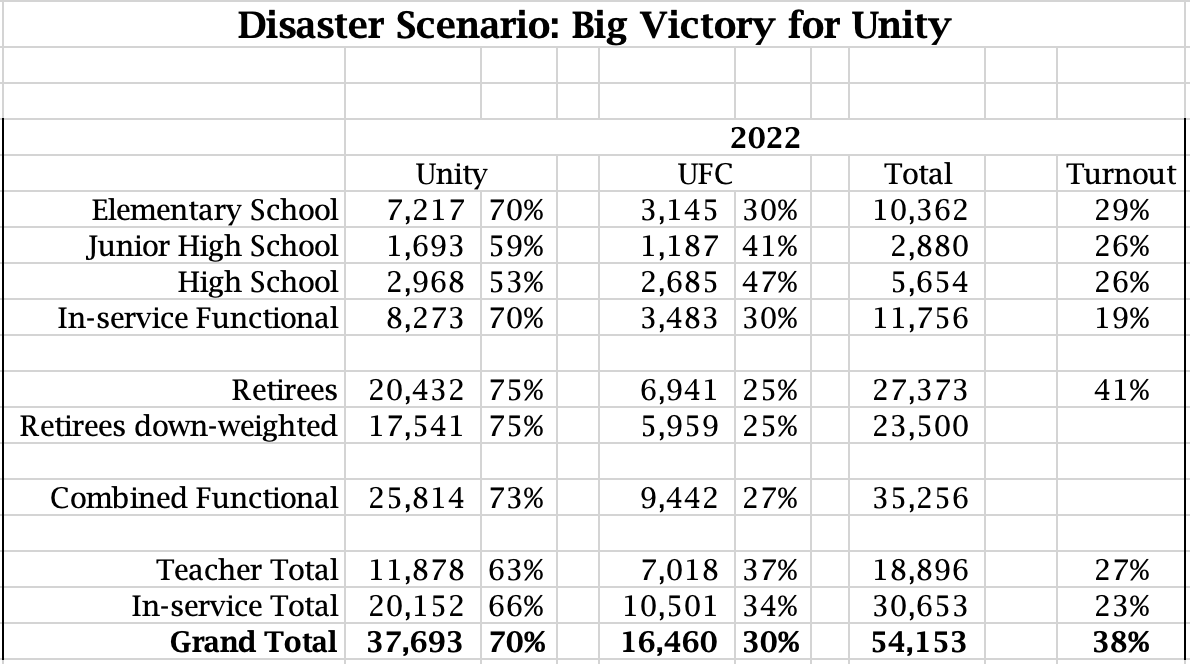
If somehow Unity kept its vote over 70%, and held onto 100% of the exec board, that would be a big win.
What would it look like?
Maybe it turns out that 70% was their low-water mark among retirees, while retirees had just heard the Medicare Advantage news. Unity might actually raise their total a bit from there. 75%?
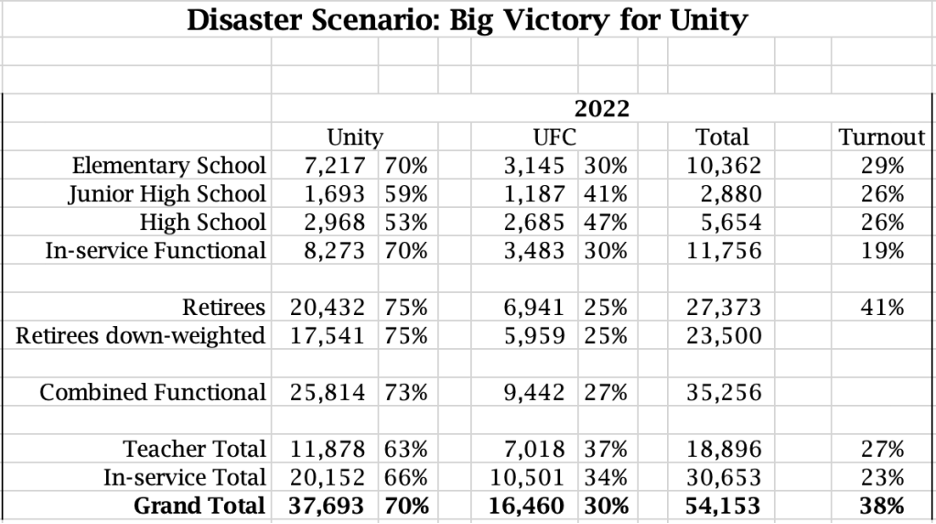
Sure, they might lose a few votes in each division (Elementary School, Middle School, High School, Functional), but not that many. Perhaps I have been overestimating the dissatisfaction over the pandemic? And some of the really bad policy was in 2020-21, which right now seems long ago? In 2019 they won 85%, 75%, and 64% Elementary School, Middle School, and High School respectively. They should lose votes, but maybe down to a manageable 70%, 60% and 51%, sweeping the seats (winner take all by division).
How Would They Have Pulled This Off?
They hid Mulgrew for the last four months. And maybe it worked. In December Mulgrew looked potentially the biggest vote-getter for the opposition – he was so unpopular. I begged Unity to drop him, for the good of us all, to no avail. Unity instead hid him, buried him. They canceled his events. They kept him off the campaign literature, and where they had to include him, did not make him noticeable. I went to the Unity Facebook page the other day. I could not find a single mention of him.
They shut up about Medicare. And people forgot. We have had almost two months of radio silence. Timing worked in Unity’s favor. A judge ruled in favor of retirees, and stopped the current implementation plan. But he showed the City and Mulgrew and the MLC how to work around the ruling (stop offering the old plan). But did Unity/Mulgrew jump at this? No. He is waiting for the campaign to end. They correctly judged that silence on Medicare during voting would save them votes. Just last week, after most of the ballots were cast, Mulgrew began sharpening his knife.
They put out good looking literature, with a unified theme. I wonder if they hired a pro? Seems like it. A media consultant to tell them what appeals to teachers. The irony of it. Some of the on-line stuff had serious issues with bad color choices that didn’t show, but the print stuff was fairly solid. And they did a full round of mailings, at least to ES, MS and HS teachers.
They highlighted individual members, especially in-service (and really in-service, full-time teachers, counselors, paras, etc). This gave them a better chance of having people campaign actively in schools, which they were never good at, but have gotten worse over the years.
They put pressure on supporters to cheat. We had pretty typical DR violations (mixing campaigning with union work, making it seem like voting for Unity was part of a union member’s responsibility, “branding” election work with union logos) but we had more lower level candidate violations (for example, lots of blocked access to mail boxes – which access is supposed to be guaranteed.)
And they successfully avoided a massive increase in turnout. Both sides knew that getting new voters to vote was key for the opposition. But Unity pulled every card they had – no electronic voting, no in-school voting, tricky ballot with double envelope, early deadlines for replacement ballots, conducting the election over break. They suppressed the vote. And in this scenario, they were successful, turnout barely rises.
For this to have happened, it would turn out that the United for Change outreach, while extensive, had been pretty completely ineffective. And it would mean all the new voters we think we encountered ended up not voting. And it would mean that the retirees who said they were switching to opposition changed their minds at the last minute.
What happens next?
In this scenario, Unity will draw the worst possible lesson. They will breathe a deep collective sigh of relief, and decide that all is good with the United Federation of Teachers.
Unity will decide there was nothing wrong with what they were doing. Mulgrew will remain president, for the indefinite future. Medicare Advantage will get restarted, and retirees will have to scramble to keep fighting it. Nothing will change?
Actually, something has been changing. The current course is corrosive. Unity/Mulgrew have been turning off members, badly, especially since March 2020. The support for the UFT from within the UFT has never been lower. Cynicism has never been higher.
Yes, Unity would have won. But with teacher turnout ticking up a few points, say as high as 27%, that still leaves almost ¾, a supermajority, disconnected.
Our union has been moving, slowly but steadily, in the wrong direction. The disconnect between membership and leadership has never been greater. This outcome will confirm Unity on the same path, a path to slow, steady decay of the UFT.
How Likely is this Disaster?
Definitely possible, but not very likely. United for Change has consistently received positive campaign feedback – probably not nearly enough to win it all, but more than enough to stop this doomsday scenario. Teachers are still angry about the UFT’s inconsistent advocacy during the pandemic. Even hidden, people remember it is Mulgrew running. Retirees do not seem less concerned with Medicare than they did a year ago – if anything, more of them are engaged on the issue.
Maybe a 10% chance that this happens? But I think that is high. Maybe a 5% chance – about 1 in 20. That seems right. Not out of the question, but not likely.
What Would a Big United for Change Win in the UFT Elections Look Like?
We have a hot United Federation of Teachers election.
The ruling Unity caucus, in power since the UFT was founded, currently controls 100% of the Executive Board. Every officer belongs to Unity. Also, every Borough Representative, every District Representative, every Special Representative belongs to Unity. And Unity uses some of these representatives to keep a lock on its control.
In 60 years Unity has always won the Elementary School division, always won the functional division. It is true that the lost the Middle School division once or twice, but that was decades ago. And they have lost the High School division many times, most recently 2016, though they won it back in 2019 and currently hold it.
Unity has always won the overall election – half the seats are at-large, all the officers are at large – and has always won it by a comfortable margin. In 2016 they got 76%, which I believe was their lowest total ever. In 2019 they climbed back to 83%.
On the other hand, incumbent president Michael Mulgrew is the least popular UFT president, well, ever. Unity looked weak and spineless during the pandemic. And our retirees, long a bulwark of Unity’s support, learned a year ago that Unity was forcing them off Medicare, into a private program. The retiree vote for the opposition (Retiree Advocate) in an election as the news was breaking rose from 15% to 30%. These were signs.
The various opposition groups coalesced into one coalition: United for Change. (I am the High School Vice Presidential Candidate for UfC). They nominated a large number of delegates, and probably reached more members in more schools than any opposition campaign in memory.
The expectation, I am guessing, is that in this environment Unity’s vote total falls, a lot. Losing 10% or 15%, would be a big deal. That would probably mean United for Change wins the High School division, and maybe even the Middle School division. That would mean controlling 11/102 seats on the Executive Board.
But is a bigger win for United for Change possible?
What Would Constitute a Really Big United for Change Win?
If somehow United for Change moved 20% of the vote, won the High Schools and Middle Schools, but put the other divisions into play, that would be a big win.
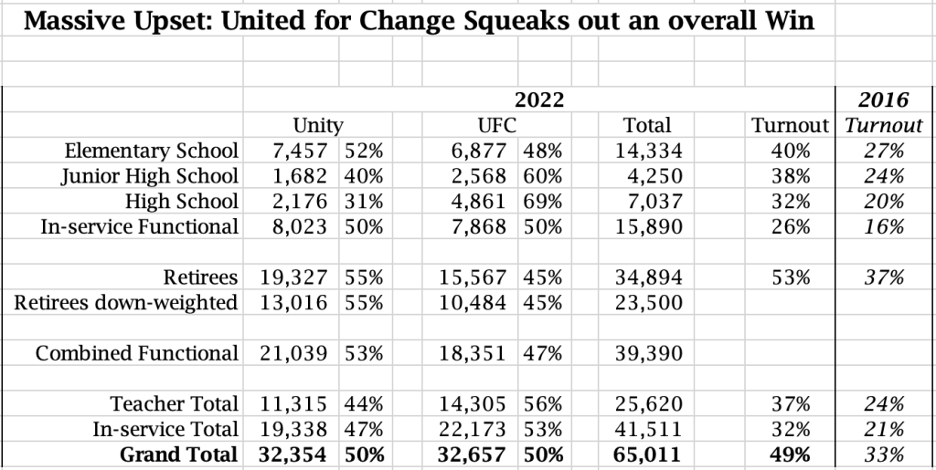
A really big win would tip things a few points further, and United for Change would win the overall vote, even by the narrowest of margins.
What would it look like?
Maybe 30% was just the beginning among the retirees, and they swing far further. Maybe a lot of non-voters are motivated to protect Medicare by voting, and those votes go overwhelmingly to UfC.
Maybe we cement our hold on the high schools, surge in the middle schools, and build some margin. And maybe we make enough ground up in the Elementary Schools to even things out. We could win two of the four divisions, and the at large seats. That would give us 70/102 Executive Board seats. We would win the 11 officer positions we are contesting. I would have a seat.
How Would United for Change Have Pulled This Off?
Mostly? Turnout. For this to happen, Unity’s threat to Medicare would have had to energize retired members who usually do not vote to do so. And they would have had to break heavily for UfC. Teachers in the schools would have to be even more tired of Mulgrew than we imagined, and non-voters became voters. And inchoate anger about the pandemic and the world would also have motivated teachers and others to vote for the first time. This scenario imagines teacher turnout soaring from 24% in 2016 and 18% in 2019 to somewhere between 35% and 40%. Notice, that is still low, too low. But it would require a pretty big increase in teacher vote.
So this scenario requires an almost unimaginable increase in turnout. But if turnout does surge, is there any doubt that the new voters would break heavily for United for Change and against Unity? That part makes sense.
Also, there would need to be former Unity voters switching sides. Something around 10%. Now, there certainly are defections, especially among retirees. And I have heard of some in service Unity people, including former chapter leaders switching. 10% seems like a lot. Another factor might be split ballots. At the count tomorrow we will see – are there Unity ballots that omit officers? one in particular? several? Each slate vote that becomes a split vote hurts Unity a little – though not as much as a defection.
There are other factors that we know about. United for Change made the case that voting for Unity was voting for Medicare Advantage. In this scenario, many members would have heard this, and either are already Medicare age, have relatives who are Medicare age, or are deeply committed to the New Deal and Great Society, and will vote to protect those programs
The pandemic hit the elementary schools differently than the high schools. United for Change has fewer campaigners in elementary schools, so we may have missed trends. Perhaps one of those trends was anger over having to go back into schools first (before high schools) and instructional lunch (much more a lower grades thing).
There are UFT members with strong opinions on pandemic policy – masks (in favor of them, against them), vaccines (mostly in favor, but some fervently opposed) – and just about all members with strong opinions are angry at Unity, or at least the person of Mulgrew. United for Change did not campaign for the “anti-vaxx” vote. No. But I bet they voted against Mulgrew – either by boycotting the election, or, in this scenario, by voting for UfC.
And then Mulgrew-fatigue may be even far greater than I imagine.
But United for Change did the work. We reached more schools with literature than any opposition ever has. Our messaging was sharp. Our print media was much better than Unity’s, and our social media was so good, they copied us.
I think we could have done more to increase turnout. But in this scenario, it turns out that our get out the vote efforts were particularly successful.
And of course our slate looked pretty good. And running women for the top officer slots was probably a smart move.
For all of this to have happened, it would turn out that the United for Change outreach, while extensive, was exceptionally effective. And it would mean all the new voters we think we encountered ended up voting. And many people we did not meet directly ended up voting for the first time. And it would mean that a significant number of Unity voters secretly voted for United for Change, or split their ballots. And it would mean that the retirees who said they were switching to opposition did so.
What happens next?
In this scenario, United for Change will win the Officers, and most of the Executive Board seats. Unity will retain one vice presidency, and 31 seats. I expect that Unity will challenge this result. There might be litigation. I hope not. I hope that wiser people than Mulgrew put the interests of the union over their desire to retain power.
In office, UfC will move quickly on a number of items.
- As rapidly as possible we will hold elections for District Reps.
- We will open the books on the Stabilization Fund, and review options. We will take Medicare Advantage off the table.
- We would probably open the proceedings of the contract negotiating committee to the membership as a whole.
- And we would prepare, super fast, for the AFT Convention (in Boston, starting July 14).
Between the results being announced, and us taking office July 1 we would need to meet and make many more decisions – but those are the first that I am confident we agree on. There might be some long term changes in staffing – but short term I expect (and do not know) that aside from a handful of key changes, we would want to make certain that the organization has a continuity of functioning.
I don’t know that UfC as a whole has given this much thought – but I would want to reach out to and consult with members of Unity Caucus who continue to serve the UFT. And I would especially want to reach out to the 30 or so Unity Executive Board members. Establishing a collaborative relationship would be essential – even if we do not always agree.
Members would notice right away. More information. More openness. Better responses.
How Likely is this Upset?
Definitely possible, but not very likely. United for Change has consistently received positive campaign feedback – but just not at the level of the teacher vote doubling or a full 10% of Unity switching sides. We will make gains, maybe big gains – but literally doubling the vote? Some signs are promising. Unity people are telling us that they switched. Even a couple of candidates told us they voted against themselves. We are surprised to encounter cluster of retirees who we thought were apolitical who have been actively spreading the word. And we have run into elementary school teachers who just want a change – in ways that we did not expect. But at this scale for this to happen? I don’t think so.
Maybe a 5% chance that this happens? But I think that is high. Maybe a 2-4% chance – about 1 in 25 to 1 in 50. That seems right. Not out of the question, but highly unlikely.
Even the incomplete results are incomplete
I wasn’t there to complain.
Missing Easy Numbers
This morning I was teaching. UFT Election chair Carl Cambria shared the number of votes per division (they are in the table, below), and Dave Hickey said that 198,900 ballots were mailed. Every other election he’s included how many were mailed in each division, which is helpful to understanding the other numbers we are seeing. But not this time.
When I arrived (almost 4) that breakdown was still not available. And I was not able to get it. “Tomorrow.” Nuisance.
Late Votes Counted
The deadline was receipt at AAA 8 AM Monday. A Monday is bad, and what is this 8AM nonsense? They decided (I assume the election committee?) to include ballots received Monday and Tuesday. Which is fantastic. About 1600 more votes.
(we should have probably checked to make sure these ballots were not from Arizona, right?)
Subtraction by Addition
But now we have less information, because all of the vote counts shared by division are now wrong. The total vote is up 1600, but we do not know what division those votes fall in.
A Surprising Nugget
Dave Hickey shared that he saw a pile of about 200 retiree ballots that were not slate (voted for individuals, not caucuses). That makes 99% slate voting. In the previous election retirees voted slate 95% of the time. We verified that this was approximately correct. That is a very big change. Was this election a referendum on Medicare? Turnout was up, although we wanted more, and there was quite a swing to UfC, though we wanted more, so yes, maybe yes. I’m a bit surprised. I expected more Unity voters to check off 11 officers, and omit Mulgrew. Maybe they either stuck, or switched completely.
Neither a Shocking Upset, nor a Resounding Vote of Confidence
I laid out two results in the last two days, both extreme. Neither the amazing United for Change upset nor that romp that would stop Unity from reexamining course happened.
A Table and A Chart, both bad
Since I don’t know where the extra 1600 votes belong, both the table and the chart are wrong. But close. I’ll do better graphics and numbers when they are available.
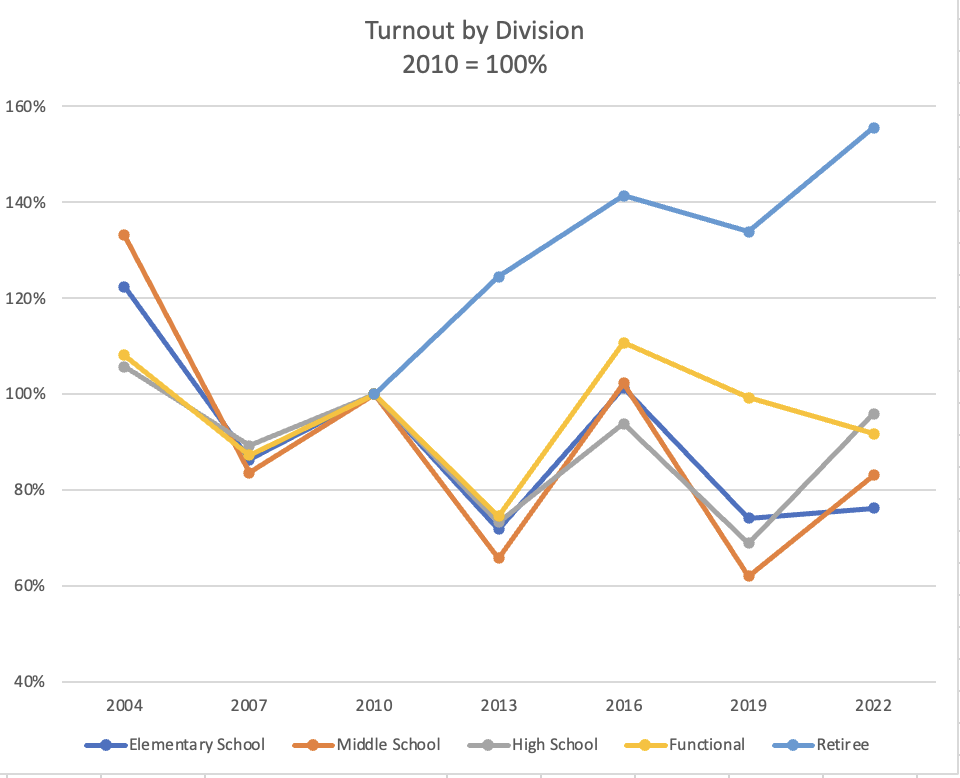
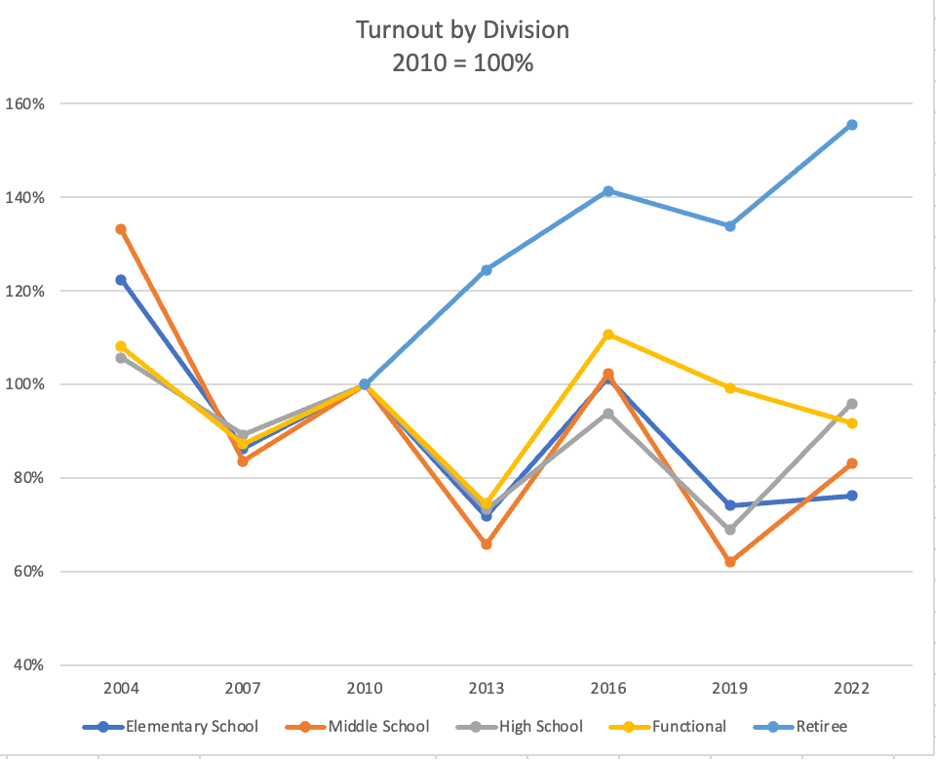
For now, the chart is just raw turnout by division, by year. I am missing two years of retiree data – what I had was just the cap number for those years.
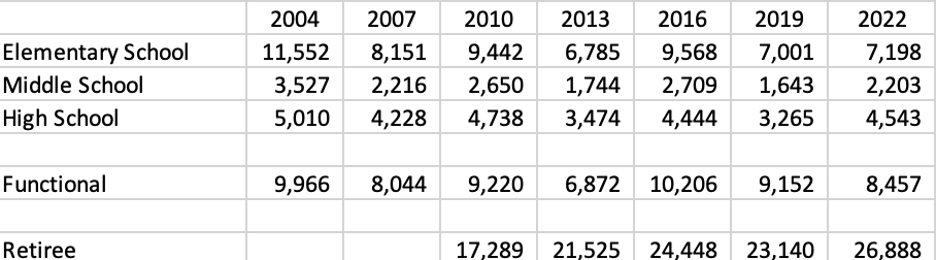
The 2022 numbers will increase. Older numbers come from a variety of sources.
The graph treats 2010 as 100% for each division, and you can see patterns. 2022 (still missing numbers) seems to roughly return to 2016 levels, after a dip in 2019. Wonder what happened to elementary? And the retirees are their own story (Medicare Advantage).
Unity scrapes out a win – United for Change takes high schools
Short quick post. Fuller results later. All of these numbers are unofficial.
Unity took the overall vote with 66%, their lowest result in – honestly, I thought ever. Soldini told me the elections in the 1960s were tight. So their lowest total in at least 50 years.
Retirees – Unity 71%. They usually score 85-90.
Functional – Unity 68%. They usually score 75-80%.
Elementary – Unity 67%. They usually score 75-80%
Middle Schools – Unity 56%. They usually score 60 – 80%
High Schools – United for Change 56%. This division leans opposition, but has swung back and forth.
Teacher total – Unity 58%. United for Change 42%. This is low. Unity has been between 65 – and 80%
More unofficial numbers
Maybe not “more” – maybe “better organized”
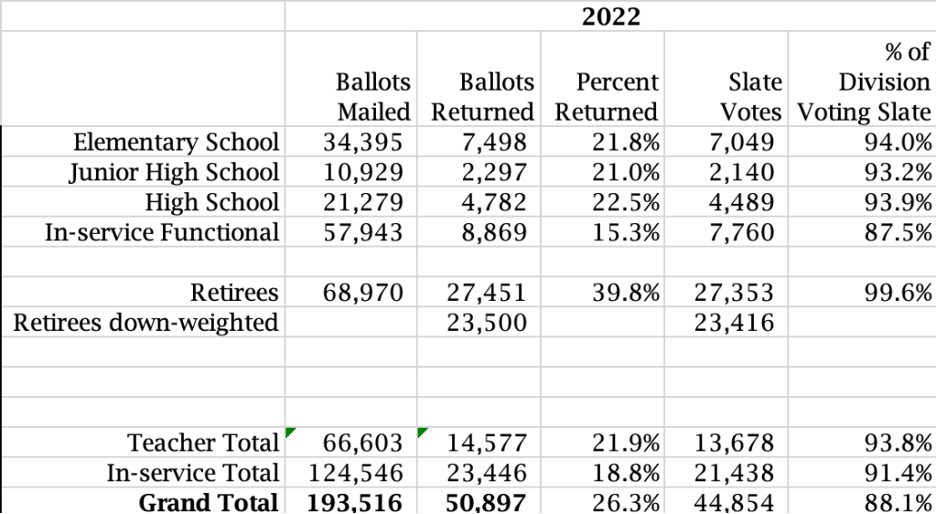
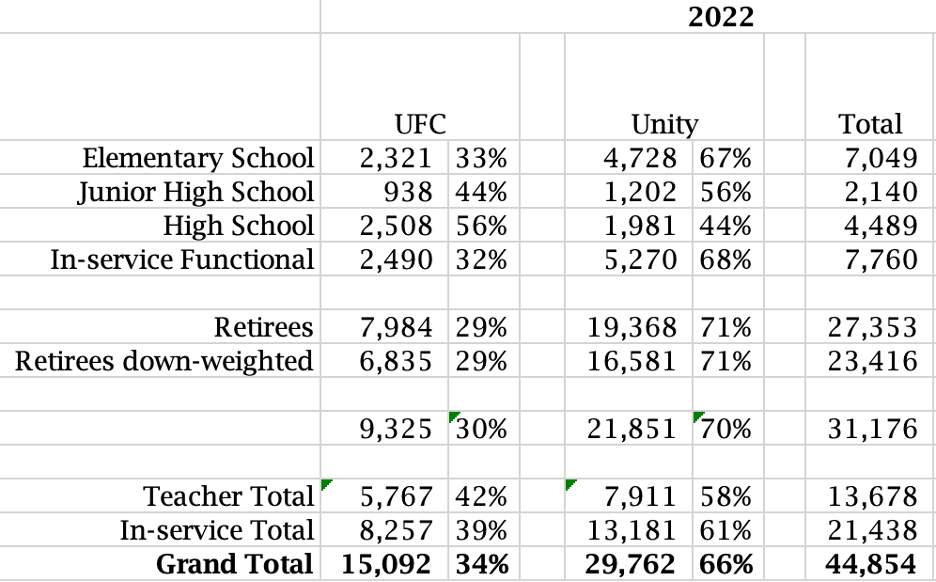

Yasmin Colon read us the numbers. Aloud. When she finished the ballots returned list, my hand shot up. The numbered return column didn’t add. She knew. Three ballots had problems, is that what I had noticed? People were kind of looking, weirded, at least a little, that I noticed 7,498 + 2,297 + 4,782 + 8,869 + 27,451 ≠ 50,900. I didn’t have the heart to explain, or the energy, frankly, that no, I had not added the numbers, just their last digits…
Good Luck
Good luck to those who won their UFT elections. Good luck especially to the United for Change high school winners.
But congratulations? I’m not so sure. With 79.5% of teachers not voting, I’m not sure that congratulations are in order for any of us. Unity won among teachers 11.88% to 8.65% for United for Change. Out of every 34 voters, 4 chose Unity, 3 chose United for Change. 27 did not vote. (numbers do not include D75 teachers – but those numbers should be similar).
In the coming days I will have more analysis of numbers. More analysis of how each side performed vs each other, but also vs our respective goals (or my estimate or guess of those goals).
But for now – some needed discussion
Engagement
- how will you increase member engagement? I do not mean voter turnout (and yes, we want to increase that). But low turnout is reflective of low engagement. And addressing that underlying problem, deep problem, is crucial. The strength of the union comes from its ability to unite the activity and energy and power of our members, and today that strength appears suspect. And that is a generous assessment.
Out of every 34 voters, 4 chose Unity, 3 chose United for Change. 27 did not vote.
Will this discussion happen within each side from the election? Will it happen within caucuses in United for Change? Or will all of us come together to address this?
Medicare
- the bit of engagement that seems to have increased, seems to have increased among one group of members – retirees. And pretty clearly that was driven by one issue – Medicare vs Medicare Advantage.
Will Unity continue to secretly deal with health care and the MLC? Or will we look together at the magnitude of the funding problem, and work together for solutions that are acceptable to our members? I don’t know. My gut says not to trust Unity – but the right thing to do is to set aside that mistrust, at least for the moment, and give them a chance to reassess.
I’ll get back to numbers and analysis.
But for today, good luck.
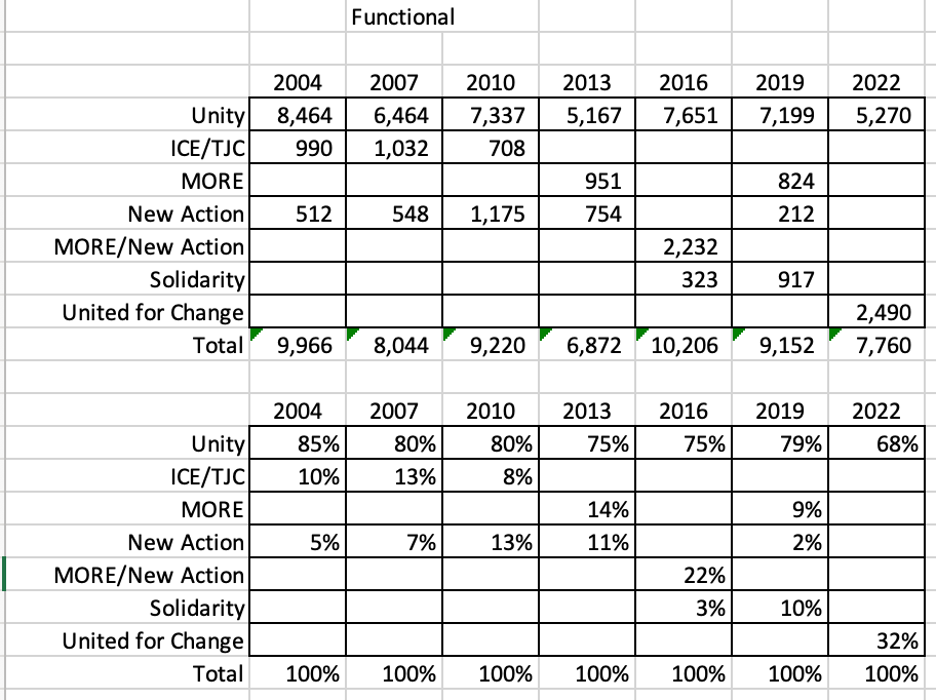
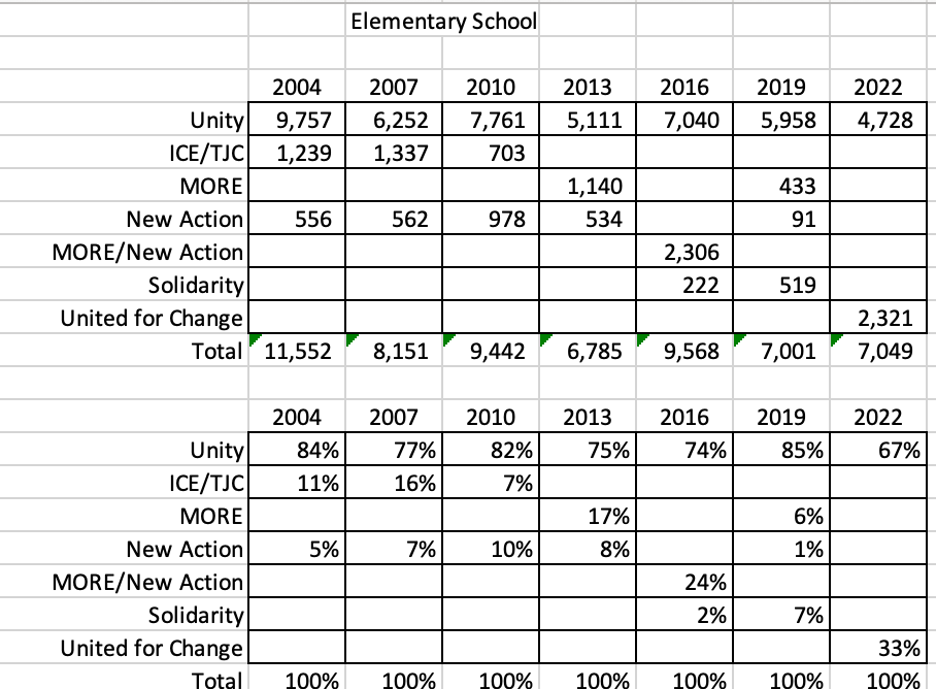
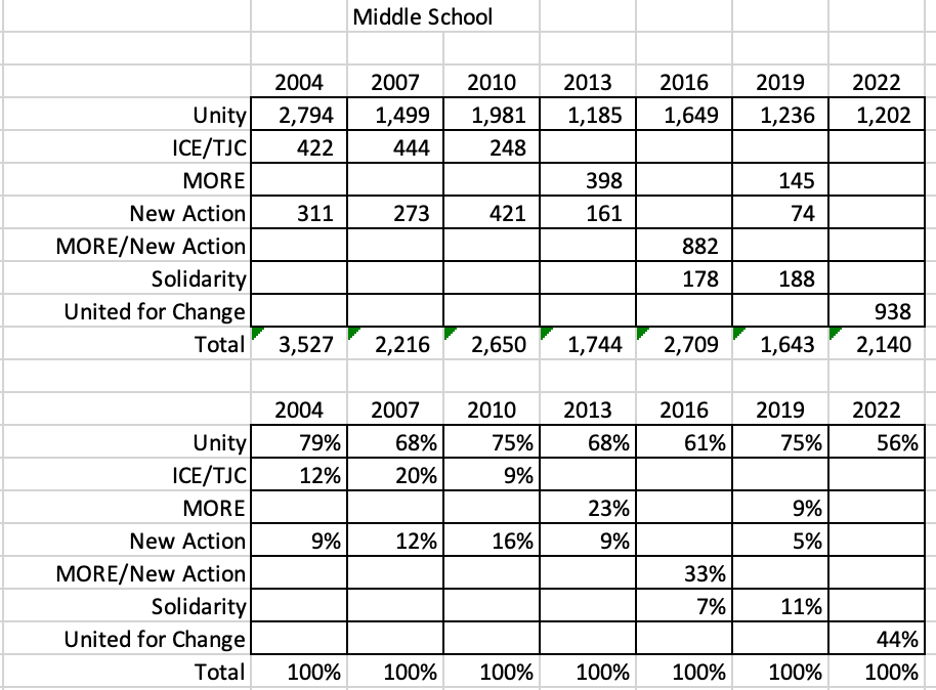
Analyzing UFT Election Results: My Data
Over the next ten days or so I will subject the recent UFT election results to some analysis. There is more here than
- Unity won 66% – 34%
- Unity’s vote totals were lower than usual
- United for Change raised its vote in most divisions
- United for Change won the high schools.
The real story will be more complicated. It might not be much more interesting. But as we ponder “what next?” it is important to have as complete a picture as possible of what just happened.
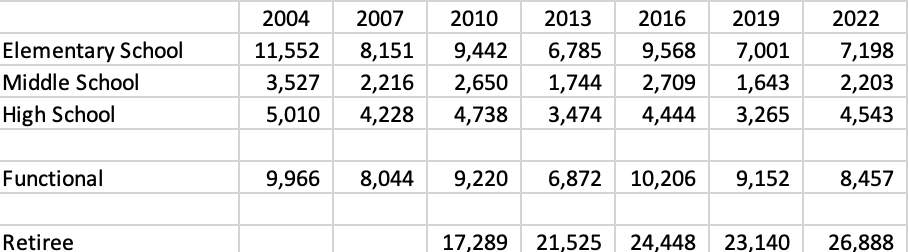
I will be using historical data. I have some historical data, going back to 2004. Some I took from Dave Kaufman. Some I compiled myself. 2019 has a different source; I’d like to double check it. And in 2016 some of the data appears altered – I myself may have been the culprit, as I wrongly adjusted for retirees’ percentage of a vote.
If you have corrections, please send them in.
If you would like the Excel file, please write to me.
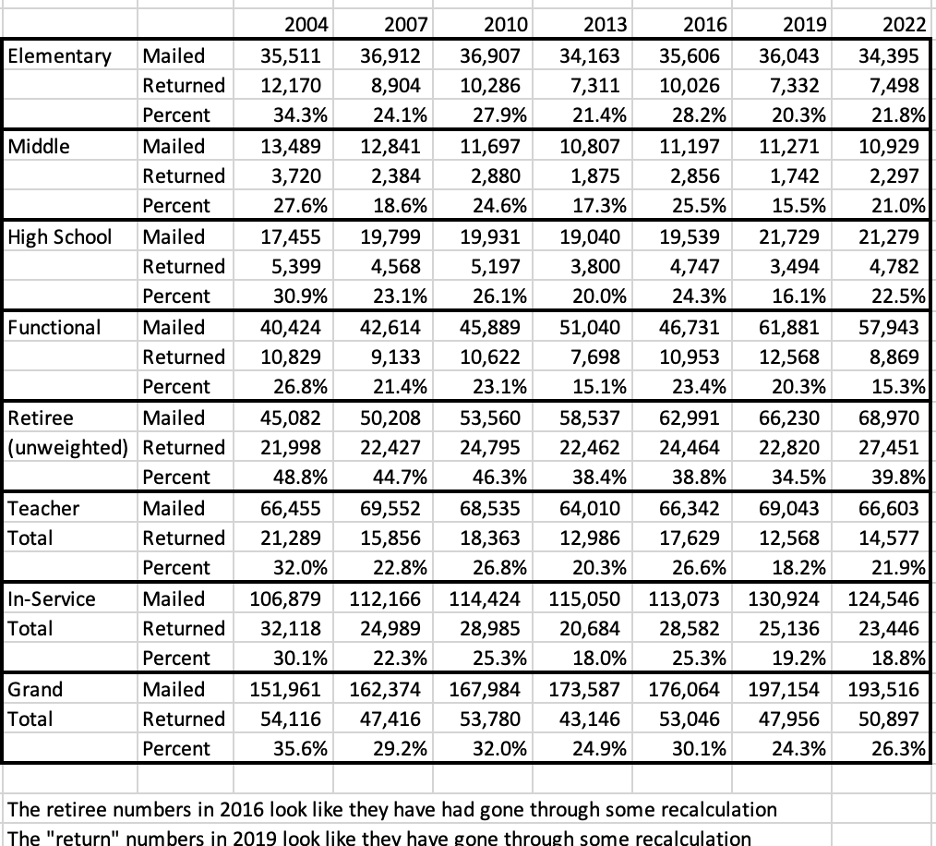
My results by division, both number of votes, and percents:
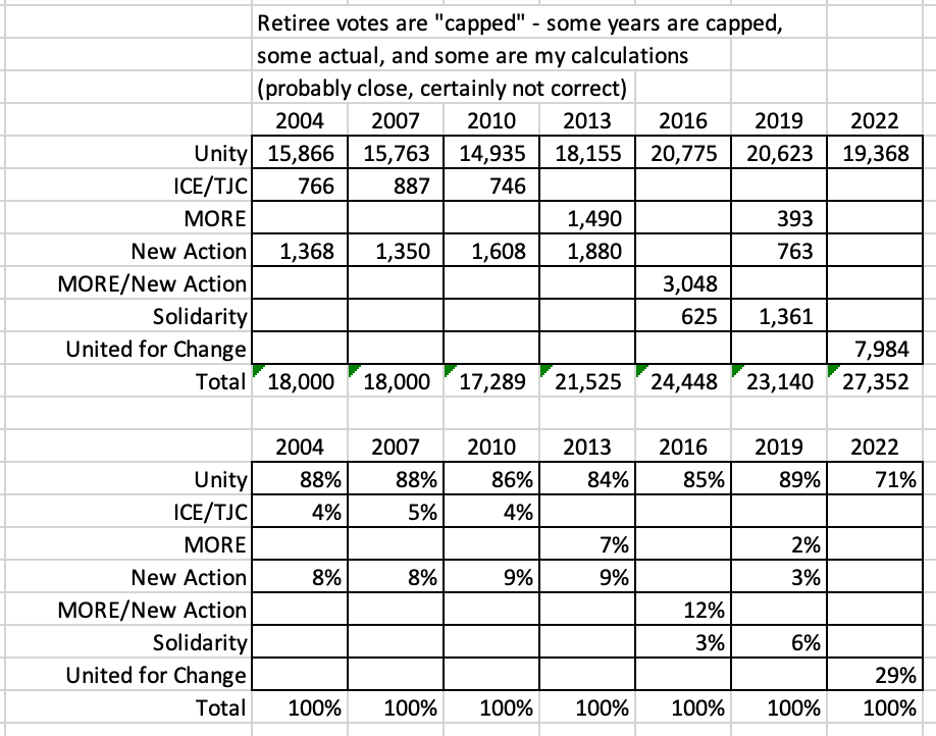

UFT Election Turnout: Four Charts
Let’s dive into the UFT election results. Let’s start with turnout. (For the beginning of the analysis, click here)
Votes Cast tells us more than Turnout Percentage
Turnout Percentage
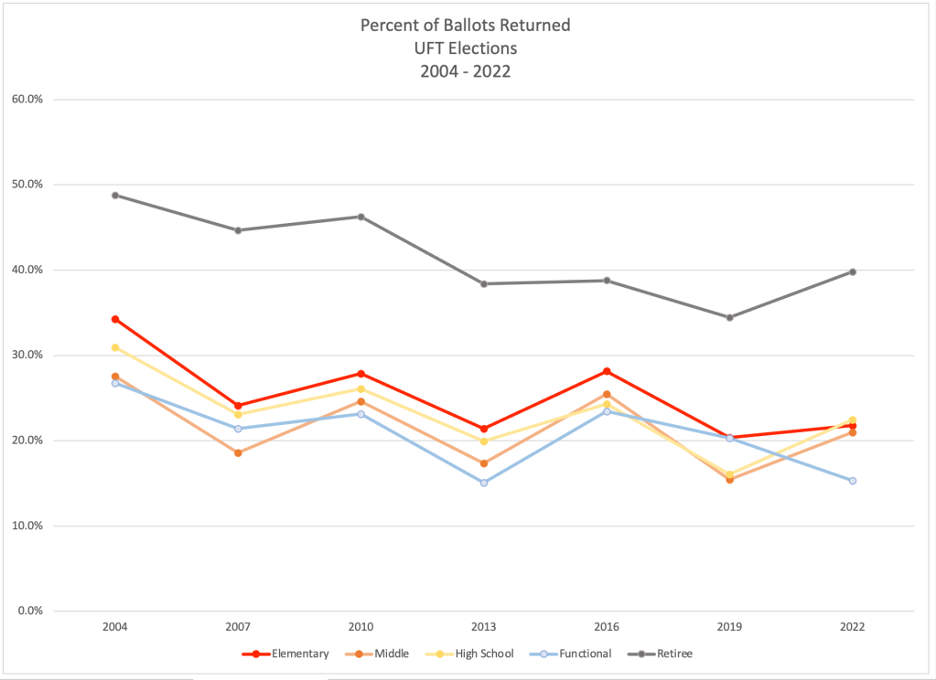
Turnout in all divisions is under 50%. And turnout has generally been falling in all divisions.
All divisions tend to move together. 2004, 2010, 2016 and 2022 were better years. 2007, 2013, and 2019 were lower. But the longterm slide is such that 2022, a better year, is not actually better than 2007, a bad year.
The rates move, more or less, together. Which makes 3 exceptions stand out:
- Retirees stand out for having a higher participation rate in general. And this year the rate among retirees. rose to better than the last three elections.
- In-service rates were moving together, mostly. But functional did not fall off much from 2016 to 2019, and then fell off noticeably from 2019 to 2022, while other rates were rising.
- Unexpectedly, elementary turnout did not rise this year in parallel with Middle School and High School.
Ballots Mailed

The number of retirees keeps going up! So the drops in percentage turnout are not as meaningful. And the RISE in percentage this year, even when the number of retirees was going up, means a lot of new voters. We will look at raw numbers of votes next.
The number of Middle School voters seems to shrink slightly. I’m guessing that’s due to teachers in K-8 and 6-12 being categorized as Elementary and High School, respectively. The middle schools are being squeezed.
The number of functionals has been rising, as we have adding categories or expanding categories of workers represented by the UFT. I don’t know why there is that blip in 2016.
This is the least interesting of the four charts.
Votes Cast
Middle School and High School move, just slightly, and together. The overall trend is down, but slightly.
- Elementary moves in a more dramatic fashion, and has fallen further. The lack of rebound from 2019 is startling.
- Retirees are not part of the same trends. Yes, there is a little motion up and down, in synch with MS/HS. But unlike any other division, the overall trend is for more votes from retirees, not fewer.
- Also, the jump in retiree votes this time stands out – it is a “thing” independent of anything else in this chart.
Functional votes stopped tracking elementary votes when we added new titles.
Putting Ballots Mailed and Votes Cast on one chart
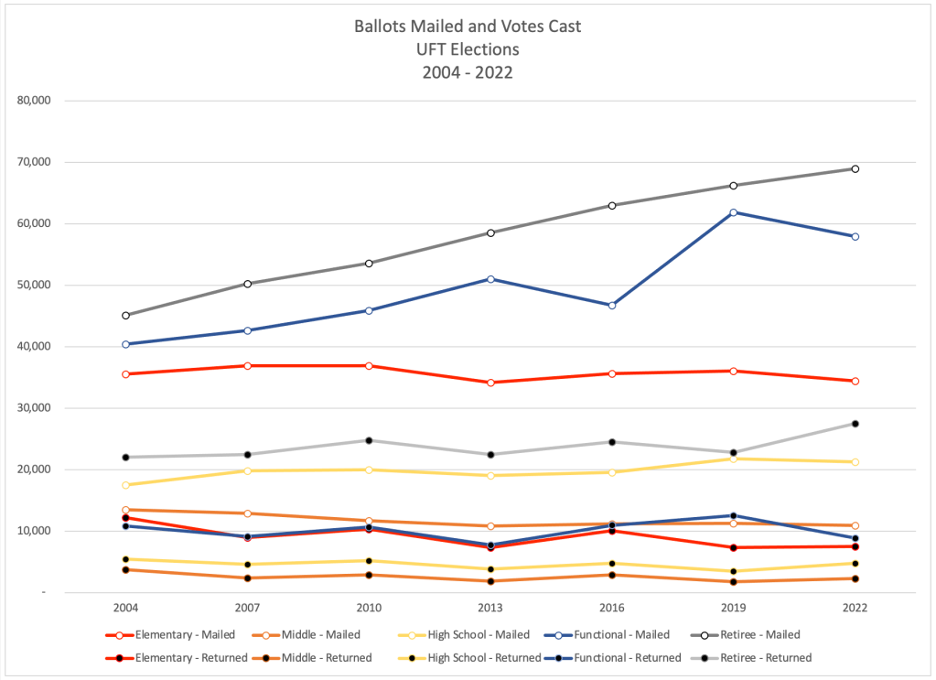
There is not obvious correlation. It looks like the votes move together year to year, independent of the number of ballots that were mailed. That suggests we should focus on votes cast, rather than on turnout percentage.
Data
Here’s what I used to create these charts:
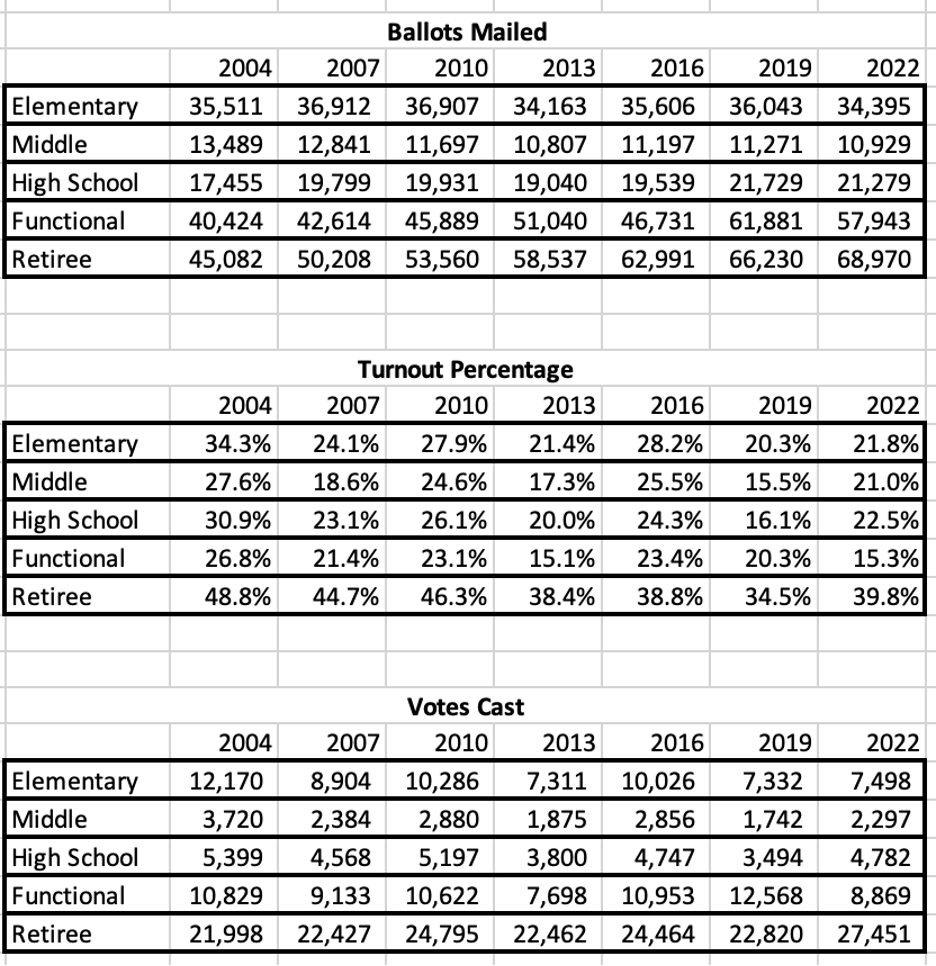
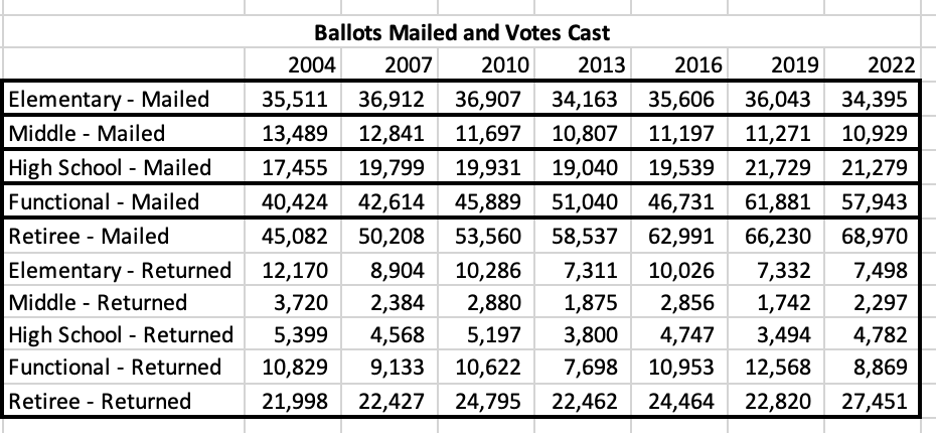
As always, comments and corrections are welcome.
UFT Election Turnout: Some Observations
The number of voters seem to change without connection to the number of voters changing. What that means – I will be looking at the number of votes cast instead of the turnout percentage (with one exception).
Earlier I looked at all the turnout data, trying to locate patterns or breaks in patterns that bore further examination. Here are some things I found, followed by a first crack at some analysis. It’s not enough, not yet. I will be digging deeper in the coming days.
- The UFT elections have alternated between higher returns and lower. 2004, 2010, 2016, and 2022 were higher. 2007, 2013, and 2019 were lower.
- There is an overall downward trend in participation. It is significant enough that the number of votes in 2022, a year of increased voting, was less than 2007, a year of lower voting.
- Retirees do not follow this trend. The number of retirees is rising. The number of retiree voters is rising. The percentage of retirees voting had been slipping, but the most dramatic number in this election’s turnout was the surge in retiree votes, 4,600 more votes than three years ago.
- The number of functional votes plummeted.
- The number of teacher votes climbed from 2019 levels back to 2016 levels – EXCEPT ELEMENTARY.
It is going to take further digging to explain these points. But there is room for some initial analysis.
- The changes, year to year, in the number of votes cast likely reflect events in the Department of Education, or in the UFT. The last two “high” years, 2016 and 2019, there were very competitive elections (in one or two divisions).
- The overall downward trend is something we have seen before. It reflects, I believe, a serious disconnect between members and our union. Short-term teachers (and it is alarming how many come into teaching for just a few years. Shouldn’t this be a career choice) do not have reason, at least in their own minds, to worry about the union. In the day to day reality of many of us, we have colleagues and a principal, and we work out what we can. If the union’s power and influence are not felt, why invest time in that union? I disagree with that stance – it is wrong. But it is rational. I will come back to this. Turning the lack of engagement around should be a high priority. I worry.
- Part of the retiree puzzle is easy: Medicare Advantage drove turnout. The other part is trickier. I have tried in past elections to dig further into retiree turnout. It is complicated, and I’m not sure it is worth it. But, in case you are curious, here’s some stuff: New retirees often pay more attention at first. And the number of retirees went down (after the incentives 25 or so years ago cleared so many out), and then has come back up. Also, a significant number of retirees stay involved for the longterm, and treat voting as an obligation. (Voter participation in state and federal elections is also higher among older voters). Also, retirees are out of schools, and out of most of the controversial stuff. So as long as they keep voting, they will probably continue to vote the same way. Except this year…
- I do not understand the drop in functional votes. I will dig, and look, and ask. One guess – the numbers rose temporarily as family child care providers (how large is the number? Large, I think) joined the UFT and were glad to have a union, but with time interest has fallen. That’s just a guess. The only supporting evidence I have is the timing. I’m curious if you have better ideas. And whatever we think of, I’ll try to ferret out something more concrete.
- The low number of votes from Elementary School teachers will become clearer as I go into the data in more detail. For now, this was a “good” year in the other divisions, but in Elementary School it looks like a bad year (7500 this year, compared to 7300, 7300, and 8900 in the last three bad turnout elections). We have a longterm downward trend, but that didn’t stop Middle Schools and High Schools from rising. Perhaps this is a reaction to the pandemic. Unity’s policies, Mulgrew’s bad deals, they made high school people scream. But we were already voting against Unity. Some of the decisions hit the Elementary Schools especially hard. They had to go back into the buildings before the other divisions, and before vaccines were available. “Instructional Lunch” which, if you read the language, was clearly a policy the UFT proposed to the DoE, hit Elementary Schools particularly hard. And even for teachers who did not get sick, being scared is a real thing, and not so easy to forget. I’ll get into this in further analysis, but it appears that a large number of loyal Unity Elementary School voters threw out their ballots this time.
Each of these points is a first stab at an explanation. They need further exploration. But the outlines are coming into focus.
Below is the data I relied on, with the total votes captured in a chart.
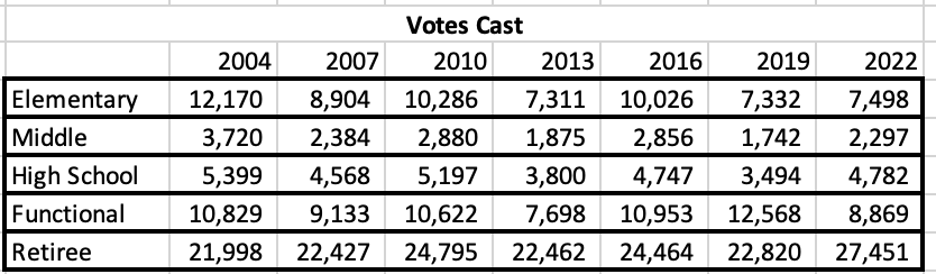
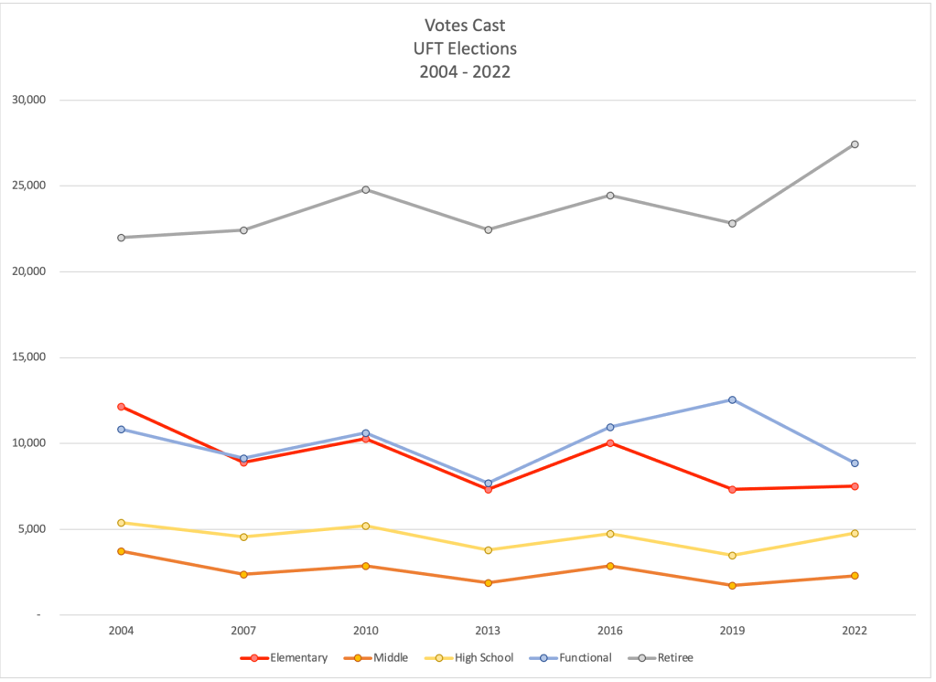
As always, comments and corrections are welcome.
UFT Elections: Voting Against Unity
United for Change won 34% of the total vote, and 42% among teachers. Fairly impressive. But how many VOTES did United for Change win? In an environment of declining turnout, do those percentages represent real gains? Or something else?
See also:
Let’s look first at the percentages, and then at the vote totals. Finally we will consider non-voters. I will use historical data from the last seven elections, going back to 2004. And for today I will only be looking at the four in-service divisions. The retiree vote requires a separate post.
In-service percents
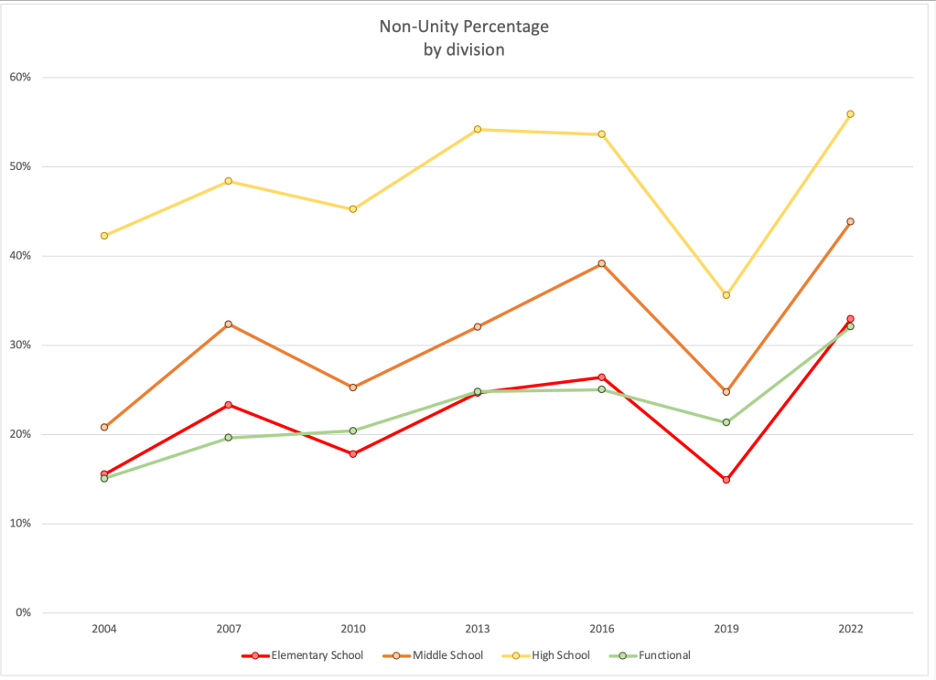
Calling anything an “opposition total” would be at least a little controversial. New Action’s votes from 2004-2013 went to Unity’s presidential candidate. Yet those voters chose to vote for hundreds of New Action candidates, and were declining to check “Unity” on the front of the ballot. I was quite hostile to Solidarity in 2016 and 2019. Yet it makes sense to combine all the non-Unity votes to get an idea of what was going on. So I’m just lumping them together as “Non-Unity.”
And a general pattern does emerge:
- relative stability 2004 – 2010
- a small jump in 2013 (most impressive in high schools, least impressive in middle schools)
- another, smaller jump in 2016 (actual dip in high schools, most impressive in middle schools, balancing out 2013)
- big drop in 2019
- return in 2022 to an increase on 2016.
Imagine that 2019 didn’t happen – do we have a straight line of increases from the averages of 2004-10, through 2013, 2016 (skipping 2019) to 2022? Take a look:
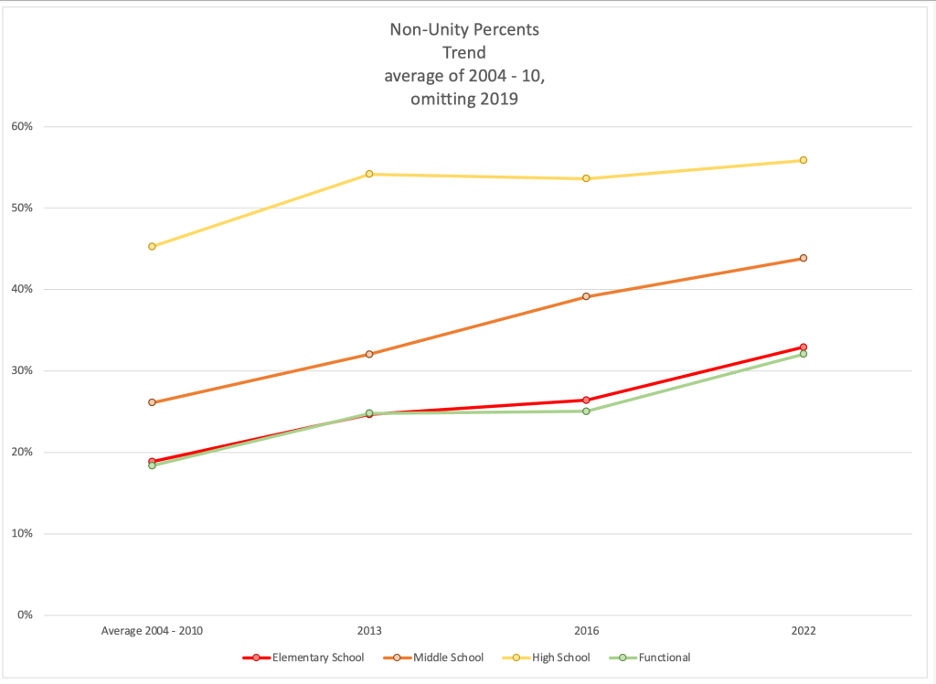
Is this a picture of steady progress? Is “the opposition” inexorably moving forward? Should we project the year “the opposition” overcomes Unity? (2025 in middle school? 2028 or 2031 among functionals and in elementary schools?) That looks very tempting. But this is the wrong graph.
In-service votes
Let’s look at in-service votes that went to opposition groups. I claim this is a better representation of how the opposition groups are doing. The percents measure us versus Unity, but that is not how voting in the low-turnout UFT works.
Do we struggle FOR the same votes? I would argue, mostly, no. Despite the bickering on Twitter and FaceBook, most of those who participate in those scrums have already made up their minds. We lose and gain relatively few votes by winning people over from the other side (as much as we are delighted when that happens. And it did happen a bit this election, but among retirees).
We might struggle to “get out the vote.” Unity does, too. But we are working in essentially separate universes. Most of our gains or losses involve people choosing to vote, or choosing not to vote.

There are still ups and downs when we look at the votes, rather than the percents. But the pattern is not so clear.
Let me narrow the data again, looking for a deeper trend. Same as above, imagine that 2019 didn’t happen – do we have a straight line of increases from the averages of 2004-10, through 2013, 2016 (skipping 2019) to 2022? Take a look:
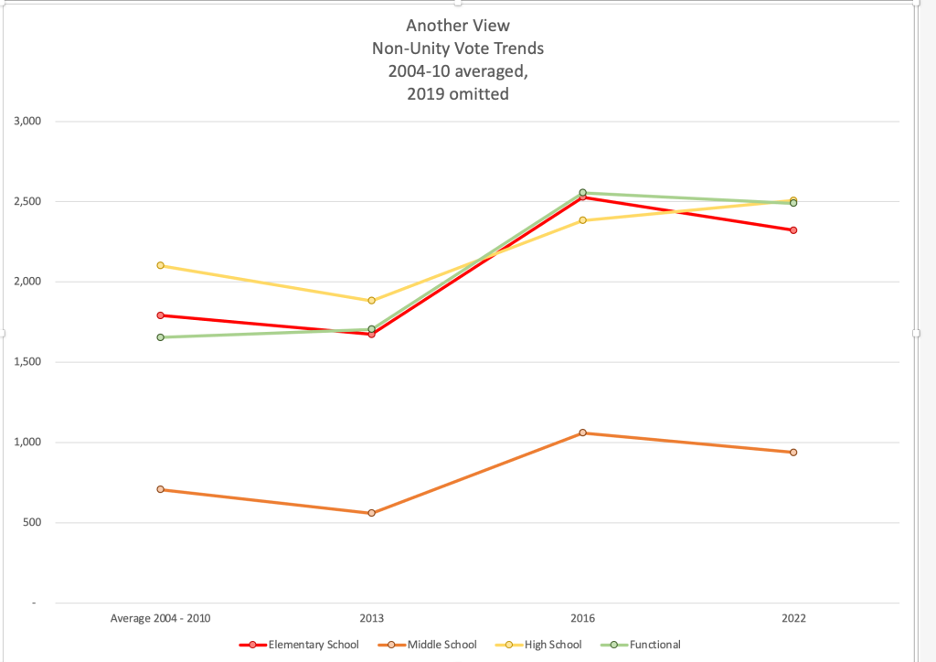
There still is an upward trend, but shallower, less clear, and with more bumps. In Elementary, for example, instead of moving from 19% to 33% (almost doubling) and only rising, we now see motion only from 1800 to 2300, with ups and downs.
Looking at votes instead of per cents does not erase all of the sense of progress, but it scales it way, way back. We cannot use this to project when the opposition will pass Unity – there’s no such clear trend. In fact, we should note that non-Unity votes fell among in-service members from 2016 to 2022.
Among all voters
It’s fine to look at the raw number of votes, as we just did. That probably gives the best picture. But a third look might be to consider what percent of members actually voted for the opposition.
For context, I reported elsewhere that of every 34 teachers, 3 voted against Unity, 4 voted for Unity, and the other 27 did not vote. Ignore Unity for the moment – what are those historic numbers for voting non-Unity?

I should pause to note, these are slate votes only, actual votes are a bit higher. Good rule of thumb for a high estimate – add 10%. For example, middle school in 2013 says 5.2%. Add 0.5 to that and use 5.7% as your estimate. Elementary in 2016 says 7.1% – add 0.7 to that and work with 7.8% as your high estimate.
I can combine these numbers into one in-service number – we can see the Unity numbers, but it still does not look good:
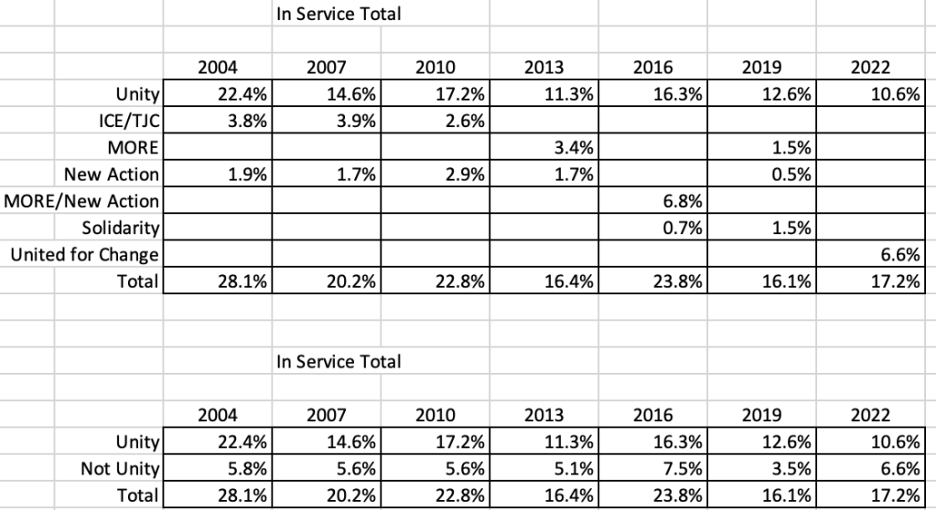
This is bad for partisans of “the opposition.” But, quite obviously, it’s far worse for Unity. They may have breathed a sigh of relief over not losing more seats, but that’s the present. No relief for them as they look into the future.
Here’s the first table, now in graph form:
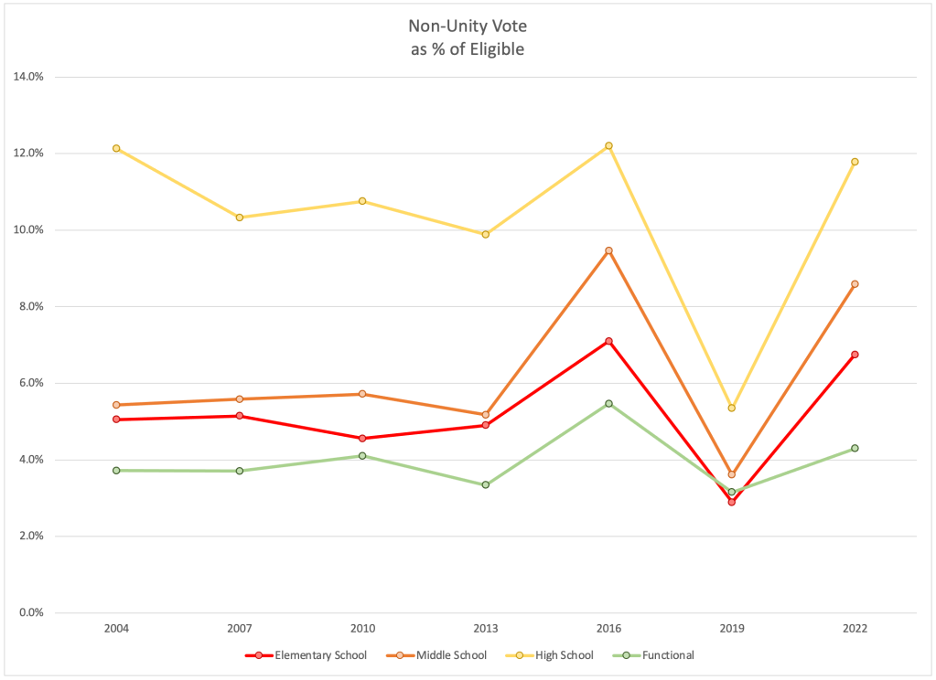
In 20 years, where’s the gain?
Even blending 2004-10 and omitting 2019, not a bright picture…

The only change that comes close to significance is in middle schools. That one requires more work/research.
And what next?
The next post in this series will be a look at what is happening to Unity’s vote. You think this was a downbeat post? it’s nothing compared to what’s happening to them.
After that? A deep look into what happened with the retiree vote – which is a very different discussion.
UFT Elections: Voting For Unity?
Unity won 66% of the total vote, just shy of two-thirds, and 58% among teachers. Those are, for Unity, not good numbers, maybe horrible numbers – the lowest since I’ve been paying attention, probably the lowest since the first decade of the UFT, and maybe the lowest in the history of the UFT. But Unity also breathed a sigh of relief – sure they lost the high schools, but they have lost the high schools many times before – and they avoided losing anywhere else.
Yesterday I looked at: Voting Against Unity?
What happens if we dig deeper into Unity’s numbers? What picture do we get? Weak performance, but they survived? Or something worse?
See also:
The 2022 United Federation of Teachers election needs a closer look.
Let’s start with the percentages (which is where the superficial analysis, above, comes from), then move on to the actual VOTES that Unity retained. Finally we will consider Unity voters as a segment of all eligible voters. I will use historical data from the last seven elections, going back to 2004. And for today I will only be looking at the four in-service divisions. The retiree vote requires a separate post.
In-service percents

And a general pattern does emerge:
- Generally down
- a small jump in 2019, but completely reversed in 2022
- 2022 is the lowest, in every division, for the past seven election cycles
Is it possible to create trend lines from this data? Sure.
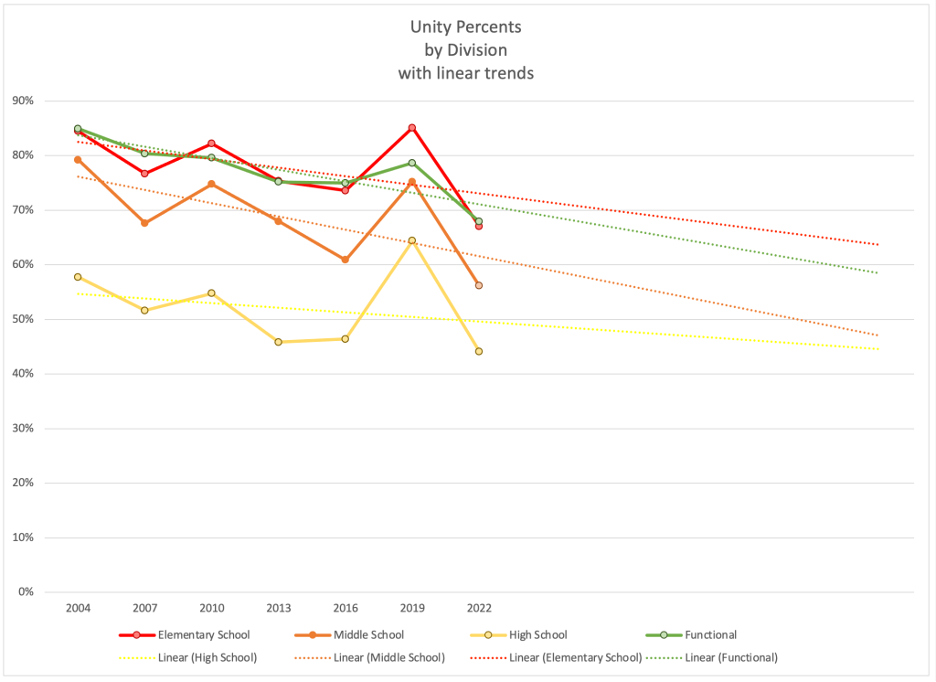
I just don’t think this is very meaningful. The end of those trend lines, by the way, are around 2040.
Could we omit 2019 to smooth the lines? Sure, but now we are forcing data to fit the story we want it to tell. This is even less meaningful, though slightly entertaining.
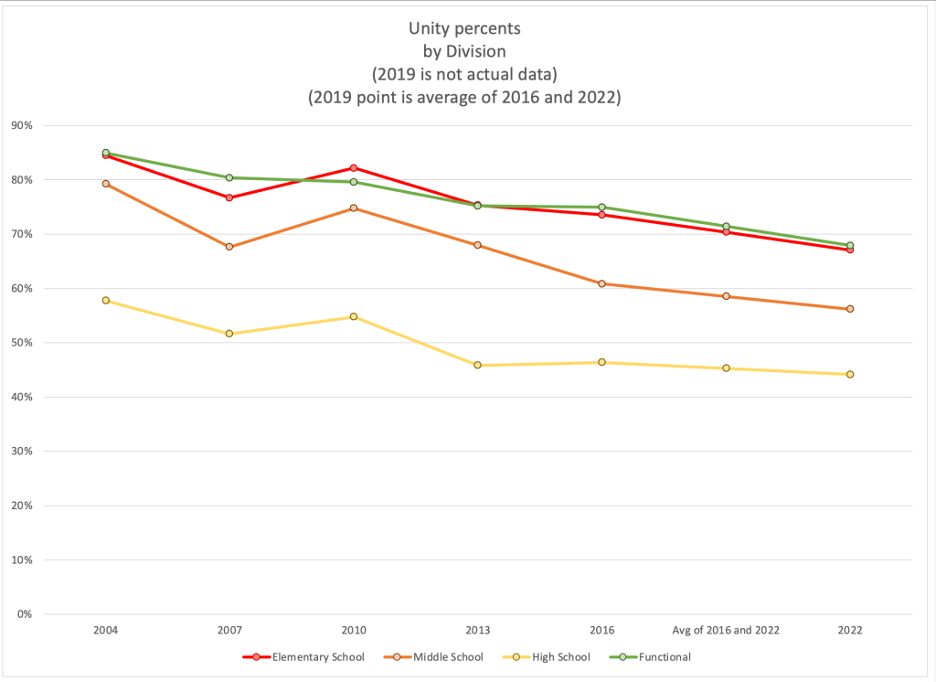
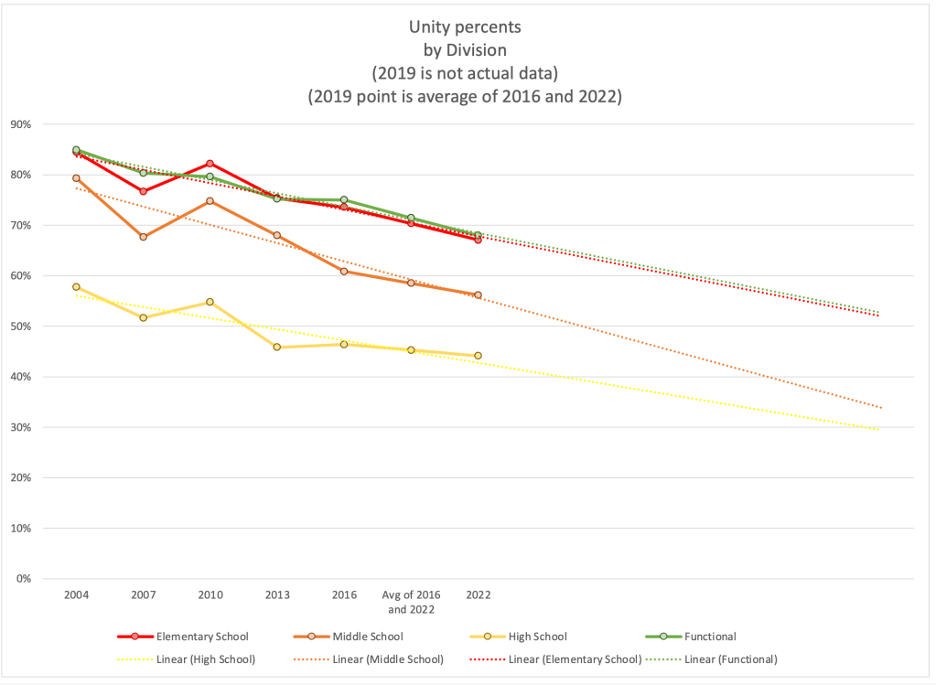
Those trendlines end in 2040 – but this is now pure fantasy. These graphs are for amusement, not for serious analysis.
For serious analysis, let’s leave out the percents, and look at actual vote totals.
In-service votes
I will demonstrate later this week that Unity and “not Unity” mostly activate or fail to activate our own votes. We generally do not trade votes back and forth (though it is quite heartening/disappointing to learn of someone who has changed sides).
(There was a significant exception in 2022 – a number of former Unity voters among the retirees did switch – but this was due to specific circumstances: the colossal Unity miscalculation around Medicare Advantage.)
This means that it makes sense to look at Unity vote totals. And these totals are more meaningful, by a lot, than looking at the percents (what we did in the section above).
Those trendlines end in 2040 – but this is now pure fantasy. These graphs are for amusement, not for serious analysis.
For serious analysis, let’s leave out the percents, and look at actual vote totals.
In-service votes
I will demonstrate later this week that Unity and “not Unity” mostly activate or fail to activate our own votes. We generally do not trade votes back and forth (though it is quite heartening/disappointing to learn of someone who has changed sides).
(There was a significant exception in 2022 – a number of former Unity voters among the retirees did switch – but this was due to specific circumstances: the colossal Unity miscalculation around Medicare Advantage.)
This means that it makes sense to look at Unity vote totals. And these totals are more meaningful, by a lot, than looking at the percents (what we did in the section above).

In the lower two lines, Middle and High School, they seem to have hit bottom in 2013, and more or less stayed there. But in Elementary School and among Functional, Unity continues to bleed votes.
Of particular interest is Unity’s steady decline among Elementary School teachers. This election they seem to have received their fewest votes, ever, in that division. The decline in two decades is 50%. I expected the pandemic to make all of Unity’s lines drop from 2019, but the two lower lines barely slipped, and Elementary and Functional were more dramatic than I expected.
Is this due to the DoE, seemingly with Mulgrew’s acquiescence, sending Elementary staff back sooner than the older grades – with instructional lunch and no vaccines? Is this a product of what seemed to be scary-inadequate protections for staff in D75? Or is this part of Unity’s long term loss of their core voting blocs?
Here’s the same data, in table form.
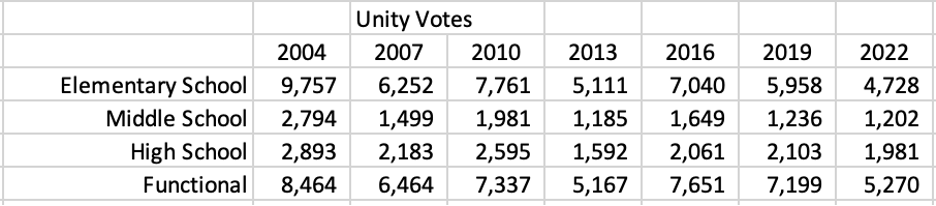
And here it is, expressed as percentage of Unity’s 2004 vote totals:

Go back to the graph. Look at what is happening. Look at the table. Look at those declines. And notice, the biggest declines are not necessarily when there are big votes for other caucuses. Unity is ailing, just fine, without any help.
Among all voters
A third look might be to consider what percent of members actually voted for Unity. We know participation (turnout) is generally lousy, and getting worse. What portion of our members actually vote for the leadership? When they claim a mandate, how deep is that mandate?
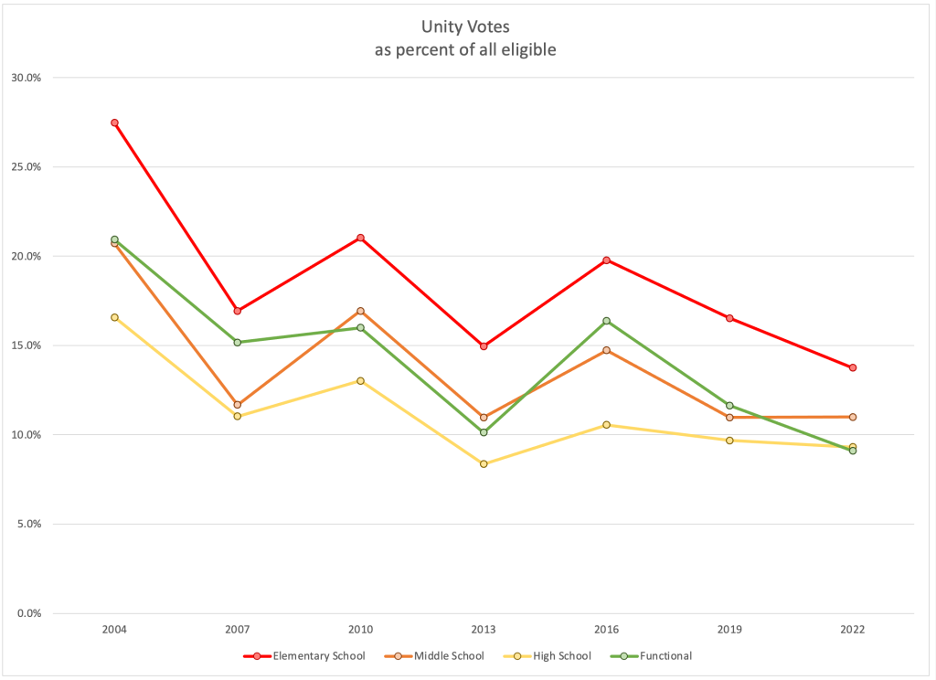
This is devastating. Unity’s longterm loss of support is consistent across the divisions. It has been around 50% over the last seven election cycles. There is no sign of any pause. And unlike 2016, when in the face of a unified MORE/New Action slate Unity actually managed to stall their decline, there is no such sign in 2022.
(Side note: the middle school numbers here are more consistent with the other divisions than in the previous section, because a significant number of middle schools have been replaced with K-8, which vote elementary, and 6-12, which vote high school. When looking at total votes, that makes it look like Unity is suffering bigger losses among middle school. When looking at votes cast divided by votes mailed, it balances out.)
Here are the numbers in a table:
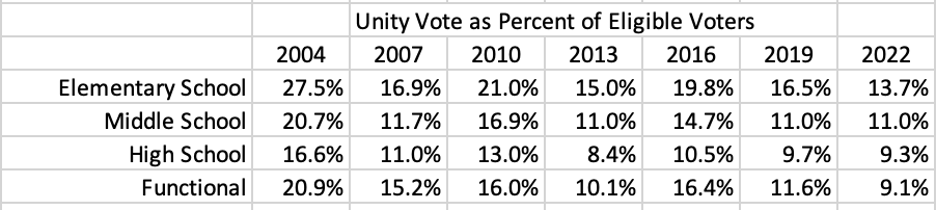
(note, these are slate numbers only. Once split ballots are added in, the totals go up, but just a bit.)
In my previous post I laid out a pretty clear case that United for Change did not have any big breakthrough among in-service members. But that seems to have had no impact on Unity – they continued their longterm decline.
That they managed to not lose more seats was unfortunate (or fortunate, for them). But that does not change the outlook – they are not doing well, and they have not been, not for a long time.
And what next?
I have been looking at vote totals, Unity and non-Unity, isolated from each other. I will lay out data that explains why this makes sense.
Something just happened among the retirees, very different from what is happening in the in-service divisions.
And then there will have to be some more digging into what is causing these changes, especially the longterm changes. There is a lot here, and that will take some time.
Finally, there needs to be a guide. Lessons learned. What steps to take next. But that part I will share privately.
Why do I look at total votes in UFT elections?
It seems obvious that we should be focused on percents. What did Unity win by? 66% to 34%. What happened in high schools? United for Change won with 56%. Unity’s 67% was a record low for them in Elementary Schools. Yet in my analysis, I have focused on total votes, not percents. Why?
See analysis at:
If Unity and the opposition were competing for the same votes, then when Unity’s votes went up, non-Unity votes would go down, and vice versa. I claim that we are fishing for votes mostly in separate ponds – and that an opposition increase and a Unity increase can happen at the same time.
Connecticut
Just take a look at this pretty chart:
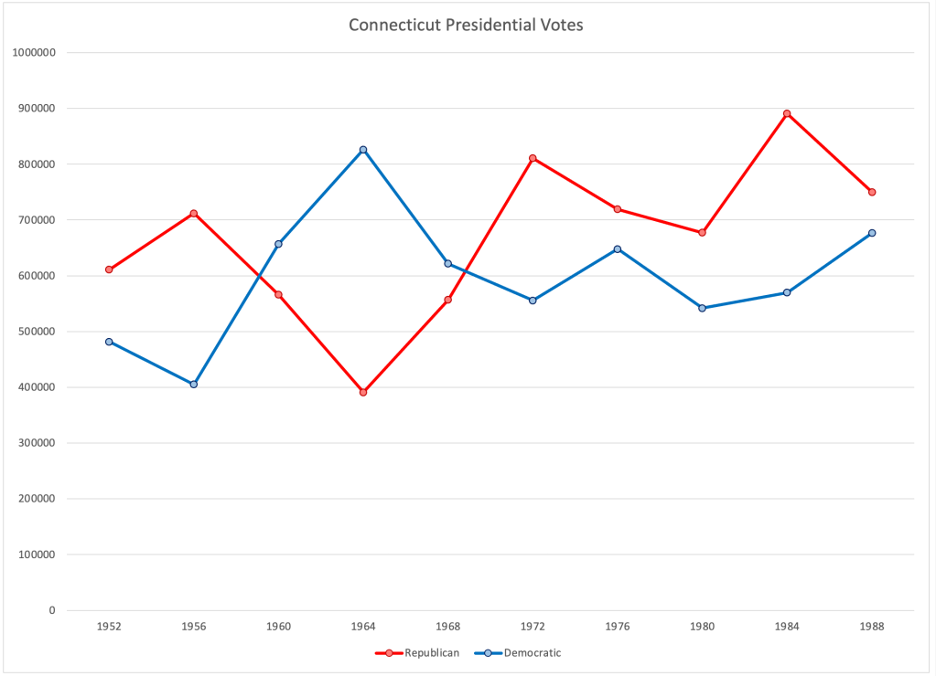
Those are Connecticut votes for president 1952 – 1988.
See the longterm upward trend? It’s there. Imagine halfway between the red and the blue. It starts around 550,000, and climbs pretty steadily to about 700,000.
Also see how the red and blue dance? When red rises, blue falls. When blue rises, red falls.
Do you see the one year that doesn’t fit? 1980. John Anderson siphoned off a bunch of votes. Raise the red dot to 810,000 and the blue to 600,000 – and there’s our pattern, clear as day:
NOT REAL
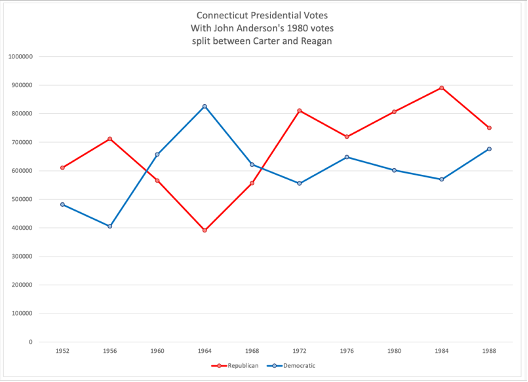
NOT REAL
That chart is not real, but only 1980 has been altered. And there it is, gentle up slope, and red goes up when blue goes down and blue goes down when red goes up. The electorate is growing, slowly, and the Democrats and Republicans are competing for the same votes.
Notice, by the way, that Connecticut used to vote pretty differently from how it votes today.
United Federation of Teachers
Do the numbers dance? Do Unity numbers rise when non-Unity numbers fall, and vice versa, or do they move independently?
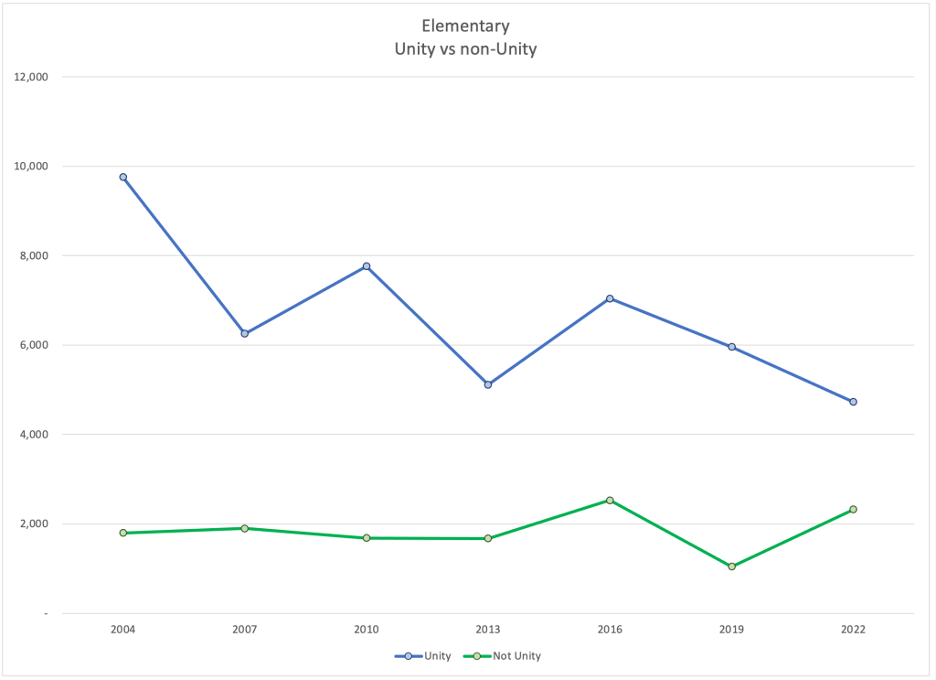
Where to begin?
The blue line drops sharply in 2007, 2013, and 2022, but only in 2022 is there a corresponding rise in the green line. The lines rise together in 2016, fall together in 2019.
Unity and non-Unity draw votes from separate pools. This is not the Connecticut map – the lines are moving independently. They are expanding and shrinking their own bases. They are not drawing votes from each other.
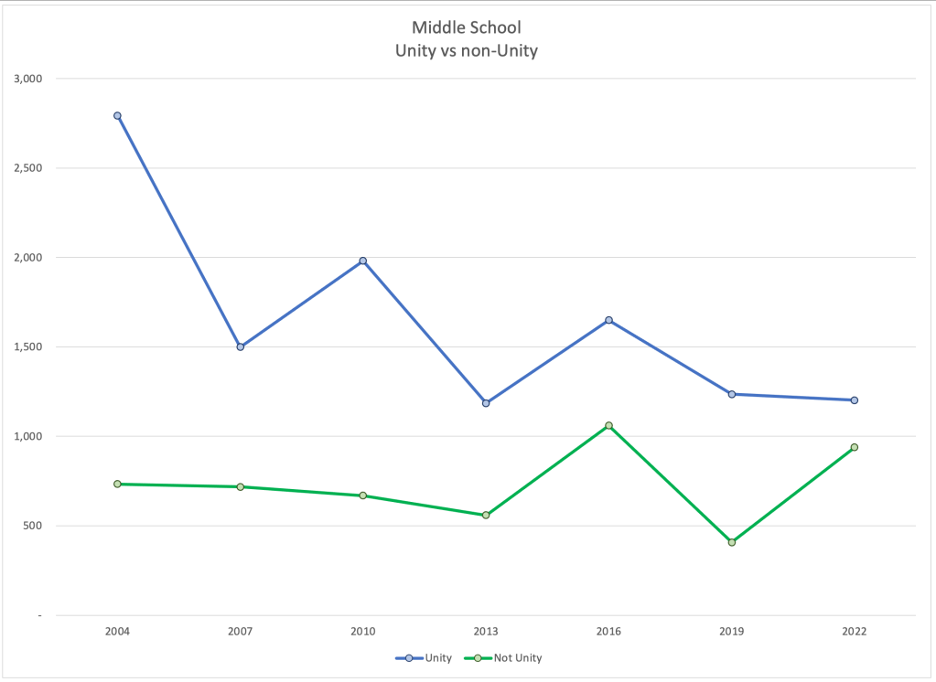
The blue and the green move in the same direction in five of the six year after year comparisons. However, in two of those Unity has a sharp fall while the non-Unity votes hold steady. There is no indication that the two sides are trading votes. They are fishing in separate ponds.
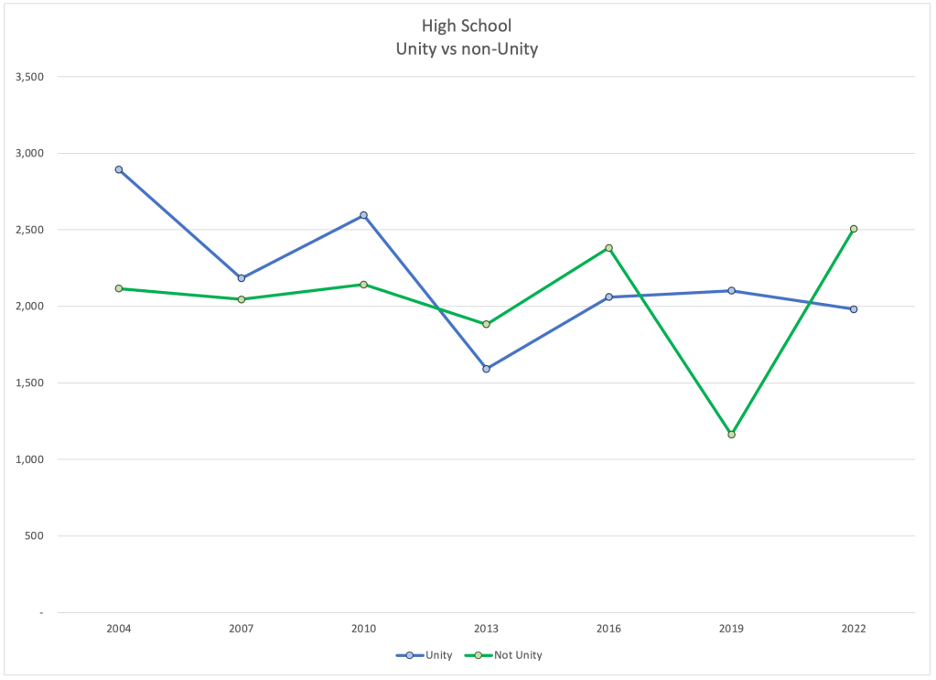
First of all, these lines almost always move in the same direction.
Second, look at the last three cycles. The opposition loses a ton of votes in 2019. Where do they go? Not to Unity. The opposition gains back a ton in 2022. Where did they get them from? Not Unity. During the same time period Unity’s votes stayed the same.
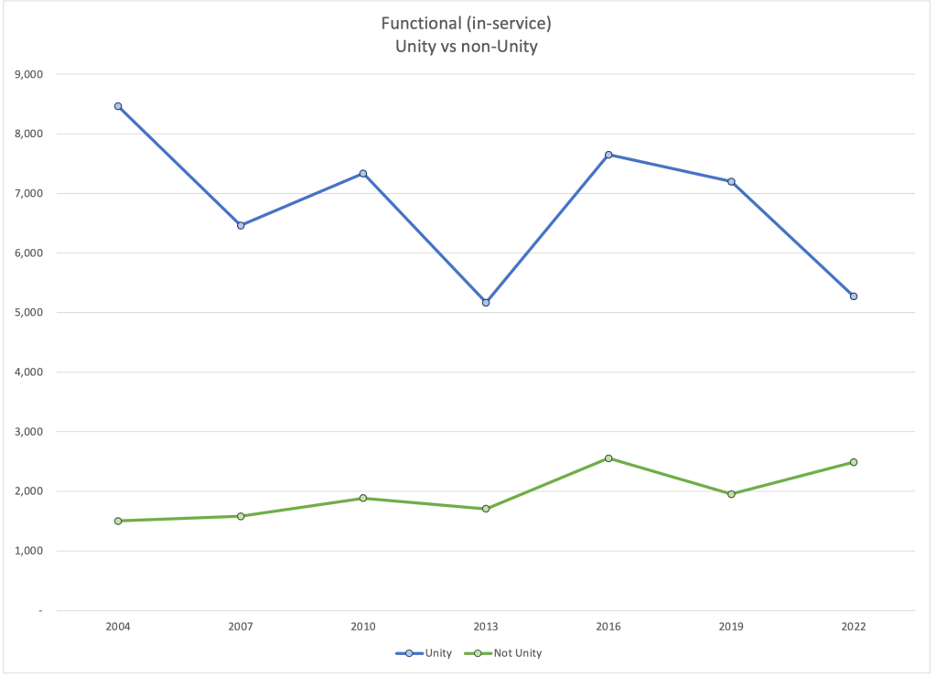
See how the lines rise together in 2016? They are not poaching each other’s votes. The only year they seem to dance, this year, the Unity fall was far greater than the non-Unity rise. This does not break the pattern.
Conclusion
Unity and the non-Unity groups are, for the most part, not directly competing for votes.
Opposition votes may or may not be cast. The struggle is getting people to vote.
Unity votes may or may not be cast. They are nearing a crisis because they cannot get their own people to vote. But their coming crisis is not being caused by the non-Unity groups; it is their failure to energize their own folks.
Analysis of 2022
Limiting the discussion to in-service, we now ask two questions: How did Unity do? How did United for Change do? We will answer each, without referring to the other.
How did Unity do?
Unity continued to lose voters across every in-service division. They may be leveling out in high schools. We would need more evidence to support that. But it is possible that they have hit rock bottom in this division.
How did United for Change do?
United for Change recovered from the separate caucus’ very weak showing in 2019 – but not to the level of 2016. It is not a bad election, but nor is it a major breakthrough.
Next up: analysis of retiree voting.
The Retiree Vote
The May results from the United Federation of Teachers elections seem clear:
- Unity won overall, but with a lower percent than in the past
- The united opposition won the high schools (not a big surprise) and came fairly close in the middle schools (not a big surprise for me, but it may have been for others).
Analysis of in-service vote totals also seems clear:
- Unity lost votes. This continues a clear and dramatic two decade trend
- The united opposition did almost, but not quite as well as MORE and New Action did two elections previous.
- Unity and the opposition do not directly compete for votes. Rather, each side struggles to engage their own potential voters.
Retirees
But I have intentionally set aside the retiree vote. It is more complicated in 2022. There’s a few structural reasons:
- Retirees are not involved in day to day union decisions. They are not (for the most part) in schools or classrooms. Arguments about MOSL or mayoral control are, for the most part, do not move retirees.
- Retirees (I strongly believe) continue to vote or not vote, according to whether they voted or did not vote in the last election before they retired. (Turnout among retirees is inelastic.)
- Retirees who vote continue to vote for the same group they voted for before they retired. (Preference among retirees is not elastic.)
- The retiree voting pool shifts differently than in-service members. I will in the near future retire. I will join the Retired Teachers Chapter (RTC). I will start voting in UFT elections, probably as I have voted in past elections. And at some point, I hope several decades in the future, I will pass on.
There’s also more data:
- There are retiree-wide elections in addition to the UFT’s general elections – the Retired Teacher Chapter (RTC) holds a full slate vote the spring before. I have data from 2018 and 2021.
And there’s something new for 2021-2022, the eight-hundred pound gorilla that Unity let into the room:
- Medicare. Medicare Advantage. Medicare Advantage Plus. Mulgrewcare. For the first time – perhaps ever – there was an issue on the table that moved retirees.
The Data
A note: Retiree votes are “capped” by the UFT Constitution. It is weird (it is) that members who are not in-service have such a large say over what happens to members in service. Conversely, when there are big retiree issues – which are rare – but Medicare! – that’s when retirees should have much more of a say. In any case, even the writers of the UFT constitution (Unity) know it would look weird for retirees to dominate the voting. So they created a “cap.” Up through 2010, if retiree votes exceeded 18,000, then they would be scaled down to 18,000. Unity, which we think of as having a “lock” on retiree votes, raised the cap to 23,500 for the 2013 election.
For 2004 and 2007 I have the vote totals after the cap was applied. That means that the percentages are correct, but the raw numbers were proportionately a bit higher.
Here’s the percents:
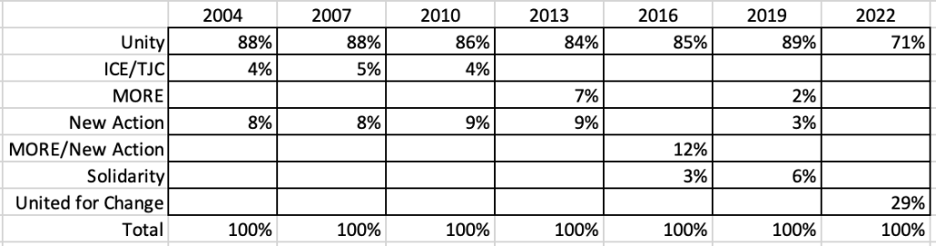
Here’s the numbers (remember 2004 and 2007 I have scaled, not actual)
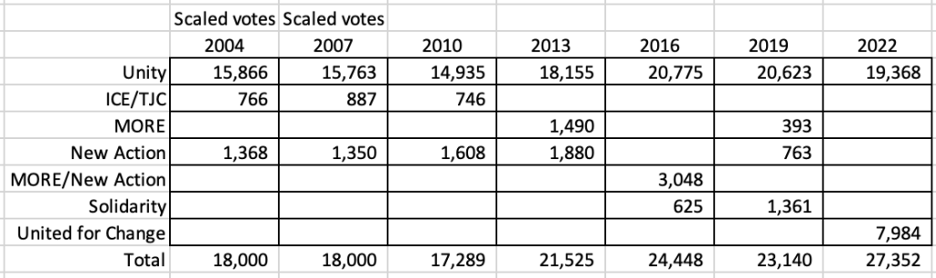
And here are the RTC 2018 and 2021 numbers and per cents:
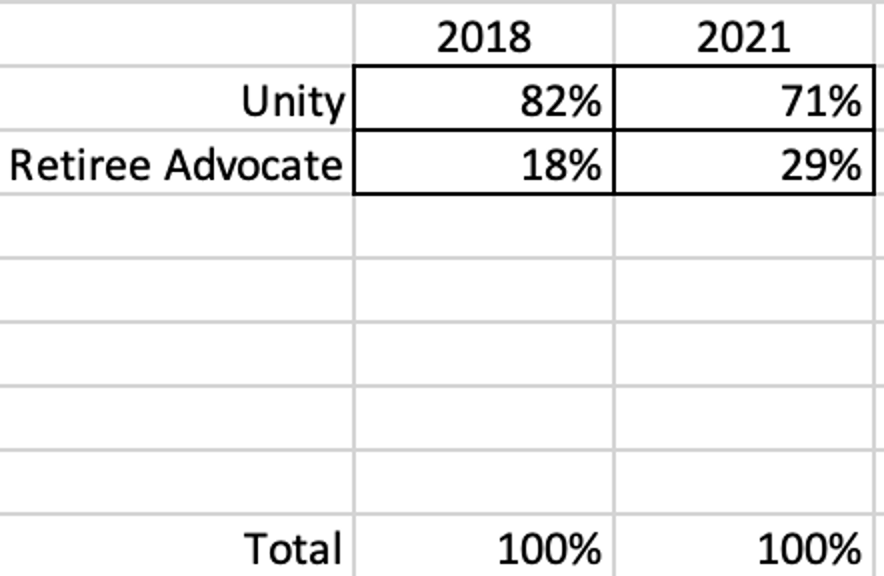
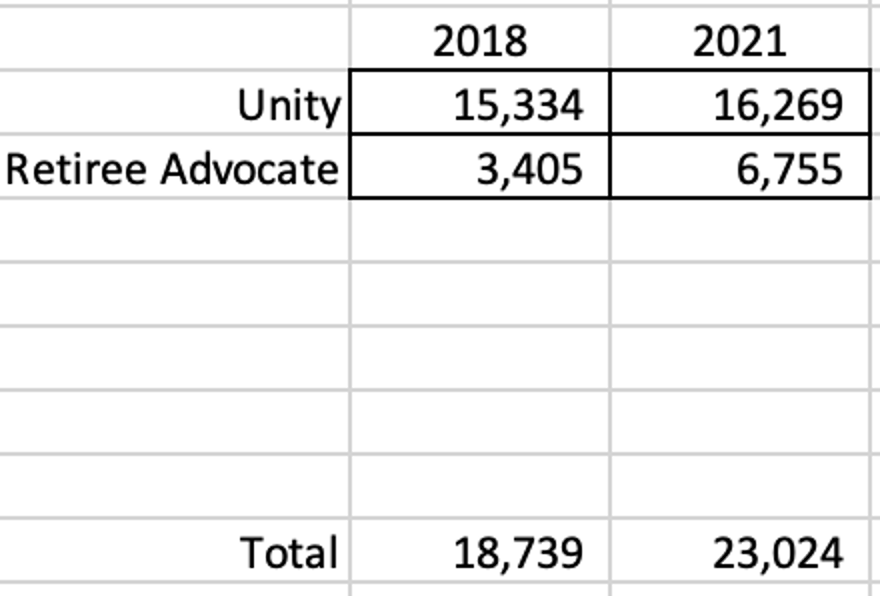
The graph initially looks a bit of a jumble:
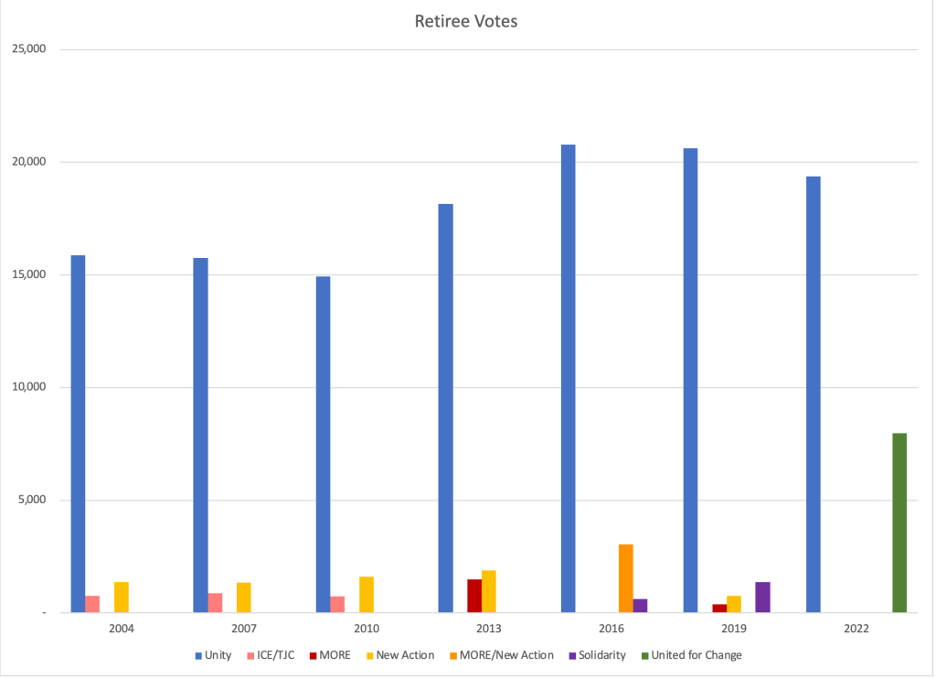
By combining all non-Unity votes, things smooth out. We have 6 stable cycles.
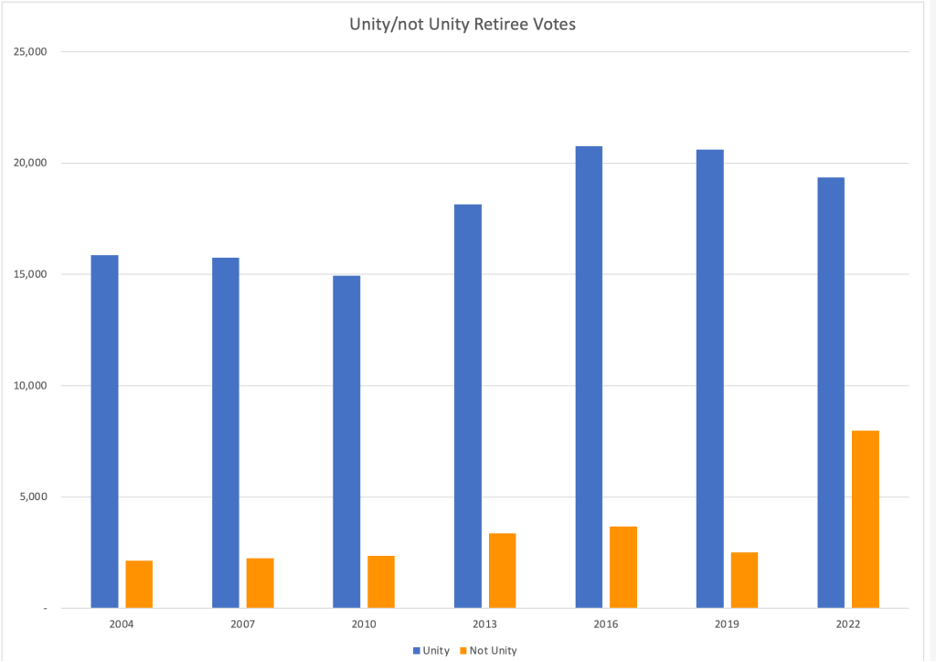
Including the RTC numbers makes it look like there are jumps – but really it’s just that turnout is a bit lower for RTC elections. (although not that much lower)
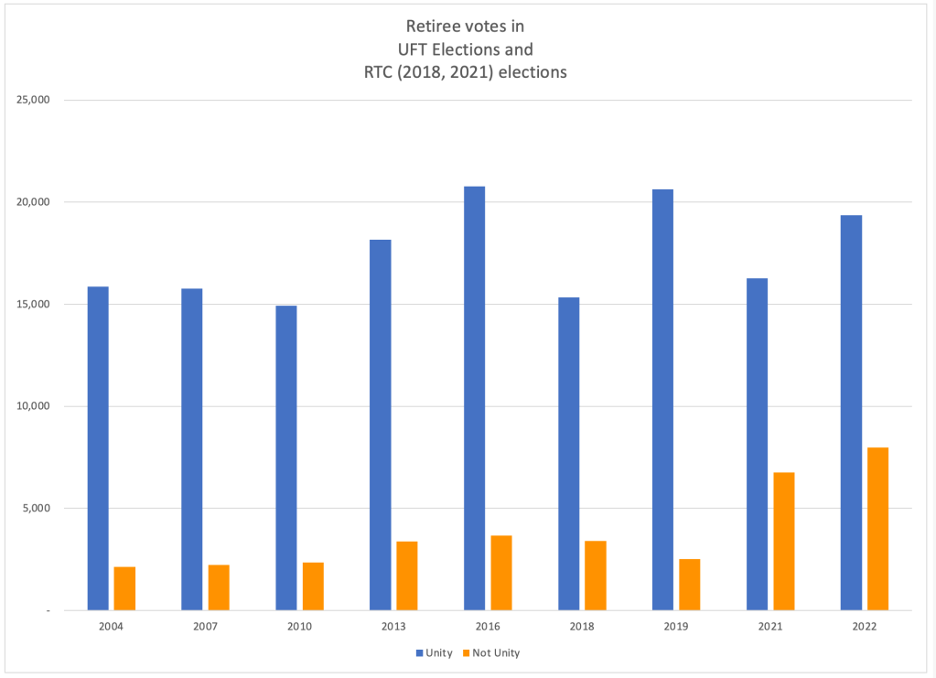
Since there is overall stability, looking at percents is not misleading.
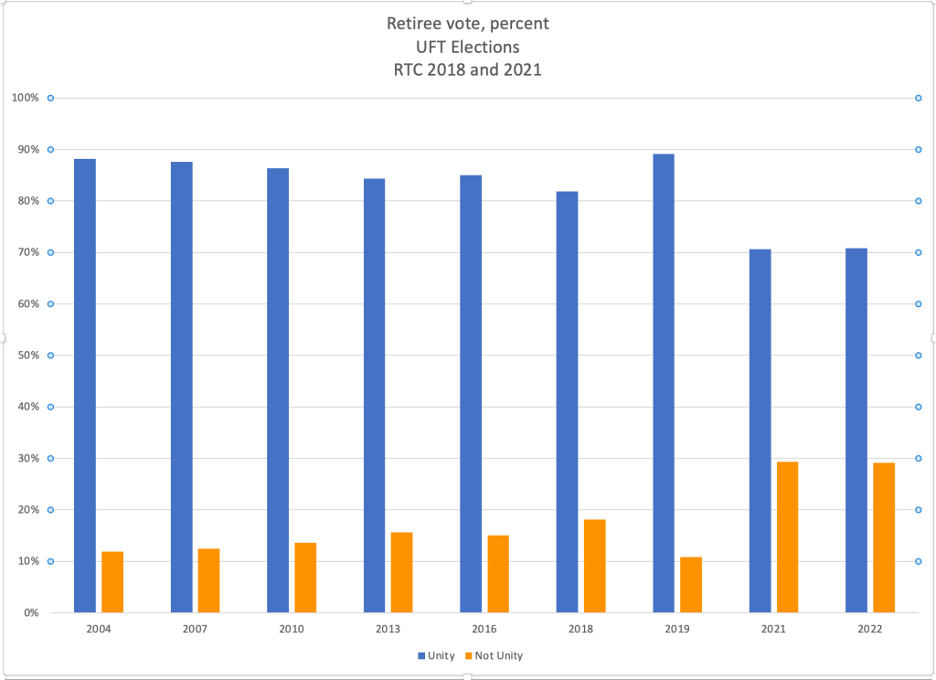
In fact now we see what we thought: Unity has won 82% – 89% of the retiree vote, until now. And they have usually been in the upper half of that range. They fell to 70-71 when the Medicare Advantage Plan was announced. They lost votes in the RTC election that Spring. Retiree Advocate members said that word had barely gotten out, and expected another jump this election. That didn’t happen. News about Medicare had an immediate impact on retirees who heard about it, and we seem to have seen most of that shift immediately, in the RTC 2021 election.
A little refinement: Since we have two RTC elections’ worth of data, can that be analyzed? It’s not really enough for deep analysis. But after the 2018 RTC, Unity vote rose 34% and after 2021 it only rose 19%. That’s about 2500 missing votes. So there is some additional underperformance on the Unity side in 2022 that this chart does not capture.
Some Guesses
What does it mean? I see Unity having “lost” 2600 votes in the RTC election in 2021, and another 1000 in this Spring’s election. United for Change/Retiree Advocate seems to have picked up about 3000 votes in the 2021 RTC election, and another 1000 or so this Spring.
Unlike the other divisions, there were a significant number of retirees who switched sides. There are also Unity voters who chose not to vote. And there were first time voters who voted for Retiree Advocate or UfC (and against Unity). I do not think there is enough evidence in the numbers to know how many Unity voters sat it out, how many switched sides, and how many votes RA/UfC picked up that were new voters, and how many we captured from Unity.
As a guess? Retiree Advocate and United for Change may have pulled in 2000 new votes, and taken 2000 votes from former Unity voters. Unity may have had about 1600 who did not send in ballots. Or it could be 1000 new and 3000 switches, with 600 Unity voters not voting. It’s hard to know without more data. Anecdotally, I know a significant number of first time voters voting for United for Change, and I know over a dozen former Unity voters who first time voted against Unity. I only know 2 Unity voters who did not vote. But my sample? These are people I know. Not a random sample.
Medicare Advantage – Lasting Impact?
More data, which will come with future elections, may reveal more of the picture. Future elections will also help us understand how permanent these changes are. Will retirees drift back to Unity? Or has their faith in the leadership been not only shaken, but broken?
For over a generation UFT retirees have not been strongly motivated to vote. What Bloomberg did to the schools did not affect retirees. Those with a strong political agenda – perhaps aligned with New Action, voted that way. Those with connections – perhaps a current or former job, or deep friendships and relationships within Unity, voted that way. But the understanding, the deal – retirees did not have to worry because the union would forever protect their pensions and their healthcare – that deal seems to have been broken.
Can Unity drop Medicare Advantage Plus, and convince retirees that this was all a misunderstanding? Can Unity force Medicare Advantage through, and will retirees find that the cuts are not so bad? (I can’t see that happening). Is there a way for Unity to win back the trust they violated? Those questions remain open.
Congratulations, Thank You, Remember…
Some delayed “first” reactions to the end of the 2025 UFT elections
I published this on Substack. I’m not sure how in the future I am going to divide up content between this site and substack. For now I am reprinting quite a bit of organizing content here. I am not putting personal stuff or math stuff on Substack.
Some personal thoughts I want to share – I know, it’s been a full week since the UFT election results were announced – but the campaign was long – I took time to breathe first.
I apologize if you’ve been waiting for something profound; this is not it.
Congratulations
Congratulations to Unity for sweeping. Congratulations to my friends among the winners. Congratulations to any candidate who intends to use their victory to make our union stronger, more responsive to our members, and more engaged with the issues that affect our students, families, and communities. Congratulations to Unity for running a better campaign in 2025. Congratulations on getting so many non-voting members to vote this time. Congratulations to whoever got those Substacks going – not that I loved all the content – but it is a genuine step forward to allow – even encourage – individual voices.
Thank you
Thank you to ARISE. Thank you to retirees who said “of course” when I asked you to be involved. Thank you to retirees who I didn’t know before this campaign, but jumped right in.
Thank you to the ARISE Steering committee – who made it so easy to discuss, plan, and work together. It was great meeting so many activists along the way – you were truly inspiring. And I am fortunate to have made new friends – now that life is quieter I look forward to spending more time with you.
Remember
Your opponents (whichever caucus you ran with) in this campaign, many of them, no matter how horribly you think they conducted themselves, are core UFT activists who make this union run. You don’t have to like them or forgive them, but we will work together. Personal feelings need to be pushed aside.
Remember that this union depends on its members. And we depend especially on a specific group of members: activists, grass roots leaders, many of them chapter leaders or consultation committee members or delegates. These are the real core, the backbone of our union. Very little that the people with office jobs at 52 Broadway decide or do would matter if we did not have our leaders in the schools. And they are the face of the union for most of our members. And leaders in schools could get very little done without our rank and file activists. If a member knows just one “union person” it is probably their chapter leader, and if they know just a few “union people” they are probably the CL and some rank and file activists in their school. And just because one of these folks ran against you, behaved badly, said stupid things – that doesn’t change how important they are to the health and future of the United Federation of Teachers.
I was thinking about naming someone who was a jerk to me throughout this campaign. A complete asshole. But there’s no need. Someone who is a chapter leader, no matter their behavior in the campaign is the face of the union for their members. If they do a good job, so much the better. No matter what they did, they are part of the backbone of the union. Would I socialize with such a person? Not too likely, not today. But treat them with the respect due a rank and file leader in our union? Absolutely.
That’s it?
No. I will write more. There is “what happened” – the stories need to be told. There is the ARISE campaign – what worked, what didn’t. And of course there are the numbers. Serious analysis is important, and will take some time.
2025 UFT Election Results
More data and analysis to come. These are unofficial. They are incomplete. But they are unlikely to change dramatically.
Ballots Mailed/Returned/Turnout
| Mailed | Registered | Void (of registered) | Valid (of registered) | Counted (of registered) | Not yet counted (of registered) | Slate (of registered) | |
| Number | 201,791 | 58,381 | 413 | 57,905 | 55,959 | 1,946 | 55,959 |
| Percent | 100% | 28.9% | 0.8% | 99.2% | 95.9% | 4.1% | 95.9% |
Votes – raw – slate
| ES | MS | HS | Teacher Total | Funct’l | Retiree | Total | |
| Unity | 5967 | 1536 | 1985 | 9488 | 7158 | 13,573 | 30,219 |
| ABC | 2897 | 619 | 1472 | 4988 | 3889 | 8997 | 17,874 |
| ARISE | 1241 | 520 | 1769 | 3530 | 1305 | 3031 | 7866 |
Votes – percent – slate
| ES | MS | HS | Teacher Total | Funct’l | Retiree | Total | |
| Unity | 59% | 57% | 38% | 53% | 58% | 53% | 54% |
| ABC | 29% | 23% | 28% | 28% | 38% | 35% | 32% |
| ARISE | 12% | 19% | 34% | 20% | 11% | 12% | 14% |
UFT Election Data 2004 – 2024
Ballots Mailed / Turnout
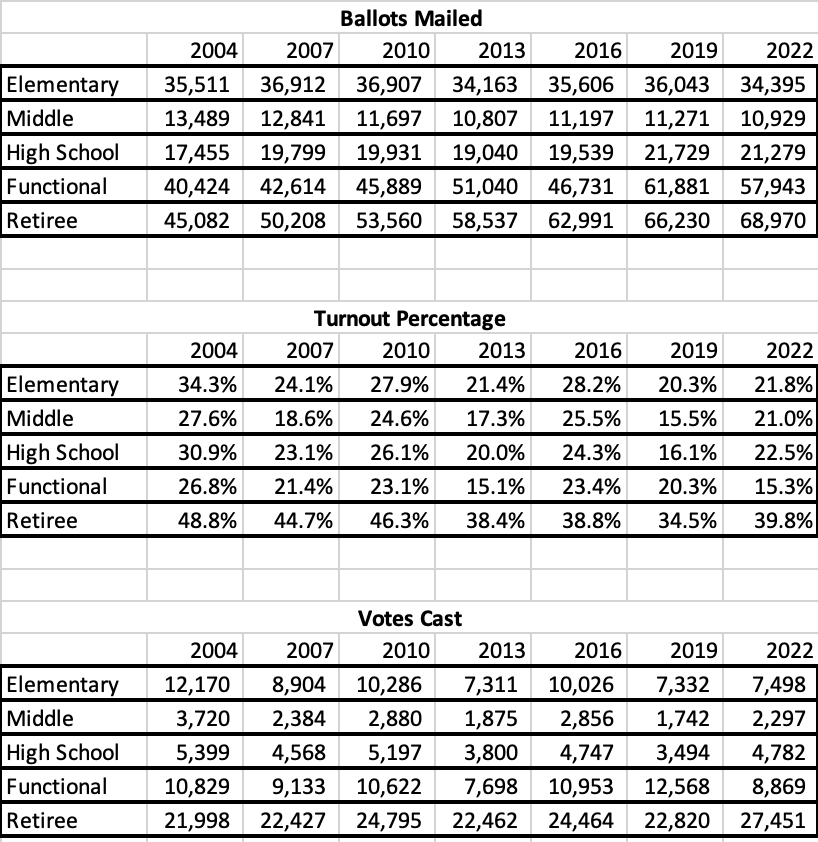
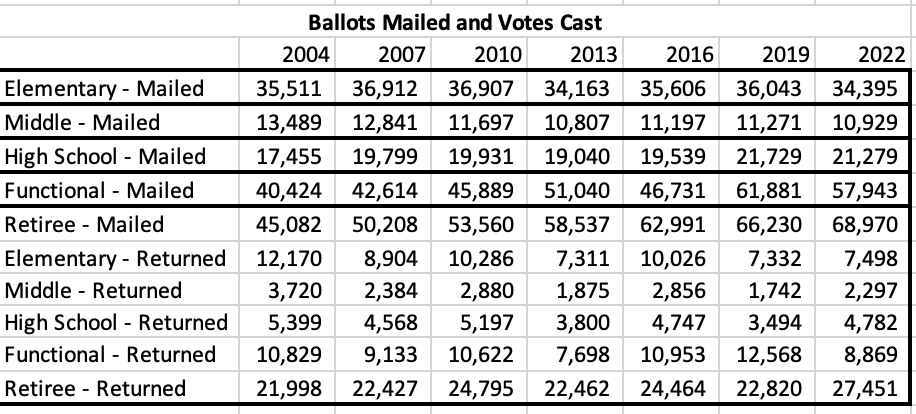
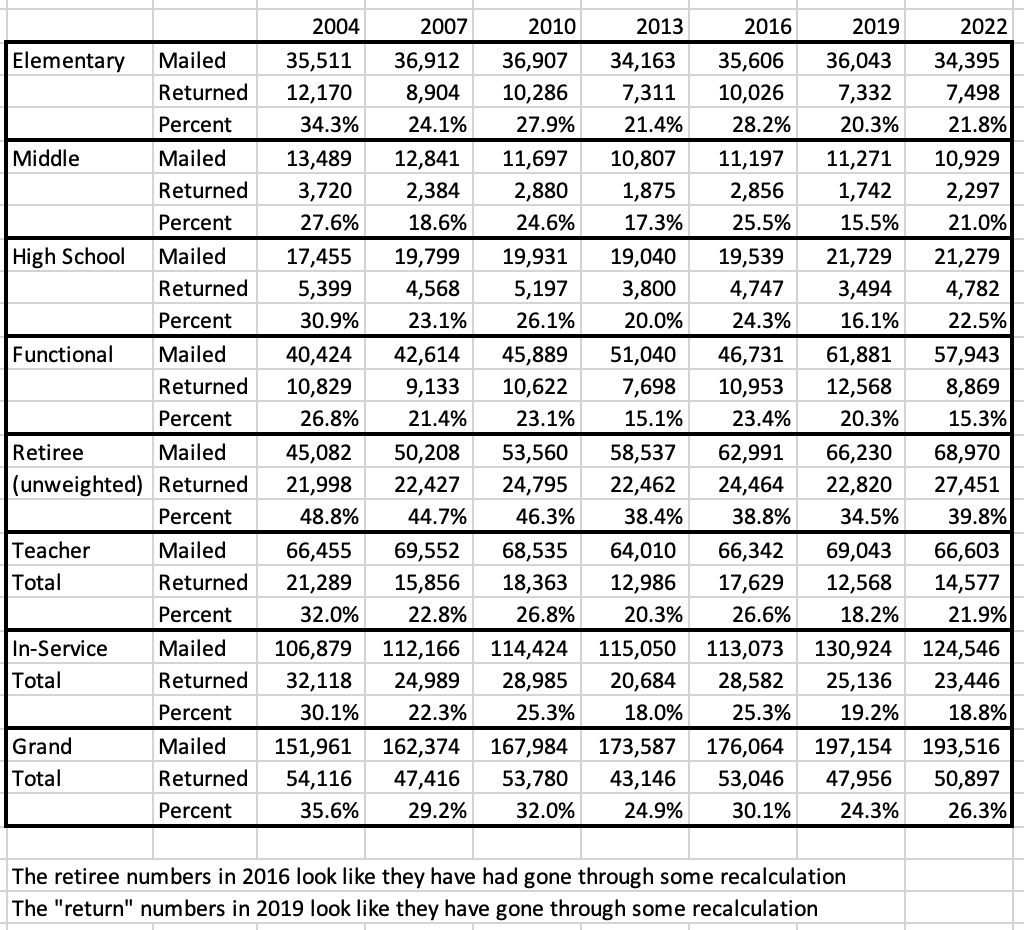
Votes (Total, In-Service, Teacher)
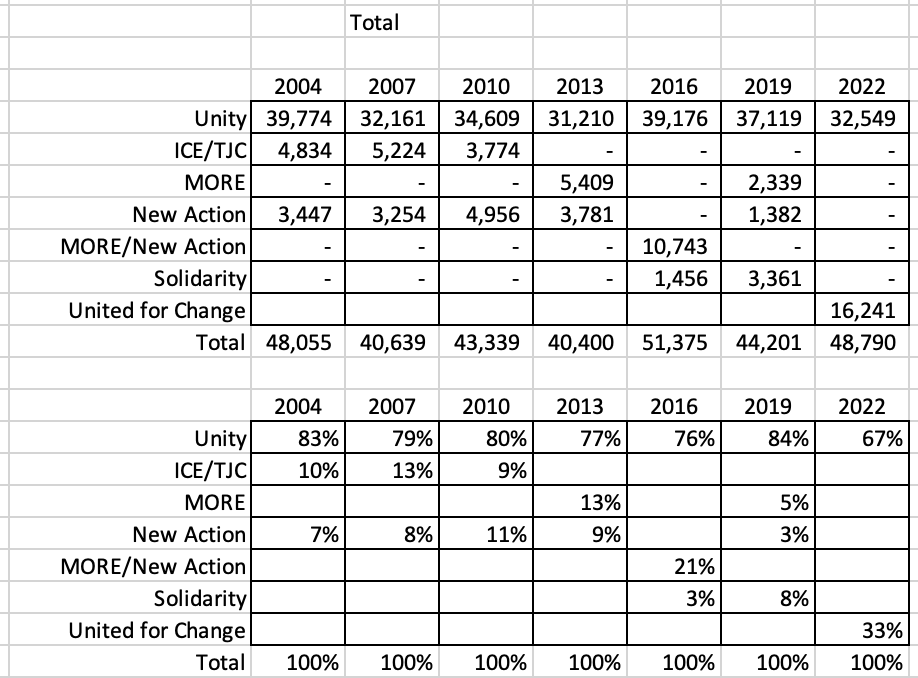
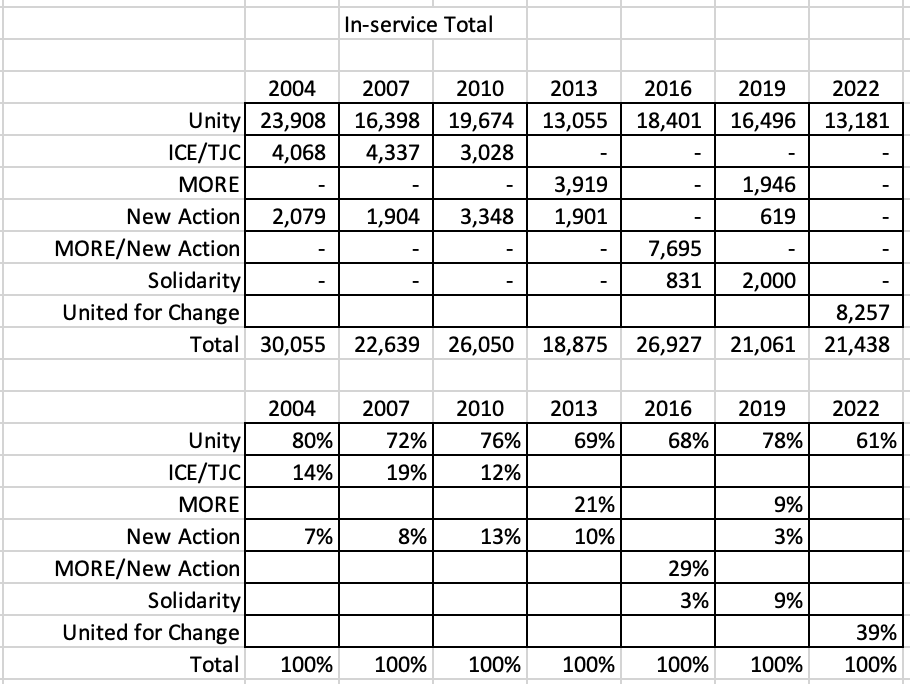
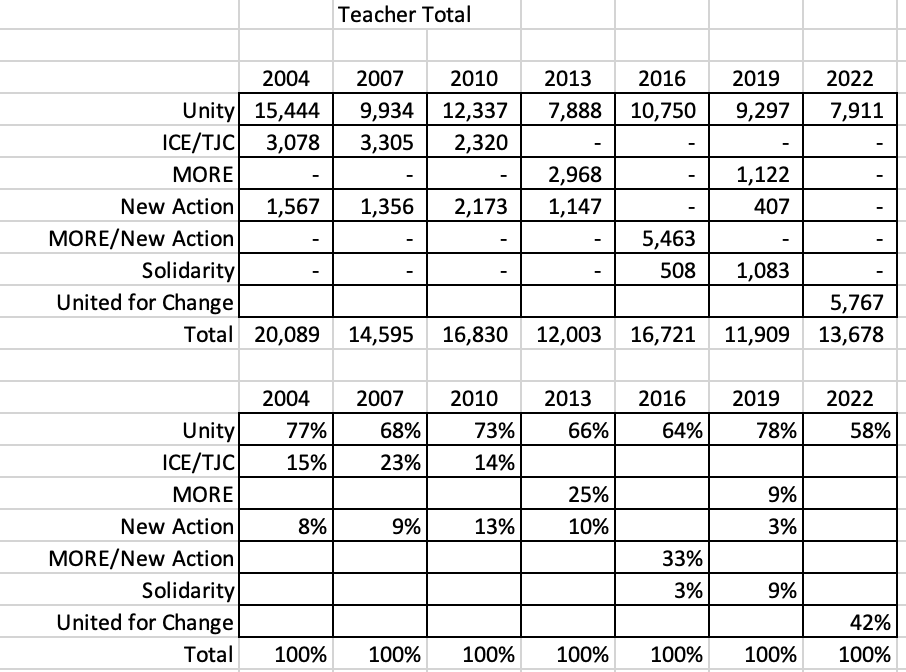
Retirees
These are tricky because my sources are inconsistent. The UFT Constitution caps Retiree vote (currently at 23,500). Some of these are capped numbers, others are raw. The percentages are correct.
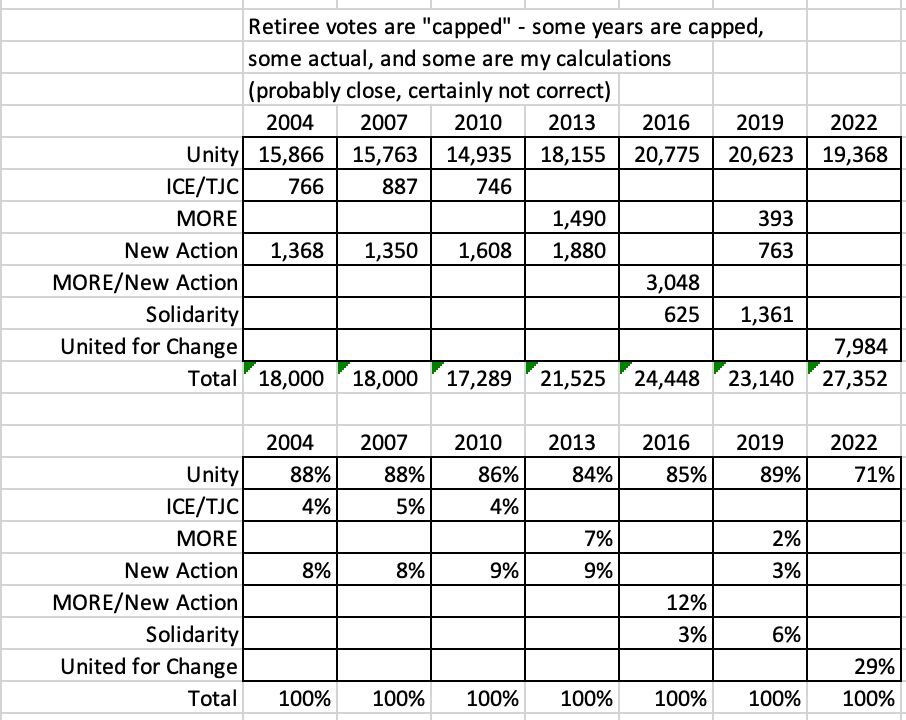
The numbers below are from RTC chapter elections.
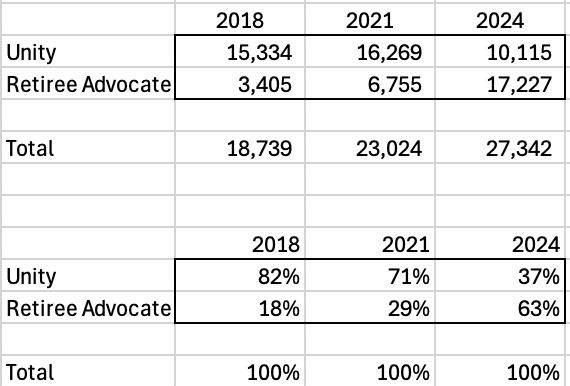
Votes by division
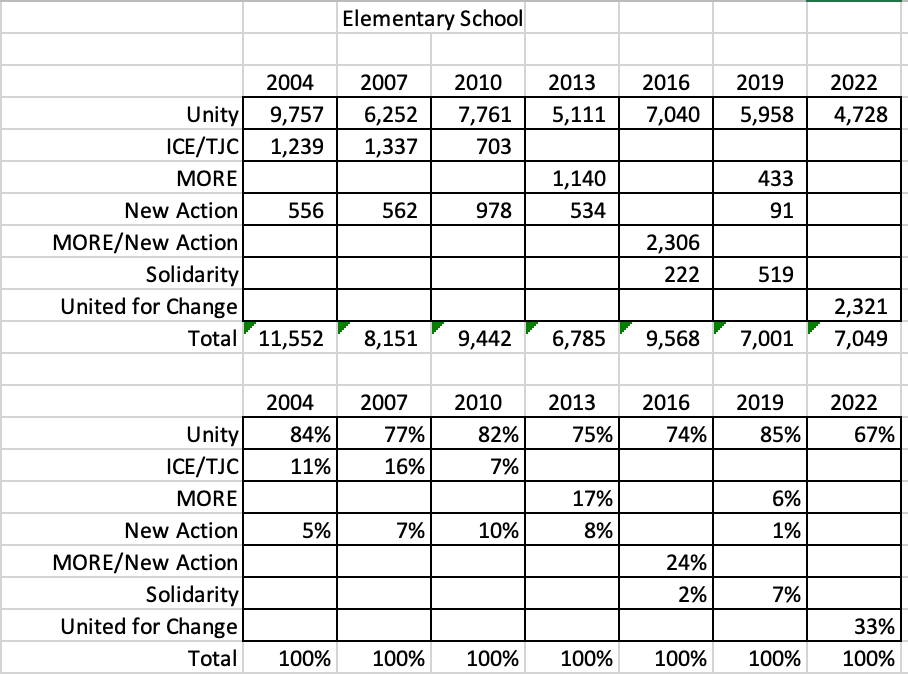
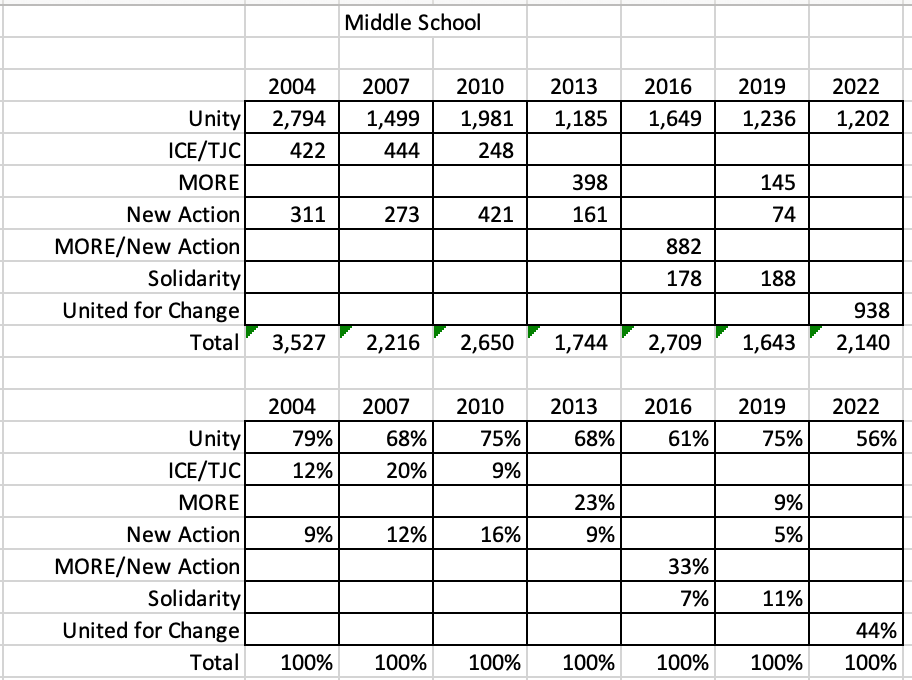
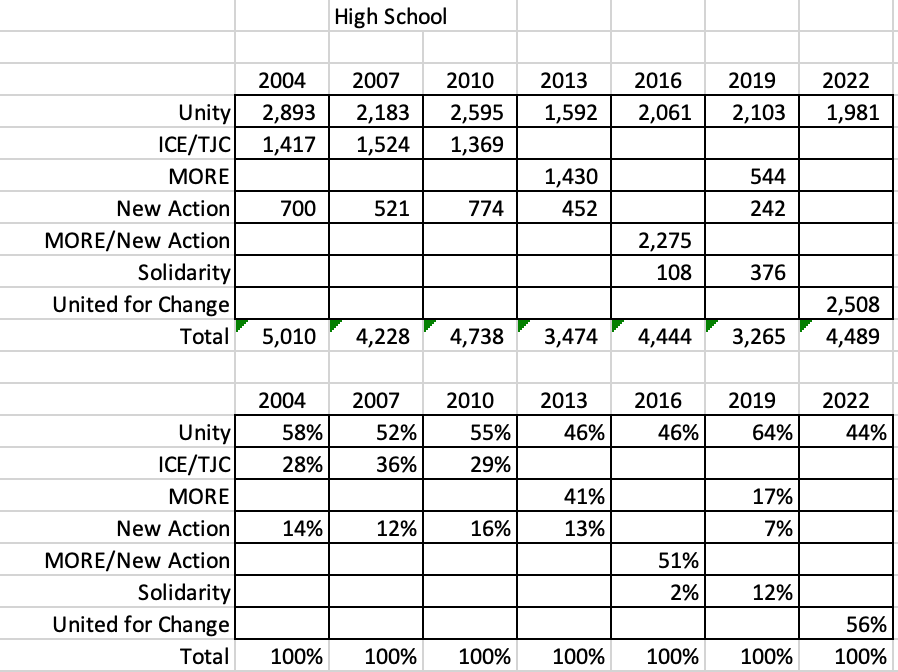
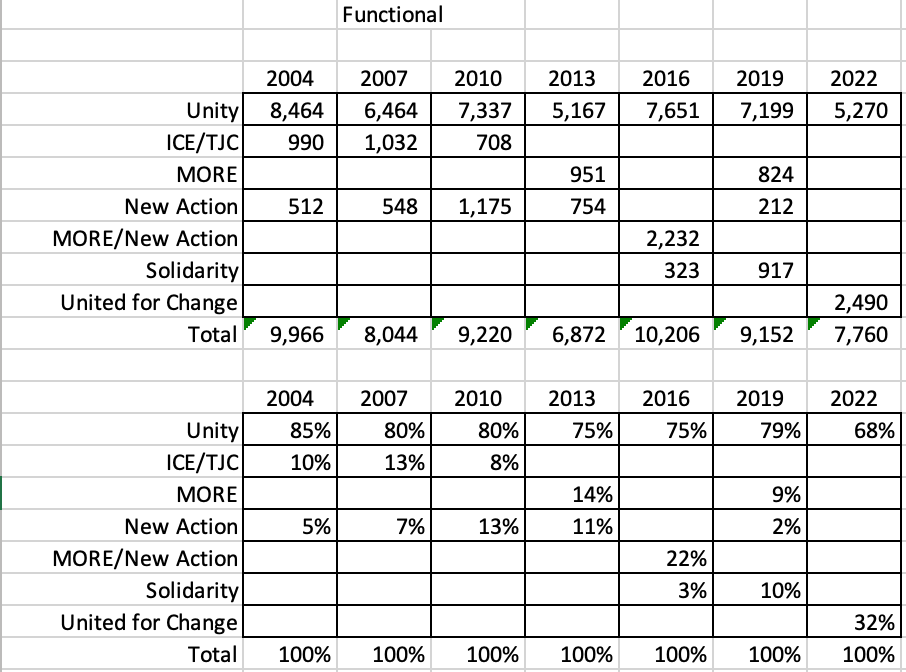
Bad, Ugly, Hopeful
The 2025 UFT elections are over, save the counting. (Copied with light editing from my Substack, jdorganizinginretirement)
UFT elections always get heated. The debate can be rough. The rule-breaking and abuse of power outrageous. But nothing like 2025, never seen anything like this.
Unity
Unity seemed to run harder this campaign than in the past, and in some ways better. They cleaned up Mulgrew so they didn’t have to hide him, like three years ago. They prepared to concede at least a few mistakes, which is new. Their substacks platformed many more voices than they are usually comfortable with. And some of them were pretty decent about disagreeing but being willing to discuss, and being open to working together to better the union.
But Unity’s campaigns are always a bit dirty. At least ‘a bit.’ And this one was at least a bit dirtier than their recent campaigns. The “outsiders” resolution, right out of the anti-civil rights / red-baiting playbook? They haven’t gone there in years. The ugly comments by a DR (I hope he resigns before he is suspended, but I fear neither will happen) essentially celebrating an opponent’s cancer…? Another DR abusing her authority to order Chapter Leaders to pull ARISE flyers from mailboxes… on union time… and then getting a pass by saying “I have been advised that my response was improper” (I’ll get the screen shots, if you need them) with no consequence – like how does an experienced DR need to be advised not to cheat? – and how does the union not address her abuse of authority and theft of union time? (I know how, they just ignore it) The gloating and taunting at the DA… The intentional lumping ARISE with the other group…? Bad.
ABC
I’ll say more, later. I’ve largely avoided writing about them, because we were largely avoiding that kind of campaign. But I have never seen anything so ugly inside the UFT. The decision to exclude “caucuses” but to become a “caucus” – that was a hard swing to the right (hoping to pick up conservative members). The decision to campaign without challenging Trump, or his voters’ beliefs – that’s a hard swing to the right. The decision to “leave politics at the door” (for anyone with progressive politics) but to fan the flames of hatred from right-wing supporters…
An example. Today there is a rally to support Dylan – the DoE student who ICE abducted last week. ABC supporters are on facebook, calling him “illegal” (an offensive way to refer to any immigrant, but Dylan is not “illegal”) – and their leaders are silent.

Unity is supporting the rally. Here’s Olivia:
But “leave your politics at the door” means any acbers who support Dylan are silent, their “caucus” says nothing, and many of their followers are spewing anti-immigrant hate on Facebook.
(for those who listened to the bit about Gompers… no, this is way past that)
They have been aggressive, nasty, spammy. Their griping, whining, screeching… Their use of AI has been gross, including at least one racist image that was calculated to be red meat for their base, or their targeted base. I’ve truly never seen anything like this inside a union. Ugly.
ARISE
Under difficult circumstances we ran a really inspiring campaign. I met some really great activists. We functioned well together (Retiree Advocate, New Action, and MORE). We raised real issues of importance to our union, around organizing, around bargaining, and around openness and democracy. We generally stayed WAY more positive than the other groups. And we walk away from the election ready to keep working together.
I am proud of how many members we reached, how far we got our message out. 550 candidates from a huge number of schools… Half of our RTC delegates ran with ARISE. We were in every district… And the message is a positive one. It represent the future for our union. Hopeful.
Divisible by Thirteen
Just a little math puzzle.
86 is not divisible by 13. But turn the 8 into a 2, and now it is (26).
62 is not divisible by 13. But change the 2 to a 5, and now it is (65).
Is every 2-digit number divisible by 13, or a number that can be made divisible by 13 by changing one digit?
If yes – explain why (and the explanation should be good enough to convince a high school freshman).
If no – show a 2-digit number that is not divisible by 13 and cannot be made divisible by 13 by changing one digit.
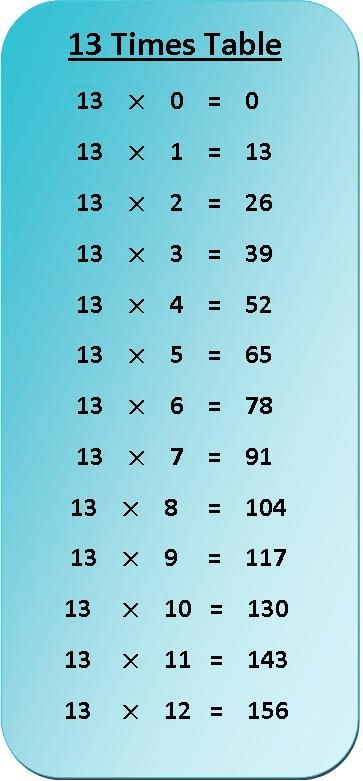
NYC Mayors Race and UFT Slates – who is in the shadows?
Copied (with some light editing) from my substack:

Where do they stand? In the shadows? Why? What are they not saying?
New York City Mayors Race. United Federation of Teachers (UFT) election. Federal budget + weaponization of Federal government against unions, immigrants, poor people, and working people.
All connected? Of course. Let’s look at the first two: NYC mayors race and UFT elections.
ARISE!
I’m running with ARISE – the Alliance of Retired and In-Service Educators. We have not endorsed a candidate, as far as I know none of the caucuses have. But we talk. And I have heard about the mayor’s race from many ARISE activists. The two names that come up the most: Zohran Mamdani and Brad Lander. Is that who ARISE will endorse? No, ARISE will not endorse a mayoral candidate. But it gives you a sense who some of us are.
Unity
Unity has controlled mayoral endorsements since I was a brand new teacher, and decades before.
Unity usually gets it wrong. Last election they passed on rank choice, and stuck with Stringer even after his campaign imploded. Decades earlier they picked three losers in one race: 2001 with Hevesi in the primary then Ferrer in the run-off, then Green in the general. Maybe the worst was 2009. Bloomberg was going for a third term. He clearly had a lead over Bill Thompson. I tried to move Thompson’s endorsement, but LeRoy Barr and Paul Egan spoke against and carried the day. And Thompson lost narrowly – our non-endorsement hurt. And Bloomberg did more damage to our schools in that third term than in the first two, combined. Paul implied that Bloomberg would give us a contract if we stayed out of the raise (spoiler alert – no contract from Bloomberg, and within a month he came after tenure. Paul got that one 100% wrong.) LeRoy is the current UFT Secretary and the leader of Unity caucus. Paul was a Unity leader and the UFT’s political action director when he cowered in the face of Bloomberg, and today he is the other group’s silent and hidden candidate for UFT secretary.
This time might be better? Mulgrew hinted they would use ranked choice, but no commitment. There is some sense of getting member input. But frankly, I’m not at all convinced. I think the recommendation to the Delegate Assembly (which will certainly pass, unless, see below) will be worked out behind closed doors.
Even more concerning? The Unity invite to Andrew Cuomo to address the Spring Conference, Unity faithful saying it is “only fair” that he gets to speak, and anger from some Unity retirees that Bennett Fischer in his report at the last Retired Teachers Chapter meeting, warned about the need to stop Cuomo.

I’d feel much better if Mulgrew would say about Cuomo what all of us know. He’s the author of Tier VI. He’s a creep. And our enemies are backing him, with cash. We should just say no. But we have not. I am concerned.
ACB
But I’m most concerned about the last ‘caucus.’ Their “leave your politics at the door” makes you wonder what their real politics are. I know some of the individuals, individually, are ok. But “leave your politics at the door” as a guideline opens up some ugliness. And the whole group has taken on that character.
We’ve already seen some of it. What do they say about immigrants? About racism? Why don’t they criticize Trump? Why don’t they support the Federal workers (except to feel bad for them). You also probably know that they have largely boycotted the Hands Off, No Cuts, and May Day rallies, and have been mostly absent from RTC picket lines in support of other unions.
They’ve promised to send UFT money (presumably COPE money) to Marianne Pizzitola and the NYCOPSR. Does that mean they support her candidates? I’m not thinking about her support for City Council rabid rightwingers Vernikov and Paladino, not today. Today is about the Mayor’s race.
In the Mayor’s Race the NYCOPSR supports technocrat Jim Walden. Bloomberg light. Running independent. Is that where Paul Egan wants to send our cope money?
Could it be worse? Sure. Look at these “like”s on one of Marianne’s recent endorsements of ABC… Bottom of the list is one of the anti-Vax leaders. And the first ‘like’? Birds of a feather. Or something foul.
Fractions at the Delegate Assembly
Some teachers tell kids “fractions are your friends” but in the United States that’s often not the case. We end up with a lot of adults who feel uncertain around them. How many jokes do we have? ” 


Lots of people, kids and adults, learn to avoid fractions. One trick is to ask someone else to handle them. Another is to work in percentages instead. Calculators give percents. Their form, a two-digit number, makes them easier to compare than fractions. How many of our neighbors are unsure which of 


Most elections work with the idea of “majority” – and there can be fuzziness about what that means. I have heard “51%” which is not right. A majority means more than 
Even simpler are up or down votes. These typically require a majority. Exactly half the votes are not enough. (But don’t say “half plus one” – as you can see above, a majority of 25 is not 

But 
If 30 people vote, 20 are
| Votes | Yes | No |
| 30 | 20 | 10 |
| 12 | 8 | 4 |
| 3 | 2 | 1 |
| 600 | 400 | 200 |
| 3n | 2n | 1n |
Can you figure out why twice as many yes votes as no votes makes exactly
This also gets to the heart of “Why
Last Wednesday at the United Federation of Teachers (UFT) Delegate Assembly, fractions became an issue. Unity, the caucus that controls the union, has had to navigate carefully to get resolutions passed this year – usually getting just one through each Delegate Assembly. And last Wednesday their focus was likely going to be the two endorsement resolutions, for City Council, and for Borough Presidents. You’d think they would have made those resolutions #1 and #2 so they could get to them. Nope. They had something else in mind.
 rds the length of the other.
Unity managed back in January to place an “outside interference” resolution on the agenda. It’s classic, disgusting redbaiting. But in this election, Unity was also aiming it at the leader of the NYCOPSR who has been backing the acb group in the election. Unity wanted this. Desperately. But Unity has not been winning all the votes… Most contested votes have been won with less than 60%, in either direction. And so Unity has avoided letting the “outside interference” reso come up. They weren’t sure they had the numbers.
But May was different. For the May DA Unity did a hard push to get their delegates to attend. And knowing that they had mobilized and had the numbers, they wanted to pass their contentious redbaiting resolution, and also get both of their endorsement resolutions up for votes, and passed. So Mulgrew shortened his report. That’s a big deal. He usually takes a report that he delivers in 15 minutes at the UFT Executive Board and extends it to an hour at the Delegate Assembly, to eat up time, and to keep motions and debate from occurring. It’s a control mechanism.
So Mulgrew’s report was done in 29 minutes – to leave time for the “outsiders” resolution and both the endorsement resolutions. But they weren’t certain that was enough. So during “Motions Directed to the Agenda” (sometimes incorrectly called “the new motion period” because that’s mostly what comes up), Academic HS VP Janella Hinds was recognized, and moved to extend the meeting until those 3 resolutions were completed.
Now, a motion directed to this month’s agenda takes a
Not me. Those opposed numbers, 279 and 120, sweet. Easy to add (no carries). That’s 399. And I know (and if you were reading closely above, you do too) that for it to be
The numbers announcer declared “67 percent, it passes” but I already knew it didn’t and objected “that’s not two-thirds. It’s like 66.5 percent rounded up.” My voice was heard by enough people. It could not be ignored. But really, it was the math talking.
There was a hubbub. Someone (was it Mulgrew?) stated that 66.5% is exactly
We are ARISE!
Your UFT ballot just arrived, or will shortly. Check off the box for ARISE!, place it in the security sleeve, place that in the envelope, and mail it in.
Spring
Did Spring come early this year? Or late?
For me, I don’t know. My mom got sick, diagnosed in January, and that’s been hard. I’ve been up a few times. We’ve been on the phone every day, longer when she wasn’t making much sense, when the only reason for the call was for her to hear my voice, and me hers. I’ve spent hours and hours reading charts, doctors notes, researching what particular words mean, what medical abbreviations stand for. I have also learned to read therapists reports, and dietitians’ reports, and how to cut through the boilerplate to find what’s new. Or what’s not new. I’ve learned about side-effects and drug interactions. And about biopsies, and blood counts. And a little about insurance. I’ve been to meetings with doctors, and prepared good questions in advance. And I translate all of this for people who depend on me to do exactly that. FWIW, I’m a much better explainer today than I used to be.
At the same time I’ve been an officer of the Retired Teachers Chapter of the UFT (I’m the Assistant Secretary). I like working with Bennett Fischer… but there’s a lot going on… and I’ve been having trouble keeping up. There’s an RTC meeting tomorrow – I’ll be there – but for the first time I didn’t contribute in any way to the planning.
I’m also working with student teachers at Queens College. Same. I’ve been having trouble keeping up. But I did get back on top of it, and it is a pleasure to be able to be visit classrooms, and to be encouraging, and to be helpful. Watching teachers get better, seemingly in front of your eyes, wow.
And then there’s the UFT election campaign. I’m working with ARISE! – an amazing slate – a coalition of New Action, MORE, and Retiree Advocate. Olivia Swisher is our presidential candidate, and Michael Shulman our Secretary, and Aixa Rodriguez our Assistant Secretary. It’s going to take our political outlook, our organizing approach, and our commitment to mobilizing members to beat Unity, push back on the DoE and NYC (healthcare, mandated curricula, etc), and build and organize the alliances that it will take to fight off Trump. And I’ve been doing a lot, but I am also overwhelmed. We have a vote-mobilization-kick-off-I’m-not-sure-what event this coming Sunday. I will be there, but happy not to be involved in organizing it. (It’s 2:30 – 5:00 on Sunday April 27 in midtown. Details to follow.)
So barely keeping afloat through the second half of January, February, March… and now it is April. I’ve started to stretch. I’m back walking in the garden and the park (the New York Botanical Garden and Van Cortlandt Park) most days. Last week I got in my first real hike since January (Carras Hill in Norvin Green State Forest, in northern New Jersey, south and a bit west of Sterling Forest). I have a pile of magazines, I’ve just started opening (and I forgot to renew the New Yorker, and honestly, I wasn’t getting to it even before January). I’ve cracked a book – it’s been months. I solved a good math problem over the weekend. I’ll write about that. I planned for some formal culture (ballet tickets. rehearsals, because they are free. but still. it counts.)




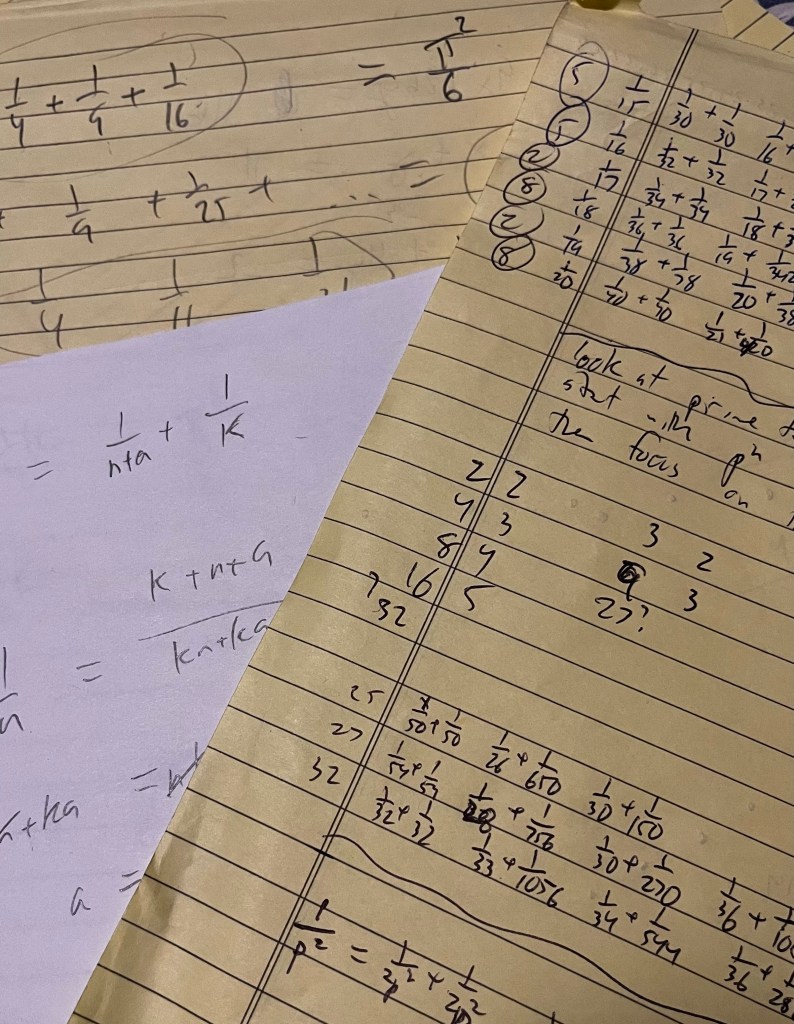

And as I am waking up, stretching my body and my mind, I just noticed, Spring is here.
ARISE!
Standing with Federal Workers? Or backing Trump?
The ABC group shows a dangerous side.
“Leaving politics at the door” apparently means not taking on Trump when he denies rights to workers. Focusing on “Bread and Butter” turns out to mean prioritizing Trump’s border wall. And “Standing with” apparently means asking others to retrain fired workers.
Workers Should Not Have Been Fired
First, these workers should not have been fired. Look for that simple statement of principle in the ABC statement. It is fully absent.
Workers Should Have Their Jobs Back
Second, these workers should have their jobs back. Look for that basic statement in the ABC statment. It is fully absent.
And it is not just words. It is deeds. At the large downtown rally to Stop the Cuts on March 24 – ARISE was powerfully present – Unity had a minimal presence – and ABC was fully absent. In each of the rallies since that I have been to or asked others about – was ABC there? No.
ARISE Stands in Solidarity with Workers Facing Bad Bosses
Third, I stand in solidarity with all workers – as workers. Unionized, ununionized, solidarity is a basic for workers. I am, ARISE is, all good unionists are opposed to workers being fired. But look at the ABC statement. Totally absent.
Instead, the second paragraph shows these workers sympathy, not solidarity. And the first paragraph names some of their “important” functions. Why the quotes? Read on…
We Oppose Anti-Immigrant Policies
When the third group writes about government functions, what do they put first?

Why are borders there at all? Hardly a “bread and butter” issue. No, they are pandering to base anti-immigrant sentiment.
Trump and Musk Do NOT Have the Right to Arbitrarily Fire Federal Workers
Fifth, they didn’t only side-step the firings. They said that Trump and Musk had the right to fire our union brothers and sisters (or sisters and brothers?) (or siblings – that’s probably best – it’ll take me a while to get used to it). Read this one closely, and then read it again.

That’s it. Musk fires thousands of workers – and ABC? recognizes that he had to make a hard decision? They sympathize with the workers? And with Donald Trump’s difficult choice? Wonder if they feel for superintendents who make hard decisions, or principals who make difficult choices? Some of us know which side we are on.
Workers Want Their Jobs Back. Workers are not Asking for “New Opportunities”
Sixth, they “stand” with federal workers, but don’t support the most basic demand – that the workers should be rehired, have their jobs back. (OK, that is really number two, from above. But there’s a new twist from the twisted author. Keep reading.) Workers are trying to get rehired. The fights are in the streets, in demonstrations and rallies, and in the courts. This is their fight today. But don’t look for that in ABC’s statement. It is totally absent.
Instead there is a bizarre call – not for action from labor and our allies, but on everyone except labor… and not to rehire our union siblings, but to retrain them. Retrain them?
Walmart? Charter school teachers?
Folks, I think they were counting on you to read the title, and not their words. But it’s here. Read it. Go over every line. Is this labor solidarity? Or pandering to Trump? Is that what you really want?
Do you want this:
A Clear Choice: ARISE!
Or would you rather sympathize with Donald and Elon?
A Clear Error, ACB
We Marched to Stop the Cuts
Just some cool photos. The RTC/UFT Labor Solidarity Project + other UFT retirees were the core of the UFT presence at Saturday’s march.
There were in-service UFT members as well – mostly supporters of ARISE. There were a few people from Unity marching. But the UFT endorsed. Why was the leadership completely absent? And the other group, of course they were missing; they support Trump’s “right” to fire federal workers.
We marched from Foley Square, up to Worth, across to Broadway, and down Broadway. As we neared 52, UFTers pulled out of the line of march to get some good UFT spirit and take some group photos and videos in front of our headquarters:
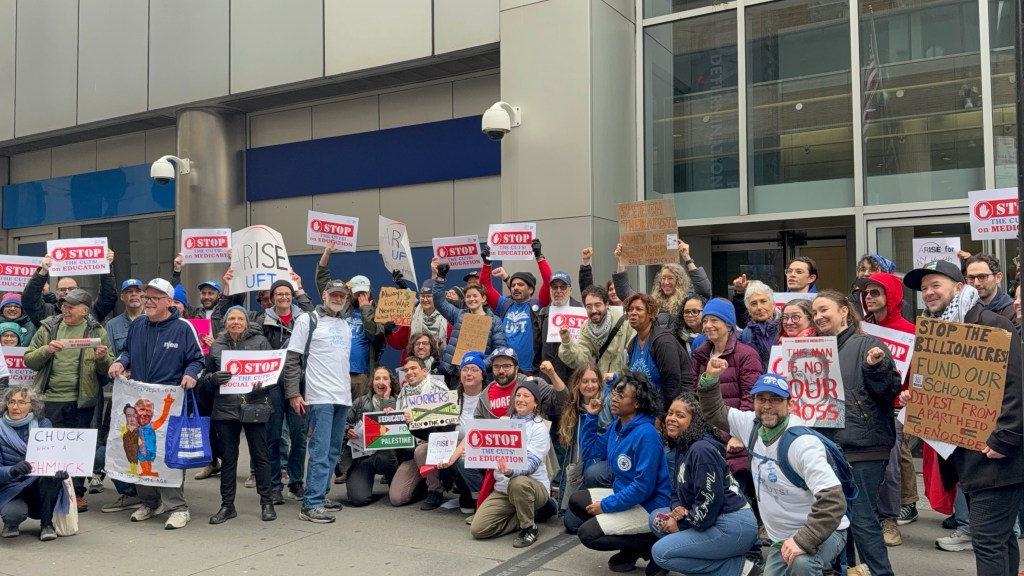
March to Stop the Cuts
Saturday 3/15/25, Foley Square, 11AM

About this event
Right-wing politicians in Washington are moving forward with devastating proposals to cut two trillion dollars from Medicaid, Medicare, SNAP, Public Education, and the Enforcement of Workers’ Rights to fund a massive tax giveaway to the wealthy and corporations. Enough with unelected billionaires being given free rein to shut down vital services of millions of Americans for their own ends.
No cuts to working people to fund tax breaks for billionaires!
Date: Saturday, March 15, 2025 Time: 11:00 am Location: Foley Square
New York City’s Hidden History – Freedom Day (reprint)
Huge civil rights protest, half a million, 60 years ago. And some of you might want to say, “but the March on Washington was sixty and a half years ago – and it was a quarter million” – which is correct. And it makes the point. A protest, twice the size, not in Washington DC but here in New York City, happened 60 years ago, and it is hidden.
The NY Daily news sent a note to subscribers – 60 years ago (Wednesday) a few hundred school kids skipped schools to greet the Beatles at JFK. A few hundred. None of the NY newspapers sent out notices about the 60th anniversary of half a million kids boycotting school earlier the same week.
Why hide the history? Few people know about “Freedom Day” – it is omitted from our history text books – around the country, and, worse, in New York State and New York City. Why do leaders and educators hide such a major event?
Let’s pause for a second, and just review what happened. February 3, 1964 was Freedom Day in New York City. 470,000 students boycotted school, and many engaged in additional protest and demonstration. They were demanding integration. They got empty promises, that were broken.
I don’t trust you anymore
https://www.youtube.com/watch?v=LJ25-U3jNWM
You keep on saying, “Go slow”
Go slow
But that’s just the trouble (too slow)
Desegregation (too slow)
Mass participation (too slow)
Other actions, strategies, and protests have occurred since. With the same results. Or less. New York City operates one of the most highly segregated big city school systems in the nation today.
From Time Magazine, September 2020:
(that’s an 8 minute video. There’s also a print story)
So Freedom Day was momentously huge. It did not bring about change. It set the pattern for promising discussions or studies down the road, and delivering nothing.
Is Freedom Day part of our history?
If a textbook in Colorado skipped over a huge protest in another part of the country that did not result in big change – I kind of get that. But half a million students is a lot. And the fact that the Civil Rights Movement produced the March on Washington that we think of as a turning point, but Freedom Day, twice as big, that did not change anything… probably worth mentioning.
But we are not in Colorado. We are in New York City. And when there are large national events or changes, we often include lessons on how they played out in our state. New York City during the Civil War (draft riots). New York City and immigration (Jacob Riis and Tenements). New York City and suburbanization (Levittown). But what about the struggle against segregation? That was across the country, including here. And a massive school boycott – that’s the biggest political action by students in New York City, well, ever. How do we leave our history out of our textbooks?
There is Black History in New York in our textbooks. I don’t have a DoE approved book at home – but Brittanica Kids has an article about riots in Harlem. But nothing about Freedom Day. Freedom Day was organized. It involved many, many more people. Why would Brittanica (and I assume other texts) privilege a story of chaotic response over an inspiring, bigger story of well-organized response?
Is Freedom Day “uncomfortable”?
If the March on Washington is history, but Freedom Day is not… If the Harlem riots are history… but Freedom Day is not… maybe the question is who is making that decision – and do they have an interest in including some stories and excluding others.
Yet, King highlighted the venality of more “polite” forms of racism and challenged Northern liberals to address racism at home — and not just in the South. Violence and hate-filled rhetoric were not the only methods by which White supremacy was maintained. King identified how people, including those who may have deplored Southern injustice, maintained the racial status quo. Moderates and liberals deployed “both-sidesism,” argued that time would solve the problems of racism, cast disruptive protest as unwise and unreasonable and embraced ideas like the “culture of poverty” to justify strong-arm policing and explain away inequities in their own cities.
https://www.aaihs.org/martin-luther-king-jr-s-challenge-to-his-liberal-allies/
Freedom Day challenged – and the fact that it occurred challenges – present tense – the racial status quo in New York City. The stories of the riots provide a rationale (false) for more and more aggressive policing – and that is “policing” which was, and continues to be, largely directed at people of color. And the story of the defeat of Freedom Day highlights the duplicity of those who counsel patience, going slow, “this is not the right time,” more study, etc.
More Links
I have been writing about Freedom Day for several years. This year I am four days late. Short post. Meandering story I told kids one year.
Chris Bonastia’s book covers much of the story of Freedom Day in detail. I recommend it.
Who decides what is history?
Freedom Day is uncomfortable. It is inconvenient. But it was a huge, huge event. It was defeated by double-talking politicians. And it continues to be mistreated, by being kept hidden from generations of students. Who has decided, up to now, that it is not taught in our schools? And who will decide to remedy that injustice?
Retiree Advocate Town Hall: The ARISE Campaign
I am excited to be working on a UFT election campaign through Retiree Advocate.
Our first event is a Town Hall this Sunday at 7:30. Please register if you are available. Hope to see you there
Attend the Retiree Advocate Town Hall on Sunday, January 12 at 7:30PM . Register Here: https://shorturl.at/96KuP or use the QR code in the flyer, below.

Like
Comment
Share
A Math Question: the Crazed Carpenter
Yesterday I heard that a current union activist teacher, math teacher, was influenced to become a math teacher, in part, from reading this blog. Wow, even if that’s just a little true… Pretty cool. And then I was thinking I should write about math again. And today I was doing a problem with a friend on a car ride, and it was too hard, so we did this one again. So why not share it? Here goes:
A crazed carpenter perfectly attaches legs to the edge of the seat of a stool, except he pays no attention to where around the seat each leg goes. They could end up perfectly separated by 120º (and it stands), or they could be clustered together (and the stool would not stand). Any arrangement is possible. What is the probability that a 3-legged stool created by this crazed carpenter will stand?

and the legs attach to the edge of the seat
Credit to Bertie Taylor of the old Compuserve Science/Math Forum (or SIG?). Bertie called it the “Mad Carpenter” problem because in his dialect “mad” meant “crazy.” Alas, when I google Bertie I get nothing, and when I google “Mad Carpenter” I get a lovely bed and breakfast that offers no math problems whatsoever.